
What Is a Kan-Badge? Sizes, Types, Display Ideas and Storage for Pin-Back Buttons
Kan-badge 缶バッジ · Tin badges
You went to display a favorite kan-badge and found the size and fastener weren’t what you expected. Here are the kinds of kan-badges and their background, what to check before you buy, and how to display them and protect them from rust and dents.

What a Kan-Badge Means
Kan-badge (缶バッジ, literally “tin badge”) is a badge with art printed on a round metal base, covered with clear film and fitted with a fastener on the back. In oshi-katsu it is the star that fills an ita-bag, a bag decorated with oshi goods, and it is also the classic random goods item.
The main sizes of kan-badges are as follows.
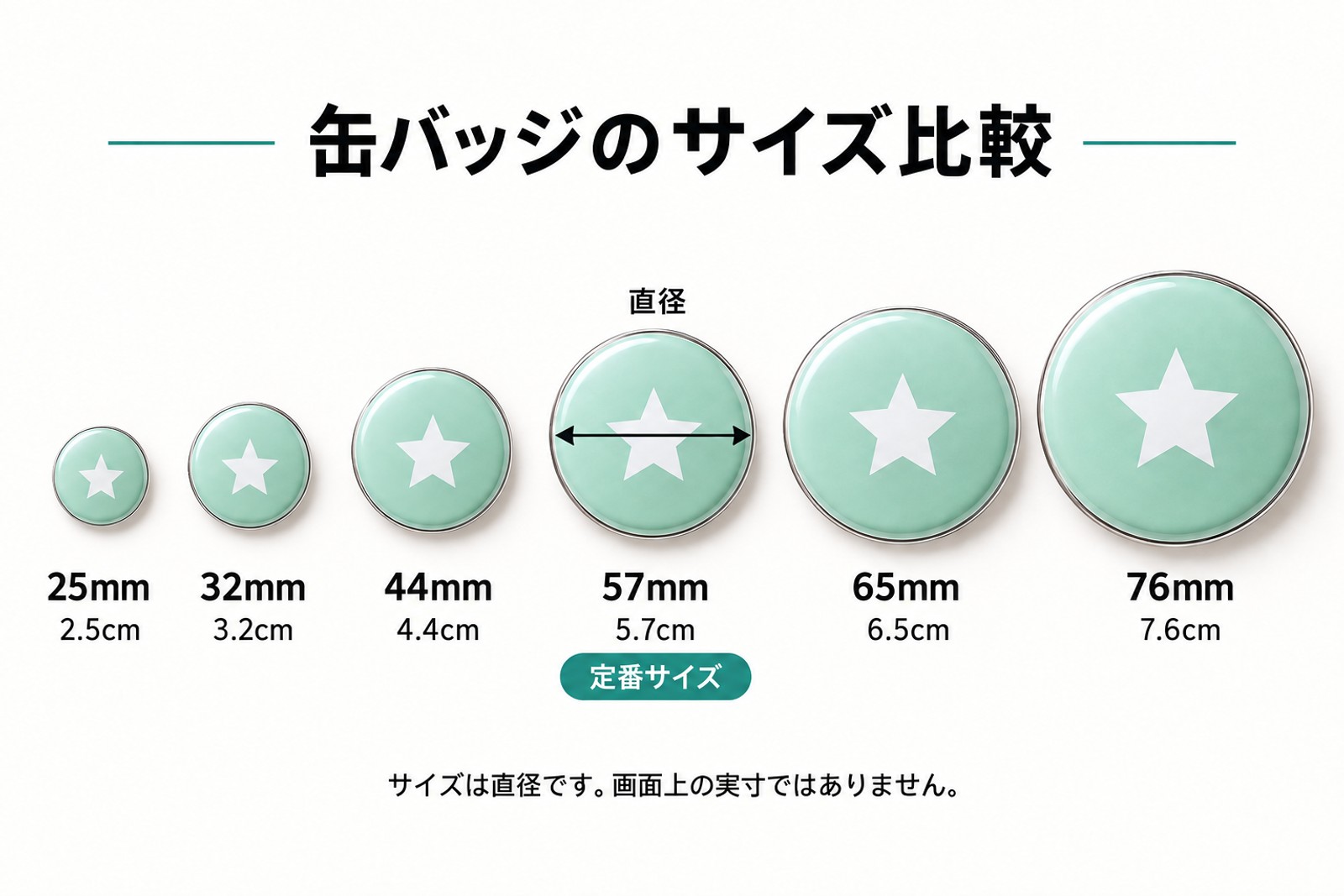
A generated image showing the differences in diameter. Treat it as a rough guide to size; it is not the actual size on your screen.
SmallLarge
- 25 mmThe smallest size listed
- 32 mm and 44 mmFor lining up many on an ita-bag
- 57 mmThe most widely distributed
- 65 mm and 76 mmFor one badge to be the star
Work backward from the area and how you'll use it.
Printing companies’ guides are also useful for sizes and uses (Graphic’s size comparison / Graphic Equipment, both in Japanese). Back fittings include the Z-pin, safety pin, magnet, hook, mirror and bottle opener, so badges sold under the same name can be built quite differently on the back. Decide what you’ll attach it to first, and look at the fitting second.
Kan-badgeDecide what you'll attach to first
- Z-pinA pin-type back
- Safety pinHooks onto a thumbtack
- MagnetA magnetic back
- HookA hook back
- MirrorA mirror back
- Bottle openerA bottle-opener back
Badges sold under the same name can be built differently on the back.
Origins and History
The badge is said to be called a “can” (kan) because early bases were tinplate, the same thin iron sheet used for canned food. In the English-speaking world it’s called a button badge, and it has long been used in elections as a way to declare support. The current structure, with a pin fastened on the back, is said to have been patented in the United States at the end of the 19th century, and the basic construction has hardly changed in the hundred-plus years since.
In Japan it is widely said to have spread in the 1970s as a fashion accessory in the youth culture centered on Harajuku, and to have settled in after the 2010s as a standard part of ita-bag culture. This history has been passed down mainly through columns by manufacturers and the like.
- The pin-back structureSaid to be patented in the United States
- Fashion accessoryYouth culture around Harajuku
- Ita-bag stapleA standard part of ita-bag culture
The basic construction has hardly changed in more than a hundred years.
How It Differs From Similar Terms
- Kan-ba and kan-bacchi: variant ways of saying the same thing
- Acrylic keychains and rubber straps: goods hung by a metal fitting. A kan-badge is fixed at its face
- Pin badge: a small emblem molded from metal itself, with no printed face
- Ita-rosette: a decoration made of layered ribbons, built around a kan-badge at the center
Examples
- “Put my new kan-badge on my bag starting today.”
- “There’s so much kan-ba supply that my wallet is dead.”
- “I got duplicates, so I’m putting them up for trade. Looking for swaps.”
- “I think the star of an ita-bag is still the kan-ba.”
Three Things to Decide Before You Buy
- Decide the surface you’ll attach to first. The front of a bag, or a wall pocket made for kan-badges? Once the area is set, the size is set
- Check whether you can choose the design. The budget you need is completely different for a badge you can buy with a design specified and one packed as random goods
- Think about where your duplicates will go. If they’re headed for goods trades, decide how you’ll open them and where you’ll keep them before you buy, and they’ll stay in good condition
Some stores offer a service to make a one-of-a-kind badge in-store from your own image (Kinko’s Japan, in Japanese). Avoid using official images and illustrations without permission; use photos you took yourself or materials whose use is permitted.
- 01Choose the surfaceBag front or wall pocket sets the size
- 02Check the design choiceSpecified purchase or random packing
- 03Plan for duplicatesDecide how to open and keep them
Once the area is set, the size is set.
How to Display Kan-Badges
- Cork board: hook the safety pin onto a thumbtack. Using two tacks for support makes it harder for the badge to fall even when tilted
- Wire grid: hang the badges by pinching them with double clips or wooden clothespins. Rearranging goes quickly
- Wall pocket: put one in each clear pocket. This guards against sun fading and dust at once
Storage That Prevents Dents and Rust
- Dents on the edge: the base is metal, so a dent doesn’t come back once it’s there. Put the ones you carry in a hard case so they don’t knock against other goods
- The film on the surface: direct sunlight causes fading. Even moving your display spot a little away from the window makes a difference
- Humidity: the metal on the back rusts. For long-term storage, add a desiccant
- Mailing: wrap the badges twice in cushioning and put them in a plastic bag for waterproofing. This is the packing often used in trades
For the overall approach to storage, see storage ideas for oshi goods.
Notes From The Oshi Lab: The Low Price of One Is Selling You Surface Area
What sets a kan-badge decisively apart from other goods is that one isn’t a finished thing. An acrylic stand can be displayed on its own, but kan-badges become a landscape only when lined up. So fans don’t buy one; they buy to fill an area. The low unit price means more than “it’s cheap, so it’s easy to buy”: it changes the unit of purchase from “piece” to “panel.”
This structure isn’t just convenient for manufacturers. Filling a panel inevitably produces duplicates, duplicates go to goods trades, and trades start conversations at the genba (live events). Random packing is often described as a device for raising the number of items bought, but in practice it has also worked as a device that artificially creates points of contact between fans. The strength of this by-product is surely why kan-badges have stayed a staple for so long.
On the other hand, the race to fill a panel scales with how much slack a wallet has. The more huge collections show up on social media, the more they can become a barrier to taking part for people who can’t reach them. With goods that get discussed in numbers, the mood of a fandom depends on whether the maker does things like keeping a slot where you can buy a specified design or adding single-item sales later.
Related Terms
Ita-bag / Random goods / Acrylic keychains and rubber straps / Goods trades / Hard cases
FAQ
What is a kan-badge?
It's a badge with art printed on a round metal base, covered with clear film and fitted with a fastener on the back. It's a staple of oshi-katsu goods, used to decorate ita-bags and for trading.
Which size of kan-badge should I choose?
The most widely distributed is 57mm. Work backward from the area and how you'll use it: 32mm or 44mm if you want to line up a lot on an ita-bag, and 65mm or larger if you want one to be the star.
Can I choose the fastener on the back of a kan-badge?
Normally it's fixed for each product. There are types such as Z-pin, safety pin, magnet and hook, and how useful they are changes depending on whether you attach it to an ita-bag or to clothing.
Can a dented kan-badge be fixed?
Because the base is metal, it is hard to restore a dent once it's there. It's realistic to handle them on the premise of prevention, such as wrapping them in thick cushioning or putting them in a hard case so they don't rub against other goods.


