
What Is Mugen Kaishu? Collecting the Same Goods Endlessly, and Managing It
Mugen kaishu 無限回収 · Infinite collecting
You want a few more copies of just your favorite design so you can fill an ita-bag, the display bag for fan goods. Does mugen kaishu really mean collecting with no limit? Here is what the word means, and how a collection sheet, a budget and storage limits keep it manageable.
What Mugen Kaishu Means
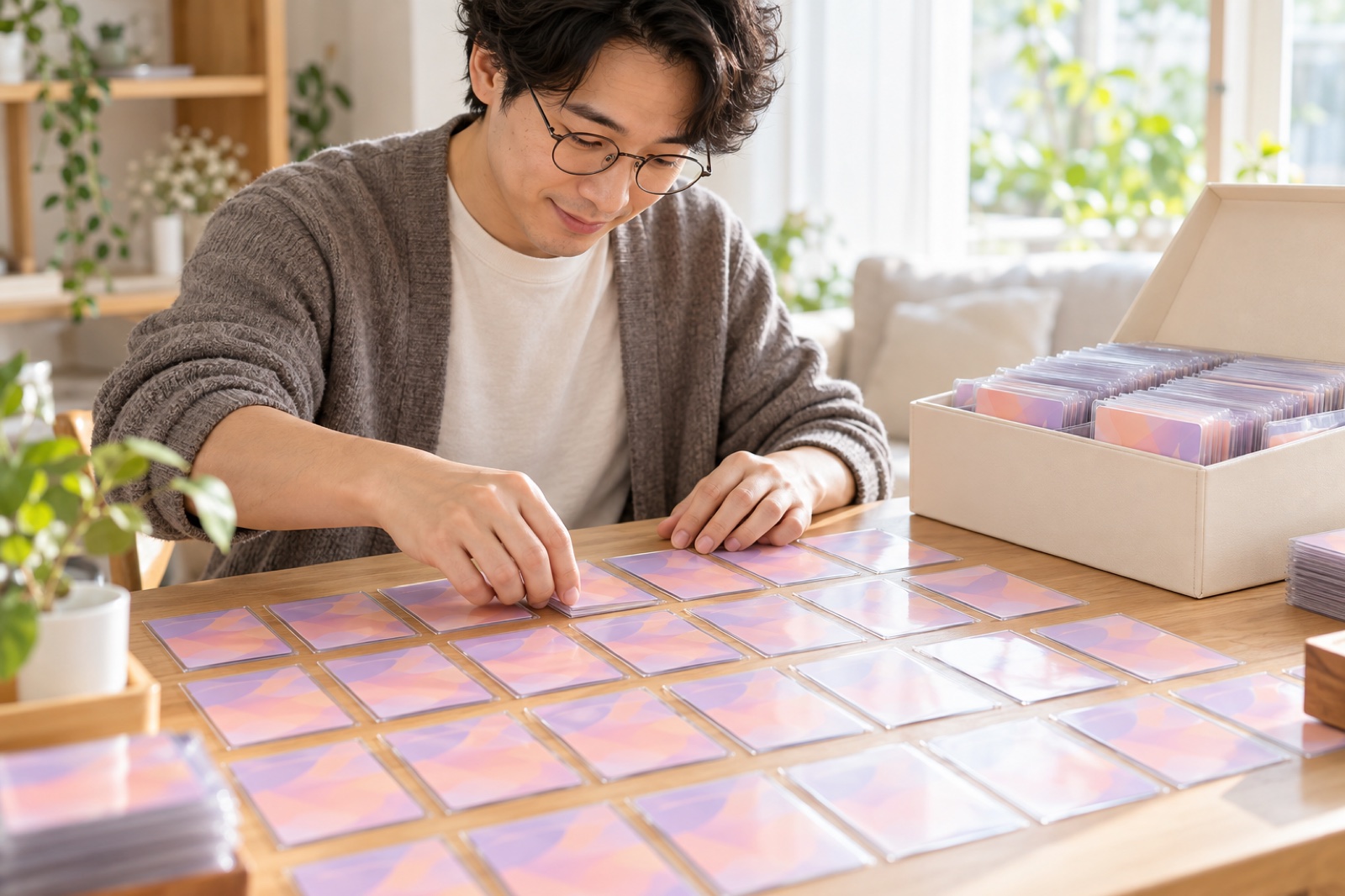
Mugen kaishu (無限回収, literally “infinite collecting”) is collecting multiple copies of particular goods or designs without deciding how many you need. People use it when hunting dozens or hundreds of the same item, such as can badges, trading cards or acrylic items. “Infinite” doesn’t literally mean there is no ceiling; it expresses the drive to keep searching until you hit your target number. Writing “mugen kaishu” in your profile tells trading partners how strongly you want something.
Origins and History
Mugen kaishu is a collecting term that uses the word “infinite” to stress the wish to gather the same design with no upper limit. It isn’t a promise of literally unlimited buying; it spread as a way to signal high priority in trade requests. Two things lay behind it: random goods (blind-box-style sales) became the main way to sell, so the design you want can’t be had in one try, and trade requests moved onto social media.
How It Differs From Similar Terms
It is all “collecting,” but each term aims at a different end result.
| Term | Center of the way of collecting |
|---|---|
| Mugen kaishu | Piling up the same design or same oshi without fixing a number |
| Completing (complete) | Filling in every type in the series, one each |
| Limited collecting (yugen kaishu) | Setting a cap first, like “up to 10,” then collecting |
| Pulling it yourself (ji-biki nerai) | Insisting on drawing it yourself without relying on trades |
Someone whose request says “mugen kaishu” can be read as willing to take any number of the same design. The word is handy at goods trades because it saves you explaining your conditions.
Mugen kaishu
- Pile up one design or one oshi
- Signals high priority in trades
Completing
- Fill in every type in the series
- The target is a full set
Limited collecting
- Set a ceiling like "up to 10"
- Then collect within it
The word saves you explaining your conditions in a trade request.
Examples
- “This design is way too cute, so I’m doing mugen kaishu.”
- “My mugen kaishu can badges finally hit 50!”
- “Thanks to trades, my mugen kaishu is coming along. Thank you all for your help.”
- “For this series I’m not doing mugen kaishu. I’m going for one of each.”
- “I wrote mugen kaishu, but my goal is one full panel of an ita-bag. Happy to discuss numbers.” (a self-introduction in a trade request)
Decide What You’re Collecting For First
Once you know how you’ll use them, the number you need follows naturally. For an ita-bag, measure the panel and the layout; for a saidan (fan altar), count the width of the shelf you’ll display on. If they’re bargaining chips for trades, check whether you also need other designs from the same series.
| Purpose | How the number gets decided |
|---|---|
| Building an ita-bag | Panel height and width ÷ badge diameter decide how many fit |
| Displaying on a saidan | Count the slots first from shelf width and tiers |
| Bargaining chips for trades | Keep one or two spare, since you can’t read what the other person wants |
| Keeping preservation copies | You take them separately from the ones you open, so the number effectively doubles |
Different purposes call for different numbers. Once you can write “30, to fill five rows across” instead of “as many as possible,” you get a chance to stop and think before buying more.
Your numberSet by purpose, not by impulse
- Ita-bagPanel height and width divided by badge diameter
- Saidan displaySlots from shelf width and tiers
- Trade chipsKeep one or two spare
- PreservationSeparate copies double the count
Saying "30, to fill five rows" beats "as many as possible."
Make a Collection Sheet
Make a table with item name, design, number owned, target number, condition and storage location. Keep what’s on order apart from what’s in hand, and mark what you’ll offer in trades. If logging items right after purchase is hard to keep up, photograph everything before opening the box and enter it all at once on the weekend. Tracking the same goods in more than one place causes duplicate purchases, so numbering your boxes helps. Combine this with the ideas in goods storage and you’ll spend less time searching.
Buying and Trading Steps
- Write down the amount you’ll spend that day first — With random items, don’t try to pull your whole target number at once; set a ceiling before you step up to the counter. Some people carve out a dedicated slot for collecting in their oshi-katsu budget book
- Leave no conditions out of your request — Say that you want several of the same design, what condition you’ll accept, and whether it’s by mail or hand-to-hand. If this stays vague while talks go ahead, mismatches appear after the deal is made
- Count the number twice — Before packing, and just before sealing. When you send a large number, keep photos of the count and the packing for both sides
- Protect the condition with hard cases or sleeves — Bends and scuffs go straight into how the item is rated in trades. Prepare a thickness that keeps the contents from shifting in transit
- 01Set a ceilingDecide the day's spending first
- 02State conditionsQuantity, condition, mail or in person
- 03Count twiceBefore packing and before sealing
- 04Protect conditionHard cases or sleeves
Keep photos of the count and packing when you send a large number.
Cut your living expenses or borrow money to collect because prices are climbing, and what was meant to be support turns into a different worry.
Letting Go Is Part of Collecting Too
Life changes, and one day you may not be able to store everything. You have options: reset your target, keep the best-condition items and trade the rest, hand them on to someone you trust, or check the official rules for secondhand sales. Letting go doesn’t mean you love your oshi any less. Keep photos and records, and you can remember the time you spent collecting in another form.
Decide the Storage Limit First
Measure the height and weight of your storage boxes, and when one fills up, review your target before buying a new box. Separate what’s for trading, display and keeping, and put what you take out often at the front, so you don’t have to spread everything out to find something.
Notes From The Oshi Lab: They Savor “the Process of Filling Out”
Watch mugen kaishu closely and you see that fans aren’t chasing the number itself. They are savoring “the process of filling out.” Between three copies of a design and ten come exchanges with trading partners, the story of how someone let you have one, and the night you rearranged everything. The number is just what’s left at the end; what stays in memory are the events around it. That’s why it helps to line everything up neatly and photograph it on the day you reach your goal. It becomes a clue when you think about what to collect next.
From the sender’s side, the word is also a sign that demand can’t be predicted by dividing by headcount. People who want one of every type and people who want dozens of a single type stand in the same line, so demand per design isn’t even. Announcing reprints early, offering a way to buy single items, standardizing on specs that are easy to trade: how much of the strain around numbers the operators are willing to absorb is also a statement of what kind of collecting that series wants to welcome.
Related Terms
FAQ
What is mugen kaishu?
It means collecting multiple copies of the goods of a particular oshi or design without fixing how many you need. People use it when they keep hunting for many of the same item, such as can badges or trading cards.
Do people really buy an infinite number?
Not really. Most people set a target that fits their budget and storage, so "infinite" is a figure of speech. In trade requests it works as a one-word sign of how badly you want something.
How do you store the goods you collect?
Use sleeves and cases that suit the item, and keep a list of type, quantity and storage location to avoid buying duplicates. Some people number their boxes and record where each one sits.
What's the difference between mugen kaishu and completing a set?
Mugen kaishu piles up many copies of the same design; completing a set fills in every type in a series, one each. Even at the same sales counter, the two aim at different end results.
What should I do when I've collected so much I've run out of space?
Many people reset their target, keep the items in the best condition, and trade away or hand on the rest. Line them up and photograph them first, and the time you spent collecting stays on record.


