
SLAM DUNK Pilgrimage Guide: Kamakura Crossing, Noshiro Basketball Museum & Akita Shrine
Where green Enoden trains glide past the sparkling Shonan sea, the railway crossing just outside Kamakurakokomae Station draws SLAM DUNK fans from across Japan and around the world who remember the iconic opening sequence of the 1990s television anime. Opened in 1903, Kamakurakokomae Station and its coastal crossing remain an active everyday commuter railway line and neighborhood road.
Further north in Akita Prefecture, the Noshiro Basketball Library & Museum showcases historical memorabilia from powerhouse Noshiro Technical High School and professional basketball teams, while Moriko Omonoimi Shrine in Yurihonjo City is celebrated for its ancient cedar grove and roughly 300 stone steps resembling the shrine where Sannoh Industry ace Eiji Sawakita prays in the feature film THE FIRST SLAM DUNK. Below, we introduce the highlights of all three destinations alongside the history of the original manga, television anime, and theatrical film.
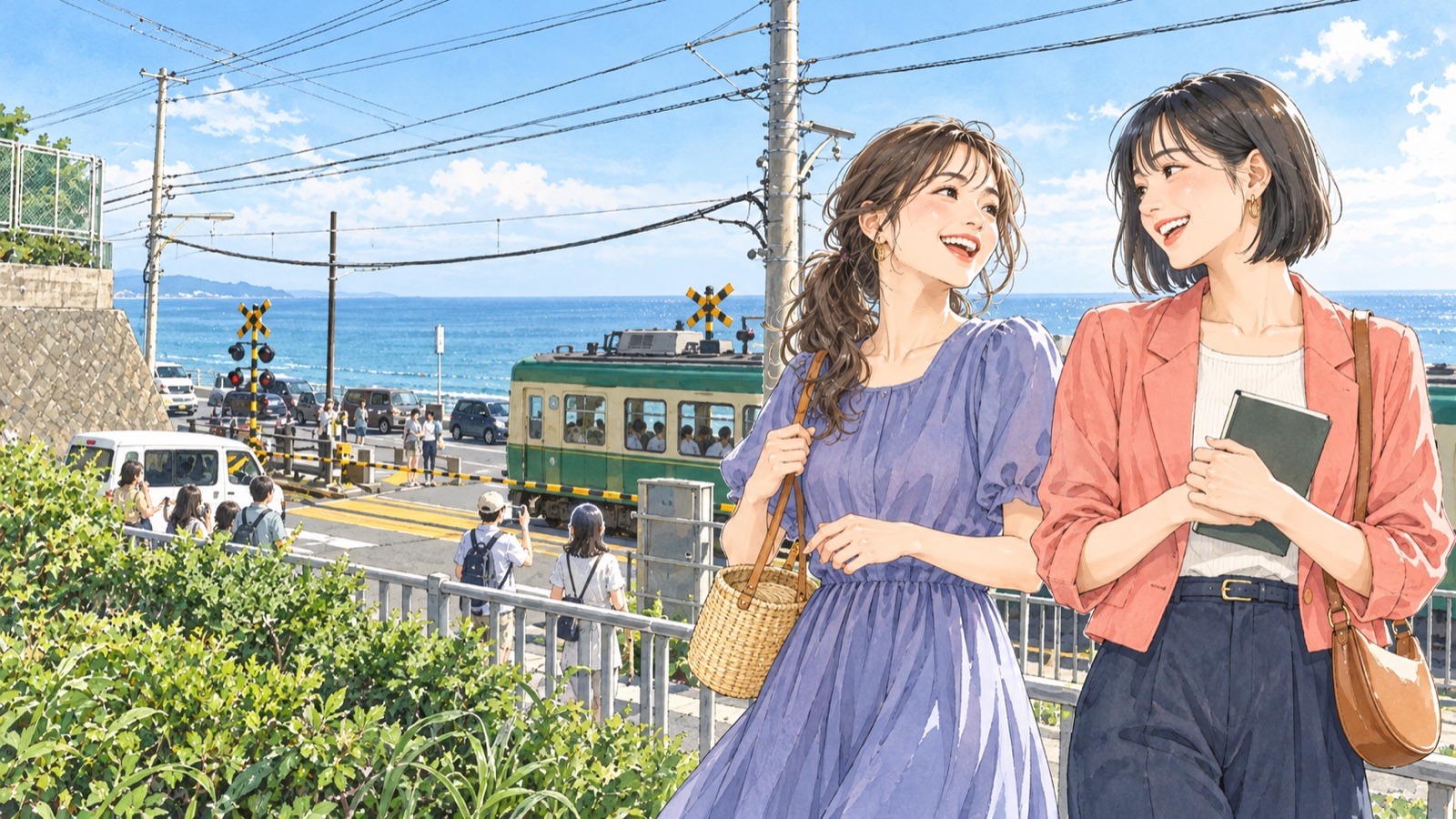
Visiting the Shonan Crossing and Akita’s Basketball Museum & Forest Shrine
From the seaside crossing at Kamakurakokomae that evokes the television anime opening sequence to the free public basketball museum preserving regional sports history in Noshiro City and the forest shrine steps in Yurihonjo City that recall a pivotal scene in the movie, these three stops let visitors experience both the world of SLAM DUNK and Japan's basketball heritage.
① Kamakurakokomae · Kamakura, Kanagawa
The seaside railway crossing widely known among fans; always follow current on-site guidance and prioritize everyday rail and road traffic.
Read the Complete Pilgrimage Guide & Access Notes for Kamakurakokomae Crossing No. 1 Area (Kamakura, Kanagawa)② Noshiro Museum · Noshiro, Akita
A free public facility displaying basketball archives and memorabilia, expanding interest from the manga to the history and culture of the sport itself.
Read the Complete Pilgrimage Guide & Access Notes for Noshiro Basketball Library & Museum (Noshiro, Akita)③ Moriko Shrine · Yurihonjo, Akita
A mountain shrine visited by fans for its striking resemblance to a pre-game prayer scene in the film, reached by climbing roughly 300 stone steps.
Read the Complete Pilgrimage Guide & Access Notes for Moriko Omonoimi Shrine (Yurihonjo, Akita)
1Kamakurakokomae Crossing No. 1: Where Enoden Trains Pass Against the Shonan Sea
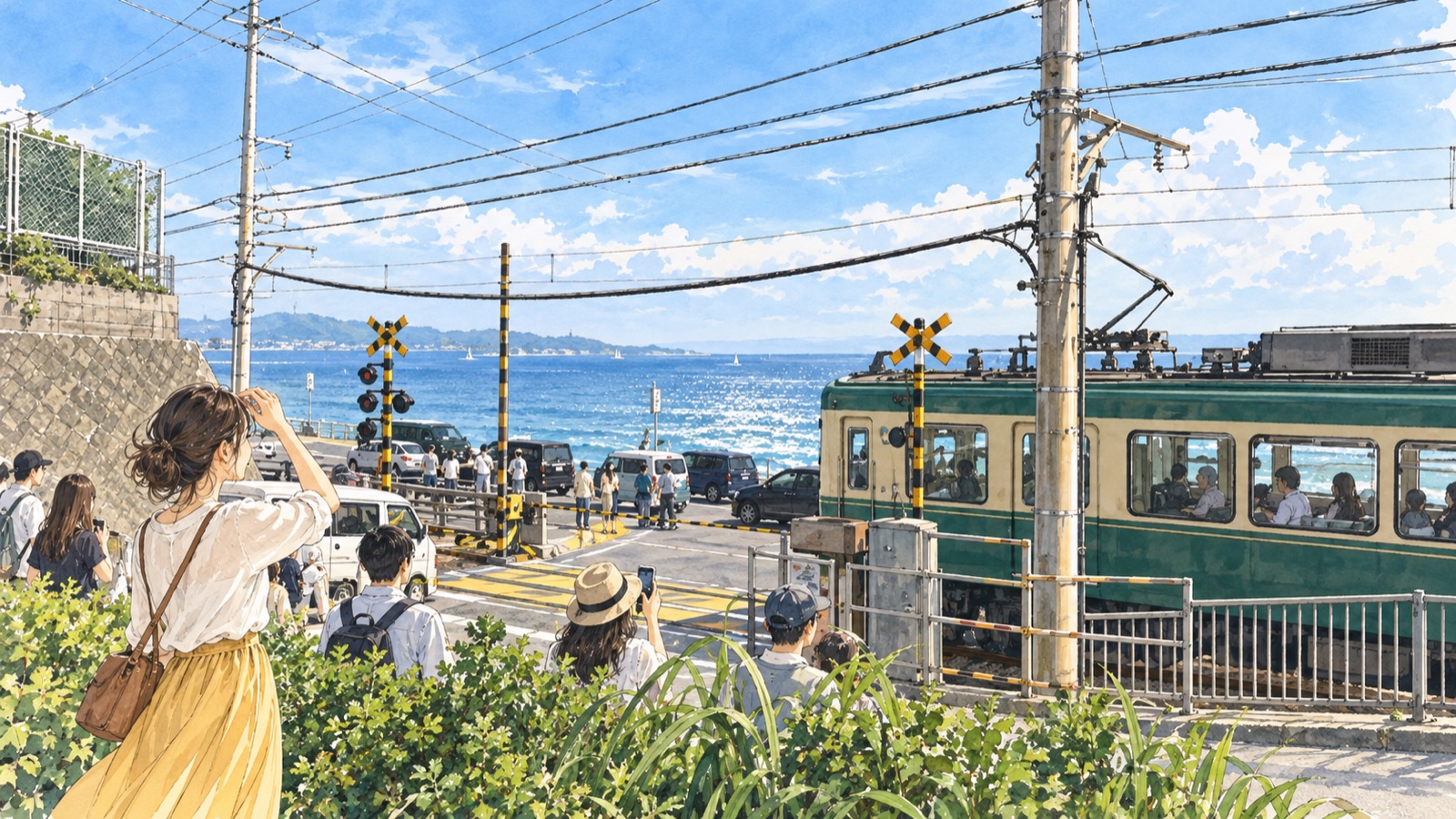
Situated right beside Enoden Kamakurakokomae Station, Kamakurakokomae Crossing No. 1 is known worldwide as a place visited by fans from Japan and abroad who associate its coastal scenery—where the Shonan sea and railway tracks run side by side—with the opening sequence of the television anime. While the view of the open ocean beyond the crossing gates and the passing green Enoden train cars leaves a lasting impression, the road and sidewalks around the crossing remain an everyday neighborhood thoroughfare used constantly by local residents and vehicles.
From September 13 to 16, 2025, Kamakura City conducted a field trial guiding visitors to a nearby public plaza as a designated photography area. Because the implementation periods and available spaces for municipal crowd-management measures change by season, always check the latest announcements from Kamakura City and follow on-site signs. Take photographs only from designated spots, never step onto the railway tracks, roadway, or private property, and always prioritize the safe passage of pedestrians and trains.
Sources: Kamakura City Photography & Etiquette Guide around Kamakurakokomae Station / Kamakura City Report on Tourism & Traffic Conditions / Enoshima Electric Railway Station Guide
History of Kamakurakokomae Station and the Enoden Line Since 1903
Kamakurakokomae Station opened in 1903 and was renamed from Hissaka Station to its current name in August 1953. Long cherished as a station where the Shonan sea opens wide right in front of the platform, it has also been selected as one of the '100 Best Stations in the Kanto Region.' Beyond the crossing itself, taking time to stand on the station platform and gaze out at the sea and sky is one of the genuine pleasures of an Enoden train journey.
Sources: Enoshima Electric Railway History of Railway Facilities / Kamakura City Historical Timeline
2Noshiro Basketball Museum: From the Manga to Real-World Basketball History
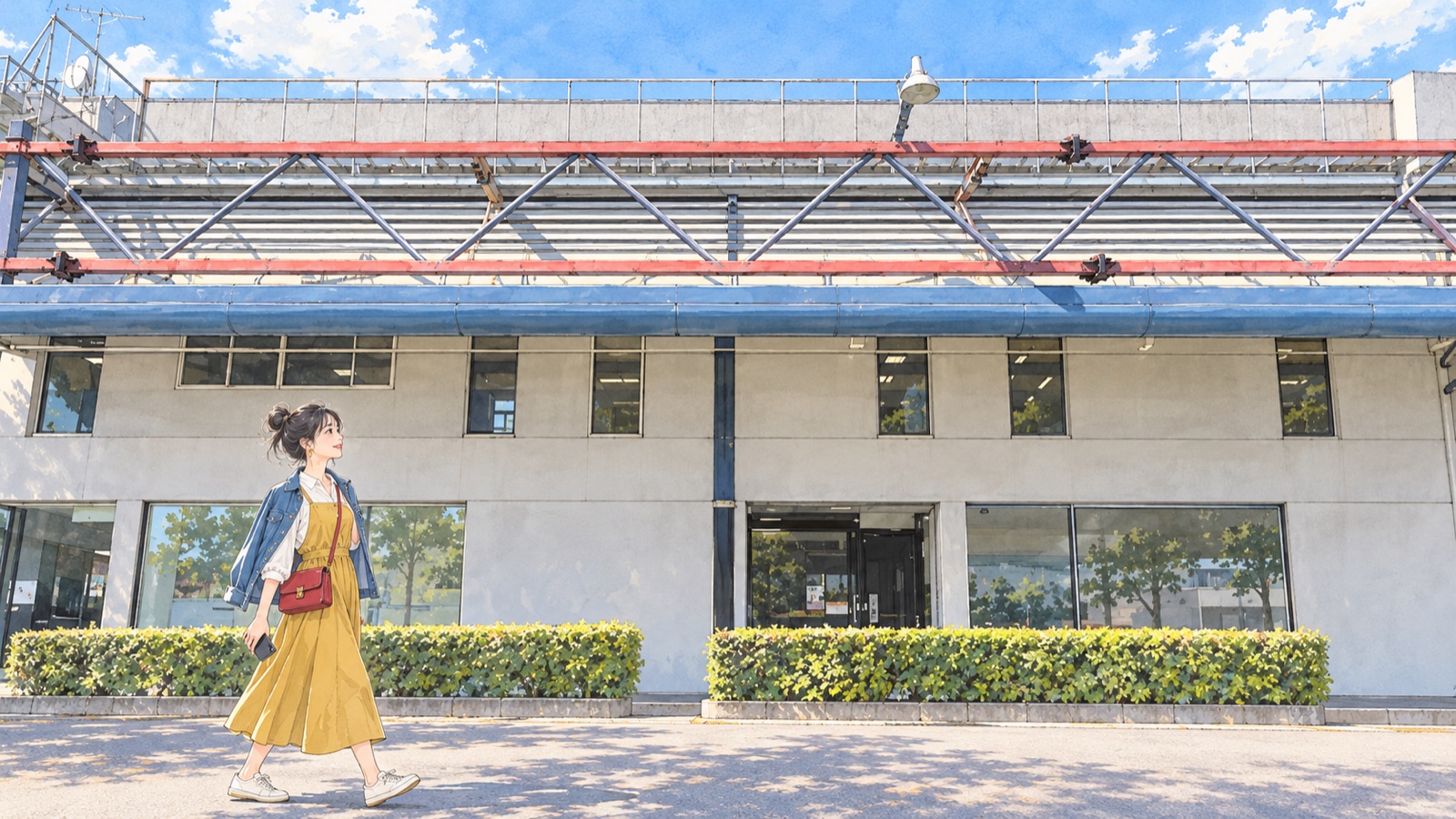
Among SLAM DUNK fans, the basketball team of Noshiro Technical High School in Akita Prefecture is widely known as the real-world inspiration for reigning Inter-High champion Sannoh Industry, whom Shohoku faces at the national tournament. Located at 5-20 Yanagimachi in Noshiro City, Akita Prefecture, the 'Noshiro Basketball Library & Museum' opened in May 2012 as a community revitalization hub and specialized public basketball facility, and relocated to its current site in June 2020. Admission is free of charge, and the museum is open from 9:30 to 18:00 daily, closing only for the New Year holidays.
Inside the museum, visitors will find exhibits covering the history of Noshiro Technical High School, the B.League club Akita Northern Happinets, and books, archival materials, and memorabilia on basketball in Japan and around the world—allowing anyone whose interest in the sport began with the name Sannoh Industry to experience the living basketball heritage passed down in Noshiro. Although the museum is featured on the official pilgrimage map jointly created by Noshiro City and Yurihonjo City, special exhibition themes rotate periodically, so if there is a specific artifact you hope to see, check current exhibitions and dates before your visit.
Sources: Noshiro Basketball Museum Official Website / Visitor Information / Noshiro Tourism Association Pilgrimage Map / Museum Official Feature on Sannoh Industry and Noshiro Technical High School
Trophies, Jerseys, and Special Exhibitions Inside the Museum
Alongside championship trophies, historic team uniforms, and game footage, the museum displays personal everyday items used by the players and coaches who carried the sport forward. In the dedicated corner honoring Coach Hiroshi Kato—who guided Noshiro Technical High School to 33 national championships—family-donated photo albums and his well-worn pen case are placed on view, allowing visitors to connect not only with a legendary winning record but with the coach's character and life journey.
In the Noshiro Technical High School corner, past game records and introductions to current team members are displayed alongside exhibits on alumnus Yuta Tabuse, who became the first Japanese player in the NBA. Additional sections cover the Akita Northern Happinets as well as women's and corporate teams across Akita Prefecture, while a library corner gathers back issues of Monthly Basketball from its inaugural issue alongside Takehiko Inoue's manga volumes and art books.
Source: Noshiro Basketball Museum Official Exhibit Guide
Alongside the legacy of 58 national titles carried forward into the reorganized Noshiro High School of Science and Technology, the museum continues to organize exhibitions cheering on active student athletes today. During the July 2026 Inter-High support exhibition, action photographs and game footage from the prefectural and Tohoku regional tournaments were screened, and on October 11, 2026 the museum announced the 'U12 Exhibition: Go Noshiro & Yamamoto Basketball Kids!' spotlighting local children playing the sport. Current exhibition themes and dates are posted in the museum's official announcements.
Sources: Noshiro Basketball Museum 2026 Special Exhibitions / Noshiro City Record of Museum Opening & Relocation
In 2023, autographed illustration boards (shikishi) by Takehiko Inoue and a circa-1955 Noshiro Technical High School uniform were also placed on display, accompanied by jerseys, warm-up suits, and basketball shoes from across the decades donated by former players and fans. Donated books, magazines, comics, and tournament programs exceeded 5,000 volumes as of 2023, and visitors can freely pull archival materials, game records, and manga volumes right off the shelves to read inside the library.
Source: Noshiro City 2023 Feature on Museum Exhibits & Donated Archives
3Moriko Omonoimi Shrine: Cedar-Lined Stone Steps Recalling the Film’s Shrine Scene
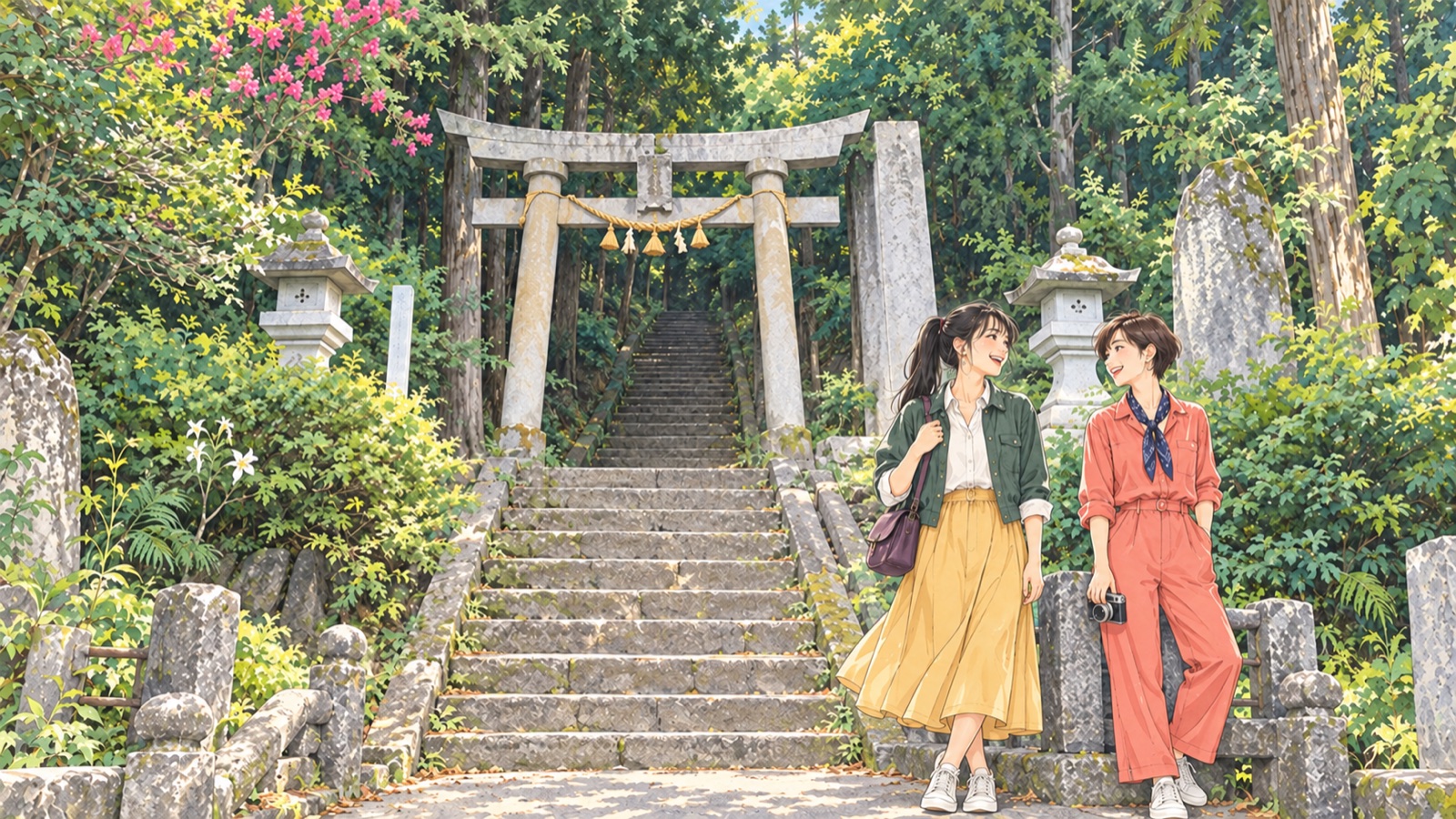
Moriko Omonoimi Shrine in Yurihonjo City drew widespread attention among fans for its close resemblance to the forest shrine where a Sannoh Industry player prays before the game in the feature film THE FIRST SLAM DUNK. Situated halfway up a mountain surrounded by centuries-old Akita cedars, roughly 300 steep stone steps climb straight up through the towering cedar grove from the first torii gate to the shrine buildings.
The shrine grounds preserve a worship and offering hall built in the second year of the Ansei era (1855) and a main sanctuary built in the fourth year of the Taisho era (1915), featuring a pair of carved wooden sumo-wrestler figures supporting the roof beam above the front of the worship hall and intricate dragon-and-cloud carvings on the main sanctuary. Known during the Edo period as Yakushido, the shrine long served as a distant worship site (yohaisho) for the Takizawa trailhead of sacred Mount Chokai, where worshippers prayed toward the mountain from afar. When passing fellow worshippers on the stairs, yield politely on the stone steps, and wear sturdy, slip-resistant footwear since the steps can be slick after rain or during the winter snow season.
Sources: Yurihonjo City Tourism Association: Moriko Omonoimi Shrine / Akita Prefecture Official Tourism Guide / Yurihonjo City Cultural Property Guide
Connection with Isa City: The Creator’s Hometown and Past Poster Display
In creator Takehiko Inoue's hometown of Isa City, Kagoshima Prefecture, a special exhibition of movie posters was held at the time of the film's theatrical release. That exhibition concluded on January 31, 2023, and the venue—the Okuchi Fureai Center—closed for major renovations on April 1, 2023. In addition, the 'Takehiko Inoue Library' manga collections donated to elementary and junior high schools in the city are school library materials for enrolled students, so general visitors cannot enter school campuses for sightseeing.
Sources: Shueisha Interview with Takehiko Inoue / Isa City Poster Exhibition Archive / Okuchi Fureai Center Facility Notice
Shohoku’s Starting Five and Their Court Positions
SLAM DUNK is the story of Hanamichi Sakuragi, who takes up basketball for the first time upon entering high school and grows alongside his teammates on the Shohoku High School basketball club. Starting with zero experience in the sport, the protagonist masters the fundamentals and discovers his own role on the court alongside Hisashi Mitsui, who returns from injury, and Ryota Miyagi, who chases the footsteps of his late older brother Sota.
Hanamichi Sakuragi
A first-year power forward standing 188 centimeters tall. Learning the fundamentals of basketball from scratch, he discovers his vital role on the team through rebounding and interior play under the basket.
Kaede Rukawa
A first-year small forward standing 187 centimeters tall. Immediately upon entering high school, he piles up points as Shohoku's primary offensive ace.
Takenori Akagi
A third-year center standing 197 centimeters tall. Raising the banner of 'National Conquest,' he serves as team captain and anchors both the paint and the entire Shohoku squad.
Ryota Miyagi
A second-year point guard standing 168 centimeters tall. Using his speed as a weapon to advance the ball, his family memories and present-day battle on the court form the heart of the 2022 feature film.
Hisashi Mitsui
A third-year shooting guard standing 184 centimeters tall. A former junior high school MVP who returns to the team after an injury layoff, he threatens defenses from the perimeter with his three-point shooting.
Sources: Official Movie Manga Overview / THE FIRST SLAM DUNK Official Website / Character Profile: Takenori Akagi / Hanamichi Sakuragi / Ryota Miyagi
How Understanding Court Positions Reveals Off-Ball Movement
The point guard position played by Ryota Miyagi serves as the floor general who surveys the entire court and orchestrates his teammates' movements. Meanwhile, Hisashi Mitsui's shooting guard position supports the point guard while hunting shots from long range, making the three-point shot—capable of adding three points in a single stroke—a decisive weapon.
Kaede Rukawa's small forward position is an all-around scoring role that attacks both with outside jumpers and slashing drives to the basket, while Hanamichi Sakuragi's power forward position handles mid-range jumpers, scoring in the paint, and grabbing rebounds off missed shots. Anchoring the interior, captain Takenori Akagi's center position protects the area around the rim with shot blocks and rebounds as all five players move in concert in response to every pass and defensive shift.
Sources: B.LEAGUE Official Guide to Basketball Positions / Character Profile: Kaede Rukawa / Character Profile: Hisashi Mitsui
Ryota Miyagi’s Perspective and Bringing the Sannoh Game to the Screen
In the feature film THE FIRST SLAM DUNK, the original manga's climactic Inter-High game against Sannoh Industry is woven together with family memories through the eyes of Shohoku point guard Ryota Miyagi, whounsettles opponents with his speed and court vision. Born in Okinawa, Ryota first started playing basketball because of his older brother Sota, a well-known local mini-basketball player three years his senior, and after moving with his family to Kanagawa he continued chasing his brother's shadow onto the Shohoku High School basketball team to face powerhouse Sannoh Industry at the Inter-High.
Sources: Toei Animation Film Synopsis / THE FIRST SLAM DUNK Official Website
On the production floor, basketball supervisors closely analyzed every detail of Miyagi's dribble breakthroughs. Testing on an actual court how a shorter player lowers his dribble, adjusts his stride length, and angles his body to get past taller defenders, the team even recorded motion-capture sessions without telling the offensive player in advance how the defender would move—capturing genuine split-second reactions under sudden defensive pressure.
Sources: Official Character Profile: Ryota Miyagi / Official COURT SIDE Basketball Supervision Interview
View the Shohoku starting five on the official movie website
Choreographing All Ten Players Between Every Manga Panel
Bringing the original manga's game to life on screen required designing from scratch all of the movement connecting one manga panel to the next. Basketball supervisors drew out court diagrams charting where all ten players—not only the ball handler—run between each printed panel, spending a full month just assembling the continuous sequence from the opening tip-off to the very next scene.
Supervisor Tatsuhito Yamamoto designed the action before and after each play to match the tactics and court spacing of the 1990s era when the manga was serialized—remembering that tall centers and power forwards did not routinely shoot three-pointers as they do today. Watching the screens and off-ball positioning of players away from the ball makes the flow of the game in the film look even more three-dimensional.
Source: Official COURT SIDE Interview with Basketball Supervisor Tatsuhito Yamamoto
Paper-Like Visual Texture and Authentic High School Cheering Sections
Director Takehiko Inoue sought a screen surface with subdued gloss that retained the tactile feel of paper, pursuing movement and facial expressions that made the characters look truly alive in their world. Personally adding hand-drawn corrections to the facial expressions and acting timing of characters built through CG and hand-drawn animation, the director continued drawing lines by hand right up until final completion to breathe life into every player.
The cheering in the stands was likewise supervised by a staff member who knew the atmosphere of real high school tournament games firsthand. Jun Niioka—who won the national double crown at both the Inter-High and the National Sports Festival as a player and team manager at Noshiro Technical High School—served as basketball sound supervisor, recording prototype cheers for Sannoh Industry at home before spending three to four days in the studio comparing the video storyboard and original manga to fine-tune the timing of every chant. Drawing on his years at Noshiro Tech while searching for a cheering style unique to Sannoh Industry, Niioka proposed the composed demeanor of a reigning national champion: never making a fuss over a single basket, and aligning the posture of the cheering section, the angle of their megaphones, and even how they hold their plastic bottles.
Sources: Official COURT SIDE Feature on Takehiko Inoue's Visual Direction / Official COURT SIDE Feature on Jun Niioka's Sound Supervision
For the voice acting as well, Director Inoue sought to portray the characters through a fresh interpretation distinct from the 1990s television anime. Recognizing that asking the previous voice cast to reprise their roles would have required them to set aside character images they had nurtured for decades, he welcomed a new cast and guided them to perform with natural, unexaggerated realism like actual high school players standing on a court.
Source: Official COURT SIDE Interview on Casting and Voice Direction
Nationwide Theatrical Run Scheduled from March 20, 2027
'THE FIRST SLAM DUNK 2027 in cinema' is scheduled for a nationwide theatrical run across Japan from March 20 to April 1, 2027. Check official announcements at the time of ticket sales for participating theaters and ticketing conditions.
Source: Official Movie Announcement of the 2027 Nationwide Screening
Revisiting the Film’s Music: Opening and Ending Theme Songs
The film's opening theme song is 'LOVE ROCKETS' by The Birthday and the ending theme song is 'Dai Zero Kan' by 10-FEET, with music by Satoshi Takebe and TAKUMA and animation production by Toei Animation and Dandelion Animation Studio. The 29-track official soundtrack ranges from intimate pieces accompanying the Miyagi family's memories—such as 'Sota's Room' and 'Mother'—to game cues named after tactics and the two schools, including 'Zone Press,' 'Shohoku,' and 'Invincible Sannoh.'
Sources: Official Movie Theme Songs, Music & Staff Credits / Official 29-Track Soundtrack Listing
Official Movie Merchandise, Home Video, and Reference Books
Official movie merchandise is carried through the online store, with sales periods and purchase conditions set for each item. In addition, the Blu-ray and DVD editions released on February 28, 2024 include both standard editions containing the main feature and limited editions packed with bonus roundtable discs ('Shohoku Talk,' 'Sannoh Talk,' 'Staff Talk,' and 'Miyagi Family Roundtable') as well as charms crafted from actual theatrical display banners; check the contents and current stock of each edition when purchasing.
Sources: Official Blu-ray & DVD Specifications / Official Theatrical Merchandise Guide / Shueisha Manga Bibliography
Milestones Across the Manga, Anime, and Film, Plus the SLAM DUNK Scholarship
- 1990Serialization begins in Weekly Shonen Jump Issue 42, 1990Original Manga
- Oct 16, 1993TV anime begins broadcastAnime Series
- Mar 23, 1996TV anime concludes its 101-episode broadcast runAnime Series
- 1996Original manga concludes in Weekly Shonen Jump Issue 27, 1996Original Manga
- 2006SLAM DUNK Scholarship established to support young basketball playersScholarship
- 2009Film adaptation proposals leading to THE FIRST SLAM DUNK beginFilm Production
- 201820-volume Shinsou Saihenban (New Reorganized Edition) published with newly drawn coversOriginal Manga
- 202030th-anniversary art book 'PLUS / SLAM DUNK ILLUSTRATIONS 2' publishedArt Book
- Dec 3, 2022Theatrical release of THE FIRST SLAM DUNK, written and directed by Takehiko InoueTheatrical Film
- May 31, 202329-track official movie original soundtrack releasedMusic Release
- Feb 28, 2024THE FIRST SLAM DUNK Blu-ray & DVD editions releasedHome Video Release
- Aug 13, 2024Nationwide revival screening across roughly 300 theaters in JapanTheatrical Screening
- Oct 13–26, 2025Limited-time theatrical encore screening heldTheatrical Screening
- Mar 20 – Apr 1, 2027 (scheduled)Nationwide theatrical run of 'THE FIRST SLAM DUNK 2027 in cinema' scheduledScheduled Screening
The original manga is published in 31 standard tankobon volumes and 20 Shinsou Saihenban (New Reorganized Edition) volumes, reaching a cumulative worldwide circulation of 185 million copies as of 2022; because the chapters included per volume differ between editions, check bibliographic details if collecting midway through the series. Following the 101-episode television anime that began airing on October 16, 1993, original creator Takehiko Inoue personally served as director and screenwriter for the 2022 theatrical film THE FIRST SLAM DUNK.
Sources: Manga Serialization & Edition History / Toei Animation TV Series Page / 2024 Revival Screening Record / 2025 Encore Screening Record
Proposals for a film adaptation began in 2009, with a total of five pitch reels submitted to Takehiko Inoue over the years. During early technical tests, the team rented the gymnasium of the former Kanagawa Prefectural Misaki High School and recorded motion-capture sessions of the manga's plays with the cooperation of streetball players—astonishing the producers when the real-time seconds of live movement matched the exact duration depicted in Inoue's manga panels.
Source: Official COURT SIDE Feature on the Film Proposal and Early Motion-Capture Tests
Supporting the Next Generation Through the SLAM DUNK Scholarship
Established in 2006, the SLAM DUNK Scholarship is a program supporting young players who possess both the determination and ability to continue competing at the collegiate or professional level after graduating from high school. Funded by a portion of royalties from SLAM DUNK together with contributions from I.T. Planning and Shueisha, the program channels support from a beloved work to the challenges of the next generation, sending scholars to preparatory schools in the United States where college coaches can evaluate them for athletic scholarships at American universities.
In an interview with Shueisha, Takehiko Inoue shared that his memories of throwing himself into basketball during high school—experiencing both moments that went well and moments of frustration—became the driving force behind drawing the series. Prospective applicants should check the official recruitment page for current eligibility requirements and support details.
Sources: SLAM DUNK Scholarship Official Mission & Guide / Shueisha Interview with Takehiko Inoue on High School Basketball
Lab Notes | Business Perspective: Dispersing Crowds from a Busy Crossing to a Nearby Park
At the Kamakurakokomae crossing, tourists taking commemorative photographs inspired by the series share the same space with everyday Enoden trains, automobiles, and local pedestrians. Over four days in September 2025, Kamakura City conducted a field experiment guiding visitors to nearby Koshigoe Rakko Park, recording a cumulative total of 9,490 park users.
Going beyond warning signs to prepare an alternative photography plaza nearby and measure actual visitor numbers offers a concrete model for managing congestion at popular sightseeing spots. When guiding visitors to an alternative plaza near a famous landmark, planners must account for the ocean-and-train framing visitors hope to capture as well as the walking distance from the station.
Related Oshi Lab report: Managing Anime Pilgrimage Foot Traffic & Municipal Initiatives
Official Sources & Primary References
- THE FIRST SLAM DUNK Official Website
- Official Movie Guide to the Original Manga
- Kamakura City: Designated Photo Area & Visitor Etiquette
- Enoshima Electric Railway: Kamakurakokomae Station Guide
- Isa City Archive: Movie Poster Exhibition Record
- SLAM DUNK Scholarship Official Website
Exhibition dates, opening hours, admission fees, and ticket details are current at the time of writing. Always check the official websites for the latest schedule updates before setting out on your pilgrimage visit.
FAQ
Why do SLAM DUNK fans visit the crossing at Kamakurakokomae Station?
Because the coastal view where green Enoden trains pass directly in front of the Shonan sea closely recalls a famous shot from the 1990s TV anime opening sequence.
Where can visitors take photos safely near the crossing?
Kamakura City periodically designates nearby plaza spaces to guide visitors away from the narrow roadway; always follow current municipal signs and on-site staff, stay off the tracks, road, and private property, and never block pedestrians or traffic.
Can visitors enter the nearby high school campus?
No. Schools are active educational facilities for students; even when discussed as a model for a work, visitors must never enter school grounds or buildings that are not open to the public.
Is the theatrical poster exhibition in Isa City, Kagoshima still open?
No. The poster display held in creator Takehiko Inoue's hometown of Isa City concluded on January 31, 2023, and the venue (Okuchi Fureai Center) closed for major renovations in April 2023.
How many volumes are in the original SLAM DUNK manga?
The original tankobon edition comprises 31 volumes, while the 2018 Shinsou Saihenban (New Reorganized Edition) with newly drawn covers by Takehiko Inoue compiles the entire story into 20 volumes.
How does THE FIRST SLAM DUNK film differ from the TV anime?
Whereas the 101-episode TV anime follows Shohoku's rise through the regional qualifiers, the 2022 feature film THE FIRST SLAM DUNK—written and directed by creator Takehiko Inoue—tells the Inter-High showdown against powerhouse Sannoh Industry through point guard Ryota Miyagi's perspective and family history.
When is the 2027 theatrical re-release scheduled?
'THE FIRST SLAM DUNK 2027 in cinema' is scheduled for a nationwide theatrical run in Japan from March 20 to April 1, 2027; check official announcements for participating theaters and ticket sales.
Where can I purchase official SLAM DUNK movie merchandise?
Official movie merchandise is sold through the THE FIRST SLAM DUNK official online store; note that items sold in theaters during the original release may no longer be in stock.
What publicly accessible locations can fans visit in Akita Prefecture?
Visitors can explore historical high school and pro basketball archives at the Noshiro Basketball Library & Museum in Noshiro City and climb the cedar-lined stone steps of Moriko Omonoimi Shrine in Yurihonjo City, which closely resemble the shrine visited by Sannoh player Eiji Sawakita in the film.
More in Pilgrimage

Haikyu!! Pilgrimage Guide: Sendai's 4 Player Monuments, Manholes & Karumai's Manga Bridges

Umamusume: Pretty Derby Pilgrimage Guide: Kasamatsu Racecourse & Real Racehorse Landmarks in Japan
