
What Is Toreca Deco? Decorating Trading Cards Without Damaging Them
Toreca deco トレカデコ · Trading-card decoration
You saw a cute toreca deco on social media and now you want to decorate the cards you own. Here’s the basic structure for enjoying trading cards without damaging them, how to choose colors and themes, and the steps from making to carrying.
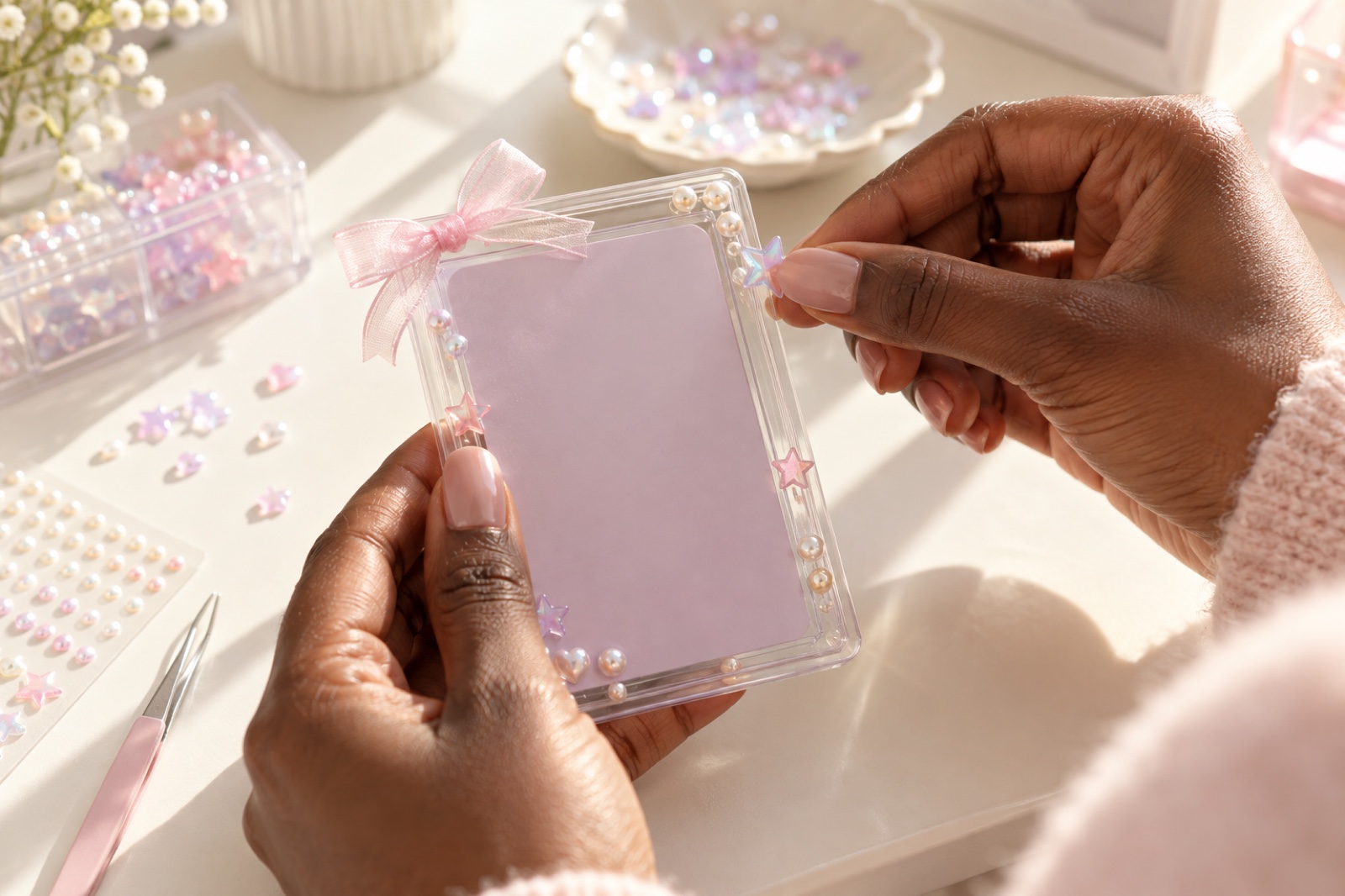
What Toreca Deco Means and Its Basic Structure
Toreca deco (トレカデコ) means leaving the trading card (toreca) itself alone and decorating around it, so that a single card ends up looking the way you like. Think in four layers and you’ll rarely go wrong: the card itself, a snug-fitting sleeve, a hard case or magnetic loader, and the parts that decorate the outside of the case. For the sleeve that touches the card, choose one that fits exactly, is highly transparent, and lets you check the material label. Too small and the corners get damaged; too large and the card shifts inside.
| Layer | Role | What to look for |
|---|---|---|
| The card itself | The star. Stick nothing on it | Photograph front and back before you start to record its condition |
| Inner sleeve | Directly protects the printed surface | Exact size. If it’s loose, the card slides inside |
| Hard case or loader | Takes bending and pressure | Choose an interior size that allows for the sleeve’s thickness |
| Outer parts | Where the decoration happens | Use fastenings that can come off so you can restore it |
- 01Outer partsStickers, charms, ribbons
- 02Hard case or loaderTakes bending and pressure
- 03Inner sleeveSnug fit, high transparency
- 04The card itselfThe star; stick nothing on it
Decoration happens on the outside, so the card can always be restored.
Attach deco parts to the outside of the hard case or to a separate decorating cover. When you use adhesive stickers, take the card out first and don’t stack the pieces until they’ve dried. Glue that seeps out makes it hard to change cases later, so beginners are safer starting with low-tack stickers or parts that simply clip on.
Where the Word Comes From and How It Spread
The name is a contraction of “toreca” and “decoration,” a phrase born when the habit of decorating bags and phone cases moved on to cards. Photo cards began circulating in large numbers as random goods, and the need to make your own copy recognizable among identical designs laid the ground for the craft’s spread. We found no record of who started calling it that, or when.
How It Differs From Similar Words
Toreca deco is the act of decorating around a card, while hard-case deco is decorating the outside of the protective case. Whether or not you stick anything directly on the card changes how well it’s preserved and how much you can restore. Deco daishi (deco mounts) put the work into the backing board itself, so you can swap cards in and out and reuse it.
Toreca deco
- Decorates around a single card
- Stickers are never placed on the card
Hard-case deco
- Decorates the protective case
- Restorable when nothing touches the card
Deco daishi
- Builds up the mount itself
- Cards can be swapped and reused
Whether you touch the card decides how well it keeps.
Examples
- “Finished a new toreca deco! I made it sparkly with stickers in my oshi’s color.”
- “Blue and white toreca deco to match this outfit. Cutest one I’ve ever made!”
- “This toreca deco is coming with me to today’s show. Can’t wait to take photos.”
- “All the decorations are on the outside of the case. If I feel like it, I can put it back to normal any time.”
- “I bought so many extra parts that my box of materials is livelier than the finished decos.”
Choosing Colors and Themes
Start with just one oshi color and add base colors such as white, clear or silver. Too many colors bury the card’s photo, so narrow it to three elements: a main color, an accent color and a shiny material. You can also pick a theme from where you’ll take the card: a ribbon for a birthday, stars and light for a live show, small pearls for everyday use.
Another approach is to match the card’s outfit or background. With a blue outfit, use light-blue clear parts; with a warm-toned background, a cream-colored frame. Picking up one color from the photo looks natural. You don’t need to copy official designs; the fun of deco is choosing colors tied to your own memories.
The Steps (Five Steps)
- Prepare your desk and hands. Work on a wiped desk, and photograph the front and back of the card once to record its current condition.
- Test-fit the sleeve and case. Once the card is inside, measure the margin so you know how much room you have for decoration.
- Arrange the parts without gluing, and take a photo. Place parts without covering the center, and judge the overall impression on the screen.
- Balance the left and right weight before fixing. If you gather ribbons or charms on one side, the case tilts and they come off easily while you carry it.
- Close it and let it dry. Check for lifted corners, how the case closes and any dust that got in, and don’t put the card back while a smell lingers.
- 01PrepareWipe the desk, photograph the card
- 02Test fitPlace in sleeve and case
- 03ArrangeDo not glue yet; take a photo
- 04BalanceEven out left and right
- 05Close and dryCheck corners and smell
Photograph first, glue last.
For cards you plan to trade, or expensive ones, it’s safer to test the size and strength on an inexpensive dummy card first.
Storage and Carrying to Shows
Store finished pieces standing up, and don’t put anything heavy on top. A clear pouch makes it easier to find the card you want to photograph, but separate the charms in small bags so they don’t rub against each other. On rainy days, double up on waterproof pouches, and watch for condensation where heating and cooling differ sharply.
Some people slip them into the gaps among the pin badges on an ita-bag, but the edge of a badge sits exactly where a card’s corner would hit. Adding a single pouch with a card window between them changes where the impact lands. As your collection grows, the approach in merch storage applies as is for dividing and displaying it.
What to Check Before Trading or Passing On
Keep cards you plan to trade or hand on separate from those you decorate and those you store. The other person may not want a decorated card, so say in your merch trade post whether it has decorations and whether they come off, and things move faster.
Parts that use unofficial images or logos shouldn’t be sold or distributed; keep them to your own enjoyment. When you post a photo of a finished piece on social media, check first that no one else’s cards are in the shot and no envelope with an address or name is in the background.
Notes From The Oshi Lab: The Value of Matching Dimensions
Toreca deco is merch with room for one more step of your own hands after you buy it. Even if thousands of copies of the same design exist, the moment you decorate one, it becomes yours. What the Lab watches is how far this touch that turns a mass-produced item into a personal possession lifts fan satisfaction. Because making, photographing and showing form one continuous game, deco satisfies both the joy of having and the joy of sharing.
For sellers, the lesson is the value of matching dimensions. If a card’s size fits sleeves and cases that are already widely available, fans skip the hunt for tools and go straight to decorating. Custom sizes narrow the choice of protective goods and push the fun of decorating further away. We think the condition for a card to be cherished for a long time is to set out, from the start, dimensions and storage guidance that work whichever way people play: those who decorate, those who store, and those who never carry.
Related Terms
Trading cards (toreca) / Hard case / Merch storage / Ita-bag / Oshi color
FAQ
What is toreca deco?
It's an oshi-katsu craft in which you put a trading card in a clear sleeve or hard case and decorate around it with stickers, ribbons and other parts. The basic rule is to never stick anything directly on the card.
Is it okay to put stickers on the card?
If you're thinking of trading or selling, it's safer not to stick anything on the card itself. Adhesive, marks and warping could affect its value and condition.
What should I watch out for when carrying them?
Put them in a waterproof pouch and make sure other belongings don't press on the hard case. Avoid direct sunlight and hot car interiors too.
Can I put a decorated card up for trade as is?
Check what the other person prefers first. Some people want the card undecorated, so say in your post whether it has decorations and whether they come off. That cuts down on mix-ups.
Where can I get the materials?
The stationery and craft aisles of 100-yen shops, specialty stores and online shops all carry them. Many people start with just low-tack stickers and a case and test how they work together on a card they already own.


