
Oshi Merch Storage Ideas: Three Rules for Displaying, Storing and Carrying
As fan merchandise accumulates, you may run out of display space, struggle to find a card or repack everything before every trip. Before buying more organizers, divide items by what you will do with them: display, store or carry.

This guide covers sorting by use, measuring items and practical choices visible in official storage products. It helps collectors choose supplies and gives merchandise businesses examples of useful after-purchase guidance.
Sort by Use, Rather Than How Much You Love an Item
Not everything needs to be on permanent display. Stored goods are still valued parts of a collection. Choosing how you intend to use an item can be easier than ranking how much you love it.
| Use | Possible location | Check first |
|---|---|---|
| Display | Shelf, tabletop case, wall pockets | Light exposure, falling or tipping, ease of cleaning |
| Store | Binder, divided case, storage box | Inner dimensions, thickness, material contact, access |
| Carry | Pouch, fitted case, inner bag pocket | Movement, pressure, rain and contact with other belongings |
An acrylic stand might be displayed at home and moved into a case for an outing. These are changing uses rather than permanent categories. Rotate items with seasons or performances if you like. Set aside undecided items instead of forcing a decision to part with them during the same sorting session.
Display
- Light and stability
- Room to clean
Store
- Fit and material contact
- Easy access
Carry
- Movement and pressure
- Weather and other belongings
One item may move between these uses.
Start With a Manageable Area
Choose a desk, one drawer or goods from one performance—an area you can finish. Starting with an amount you can handle avoids spreading everything across the floor and having nowhere to put it back.
- Check what is there. Count items in the chosen area and identify unopened products.
- Sort by intended use. Decide what to display now, store or take on the next outing.
- Measure before choosing supplies. Include bases, outer bags and sleeves, not just the bare item.
- Keep items accessible. Label boxes and avoid burying frequently used things at the back.
Test organizers with a small number of less prominent items before filling them. If insertion needs force, the lid presses down or the printed surface rubs, reconsider the size or arrangement.
Official Example: A Carrying Case That Limits Movement Inside
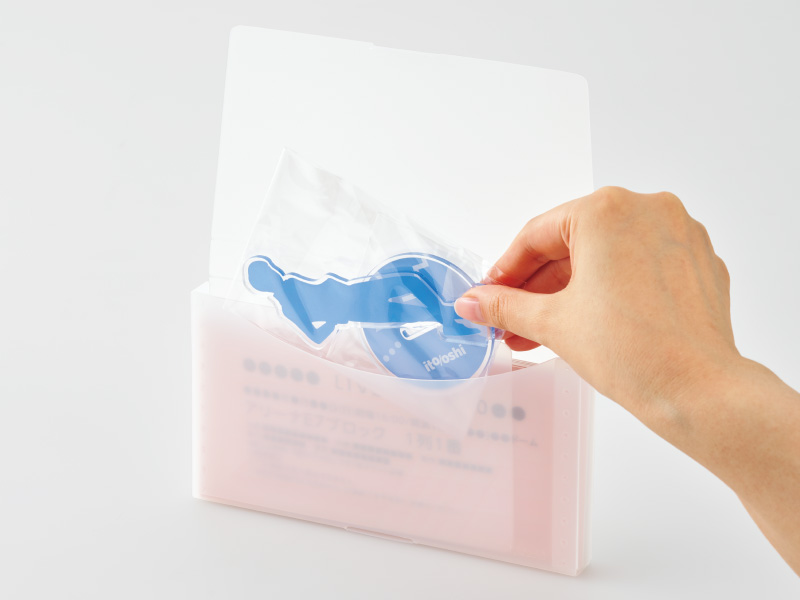
PLUS presents the FL-360CF ito/oshi Case File as a way to carry tickets and an acrylic stand together. In the official photograph, the bag holding the stand is placed under an internal retainer. The design does more than put a box around an item: it helps limit movement inside.
Its external dimensions are 173 mm wide by 17 mm deep by 93 mm high, and it is made from polypropylene. These are not the dimensions of merchandise it can hold. The lid, folds and retaining section take up space, so do not assume an item can fill the outside dimensions. The listed capacity of approximately 50–70 tickets applies to tickets alone, not tickets plus an acrylic stand.
This distinction is useful for any organizer. Check four measurements: external size, internal storage space, opening width and thickness when closed. For an irregularly shaped collectible, check the base and protruding parts too. Read whether props shown in the photographs are included.
If searching Amazon Japan for the same model, match the model number, color, quantity and seller. Do not mistake another size from the same series for this one on the strength of a photograph alone.
Pin Badges: Protect the Front and Allow for the Fittings Behind
Clear pockets or dedicated stands are options for display; divided cases can suit storage. Measure the badge’s thickness including its pin and clasp, as well as its diameter. Avoid packing several so that metal fittings touch a printed surface.
A cover can reduce surface rubbing but cannot completely prevent rust or moisture damage. Check the intended size rather than forcing on a tight cover, which may itself cause damage. Do not seal a wet item away; avoid locations prone to condensation or humidity.
Acrylic Stands: Keep the Body, Base and Bag Identifiable Together
For home display, check that the base sits level and is unlikely to fall from the front of the shelf. Tiered stands can make items at the back easier to see, but consider tipping when the shelf is moved.
During storage, keep the body and base from rubbing while making their pairing clear. Label a pocket or separate them within the same bag. Avoid attaching glue or adhesive tape directly to the printed surface.
When carrying a stand, consider more than whether it fits the pouch. Choose a place where a wallet or charger will not press against it. A hard case can still allow rubbing inside, depending on the contents and packing, so test bags or dividers with it.
Photocards and Cheki: Measure With the Sleeve On
Cards and cheki instant photographs differ in dimensions between products. For sleeves and rigid cases, check usable dimensions rather than the size-category name alone. With two protective layers, the inner sleeve must fit the outer case without force.
A binder lets you turn pages and revisit a collection. However, forcing a thick case into a pocket or closing the binder on a card near its rings can cause bending. As the collection grows, consider splitting it across binders rather than continually adding pages.
Magnetic holders also need to suit a card’s thickness and surface finish. A more expensive case is not automatically right for every card. Check materials, UV-blocking specifications and the thickness it accepts. Protective Supplies for Fan Merchandise explains the differences.
Streamers, Penlights and Uchiwa: Follow the Shape and Product Instructions
- Concert streamers: Avoid forcing folds. Use a dedicated holder or a container that accommodates a roll, without winding tightly or attaching adhesive directly to the surface.
- Penlights: Follow the instructions. For a removable dry-cell model left unused for a long period, remove the batteries and check their condition and the terminals. Do not dismantle rechargeable or other models whose batteries cannot be removed.
- Uchiwa fans: Choose a case large enough for the handle too, and avoid heavy objects on top. Account for the thickness and fragility of decorations.
A bag may reduce rubbing and dust without having guaranteed waterproofing or long-term storage performance. Carrying something in rain and storing it at home are different conditions.
At a 100-Yen Shop, Test One Before Buying Many
Divided cases, pockets and boxes may be available at 100-yen shops. Test one for fit and ease of removal before buying the required quantity. Prices and specifications vary by product and store; ¥1,000 will not necessarily provide the same starter set for every collection.
For desiccants, read the type, amount and replacement or regeneration conditions. Do not assume that one packet per box always suffices, and check whether it may touch the collectible. Review light, temperature, humidity and dust at the storage location as well as adding supplies.
- 01Measure the collectibleInclude sleeves, bases and protrusions
- 02Read usable dimensionsExternal dimensions are not internal capacity
- 03Test a small amountCheck rubbing, access and lid pressure
- 04Choose the quantityAdd only the supplies you need
A fit test is more useful than buying a large matching set first.
Notes From The Oshi Lab: Give Guidance for Life After Purchase
A merchandise business can state dimensions including bases and accessories, carrying precautions and care instructions. When official pictures show a storage arrangement, explaining whether organizers and props are included helps buyers understand what they will receive.
Questions about which case fits a product may also suggest related-product ideas. Before recommending a specific combination, test it. Look beyond inner dimensions to whether an item rubs during removal and whether the lid closes comfortably.
For fans, organizing and parting with goods are separate decisions. Rotate what you display and store undecided items while you think. Before expanding storage, reconsider the collection’s current size and available space. If choosing to part with merchandise, take the time and approach that feel right to you.
Related articles: Creating a Fan Display / Protective Supplies / Packing for a Concert Trip
FAQ
How should I store pin badges?
Clear pockets and stands can suit display; divided cases are options for storage. Allow for the pin and clasp as well as the badge diameter. Covers can reduce rubbing but cannot completely prevent rust or moisture damage.
Do I have to part with goods when my room is full?
No. Displaying, storing and carrying are different uses, not rankings of how much you love an item. Rotate displays or set undecided items aside. Organizing and choosing to part with an item are separate decisions.
How do I reduce fading?
Avoid direct sunlight and strong lighting, and follow each product’s care instructions. A case alone cannot prevent every kind of deterioration. Review the location, temperature, humidity and contact with other materials.
Can I use a case’s outer dimensions to judge the fit?
Outer dimensions do not equal usable storage space. Check inner dimensions, the opening and closed thickness, allowing for sleeves, bases, lids and internal retainers.


