
How to Plan an Oshikatsu Event: Participation Rules and On-Site Operations
When planning an oshikatsu (fan-support) event, organizers must consider what attendees will actually experience in tandem with the precise instructions required to make that happen. Cheering out loud, admiring an exhibition at a relaxed pace, or participating online without traveling to the venue—each format demands a completely different space, reception process, and set of rules communicated to the audience.
In this guide, we examine how to structure an event using official guidelines from anime cheer screenings (oen joei), department store exhibition events, and hybrid services that bridge online participation with on-site physical displays. Designed for companies and organizers planning their first fan gathering, this article provides practical examples of public announcements, ticketing strategies, and day-of-event operations. The film screenings and exhibitions featured here are presented as specific past case studies.
Learning from Cheer Screenings: Rules for Special Sessions
In cinema screenings, planners often differentiate standard quiet screenings from special interactive sessions where fans are permitted to voice their support aloud. The January 24, 2026 news release for Demon Slayer: Kimetsu no Yaiba – The Movie: Infinity Castle – Chapter 1: The Return of Akaza (in Japanese) serves as an instructive example of how to present participation conditions.
The film’s wide theatrical release date was July 18, 2025. This particular news release announced supplementary cheer screenings: a “Demons” cheer screening held at 10 theaters across eight major cities on January 31, 2026 at 17:00, followed by a “Demon Slayer Corps” cheer screening on February 3 at 19:00. The announcement clearly distinguished the film’s original theatrical release from the specific dates of these special participatory sessions.
The guidelines permitted vocal cheering and the use of glow sticks (such as chemical light sticks or LED penlights) exclusively during these designated cheer screenings, while stipulating that all cheering goods must be held no higher than chest level. Standing up, jumping, banging on seats, noisemakers like whistles and party poppers, as well as photography, video recording, and audio recording inside the theater remained strictly prohibited.
Merely stating that “cheering is allowed” leaves attendees unable to gauge how high they can raise their merchandise or what actions cross the line. Organizers must clearly articulate the exact boundaries of permitted behavior down to specific physical heights and explicit prohibitions. Furthermore, to prevent fans from misunderstanding that regular screenings have adopted the same rules, the targeted dates, showtimes, and participating theater locations must be explicitly stated together.
Communicating Necessary Advance Preparation Before Arrival
For the “Demon Slayer Corps” cheer screening on February 3, the announcement also highlighted a supplementary audio guide featuring the Kasugai Crow character. To use this feature, attendees needed to prepare in advance: downloading the “HELLO! MOVIE” smartphone app along with the dedicated audio guide data beforehand, and verifying playback using a compatible mobile device and personal earphones. This audio commentary was also restricted exclusively to designated cheer screening sessions.
Event planners must clearly communicate not only “what can be done on the day” but also “what preparations users must finish before leaving home.” External dependencies—such as noting that ticket sales schedules follow each individual theater’s standard box-office schedule—should also be clearly delineated so attendees know where to look.
The official film website directed attendees to a guidance video hosted on the Aniplex YouTube channel as a visual code of conduct titled “Cheer Screening Etiquette.”
Official Video: Aniplex Channel “Teachings of the Demon Cheer Screening” (in Japanese)
Enabling attendees to move seamlessly between the announcement web page and the video ensures they can verify the exact conditions that apply to that specific session. This thorough communication prevents attendees from mistakenly assuming that behaviors permitted in other anime franchises or past live performances will automatically be allowed at this event.
- 01Designate Eligible SessionsExplicitly state the date, showtime, and theater to clarify the difference from standard screenings
- 02Define Allowed Actions and BoundariesDetail rules for vocal cheering and fan goods, chest-height limits, and photography bans
- 03Outline Advance PreparationsFor the audio guide in this case, prompt attendees to check the app, data, compatible phone, and earphones
- 04Link Verification ChannelsConnect the official website, guidance videos, and box-office ticketing outlets
This diagram summarizes the conditions for these screenings; not all events require the same items or apps.
Source: The Oshi Lab’s summary of the article
Pairing Promotional Key Visuals with Detailed Admission Requirements
In a September 9, 2025 press release by Daimaru Matsuzakaya Department Stores (in Japanese), the company announced that the TV Anime “SAKAMOTO DAYS” FES would take place from September 25 through October 7, 2025, in the 6th-floor event hall of the Matsuzakaya Ueno store. The event combined photo spots and three-dimensional installations with an on-site merchandise store.
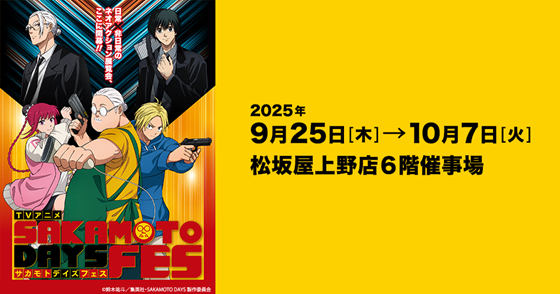
This announcement image effectively divides information: the left side showcases the featured characters and event title, while the right side displays the dates and venue prominently. This visual hierarchy immediately establishes the franchise connection while allowing fans to confirm when and where to go at a glance. It functions as an informational promotional visual rather than a collection of on-site photography.
However, purchasing tickets and attending an event involves complex requirements that cannot fit onto a single promotional poster. The full text of the press release detailed comprehensive rules covering admission deadlines, hall closing times, ticket categories, rules for accompanying guests, and merchandise shopping access.
Closing Time Differs from Final Admission Time
The event operated under standard hours where admission was open from 10:00 to 18:00 with the hall closing at 19:00, while the final day restricted entry to 14:00 with the hall closing at 15:00. Simply writing “Open until 19:00” leaves visitors confused about the latest entry time. Planners must clearly distinguish the final admission cutoff from the ultimate closing time, ensuring that special schedules like the final day can be checked on the exact same page.
Pricing was set at 1,500 yen advance / 1,800 yen same-day for general adults and university students, 1,000 yen advance / 1,200 yen same-day for junior high and high school students, and 600 yen advance / 800 yen same-day for elementary school students, while preschoolers entered free of charge. Crucially, children of elementary school age and younger were required to be accompanied by a guardian aged 18 or older, and that guardian also required a paid admission ticket. Simply announcing ticket prices for children does not give families enough information to know how many and which tickets they need to purchase.
The press release also established the following specific stipulations:
- Certain time slots operated under a strict date-and-time reservation system. Reserved slot tickets were limited in quantity, with same-day tickets sold only if capacity remained.
- Re-entry was not permitted, and an event admission ticket was mandatory even to browse or purchase items in the merchandise area.
- Standard department store customer loyalty perks and member discounts did not apply to this event.
- Holders of designated disability certificates were required to purchase an admission ticket, but one accompanying caregiver was granted free admission.
These represent the specific conditions established for this particular exhibition; they are not universal rules across all department store events. Organizers adapting these practices for their own initiatives must coordinate with the venue well before ticket sales launch to establish rules for exhibition access versus merchandise shopping, policies for accompanying guests, and deviations from the venue’s usual amenities. This ensures that ticketing websites and front-desk reception staff operate under the exact same reference criteria.
Connecting Remote Online Participation to Venue Displays
Another effective method is establishing a dedicated channel for fans who cannot visit the physical venue in person to participate remotely. KAZAORI Co., Ltd., the operator of The Oshi Lab, provides a co-creative fan support platform called PQuuut (in Japanese).
The official platform website describes a system where fans purchase balloons or promotional merchandise packages online; as orders accumulate, digital balloons color in on-screen, translating directly into physical balloon installations and photo spots constructed at the real-world venue. Additional program features highlighted on the site include fan message walls and collectible cards featuring unique serial numbers.
What organizers must evaluate in this model is how to bridge digital participation on a screen with the physical experience observed inside the venue. Before participants submit an application or purchase, organizers must clearly explain which purchases or submitted messages will manifest in physical form, and what tangible items will be shipped to remote fans. Furthermore, because venue decoration, novelty production, and merchandise shipping are rarely handled by a single individual, the division of operational responsibilities must be clarified early.
Premium
- Promoted with zero upfront cost on a performance-fee model
- Must verify notes regarding minimum sales guarantees
Standard
- Structured around a predetermined project budget
- Requires checking shortfall liabilities if targets are missed
- Must confirm refund or return terms for surplus revenues
Light
- Centered on online merchandise sales and product dispatch
- Verify the scope of sales and shipping handled by the organizer
This summarizes the official guidance. Actual costs and scope of responsibilities should be confirmed with the chosen plan and contract terms.
Promotional descriptions highlighting “0 yen in initial costs” do not mean that the organizer bears zero financial liability. Organizers must review the specific plan details alongside contract clauses governing minimum sales guarantees, shortfall liabilities if sales targets are missed, the distribution of surplus revenue, and the precise party in charge of physical shipping and customer inquiries. Differentiating the software platform’s automated mechanisms from your company’s own manual operational duties is vital.
Accommodating the Solo Fan Experience
When mapping out a venue floor plan, organizers should avoid designing exclusively for friend groups and explicitly accommodate fans attending alone who want to view exhibits or take photos at their own pace. For instance, photo spots should be structured and staffed so that visitors can comfortably photograph the entire scenic installation or capture snapshots of their handheld merchandise (such as acrylic stands or plushies), rather than only posing in portraits themselves.
Review the complete traffic flow on the floor plan—from the entrance through the exhibits, photo zones, merchandise counter, and exit—marking exact queuing positions and the path taken by attendees departing a photo area. If staff members need to enforce time limits at photo stations, define beforehand where those staff members will stand and the specific verbal guidance they will provide. If interactive fan networking elements are included, clearly communicate which areas require social interaction and which remain optional.
Moreover, if participation is split across multiple formats—such as attending in person, sending digital messages, or purchasing merchandise—explicitly outline what can be achieved through each channel. Rather than ranking fans’ dedication by total purchase amount or attendance frequency, organizers should craft clear guidelines that transparently explain the conditions of whichever participation method a fan chooses.
Core Operational Decisions to Finalize During Planning
| Decision Category | Key Elements to Define |
|---|---|
| Target Audience & Schedule | Who can attend, and which specific sessions will apply rules that differ from standard sessions |
| Timetable & Ticket Tiers | Final admission deadlines, venue closing times, last-day exceptions, and ticket requirements for accompanying companions |
| Admission & Merchandise Access | Timed-entry slots, re-entry restrictions, and ticket prerequisites for accessing the merchandise corner alone |
| Fan Preparation & Etiquette | Permitted items, photography and vocal cheering boundaries, and smartphone app setup required before arrival |
| Responsibilities & Finances | Assigned teams for venue decor, sales, logistics, and inquiries; contract policies regarding refunds and changes |
Every finalized operational decision must be reflected on the official web page—which serves as the primary source of truth—as well as in the instructional manuals used by on-site event staff. Whenever changes or adjustments occur, state clearly what changed along with the precise timestamp of the revision, directing attendees to that same central page via social media announcements. When incorporating official character logos, illustrations, music, or video footage, planners must also confirm the approved scope of use, attribution requirements, and venue-specific technical regulations mandated by intellectual property rights holders.
Once the event concludes, organizers should review operational records regarding queue congestion, attendee inquiries, and instances where advance public announcements conflicted with front-desk handling. For example, if staff received numerous inquiries regarding the final day’s early admission cutoff, that feedback can inform where and how prominently that cutoff is displayed on future promotional visuals and ticketing pages. Combining post-event attendee impressions with operational challenges documented by on-site staff ensures that valuable organizational know-how is systematically passed down to the next fan event.
FAQ
Where should you start when planning an oshikatsu fan event?
Start by defining specifically who can participate and what they can do on-site or online. Rather than starting with decorations or merchandise perks, build the framework of the experience first—such as deciding whether to separate quiet viewing sessions from vocal cheer screenings, or how admission conditions tie into exhibition and merchandise areas.
What guidelines are necessary when setting up special sessions or cheer screenings?
It is essential to clearly state the rules that differ between regular screenings and special sessions in advance. Share whether vocal cheering and penlights are permitted, height limits for holding up fan goods, prohibited disruptive behaviors, boundaries for photography or recording, and any prerequisite mobile app preparation through official pages and guidance videos.
What conditions are most easily overlooked when announcing exhibition and merchandise sales events?
Commonly missed details include final admission cutoffs versus closing times, last-day exceptions, timed-entry slots versus same-day tickets, re-entry rules, ticket requirements for shopping at the merchandise counter, and policies regarding accompanying guests or standard member discounts. The SAKAMOTO DAYS example in the article serves as a specific case study of these details.
Is there a way for fans who cannot visit the physical venue to participate?
One effective approach is a co-creative support system where fans purchase support items online, which pool together to fund physical balloon decorations or photo spots at the venue. When adopting such services, verify the upfront costs, minimum sales guarantees, handling of budget shortfalls or surpluses, and fulfillment responsibilities for each plan.
What metrics and records should be reviewed during the event post-mortem?
Review on-site records of queue bottlenecks, attendee inquiries, and situations where pre-event guidelines conflicted with front-desk responses. By combining attendee feedback with operational challenges recorded by staff, teams can identify exactly what to revise in future guidelines and on-site procedures.


