
Oshikatsu at the Arcade: Distinguishing Crane Prizes, Spend Bonuses, and Pop-Up Merch from Sample Photos
Items that players aim to win in crane games at Japanese game centers (arcades) are called “prizes” (puraizu), and part of the fun of fan activities (oshikatsu) is winning official franchise merchandise through gameplay. In addition to limited crane prizes, some arcade campaigns combine bonus novelties based on the amount of money spent with retail merchandise sales and special displays at selected locations.

At the same time, because a single campaign announcement often lists multiple ways of getting items alongside different event dates, fans visiting an arcade need to read carefully to understand which item is obtained through which method. For the companies planning these events, designing clear announcements that communicate the differences between crane prizes, spend bonuses, and standard retail merchandise without causing misunderstandings is essential.
Through publicly released campaign announcements and a close reading of sample product photos, this article organizes the key points fans should check before visiting an arcade, as well as the core information-design principles for game centers and campaign planners when creating promotional guides.
Three Ways to Obtain Items in Arcade IP Collaborations
In the intellectual property (IP) collaborations discussed here, items featuring the exact same newly drawn illustrations can have completely different acquisition methods. Let us first organize the three typical categories.
| Category | Basic Mechanism for Obtaining Items | Examples of Conditions to Check |
|---|---|---|
| Limited crane prizes (puraizu) | Items players aim to win by operating a crane game machine | Launch date, participating arcade locations, stock and shipment status |
| Spend-based bonus novelties | Promotional novelty items received when inserting a set amount of money into eligible crane game machines | Designated eligible machines, required spend amount, random distribution vs. selectable design, differences in online conditions |
| Accompanying paid merchandise sales (retail) | Products purchased at list price at an in-store special corner or pop-up store | Limited participating locations, differences in event dates, presence or absence of displays |
For fans, which of these three categories a desired item falls into determines which store to visit, what dates to go, and how to proceed once on site. For corporate planners, designing announcement web pages and in-store point-of-purchase (POP) displays so that these three tracks are not confused serves as the foundation for preventing confusion on the arcade floor.
Limited Crane Prizes
- Players aim to win the item by operating a crane game machine
- Inserting a set amount of money does not guarantee winning the prize
- Stock status and availability vary from store to store
Spend-Based Bonus Novelties
- Distributed each time the specified amount is spent on an eligible machine
- Often available in limited quantities and handed out at random without design choice
- Participation conditions may differ between physical stores and online crane games
Accompanying Pop-Up Retail
- Paid merchandise purchased as standard retail goods
- Participating locations may be much more limited than prize locations
- The closing date may differ from the overall prize campaign period
Source: The Oshi Lab summary of arcade collaboration formats
Case Study: Breaking Down the “Attack on Titan x GiGO” Campaign Structure
To see how a concrete campaign is put together, let us look at the collaboration with Attack on Titan (Shingeki no Kyojin) announced by GENDA GiGO Entertainment on September 5, 2025.
According to the official announcement (PR TIMES / GENDA GiGO Entertainment (in Japanese)), a nationwide rollout of limited crane prizes and a “must-buy” spend campaign took place at participating arcades from September 20 to October 19, 2025. In this collaboration, limited crane prizes, spend-based bonuses, and a separately organized pop-up store all launched side by side starting on September 20.
First, the items prepared as limited crane prizes were Big Diorama Acrylic Figures (4 varieties in total) and B2 Tapestries (4 varieties in total) featuring newly drawn illustrations. These were prizes to be won by playing crane game machines, and the announcement noted that some stores would not carry them and that shipment status could vary by location.
Second, as a spend-based bonus novelty, a mechanism was set up in which players received 1 random photo-style card (out of 4 varieties in total) for every 500 yen inserted in one batch into eligible crane game machines. The crucial point here is that what you receive for inserting 500 yen in one batch is strictly the bonus photo-style card; it is not a guarantee that you will win the crane prize itself for 500 yen. In addition, players could not choose the design of the photo-style card, and distribution was limited in quantity and ended once supplies ran out. Participation conditions for the online crane game were set separately from those at physical stores.
Furthermore, starting on the same day—from September 20 to October 5, 2025—a separate pop-up store organized by Bushiroad Creative was held at four locations nationwide. Those four venues featured character standee displays and sold paid retail merchandise.
In the official announcement, the campaign combined limited crane prizes, bonus cards distributed for every 500 yen inserted in one batch, and paid merchandise sales and displays limited to four stores. Moreover, while the prize campaign ran until October 19, the pop-up store ended on October 5—a two-week difference in closing dates. This case clearly illustrates how multiple mechanisms and schedules coexist under a single collaboration title.
What to Read from Sample Photos: The Diorama Acrylic Figure Example
When looking at campaign announcements, observing the posted product images (sample photos) is just as important as reading the text. Let us examine the sample photo of the limited crane prizes that was actually released.
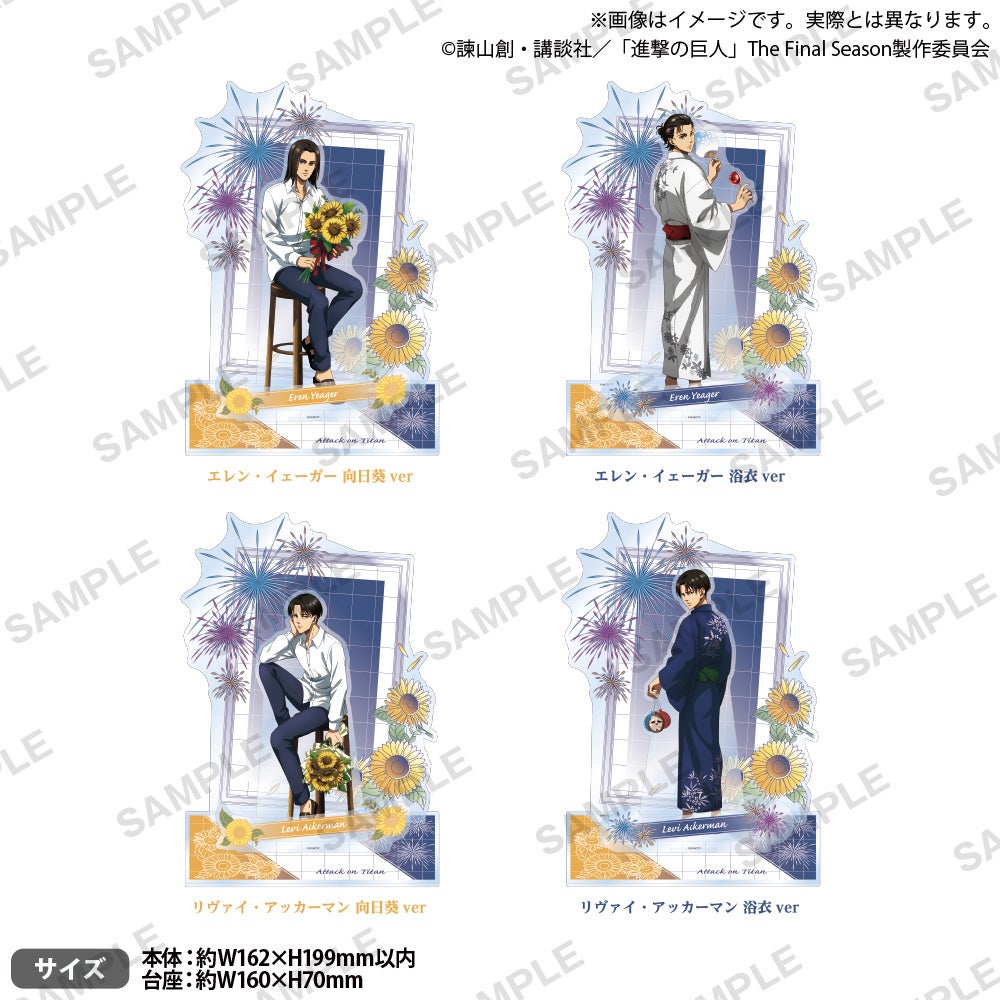
This image shows the full lineup of all four Big Diorama Acrylic Figures released as GiGO-exclusive crane game prizes. For the characters Eren and Levi, there are two versions each—“Sunflower ver.” (Himawari ver.) and “Yukata ver.” (summer cotton kimono)—making a total of four varieties lined up together.
Looking closely at the photo, you can see that behind the character standee piece in the foreground sits an overlapping background panel depicting sunflowers, fireworks, and scenery, all arranged three-dimensionally on a base in a diorama format. The image also includes the word “SAMPLE” indicating that it is a preview image, dimension specifications to give a sense of size, the franchise title, and copyright notices.
There are two reasons why fans check specifications from a sample photo like this.
The first reason is to avoid mistaking which acquisition route the item belongs to. This four-item lineup image is a sample of the acrylic figures that players aim to win in crane games; it is not an image of the photo-style cards given for every 500 yen inserted in one batch on eligible machines. Even when the exact same Sunflower ver. and Yukata ver. illustrations are used, there is a clear distinction: the three-dimensional diorama acrylic figures are crane prizes, whereas the flat cards are randomly distributed bonuses based on spend amount.
The second reason is to plan where to display the item at home and how to carry it back. By confirming from the photo that the item is a diorama format with overlapping background and character panels, and by checking the dimensions printed inside the image, fans can estimate in advance whether it will fit on a shelf at home and what size bag or protective case they will need to carry it home after winning it. However, because a sample photo does not reveal the thickness or strength of the acrylic material, how easily the parts fit together or detach, or how each piece is individually packaged, it is safest to base expectations solely on the visible shape in the photo and the officially listed dimensions.
Thinking from the Fan’s Perspective: Step-by-Step Decisions Before Visiting and at the Arcade
Next, let us organize what checks and decisions fans should make at each stage when actually heading out to a game center.
- 011. Identify the category of the desired itemCross-check official images and descriptions to see if it is a crane prize, spend bonus, or paid retail item
- 022. Check campaign dates and participating stores separatelyLook up differences in closing dates and locations between prize arcades and pop-up store venues
- 033. Understand participation rules and bonus conditionsCheck designated eligible machines, staff call-out or voucher exchange steps when inserting 500 yen in one batch, and physical vs. online rules
- 044. Set a budget and stopping point for the dayKeep in mind that bonuses for inserting 500 yen in one batch and winning crane prizes are separate mechanisms, and play within a comfortable budget
Source: The Oshi Lab guide to arcade campaign participation
Organizing Information Before Visiting: Don’t Overlook Gaps in Dates and Store Lists
When opening a campaign announcement page, the first step is to separate whether the item you want is part of a “nationwide prize rollout” or a “pop-up retail shop limited to select stores.” As seen in the Attack on Titan x GiGO example, even when a prize campaign runs at stores nationwide until October 19, a pop-up store offering standee displays and paid retail merchandise may only take place at four stores nationwide and end earlier on October 5.
Instead of assuming, “The campaign is still running, so the retail merchandise must still be on sale,” or “My local arcade should have the standee display too,” checking the list of prize-participating locations separately from the pop-up store venues and dates prevents the disappointment of arriving on site only to find that the corner you came for is not there.
Choosing Between Online Crane Games and Physical Stores
When there is no participating store nearby or visiting in person on the campaign dates is difficult, online crane games become an option. However, the bonus novelties received for every 500 yen inserted in one batch on eligible machines at physical arcades and the participation conditions for online crane games are sometimes governed by separate rules. If you also want the bonus card, it is important to check the online platform’s notices in advance to confirm whether the bonus is offered online and what procedures are required to claim it.
Setting Your Personal Budget at the Store
Receiving a bonus card for every 500 yen inserted in one batch and actually winning a crane prize are two separate mechanisms. You cannot choose the design of a random bonus card, and there is no guarantee that you will win a crane prize within your planned spend amount. Decide the upper limit of what you will spend based on the entertainment budget you can comfortably set aside for play that day.
How Companies Should Pair Product Images with Acquisition Methods in Announcements
When arcade operators and collaboration planners create promotional guides, they should pair the images of crane prizes, spend-based bonus novelties, and paid retail merchandise directly with each item’s specific acquisition conditions. The more frequently the same character illustrations are reused across different item types, the more important it is to indicate right next to each image how that specific item is obtained. Planners should preserve SAMPLE watermarks, dimension notes, and copyright notices, and clearly distinguish between an image showing the full set of varieties and the quantity a customer receives at one time.
When announcing multiple sub-events running in parallel, planners should also display schedule differences side by side—such as noting that crane prizes and photo-style cards run until October 19 while the four-store pop-up shop runs until October 5. For store lists as well, clearly separating and labeling which stores participate in which part of the collaboration helps prevent visitor confusion.
Instructions for physical stores and online crane games should also be separated, stating the required spend amount, the step-by-step procedure for receiving bonuses, limited-quantity rules, and whether designs can be chosen according to each participation method. Finally, providing clear participation instructions for visitors and measuring business results such as foot traffic or sales should be treated as separate tasks.
Related articles: What Is Oshikatsu Marketing? / What Is Ichiban Kuji? / What Are Random Goods (Blind Merchandise)? / What Is Nuikatsu (Plushie Fan Activities)?
FAQ
What is the difference between a limited crane game prize and a bonus item given for every 500 yen inserted in one batch?
A limited prize is an item you aim to win by operating a crane game machine. By contrast, a bonus given for every 500 yen inserted in one batch on eligible machines is a promotional novelty distributed on the condition that you insert the required play fee. Spending 500 yen does not guarantee that you will win the crane prize itself.
What should fans pay attention to when looking at photos in collaboration campaign announcements?
It is important to check the sample photos against the captions and headings to see whether each pictured item is a crane game prize, a bonus card distributed based on the amount spent, or paid merchandise sold at an accompanying pop-up shop.
Can the prize campaign and the pop-up store run for different periods even within the same franchise collaboration?
Yes. For example, in the autumn 2025 Attack on Titan x GiGO collaboration, the prize campaign ran from September 20 to October 19, whereas the pop-up store held at four locations nationwide ran from September 20 to October 5, ending on a different date.
Can you receive bonus items under the same conditions in online crane games as at physical arcade locations?
Online crane games may have different participation requirements and distribution methods than physical stores. You need to check the eligible conditions in advance on the dedicated online campaign page and notices.
What is important for companies to include in signage and notices when planning an IP collaboration at an arcade?
Companies should clearly separate crane prizes, spend-based bonuses, and standard retail merchandise both visually and in writing, and state the respective campaign periods, participating locations, whether designs can be chosen, and limited-quantity conditions so that visitors do not confuse them.


