
Anime Figures for Beginners: Prize vs. Scale vs. Nendoroid, the Market, and How to Display Them
Start looking for a figure of a favorite character to keep on your desk or shelf, and you quickly run into a puzzling price gap. Game centers and secondhand shops stock figures around ¥2,000, while online stores list the very same character for ¥20,000 or more. Add unfamiliar terms like “prize,” “1/7 scale,” “Nendoroid,” and “figma,” and many newcomers aren’t sure where to begin with their first figure.

This guide breaks down the four main types of anime figures and why their prices differ so widely, written for anyone buying their first one. We cover how to read scale numbers, how preorders work from prototype to delivery, and how to display and store figures without yellowing or warping.
What to Compare Alongside the Price
Price depends on the sales route as well as size, parts, paint, accessories and release timing. A prize designed for a crane game and an item sold through an official shop start from different planning conditions.
The Japan Amusement Industry Association’s guideline, revised in March 2022, sets an approximate retail-value ceiling of ¥1,000 for arcade prizes. This describes the prize that may be offered. It does not mean you can win it for ¥1,000, or that a secondhand shop must sell it for less than that. Set a play budget in advance: the required number of attempts is not fixed.
A retail scale figure’s price does not decide whether you will love its face or enjoy displaying it. Consider shelf space, favorite expressions and whether you want to swap parts or change poses.
Arcade prize
- Intended for a prize game
- Winning cost and resale price are separate questions
Retail figure
- Sold with product specifications and a price
- Check size, accessories and release conditions
The sales route is one factor, not a ranking of how much a fan will enjoy a figure.
Four Main Types to Know First
Most figures you see in shops and online stores fall into these four categories.
| Type | Approximate price | Main way to get one | Features | Best for |
|---|---|---|---|---|
| Prize figure | Winning cost and resale price vary | Arcade prizes, shops that sell won items | Produced for arcade prizes; check each item’s sculpt and accessories | People who want to try displaying one / people who want the satisfaction of winning it themselves |
| Scale figure | From the ¥10,000s to several tens of thousands of yen (varies by scale, specifications and release timing) | Maker’s official online shop, hobby shop preorders | A retail item with a stated scale; check each product’s sculpt and accessories | People who want a definitive figure to display for years |
| Nendoroid | Varies by series | Official online shops, hobby shop preorders | Deformed at 2 to 3 heads tall. You can swap face parts and props | People who like displaying them in rows / people who like taking photos |
| figma | Varies by series | Same as above | Articulated figures. You can pose them and recreate scenes from the original | People who want to move and play with them |
Figures at the same scale can differ in price and the space they need. A new item’s list price and its secondhand price are different measures. Compare the exact maker, version and condition, rather than relying on the character name alone.
The 7 in “1/7” Divides the Character’s Height
The scale notation is what trips beginners up most. 1/8 is one eighth of the character’s official height; 1/7 is one seventh. The smaller the denominator, the bigger the figure, which runs against intuition.
For a character whose stated height is 162 cm, 1/8 is about 20 cm and 1/7 is about 23 cm. The 3 cm difference looks small as a number, but because a three-dimensional object expands in height, width, and depth, its presence on a shelf is completely different. Measure the height and depth of your shelf before you buy, so those 3 cm don’t catch you out.
- 01ScaleA guide to the character’s relative size
- 02Overall dimensionsInclude the base, hair, weapons and effects
- 03Shelf clearanceAllow space for assembly and access
The published product dimensions matter more than a height calculated from scale alone.
A height calculated from the scale may differ from the product’s overall height. Hair, weapons, bases and seated or leaning poses change the outside dimensions. Check the listed dimensions, including the base and effects, instead of choosing a shelf from the scale alone.
An Official Diagram of Nendoroid Part Swapping
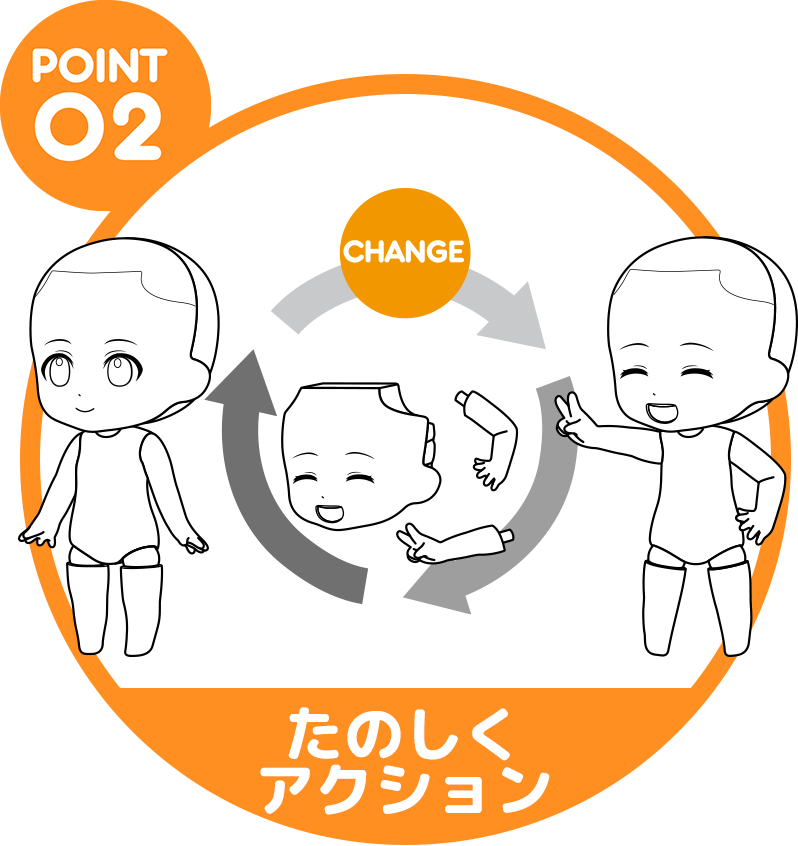
The diagram swaps face and arm parts to change the same figure’s expression and gesture. As well as displaying a finished figure, you can rearrange the parts to suit the scene you want to photograph. Included faces, props and articulation vary by product. Parts from different products are not necessarily interchangeable; check the particular set’s contents.
You can also search Amazon Japan for Nendoroids. A character may have a standard version, another outfit or a rerelease. Match the official product name and accessories, then check the seller and condition.
Who Makes Them: How the Major Makers Divide the Field
Price ranges reflect the makers behind them. Once you know which major brand covers what, the shelf gets easier to read.
- Good Smile Company runs Nendoroid, figma and scale figures across the board. Nendoroid began in 2006 and marked its 20th anniversary in 2026. The company’s August 2026 announcement describes a lineup of more than 3,000 items (Good Smile Company).
- BANDAI SPIRITS makes prize figures, Ichiban Kuji lottery merch and the articulated figure brand TAMASHII NATIONS, among others. It holds many of the routes by which fans win figures from a lottery or at an arcade
- Kotobukiya focuses on model-kit figures you assemble yourself, in addition to finished figures. Its series, such as Megami Device and Sousai Shojo Teien, combine articulation with assembly
- Kaiyodo, a long-established name in candy toys (small figures packed with snacks) and garage kits (limited kits made by hobbyists and small studios), runs sculpt brands such as Revoltech and ARTPLA (Kaiyodo, in Japanese)
Some makers also manufacture in Japan. Good Smile Company established the Rakutsuki Factory in Kurayoshi, Tottori Prefecture in 2014, then added the Mochizuki Factory in April 2025 (company profile in Tottori Company Guide, Japanese).
Reading Toy Market Statistics and the Scale of Figures
When looking at market size, statistics for the overall toy market and estimates for figures alone need to be read separately.
The Japan Toy Association’s June 2026 report puts Japan’s fiscal 2025 toy market at ¥1.1664 trillion on a suggested-retail-price basis, or 106.3% of the previous year. The period runs from April 2025 to March 2026 (Japan Toy Association, Japanese).
That is an overall toy-market measure, not figure sales or spending solely on oshi-katsu. Likewise, Nendoroid’s lineup of more than 3,000 items counts products, not units sold. Separating market value, product counts and shipment counts avoids calculating growth or market share from incompatible numbers. Broader fan-spending surveys are discussed in The Size of the Oshi-Katsu Market (2026 Edition).
From Preorder to Delivery: How Buying Scale Figures Works
For a preorder, payment and delivery may fall in different months. Check the following before ordering.
- Identify the exact item. Confirm the maker, product name, outfit or expression version, and whether it is a rerelease. An event prototype may appear before the final sales specifications are settled.
- Read the ordering and payment terms. Check the deadline, payment method and timing, shipping cost and any combined-shipment conditions.
- Check the planned release and delay notices. Production or logistics can change a schedule. Find out how the seller will announce changes.
- Read change and cancellation terms. Check whether an order can be altered or canceled and the deadline for updating a delivery address.
- 01Exact versionMaker, outfit, accessories and rerelease status
- 02Order and paymentDeadline, payment timing and shipping
- 03Release noticesPlanned month and changes
- 04After orderingCancellation and address-change conditions
Retailer terms vary; the release month is a plan.
Several preorders can produce payments in the same month. Keep a monthly payment list alongside the shelf space each item needs. If you want something to enjoy immediately, check stock of products already released.
Display and Storage: The Enemies Are UV Light, Heat and Dust
Good Smile Company advises against keeping figures unopened for long periods: deterioration, stickiness or delayed discovery of defects and missing parts can result (official arrival checklist).
- Open the package on arrival and check the figure, base and accessories for damage or missing pieces.
- Choose a well-ventilated place away from direct sunlight, strong lighting, heat and humidity.
- If storing the figure in a box or container, take it out periodically to check its condition.
- Avoid leaving exchangeable parts touching for long periods, which can transfer color.
- Follow the product’s instructions and do not force joints or delicate parts.
A case helps keep dust off, but location, temperature and humidity still matter. UV-blocking performance is specific to the case; do not assume every case performs alike. If keeping the outer box, record where the instructions and accessories are stored.
The overall approach to storage, including how to present things as a saidan (fan altar), is covered in Oshi Merch Storage Ideas.
Your Options When You Let Go
When moving or making space, compare market prices and buyback terms for the exact same product in the same condition. Appraisal values and listing descriptions change depending on whether it is unopened, has damage or missing parts, and includes the base and instructions. If requesting several buyback quotes, check shipping, return-shipping and cancellation terms as well as the quoted amount. Taking photographs before parting with an item, or keeping one favorite, can make the decision easier.
Developments From 2025 to 2026
- A character model and a motorcycle kit in one package. Kotobukiya’s official shop lists Koishikawa Emma [Nocturne] with Honda AB12 Motocompo, pairing a 1/10-scale character with a 1/12-scale motorcycle kit. The listing identifies the character’s height as approximately 140 mm and the vehicle’s length as approximately 108 mm. Assembly is required, and the motorcycle needs model glue (official product listing, Japanese). It is a useful reminder that a boxed set can combine different scales and is not necessarily a finished figure.
Notes From The Oshi Lab: Designing Clearer Guidance for First-Time Buyers
What draws our attention to the figure market is how little beginner-friendly guidance accompanies such compelling products. The difference between prize and scale figures, what 1/7 means, and the lead time from preorder to release are all common knowledge inside existing fan communities. To someone buying for the first time, however, a shelf where a ¥3,000 item and a ¥28,000 item sit under the same category name looks impossible to choose from.
For a seller, the useful information is concrete: overall dimensions including the base, what needs assembly, included accessories and payment or delivery conditions. If a product is 23 cm tall, show that measurement rather than relying on “1/7 scale.” Explain how buyers will receive schedule changes and where they can check them. These details let someone decide whether the item fits their room and their plans.
Product pages aimed at first-time buyers become far more welcoming when they show width and depth including the base alongside height, note whether assembly is required, and cover basic care. Information that helps people picture daily life with the figure in their room serves as the real doorway for new fans.
For consultations on merch planning and product design, contact KAZAORI Inc. (in Japanese). You can also try the Oshi Level Check (free diagnostic).
Related articles: Oshi Merch Storage Ideas / What Is Ichiban Kuji? (Glossary) / Oshi-Katsu at Game Centers / The History of Acrylic Stands
FAQ
What is the difference between a prize figure and a scale figure?
Prize figures are primarily arcade prizes; scale figures are finished retail products with a stated scale. Sculpting and paint specifications vary by product. The arcade prize-value guideline is not a cap on the cost of winning a prize or its resale price.
What do numbers such as 1/7 and 1/8 mean?
They indicate scale relative to the character’s stated height. For a character who is 162 cm tall, 1/8 is about 20 cm and 1/7 is about 23 cm. With the same stated height, 1/7 is larger, but check the actual product dimensions, including its pose and base.
Should I choose a Nendoroid or a figma?
If you want to swap face parts and display it with small props, a Nendoroid suits you. If you want to recreate poses from the original and move the figure, figma is the better fit. Both are brands of the Good Smile Company group.
How long does a scale figure take to arrive after preordering?
It depends on the product and production status. A preorder may be for a release several months away or longer. Check the planned release month, payment timing, delay notices and cancellation terms on the product page.
How can I keep a figure from yellowing?
Avoid direct sunlight, strong lighting, heat and humidity; choose a well-ventilated place. UV-blocking performance varies by case, and a case cannot prevent all deterioration. Long contact between exchangeable parts can also transfer color.


