
How to Enjoy and Buy Idol Photo Prints: Reading Official Merch Lineups, Albums, and Blind Packs
Whenever an idol group unveils a newly shot set of visuals, official stores often announce collectible photo prints—known in Japanese fandom as nama-shashin (literally “raw photographs,” referring to photographic-paper prints)—alongside a wide range of merchandise featuring those exact same photos. When you want to keep a piece of your oshi (favorite member) close at hand, how you shop and how you use what you buy changes significantly depending on whether you try your luck with blind-packed photo prints, pick up a different merchandise item printed with the photo, or get a dedicated album to store the prints you collect.

One of the joys of collecting photo prints is being able to compare differences in outfits and facial expressions right in your own hands. Lining up prints from the same campaign or keeping them alongside the dates of events you attended turns your collection into a personal record of your fan journey. However, promotional announcement graphics often display the photo prints themselves side by side with other merchandise made from those same photographs. By looking at a real official collaboration example, let’s explore how to enjoy photo merchandise and what conditions you should check before buying.
For the basic definition of the term, please also see What Are Nama-Shashin (Idol Photo Prints)? (Glossary), and for how the term is distinguished from bromides and postcards, see What Are Bromides and Postcards?.
Reading Product Lineup Graphics: The Difference Between Photo Prints, Photo Merch, and Storage Supplies
In exclusive photoshoot campaigns and special collaborations, multiple product lines are frequently rolled out at the same time using a shared set of visuals. First, let’s break down what we can read from an actual official merchandise announcement graphic.
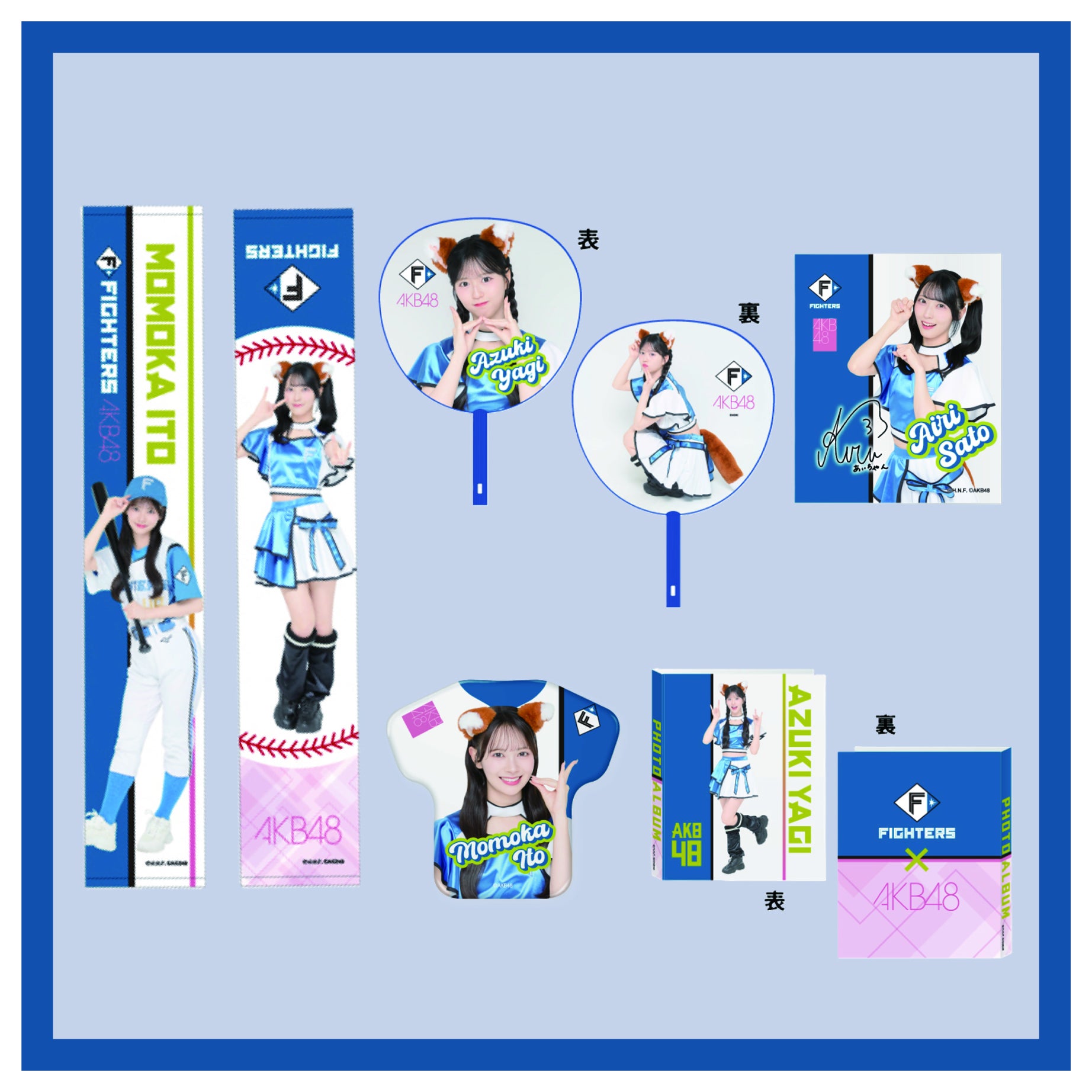
The image above shows the collaboration merchandise for “Hokkaido Nippon-Ham Fighters × AKB48,” announced on August 20, 2026. Pre-orders were scheduled to run from August 22 at 10:00 AM to August 31 at 11:59 PM of the same year. For this project, two distinct visual themes were prepared: a “Uniform Ver.” and a “Fighters Girl Ver.” featuring members in light blue outfits.
Looking closely at the graphic, you can see that the newly shot photographs of the same members have been adapted into products of many different shapes and formats—including towels, jumbo uchiwa (handheld cheering fans), acsta (acrylic stands), acrylic shikishi (rigid display boards), pin badges, and a photo album shown with both front and back cover designs. The key point to watch out for here is that not every item pictured in this overview graphic is included inside a “photo print set.” On the official announcement page for this collaboration, a “Random 6-Photo Print Set” (Random Nama-Shashin 6-Mai Set) and a “PhotoEight Random 6-Piece Set” are listed alongside all of these individual merchandise items.
When choosing what to buy as a fan, you first need to sort out which of the following three categories matches what you are actually looking for:
- Do you want to collect the physical photographs themselves? (Photo print sets)
- Do you want to own that photo visual in a form you can use for cheering at venues or displaying in your room? (Towels, jumbo uchiwa fans, acrylic stands, acrylic shikishi boards, pin badges, etc.)
- Do you want to organize and safely store the photographs you have acquired? (Photo albums)
When you spot an outfit or expression you love in a promotional image, rather than immediately deciding, “I want this visual, so I’ll buy the photo prints,” take a moment to check whether that same visual is also being sold as a separate item like a towel, an acrylic shikishi board, or an uchiwa fan. Working backward from your intended purpose keeps you from second-guessing your choices: if you already have a specific use in mind—such as displaying an item on a shelf or carrying it to an event—choose photo merchandise; if you want to collect card-sized photographs to flip through and admire over time, go with photo prints and a photo album.
Why You Should Check the Specs of a “Random 6-Photo Set”: Pack Count Is Not a Completion Guarantee
When purchasing idol photo prints, the easiest place for misunderstandings to happen is the relationship between the “number of prints per set” and “whether your pulls will form a complete or non-repeating lineup.” In the Hokkaido Nippon-Ham Fighters × AKB48 collaboration example above, the product categories announced included a “Random 6-Photo Print Set” and a “PhotoEight Random 6-Piece Set.”
Here, the phrase “6-Photo Set” in the product name simply indicates the quantity unit: six photographs are packed inside a single pack (one set). The official announcement page does not state the probability of pulling any individual member, nor does it offer any guarantee that “all six prints in a pack will feature different members” or that “buying one set or multiple sets will complete the entire lineup.” Furthermore, this six-print pack format is a specific setup for this particular collaboration project, not a universal rule that applies to every photo print product released by the group.
The reason to examine product specifications carefully when considering blind-packed items is to distinguish between “how many prints come in one set” and “which specific photos you will actually receive.” We explain the fundamental mechanics of blind-pack sales in What Are Random Goods (Blind-Pack Merch)?, and cover the concepts of pulling your favorite yourself (jibiki) and completing a full set (comp) in detail in What Are Jibiki and Comp?.
When reading an official product page, verify the following points in order:
- Scope of included visuals: How multiple outfits or visual themes—such as the Uniform Ver. and Fighters Girl Ver.—are divided across different product listings.
- Number of prints included per set: Check the specific pack unit for the campaign, such as whether a pack contains five prints or six prints.
- Any stated rules on duplicates or inclusion guarantees: Unless the official listing explicitly states “no duplicates” or “complete all-types set,” assume from the start that blind packs carry the possibility of pulling duplicate visuals or not pulling a specific visual at all.
- Sales format and ordering window: Confirm whether the item is venue-exclusive, a made-to-order or online pre-order item with a fixed reservation window, or if post-event online sales are planned.
The number of packs you buy or the amount of money you spend is never a measure of how much you love your oshi. Reading the officially stated conditions accurately and enjoying the hobby within a budget you feel comfortable with is the foundation for sustaining your fan activities over the long run.
- 011. Compare promo graphics with the product listCheck whether the same photo is used on towels, uchiwa fans, shikishi boards, photo prints, or albums.
- 022. Separate your goal from the sales formatDecide whether to buy separate merch where you can choose the member design or try blind-packed photo print sets.
- 033. Check pack conditions and ordering windowsDo not confuse pack count with a completion guarantee, and order within the reservation window and your budget cap.
- 044. Protect and sort prints after openingSeparate the prints you are keeping in a storage album from those you plan to set aside for fan trading.
Source: The Oshi Lab's summary of the article
Making Decisions by Scenario: Practical Preparation and Selection Tips for Fans
Once you have confirmed the product specifications, the next step is to choose how to act based on how you want to enjoy the visuals and where you plan to use them. Let’s organize the practical steps fans can take by dividing them into two stages: before purchasing and after purchasing.
Before Purchasing: Choosing Product Categories Based on How You Want to Enjoy the Visual
When you fall in love with a new photoshoot visual, there is no need to collect every single product line in the exact same way. Using the specific setting where you want to enjoy that visual as your benchmark makes it clear which items to pick.
- When you want to hold it up at an in-person event, game, or cheering venue: Rather than a small photo print, a towel or jumbo uchiwa fan printed with a large photo is a much better fit for practical use at a venue.
- When you want to stand it on your desk or shelf at home to enjoy every day: Choosing items that stand on their own or lean easily against a wall—such as an acrylic stand or an acrylic shikishi board—lets you enjoy the visual daily without the hassle of taking prints in and out of storage cases.
- When you want to closely compare different outfits and camera cuts in your hands: Choose the photo print sets, and prepare either the official photo album released alongside the campaign or storage supplies you already own.
If you decide to buy random photo prints, set a clear upper limit on “how many sets I will buy” before heading to checkout. Compare the full product list, and if there are items where you can select and buy your favorite member’s design directly, factor those into your overall budget plan as well.
After Purchasing: Separating Prints for Storage and Fan Trading
Once your random photo prints arrive, prepare a clean workspace before opening them. To prevent fingerprints from getting on the glossy surface or corners from getting bent, clear off your desk ahead of time so you can slide each print straight into a protective plastic sleeve the moment you open the pack.
Immediately sort the opened prints into two groups: “prints to keep for yourself (for personal storage)” and “prints that may be offered for exchange (for trading).”
Place the prints you are keeping into the official photo album released alongside the project or into a binder that matches the print dimensions. Official campaign photo albums often feature collaboration-exclusive designs on their front and back covers; gathering all your prints from that project into a single album lets you tell at a glance which event and which outfit the collection records whenever you look back through it later.
On the other hand, if you plan to trade prints with fellow fans, standardize how you write out your trade details to prevent any misunderstandings with your trading partner:
- Clearly state the prints you are offering and the prints you are seeking: Write out the exact project name, visual theme (for example, whether it is the Uniform Ver. or the Fighters Girl Ver.), member name, and pose/cut.
- Confirm the handoff method and protective packaging: Agree in advance on whether you will trade in person at a venue or by mail. When carrying prints to a venue or mailing them, use a hard plastic case (koshitsu case) or similar rigid protection to prevent bending, and keep the number of times a print is taken in and out of its sleeve to an absolute minimum.
What Organizers and Planners Should Include in Product Listings
The appeal of photo-based merchandise lies in letting fans enjoy the same visual across many different settings. In the AKB48 collaboration example, products for collecting prints were lined up alongside uchiwa fans for venue cheering, acrylic stands for room display, and an album for safekeeping. When project planners design product announcements so that buyers can easily picture how each item is used after purchase, it gives fans much clearer signposts for choosing what suits them best.
What Fans (Buyers) Want to Verify
- Which items in the overview image are photo prints, and which are separate merch or storage supplies
- The number of prints per set, and whether duplicates can occur or completion is guaranteed
- How multiple outfits and visual versions are distributed across different products
- Whether there are options to buy a favorite member's design directly alongside blind packs
Information and Lineup Design for Planners
- Label and separate the categories and roles of photo prints, photo merch, and photo albums clearly
- State inclusion rules for "Random N-Piece Sets" and clarify that full-set completion is not guaranteed
- Organize how visual theme names (such as outfit versions) map to each eligible product
- Offer select-your-design merch and storage supplies alongside blind-pack products
Source: The Oshi Lab's summary of the article
In overview graphics, place each product name right next to its sales unit. In the body text of the announcement, write out all the conditions buyers need to make an informed decision—including the number of prints in a “6-photo set,” the eligible members and visual versions, and how duplicates are handled. When fans can verify these conditions before purchasing, buyers no longer have to guess what is inside a product from a promotional image alone.
If a photo album is being sold at the same time, it is also helpful to specify the exact dimensions and number of photos it can hold, as well as whether any bonus photo print is included with the album itself. Providing clear specification details like these bridges the excitement of buying new photo prints with the lasting enjoyment of keeping and revisiting them at home.
Related articles: What Are Nama-Shashin (Idol Photo Prints)? (Glossary) / What Are Trading Cards (Toreca)? / What Are Random Goods (Blind-Pack Merch)? / The History of Acrylic Stands (Acsta)
FAQ
Even when they use the same exclusive photoshoot visuals, how do photo prints differ from other photo merchandise?
Even when items share the same outfit and composition, they serve different roles: 'photo prints' (nama-shashin) are for collecting the photographs themselves; items like towels, jumbo uchiwa fans, acrylic stands, acrylic shikishi boards, and pin badges turn the photo into a usable or displayable product; and 'photo albums' are made to store the prints you collect. When multiple products appear together in a single promotional lineup image, it is important to check each product category to see whether you want the visual print itself, an item suited to a specific use, or storage supplies.
If a product is labeled 'Random 6-Photo Print Set,' does that mean I will get six different members?
The label '6-photo set' only indicates the number of prints included in a single pack; it does not guarantee that all six prints will feature different members or that buying one set will complete the full lineup. Unless the official listing explicitly states individual pull rates or guarantees no duplicates, you should plan your purchases on the assumption that the same member or pose may appear more than once.
How are idol photo prints (nama-shashin) distinguished from trading cards (toreca) and bromides?
How these terms are used varies depending on the storefront and project. Because products meant for collecting photographs themselves may be listed as 'nama-shashin' (raw photo prints), 'bromides,' or 'trading cards' (toreca), the most reliable approach is not to assume specifications from the name alone, but to check each item's official product page for its dimensions, set contents, and sales format.
What should I keep in mind when trading photo prints with other fans?
When looking for a trading partner, clearly state from the outset which member names and visual versions you have on hand, what you are looking for in return, and your preferred handoff method (in-person at the venue or by mail). Placing prints into protective sleeves or cases immediately after opening them to prevent bends and fingerprints—and accurately communicating their condition—helps ensure a smooth exchange.
What should I check when buying collaboration photo prints that have a fixed pre-order window?
Check the exact start and end dates and times for pre-orders, along with the inclusion rules and contents for each product. If there are separate products that let you choose a specific member's visual directly, weigh those alongside the blind packs to pick what best fits your goals, while keeping your budget and storage space in mind.


