
How to Plan Oshikatsu Savings: Working Backward from Target Amounts and Payment Dates
When a tour or anniversary event is announced, you may need money for tickets, transportation, and lodging within a short window of time. Oshikatsu savings (oshikatsu chokin, setting money aside specifically for fan activities supporting your oshi, or favorite idol, character, or creator) is a way to separate funds in advance for those plans. There is no need to turn it into a competition where whoever saves the most is considered the better fan.

What matters is thinking through the dates when you will need the money and your target amount, while keeping those funds separate from everyday living expenses and payments you are already committed to making. Here, we walk through how to prepare using a hypothetical calculation example and tracking apps whose features can be verified on official app stores.
Separating Money Saved for Oshikatsu from Everyday Emergency Funds
Money set aside for tickets and concert travel should be treated separately from savings meant for unexpected medical visits or everyday living contingencies. Even if you have a lump sum in your bank account, that does not mean all of it is available for fan activities. Start by checking the payments you already have to make, such as rent, tuition, and upcoming credit card withdrawals.
Educational materials from J-FLEC (Japan Financial Literacy and Education Corporation) explain that savings serve the role of preparing for future life events and unexpected expenses, and introduce the approach of setting aside savings from your income first and treating the remainder as money available to spend. Even if you use this pay-yourself-first approach, it is important not to treat your entire savings balance as money that can be shifted into oshikatsu.
J-FLEC: “Savings Are an Essential Item for Preparing for the Future” (PDF) (in Japanese)
You can separate funds by purpose using whatever method is easiest for you to check—whether that is physical envelopes, a personal notebook or log, or sub-account management features inside a bank account. If you actually open separate bank accounts or set up automatic transfers, check the official guidance from that financial institution regarding fees, eligibility conditions, and how to withdraw funds or stop transfers.
If Your Target Is 30,000 Yen and You Already Have 10,000 Yen, You Need an Additional 20,000 Yen
Suppose you want to have 30,000 yen ready for an event five months from now, and you have already set aside 10,000 yen specifically for that purpose. Because you need an additional 20,000 yen, preparing evenly over five months comes to 4,000 yen per month. This is a hypothetical calculation example for explanation purposes; it does not represent an average spending amount or a recommended budget for oshikatsu.
| What to Check | Hypothetical Example |
|---|---|
| Total amount you want to prepare | 30,000 yen |
| Amount already set aside for that purpose | 10,000 yen |
| Additional amount needed from here on | 20,000 yen |
| Time period available to prepare | 5 months |
| Monthly amount if divided evenly | 4,000 yen |
The preparation period you count here does not necessarily run all the way up to the day of the show. If ticket payments are due earlier, or if a hotel reservation settles on a different date, break down the timeline by each date on which money actually leaves your hands. Also check whether your 30,000-yen target needs to cover shipping fees, ticketing fees, local transportation at the venue, and a small buffer for unexpected costs.
- 01Estimate the purpose and total amountInclude tickets, transportation, lodging, and handling or shipping fees in your estimate
- 02Subtract what is already set asideDo not double-count living expenses or money meant for other plans toward this target
- 03Check the actual payment datesLook at earlier deadlines too, such as ticket payment after winning a lottery or hotel settlement
- 04See if you can prepare it comfortablyIf the amount falls short, reconsider the schedule, purchase amounts, or preparation period
A step-by-step process for building a plan. This does not guarantee event announcements, lottery wins, or prices.
If setting aside 4,000 yen a month feels difficult, before forcing adjustments onto your other necessary bills, consider adjusting the plan itself—such as looking for a show date that does not require an overnight stay, buying fewer merchandise items, or choosing another way to participate. Changing your target amount is also a normal part of reviewing a plan.
Tailoring Your Saving Habits to Your Own Income and Schedule
One approach is to set aside money for your next fan event at the same time you set aside money for essential bills on payday. Having a fixed monthly amount makes tracking easier for some people, but avoid making it a priority to stick to the exact same amount in months when your work hours or household expenses change.
Another method is using envelopes or piggy banks in your oshi’s image color so you can tell the purpose of the money at a glance. If you use a habit like transferring money from a purchase you decided to skip, record only the amount you actually kept untouched. Even if you feel like you skipped buying something, be careful not to add that amount to your savings log if the money actually went toward another bill instead.
Saving a fixed small amount every time a new song drops or a livestream airs can be a fun option as long as it stays within a comfortable range. However, during months with a high number of announcements, the burden can quickly snowball. Consider setting a monthly cap, only logging the event without adding money that time, or taking months off so that the act of saving does not turn into a new obligation.
For bonuses or unexpected extra income, wait until you confirm the actual payout amount and your necessary expenses before dividing the money, rather than committing the full expected sum to your fan plans before you receive it. Nor do you need to operate on the assumption that money set aside for contingencies must be completely spent every single time.
Choosing a Tracking App Based on What You Want to Record
The features you need in an app depend on whether you simply want to track monetary amounts or want to save photos and event schedules alongside them. Below are two examples based on official app store listings verified in November 2026. These are not hands-on comparative reviews based on operating the apps.
#OSHI Oshikatsu Chokin (#OSHI 推し活貯金) lists features for logging savings and expenses alongside photos, a calendar, and monthly look-backs. It is an option to consider if you want to keep memories of your fan activities together with your financial records. App Store (in Japanese) / Google Play (in Japanese)
Hajime App Lab’s Dedicated “Oshikatsu Chokin” App (Hajime App Labの「推し活貯金」専用アプリ) lists features for logging spending and savings, setting a monthly budget, and tracking target amounts with deadlines. It is an option to consider if you want to check your remaining monthly budget separately from your progress toward a savings goal. App Store (in Japanese) / Google Play (in Japanese)
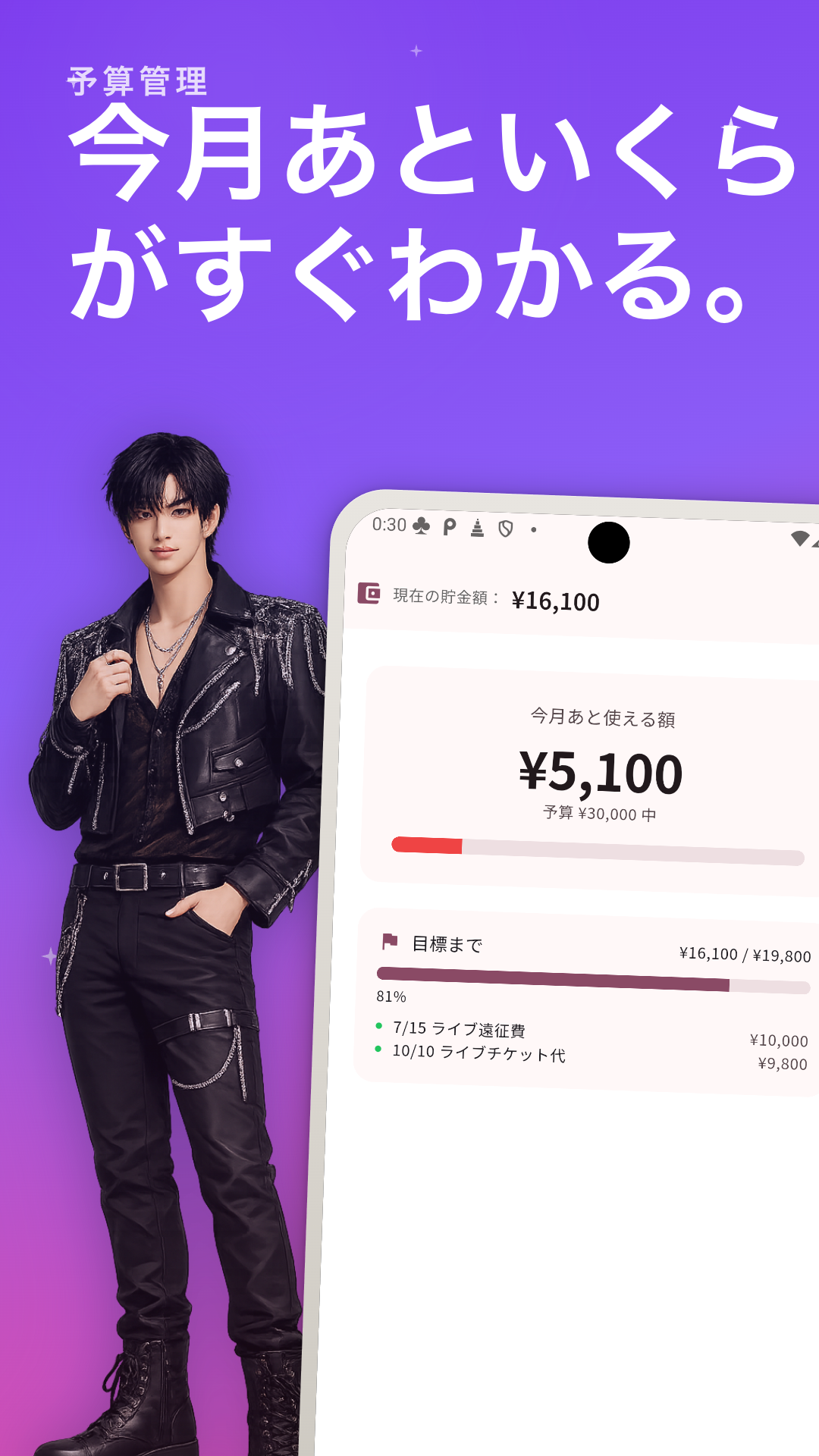
In the promotional screenshot, the displays for “Current Savings Amount,” “Remaining Budget Available This Month,” and “Remaining Until Goal” are separated. Do not assume that money is sitting in your bank account just by looking at the numbers entered into a tracking log; always check them against your actual account balances and upcoming payments. Simply recording a target amount in an app does not mean a bank deposit has actually been built up.
Please verify the latest details regarding features, advertisements, in-app purchases, and supported devices on the app store you use. Because these examples are based on store listings in Japan, the exact same content may not be available in every country or region. And if keeping records on paper works well for you, there is no need to switch to an app.
Coordinating with Expense Logs so You Don’t Count the Same Money Twice
Moving money into a dedicated savings spot and actually purchasing a ticket or item are two distinct actions. If you transfer 4,000 yen from your everyday checking account into a savings account, and later use that exact money to make a purchase, adding both the transfer and the purchase to your “oshikatsu spending” total means counting the same 4,000 yen twice.
Check how transfers between accounts, savings logs, and shopping expenses are totaled in your household ledger or tracking app. When paying by credit card, keep a separate note of what you purchased and when the withdrawal is scheduled to hit your account. Our guide to Keeping an Oshikatsu Budget Ledger introduces concrete examples of how to organize pre-orders and credit card payments.
Money That Already Has a Purpose
- Amounts needed for living expenses, tuition, and near-term bills
- Pre-ordered merchandise and scheduled credit card withdrawals
- Funds set aside for another trip or unexpected everyday expenses
When Planning for Your Next Event
- Count only the amount specifically set aside for that target
- Check when and how much additional money needs to be prepared
- Avoid double-counting account transfers and actual shopping expenses
An example for organizing funds by purpose. Avoid deciding your spendable budget based solely on the raw number shown in a bank account or tracking app.
When Changing Your Goal, Review Starting from the Very Next Payment
Perhaps a scheduled concert was canceled, the date you want to attend changed, or a new expense came up in your daily life. When that happens, you do not have to keep saving just to protect an old target number. Separate what has already been paid, what still needs to be paid, and what can still be changed.
Check the terms set by the event organizer or seller to see whether refunds or booking cancellations are possible. Be careful not to add expected money—such as thinking “I can cover this if my old merch sells” or “I should be getting a refund soon”—into your spendable balance before the money actually arrives in your account.
You can also reconsider how to use the money you have saved, such as rolling it over to a future event or moving it into your everyday emergency fund. Your monthly contribution amount can likewise be adjusted gradually to match your schedule. If making a payment becomes difficult, do not try to maintain your target by relying on new borrowing or buy-now-pay-later services; if needed, reach out to a local household finance or consumer affairs consultation service for support.
Lab Note: Communicating Prices and Payment Timing Alongside Time to Prepare
When companies and event organizers share prices, application windows, and payment settlement dates early, fans can weigh them alongside their other plans and essential living costs. For made-to-order or pre-order merchandise that charges at the time of shipping, clearly stating the expected billing schedule and how buyers will be notified of any schedule changes is equally helpful.
It is also important for businesses not to assume that just because fans practice oshikatsu savings, they have money available to buy additional products right away. That money may be carefully reserved for an upcoming concert tour or another specific milestone. Building sales plans around communications that give fans room to choose their plans—and even pass on a purchase when needed—supports a healthier long-term relationship.
FAQ
How much should I aim to save each month for oshikatsu?
There is no single right amount for everyone. Subtract the amount you have already set aside for that specific purpose from the total you need, and look at the time remaining until payment is due. Check whether you can prepare that amount after covering living expenses and existing payment obligations, and revise your plans or target amount if it feels difficult.
Is it okay as long as I save up the money by the day of the show?
Some payments—such as paying for tickets after winning a lottery or settling hotel bookings—may be due well before the day of the performance. Check when and how much money you need to have ready for each actual payment date.
If I enter a savings amount into an app, does that mean the actual money is saved?
Simply logging a number in an app does not mean money has been deposited or set aside in a bank account. Check your logged amounts alongside your actual account balances and upcoming payments. If you use bank transfers or automatic savings features, verify the specific terms and procedures with your financial institution.
Is it okay to change my goal or reduce my monthly savings?
Yes, you can review and adjust your plan whenever your income, living expenses, or the events you want to attend change. Separate what has already been paid, what still needs to be paid, and what can still be changed, and avoid maintaining a savings target based on borrowing money or counting proceeds from item sales that have not yet been paid out.


