
Oshikatsu at 100-Yen Shops: Choosing Display Bases, Cases, and DIY Storage from Official Guides
Japanese 100-yen shops offer a wide variety of products for oshikatsu (fan activities supporting your favorite idol, character, or creator), ranging from small accessories for displaying merchandise and cases for carrying items around to DIY craft recipes for building your own storage. While their affordable prices make them easy to try out, figuring out whether an item will actually fit what you want to use it with requires looking closely at shapes, dimensions, and package contents before you choose.

Using public product guides from Daiso, Can Do, and Seria, we will look at what you can tell from official product photos alongside what you should verify in specification tables. As we read through these examples, we will also distinguish between standard 110-yen (tax included) items, products in other price tiers, and craft proposals that require gathering multiple materials.
What Daiso’s Official Photos Show About Slot-In Display Accessories
Our first example is the “Oshikatsu Acrylic Stand Deco (Slide Type)” (Oshikatsu Akusuta Deko [Suraido-shiki]), officially introduced by Daiso on March 9, 2025 (Daiso’s official product introduction page (in Japanese)).
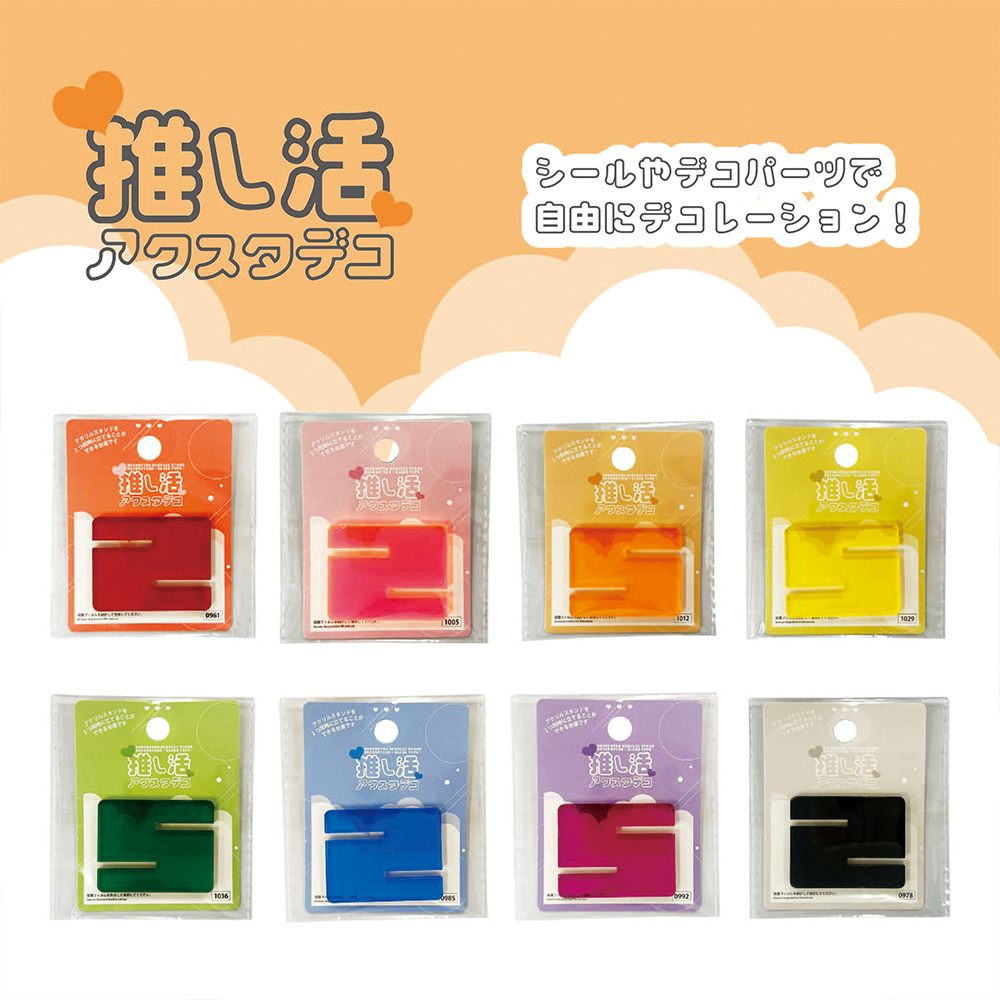
Looking at the official photo above, we can see flat, plate-shaped items in eight colors lined up inside their packaging, with two cutouts (insertion slots) visible on the surface of each board. The first point to keep in mind here is that this product is neither a character acrylic stand (akusuta) itself nor a pre-decorated finished piece complete with stickers and decorative parts; rather, it is a base accessory designed for slotting in and displaying your own acrylic stands and similar items. While the official guide introduces ways to enjoy decorating this plate with stickers and deco parts, shoppers should carefully distinguish between what is actually included with the product and what is shown as an example of how to use it.
Furthermore, although the eight colors are neatly lined up in the photo, the official page explicitly includes a disclaimer stating that “product assortment and stock vary by store.” The price of 100 yen before tax (110 yen including tax) each and the eight-color lineup reflect the official announcement at the time of introduction. Visiting a nearby store does not guarantee that all eight colors will be sitting on the shelf, so fans looking for a specific member color or image color for their favorite (oshi) need to keep store-by-store stock differences in mind from the start.
Why Checking the Insertion Slot Measurements Matters More Than Outer Dimensions
Even if you know the outer dimensions of a base, there is no guarantee that your acrylic stand will actually slot into it. You need to compare the insertion tab at the bottom of your acrylic stand against the measurements of the slots in the base.
Checking the specifications for the black version of this item (JAN code: 4531762930978) published on the Daiso Net Store (Daiso Net Store size and specifications page (in Japanese)) shows that the main unit is made of acrylic resin, the package contains 1 piece, and the outer product size is listed as 5 × 4 × 0.3 cm. Even more importantly, the size of the two insertion slots is explicitly stated as “approximately 3 mm vertical × 25 mm horizontal each.”
Just as the official page cautions that “some acrylic stands may not fit depending on their size and shape,” if the insertion tab (prong) at the bottom of your acrylic stand is wider than 25 mm, or if the thickness of the acrylic sheet does not match the 3 mm groove, you will not be able to push it in. Conversely, if the insertion tab is extremely small or thin, it can affect how the item fits once placed in the slot.
For that reason, when fans select this product in a store or online, it is essential not only to look at the overall height of their acrylic stand, but also to use a ruler to measure the horizontal width and thickness of the bottom tab that plugs into the base, comparing those numbers against the slot specification of approximately 3 mm × 25 mm. How you plan to use the two slots should also be considered alongside the shapes of the items you want to insert.
Looking at the Zipper and Clear Front on Can Do’s Photos
Can★Do’s official Oshikatsu Support Items special feature (in Japanese) introduces products organized by the situations in which fans use them.
On this special feature page, items are sorted and presented by use case: “Concert,” “Collection,” “Display,” “Sleeves & Hard Card Cases,” and “Photography.” Depending on whether your current concern is “I want to store trading cards without scratching them (Sleeves & Hard Card Cases),” “I want to set them up in my room (Display),” or “I want to take them outside for photos (Photography / Concert),” both the shape of the tool you should choose and the specifications you need to verify will change.
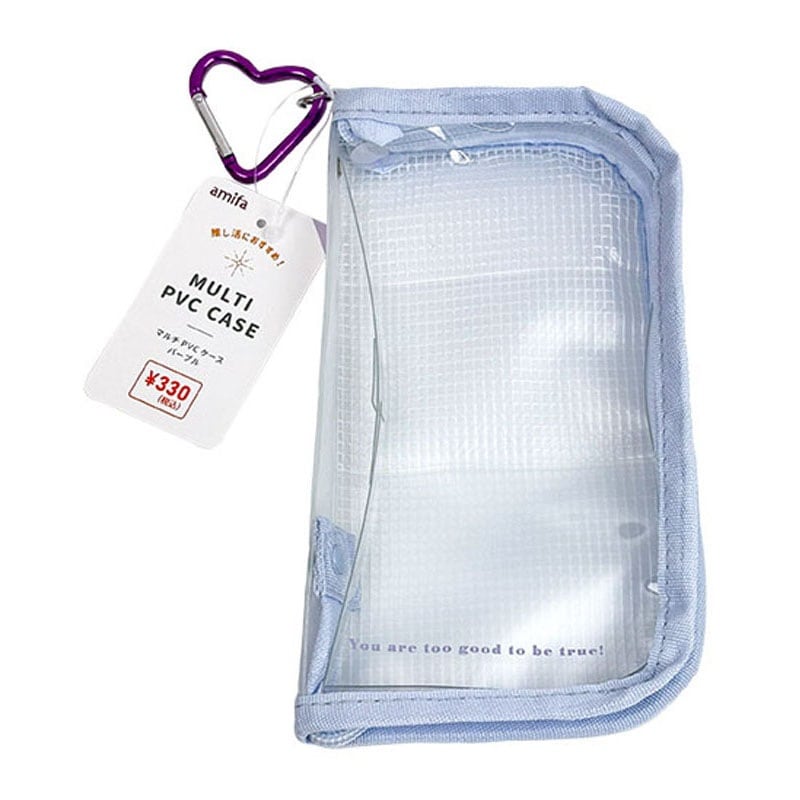
The image above shows the “Multi PVC Case Purple” listed in that same special feature. Observing the photo closely reveals purple-toned trim, a transparent front panel that lets you see the contents inside, a zipper for opening and closing, a heart-shaped carabiner attached to the top, and a tag reading “330 yen including tax.”
Looking at the price first, we can see clearly that even within a 100-yen shop’s special feature, this item costs 330 yen including tax, demonstrating that prices and uses vary from item to item. Rather than assuming that everything costs 110 yen just because it is at a 100-yen shop, checking the price display on the tag or product page one item at a time is a basic necessity.
Display Boards and Carrying Cases Require Checking Completely Different Points
With a display board like Daiso’s “Oshikatsu Acrylic Stand Deco” discussed earlier, the single most important check was the size of the insertion slots in the plate (approximately 3 mm × 25 mm). By contrast, when choosing a zippered storage and carrying pouch like this “Multi PVC Case,” the points you need to verify are completely different.
First, instead of looking only at the overall outer dimensions of the case, you need to examine the “inner dimensions,” the “width of the zipper opening,” and “how those interact with the thickness of your merchandise.” Because of the outer binding, seam allowances, and the curve of the zipper, an item whose size matches the full outer dimensions of the pouch will not necessarily fit inside as-is. In particular, when putting in a three-dimensional plush mascot or stacking multiple tin badges and acrylic stands together, not just the height and width but the “thickness (gusset depth)” can get in the way and prevent the zipper from closing. Measuring the height, width, and thickness of your merchandise stacked in the actual combination you plan to carry—and thinking through whether that stack can pass smoothly through the opening when putting it in and taking it out—is a practical way to prepare.
From the photo, we can confirm the transparent front panel, the zipper, and the carabiner for attaching the pouch to a bag. On the other hand, qualities like water resistance, impact protection, and how much weight the carabiner can safely support cannot be judged by appearance alone. Any performance requirements needed for the setting where you plan to use the case should be verified through the product specifications and handling instructions.
Seria’s “Oshikatsu Chest” Is a Proposal for Combining Materials
Seria publishes an official craft recipe for the “Handmade with Seria Oshikatsu Chest” (in Japanese). It is a DIY project proposal that uses multiple wooden boards, hardware parts, and tools to assemble a storage unit with drawers.
The preparation required here is quite different from simply buying a single pre-made storage case. You need to read through the materials list, separate the supplies you already own from the ones you need to buy, and calculate both the required quantities and the total cost. Rather than deciding on your budget based solely on the photo of the finished shelf, you should compare options by factoring in all the necessary materials and tools.
If you decide to build it, read the official step-by-step instructions all the way to the end first and prepare a workspace where you can safely perform the specified tasks and use the required tools. Because adhesives and glues also have specific usage conditions, be sure to check the instructions on the individual products you use alongside the recipe. Whether to build storage yourself or pick out a finished product is a choice you can make based on the time you have available and the space where you plan to keep it.
Daiso's Acrylic Stand Deco
- Introduced as a slot-in display accessory
- Compare not just the main board size, but also the insertion slot dimensions
Can★Do's Carrying Case
- Listed in a use-case feature alongside items from different price tiers
- Check the inner dimensions, zipper opening, and thickness of the items going inside
Seria's Chest Recipe
- A DIY craft proposal that combines multiple separate materials
- Factor in the full materials list, required tools, and assembly time
Source: Organized by The Oshi Lab from the official guide examples in this article
This comparison is not a classification of every product carried by each company. Rather, it organizes the key points to check when choosing items across three distinct types of examples: a display base, a carrying case, and a DIY craft recipe.
Decide on Your Purpose and Measure Your Merchandise Before Buying
While browsing store aisles to look at colors and patterns is part of the fun, if you are shopping for storage or display items, checking the quantity and dimensions of the merchandise you want to put inside ahead of time makes comparing options much easier. Whether you are storing flat cards alone, acrylic stands together with their bases, or plushies dressed in outfits completely changes which measurements you need to verify.
If you want to place multiple items into a single case, think not only about whether each piece fits on its own, but also about the combined thickness when they are stacked and the order in which you will put them in and take them out. Taking a photo of your merchandise next to a ruler on your phone is another handy way to keep a record of their dimensions while you shop.
Just because you spot several items in the same member color does not mean you need to buy multiple storage pieces upfront. Testing a single piece with your merchandise first before deciding how many more to get, or continuing to use cases you already own, are both great ways to choose thoughtfully without accumulating clutter.
- 01Decide on your purposeConsider whether you want to display, carry, store, or build something
- 02Measure your merchandiseRecord the outer dimensions, thickness, and any insertion tabs of your items
- 03Read the product conditionsCheck the dimensions of the working parts, package quantity, price, and stock notes
- 04Test the fit before buying moreConfirm how the item works with your merchandise first, then choose the quantity you need
Source: Checkpoints from this article organized by The Oshi Lab
The Oshi Lab Note: Communicating the Dimensions of the Parts Fans Actually Use
For companies planning and producing miscellaneous goods, there are clear ways to show not just overall outer dimensions, but also the specific measurements buyers need to compare against their own collections—such as insertion slots, usable inner dimensions, and opening widths. Even when listing numerical measurements, showing which exact part of the item was measured using a diagram or annotated photo helps buyers immediately understand where to measure their own items for comparison.
On store shelves and online product pages, information like price, package quantity, items used in example photos, and store-by-store availability differences should be placed right near the product photos where shoppers can easily read them. When presenting a DIY craft proposal, using a clear heading that prevents confusion with finished retail products and providing a direct link to the materials list and assembly instructions makes the experience much smoother.
When reviewing customer inquiries or reasons for returns, going beyond a simple summary of “it didn’t fit” to find out which specific part’s dimension was hard to understand provides valuable insight. Alongside expanding color and title lineups, organizing clearer explanations that help fans choose from existing products is an essential part of planning oshikatsu lifestyle goods.
For consultations on merchandise planning and retail display design, contact KAZAORI Co., Ltd. (in Japanese). Related articles: Oshi Goods Storage Ideas / Decorating for Your Oshi’s Birthday / What Is Fan Marketing?
FAQ
Can all oshikatsu goods at 100-yen shops be bought for 110 yen including tax?
Not everything costs 110 yen including tax. While some items are listed at 110 yen including tax each, such as Daiso's 'Oshikatsu Acrylic Stand Deco (Slide Type),' others are priced at 330 yen including tax, such as the 'Multi PVC Case Purple' featured in Can Do's official special page. There are also DIY craft proposals like Seria's 'Oshikatsu Chest,' which combine multiple pieces of wood and parts that you assemble yourself, so prices and how you gather what you need vary depending on the item or project.
What dimensions should I check before buying Daiso's 'Oshikatsu Acrylic Stand Deco (Slide Type)'?
You need to check not only the outer dimensions of the main unit (5 × 4 × 0.3 cm), but also compare the size of its two insertion slots (each approximately 3 × 25 mm) against the insertion tab of your own acrylic stand. Because some acrylic stands will not fit depending on their size and shape, measuring the thickness and width of your item's tab beforehand makes it much easier to judge whether it will work.
If I visit a store, will all eight color variations shown in the official page photo be in stock?
Even when eight colors are listed on an official product introduction page, the guide explicitly notes that product assortments and stock levels vary by store location. An official listing at a given point in time shows the available product variations, and it does not guarantee that all colors can always be purchased at every store.
How should I choose a carrying case like Can Do's 'Multi PVC Case'?
The points to check are different from those for a display base. Rather than looking only at the overall outer dimensions of the case, you need to check whether the inner dimensions and the zipper opening match the thickness and width of the merchandise you want to put inside. Also, even if a photo shows a carabiner or a clear front window, water resistance or impact protection that is not stated in the official guide is not guaranteed, so you should handle the case according to your intended use.
What kind of information should companies communicate when planning and presenting low-priced oshikatsu-related merchandise?
It is essential to clearly state preconditions that are hard to tell from product photos alone—such as the inner dimensions of insertion slots, the package quantity, compatible sizes, price tier differences (whether an item is 110 yen or another price like 330 yen), and whether the listing is for a finished product or a DIY craft recipe. Alongside this, noting that stock and availability vary by store helps reduce mismatches in expectations before and after purchase.


