
What Is Oshikatsu Marketing? Designing Fan Campaigns and Rewards Through Real-World Examples

Oshikatsu marketing refers to the practice of designing promotions and experiences where a company’s products or services directly assist fans as they cheer on their favorite idols or characters, collect beloved goods, and celebrate milestones. Successful initiatives go beyond simply licensing popular characters—they establish transparent rules and conditions that allow participants to choose how they engage, matching their personal budgets and schedules.
By examining two real-world examples—the Yoshinoya app point campaign featuring hololive VTuber Shirogane Noel, and the Attack on Titan collaboration at GiGO entertainment centers—we can analyze the essential mechanics of transaction thresholds, reward fulfillment methods, and campaign timeline communication. This guide is written for corporate brand managers and retail planners preparing to design fan-focused initiatives.
Connecting Fan Behaviors with Real-World Product Use Cases
Fans participate in a wide variety of activities, from coordinating everyday personal accessories around their oshi-color (favorite member’s image color) and organizing seitansai (birthday celebrations) to engaging in fukyo (advocacy to spread awareness) to introduce their favorites to others. When planning a corporate campaign, the first step is pinpointing exactly which of these moments your product or service can naturally enhance.
For instance, a café can set up dedicated seating areas designed with clean backdrops and props to make it easy for patrons to photograph their character goods, or offer special celebratory dessert services for birthdays and debut anniversaries. A lifestyle or stationery retailer can rearrange displays so shoppers can easily discover items color-coded by idol image colors. These concepts can be developed independently of formal intellectual property (IP) tie-ins, drawing entirely on the inherent functions and environments your business already provides.
Macro market size estimates provide helpful context, but they should never be treated as an automatic benchmark for your campaign’s target spend per customer. CDG and Oshicoco’s 3rd survey (in Japanese), conducted between January 15 and 22, 2026, surveyed 23,125 male and female respondents aged 15 to 69 residing in Japan, weighting responses to reflect national demographic distributions. Among respondents actively participating in oshikatsu, the average annual expenditure was 209,716 yen, while the median stood at 40,000 yen. Across the entire 2025 calendar year (January to December), the overall market scale was estimated at roughly 4.1 trillion yen.
Crucially, these figures represent an aggregate total across numerous distinct fan activities over an entire year. Looking at a high overall average does not mean every customer has the capacity or desire to spend that same amount on your brand’s specific offering. Pricing tiers and participation requirements must be determined by assessing the specific occasion where your product fits into a fan’s routine and the realistic disposable budget of your target audience. We explore the underlying assumptions and methodology behind these statistics in our analysis of the market size of oshikatsu.
Yoshinoya x Shirogane Noel: Specifying Precise Terms for Point Redemptions
As detailed in Yoshinoya’s official campaign announcement (in Japanese), the beef bowl chain ran an app-based loyalty point promotion from 11:00 AM on January 26, 2026, through 8:00 PM on April 30, 2026. The mechanic required diners to scan a dedicated barcode in the smartphone app prior to paying at the register, earning 1 point for every 500 yen (tax included, post-discount) spent in a single transaction, which could later be redeemed for exclusive character rewards.
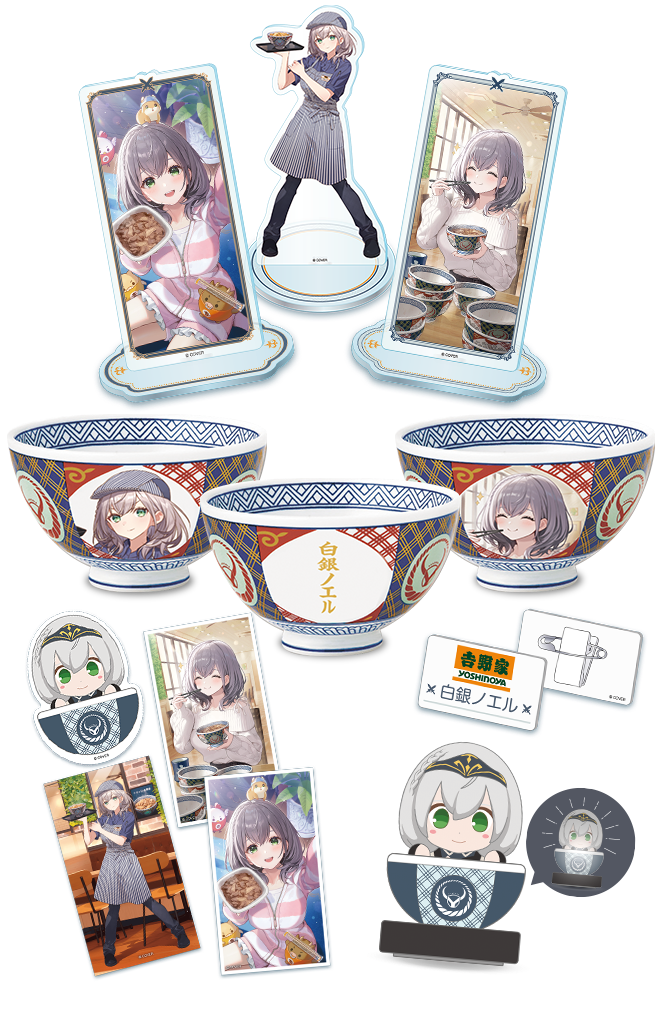
The featured reward merchandise showcased Shirogane Noel in Yoshinoya staff uniforms across acrylic stands, authentic restaurant-style beef bowls (donburi), employee nametags, and novelty bowl-shaped interior lights. This design cleverly paired core elements intrinsic to the restaurant chain—dining tableware and staff attire—with the guest character. Each physical item required a distinct point balance to redeem:
| Points Required | Reward Item | Selection Rules and Specifications |
|---|---|---|
| 3 points | 2-piece sticker set | Select 1 out of 2 designs |
| 10 points | Nametag | Redeem points to exchange |
| 20 points | Acrylic stand | Select 1 out of 3 designs |
| 45 points | Donburi (beef bowl) | Made of melamine resin |
| 90 points | Room light | Redeem points to exchange |
By displaying the eligible designs and required point thresholds side by side, customers could immediately verify the exact conditions needed to secure their preferred item. Furthermore, customers could confirm material specifications—such as the bowl being made of durable melamine resin rather than traditional ceramic—directly from the official text rather than guessing from marketing photos alone.
Separate Rules for Payments, Point Posting, and Merchandise Redemption
In this campaign, combining multiple receipts was not permitted, and delivery orders alongside certain non-participating locations were excluded from point accumulation. Points were credited to the user’s account within four days (including the transaction date), and redeeming a reward deducted the corresponding points directly from the user’s running balance.
To illustrate the arithmetic: paying for two separate 480-yen meals across different visits could not be combined to earn 1 point, as each checkout fell short of the 500-yen threshold. Furthermore, if a customer reached a balance of 20 points and claimed a 20-point acrylic stand, their balance dropped back to zero. This is a point-spending mechanic, fundamentally different from a cumulative milestone system where reaching a 20-point threshold permanently unlocks rewards while preserving points for future tiers.
The fact that points were not credited instantaneously was another crucial piece of information customers needed before arriving at the restaurant. For patrons who assumed they could immediately access the redemption screen right after paying at the counter, establishing the multi-day verification window was essential. For organizers, separating the instructions for in-store checkout actions, point reflection timelines, and post-redemption balance subtractions allows participants to easily navigate each stage of the experience.
The official redemption deadline was set for May 14, 2026, at midnight, with physical items scheduled to ship in late October. In this design, the window for earning points through dining, the deadline for submitting reward claims, and the fulfillment delivery date were structured as three distinct operational phases. These rules also had to be clearly distinguished from a separate in-store giveaway held during the same period, where showing an app screen granted a limited-quantity, randomized novelty item on the spot. In addition, the official FAQ explicitly prohibited transferring or reselling redeemed merchandise to third parties.
Attack on Titan x GiGO: Separating Arcade Prizes, Novelty Cards, and Retail Sales
In GENDA GiGO Entertainment’s September 5, 2025 press release (in Japanese), the arcade operator announced the nationwide “Attack on Titan x GiGO Campaign,” running from September 20 through October 19. Here, multiple campaign elements coexisted within the same physical entertainment centers, but each required a distinct acquisition route:
- Exclusive crane game prizes: Giant diorama acrylic figures (4 designs) and B2-size tapestries (4 designs), obtainable exclusively by playing the machines.
- Participation incentives on eligible machines: Inserting 500 yen directly into designated crane machines granted 1 random novelty photo-style card (out of 4 designs). Designs could not be selected, and supplies were strictly limited.
- Pop-up store retail corners: Hosted at four locations nationwide, featuring character standee photo spots alongside retail merchandise available for direct purchase.
Importantly, inserting 500 yen into a machine did not guarantee winning a crane game prize. The promotional card received for feeding the coin slot was an entirely separate incentive from actually catching and winning an acrylic figure or tapestry from the machine. Furthermore, participation terms for the online mobile crane application were separated from physical in-store arcade play.
The retail pop-up shops, organized by Bushiroad Creative, operated on a separate timeline from September 20 to October 5, concluding two weeks earlier than the wider arcade campaign’s October 19 finish. In addition, prize availability, machine line-ups, and restocking schedules varied from store to store. Customers could not assume that every arcade bearing the campaign banner offered identical merchandise or ran every component until the final calendar date.
Identical 500-Yen Increments, Fundamentally Different Acquisition Paths
Yoshinoya x Shirogane Noel
- 1 point earned for every 500 yen including tax (post-discount) in a single transaction
- Points credited within 4 days including transaction date; multiple receipts cannot be combined
- Accumulated points are spent and deducted to redeem physical merchandise rewards
- The redemption deadline and subsequent shipping schedules are announced separately
Attack on Titan x GiGO
- 1 novelty photo-style card received for every 500 yen inserted into eligible crane machines
- Cards are distributed at random in limited quantities, completely separate from winning arcade prizes
- Pop-up store locations also sell merchandise for direct purchase
- The retail merchandise operation across 4 branches concludes earlier than the overall campaign
Comparing Yoshinoya’s point-redemption model with GiGO’s direct card distribution highlights how identical monetary thresholds (500-yen units) can entail entirely different user experiences, procedures, and deliverables. Campaign planners must look beyond eye-catching prices and product photography to clearly communicate the exact relationship between customer actions and resulting rewards.
Step-by-Step Campaign Planning and Post-Mortem Evaluation Metrics
- 01Determine the use caseIdentify how your products or facilities naturally support photography, anniversaries, dining, or gathering
- 02Establish accounting and reward rulesDefine spending thresholds, receipt combination rules, selection vs random distribution, and exact material specs
- 03Coordinate and announce schedules and store conditionsClearly publish point crediting, redemption, and shipping dates alongside closing dates for sub-events
- 04Record participation rates and operational frictionTrack redemption volumes by tier and log customer inquiries to refine conditions for subsequent campaigns
When building an oshikatsu initiative, organizations can begin by observing how their products and venues are already being used in retail aisles and across social media. Look for tangible, real-world utility: colors that match popular member imagery, physical counter space capable of holding acrylic stands and plushies, or product dimensions convenient for fans to carry to concerts. Where appropriate, gather direct feedback from core users. If you introduce multiple price tiers, ground them in real usage contexts rather than relying on abstract annual market spending statistics.
From an operational standpoint, brand managers must ensure that messaging is perfectly aligned between front-line cashier staff and promotional web pages. Essential policies—such as whether receipts can be combined, which ordering channels qualify, when loyalty points reflect in accounts, and how out-of-stock situations are handled—must be summarized in an easily accessible reference format for customers and floor staff alike.
After a campaign wraps up, evaluate performance beyond top-line revenue. Review application volumes across individual reward tiers, and carefully analyze the inquiries and points of confusion submitted by participants. Even if redemptions for a particular tier lag behind expectations, avoid reflexively blaming the price point alone; evaluate whether inventory limits, lack of promotional clarity, or cumbersome redemption procedures created unnecessary barriers. Spontaneous fan reactions on social media and frontline feedback from retail staff provide the most valuable qualitative insights for refining the rules of your next promotion.
Related articles: What Is Oshikatsu? The Complete Guide / The Market Size of Oshikatsu / How to Plan Oshikatsu Events / Common Pitfalls and Failures in Oshikatsu Marketing
FAQ
What is the difference between oshikatsu marketing and a standard promotional campaign?
Oshikatsu marketing centers on designing promotions that genuinely support fans when they are cheering on their favorites, collecting merchandise, or celebrating special anniversaries, by aligning a company's products or services with those emotional moments. Beyond licensing collaborations with specific anime or idol properties, businesses can also approach this by examining their existing strengths—such as organizing retail displays by member colors or providing photo-friendly spaces in their stores.
Can businesses use average market spending estimates as their direct target for average customer spend?
No, you cannot directly adopt annual overall fan expenditure averages as the target basket size or per-customer transaction value for your own products. According to survey research by CDG and Oshicoco, active fans spent an average of 209,716 yen in 2025, but the median was 40,000 yen. Because these figures reflect broad annual totals across many diverse fan activities, companies must evaluate their specific product usage context and their target audience's realistic discretionary budget separately.
What campaign conditions should customers and staff verify before participating in dining or in-store retail collaborations?
Key rules include the required spending threshold per single transaction, whether multiple receipts can be combined, how many days it takes for points to post to an account, which order methods are excluded (such as delivery services), and whether incentive items can be selected or are distributed at random. Leaving these conditions ambiguous leads to confusion and friction at the register.
Can a company launch an oshikatsu initiative without executing a formal character collaboration?
Yes, absolutely. Companies can begin right away by arranging existing merchandise so customers can easily browse items by their favorite idol or character's color, or by preparing tabletop spaces where customers can display and photograph acrylic stands and plushies. Starting from ways to make current storefronts and products more accessible to fan rituals is a highly effective first step.
What performance metrics should organizers track besides top-line sales?
In addition to revenue, it is valuable to monitor the number of redemption applications across different tier thresholds, the volume and nature of customer inquiries regarding excluded orders or receipt combination restrictions, repeat visit frequency throughout the campaign window, and spontaneous user-generated content on social media detailing creative ways fans enjoyed the offering. These data points provide critical lessons for structuring future promotions.


