
Navigating the VTuber Market and Corporate Partnerships: Business Models and Planning Essentials

Corporate collaborations with Virtual YouTubers (VTubers) take many forms, ranging from appearances on live streams and licensed merchandise lines to creative assistance in video production. Looking only at Super Chat totals or channel subscriber counts will not reveal what specific business areas offer viable collaboration opportunities for an enterprise.
Drawing from Cover Corporation’s official business overview and the collaborative project between Studio STELLAR (featuring talent Hoshimachi Suisei) and travel agency JTB, this guide outlines how to interpret industry metrics and structure successful partnerships.
Analyzing VTuber Agencies Beyond Live Streaming: Merchandise and Intellectual Property
According to Cover Corporation’s official business overview (in Japanese), the company’s operations are divided into distinct business domains: VTuber agency management, merchandise sales and IP licensing, corporate tie-ins, media-mix projects spanning manga and anime, and the ongoing development of its proprietary metaverse platform, Holoearth.
It is common for viewers who discover a talent through live streams to later purchase merchandise and attend live events. However, planning a sponsored live broadcast, licensing a character design for commercial goods, and co-developing a bespoke virtual environment or original digital content require fundamentally different scopes of work and involve completely different corporate departments. When planning an initiative, the initial desire to “work with a VTuber” must be translated into concrete details: defining the exact operational sector and determining what the two parties will build together.
Why 95.25 Million Total Subscribers Does Not Mean 95.25 Million Unique Fans
Cover Corporation’s business overview highlights a cumulative YouTube subscriber count of 95.25 million as of June 2026. This metric represents the arithmetic sum of subscribers across every talent’s individual channel. Because an individual viewer frequently subscribes to multiple talents within the same agency, this aggregate number includes substantial duplication. Consequently, it cannot be treated as a measure of unique individual fans or as the prospective customer reach of a campaign.
Furthermore, this metric reflects neither overall revenue nor the total market size of the entire VTuber industry. One cannot deduce broader industry revenue splits—including those of competing agencies or independent creators—from the business materials of a single enterprise. When citing such data in internal business proposals, always attribute the numbers precisely by naming the reporting company, the exact scope of the metric, and the measurement date. Crucially, unless confirmed in official financial documentation, hypothetical assumptions regarding talent revenue shares from fan tipping or internal production costs should never serve as the foundation of a project budget.
Disclosed Metrics
- Total subscriber counts aggregate multiple channels and include significant user overlap
- A single company's performance metrics cannot represent overall industry size or revenue structures
- Budget plans must not rely on speculative guesses about undisclosed talent revenue splits or production costs
Corporate Collaboration Scope
- Clearly distinguish between stream broadcasts, merchandise, licensing, and production assistance
- Define precisely what assets or services your company provides and what you request in return
- Align communication channels, legal contracts, and production schedules with the specific project type
Hoshimachi Suisei and JTB: A Travel Agency Assisting with Music Video Location Scouting
On June 30, 2026, JTB announced (in Japanese) that Studio STELLAR (representing Hoshimachi Suisei) and JTB had officially launched a joint initiative named “PROJECT Stargazer” on the preceding day, June 29.
The inaugural phase of this partnership was the music video for the song “Hoshi wo Miru Shoujo” (The Girl Looking at the Stars), released on the official YouTube channel “Suisei Channel” on that same launch date. JTB supported the video production through location scouting, researching domestic and international destinations that matched the creative vision of the song. In a personal comment included in the official announcement, the talent referenced filming on location in the wilderness of Kazakhstan.
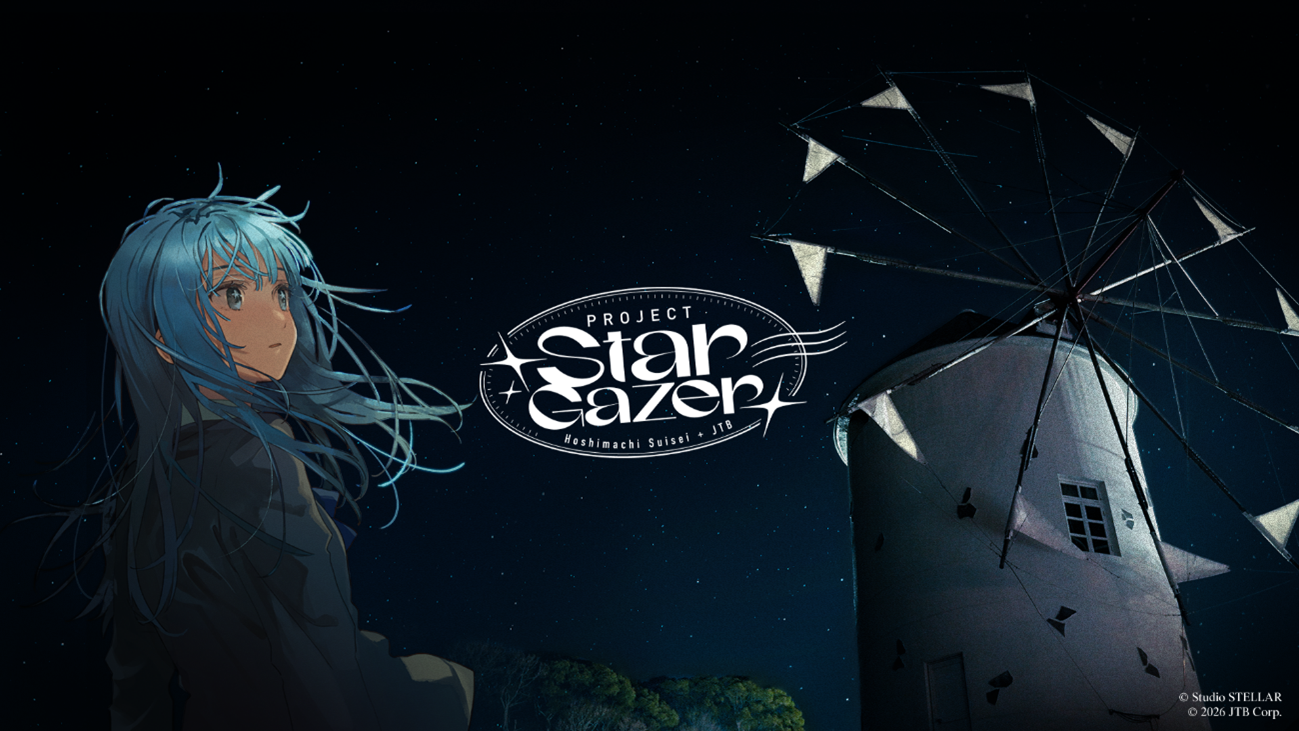
The promotional image positions Hoshimachi Suisei on the left, the “Stargazer” logo in the center, and a structure resembling a communications tower or antenna under a starry sky on the right. Directly below the logo, the credit reads “Hoshimachi Suisei × JTB.” By placing the artist, the project name, the corporate partner, and the backdrop together in a single frame, the visual conveys the cohesive atmosphere of the joint endeavor.
While a partnership with a travel agency often brings commercial vacation packages to mind, this specific announcement focused exclusively on the project’s launch and JTB’s behind-the-scenes support for video production. The release contained no public travel itineraries, pricing, booking options, or visiting guidelines for fans wishing to explore the filming locations. It is impossible to determine the exact geographical location of the tower or verify whether the site is accessible to the general public solely from this promotional visual.
Contributing Corporate Expertise to Creative Production Workflows
Brand partnerships do not have to be limited to printing existing character illustrations onto retail products. As demonstrated by the JTB initiative, an enterprise can also participate by contributing its specialized knowledge—such as location expertise and coordination logistics—directly into the creative production workflow.
When evaluating potential collaborations within your organization, consider starting with the question of where your capabilities fit into the creative process, rather than focusing immediately on what retail merchandise to sell. When proposing specific venues, technical infrastructure, or specialized equipment, closely align the requirements of the creative work with the realistic scope of support your company can provide.
Public announcements must clearly define what is being revealed at each stage. If the announcement centers on production cooperation, the messaging should avoid creating confusion with commercial travel package sales or open site tours. If commercial products or fan events are introduced at a later date, detailed application criteria and eligibility windows should be provided through official updates published at that time.
Critical Early Checkpoints: Points of Contact, Digital Assets, and Creative Guardrails
When planning a VTuber initiative, discussions should not stop at the talent’s name or character likeness; teams must catalog and review every specific asset to be used, including still images, voice recordings, and musical tracks. Below are essential checkpoints for managing individual projects:
Confirm Contracting Entities and Official Billing Credits
The appropriate point of contact and contracting entity differ significantly between indie VTubers and corporate agency VTubers. If external creators such as illustrators or music producers are involved, teams must confirm who is responsible for clearing the necessary intellectual property rights for the project.
Talent affiliations and project billing names should never be copied uncritically from past media articles; they must match the official documentation provided for the specific campaign. In the JTB announcement, the talent is credited under the formal entity “Studio STELLAR (Hoshimachi Suisei).” Even when presenting this alongside other corporate profiles, take care not to imply identical agency affiliations or organizational structures where they do not exist.
Detail Exactly How and Where Creative Assets Will Be Applied
Confirm all asset requirements in advance, including placement locations, display dimensions, allowable edits, voice clip applications, publication timeframes, and copyright credits. Gaining permission to use an existing still image does not automatically grant authorization to alter facial expressions or generate synthetic voice audio under the same terms; the intended application and modification limits must be negotiated separately.
Teams should also share the creative tone and worldview valued by the talent, along with any sensitive themes or expressions they wish to avoid. Rather than submitting all materials for review in a single batch after production is finished, structuring formal supervision checkpoints across key milestones—such as concept planning, draft sketches, and pre-final sign-offs—keeps project progress transparent and organized.
Establish Fan Guidelines and Long-Term Asset Management
If your campaign involves in-store photography displays, social media sharing, or clipped video highlights (kirinuki), discuss and define the behavioral guidelines that will be communicated to fans. Assets authorized for corporate commercial use do not automatically carry permission for fans to freely alter or redistribute them.
For long-term campaigns, establish procedures for handling promotional images and video assets after the public campaign concludes, and secure emergency contact channels in the event of talent hiatuses or management restructuring. Planning these contingencies in advance ensures that the handling of produced inventory and published announcements is never left to improvised, post-campaign decisions.
- 01Determine Your Engagement AreaDefine what to create, such as stream programs, merchandise, licensing, or video production support
- 02Align Contact Points and BillingIdentify the contracting party, verify rights clearance leads, and confirm official credits
- 03Establish Assets and Approval MilestonesAgree on usage scopes for images, voice, and music, while setting clear review checkpoints
- 04Define the Scope of Public AnnouncementsDistinguish production support from product releases, and communicate fan participation rules
While large subscriber counts provide an initial indicator of public visibility, creating a successful partnership requires connecting your company’s intended message directly to the creator’s actual business domains and artistic expression. By systematically verifying data collection scopes, contracting entities, required creative assets, and public messaging boundaries, corporate planners can deliver an initiative that resonates meaningfully with the fan community.
Related Articles: What Are Super Chats? / What Are Indie and Corporate VTubers? / What Is Oshikatsu Marketing? / What Is the Market Size of Oshikatsu?
FAQ
Is live streaming the only business model for VTuber management agencies?
No, live streaming is only one part of their business. For instance, Cover Corporation's official business overview distinguishes several distinct domains: managing its VTuber talent agency, merchandise sales and licensing, corporate tie-ins, media-mix expansions including manga and anime, and developing the metaverse platform Holoearth.
Does total YouTube subscriber count directly represent the total fan base or overall market size?
No, it does not. The cumulative YouTube subscriber count of 95.25 million reported by Cover Corporation as of June 2026 is an aggregate sum across all individual talent channels. Because a single viewer often subscribes to multiple channels, this figure includes significant overlap. It must be evaluated separately from unique fan headcounts, industry-wide market scale, or total revenues.
Did the 'PROJECT Stargazer' announcement by Studio STELLAR (Hoshimachi Suisei) and JTB announce the sale of tour packages?
No. JTB's June 30, 2026 announcement marked the launch of the collaborative project and highlighted its location-scouting assistance for the music video 'Hoshi wo Miru Shoujo' (The Girl Looking at the Stars). As of that announcement, no commercial travel packages, itineraries, pricing, or public access terms for filming sites were introduced, meaning tour sales did not begin at that stage.
What should a company confirm first regarding contracts and creative expression when planning a VTuber collaboration?
Companies should first identify the contracting entity and the appropriate rights clearance contacts, clarify the permitted scope and modification limits for images, voice recordings, and music, identify any themes or depictions the talent prefers to avoid, and establish a clear supervision workflow. Furthermore, teams should clearly distinguish production support announcements from commercial product launches, while coordinating publication windows and community sharing guidelines for fans.


