
What Are Bi-Kakin, Juu-Kakin and Hai-Kakin? Japan's Slang for Game Spending Tiers
Bi-kakin / Juu-kakin / Hai-kakin 微課金・重課金・廃課金 · Spending tiers
Someone says “I’m bi-kakin,” and everyone pictures a different amount. Here’s what bi-kakin, juu-kakin and hai-kakin mean, why it’s hard to draw a clear line between them, and how to think about setting your own limit.
What Bi-Kakin, Juu-Kakin and Hai-Kakin Mean
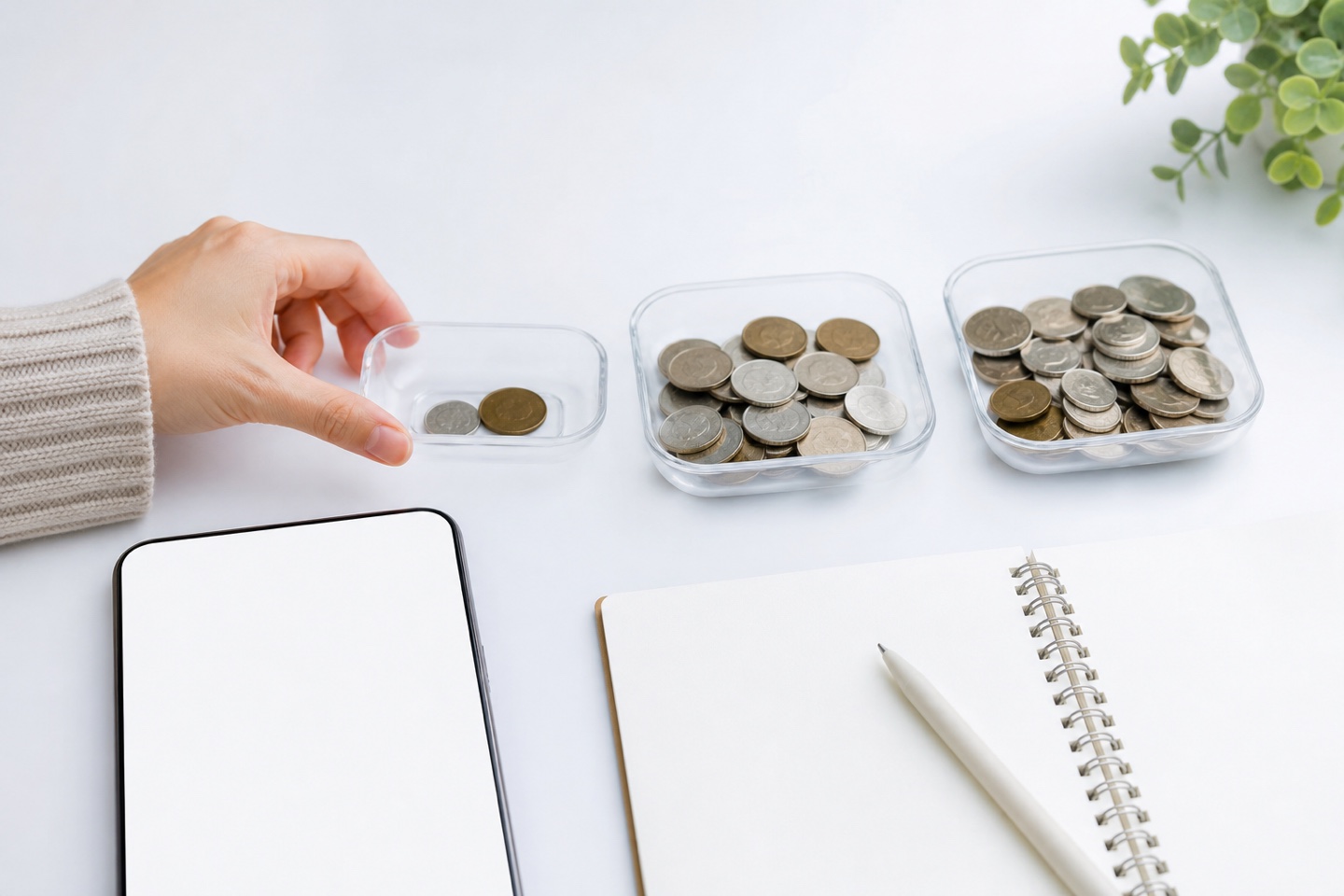
Bi-kakin (微課金) means paying small amounts, juu-kakin large amounts, and hai-kakin an amount big enough to worry people about the effect on your life. They are slang used to report your own spending. People talk about them in contrast with mukakin-zei, players who pay nothing, but the operators don’t define these tiers, and there is no shared amount.
All three can be used as self-labels for conveying briefly how you play. The moment they start to be used as a yardstick for measuring other people, the words turn sharp.
Examples
- “I’m bi-kakin who only buys the monthly pass, so I basically skip the limited gacha.”
- “I hit the limit I set this month, so I’m waiting until the next rerun.”
- “Even when I see a friend’s purchase report, I can’t tell whether it weighs heavily on them.”
- “You’re free to call yourself hai-kakin, but pointing it at someone else ruffles feathers.”
- Social media post: “Totaled last month’s oshi spending. I’m watching whether it stayed within the limit I set, more than the tier.”
How the Word “Kakin” Spread
Kakin originally belonged to the side doing the charging, but with the spread of online games it settled in as a word for users paying by choice. With free-to-play as the premise, “pay or don’t pay” became a description of a play style in itself.
From there, bi-kakin, juu-kakin and hai-kakin came into use to describe how much people pay. In fan activity, the terms have spread beyond gacha, the paid random draws, to self-descriptions of ongoing spending in general: super chats (supacha), membership plans, digital purchases.
The Three Terms, and Why They’re Hard to Use
| Name | What the self-label conveys | What makes it hard to use |
|---|---|---|
| Mukakin (free-to-play) | The choice to play without paying | Not evidence that you don’t support |
| Bi-kakin | Awareness of keeping it small | What counts as “small” differs by person |
| Juu-kakin | Awareness of spending a lot | Easily becomes a comparison that ignores income and living costs |
| Hai-kakin | Self-deprecation about cutting into your life | Can be an insult when aimed at others |
The same ¥10,000 weighs completely differently on different households. Try to draw a line by absolute amount and it’s bound to break down somewhere. “Mukakin” also refers only to a choice not to pay and is not a category that shows your worth as a fan.
Pays nothingWorries others
- MukakinChooses not to pay
- Bi-kakinKeeps it small
- Juu-kakinSpends a lot
- Hai-kakinCuts into daily life
No operator sets these tiers, and no shared amount exists.
Four Steps to Setting a Limit
- Work out what you can spend first. From your take-home pay, subtract housing, food, taxes and social insurance contributions not already deducted, repayments and savings, and set the limit within the entertainment budget that remains
- Add up across services. Games, streams, memberships, purchases for tsumu (stockpiling money for a future banner). Spending doesn’t show up in one place. Add next month’s auto-renewals and fees too
- Stop on both count and amount. Random items are a format where “just one more” easily pushes you past the limit. Calculate beforehand what it costs to reach the pity ceiling (tenjo), and decide a point of retreat for when you won’t reach it
- Check against statements once a month. Cross-checking your card statement with the in-app history turns up recurring charges you’d forgotten
What can be written here stops at a general way of thinking about household management. If repayments or living expenses are being affected, it is the stage to treat it as a household-finance problem, not a question of labels, and this article is no substitute for professional advice.
- 01What you can spendEntertainment budget after essentials
- 02Add it upGames, streams, memberships, tsumu
- 03Stop on count and amountDecide a retreat point for the pity ceiling
- 04Check monthlyCard statement against in-app history
A general way of thinking about household management, not professional advice.
Don’t Make the Label “Proof of Love”
If you start talking about the size of what you pay as the depth of your support, an atmosphere forms in which only people who can pay are right. Support you can give at no cost (musen) and fukyo, spreading the word about your oshi over time, hold up the same place.
Publicizing a large expense can draw in not only praise but fraud and invitations to lend or borrow. It’s safest to hide images that show statements, membership numbers or balances. Minors should check each service’s requirements for parental consent and age restrictions, and use available spending limits and controls.
You’re free to use “hai-kakin” as a joke, but we’d draw the line at asking someone genuinely struggling with payments to reveal amounts, or taking self-mockery at face value and egging them on. The same goes for reports of a bakushi, a blown-up pull with nothing to show: only the person themselves knows whether it’s within the range of laughing about.
Notes From The Oshi Lab: Don’t Overlook Support That Doesn’t Become a Number
The reason spending-tier names are so widely used is that the easily counted yardstick of amount spent is convenient for explaining where you stand. What concerns us is that the same convenience can turn into a tool for comparison. When a self-label starts being used as a scale for measuring other people, a structure forms in which those who can pay more carry more weight, and the conversation in the fandom thins out. There is also a side effect: the more that can be told in numbers, the harder it is to see support that doesn’t become a number.
From the business side, this vocabulary is also evidence that users are conscious of their own spending. Easy-to-use spending limits, purchase histories that are easy to read, the option of guaranteed acquisition, designs that don’t penalize you for taking a break. Such mechanisms may appear to cut short-term sales, but one view is that they work toward preventing churn. A design that assumes only big spenders loses its footing the moment they leave for reasons of daily life. Not who paid how much, but whether every tier can keep going without strain. We propose this as a goal for lasting operations.
Related Terms
FAQ
What is bi-kakin?
It is a self-label for paying only small amounts, for example buying just a monthly pass or guaranteed items. What counts as small differs from person to person.
How much is juu-kakin or hai-kakin?
There is no shared amount. The sense changes with the game and a person's income, so these words are a poor fit for pronouncing on what someone else spends.
How can I manage my spending safely?
Set a monthly limit first, check payment notifications and your usage history, and make it a rule never to use borrowed money or living expenses. This article offers a general way of thinking, not professional advice.
What if I feel I can't stop paying?
At that point it is a household-finance problem, not a question of labels. The priority is to switch off your payment methods for now and turn to family or a public consultation service.


