
What Is a Nama-Shashin? Japan's Official Idol Photo Prints, Sizes and Storage
Nama-shashin 生写真 · Official photo print
You bought a nama-shashin, and now you can’t find a sleeve that fits. What makes it different from a bromide or a trading card? Here is what the word means and where it comes from, how to choose protective gear, and how to open, store and trade them.
What Nama-Shashin Means
In oshi-katsu, a nama-shashin (生写真) is an official photo print of an idol, actor, voice actor or similar performer. They are sold at live venues, theaters and online stores, as singles, sets, random packs and other formats.
The character for “nama” (raw, fresh) makes it easy to imagine a one-of-a-kind print developed on the spot, but these days mass-produced official merchandise is also called nama-shashin. Whether signatures and dates are handwritten or printed varies by product, too. Many are sold as random goods, so you won’t know whether the one you want is inside until you open the pack.
Origins and History
Back when a photograph was a physical print, unlike magazine printing or video, people used a name that stressed the value of a “raw photograph.” The term took hold through singers’ and actors’ bromides, idol shops and theater merchandise, and grew into random sales and trading culture. No strict industry-wide definition says which production methods count as nama-shashin.
The artist photo (a-sha), another kind of photo product handed out for publicity, is not sold, and it is handled and distributed differently.
Examples
- “I opened just one pack on the train home from the merch table, and it was a close-up of my oshi right away.”
- “I finally got every nama-shashin in this outfit, so I lined them up to celebrate.”
- “The nama-shashin I’d been looking for arrived through a trade. I’ll take good care of it.”
- “I pulled a close-up of my oshi myself from today’s release, and I’ve been happy since this morning.”
- Social media example: “Nama-shashin trade. Have: 3 designs in outfit A / Want: solo in outfit B. Considering mail only.”
How It Differs From Bromides and Trading Cards
| Product | Common traits |
|---|---|
| Nama-shashin | Official portraits on photo-paper-like stock. Often L-size |
| Bromide | A historical term broadly covering portrait products in photo or illustration form |
| Trading card | Often has a card standard, a designed back and numbering |
| Cheki | An instant photo, or a card in the style of one |
| Postcard | Postcard-sized, sometimes with a postal layout on the back |
Don’t buy protective gear by name alone. Measure the width, height and thickness. Even under the name nama-shashin you’ll find large and square formats.
Nama-shashin
- Official portrait on photo-style stock
- Often L-size
Bromide
- Broad word for portrait products
- Photo or illustration
Trading card
- Designed back and numbering
- A card format
Measure the item; the name alone won't tell you the size.
Measure the Size Before Choosing Protection
| Size | Approximate actual dimensions | Protective supplies that fit easily |
|---|---|---|
| L-size | 89 x 127 mm | L-size sleeves, binders with L-size pockets |
| 2L-size | 127 x 178 mm | 2L-size sleeves, A5-ish binders |
| Square | A square approximately 9–13 cm per side | Dedicated sleeves, or pockets that leave margins |
| Large / bonus sizes | Different for each product | Measure first, then match a hard case |
L-size and 2L-size are standards for ordinary photo prints. Bonus nama-shashin often fall outside the standard, so getting into the habit of measuring to the millimeter cuts down on wasted purchases.
From Opening to Storage
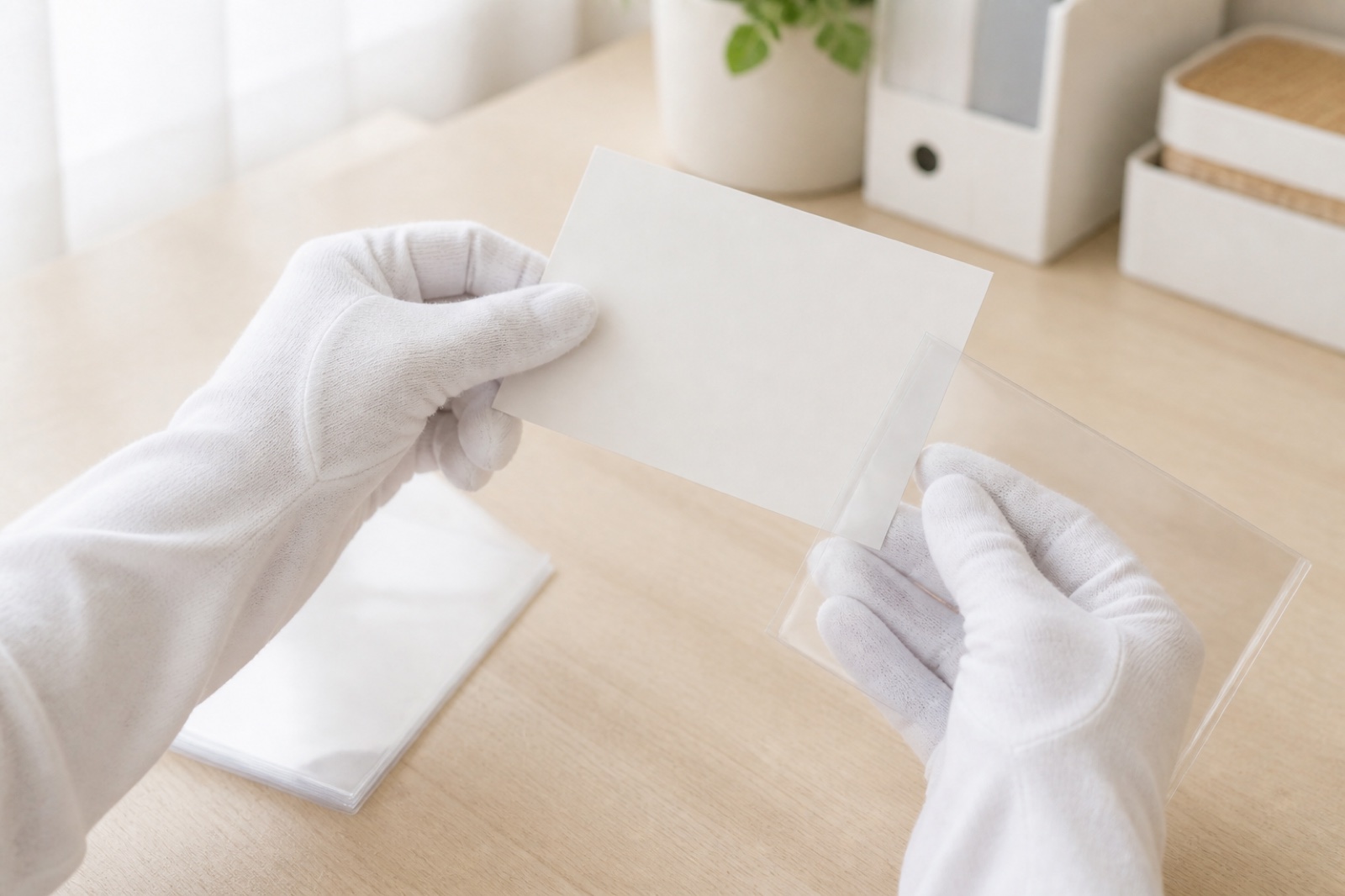
- Wash and dry your hands before opening. Skin oils rise to the surface with a delay, and just not touching the face with bare hands over and over changes the condition
- Put it in a sleeve the same day. Stacking loose prints right after opening can bend or damage their corners
- Separate the one you display from the ones you keep. Direct sunlight, high heat and humidity, acidic materials and adhesive applied directly to the print lead to fading and warping. Some people accept that the one on their saidan (fan altar) is for display and keep a spare separately
- Record the purchase year and series name. Noting them on the binder’s label lets you trace where each print came from later
- 01Wash and dry handsSkin oils show up later
- 02Sleeve it that dayLoose stacks can bend corners
- 03Split display and keepAvoid sun, heat and humidity
- 04Log year and seriesNote it on the binder label
Handle loose prints carefully after opening to help protect their corners.
Before You Put One Up for Trade
For trades, check for scratches, fingerprints and bent corners, and reinforce with cardboard or a hard case. Many people keep goods trading requests on a separate trading account, and stating up front whether you do mail only or hand-offs and when you’ll ship keeps the exchange short.
For high-priced limited items, don’t be swept up by inflated market prices. Compare the plan for official reprints and what protection a trading service offers.
Don’t Judge Rarity by the Photo Alone
Even the same design can have different trading terms depending on whether it is official or unofficial, the sales period, the venue, handwritten elements and condition. Don’t assume rarity from a photo alone; check the purchase history and the official product name. For expensive items where authenticity worries you, choose a sales route with protection.
When posting your collection on social media, make sure address labels, purchase numbers and signature-verification details other than your trading ID stay out of the shot. Publishing high-resolution images of handwritten items can also become material for imitations. It’s safer to keep a photo for public posting separate from the confirmation photos you send to trading partners. On a trade post that has finished, add a note that entries are closed, in a way that leaves no personal information behind.
Notes From The Oshi Lab: Merchandise Design Becomes Community Design
A nama-shashin is merchandise for carrying home a moment of the live show or a costume in the palm of your hand. What we find notable is that this product has made random sales and trading culture work at the same time. A system in which the one you want doesn’t come out pushes up how many you buy, but if that were all, you’d be left with lopsided stock in your hands. Only when there’s a route to swap the extras for someone else’s search do fans meet each other and the relationships of a fandom sphere get woven together. It is a rare product where the design of merchandise is the design of a community.
- 01Buy random packsThe one you want may not appear
- 02Extras pile upLopsided stock in your hands
- 03Post a tradeSwap extras for someone's wish
- 04Meet fansRelationships form in the sphere
Without the trade, random sales end at a pile of duplicates.
That said, no one is obliged to keep buying until they get it. In recent years there are also examples of made-to-order sales where you choose the design, or complete sets sold later alongside. Whether the seller can run the fun of chance in parallel with an option that guarantees you get it is what decides whether support lasts. On the buying side too, putting the condition of the one you love before the number of pieces will let a collection last for years.
Related Terms
FAQ
What is a nama-shashin?
It is an official photo print of an idol, actor, voice actor or similar performer. They are sometimes sold as random sets or as venue-exclusive items.
Is each one really a photo developed individually?
Today's official products are mostly mass-produced prints. "Nama" (literally "raw" or "fresh") is a name that stressed a photographic product as distinct from data or printed matter, and it doesn't guarantee how the item was made.
How is it different from a bromide or a trading card?
The names, paper quality, size and back-side printing differ. Nama-shashin are often L-size, but check the product specifications.
What protective supplies should I buy?
Start by measuring the actual width, height and thickness. For L-size, commercial L-size sleeves fit, but bonus nama-shashin are often non-standard, so measure first and then pick binders or cases to avoid buying twice.
Can the colors change in storage?
Direct sunlight, high heat and humidity, and adhesive applied straight onto the print are said to contribute to fading and warping. Many people separate one to display from one to keep, and store the keeper where light and humidity rarely reach.


