
What Is a Nui Pouch? How to Choose a Case for Carrying Your Plushie Oshi
Nui pouch ぬいポーチ · Plush display pouch
You picked a pouch to match your plushie’s height, but once the plushie is dressed in its outfit, it won’t fit. Here is what a nui pouch is, how it differs from cases and ita-bags, how to measure the inside, what each type does best and how to prepare for carrying one.
What a Nui Pouch Means
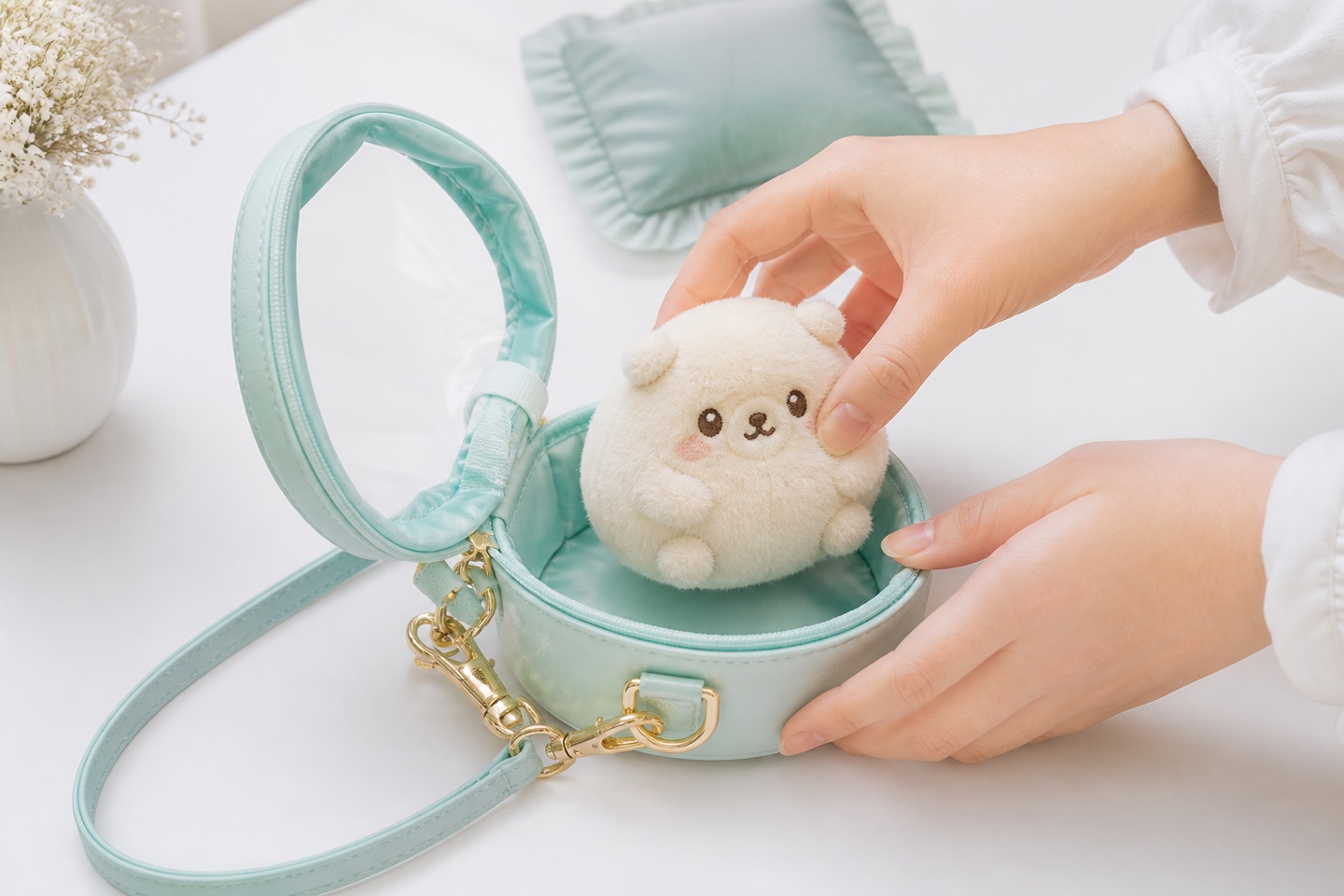
Nui pouch (ぬいポーチ) is a small case that shows the plushie you carry for nui-katsu through a clear window while protecting it from dirt and drops. Types include single-plushie pouches, multi-plushie versions and styles built into a bag.
What sets it apart from an ordinary pouch is that it shows and protects at the same time. Thanks to the window, you don’t have to take the plushie out every time you shoot a photo.
Examples
- “Once I switched to a nui pouch with room up to the tips of the ears, the hair accessory stopped losing its shape.”
- “I thread a carabiner and a strap through separate points, so it’s protected twice over against drops.”
- “After shooting, I’ve gotten into the habit of wiping off sand and water drops before putting it back.”
- “On days when rain is forecast, I carry the pouch inside my bag.”
- Social media post: “My first nui pouch. I measured the inside before buying, so it fit on the first try.”
How It Grew as Merchandise
Taking a plushie out and photographing it against the scenery is an old pastime. Then small mascots became standard official merch, and as places to share photos multiplied, demand arose for a container made for taking them along.
Early on, many people repurposed makeup pouches and card cases. Clear windows, air vents and anti-drop fittings were added over time. Today, dedicated products that state which plushie sizes they suit are widely sold.
How It Differs From Nui Cases and Ita-Bags
| Name | Main role | Meant for display? |
|---|---|---|
| Nui pouch | Carrying one to a few plushies | Yes; shown through a clear window |
| Nui case | A broad term that includes storage | Storage versions can be opaque |
| Ita-bag | A bag that shows off pin badges and more | Yes; can also serve as a base to attach a nui pouch to |
| Hard case | Keeps flat goods from losing their shape | Yes; for acrylic stands and trading cards |
A nui pouch attached to the surface of an ita-bag is a common sight. Because these tools overlap, deciding what you want to protect first makes it easier to choose.
How to Measure the Inside (4 Steps)
- Measure the body’s height — Take the actual size with the plushie laid straight, not sitting
- Add the widest point around the head — Ears, horns, hair shapes and anything else that sticks out count here
- Add the thickness of its clothes and accessories — If you’ll carry it dressed, measure it in that state
- Leave some slack on each side — If the face is pressed against the window, the embroidery warps. Leave a few millimeters of margin top, bottom and sides
Store-bought pouches are often sorted into sizes around 10 cm, 15 cm and 20 cm. The labeled size is a guide to the plushie it fits, not necessarily the inner dimension itself. Check whether the product page lists the inner size before you choose, and there will be fewer surprises when it arrives.
- 01Body heightPlushie laid straight
- 02Widest pointEars, horns, hair shapes
- 03Clothes and accessoriesMeasure it as it will be carried
- 04SlackA few millimeters each side
A plushie pressed against the window warps its embroidery.
What Each Type Is Good and Bad At
| Type | Good for | Watch out for |
|---|---|---|
| Shoulder type | Long trips, when you want both hands free | Easily crushed under your body when you sit |
| Bag-attached type | Short outings, using together with an ita-bag | The outside rubs in crowds; needs drop protection |
| Multi-plushie type | Bringing two or more | They rub against each other inside, so dividers help |
| Drawstring / opaque type | Protection while traveling, places where you can’t shoot | Not suited to showing off |
The window material’s transparency alone does not determine its rigidity or resistance to cracking. Softer materials scuff and cloud easily. Neither is better; you choose by situation.
Shoulder type
- Keeps both hands free
- Easily crushed when you sit
Bag-attached type
- Works together with an ita-bag
- Needs drop protection
Multi-plushie type
- Carries a group
- Dividers stop rubbing
Drawstring and opaque types suit travel and no-photo places.
Carrying and Care
In restaurants, keep it where it won’t touch the food, and don’t let the plushie take up a shared seat. Give up your place when you shoot, and don’t post shop logos or other customers’ faces without permission. Don’t take it out where photography is banned, such as shrines, museums and theaters. These courtesies apply to nui-dori in general.
When you get home, check for dirt and moisture. Plasticizers in some clear materials, such as flexible PVC, can affect printed surfaces, so a known approach for long-term storage is to take the plushie out of the pouch and move it to merch storage. Not leaving it in a car in direct sunlight also helps prevent fading.
The Night-Before Check for a Trip
Cracks in the window, frayed seams, loose fittings, where the backup strap is threaded, and dirt on the plushie itself: look over these five points the night before and you won’t have to scramble on the day. Some people bring an inner bag that holds the whole pouch, in case a venue restricts large bags.
- 01WindowCracks or clouding
- 02SeamsFrayed threads
- 03FittingsAnything loose
- 04Backup strapWhere it is threaded
- 05The plushieDirt on the toy itself
A few minutes the night before beats scrambling on the day.
If you attach an address tag, avoid a form that shows your real name or phone number as is. If you want to leave contact details, one option is a social media ID or a partly hidden version. On an ensei, a trip to see your oshi, weigh the chance of getting the pouch back if you drop it against the chance that whoever picks it up can read your personal information.
Jot down which plushie you took, where you shot and the weather that day, and you can trace the cause of material wear or color transfer later.
Notes From The Oshi Lab: Merch Becomes a Companion
The nui pouch is a clear example of merch turned into a tool you use. Displaying merch or putting it away are two familiar ways to enjoy it. As a third option, carrying it along has taken hold, and plushies have moved to a position closer to a companion than a possession. What interests us is that demand is appearing in places that had nothing to do with performances: photo spots, restaurants and tourist sites.
For shops and facilities, this is also a movement they can join at low cost. No special equipment is needed: a small stand where a plushie can sit, or a sign saying whether photography is allowed, can be reason enough to visit. Friction such as taking up seats and shooting in aisles is happening too, and the burden on staff changes a great deal depending on whether the rules are posted in advance. Whether a shop welcomes or restricts, fans find it easier to move when the policy is visible first.
Related Terms
FAQ
What is a nui pouch?
It is a small protective case that lets you carry your oshi's plushie while still showing it through a clear window. Types include single-plushie pouches, multi-plushie versions and styles built into a bag.
How do you measure for one?
Measure the plushie's height plus anything that sticks out, such as ears or horns, and the thickness of its outfit and accessories. If a face is pressed against the window, the embroidery can warp, so choose an inner size with a little room on each side.
Is the listed size the same as the inner size?
Not necessarily. Labels such as "fits 10 cm" are often only a guide, so you'll make fewer mistakes if you check that the product page states the actual inner dimensions.
Is it safe to attach one to the outside of a bag?
A known approach is not to rely on a single fitting, and to run an anti-drop strap through a separate point. It also helps if the pouch is small enough to move inside your bag when it's crowded or raining.
Can I keep the plushie in the pouch for long-term storage?
Plasticizers in some clear materials, such as flexible PVC, can affect printed surfaces, so many people take the plushie out for storage. If there is an official warning or a materials label, follow that first.


