
What Are Renketsu Uchiwa? How Fans Link Fan Signs to Spell Long Names
Renketsu uchiwa 連結うちわ · Connected fan signs
You’ve seen a renketsu uchiwa on social media that made a name look huge, and now you want to make one yourself. This guide covers how it differs from a regular uchiwa and a cheering board, which venue rules to read before you start building, and how to think about character count and carrying.
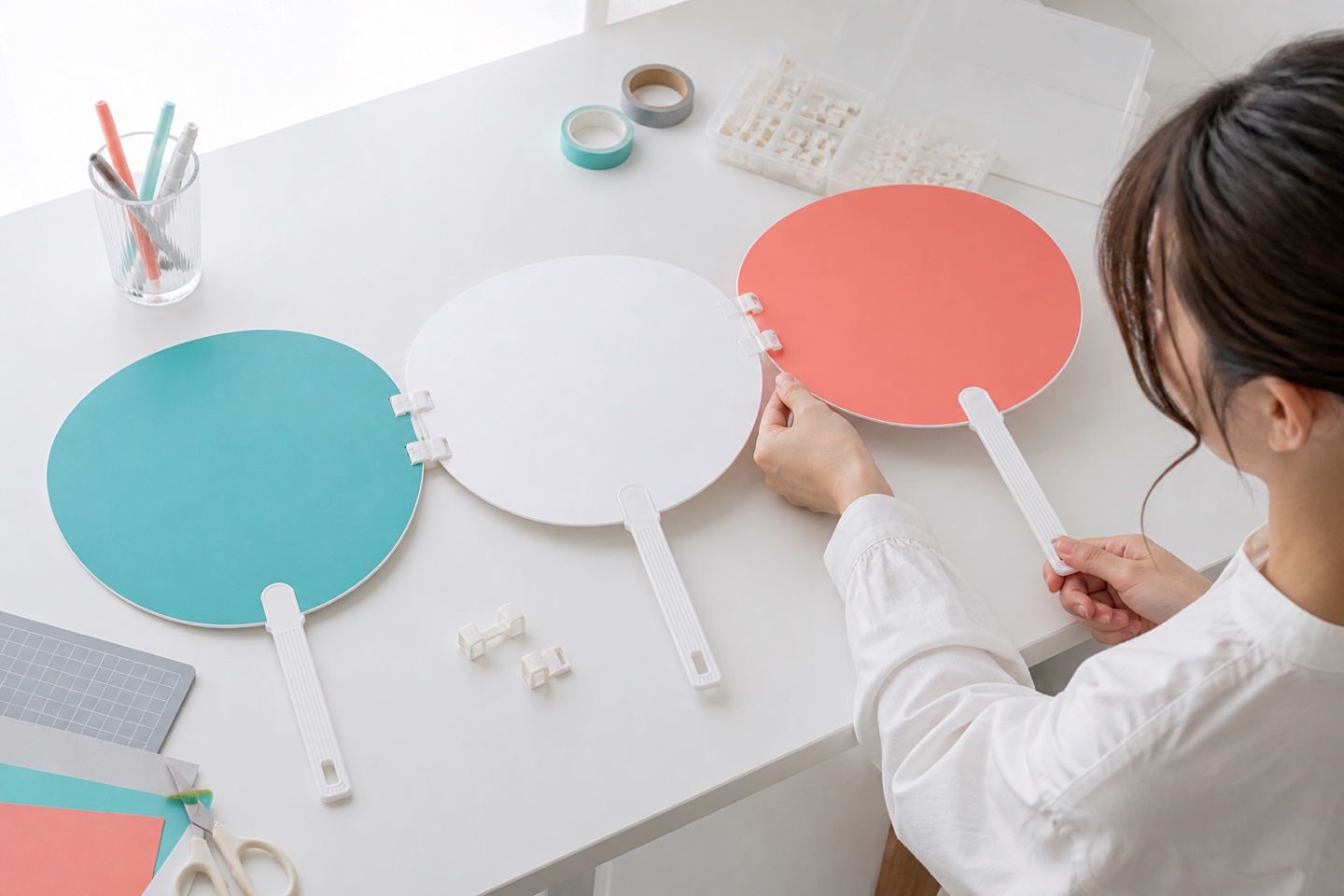
What Renketsu Uchiwa Means
Renketsu uchiwa (連結うちわ, “linked fans”) are cheering goods in which several cheering uchiwa, the handheld paddle fans that fans hold up at shows, or letter panels sit side by side to show one name or phrase. Some fold up and are joined only for photos.
Because each panel carries fewer characters, every character can be bigger. They suit long names, or groups of fans who share the job of holding one up.
Examples
- “I split a five-character name across three panels, and now it’s readable even from the second-floor seats.”
- “I don’t link them inside the venue; I only line them up at a photo spot outside.”
- “It’s become a habit to check for people behind and beside me before I open them.”
- “My friend and I hold one panel each, so we decide on a signal in advance in case we get separated.”
- Social media post: “Remade my renketsu uchiwa. Rereading the rules, the total width was stricter than I expected.”
How the Form Came About
Once writing a name or a fansa (fan service) request on a single uchiwa had caught on, fans who wanted bigger characters and longer phrases began lining up several panels. Showing words on a big surface is an old idea in other fields too, such as the game flags (gēfura) of stadium cheering sections and cheering boards.
Because they stand out in group photos and social media posts, they are increasingly used in photo settings rather than at the performances themselves. No one person or moment can be named as the origin; the form seems to have grown up in parallel at many genba, the live-event venues.
How to Tell Them Apart From Cheering Uchiwa and Boards
| Name | Basic form | How venues treat it |
|---|---|---|
| Renketsu uchiwa | Several uchiwa with handles linked together | Easily runs into rules on number and total width |
| Cheering uchiwa | One fan of a set size | A form covered by the rules of some performances |
| Cheering board | A single piece of card or panel | Material and thickness may be regulated separately |
| Game flag | A flag stretched on a pole; stadium cheering culture | Areas where they may be displayed are often designated |
“It folds, so it counts as one” doesn’t necessarily hold. What counts is its state when opened inside the venue.
Renketsu uchiwa
- Easily runs into number and width rules
Cheering uchiwa
- A form covered by the rules of some performances
Cheering board
- Material and thickness may be regulated
Venues judge the state it is in when opened inside.
Rules to Check Before Making One
- How many one person may hold. At performances that say “one uchiwa only,” linking isn’t even envisioned
- Total width and height once linked. Even if each part is within the rules, the total may exceed the limit
- Restrictions on material and thickness. Reflective or glowing materials and thick three-dimensional decorations may be prohibited
- Allowed height and timing. Conditions such as chest height or seated only may apply
- Who to ask when nothing is written. If the official notices don’t mention it, check with the organizer before you make it
Exact dimensions and what is allowed differ by performance. Assume that even for the same performers, conditions change with the venue, and reread the rules each time.
- 01How many per personOne uchiwa only?
- 02Total sizeWidth and height once linked
- 03MaterialReflective, glowing, thick
- 04Height and timingChest height, seated only
- 05Who to askThe organizer, if nothing is written
Each part can be within the rules while the total is not.
Guide to Character Count and Number of Panels
| Characters | Suggested panels | How it looks |
|---|---|---|
| 2 to 3 | 1 | One is enough; little need to link |
| 4 to 5 | 2 | Each character can be large, and it’s easy to switch hands |
| 6 or more | 3 or more | Easy to read, but the burden of total width and storage rises |
Even fluorescent colors sink from a distance without a light-dark contrast against the background. Stick to a name and a short phrase, and choose a typeface with thick strokes to make it easier to read from distant seats. Avoid using official logos, official photos or existing characters without permission.
Short nameLong name
- 2 to 3 charactersOne panel; little need to link
- 4 to 5 charactersTwo panels; easy to switch hands
- 6 or moreThree or more; total width becomes a burden
Easy to read, but storage and width costs rise.
Holding Height and Consideration for Those Around You
The widely shared guideline is to keep it at chest height and not hold it overhead for long. From a seat behind, a difference of one uchiwa’s height decides whether you can see the stage. The closer you sit to the front, in a kamiseki (a “god seat” with a great view), the more it affects the people behind.
Don’t spread them in aisles, while moving during a show or on a performer’s path. Keep photos short, at a designated place outside the venue, and make sure other attendees aren’t caught in the frame. Remaking a bigger one or moving to another seat because you got no reaction is a typical case of seeking ninchi, being noticed by your oshi, at the expense of other people’s view.
Design Including Storage and Carrying Home
What’s easy to overlook when making one is how it’s handled afterward.
- Length after taking it apart. Even split into single panels, it can’t be taken home if it doesn’t fit in your bag
- Weight. The more decoration you add, the harder it is to hold with one hand for long
- Drying time. Gluing and painting need to be done by the day before
- A spare bag. Carry something you can put it away in right there if it turns out you can’t use it
If the adhesive comes off, don’t remake it on the spot; collect the pieces and put them away. If you note the rules and how it went at each performance, next time you can make only the panels you need. Rather than competing on size, call it finished when the name is easy to read and the people around you can see the same stage. As with putting together a sansen outfit, what you wear to a show, or your oshi color, working back from the whole picture on the day helps you find the right place to stop.
Notes From The Oshi Lab: Show the Shape of the Box It Fits In First
Renketsu uchiwa are a typical case where fan-made items easily collide with a venue’s operating rules. The makers’ motive is plain: they want their name to be read from a far seat. But a venue is a finite space, and a way of raising one person’s visibility can block the view of someone behind. Because of this structure, rules on displaying items have grown more detailed year by year.
From the organizers’ side, whether you dismiss it with a single word, “prohibited,” or spell out the conditions changes where fans’ urge to make things goes. At performances where dimensions, number and the times you may hold them up are written concretely, a culture of ingenuity within that frame grows. If the notice stays vague, judgment splits at the venue on the day, and the burden on the staff giving directions rises. One view is that, rather than suppressing creation, showing the shape of the box it fits in first costs both sides less.
Related Terms
FAQ
What are renketsu uchiwa?
Cheering goods in which several uchiwa fans or letter panels sit side by side to show one name or phrase. With fewer characters per panel, each character can be bigger.
Can you open them up inside the venue?
It depends on each performance's rules. Some shows allow only a single uchiwa of a set size, and being able to fold something up doesn't mean you may carry it in or hold it up.
At what height should you hold them?
Even where they're allowed, the widely shared rule of thumb is chest height. Raised overhead or opened in an aisle, they can block the stage for the seats behind you.
What should I do if the rules don't mention them?
If the official FAQ and notices say nothing, it's safer to ask the organizer before you make one. Getting through at the last show is no permission for the next venue.
Can the same one be used for photos and for performances?
They can be treated differently. Many people think of the size they use for photos outside the venue and the size they can hold up in their seat as two separate things, and carry a bag they can stash it in right away if it isn't allowed.


