
Analyzing Collaboration Pitfalls: Purchase Limits, Blind Items, and On-Site Guidance
Even when a brand collaboration with a popular intellectual property sells out completely, that sellout alone cannot be used to evaluate the overall success of the project. Were the purchase conditions clearly conveyed to customers? Were waiting lines promptly informed of out-of-stock items? In promotions involving food, were meals handed over properly? After sales conclude, there are critical operational aspects that need to be evaluated right alongside revenue figures.

In this article, we examine public announcements from McDonald’s Japan in August 2025, press conference transcripts from the Consumer Affairs Agency, and official pop-up shop event guidelines from SHIBUYA TSUTAYA to break down where corporate planners should focus when structuring sales and floor operations. We will analyze the pre-sale conditions announced, the operational hurdles that surfaced after launch, and actionable recommendations proposed by The Oshi Lab.
Having Written Disclaimers Is Different from Preventing Issues on the Floor
McDonald’s Japan announced in its official press release on August 4, 2025 (in Japanese) that it would launch a Pokémon Happy Set nationwide starting August 8. Alongside this announcement, the company stated that during the three-day weekend from August 9 to August 11, it planned to distribute a limited-quantity set of two Pokémon trading cards with each Happy Set purchase.
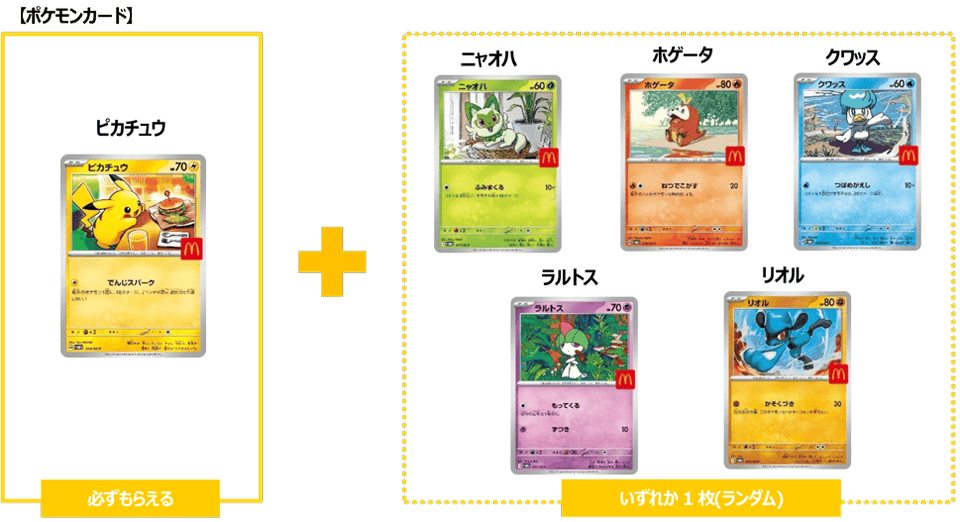
In the promotional image, a Pikachu card appeared on the left, five different card designs were lined up on the right, and a large ”+” symbol was placed between them. Customers received two cards in total: one guaranteed Pikachu card, plus one random card drawn from the five designs. It did not mean that a single purchase would yield all the designs shown in the image.
The announcement explicitly requested that during the three scheduled distribution days, customers purchase no more than five sets per person, and to refrain from purchases for commercial purposes such as resale or redistribution, as well as ordering quantities beyond what they could finish eating. It also clearly noted that toy and card designs could not be chosen, that buying five sets would not guarantee a complete set of all designs, and that supplies were strictly limited and would end once inventory ran out.
In short, this was not a case where the pre-sale announcement lacked warning text or rules. Keeping that fact in mind, it is necessary to examine what issues actually surfaced after sales began.
Improvement Requests Outlined by the Consumer Affairs Agency
According to the press conference summary by the Commissioner of the Consumer Affairs Agency on August 21, 2025 (in Japanese), the agency stated it was aware of media reports detailing large-scale purchases intended for resale, as well as purchased food being left behind or discarded. In light of this, the agency revealed that it had formally requested McDonald’s Japan to improve its sales methods to prevent food waste and to implement measures ensuring such incidents would not recur.
The Commissioner also noted that McDonald’s was currently reviewing and publicly sharing countermeasures, including stricter purchase quantity caps and procedures to turn away repeat buyers. This press briefing was an explanation of an administrative request for improvement; it was not an announcement of formal administrative penalties or fines. Furthermore, the behaviors reported in the media cannot be generalized as the conduct of every visiting customer or fan of the franchise.
- 01Aug 4, 2025: Initial AnnouncementPublished guidelines requesting a cap of 5 sets per person and asking customers to refrain from resale or ordering more than they could finish eating.
- 02Planned Sales & Distribution ScheduleStated products would launch Aug 8, with the 2-card sets distributed in limited quantities during the 3-day weekend of Aug 9–11.
- 03Aug 21, 2025: Consumer Affairs Agency BriefingAddressed reports of abandoned food and waste, explaining that the agency requested improved sales methods and measures to prevent recurrence.
The sales and distribution schedule reflects what was published on August 4. Stated plans alone do not determine the actual end date of distribution or operational outcomes across all restaurant locations.
What corporate project managers must consider is this: after drafting an advisory “request,” through which ordering channels, by whom, and how will those terms be verified at the point of sale? Is the cap per checkout transaction, or is it per person per day? How will re-queuing and multiple ordering channels be handled, and to whom should frontline staff escalate decisions when turning down repeat buyers? Policy wording and floor register procedures must be developed side by side.
When campaigns involve perishable food, operational planning must address not only promotional gift inventory, but also how ordered food is handed over and how staff respond to excessive meal orders that cannot reasonably be consumed. Rather than stopping at “we included it in our terms and conditions,” organizations need to establish practical, concrete judgment protocols for store staff.
Grouping 66 Blind Items: Defining the Scope of Buyer Choice
The official event page (in Japanese) for the “Holo Natsu Paradise” pop-up shop held at SHIBUYA TSUTAYA from August 1 to August 31, 2025, outlined both merchandise grouping systems and store admission rules.
According to the publicly available guide, a total of 66 blind merchandise designs were divided across five distinct groups containing 12, 13, 14, 13, and 14 designs respectively. What can be confirmed directly from this event page is the published group breakdown; whether all 66 items were initially placed in a single pool and later split cannot be conclusively determined from this announcement alone.
The published tax-inclusive prices at the time listed random swim-ring keychains at 1,540 yen, acrylic coasters at 1,320 yen, and acrylic charms at 660 yen. These figures reflect the specific event pricing at that time and do not represent current inventory levels or standard prices across other projects.
For consumers, what matters is not just the overall number of designs, but which group their favorite character falls into and how much choice they have at the register. Event organizers should design sales materials so that the overall product catalog and the corresponding group allocations can be clearly cross-referenced before purchasing.
The financial burden on the customer also varies significantly based on unit price. For example, if a customer purchases five blind items, a 660-yen item totals 3,300 yen, whereas a 1,540-yen item totals 7,700 yen. This is purely an illustrative calculation based on published prices, not an endorsement of buying in multiples. Even when two product lines feature the same number of character variants, the total expenditure of buying multiples diverges dramatically depending on unit cost.
In planning sessions, teams should specify not only “how many total variants will be manufactured,” but also formalize “from what subset a random item will be pulled” and “what portion of the selection the customer can control.” When designing random goods, it is vital not to assume that having an identical total design count means the customer experiences the same degree of choice.
Validating Numbered Queue Tickets at Both Entry and Checkout
The guidelines for the same SHIBUYA TSUTAYA event specified that for the opening three days (August 1 to August 3), admission operated on a first-come, first-served numbered queue ticket system in 15-minute intervals, requiring ticket validation at both store entry and register checkout.
This serves as a prime example of coordinating reception and payment rather than treating them as disconnected checkpoints, explicitly establishing where the same physical ticket must be inspected. However, the presence of a ticket advisory alone does not prove how many minutes waiting times were reduced, nor whether all repeat purchases were eliminated.
When implementing timed reservation slots for your own events, project teams must separately estimate the physical capacity of the venue floor and the transaction throughput of the checkout registers during that timeframe. Organizers must decide who checks tickets, how to record that a ticket has completed checkout, and whether repeat transactions will be permitted. There is no need to copy a 15-minute window identically across all event venues.
Pre-Purchase Customer Announcements
- Purchase limit units (per person, per day, or per transaction)
- Total variant count, subgroup divisions, selectable ranges, and unit prices
- Applicable dates and times for queue tickets, plus admission and checkout terms
- Daily inventory allocations, restock plans, or post-event online sales channels
Floor Operational Protocols to Establish
- Criteria for refusing repeat purchases and designated managers for escalations
- Verification procedures for admission and checkout tickets
- Workflows for updating waiting queues and official web pages regarding stockouts
- Food handover workflows and procedures for handling excessive food orders
Summary framework compiled by The Oshi Lab based on the case studies discussed. This does not represent specific performance metrics of individual retail stores.
Coordinating Sell-Out Notices Before Promising Restocks
Drawing on these real-world case studies, The Oshi Lab offers several proactive recommendations for retail planners. Prior to opening day, prepare standard notification copy for when daily stock runs out. Internal teams must verify whether stock is allocated daily, whether mid-event replenishments are scheduled, or whether post-event mail orders are planned.
For instance, the announcement “Sold Out for Today” prompts an entirely different consumer response than “Sold Out for the Event Run.” If restocks have not been locked in, state clearly that restocks are “Undetermined.” It is equally crucial never to present unconfirmed internal discussions as confirmed logistics schedules.
Consider not only signage inside the retail space, but also notices posted where lines begin forming and official web pages that can be checked prior to arrival. Establish clear protocols detailing who on the floor contacts the online communications desk, and define which official guidance customer-facing floor staff should reference when fielding inquiries.
Following the close of sales, teams should review sales numbers and remaining inventory alongside logged customer inquiries, instances where policy explanations conflicted, and records regarding product handovers and food waste prevention. Rather than writing off logistical friction with a vague “it was just overwhelmingly popular,” organizations should pinpoint exact revisions needed for future promotional wording and queue intake procedures. In oshi-katsu marketing (fan-support marketing), communicating the creative appeal of a franchise and designing the logistics of how those goods reach fans must be planned as two sides of the same coin.
FAQ
Is asking buyers in advance announcements to refrain from reselling or buying in bulk sufficient as a countermeasure?
Written advisories and on-site enforcement must be treated separately. In McDonald's Japan's August 2025 campaign, purchase quantity requests and cautionary notes were published in advance, yet the Consumer Affairs Agency later issued an administrative request for operational improvements. When planning promotional events, advance announcements must be designed in tandem with concrete ordering, admission, and checkout procedures.
When planning blind-packaged merchandise with many variations, how can they be divided into groups?
The official August 2025 event guidance for SHIBUYA TSUTAYA demonstrated a system that divided 66 total character designs into five smaller groups: 12, 13, 14, 13, and 14 designs each. Organizers should provide clear informational charts showing the total number of variants, the specific groupings available at purchase, and the unit price side by side.
If a collaboration product sells out quickly, can the campaign be declared an unqualified success?
A campaign cannot be evaluated solely by immediate sellouts. Planners must also review whether purchase terms were properly communicated, how waiting lines were informed of stockouts, and maintain records regarding food distribution and waste reduction.
How should admission and checkout workflows be structured for high-traffic pop-up shops?
Planners need to project venue capacity alongside checkout processing capacity, determining precisely who checks admission tickets and where. In the TSUTAYA case study, a timed 15-minute numbered ticket system was implemented for the first three days, requiring ticket validation at both entry and payment registers. This does not mean identical 15-minute intervals fit every venue.
How should a company issue public notices when operational issues or stockouts occur?
Notices should clearly distinguish between 'sold out for today' versus 'sold out for the entire run,' as well as confirmed restocks versus unconfirmed possibilities. Establish clear communication channels between on-site floor staff and online update managers, aligning the information shown to waiting queues, official websites, and frontline customer service staff.


