
Oshikatsu x Restaurant Chains: Yoshinoya x Shirogane Noel Perks & Points Guide
Across Japan, everyday restaurant chains frequently partner with anime, VTuber, and other intellectual property (IP) franchises to pair routine dining with special bonus campaigns (a staple of oshikatsu, or fan activities supporting a favorite character or creator). Alongside dedicated pop-up events like collaboration cafes, many campaigns are built directly into the normal day-to-day operations of permanent restaurant chains.

However, the steps required to participate in a restaurant chain collaboration vary widely depending on the campaign’s design. Some campaigns hand out a bonus item on the spot when you order an eligible menu item, while others let you accumulate points in a smartphone app based on your checkout total to redeem for merchandise later. If you visit a restaurant without understanding how a particular campaign works, it is easy to run into misunderstandings—such as discovering your order did not qualify for the perk you wanted, or finding out that you cannot complete the required app steps after payment has already been processed.
In this article, we examine how point-redemption collaborations work at restaurant chains, using the official specifications of the Yoshinoya and VTuber Shirogane Noel collaboration campaign “Kon-Muscle!” (held from January to April 2026) as a concrete case study. In the first half, we organize what fans need to check before visiting a store and how to read promotional merchandise graphics accurately. In the second half, we look closely at in-store operations and customer guidance design for corporate planners at food-service companies.
Three Formats Used in Permanent Restaurant Chain Collaborations
IP collaborations run by permanent restaurant chains can be grouped into three main formats based on how bonus items are earned and received. Let us start by looking at the structural differences among them.
The first is the menu-linked format, where ordering a specific menu item gets you a trading card or piece of merchandise handed to you on the spot. While this makes it completely clear which item a customer needs to order, the planning team must establish procedures for managing bonus inventory at each branch and serving the eligible menu items.
The second is the in-store screen-presentation format, where customers receive a limited-quantity novelty item by showing a designated app screen or coupon at checkout. Because this approach does not restrict customers to a specific dish, it offers an approachable way to participate during an ordinary meal—though when items are distributed on a first-come, first-served basis in limited quantities, handouts can end early.
The third is the point-redemption format, where customers accumulate points inside an app based on the amount they spend at checkout, apply for the merchandise they want, and receive their items via shipping at a later date. This design removes the need for individual restaurant branches to store and hand over bulky merchandise at the counter, and it naturally connects the campaign to multiple dining visits over the promotional period.
In-Store Handouts (Menu-Linked / Screen Presentation)
- Customers receive bonus items on the spot at checkout or when food is served
- Per-store inventory is finite, making giveaways prone to first-come, first-served limits
- The entire process from ordering to receiving the item finishes in a single visit
App Point Redemption (Shipped Later)
- Customers present a dedicated barcode before checkout to earn points based on spend
- Earned points are used within the app during the redemption window to apply for goods
- Customers check application rules and shipping estimates, receiving items at a later date
Source: The Oshi Lab’s summary of the article
In actual promotions, these formats are not always run in isolation; chains often combine more than one method inside a single campaign. From the perspective of a participating fan, it is essential to sort out before visiting the restaurant which specific format applies to the bonus item you want to get.
The Merchandise Lineup in Yoshinoya x Shirogane Noel “Kon-Muscle!” and How to Read Promotional Graphics
Now let us examine the official materials from a concrete case: the “Yoshinoya x Shirogane Noel ‘Kon-Muscle!’ App Point Campaign” run by the beef-bowl chain Yoshinoya (held from 11:00 AM on January 26, 2026, to 8:00 PM on April 30, 2026; now concluded).
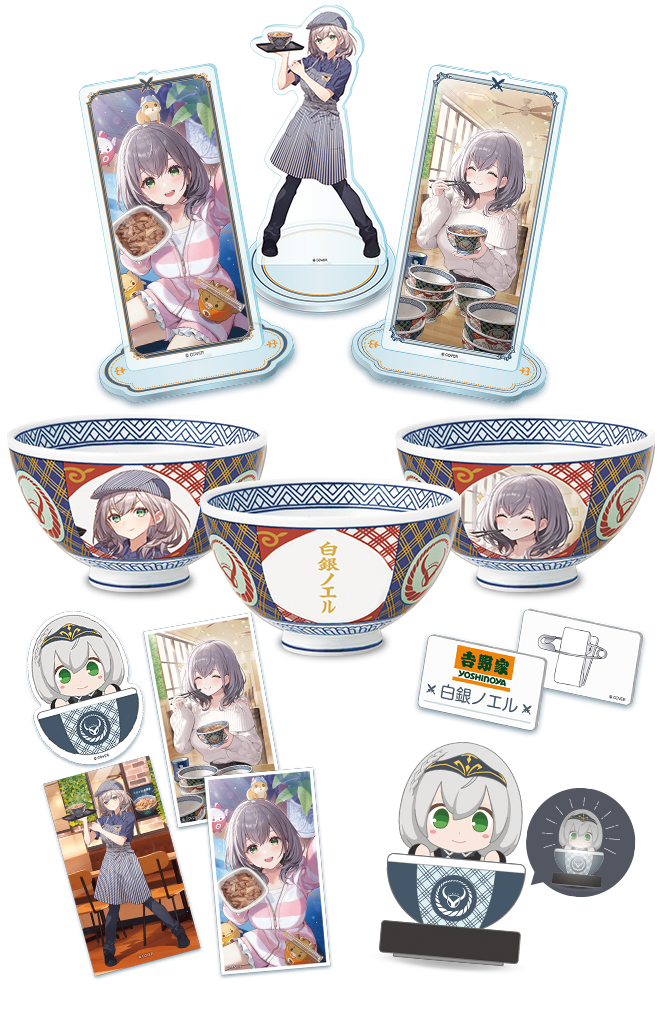
The official promotional graphic showing the full reward lineup features acrylic stands and stickers made with newly commissioned illustrations (in three versions: Uniform ver., Munching [Mogu-Mogu] ver., and Selfie ver.), an item modeled after a restaurant staff name badge, a donburi bowl combining character art with Yoshinoya’s classic bowl pattern, and a donburi-shaped room light. Across the board, the designs blend signature restaurant motifs—like dining bowls and employee name tags—with the character’s outfits and dining scenes.
When fans read a summary graphic like this, it is important to recognize two things right away: you do not receive every item pictured in a single order, and none of these items are handed over at the restaurant register on the day you eat. Rather, this single image brings together the full lineup of redeemable rewards that you can apply for by saving up points, with tiered point requirements set for each item.
Specifically, under the official rules at the time of the campaign, the point exchange rates were structured as follows:
- 3 points: 2-piece sticker set (choose 1 of 2 designs)
- 10 points: Staff-style name badge
- 20 points: Acrylic stand (choose 1 of 3 designs: Uniform, Munching, or Selfie)
- 45 points: Donburi bowl
- 90 points: Donburi room light
It is also important not to make assumptions about the physical material of a piece of merchandise based solely on how it looks in a promotional graphic. For instance, while the 45-point donburi bowl looks in the graphic much like the heavy ceramic bowls used inside Yoshinoya restaurants, the official specifications clearly state that it is made of melamine rather than porcelain. When thinking about how heavy a bowl will feel, how to care for it, and how you might use it for everyday meals at home, checking the written material specifications on the official campaign page rather than judging by the picture alone is a helpful habit.
Furthermore, separate from the point-redemption merchandise listed above, this campaign also offered a random freebie that customers could receive at checkout by showing an app screen. However, that random present was limited in quantity, and both its eligibility rules and its handover method differed from the point-redemption rewards. When a single collaboration campaign runs “limited-quantity in-store handouts via screen presentation” alongside “point accumulation via barcode presentation for later delivery,” what you need to show at the cash register changes depending on which perk you came for.
From Checkout to Delivery: The Step-by-Step Flow and Checkpoints of a Point-Redemption Collaboration
What exact steps does a reader follow from the moment they walk into a restaurant until their bonus merchandise arrives? Using the official rules of the Yoshinoya x Shirogane Noel campaign, let us trace the chronological sequence and key checkpoints.
- 01Pre-Visit & Pre-Checkout PrepConfirm the branch is participating and present the dedicated Yoshinoya app barcode before paying
- 02Payment & Point CalculationEarn 1 point per 500 yen tax-included after discounts in a single transaction (no combining receipts; delivery excluded)
- 03Waiting for Points to AppearPoints are credited to the app within 4 days including the checkout date (not reflected instantly)
- 04Applying for Reward RedemptionSubmit redemption requests inside the app by the deadline (May 14 at midnight); redeemed points are deducted
- 05Waiting for Later DeliveryWait for home delivery around the scheduled shipping window (slated for late October)
Source: The Oshi Lab’s summary of the article
1. Conditions Before Visiting and at the Checkout Register
The easiest place to trip up at the beginning is the eligible ordering method and how qualifying spending is calculated. In this campaign, certain non-participating locations were excluded, and delivery orders did not qualify. In addition, to earn points, customers had to present the dedicated barcode inside the Yoshinoya app before payment was processed.
The spending threshold was set at “1 point for every 500 yen (tax included) paid after discounts in a single transaction,” and multiple receipts could not be combined. For example, if applying a coupon or discount brought your final tax-included payment down to 490 yen, the transaction would earn zero points. Similarly, a checkout total of 980 yen (tax included) would earn 1 point, and the remaining 480 yen could not be carried over or combined with a receipt from your next visit. Calculating the tax-included prices of the menu items you want—and your final total after any coupons—before stepping up to the counter prevents confusion at the register.
2. Time Lag in Point Reflection and Deduction Rules Upon Redemption
Even if you open the smartphone app immediately after paying at the register, your point balance will not necessarily have gone up right away. Under the official guidelines for this campaign, points were awarded “within 4 days, including the date of checkout,” meaning the system was not designed for instant reflection.
In this case study, the period for earning points ran until 8:00 PM on April 30, while the deadline to redeem points for merchandise was midnight (24:00) on May 14. Fans therefore need to check both the waiting window for points to post and the final application deadline separately.
Moreover, when you exchange your accumulated points for a reward, the corresponding number of points is deducted from your balance. Rather than operating as a cumulative milestone system—where reaching 90 total points would automatically grant you the 3-point, 10-point, 20-point, and 45-point items along the way—this is a spend-and-redeem model where you consume your available points to apply for the specific tier you want. For example, if you save up 20 points and redeem them for one acrylic stand, your balance drops back to 0 points. If you want multiple items or different character art variants, you need to plan out which combination of rewards you are aiming to apply for.
3. Later Delivery Schedules and Rules Prohibiting Transfer or Resale
Even after you complete your redemption application inside the app, you do not receive the merchandise right away. In this campaign, following the January–April promotional window and the mid-May redemption deadline, the official terms listed the estimated delivery window as “scheduled for late October.” Because delivery was scheduled for late October, several months after redemption applications, anyone who may be moving or changing residences during that gap needs to pay careful attention to how their shipping address information is managed.
Alongside delivery details, the official FAQ explicitly states that transferring redeemed merchandise to third parties—including resale—is prohibited. Just as with random blind-pack goods and limited promotional perks in general, participating within the boundaries of the official terms of use is a basic prerequisite for enjoying the campaign.
Planning a Comfortable, Sustainable Pace of Participation
In a point-redemption collaboration, the required spending spans a wide range—from the 3-point sticker set (requiring at least 1,500 yen in qualifying checkouts) all the way up to the 90-point room light (requiring at least 45,000 yen in qualifying checkouts).
An important mindset for fans to keep in mind when making their own choices is not to equate the number of visits or the total points earned with the size of their love for their oshi (favorite talent). There is no need to order more food in a single sitting than you can comfortably eat just to accumulate points faster, nor should you force yourself to visit repeatedly beyond your normal daily routine or personal budget. Counting how many times you would naturally stop by during the campaign period at your everyday dining pace—and setting your sights on a 3-point, 10-point, or 20-point reward that fits comfortably within that range—is a practical way to enjoy a restaurant collaboration without strain.
Dividing Roles Between Store Counters and Shipping: Key Decisions for Restaurant Chains
When a restaurant chain decides how customers will receive collaboration perks, planners compare the preparations required for in-store handouts against those required for later delivery. In-store distribution requires allocating stock across branches and preparing clear signage for when items run out, whereas later delivery requires managing customer application data, shipping addresses, manufacturing runs, and fulfillment schedules. Companies should evaluate which set of procedures best matches their internal operational structure.
When planning the merchandise itself, teams consider how to combine things customers naturally see inside the restaurant—such as staff uniforms, name badges, and signature bowl patterns, as seen in the Yoshinoya promotional graphic—with the collaborating character. Looking at the lineup from the perspective of what aspect of the restaurant experience fans might want to keep at home helps planners choose among tableware, wearable items, and display pieces. Because each category serves a different practical purpose, the size and material details that need to be communicated to customers will also differ accordingly.
In a point-redemption system where applicants can choose their preferred variant, fans match the required point total to the exact illustration or item they want to apply for. By contrast, a random in-store handout does not allow customers to pick their design. If a company offers both methods within the same campaign, stating clearly near the promotional graphics which items are selectable, which are random, and how each type is received helps prevent confusion at the counter.
Presenting the barcode before payment, calculating points based on the post-discount total, noting the number of days until points appear, explaining point deduction upon redemption, and stating the final application deadline—presenting these five rules in the exact chronological order a participant experiences them makes it crystal clear what customers need to check and when. Furthermore, when shipping takes place several months after the campaign ends, chains should also provide clear guidance on whether shipping addresses can be updated after an application is submitted, the procedure for doing so if permitted, and where customers can direct inquiries.
Related articles: How to Plan a Collaboration Cafe and Case Studies / What Is Oshikatsu Marketing? / What Is Fan Marketing? / What Are Random Goods?
FAQ
How do restaurant chain IP collaborations differ from collaboration cafes?
At permanent restaurant chains, campaigns often combine bonus perks with standard operating locations and regular dining menus. Rather than distinguishing them solely by whether there is a dedicated themed space, fans should check the participating locations, eligible menu items, and reservation requirements for each specific campaign.
How were in-store handouts and point redemptions separated in the Yoshinoya x Shirogane Noel collaboration?
The campaign was divided into two tracks: a limited-quantity random freebie received at the register by showing an app screen at checkout, and a point-redemption system where diners presented a dedicated barcode before paying to earn 1 point per 500 yen (tax included) and apply for merchandise shipped at a later date.
What should fans check before paying when participating in a point-redemption collaboration?
You need to check the official terms for how the eligible amount per transaction is calculated (such as whether it is based on the tax-included total after discounts), whether multiple receipts can be combined, whether delivery orders or certain locations are excluded, and whether points are awarded immediately or reflected several days later.
What are the advantages and considerations when a restaurant chain designs a point-redemption collaboration?
With a later-delivery model, a chain can separate the timing of in-store dining from the fulfillment of bonus merchandise. At the same time, it requires managing application records, shipping addresses, and manufacturing and delivery schedules. Chains should also clearly communicate in advance when to present the barcode, how many days points take to appear, and how points are deducted upon redemption.


