
How Much Do Fans Spend a Month on Oshikatsu? Annual Averages, Medians, and Personal Budgeting [2026]
How much are other fans spending a month on oshikatsu (activities supporting a favorite idol, character, or creator)? Seeing concert trips and merchandise hauls on social media makes it natural to wonder, yet an annual survey average divided by 12 is not the same thing as what someone actually spends each month.

Drawing on a survey published by CDG and Oshicoco in January 2026, this article breaks down the difference between averages and medians, as well as between annual and monthly totals. When working out your own budget, checking your required payments and the events you want to join matters far more than trying to match a survey average.
Annual Average of 209,716 Yen and Median of 40,000 Yen
According to the 3rd Oshikatsu Survey, the published annual average spending on fan activities was 209,716 yen, while the median was 40,000 yen. The survey was conducted from January 15 to January 22, 2026, among 23,125 residents of Japan aged 15 to 69, with the tabulated figures weighted by gender and age group based on national population estimates. The period shown in the annual spending chart covers January through December 2025. Official announcement by both companies (in Japanese)
| Metric | Published Annual Amount | Reference Value (Annual Amount Divided by 12) |
|---|---|---|
| Average | 209,716 yen | Approx. 17,476 yen |
| Median | 40,000 yen | Approx. 3,333 yen |
The figures in the right-hand column are reference values calculated specifically for this article. In particular, dividing the 40,000-yen annual median by 12 does not produce a median derived by lining up individual monthly spending figures in order. It cannot be read as meaning that the person right in the middle spends 3,333 yen every single month.
In addition, the 23,125 respondents represent the total sample asked whether they participate in oshikatsu. Rather than assuming that every one of those respondents spent money on fan activities, it is important to distinguish between the overall survey sample and the specific group included in the spending calculations.
Averages Are Pulled Up by High-Spending Outliers
An average is calculated by dividing the total amount spent by the number of people. A median is the middle value when all amounts are lined up from smallest to largest. Both metrics are useful, but they describe different things.
For example, if five people have annual fan spending of 10,000 yen, 20,000 yen, 40,000 yen, 50,000 yen, and 1,000,000 yen, the average is 224,000 yen, while the median is 40,000 yen. If that final 1,000,000 yen is changed to 80,000 yen, the average drops to 40,000 yen, whereas the median remains unchanged at 40,000 yen. This is a hypothetical illustration to explain how the math works, not actual response data from the survey.
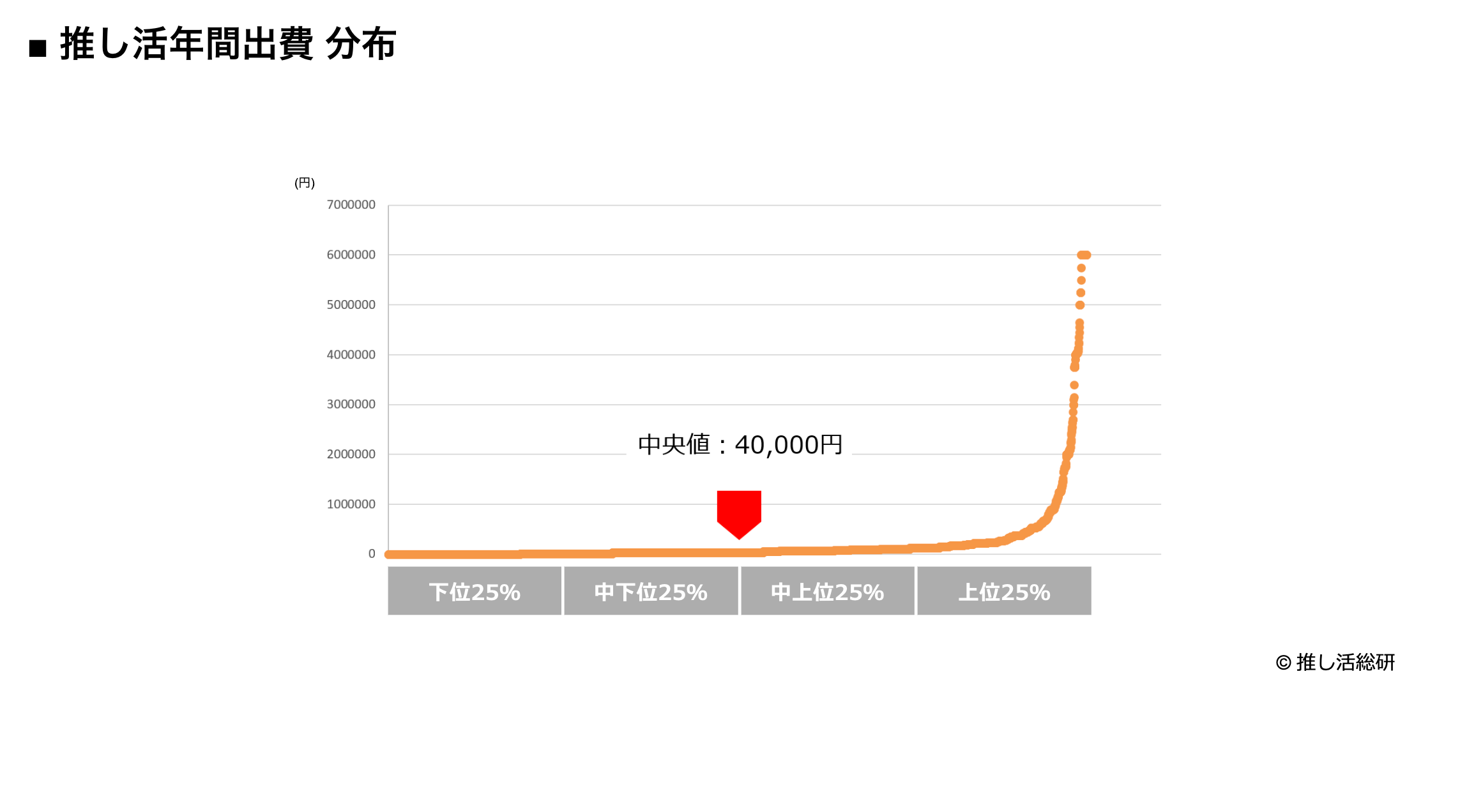
The official distribution chart likewise shows that fan spending spans a wide range. You cannot treat the average as “the amount an ordinary fan ought to spend,” nor can you automatically conclude that spending more than the median is overspending. Essential living costs, personal income, and the specific activities a person wants to join vary from one fan to the next.
What the Numbers Show
- The average and median annual spending within the published tabulation scope
- That spending spans a wide range rather than clustering at a single amount
- That averages and medians capture spending differently
What Cannot Be Decided from These Numbers Alone
- The median monthly spending, or a standard amount that everyone spends
- A budget that is safe to spend within your own household finances
- The maximum amount you can spend on a single event or item
Knowing the items in the right-hand column requires separate information, such as monthly data or your own upcoming payment schedule.
Spending 60,000 Yen a Year Does Not Always Mean 5,000 Yen Every Month
Dividing annual spending by 12 can serve as a rough reference when thinking about your plans. However, for fans who travel to events (ensei), pay annual fan club fees, or buy anniversary releases, actual payments often cluster heavily in certain months.
For instance, if someone spends 2,000 yen a month for 11 months and then spends 38,000 yen in the remaining month, their annual total comes to 60,000 yen. Someone who spends 5,000 yen every month for 12 months also reaches the exact same annual total of 60,000 yen. You need to look separately at the annual total and the timing of when that money is actually needed.
Example Where Spending Varies by Month
- 2,000 yen per month for 11 months
- 38,000 yen in the remaining 1 month
- Annual total comes to 60,000 yen
Example of Spending the Same Amount Monthly
- 5,000 yen per month for 12 months
- Annual total comes to 60,000 yen
- The account balance needed each month differs from the left-hand example
Both are hypothetical calculation examples. Even when the monthly average is identical, the actual timing and financial weight of the payments are not necessarily the same.
When planning for upcoming activities, try putting not just the event date on your calendar, but also the payment deadline after winning a ticket lottery, the settlement date for lodging, payment upon shipment for pre-ordered merchandise, and your credit card withdrawal dates. If you are setting money aside in installments, check whether you will have the funds ready by the exact date payment is due. Our guide to Oshikatsu Savings walks through examples of working backward from your target amount and payment due dates.
Before Comparing Different Surveys, Check Who and What Is Included
“People who have a favorite (oshi),” “people who answered that they actively practice oshikatsu,” and “people who spent money in a specific entertainment category” are not necessarily the exact same group. If the target age range, region, or method of recruiting respondents differs, even the same question can yield different results.
You should also verify the scope of the expenses included. Does a survey count only tickets and media or merchandise purchases, or does it also include transportation, lodging, dining, and storage supplies? Be careful not to compare figures without first checking whether they measure spending per person, per trip or event, or per household, and whether the timeframe covers the past month, a calendar year, or the past 12 months.
For example, placing the “average cost of a single concert trip” next to the “overall monthly average for oshikatsu” does not tell you which survey’s respondents spend more overall. The subject of their fandom, how often they travel, and the cost categories included are all different. Rather than looking only at the big numbers in headlines, examine the survey name, when it was conducted, who was surveyed, and the exact conditions of the questions and tabulations together.
Market size estimates and individual spending are also separate figures. Just because the overall market has grown does not mean you need to increase your personal budget. We cover how to read industry figures in The Market Size of Oshikatsu.
Base Your Monthly Budget on Essential Costs and Scheduled Payments
When you want to know how much you can afford to spend this month, your starting point should be your own income and already committed payments rather than other people’s averages. Check your essential expenses—such as rent, food, tuition, and medical costs—along with loan repayments, upcoming credit card withdrawals, and the amount you want to keep in reserve for daily life.
Educational materials from Japan’s Financial Literacy and Education Corporation (J-FLEC) also explain that recording what you spend in a household ledger helps reveal patterns in how you use money. Whether on paper or in an app, you can choose whichever method is easiest for you to review and use it as a starting point to understand your own spending.
J-FLEC: “The Necessity of Household Financial Management and Household Ledgers” (PDF, in Japanese)
When listing your fan expenses, include not only the price of merchandise itself, but also shipping fees, service charges, transportation, and lodging. Avoid counting money you hope to make if items sell on a flea market app, or money you might not have to spend depending on ticket lottery results, as available budget from the start. We introduce methods for keeping pre-orders separate from scheduled account withdrawals in Keeping an Oshikatsu Budget Book.
You can also make choices like skipping merchandise purchases this month, opting for a livestream, or saving your money for the next concert trip. There is no need to equate spending less money with caring less about your favorite. For ways to think about budgeting as a student or during periods when your income fluctuates, Student Oshikatsu and Money is also a helpful reference.
Lab Note: Do Not Treat Average Fan Spending as a Product Purchasing Budget
When businesses read survey averages and medians for annual fan spending, they likewise cannot assume that fans can devote that entire sum to their company’s products alone. Fans may be splitting that money across other titles, live performances, transportation, and lodging. Businesses also need to keep in mind that even when the annual total is the same, the timing of when fans actually pay varies.
In product planning, clearly communicate not only the item price, but also the total cost including shipping and handling fees, the sales window, the payment settlement timing, and any purchase quantity conditions. When releasing multiple items or staging performances close together in time, it is worth checking whether fans are given enough information upfront to line up their schedules and weigh their options. Rather than treating a survey average as a sales target per customer, use clear communication to help fans choose ways to participate that fit their budgets.
FAQ
What is the average monthly spending on oshikatsu?
Dividing the survey's annual average of 209,716 yen by 12 gives roughly 17,476 yen, but this is a reference figure calculated on this page rather than a direct survey measurement of monthly spending. Because expenses often cluster in specific months, keep this estimate separate from your actual payment schedule.
Does dividing the 40,000-yen annual median by 12 give the monthly median?
No, it does not. The resulting figure of roughly 3,333 yen is only a reference calculation made by dividing the annual median by 12, not a true median found by sorting individual monthly spending figures. Finding a true monthly median requires monthly spending data.
Should I treat the survey's average or median as the budget I am supposed to spend?
These figures do not indicate the upper limit for your personal household budget. Start by setting aside essential living costs, already scheduled payments, and savings for daily life, and then plan your fan activities within what remains. There is no need to try to match the amounts reported in surveys.
Why do spending amounts differ from one survey to another?
Surveys can differ in their target respondents, age groups, regions, time periods asked about, and whether expenses beyond tickets—such as travel and lodging—are included. Always check whether a figure is measured per person, per trip or event, or per household, and avoid casually comparing numbers as if they came from identical conditions.


