
Acrylic Stands: From Transparent Material to Fan Merchandise
An acrylic stand can sit beside a café meal, become part of a travel photograph or join a shelf of favorite performers at home. Known in Japanese as an akusuta, it turns an image printed on a flat sheet into merchandise that can be enjoyed in different settings.

Its history becomes clearer when we distinguish the transparent material, printing technology and fans’ uses. Acrylic has a history of more than 90 years; today’s fan merchandise has not necessarily been sold for that whole period. Official historical materials and product examples help explain what has come together.
1933: The Transparent Acrylic Material
According to PLEXIGLAS’s official history, the transparent PMMA—polymethyl methacrylate—developed through Otto Röhm and his colleagues’ research was registered under the PLEXIGLAS name in 1933. Producing hard, clear sheets provided a basis for many applications (PLEXIGLAS History).

The illustration demonstrates a clear sheet being bent by hand. Like a modern acrylic stand, it allows the viewer to see through the material. It is an illustration of material properties, however, not an advertisement for fan stands. Whether a sheet can bend or withstand force depends on its thickness and processing; this is not an instruction to try the same action on a collectible.
A material’s invention date and a particular product’s first release are separate matters. The existence of acrylic in a period does not establish that fan-oriented acrylic stands existed then.
From the 2000s: Printing an Image on Transparent Material
A stand’s appearance involves more than a transparent sheet. Color printing, selective white layers and contour processing also play a part. White areas can distinguish where the background shows through from where a person or character should remain visible. Methods differ between products.
Roland DG’s 2008 announcement for its LEC-300 UV printer describes printing white onto transparent film and layering color (official 2008 announcement, Japanese). It concerns transparent film, rather than documenting the manufacture of every acrylic stand.
Its 2012 announcement describes the LEF-12, launched in June 2011, being used for direct printing on three-dimensional objects and producing original goods such as promotional items (official 2012 announcement, Japanese). These records show particular printing functions commercialized around 2010.
The release of a printer does not establish when random sales or set-completion culture began. Being able to print something and deciding which franchise, quantity and sales format to use are different decisions.
An Official Product Combines Standing and Carrying
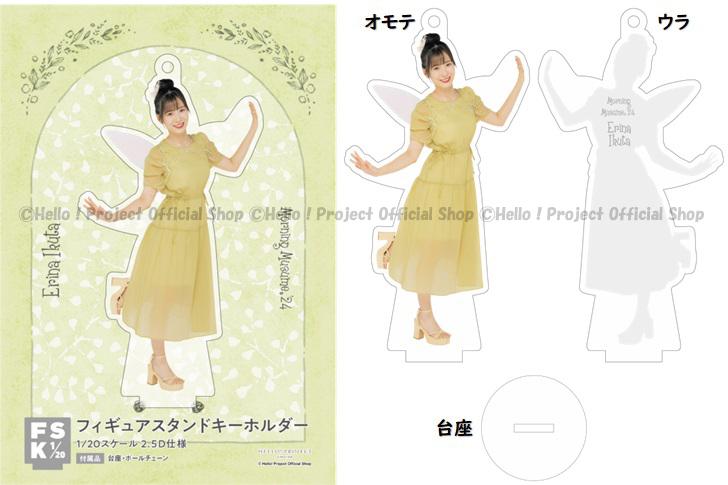
The official page lists the shop-original Twinkle costume version for release on April 26, 2024, following advance event sales that March. It is approximately 1/20 of the performer’s height, with a base and ball chain. This photograph illustrates a 2024 product, not the earliest release.
The image shows a chain hole above the head and a tab at the feet for the base. The same item can hang from something or stand on its base. Its backing card, performer photograph and reverse-side name and outfit text all contribute to the product.
Distinguishing an acrylic stand from an acrylic keychain as “standing” versus “hanging” is convenient, but products like this combine both functions. Check the included base and chain, and which parts need removing for travel, rather than relying on the name alone.
2025: Linking Fans’ Photographs to an Official Activity
In August 2025, Hello! Project announced a photo contest inviting pictures of FSK merchandise with summer scenery, food and other subjects on X. Entries ran from August 15 to September 30, 2025 (official announcement, Japanese). The submission period has ended; this is not a currently open invitation.
The announcement illustrates a use beyond buying and displaying: taking the item outside, photographing it and sharing the result. The official organizer incorporated fans’ enjoyment of photography into an activity. An announcement is different from demonstrated sales growth or participant satisfaction.
When photographing a stand at a café or destination, follow the venue’s rules and consider others. Keep merchandise off food and venue equipment, leave walkways clear, and avoid publishing identifiable bystanders without considering their privacy. Choose a position that reduces the risk of falling or blowing over.
Timeline: Material, Printing, Products and Participation
| Year | Event traceable in official material | What it documents |
|---|---|---|
| 1933 | PLEXIGLAS trademark registration | Transparent acrylic material |
| 2008 | LEC-300 announcement describes white printing on transparent film | Printer functionality |
| 2011 | LEF-12 launches with direct printing on objects | Equipment supporting goods production |
| 2024 | Twinkle Figure Stand Keychain goes on sale | A product combining base and chain |
| 2025 | Summer FSK photo contest is announced | A post-purchase participation activity |
This timeline does not identify an inventor or the first acrylic stand. It organizes different kinds of evidence so that the relationship between material, production, specifications and fan use can be examined.
- MaterialPLEXIGLAS name registered
- Printing equipmentSpecific capabilities reach commercial machines
- Product exampleA stand with a base and ball chain
- Fan participationA summer photography contest
The material’s age is not the age of a fan-merchandise category.
Carrying a Stand Makes Dimensions and Storage Important Too
Acrylic stands are flat, but they are not all small or resistant to damage. Poses and costumes change their width; narrow parts and tabs may be vulnerable to pressure. A carrying case should accommodate both the body and base while limiting rubbing against the print.
The same character can appear in different outfits, poses and sizes with different accessories. To display a group, measure base widths and spacing as well as height. Assign a place for each base so that hurried packing after a photograph does not leave one behind. Merchandise Storage Ideas provides further guidance.
An estimate of overall fan spending cannot simply be labeled the acrylic-stand market. Popularity, product counts, company revenue and total fan spending are separate indicators. The Size of the Oshi-Katsu Market explains conditions for reading market statistics.
- 01MeasureBody, base and spacing
- 02CarryAvoid pressure and rubbing
- 03Set upFollow venue rules and keep the stand stable
- 04Pack awayReturn the base and accessories to their places
A flat collectible still needs a considered way to travel.
Notes From The Oshi Lab: Plan for the Setting in Which Goods Will Be Used
Alongside choosing a photograph or illustration, planners can ask where the stand will sit, what will be displayed beside it and how it will travel. Base dimensions, ease of assembly, reverse-side appearance and compatible organizers make the after-purchase experience more concrete.
For a range of performers, consider someone who enjoys one item over time as well as a person collecting the entire group. Clear information about chosen versus random sales, possible rereleases and ordering periods belongs in the product guidance too.
Rather than presenting material invention and fan photography as one inevitable success story, examine what became possible and how it was used at each stage. That approach can inform a new product or a new way to enjoy an item already on your shelf.
Related articles: What Is an Acrylic Stand? / Merchandise Storage Ideas / A Birthday Party for an Absent Oshi
FAQ
Does acrylic’s 90-year history mean fan stands have existed that long?
No. The invention of a material and a particular product’s first release are separate questions. This article distinguishes material history, printing functions, an official 2024 product example and a 2025 fan activity.
Does the launch of UV printers explain when random sales began?
No. Official announcements document printer functions, but the choice of franchise, quantities and sales format is a separate decision. Those announcements alone do not establish the origins of random sales or set-completion culture.
How does an acrylic stand differ from an acrylic keychain?
A stand generally uses a base for display, while a keychain hangs from a chain or fitting. Some products include both a base and a ball chain, so check the particular item’s specifications.
Can I still enter the 2025 FSK summer photo contest?
The published entry period was August 15–September 30, 2025 and has ended. It appears here as a historical example of a fan participation activity.

