
Oshikatsu & Convenience Stores: Lessons from Genshin Impact Visuals on Cups, Prints, and Merch
Media and pop-culture collaborations rolled out at Japanese convenience stores (conbini) frequently bundle several distinct sales formats—such as special packaging on everyday products, print-on-demand sales via in-store multi-copy machines, and limited-edition merchandise stocked on retail shelves—under the umbrella of a single campaign. For visiting fans conducting oshikatsu (activities supporting their favorite characters or creators), this means figuring out when to go, which stores participate, and what conditions apply to get each item. For the businesses planning these campaigns, it is an area that tests their ability to design clear customer guidance that prevents confusion between free purchase bonuses, standard everyday products, and standalone retail merchandise.

Because convenience stores sit right along people’s daily commuting and errand routes, they are easy places to drop by even on busy days when fans do not have time to travel to specialty shops or event venues. Yet precisely because these stores feel so accessible, assumptions like “if I just stop by a store, they’ll probably have the full lineup of something” or “if I buy an eligible item, I should be able to pick the character design I want” can easily lead to confusion at the register and inquiries to store staff.
In this article, using the public announcement materials for the Genshin Impact collaboration unveiled by FamilyMart on February 6, 2026, as a concrete case study, we walk step by step through how to read official promotional images, why it is vital to verify product specifications, how fans can make informed decisions when visiting a store, and what design points campaign planners should keep in mind for their announcements and store operations.
Different Sales Formats Coexisting Inside a Single Collaboration
When people hear about an intellectual property (IP) collaboration at a convenience store, many immediately picture a “purchase bonus” where buying several qualifying snacks or bottled drinks earns you a clear file folder, a “character lottery” (kuji) where every paid draw wins a prize tier, or a “receipt-entry sweepstakes.” However, when you read actual campaign announcements carefully, you often find that instead of free giveaways or prize draws, multiple independent, paid products are being promoted side by side across completely different sales channels.
Looking at the announcement for the Genshin Impact collaboration released by FamilyMart on February 6, 2026, the rollout carrying the same title’s name included at least three distinct purchasing mechanisms (FamilyMart Official News Release (in Japanese)):
- Collaboration Packaging on Everyday Products (FAMIMA CAFE Cups) Under this setup, the cups used for specific sizes and menu items of the store’s regular counter-service coffee switch to limited-quantity collaboration designs. When you buy the beverage itself, the container comes printed with character artwork; it is not a promotion where a separate, free giveaway item is handed out alongside your drink.
- Print-on-Demand Sales via In-Store Machines (Famima Print) This format uses the multi-copy machines installed inside the store, allowing customers to purchase and print out character bromides (collectible photo prints) and similar items during a designated sales window. Rather than searching store shelves for physical stock, fans operate the kiosk terminal to buy standalone prints one sheet at a time.
- In-Store Limited Merchandise Sales In this format, original goods such as acrylic stands are placed on retail displays at participating stores starting on a specified release date and time. Just like standard retail merchandise, availability depends on whether a given store carries the line and how much local inventory remains in stock.
Collaboration Cups (Everyday Product Packaging)
- Available in limited quantities from February 10, 2026 (announced for approx. 16,000 stores excluding Okinawa Prefecture)
- Applies specifically to the red medium (M) cup for Blend M and Cafe Latte M
- Four designs in total, but customers cannot choose the design
Famima Print (In-Store Machine Sales)
- Announced sales window from 10:00 a.m. on February 10 to 11:59 p.m. on March 29, 2026
- A separate paid product where bromides and prints are bought at the multi-copy machine
- Not a free purchase bonus included with beverages or other merchandise
In-Store Limited Merchandise (Retail Goods)
- Scheduled on a separate date starting at 10:00 a.m. on February 13, 2026
- Launch date and time differ from the start date for the cups and prints
- Sales conditions and stock must be checked as standalone retail products
As this breakdown shows, even when everything looks like “the same title collaboration at the same convenience store” from a fan’s perspective, a beverage ordered at the counter register, a print produced at the multi-copy machine, and physical merchandise stocked on retail shelves differ completely in how you buy them and when they go on sale. Sorting out exactly what you receive in exchange for which payment is the first step toward preventing wasted trips.
Reading Display Design and Participation Conditions from Official Visuals
When looking at press releases and promotional graphics for a collaboration campaign, paying attention not just to the character illustrations but also to how elements are arranged on the screen and what the text notes say reveals concrete clues about the participation rules. As an example of information design in a past campaign announcement, let us examine the visual for the FamilyMart × Genshin Impact FAMIMA CAFE collaboration cups announced on February 6, 2026.
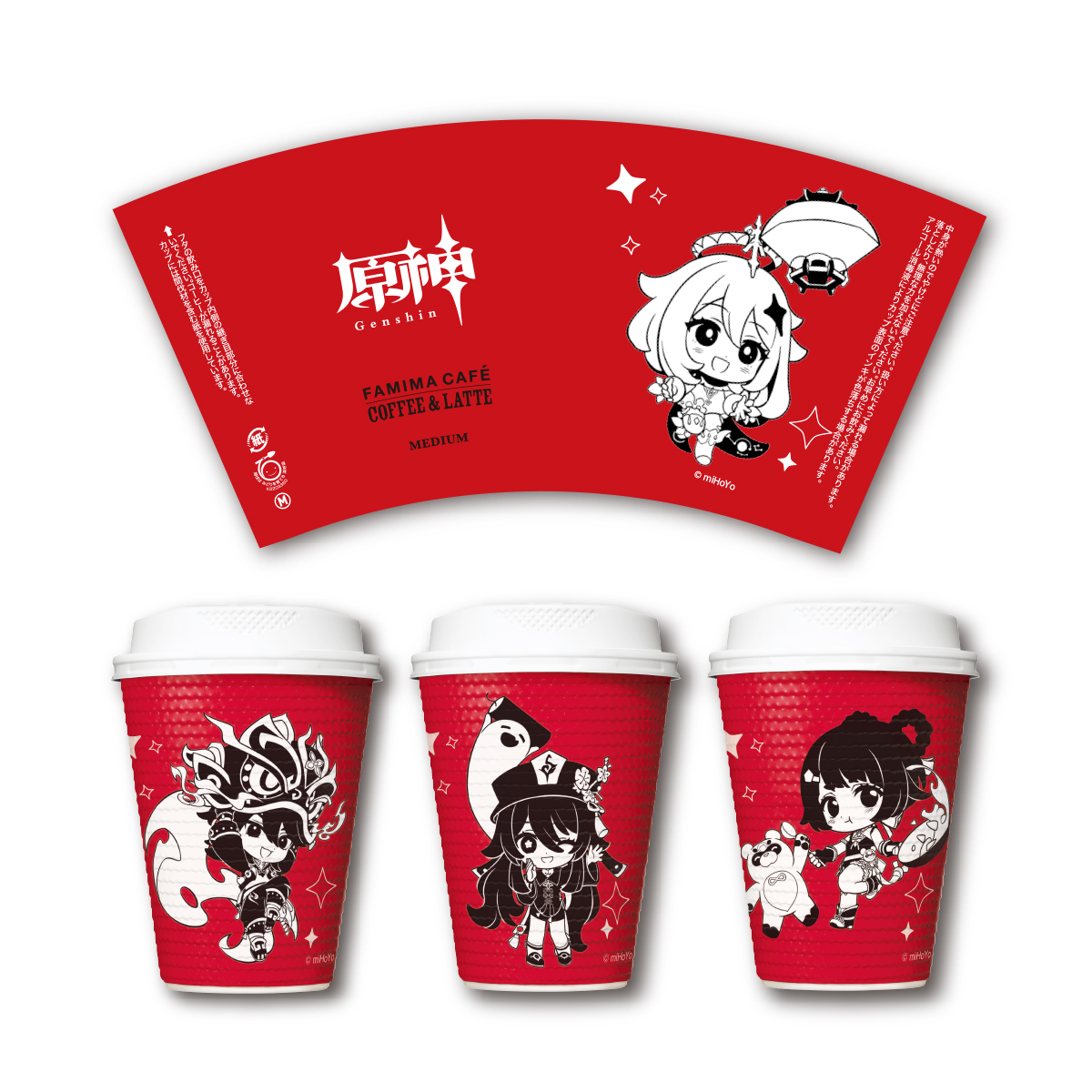
This graphic is an informational visual that fits all four cup designs into a single square frame. When we observe it closely, we can see thoughtful information design that goes well beyond simply lining up character art.
What catches the eye first is the large, flattened wrap-around layout diagram of a red cup positioned across the upper half. It features an illustration of Paimon, spreading the artwork out flat so viewers can take in the entire design at a single glance—something that would be hard to see from one angle once the cup is formed into a cylinder. Arranged across the lower half are three fully assembled cups, positioned so that the front-facing designs for Gaming, Hu Tao, and Xiangling are clearly visible.
In other words, by combining one flattened wrap-around diagram with three three-dimensional cup mockups, the single visual simultaneously communicates where the character art and logos sit around the curved surface of the cup and shows that there are four designs in the lineup. Furthermore, alongside the characters, the graphic preserves essential text details: the names of the eligible beverages, the “M” size indicator, cautionary fine print, and the copyright notice (©miHoYo).
Why You Should Check the Specifications Instead of Judging by the Photo Alone
From the perspective of a reader or fan, the first point to watch out for here is that just because all four designs appear together inside a single promotional image does not mean a single purchase gives you a set of all four cups. Moreover, when all the designs are displayed side by side in an appealing lineup, it is easy to fall under the impression that you can walk up to the counter and ask for “the Hu Tao cup, please”—yet the actual announced terms explicitly state that customers cannot choose the design.
Checking the detailed conditions in the official release further reveals several specific restrictions (FamilyMart Official News Release (in Japanese)):
- Restrictions on Eligible Menu Items and Sizes: The collaboration cups apply only to the red medium (M) cup used for “Blend M” and “Cafe Latte M.” Ordering a small (S) or large (L) size, an iced beverage, or a menu item served in a differently colored cup will not give you this collaboration cup.
- Regional and Quantity Conditions: FamilyMart announced that the cups would roll out in limited quantities starting February 10, 2026, at approximately 16,000 FamilyMart stores nationwide, excluding Okinawa Prefecture. However, this reflects the distribution plan at the time of the announcement; it does not guarantee that every store will have all four designs on hand at the exact same moment or that stock remains available at any given time.
- Avoiding Assumptions About Details Not Shown in the Photo: While the promotional image clearly shows the exterior artwork on the red cup, it cannot tell you about the paper weight, heat or cold insulation properties of the material, or whether the cup can be washed and preserved long-term. It is important not to guess at material performance or care methods based solely on how a product looks in a promotional graphic when those aspects are not officially specified.
In short, a promotional visual serves only as an entry point for seeing which characters appear and how the layout is arranged. What you actually need to order at the register can only be confirmed by cross-referencing the small notes inside the graphic with the detailed specification text in the news release.
Communicating Not Just the Start Date, but the Exact Time for Each Item
In this announcement, the cups were scheduled to launch on February 10, the multi-copy prints at 10:00 a.m. on that same day, and the in-store retail merchandise at 10:00 a.m. on February 13. If fans only remember that “the collaboration starts on the 10th,” they can easily mix up the release date and time for the specific item they want. On the promotional side, planners need to break down and display what becomes available when on an item-by-item basis.
- 011. Separate the "Sales Format" of the Desired ItemDistinguish whether the item is everyday product packaging (like a drink cup), an in-store copier print, retail shelf merchandise, or a purchase bonus or lottery.
- 022. Check the Start Date, Time, and Eligible Regions per ItemVerify whether dates and times are split even within the same collab—such as 'starts Feb 10,' 'starts Feb 10 at 10:00 a.m.,' and 'starts Feb 13 at 10:00 a.m.'
- 033. Confirm Eligible Products, Sizes, and Selection RulesCheck conditions that are easy to mistake when ordering, such as 'red M cup for Blend M and Cafe Latte M only' and 'design cannot be chosen.'
- 044. Decide How to Act Based on Store Conditions That DayDistinguish between limited-stock items and fixed sales periods, and confirm the conditions that apply at the time of ordering or purchase.
A print bought at a multi-copy machine and physical merchandise displayed on a retail shelf also require looking in completely different parts of the store. When promotional announcements guide customers directly toward instructions on how to operate the target kiosk or where to find the retail display, fans can understand the buying process before they ever step through the doors. Pairing the visual appeal of photos and character names with clear explanations of purchasing procedures and conditions is essential.
Conditions Campaign Planners Should Align Across Graphics and Body Text
The Genshin Impact cup graphic presents one design as a flat wrap-around diagram and three designs as three-dimensional cup mockups. While this layout makes it easy to compare the character artwork, illustrations alone cannot fully convey conditions like which specific beverages qualify or whether customers can pick their design. That is why planners need to place concise notes—“4 designs in total,” “red M cup,” “design cannot be selected”—right next to the visual inside the graphic, while also repeating those exact same conditions consistently in the body text of the announcement.
When bundling multiple product categories into a single campaign, planners should clearly separate standard product packaging, separately sold retail merchandise, free purchase bonuses, and entry-based lotteries. In the Genshin Impact case as well, the coffee cup serving as a beverage container is presented separately from the prints and retail goods that customers pay for individually. When building a product lineup table or guide, pairing the price of each item category with its participating store scope, start and end dates and times, and quantity limits helps prevent misunderstandings.
Similarly, when planning a campaign with staggered release dates, it is important to estimate the on-site workload generated at each store—such as stocking shelves, handling counter register orders, and answering questions about the multi-copy machine. Alongside a clear schedule of release dates and times, these operational details are vital information to share with store staff in advance.
Convenience store collaborations offer the unique fun of encountering artwork from a favorite series right in the middle of an everyday shopping trip. Campaign planners and communicators do well to pair creative visual layouts that showcase character designs clearly with straightforward, comprehensive guidance explaining the exact conditions for buying each item.
Related articles: What Is Oshikatsu Marketing? / Case Studies of Oshikatsu Marketing Mistakes / How to Plan a Collaboration Cafe and Successful Case Studies / The Oshikatsu Market Size (2026 Edition)
FAQ
What are the different sales formats used in convenience store collaboration campaigns?
Broadly speaking, they include everyday products packaged in special collaboration designs (such as cups for eligible drinks), print-on-demand items that can be purchased during the campaign period using in-store multi-copy machines, and limited-edition merchandise displayed on store shelves. Because free purchase bonuses distributed with qualifying buys work differently from separate products that each require their own payment, checking how each item is sold ahead of time is essential.
Can customers choose their favorite design for collaboration cafe cups?
That depends on the specific campaign and how individual stores operate. For example, in the announcement for the Genshin Impact collaboration FAMIMA CAFE cups (four designs in total) released by FamilyMart on February 6, 2026, the campaign applies to the red medium (M) cup used for Blend M and Cafe Latte M drinks, and the official guide states that customers cannot choose the design. Not every cup size or beverage is eligible, nor does a single purchase give you the entire set of designs.
If items belong to the same collaboration campaign, do they all go on sale on the same day?
Even within a single collaboration for the same title, the sales start dates, times, and periods may be split up by product category. In FamilyMart's Genshin Impact collaboration announcement, the collaboration cups were scheduled to launch in limited quantities starting February 10, 2026; Famima Print items were scheduled from 10:00 a.m. on February 10 to 11:59 p.m. on March 29 of the same year; and limited in-store merchandise was scheduled on a separate date starting at 10:00 a.m. on February 13, 2026.
What is the difference between multi-copy machine print items and in-store merchandise?
Print items from a multi-copy machine are purchased by operating the in-store kiosk yourself during the announced sales window. By contrast, limited in-store merchandise is stocked on shelves at individual locations starting at the designated release date and time, making it much more dependent on which stores carry the items and their local inventory levels. Even when visiting the exact same convenience store, the conditions you need to check in advance change depending on which type of item you are after.
What should companies keep in mind when creating promotional graphics for a convenience store collaboration?
When displaying multiple designs or products inside a single promotional image, it is crucial to distinguish them clearly so fans do not mistake the visual for a complete set included with a single purchase or a free purchase bonus. Planners need to align the fine print inside the graphic with the main body text to communicate the exact names and sizes of eligible products, the fact that designs cannot be selected, the specific start dates and times for each item category, and any regional exclusions.


