
Oshikatsu at Bookstores & Stationery Shops: Character Displays and Choosing Fan Planners
In bookstores and stationery departments, we see examples of both shelves displaying official character goods from anime and comics, and sections carrying planners and stationery for fans to write down and preserve their own activities and impressions. Even when they sit side by side inside the very same store, a shelf that visitors seek out for a specific series and stationery that people choose to match their personal recording style regardless of genre differ in both what prompts a store visit and how shoppers select products.

For fans, the store information and product specifications they need to check in advance change depending on whether they are looking for official merchandise from a target series or tools to use for daily journaling and storage. Meanwhile, for planners at bookstores and manufacturers designing sales floors and products, it is essential to separate these two distinct qualities in their planning and organize in-store guidance and specification displays accordingly. Drawing on publicly available official announcements, this article examines how permanent character shelves work, how fans choose recording stationery, and how retailers approach sales floor design.
Permanent Shelves Visited for a Specific Title vs. Recording Stationery Chosen for One’s Own Activities
When looking at initiatives related to oshikatsu (fan activities supporting a favorite character or artist) in bookstores, we need to distinguish between character merchandise sections built around specific media titles and stationery sections that support fans’ own journaling and organization.
In sales areas built around specific titles, official character goods like acrylic stands and pin badges line the shelves. The direct reason readers and fans visit the store is whether products featuring the series or characters they support are stocked there. For that reason, the accuracy of information—such as which store locations have the shelves installed, which titles are lined up during the current period, and what the stock arrival status looks like at each individual store—serves directly as the basis for deciding whether to visit.
By contrast, stationery items like planners, notebooks, and binders get chosen even when no specific series title is printed on them. What fans prioritize are the specifications themselves: whether the item fits the pace of their fan activities, whether it has enough pages for the amount they want to write, and whether it is easy to use alongside the trading cards, rigid card cases, and pens they already own. Whereas a franchise shelf is a place for encountering titles and collecting items, a recording stationery shelf functions as a place to select tools for keeping a personal record of events and daily viewing experiences.
Permanent Shelves for Official Character Goods
- Shoppers visit the store specifically looking for particular anime, comic, or game titles
- In the announcement covered here, three franchises of character goods are scheduled to be updated on an irregular basis
- Checking participating stores as well as store-specific product selection and stock arrival status in advance becomes crucial
Recording Stationery for Oshikatsu and Life-Logging
- Chosen to fit a fan's own recording pace and intended use without being restricted to a specific title
- Specifications such as dated vs. undated layouts, page size, and how pages are divided serve as the selection criteria
- Used continuously not only when attending events, but also for daily schedule management and reflection
As this comparison shows, even among initiatives inside the same bookstore, the points fans pay attention to differ between franchise shelves and recording stationery. Let us first look at the mechanics of each through concrete examples from official announcements.
How Permanent Shelves Work and What to Check: Miraiya Shoten’s “Character Spot”
One example of setting up a permanent sales area for character goods inside a bookstore is Miraiya Shoten’s “Character Spot.” In Miraiya Shoten’s official “Character Spot” announcement (in Japanese), the company announced the installation of permanent shelves handling anime, comic, and game goods across 17 stores nationwide. Those 17 stores represent the number of participating locations announced in that release; the figure does not indicate the chain’s total store count or its latest number of participating locations today.
What stands out in the announcement is that while establishing a permanent shelf space, the store plans to update the three franchises of character goods carried within it on an irregular basis. As the initial lineup, three titles were named—Pokémon Masters EX, My Hero Academia, and Tashiro-kun, Kimi tte Yatsu wa. (a boys’ love manga title by Yamada)—with plans announced to roll out miscellaneous goods such as acrylic stands and pin badges.
Key Points Fans Should Check Before Visiting a Store
What readers and fans want to keep in mind when using this permanent shelf is that not every Miraiya Shoten location nationwide has the exact same display, and furthermore, the announcement notes that product selection and stock arrival status vary from store to store even among the locations chosen for installation. The official release explicitly states that availability and deliveries differ depending on the store.
Under a system where three featured titles rotate on an irregular basis, a series that was lined up on a previous visit will not necessarily still be carried today. Moreover, even during the same period, inventory and delivery timing for specific products can differ depending on the location. When heading out to look for goods from a target series, first checking whether your nearest location is included among the stores with a “Character Spot” installed, and then verifying the currently carried titles and stock status through each individual store’s posts or guidance before making the trip, will help reduce misunderstandings in store.
The Bookstore and Planner Perspective: Designing Permanent Spaces with Rotating Lineups
Here, let us shift our perspective to the bookstore staff who plan and operate the sales floor. Compared to setting up a limited-time pop-up event space from scratch each time, securing a permanent frame like “Character Spot” inside the store and updating the featured titles three at a time on an irregular basis offers the advantage of keeping the sales location fixed and easy to direct customers toward. For store visitors as well, it becomes easier to build the expectation that if they check that designated spot in the store, some kind of franchise merchandise will be lined up there.
However, as long as the contents rotate even within a permanent shelf, organizing clear information about which store is currently carrying which titles—and how much stock has arrived—becomes vital. If press release announcements alone leave shoppers with the impression that identical inventory is available across every participating store, fans who make a trip to the shop may be unable to find the products on the floor and end up confused. When headquarters plans a lineup rotation, designing a coordinated approach for communicating store-by-store availability and delivery differences via in-store signage and individual store updates forms the foundation for keeping a permanent shelf functioning well over the long term.
Structure of Recording Stationery and Reading the Product Photos: MARK’S “funlog”
Next, let us look at an example of stationery designed for fans to write down and keep track of their own activities and daily events. On July 15, 2025, MARK’S Inc. published its announcement release for “funlog” (in Japanese) as a new brand for enjoying life-logging. According to this announcement, “funlog” is structured to launch with a total of seven products, combining new undated planners with existing items.
Under the release schedule announced at the time, the 2026 edition weekly block planners were slated to go on sale sequentially starting August 7, 2025, while the newly added A6-size half-year undated planners (a format used only on the days you want to write) were scheduled for sequential release starting September 1, 2025. A major defining feature is that within the very same brand, both a weekly block format with pre-printed dates and an undated format where users fill in the date themselves on the days they wish to write are provided.
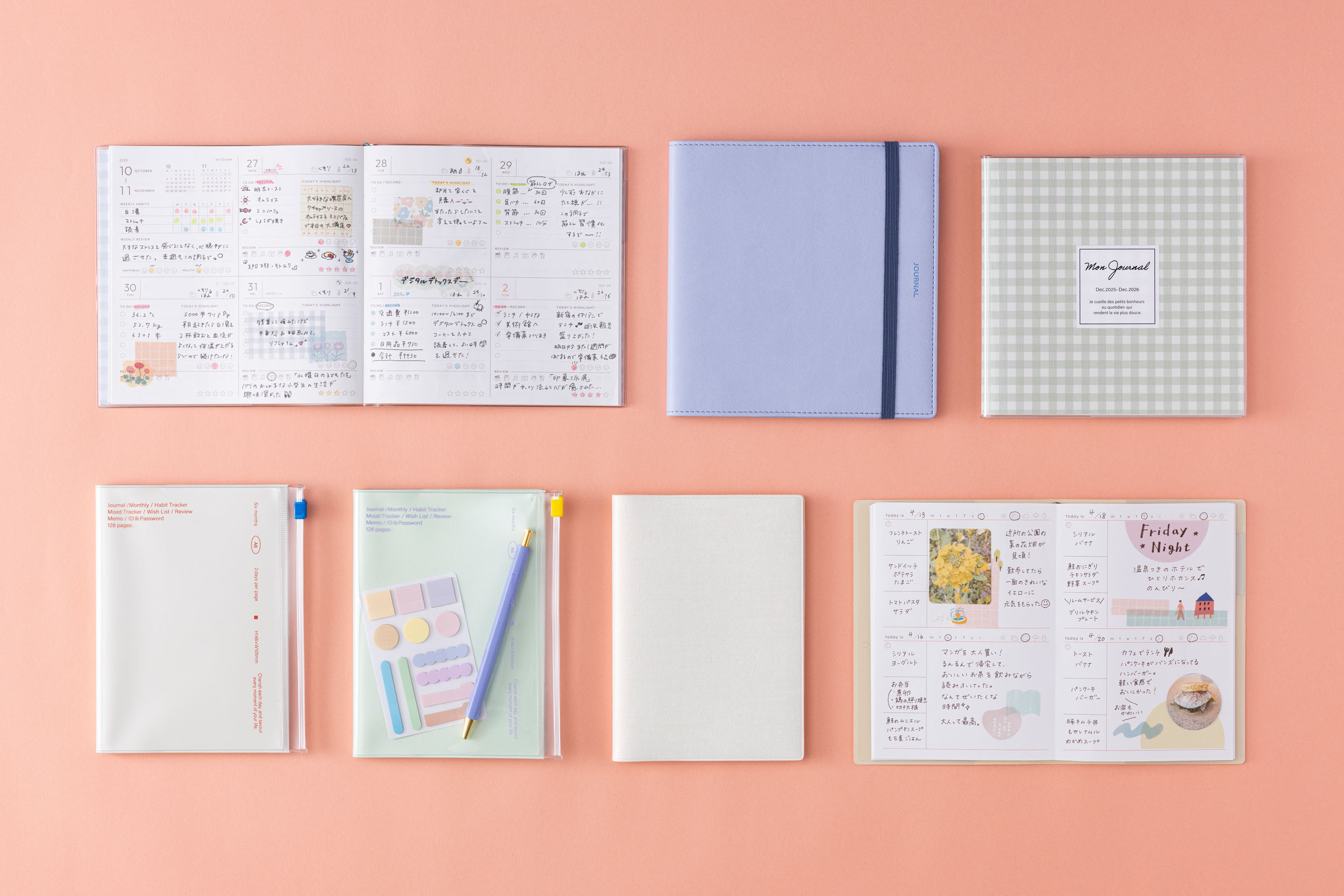
When we closely observe the official product photo above, the differences between the two formats and how they look in use become clear. In the upper row of the photo, alongside planners with blue and plaid covers, we can see the layout of the dated weekly pages. A single week is divided across a two-page spread or similar layout, structured so that users can line up schedules and events along the days of the week and calendar dates.
Meanwhile, the lower row of the photo shows nearly blank white pages, examples where a user has written in their own illustrations and short text entries inside the page, and scenes of pens and sticky notes tucked in together for use. Rather than filling in a fixed box every single day, this illustrates a style of jotting things down in one’s own layout whenever there is something one wants to write.
Choosing Between a Weekly Divided Format and a Write-When-You-Want Format
For readers choosing a planner, the contrast between the upper and lower rows of this photo offers a practical clue for considering which style better fits the pace of their own oshikatsu and daily journaling.
For instance, if you want to keep track of weekly anime broadcast or livestream schedules, ticket application windows, lottery result announcement dates, and multiple event dates in chronological order, a dated weekly block planner like the one in the upper row is well suited. Because the weekly divisions are pre-printed, you can see at a glance when a plan takes place, and you can use it directly for managing schedules before and after fan travel (ensei).
Conversely, if “what I write isn’t decided on a daily basis” or “I only want to put together my thoughts and drawings on days I went to a concert or stage play, days I got new merch, or days there was a memorable livestream,” a planner with dates lined up for every single day will end up with many blank pages. In those situations, an undated planner designed to be used on the days you want to write (A6 size, half-year capacity), as shown in the lower row, becomes a strong option. Because you can use pages only on days when an event worth recording happens without worrying about strings of blank days, it is a format that even fans whose event frequency fluctuates can easily continue using at their own pace.
Concrete Preparation When Fans Choose and Use Planners and Stationery
When actually selecting a recording planner and related items at a bookstore or stationery shop, and when starting to use them after purchase, going through a few concrete checks and preparations helps prevent missteps.
- 01Organizing What and How Often You Want to RecordDecide whether to track weekly livestream and application dates or focus on saving impressions from events you attended
- 02Checking Planner Format and Page SizeVerify whether to pick a dated weekly block or undated format (such as A6 half-year), and whether it fits inside the bag you carry
- 03Combining with Companion StationeryConsider whether to pair it with pens and sticky notes as in the photo, and how to choose oshi colors and cover designs
- 04Mindful Sharing Scope and Rights ConsiderationsWhen posting pages to social media, avoid unauthorized reproduction of official images or accidentally capturing ticket face details
First, the reason to check specifications in-store or on official web pages is that not only the visual design, but also “how long a time span and how much volume you can write” differs from product to product. For example, the “funlog” undated planner was announced as an A6-size format covering half a year, which differs in both page dimensions and time-span concept from the 2026 edition weekly block planner. Which product you should choose changes depending on whether you want to manage your schedule across an entire year in a single booklet, or compile event logs in a compact A6 size covering six months at a time. Please note that because release dates and specifications in official announcements reflect information as of the announcement date, you should verify current in-store stock status and the latest product guidance when actually making a purchase.
Next is preparing peripheral stationery tailored to how you use your planner. In the product photo earlier, we saw examples of pens and sticky notes tucked in right next to the pages. For information where dates are finalized or changed later—such as advance ticket lottery windows or payment deadlines—writing them on sticky notes and sticking them in is easier to organize than writing directly onto the page from the start. Furthermore, if you plan to use pens or stickers in your oshi color (a signature color associated with your favorite character or idol), or carry the planner around inside an ita-bag (a clear-windowed bag displaying character badges and merch) or your everyday bag, you will also want to check whether the cover pattern and physical size match the items you already own. For methods on organizing merchandise itself, Oshi Goods Storage Ideas is also a helpful reference.
Before sharing photos of your planner pages on social media or other platforms, check the usage terms for any pasted images or drawn illustrations, as well as whether personal names, reservation numbers, or barcodes are visible in the frame. Another practical approach is to keep a separate setup for records meant solely for your own enjoyment versus photos taken for public sharing. The conditions around handmade items and image usage are organized in Checking Rights for Handmade Oshikatsu Goods.
Considerations When Bookstores and Stationery Makers Present Their Sales Floors
When a bookstore promotes a shelf carrying franchise merchandise, it should clearly indicate the currently carried titles, participating store locations, and where customers can check stock arrivals. When there are plans to rotate the lineup—as in Miraiya Shoten’s announcement—stores should separate guidance about the shelf itself being permanent from expectations about being able to continuously buy the exact same title. One effective approach is to build a pathway from the initial introductory article directly to each individual store’s update feeds.
In planner and stationery sections, retailers should display not only the outer covers, but also the interior page layouts and examples of how to fill them in. When placing examples of a weekly format alongside a write-when-you-want format, arrange them so shoppers can compare their respective date structures, page divisions, and portable dimensions. Even when multiple products appear together in promotional photography, clearly label which product’s specifications are being shown.
When creating sample displays in-store or on the web, retailers can present not only examples where an entire page is filled with heavy decoration, but also straightforward approaches that simply record dates and short impressions. Finally, stores should prepare clear navigation leading from launch-time introductions to actual participating store lists, inventory checks, and arrival updates.
Related articles: What Is Oshikatsu Marketing? / Oshikatsu Market Size (2026 Edition) / What Are Trading Cards (Toreca)? / Oshi Goods Storage Ideas
FAQ
What is the difference between an official character goods shelf at a bookstore and recording stationery designed for oshikatsu?
A permanent shelf for official character goods is a sales area where store visits and purchases are sparked by a specific title, whereas recording planners and stationery are tools that fans choose regardless of any specific title to write down and keep their own schedules and impressions.
Can you buy the exact same products at every Miraiya Shoten location that has a 'Character Spot'?
The official announcement states plans to install the display in 17 stores nationwide and update its three initial franchises of character goods on an irregular basis, while noting that product availability and stock arrivals vary by store. Shoppers need to check each individual store's updates before visiting.
How should fans choose between the dated planners and undated planners in MARK'S 'funlog' lineup?
A dated format like the 2026 weekly block planner works well when you want to line up and manage a full week of schedules, livestreams, and event dates in chronological order. On the other hand, the half-year A6 undated format is suited for when you want to pick and record only the days you attended an event or want to write down your thoughts.
What kind of information do bookstores and stationery makers need to provide when presenting oshikatsu sales areas and products?
For permanent displays, it is essential to clearly state participating store locations and note that product selection and stock arrivals differ by store; for planners, presenting specifications like dated versus undated layouts, sizes, and page structures is key. In addition, when handling limited-edition bonuses or popular items, stores need to prepare purchase conditions and in-store guidance methods in advance.


