
Oshikatsu & Railways: Reading Keihan's Sound! Euphonium Train Wraps and Tickets
In transportation infrastructure such as railways and aviation, oshikatsu (supporting one’s favorite characters, idols, or creators) initiatives are built not just around traveling to a destination, but around multiple layered experiences: purchasing limited-edition tickets, touring stations and local neighborhoods, and admiring custom-wrapped vehicles. However, operating formats and ticket rules are far from uniform across transit providers, and conditions that apply to one specific rail line do not automatically carry over to other lines or to the aviation sector.

In this article, we examine a concrete case study from the railway sector: Keihan Electric Railway’s “Keihan Electric Railway x Sound! Euphonium 2026 Autumn” campaign. By carefully reading through the officially released design diagrams for the wrapped train, the specifications for the free tickets (special day passes), and the schedule divisions for the digital stamp rally one by one, we will connect the decision-making criteria fans use when visiting in person with the design perspective corporate planners need when structuring campaigns and visitor guides.
Reading the Official Design Diagrams: What to Look For in Wrapped Trains and How to Check Schedules
In any railway collaboration, the first thing that catches the attention of many fans is the wrapped train—railcars decorated on the exterior with visual artwork from the featured series. First, let’s take a look at the visual for the Otsu Line wrapped train released on the official campaign page.
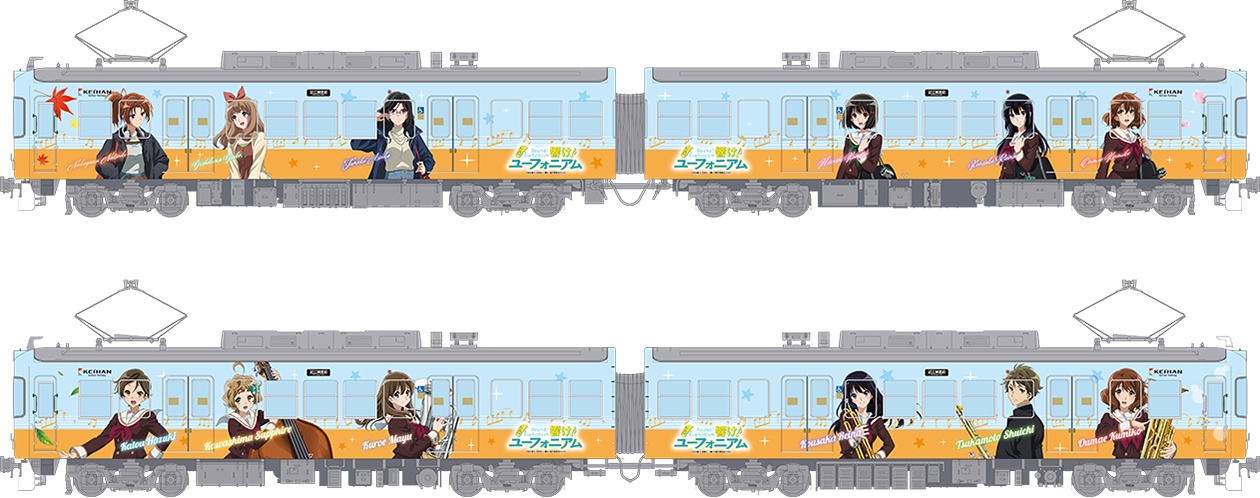
This image is not a photograph taken of the train running in real life, but an officially provided wrapping design diagram. On the screen, the side designs for two railcars featuring a blue and yellow color scheme are arranged vertically. Because four side-view illustrations are stacked from top to bottom, it might look at first glance as though there are four different train sets; however, this diagram shows both the left and right sides of a single two-car train set. Readers should be careful not to miscount the number of operating train sets or attempt to guess real-world photography locations from this layout drawing.
When we observe the placement of the design elements closely, we can see that the character illustrations are laid out to fit neatly below the windows or near the ends of the cars, while the series title and musical note motifs connect in a continuous band running from the center of the car body toward the ends. Railway cars have numerous structural elements—such as passenger windows, doors, and exterior destination displays—that break up visual sightlines and surface decoration. From a design that places characters beneath windows and at car ends while using a ribbon of musical notes to create visual continuity across the entire car body, we can see how the artwork is coordinated with the exact positions of windows and doors.
When fans decide they want to see this train in person or actually ride aboard it, the very next thing they must check after viewing the design diagram is the operating rail line and the conditions of its running schedule. This wrap is applied to Otsu Line 700 series cars 705–706, with the operating section designated as the Ishiyama Sakamoto Line and the scheduled operating period announced as September 1, 2026, to March 31, 2027.
An important point to keep in mind here is that even during the overall operating period, there is no guarantee that you will be able to ride this specific train every single day. Because the operating schedule is announced on the official website, visitors need to cross-reference their planned travel date with the target train set. For that reason, checking the running schedule via the official announcements before departing for the area is an essential step. Furthermore, when viewing or photographing the train, the fundamental premise is to enjoy it from designated public areas available to regular passengers—such as station platforms or public roads—and fans must refrain from entering restricted or unauthorized areas just to get a shot.
When a transit company presents this design diagram alongside its operating guide, it connects the specific train set, the rail line, and where to check the running schedule. Because a design diagram alone cannot tell passengers what time the train runs on any given day, the company also provides clear directions on where to check the daily operating schedule.
How Free Ticket Specifications Differ Between the Keihan Line and Otsu Line—and How to Choose
Once you have confirmed which rail line the wrapped train runs on, the next decision you face is choosing the right train ticket. In railway collaborations, special free tickets (unlimited-ride day passes) bundled with commemorative bonus items are often sold, but even within a collaboration for the exact same anime series, ticket types are sometimes divided by rail line.
In the “Keihan Electric Railway x Sound! Euphonium 2026 Autumn” campaign, a free ticket for the Keihan Line and a free ticket for the Otsu Line are prepared as completely separate products. When we organize the sales conditions, valid travel zones, and included bonus items for each pass, it becomes crystal clear why checking the specifications in advance is so important.
Keihan Line Free Ticket
- Sales period: October 17, 2026 – March 31, 2027
- Price & eligibility: 1,700 yen (Adults only, limited quantity)
- Valid zone: All Keihan Line routes and the Cable Line for 1 designated day (Otsu Line excluded)
- Included bonus: Comes with a ticket-style clear card
Otsu Line Free Ticket
- Sold as a separate ticket from the Keihan Line version (sales locations and conditions also differ)
- Price & structure: 1,700 yen (Set of two 850-yen 1-day passes)
- Valid zone: Valid across the entire Otsu Line
- Included bonus: Comes with a clear photo card
Source: Compiled from official announcements for Keihan Electric Railway x Sound! Euphonium 2026 Autumn
Comparing the two tickets side by side, both are priced at 1,700 yen, yet what is inside the package and where you can use them differ substantially. The Keihan Line Free Ticket is on sale from October 17, 2026, through March 31, 2027, is available in an adult fare version only in limited quantities, and comes with a ticket-style clear card. It is valid for one designated day across all Keihan Line routes as well as the Iwashimizu-Hachimangu Sando Cable (funicular line), while the Otsu Line is explicitly excluded from its valid travel zone. In other words, while this pass is well suited for touring locations along the Keihan Line such as the Uji area, it cannot be used as a fare ticket to ride the wrapped train (700 series cars 705–706) running on the Ishiyama Sakamoto Line that we looked at earlier.
On the other hand, if you want to ride the Otsu Line wrapped train back and forth along the Ishiyama Sakamoto Line, or if your goal is to collect the clear photo card bonus, the Otsu Line version of the free ticket becomes your option. Priced at 1,700 yen, this version is structured as a two-ticket set of 850-yen one-day passes, covers the entire Otsu Line as its valid zone, and has different sales locations and conditions from the Keihan Line version. Additionally, if you do not need the collaboration bonus item, you can also consider using standard fare tickets suited to the specific sections you plan to ride. Please note that these prices and specifications reflect the details presented in the official announcements for this campaign, and they do not guarantee constant inventory at every station ticket window or identical terms across other campaigns.
When fans plan a longer fan travel trip (ensei) or a day-trip anime pilgrimage, the ticket they should buy changes depending on their primary goal: “Do I most want to experience touring spots in the Uji area, riding the wrapped train on the Otsu Line, or visiting both areas in a single day?” If you plan to tour both the Keihan Line area and the Otsu Line area in one day, avoiding the assumption that a single Keihan Line Free Ticket covers the entire company network—and instead researching the right combination of tickets for your travel sections and their sales locations ahead of time—will keep you from getting stuck at the ticket gates or station counters on the day of your trip.
For the railway company planning the campaign, presenting the information so passengers can compare the two before purchasing makes it clear that even tickets with the exact same price have different valid zones and ticket counts. From this case alone, we cannot determine the internal business reasons for creating separate tickets or measure whether the two-pack structure led to repeat visits. What is essential is guiding passengers by clearly separating the conditions for using the ticket to board trains from the commemorative bonus items they take home.
Digital Rally Schedule Divisions and Etiquette When Walking Around Local Neighborhoods
After taking the train and stepping off at your destination station, a digital stamp rally serves as a mechanism to encourage fans to venture out from the station into the surrounding town. A digital rally is also being held as part of this Autumn 2026 campaign, but the overall campaign period, the rally period itself, and the first-half and second-half phases within the rally are finely divided.
Specifically, the first half (zenki) of the digital rally is set from September 1 to October 31, 2026, while the second half (kouki) runs from November 1 to December 20, 2026. When we compare these dates against the scheduled operating period of the wrapped train (September 1, 2026 – March 31, 2027) and the sales period of the Keihan Line Free Ticket (October 17, 2026 – March 31, 2027), we see that the overlapping initiatives shift depending on when you visit. For example, someone visiting in November 2026 will arrive during the wrapped train’s operating period, during the Keihan Line Free Ticket’s sales period, and during the second half of the digital rally. Conversely, if someone visits in or after January 2027, the digital rally will have already ended, even though the wrapped train and free tickets are still within their active periods.
In the second half of the digital rally, three locations are listed as eligible check-in spots: the Uji River Riverside Aqueduct Bridge (Ujigawa Kasenjiki Suikankyo), Agata Shrine, and Kohata Shrine. While all of these are wonderful places within walking distance of stations where visitors can take in the local scenery, historic shrines, and the atmosphere of the riverbank, they are not just tourist sites—they are also everyday living spaces for local residents and quiet, sacred shrine grounds.
For this reason, the official announcements specifically call on visitors to be considerate so as not to disturb the neighborhood, particularly regarding conversation noise at night. From autumn into winter (November through December), the sun sets early, making it a season when the surroundings quickly grow dark during late-afternoon and evening pilgrimages. When fans tour these locations in person, they are expected to act with respect for the daily lives of the local community—such as working backward from sunset to plan an arrival time that leaves plenty of daylight to complete their walk, and lowering their voices when walking in groups near residential streets or shrine precincts.
When corporate planners design region-linked rallies, simply listing locations associated with the anime series is not enough. If the event period spans from autumn into winter, planners need to account for shorter daylight hours and nighttime quiet, explicitly stating reminders about “consideration for the neighborhood, such as keeping voices down at night” on the official website and within the rally app. Building guidance that protects the relationship with the local community into the campaign from the very beginning ultimately creates the foundation that allows collaborations to continue in the same region over time.
Coordinating Separate Reservations for Hotels, Cafes, and Events Within Your Overall Schedule
On special campaign websites for railway collaborations, information about collaboration hotels, collaboration cafes, and even special one-day events is frequently listed alongside train tickets and stamp rallies. A common pitfall for fans here is the misconception that “if I just buy a free ticket and head to the area, I can casually experience the cafe and hotel tie-ins on the spot as part of the flow.”
In this campaign as well, the hotel, cafe, and special events each have their own individual schedules and terms of use; simply purchasing a train ticket does not guarantee hotel accommodations, cafe dining, or event admission. Visitors must check each individual announcement to see whether advance reservations or lottery applications are required. Moreover, the campaign includes future events held only on specific dates, such as a special event scheduled for December 19, 2026.
If we organize the steps that fans heading to the area should check in advance as a chronological workflow, it looks like this:
- 011. Cross-Check Your Visit Date Against Active PeriodsVerify what is running on your travel date—such as the wrapped train (through Mar 31, 2027), the rally's second half (Nov 1 – Dec 20), or the Dec 19 event.
- 022. Arrange Initiatives Requiring Separate BookingsCheck the individual official announcements for hotel, cafe, and event dates, and confirm whether advance reservations or lottery entries are required.
- 033. Select Train Tickets Matching Your Travel ZonesResearch free ticket types and sales locations based on your route—whether all Keihan Line routes + Cable Line, or the entire Otsu Line.
- 044. Check Daily Train Schedules and Local EtiquetteConfirm the operating schedule for 700 series cars 705–706 via official announcements, and be mindful of nighttime voices around the Uji River aqueduct and shrines.
Source: The Oshi Lab's summary of the article
Breaking down the process this way reveals that planning a railway collaboration trip goes much more smoothly when you work backward from securing dates for separately booked hotels, cafes, or specific single-day events (such as the December 19 event), rather than starting with buying a train ticket. Of course, there is no obligation to participate in every single initiative. A fan’s dedication is never measured by the quantity of merchandise or tickets purchased or by how frequently they visit. In fact, one of the best parts of a multi-part collaboration is the freedom to pick and choose according to your own budget and schedule—saying, “This time, I’ll just enjoy riding the Otsu Line wrapped train and getting the commemorative pass,” or “For this trip, I’ll focus on walking around Uji for the second half of the digital rally.”
Considerations for Companies Designing Multi-Part Campaign Guides
On a comprehensive landing page for a multi-part collaboration like this, planners should display the train operating period, ticket sales and validity periods, digital rally periods, and cafe or hotel operating and stay periods separately. Because purchasing a transit pass and reserving a cafe table or hotel room do not follow the same booking procedure, clear links should be provided to guide users directly to each respective instruction page.
Furthermore, the guidance visitors need differs between places where they view trains and places where they walk through local neighborhoods. Planners should place links to daily train operating schedules and reminders about consideration for local residents right next to each corresponding initiative. Finally, clearly distinguishing between first-half initiatives that have already concluded and upcoming events scheduled for specific dates like December 19, 2026, allows fans to verify exactly what is available when choosing their travel dates.
Related articles: What Is Oshikatsu Marketing? / What Is Fan Marketing? / Fan Travel Packing Checklist / Oshikatsu Market Size (2026 Edition)
FAQ
If I visit during the wrapped train's operating period, am I guaranteed to be able to ride the featured train on any day?
Even during the overall operating period, there is no guarantee that you can ride the train every single day. While the Otsu Line wrapped train (700 series cars 705–706) is scheduled to run on the Ishiyama Sakamoto Line from September 1, 2026, through March 31, 2027, you need to check the official announcements in advance for the daily operating schedule.
If I buy one Keihan Line free ticket (day pass), can I also use it to ride the wrapped train on the Otsu Line?
The valid travel area for the Keihan Line version does not include the Otsu Line. If you plan to ride the Otsu Line, you will need to prepare a ticket valid for the section you are using, such as a standard fare ticket. If you also want the collaboration bonus item, the separately sold Otsu Line Free Ticket (1,700 yen for a set of two 850-yen one-day passes) is an option.
Does buying a free ticket automatically allow me to participate in the collaboration cafe and hotel programs?
Purchasing a train ticket alone does not guarantee hotel stays, dining, or event participation. You must check the separate official announcements for the schedules of the hotel, cafe, and special events, as well as whether advance reservations or lottery applications are required.
What should I keep in mind when visiting spots around Uji for the digital rally?
In addition to checking that the event periods and eligible locations differ between the first half (September 1 to October 31, 2026) and the second half (November 1 to December 20, 2026), local etiquette on the ground is essential. When visiting the second-half locations—the Uji River Riverside Aqueduct Bridge (Ujigawa Kasenjiki Suikankyo), Agata Shrine, and Kohata Shrine—visitors are asked to be considerate so as not to disturb the neighborhood, especially regarding loud conversation at night.
When corporate planners create visitor guides for railway collaborations, why is it necessary to break down the rail lines and schedule periods in such detail?
Because a single collaboration campaign brings together multiple initiatives with different conditions—including operating rail lines, valid ticket zones, first-half and second-half rally periods, and separately booked cafes or hotels. Clearly separating excluded sections and reservation requirements is essential so that passengers can build their itineraries without getting confused on the ground.


