
Oshikatsu and Well-Being: What Survey Numbers Say About Joy and Strain
You finish work looking forward to a day when your favorite—your oshi—is streaming. After watching a match, conversation with friends flows easily. How does the everyday feeling that life is more fun when you have someone to root for connect with the happiness levels reported in surveys?

Some surveys find higher happiness among people who practice oshikatsu (supporting a favorite idol, character, athlete, or creator), while others using a proprietary composite index find scores close to the overall average. To compare results, we need to check what was asked and of whom. As we unpack these surveys, we will also look at ways to reflect on our own enjoyment and strain.
In ASAKO’s Survey, People Practicing Oshikatsu Reported Higher Happiness
ASAKO’s 5th Well-Being Survey was conducted in November 2025 among 2,800 people in their 20s through 80s across Japan. Among those practicing oshikatsu, happiness was 67.3% and self-affirmation was 50.6%. The company reported that these figures were 3.9 percentage points and 7.5 percentage points higher, respectively, than among people not practicing oshikatsu.
| Metric | All respondents | People practicing oshikatsu |
|---|---|---|
| Happiness | 63.8% | 67.3% |
| Self-affirmation | 43.9% | 50.6% |
The “All respondents” column in the table includes people who practice oshikatsu. The 3.9-point and 7.5-point differences reported by the company are not the result of simply subtracting one column in this table from the other. ASAKO’s survey analysis (in Japanese)
What we can say from this is that there was a difference between the surveyed groups. It is not a measurement of change showing that each individual respondent became happier than they were before starting oshikatsu.
How Many People Had an Experience Differs from How Much They Value It
According to a survey by Ponta Research, the most common positive experience through oshikatsu over the past month was “feeling comforted or reassured,” at 35.6%. Meanwhile, when rating importance to their sense of happiness, “having fun every day” ranked at the top. The left side of the chart shows the percentage of respondents who experienced each item, while the right side shows the degree of importance they placed on it—they are not measuring the same ranking.
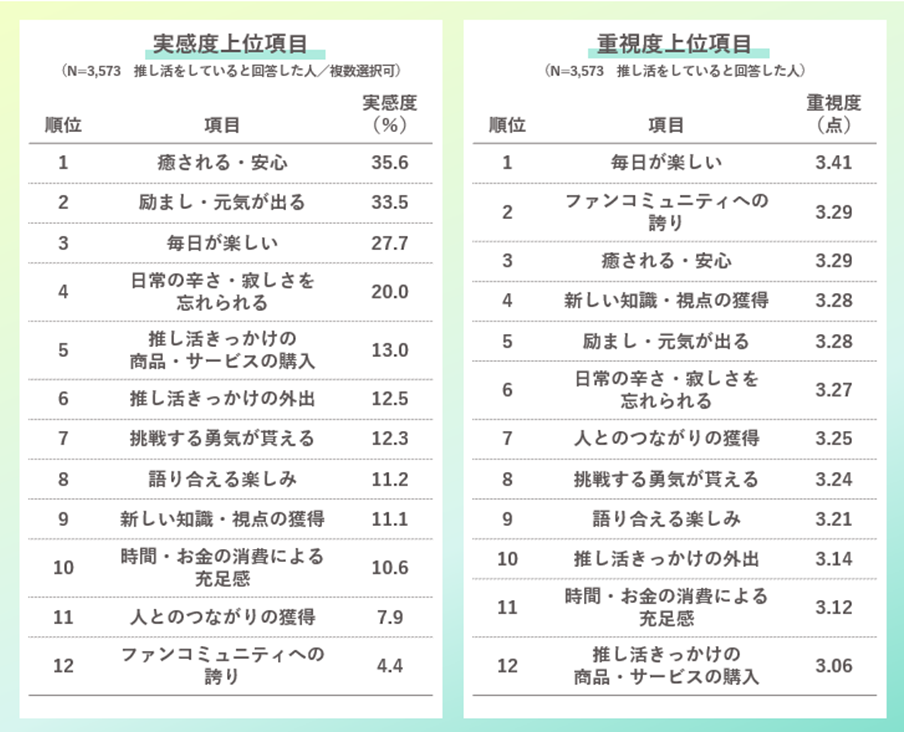
The survey was conducted from August 1 to 11, 2025, among 9,904 Ponta Research members aged 15 to 89 living in Japan. Within that sample, 3,573 responses came from people practicing oshikatsu, and the tabulated figures were weighted to match Japan’s population composition. Survey results and tabulation conditions (in Japanese)
To put this in everyday terms, even if you have many days where listening to a song brings you peace of mind, what you value most deeply might be the time spent talking over your impressions with a friend. How often an experience happens and how much weight it carries for a person need to be asked about separately.
When Metrics Differ, the Same Oshikatsu Looks Different
In the same Ponta Research survey’s proprietary index, totonoi-do (degree of overall life balance and well-being), the composite score for people practicing oshikatsu was 49.8 points, while the overall average—including those who do not practice oshikatsu—was 50.1 points. In addition, among negative experiences, “wasting money” was the most common at 17.1%. All figures are from the Ponta Research survey. Loyalty Marketing’s published report (in Japanese)
ASAKO’s happiness figure is a percentage, whereas Ponta Research’s totonoi-do is a proprietary point score. Because both the respondents and the questions differ, we cannot conclude that “one was higher and the other was lower, so one of them must be wrong.” Nor can we average the two figures to create a single happiness score.
In the first place, having moments of satisfaction is separate from having no strain across your life as a whole. Even when a live show itself is wonderful, you might still worry about lost sleep after getting home late or about the bill afterward. It is important not to try to explain a person’s entire life from a single “I had fun” response.
What Is Being Measured
- The substance of the question—such as enjoyment, self-affirmation, or overall life
- Whether it is the percentage of people who had an experience or a score of importance
- Whether it covers experiences over a set period or feelings at the time of response
Who Is Being Compared
- Respondents' age range, region, and how participants were recruited
- Whether it is the difference between people who practice oshikatsu and people who do not
- Whether it tracks changes in the same individuals between before and now
A guide to reading published survey materials. It is not meant to combine numbers from different metrics into one.
Even When Groups Differ, the Reason Cannot Be Narrowed Down to One Thing
Even when happiness is higher among people practicing oshikatsu, we cannot rush to conclude that oshikatsu raised their happiness. We also need to consider the possibility that people who already have room in their schedule and budget find it easier to start such activities, along with differences in age, health status, and living environment. Determining which explanation applies requires separate verification.
For example, if the period when someone started going to concerts overlapped with a period when their workload became lighter, it would be difficult to narrow the reason for their change in mood down to just one factor. That is a hypothetical example for explanation, but it shows why knowing the sequence of events still requires thinking about what else happened in between.
Tracking the same individuals over time and accounting for differences in living conditions provide material for thinking about potential reasons. Even so, those steps alone cannot establish every cause with certainty. When businesses cite these findings in presentations or communications, a group difference shown in a survey does not serve as evidence promising that every participant will experience the same effect.
Reflect on Your Own Week Through What You Enjoyed and Where You Overextended
Survey averages are not a grading scale for your own way of enjoying fandom. It is completely fine to have days when your mood does not lift even while practicing oshikatsu, and someone who enjoys following their favorite while spending very little money is not necessarily any less satisfied than someone who spends a lot.
To look back on your week, one approach is to write brief notes on three questions: “What was fun?”, “Where did I push myself too hard?”, and “If I change one thing next, what will it be?” You can write down both that watching a stream cheered you up and that staying up late made the next morning rough. There is no need to assign point scores; this is simply a record to check whether days in the same state are continuing in a row.
- 01Note the moments you enjoyedWrite down what felt good to you—songs, matches, works, or conversations
- 02Write down what felt taxing tooLook at where you pushed yourself in sleep, travel, spending, or socializing
- 03Pick one thing to change nextWatch via archive, trim your schedule, or review your budget
- 04Try it for a while and revisitAvoid locking in a fixed amount to keep up; match your current life
An example for reflecting on everyday life. It is not a method for measuring happiness or a diagnostic check of mental health.
For instance, if watching late-night streams is fun but leaves you struggling the next day, you can check how long the official archive stays available and set aside days to watch later. If buying merchandise used to be a joy but payments are starting to worry you, you can review your total expenses—including shipping and travel costs—before your next purchase.
If talking with friends is a source of support, yet conversations comparing how many items everyone bought leave you exhausted, you can change the topics you focus on or how often you meet. You can keep supporting your favorite while reducing only the parts that have become a burden. Our guides to healthy distance with your oshi and keeping an oshikatsu budget book also cover concrete ways to make adjustments.
Do Not Use Survey Numbers to Blame Yourself When You Cannot Enjoy It
Even if you find yourself thinking, “People who do oshikatsu are supposed to be happy, so why am I struggling?”, a survey does not judge an individual’s feelings. When life circumstances change or you no longer have the bandwidth to keep up with works and broadcasts, the way you used to enjoy fandom may simply stop fitting your life.
A youth mental health website run by Japan’s Ministry of Health, Labour and Welfare introduces self-care ideas matched to your physical condition and mood that day—such as moving your body, writing down how you feel, or listening to music. When you are having a hard time, there is no need to do all of them. If you continue to have trouble sleeping or eating, or if work or school remains difficult, do not try to carry it solely through adjustments to your oshikatsu; please also consider speaking with someone close to you, a local support service, or a medical professional. Public self-care guidance in Japan (in Japanese)
Lab Note: Alongside Sales, Ask About Both Satisfaction and Strain
When companies and event organizers measure purchase amounts, attendance counts, and viewing hours, each metric serves a specific business purpose. However, those numbers alone cannot explain fans’ well-being or the depth of their affection.
In a post-event survey, alongside asking what went well, organizers can also ask about wait times, transit, clarity of on-site guidance, and whether attendees felt good about what they spent. It is also important to remember that the experiences of people who do not respond—or who have stopped attending for a while—drop out of the totals. Before proposing ways to increase participation, it is worth considering whether current participation options can be made easier to choose and whether sources of strain can be reduced.
FAQ
Do people who practice oshikatsu have higher well-being?
In ASAKO's 2025 survey, respondents who practiced oshikatsu reported higher happiness than those who did not. By contrast, Ponta Research's proprietary composite index showed a score close to the overall average. Because the respondents, questions, and metrics differ, the numbers cannot be compared on a single scale.
Will starting oshikatsu make me happier?
The surveys introduced here show differences between groups and patterns in responses; they do not prove that starting oshikatsu caused an increase in happiness. Other factors—such as a person's living environment or existing room in their time and budget—also need to be considered.
What is the difference between the percentage of people who had an experience and the importance placed on it?
The percentage who had an experience reflects how many respondents said they experienced it. Importance is the score respondents gave for how much that experience matters to their sense of happiness. A common experience is not necessarily evaluated as the most important one.
How can I reflect on the strain in my own oshikatsu?
One method is to jot down brief notes on moments you enjoyed, where you pushed yourself too hard, and one thing you want to change next. This is not a scored diagnostic test. If effects on your sleep, meals, work, or studies continue, please also consider speaking with someone close to you, a local support service, or a medical professional.


