
Designing First Fan Encounters: Lessons from the Pokémon × J.League Collaboration
The project linking Pokémon and Japan’s professional soccer league, the J.League, offers a clear catalyst for people to look from a character they already love toward a regional club they do not yet know—a practical way to spark an encounter with a new oshi (a favorite team, player, or character to support). What businesses planning collaborations can learn from this example is how to create specific touchpoints with individual regions rather than simply issuing the exact same announcement nationwide.
In this article, based on the official 2026 announcements, we examine the distinct roles of club pairings, visitor giveaways, retail merchandise, and on-site experiences. We do not treat the announced giveaway volume itself as a measured result of new fan acquisition.
Comparing Pairings Across All 60 Clubs
The official Pokémon J.League Fest special website (in Japanese) introduces all 60 clubs across the J1, J2, and J3 divisions alongside each club’s designated partner Pokémon. For example, the pairings link Hokkaido Consadole Sapporo with Noctowl (Yorunozuku) and Urawa Red Diamonds with Incineroar (Gaogaen).
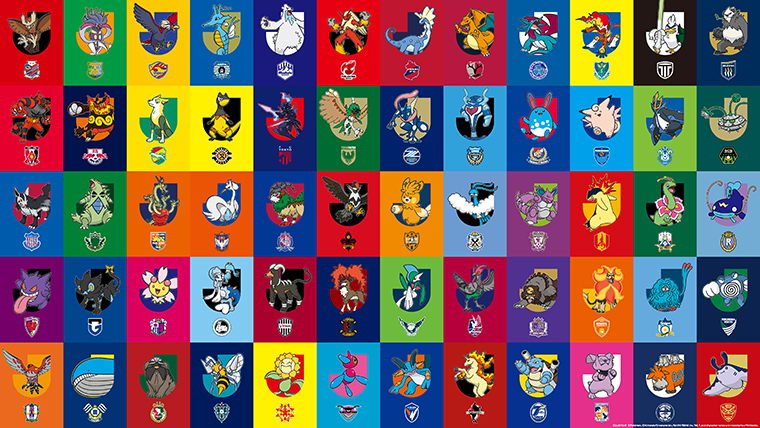
Whether someone searches first for a favorite Pokémon or starts with their hometown club, the directory allows them to discover the corresponding name on the other side. When a business adapts this structure for its own campaigns, simply preparing pairings between regions, stores, or products and an intellectual property (IP) is not enough; it also needs a lookup directory where visitors can check those pairings and clear navigation guiding them onward to each individual store or venue.
- 01Start from a Familiar InterestVisitors enter the directory looking either for a favorite Pokémon or for their local regional club.
- 02Discover the Paired CounterpartThe side-by-side list of all 60 J1, J2, and J3 clubs introduces the corresponding club or character name.
- 03Navigate to Regional VenuesClear links guide prospective visitors from the central lookup list to individual club or venue details.
Source: The Oshi Lab’s summary of the article
When discussing the reasons behind each pairing, it is important to keep official explanations separate from fan speculation. Observations from fans that a club and a Pokémon share similar colors or vibes should not be presented as the rightsholders’ official selection criteria.
Giveaways and Retail Merchandise Can Serve Distinct Purposes
The July 6 J.League announcement (in Japanese) stated that across eligible matches in August and September, a total of 1 million “EVO BAG” items—not-for-sale reusable tote bags featuring Pikachu alongside each club’s partner Pokémon—would be given away to attendees.
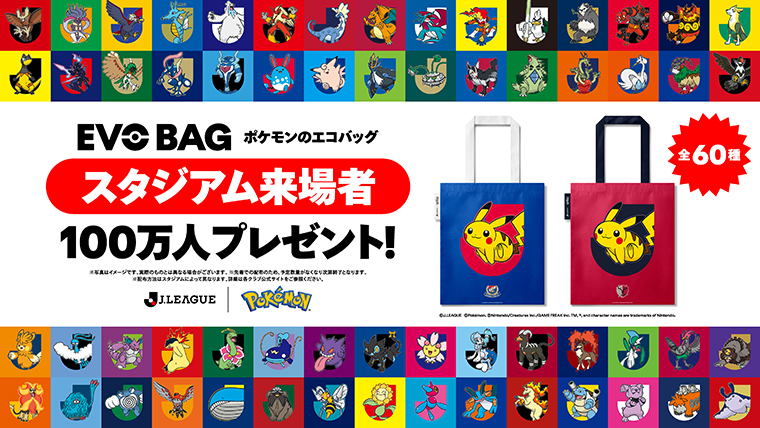
Meanwhile, a follow-up announcement on July 21 (in Japanese) introduced sales of original merchandise such as T-shirts, stadium photo spots, and tie-ins with the mobile game Pokémon GO. Rather than lumping retail goods and visitor giveaways together as the same thing, planners should consider what kind of touchpoint each format creates.
| Touchpoint | Conceivable Role in the Project | Conditions to Check |
|---|---|---|
| Visitor giveaways | Create an initial reason to attend and a physical keepsake | Eligible matches, eligible recipients, quantities, and how to claim |
| Merchandise sales | Let fans actively choose and own their favorite pairing | Sales locations, pricing, inventory, and made-to-order or shipping terms |
| Photo and game experiences | Build time spent participating at the venue itself | Event dates, exact locations, operating hours, and participation steps |
| Next-step guidance | Bridge interest beyond the collaboration itself | Information on upcoming matches or players, and ways to receive updates |
This table is a framework prepared by The Oshi Lab for evaluating campaign design. Even when an item is described as free, if claiming it requires conditions such as holding a match ticket, those requirements must be communicated clearly. It is vital not to let the phrase “free giveaway” alone give the impression that anyone can walk up and receive the item unconditionally.
Connecting the Theme of “Evolution” to League Changes
The official theme set for the project is “EVOLUTION! — The J.League Evolves.” It connects the J.League’s structural transition to an August season kickoff starting in the 2026/27 season with the concept of evolution in Pokémon.
In corporate collaborations as well, when audiences can immediately see why two logos have been placed side by side, the project becomes much easier to explain. For instance, planners can look for phrasing that fits an actual business milestone—such as “meeting for the first time” for a new store opening, or “time built together” for an anniversary. These are examples of how other businesses might apply the principle, not an indication that the Pokémon project had alternative themes.
Once the theme wording is chosen, planners should verify whether the promotional notices, item pickup process, and on-site activities genuinely connect back to that theme. Rather than choosing a slogan solely because it sounds catchy, explain what participants can actually do as part of the project.
Separating Official Announcements from Outcome Verification
A large-scale giveaway plan demonstrates the scale of a campaign’s setup. However, the announced scale alone cannot tell us how many people attended a match for the very first time, or whether the experience made them want to come back again.
What Official Announcements Show
- Planned scope across all 60 J1, J2, and J3 clubs
- Scheduled distribution plan for 1 million EVO BAG items
- Lineup of original retail goods, photo spots, and Pokémon GO tie-ins
What Separate Verification Must Measure
- Whether attendees were visiting for the first time and what prompted them
- Friction points or wait times during giveaway pickup and merchandise purchases
- New interest in players or matches and follow-up contact within consented bounds
Source: The Oshi Lab’s summary of the article
Depending on what a team wants to verify, the following methods can be considered:
- Ask on an optional basis whether attendees are watching a match in person for the first time and how they learned about the event
- Gather feedback on any confusing steps or waiting times experienced during giveaway pickup or merchandise purchases
- Ask whether the visit sparked an interest in specific players or the matches themselves
- Track subsequent touchpoints strictly within the scope of consented contact details or membership information
Keep what fans are buzzing about separate from whether business objectives were achieved. Avoid estimating repeat attendance or sales based solely on the volume of social media posts.
Preparing Regional Operations When Scaling Nationwide
The more pairings a campaign introduces, the more operational details each individual store or venue has to communicate. Start dates and times for sales or giveaways, eligibility conditions, and contact points for inquiries should be kept consistent between the central campaign website and each regional page. Decide in advance who is responsible for updating the information when changes arise.
After creating the fun of choosing a pairing, participants still have to go through the practical steps of searching, participating, and claiming their items. Making sure first-time participants can move through those steps without confusion is just as important as designing eye-catching visuals.
Related articles: The J.League and Oshikatsu / Fan Marketing / Oshikatsu Marketing
FAQ
What is the Pokémon J.League Fest?
It is an official project connecting all 60 J.League clubs across Japan with Pokémon to match the opening of the 2026/27 season. The announcements introduced a partner Pokémon for each club, visitor giveaways, merchandise sales, and on-site experiences.
Why create pairings for each of the 60 clubs?
This structure lets fans use a favorite Pokémon or a local club as an entry point to discover its corresponding partner. However, the actual effect on first-time attendance or repeat visits must be verified separately from the project announcement.
Can free giveaways and merchandise sales work together?
Yes, by separating their purposes: giveaways create initial encounters and keepsakes, while retail items let fans actively choose and own what they want. Even when an item is free, if receiving it requires conditions such as a ticket to an eligible match, those conditions should be stated clearly.
What should other industries keep in mind when applying this approach?
Provide both a complete directory for looking up pairings and clear participation rules for each store or venue. It is also essential to distinguish rightsholders' official explanations from fan theories, and not to treat announced campaign scale as proven business results.


