
In-House Oshi-Katsu: Sharing Appreciation at Work Without Compulsory Participation
How do people in your workplace share appreciation for a colleague’s help or a useful approach to a task? The Oshi Lab uses behaviors associated with fandom—supporting others, describing what is appealing and celebrating milestones—as prompts for thinking about workplace relationships. In this article, we call that perspective in-house oshi-katsu.

This does not guarantee that a particular initiative will change employees’ feelings. Drawing on a published company example, the guide explains decisions to make when creating a place for appreciation and how to check whether it adds burdens.
Workplace Appreciation and Benefits for Personal Fandom Have Different Purposes
Oshi-katsu leave or allowances for activities such as attending concerts support employees’ interests outside work. In-house oshi-katsu, as used here, is a way of thinking about sharing the value of people and work within an organization. A survey expressing support for fandom-related benefits does not establish that internal appreciation-sharing works.
Examples of fan behaviors and possible workplace applications include:
| Fan behavior | Possible workplace connection |
|---|---|
| Describe an appeal in your own words | Share a colleague’s useful approach or help you received |
| Write a fan letter | Send a short message of thanks |
| Celebrate anniversaries and milestones | Share project completions or small steps forward |
| Connect with people sharing an interest | Offer optional study groups or opportunities to share work-related knowledge |
This is The Oshi Lab’s application framework. Affection for an oshi and behavior within an employment relationship are different; select the elements useful for your setting rather than treating them as equivalent.
An Official Example: MRT’s Paper Thank-You Cards and Sharing Across Offices
Unipos’s published MRT case study describes displaying paper messages of thanks on an office wall. As employee and branch numbers increased, manual counting and communication between distant offices became challenges, leading to the introduction of a digital system.
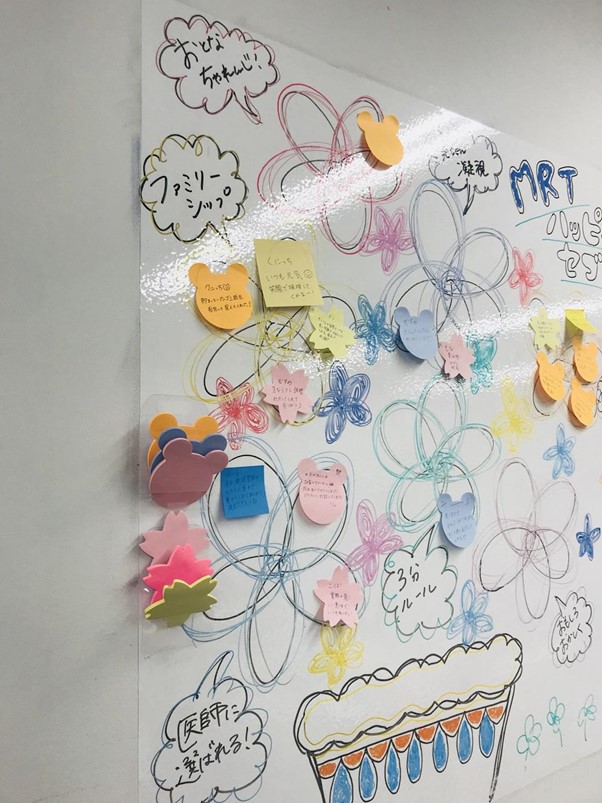
The photograph illustrates a way to leave short messages for others to see. But a single physical board does not reach colleagues working far away in the same way. The planning lesson is to decide whom a message should reach and how, before choosing paper or an app.
A case study helps explain an initiative. A provider’s account alone should not be treated as proof of effects on staff turnover or sales. When reviewing your own trial, distinguish it from other policy changes and business conditions.
- 01Define the purposeWhat help or useful work should be recognized?
- 02Choose the audienceThe recipient, a team or the whole company
- 03Choose the mediumPaper, an existing tool or another suitable channel
- 04Review the burdenInclude writers, recipients and administrators
The medium should follow the purpose and intended audience.
Four Decisions Before Starting
1. What Is the Space For?
“Make employees like the company” leaves people uncertain about what to write. Concrete actions, such as help received when stuck or an approach useful at work, make messages easier to compose. Provide examples so the space does not become a ranking of personalities or popularity.
For example, alongside “thank you as always,” someone might write, “you showed me where the documents were, which helped me prepare the handover.” This is an illustrative message, not an actual employee statement.
2. Who Can See It?
What people can write differs depending on whether the audience is only the recipient, a team or the whole company. Set rules against including client names, unreleased projects and personal circumstances. If photographs or messages will be used in recruitment publicity, confirm the intended use with the person; permission for internal sharing alone does not cover it.
3. How Can People Choose Not to Participate?
Plan an arrangement in which not posting or declining a feature does not disadvantage someone. Reconsider whether weekly posting quotas or rankings of messages sent and received fit the purpose of expressing thanks.
Other ways to engage can include reading, thanking a colleague directly, or using a non-public contact channel. A low posting count is not a reason to repeatedly ask employees to declare affection for the company.
4. Who Will Administer It?
Assign responsibility for questions, corrections and requests to remove a message. Start at a scale where administrators can respond to teasing or intrusions into private life. With an app, also check permissions, viewing scope, retention periods and costs.
Try It on a Small Scale and Check Reach and Burden
- Choose one purpose. For example: create opportunities to learn about help across teams.
- Try it with a small group of volunteers. Choose paper, an existing internal tool, a short sharing session or another available method.
- Ask writers and recipients for feedback. Check what helped, what required uncomfortable effort and whether anything was shared that they preferred to keep private.
- Decide what to continue. Include administration time, and retain the options to change, pause or end the trial.
If connecting appreciation with awards or performance assessment, explain fairness across the wider system. The number of thanks received should not be treated directly as a measure of contribution. Less visible work, working hours and office locations also affect opportunities for contact.
- 01One purposeIdentify the help that is hard to see
- 02Volunteer trialUse a method the group can manage
- 03Ask both sidesWriters and recipients may experience it differently
- 04Review the scopeContinue, adjust, pause or finish
Administration time and employee feedback belong in the review too.
Review More Than Posting Counts
| Question | An example of what to check |
|---|---|
| Did the message reach its intended audience? | Whether exchanges occurred across departments or offices |
| Has participation become burdensome? | Optional interviews or surveys about writing time and social pressure |
| Can non-participants still feel comfortable? | Comments treating non-participation as a problem and concerns about viewing scope |
| Can administration continue? | Time, inquiries and costs |
In small organizations, even anonymous feedback may be identifiable. Explain beforehand how responses will be handled and shared, and allow concerns to be raised individually. If using an engagement survey, a score change alone does not establish an initiative’s effect.
Notes From The Oshi Lab: Start With Everyday Appreciation
Support in fandom continues because the individual wants to engage. In a workplace application, the Lab prefers starting with making it easier to deliver thanks people wanted to express, rather than a system that checks whether employees “like” the company.
Ask one team which examples of mutual help tend to go unnoticed. Choose a communication method and viewing scope, then adjust them using employees’ feedback. This is something you can try before introducing an elaborate program name.
For consultations on fandom-related business projects and fan relationships, contact KAZAORI Inc.. Related: Oshi-Katsu Marketing / Fan Marketing
FAQ
What does in-house oshi-katsu mean here?
This article uses the term for applying fan behaviors such as support, describing appeal and celebrating milestones to thinking about workplace relationships. It is not presented as a program with guaranteed effects.
How is it different from fandom-related leave or allowances?
Leave and allowances support employees’ personal fandom activities. In-house oshi-katsu here concerns ways of expressing appreciation for people and work within the organization. Responses and effects should be examined separately.
Can a small company try it?
Choose one purpose and try paper or an existing internal tool with a small group of volunteers. Review burdens on writers and recipients and administration time, retaining the option to change or stop.
How can it be evaluated?
Look beyond posting counts to whether messages reach the intended audience, non-participants remain comfortable, and writing and administration are manageable. Do not equate thanks received with contribution or attribute survey-score changes to the initiative alone.


