
Feeling Oshikatsu Fatigue? How to Review Your Feeds, Schedule, Spending, and Fan Connections
You still care about your oshi—the favorite idol, character, or creator you support—yet keeping up with the constant stream of updates feels exhausting. When you see talk of the next concert or merchandise drop, the thought that “I have to keep up” hits you before any sense of excitement. At times like that, before questioning whether your affection is still real, it helps to look closely at which specific parts of your current fan activities (oshikatsu) are becoming a burden.

“Oshikatsu fatigue” (oshikatsu-zukare, or oshi-zukare) is not a medical diagnosis; it is an everyday expression describing a state in which the information, expenses, schedules, or social interactions involved in supporting a favorite feel heavy to carry. Rather than assuming that every fan shares the exact same cause or solution, this article separates what survey findings actually show from practical ways you can review and adjust your daily routine.
In the Survey, 70.8% and 55.1% Are Answers to Two Different Questions
In a survey published in April 2026 by Booklista’s Oshikatsu Research Department, 70.8% of respondents said they had experienced a drop in motivation toward their oshi or oshikatsu, while 55.1% said they had experienced oshi fatigue (oshi-zukare). These two figures come from separate questions. We should be careful not to misread the results as saying that all 70.8% experienced oshi fatigue.
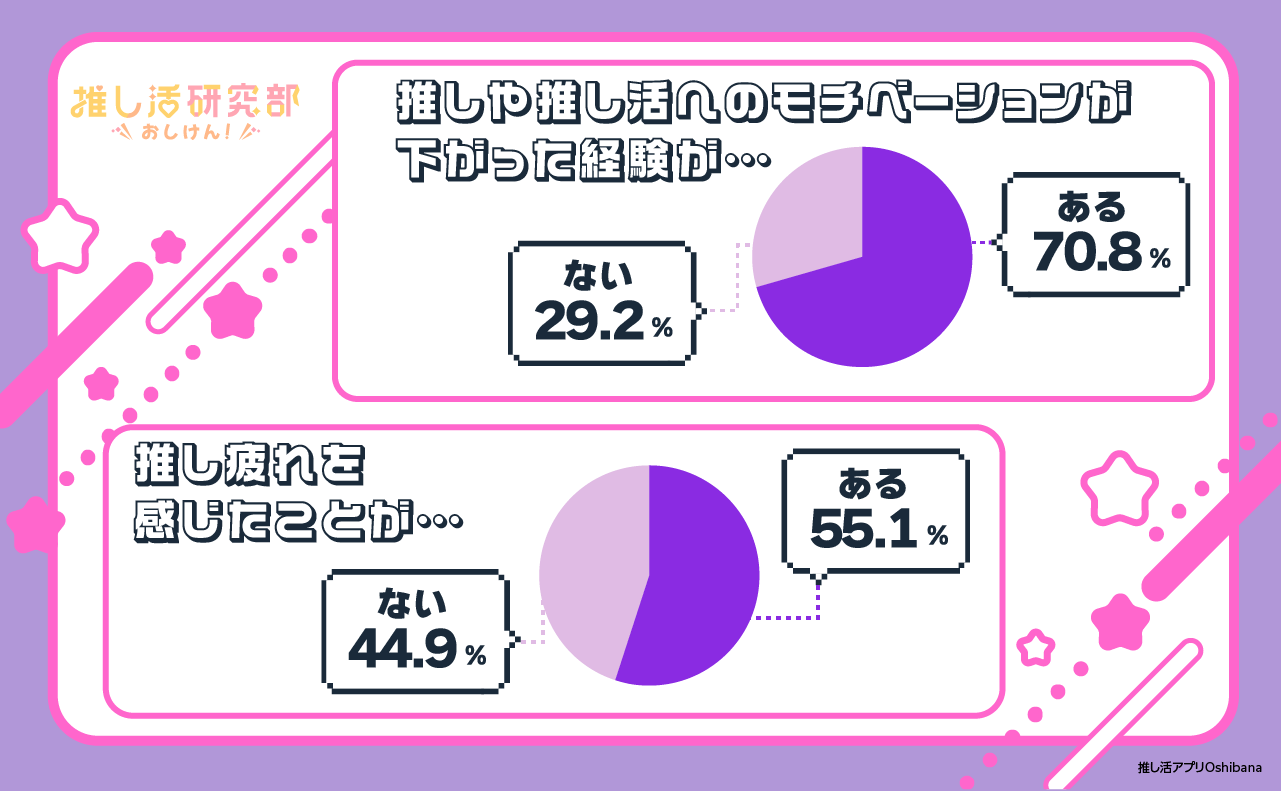
The survey was conducted as an online questionnaire from February 13 to March 19, 2026, through the oshikatsu app Oshibana. The respondents were 277 people from their teens to their fifties who engage in oshikatsu, with teenagers accounting for 52.9% of the sample. These figures should not be treated as percentages drawn at random from the entire population of fans in Japan. Booklista Survey Overview (in Japanese)
A shift in your enthusiasm for fan activities is also not the same thing as experiencing disruptions to your sleep or daily life. Rather than using survey percentages to tell yourself “everyone goes through this, so I should just tough it out,” or conversely deciding on your own that you must be ill, the key is to look specifically at what is causing you trouble right now.
When Following Updates Feels Tiring, You Have Room to Decide What Not to Check
Official posts, livestreams, reactions from fellow fans, and media appearance announcements often arrive across many different platforms at once. When you try to catch every single piece of information, you can easily end up checking your phone even during the hours meant for rest. Alongside finding ways not to miss important announcements, it is worth considering which kinds of updates you can choose not to follow right now.
For instance, you might check ticket notices and updates on items you have already purchased yourself, while temporarily cutting back on the time you spend searching related keywords or scrolling through algorithmic recommendation feeds. For late-night livestreams, another option is to check the availability window and conditions for the official archive first, and save the stream for another day when later viewing is possible. That way, you can adjust your intake without shutting down all of your social media accounts, keeping necessary lines of communication open.
If you turn off notifications, check the settings for each app and contact so that you do not accidentally block essential messages from travel companions or family members. If deciding to “look at nothing at all” makes you feel anxious in itself, you can try a routine where you check official announcements just once a day, such as during your lunch break. And if there is a day when you cannot stick to the number of checks you aimed for, you do not need to treat that as proof of failure.
- 01Notices with deadlines or required proceduresDecide on a single entry point for checking payments, lottery results, shipping notices, and venue changes
- 02Works and livestreams you genuinely want to enjoyPick what you personally want to watch and check the archive viewing conditions
- 03Fellow fans' reactions and related chatterAdjust for yourself how much you follow and when you look at it
- 04Topics that feel burdensome right nowTake a break from searches and notifications, and mute keywords or accounts if needed
This diagram does not rank the value of information. It is an example of sorting out the checks required for your practical life from the content you engage with for enjoyment.
Source: The Oshi Lab’s summary of the article
Before Applying for Events, Put Travel and Rest on the Calendar Too
Being technically able to get to a show is not the same thing as being able to attend comfortably without overextending yourself. When you look at your calendar with not only the curtain time in mind, but also travel, waiting lines, the trip home, and your schedule for the next day, overlapping burdens become much easier to spot.
For example, if an out-of-town concert trip (ensei) falls right before a morning when you have work the next day, think through your post-show transportation options, lodging, and time to rest after getting home before you commit. There is no need to set the upper limit on how many shows you attend based on how many dates other fans are going to. Whether you choose specific venues or pass on applying this round can be decided around your own schedule.
If you have already promised to attend with a companion, separate your decision to scale back your own participation from the practical step of communicating with the other person. Where promises involving coordination or splitting costs remain, talk through the specific arrangements that need to be handled. That does not mean you are obligated to explain every detail of why you are feeling worn out. Our guide to What to Pack and Prepare for Concert Travel is also a helpful reference when reviewing upcoming plans.
Check Your Spending by Your Payment Outlook, Not as a Measure of Affection
Look not only at the sticker price of merchandise and tickets, but also at shipping fees, transportation costs, lodging, and ticketing or payment processing fees combined. Even if you hold back on new purchases this month, billing withdrawals from earlier orders may still overlap. Check your current account balance, upcoming scheduled payments, and essential living expenses first.
In a survey conducted in July 2025 and published by Hibiki Law Office, out of 9,000 preliminary survey respondents, 2,810 people who engage in oshikatsu answered questions about their experience with borrowing money. Among them, 11.6% responded that they had gone into debt for oshikatsu. This response percentage cannot be applied directly to all fans across Japan as a whole. Survey Overview and Results (in Japanese)
It is crucial not to treat the sheer amount of money you spend as proof of how much you love your oshi or how much fun you are having. When payments you had planned for become difficult to meet, pause any new purchases for the time being and write down exactly which payments are due, when they must be paid, and how much each one requires. If you are struggling with payments or contracts, please also consider consulting an appropriate support desk for your situation, such as a public consumer affairs center or legal consultation service in your local area. Our article on Keeping an Oshikatsu Household Budget covers practical ways to organize and review your expenses.
Have Conversations With Fellow Fans Turned Into Comparisons of Attendance and Purchases?
When you see friends posting about their concert trips or merchandise hauls, it is easy to find yourself comparing your own record against theirs. Yet a social media post never shows the full picture of how the other person is managing their overall finances or what other plans they traded off behind the scenes. You do not have to turn the visible highlights of someone else’s activity into the minimum baseline for your own.
There are gentle ways to communicate what you would like to talk about and which topics you would rather step back from—for example, saying “I’d like to hold off on talking about purchase counts right now,” or “I’m enjoying this round from home, so I’d love to chat about our impressions of the performance.” Even when fans care about the exact same oshi, not everyone needs to meet up at the same frequency or spend the same amount of money.
There are also times when you want to maintain a friendship over the long term, yet right now you need a break from notifications or group chats. You can let people know when and how you are reachable and choose to take a little distance. Without demanding that others take a break in the same way or blaming fans who are highly active, start by thinking about the boundaries you can adjust on your own side.
Examples of Difficult Situations
- Reading updates late into the night and struggling the next morning
- Overlapping ticket applications and purchases making your schedule feel anxious
- Feeling drained by social tiptoeing and finding it heavy to share reactions
Examples of Adjustments to Try
- Cut back on notifications and searches, and shift archive-friendly content to another time
- Check your calendar dates and payment commitments before adding the next plan
- Adjust the topics you discuss, how often you meet up, and when you reply to messages
This is not a diagnostic chart of symptoms. Which adjustments fit best differs from person to person, and there is no need to carry out all of them.
Source: The Oshi Lab’s summary of the article
Do Not Turn Getting Your Fond Feelings Back Into Another Homework Assignment
Some fans want to reconnect with what first drew them in by revisiting an early song or favorite work, while for others, even looking at those originals feels painful right now. If you try to measure the success of a break by asking “Do I love them more than before yet?”, resting itself turns into just another assignment you have to pass. You do not need to set a deadline for when your feelings have to bounce back.
The sense of emptiness that follows an oshi’s graduation, group disbandment, or retirement sometimes cannot be sorted out simply by reducing your activity volume. We have brought together ways of relating to your memories in those situations in our article on oshi loss. And if you want to think through whether to step away from supporting an oshi altogether, you can also refer to Sorting Through Your Feelings When You Want to Quit Oshikatsu.
When difficulties such as not being able to sleep, not being able to eat, or struggling to keep up with work or school continue, please do not try to carry everything strictly through adjustments to your fan habits—consider speaking with someone close to you, a local consultation service, or a medical professional. A youth-oriented website from Japan’s Ministry of Health, Labour and Welfare introduces consultation desks at schools and public institutions. If you live outside Japan, please check the support services and helplines available in your local area. Guide to Consultation Services in Japan (in Japanese)
Lab Note: Do Not Make Following Everything a Prerequisite for Participation
Companies and management teams have room to separate essential procedural notices from day-to-day promotional posts and community notifications. Making participation requirements and deadlines easy to verify in a single place, clearly stating how long livestream archives remain available to watch, and ensuring that notification settings are simple to find and adjust are all practical design choices worth considering.
When planning campaigns that reward or spotlight fans solely by total amount spent or number of events attended, it is also worth checking how those initiatives look to fans who do not or cannot take part at that level. Rather than funneling every fan into a single template of how to enjoy a project, organizers can build clearer, more welcoming guidance that also makes it easy for people who participate lightly—or who take a break for a while—to stay connected in their own way.
FAQ
Are oshikatsu fatigue and a drop in motivation the same thing?
It is important not to treat them as the same thing. Even in the survey introduced in this article, having experienced a drop in motivation and having experienced oshikatsu fatigue were asked as separate questions. Neither percentage represents a medical diagnosis.
If I get tired of oshikatsu, is quitting altogether my only option?
You can also make partial adjustments, such as cutting back on notifications and searches, reviewing your purchases and event plans, or changing how often you interact with other fans. By separating out which specific situations feel heaviest, you can try approaches that fit your own life.
If paying for oshikatsu becomes difficult, what should I check first?
Pause any new purchases for the moment and sort out the exact amounts and due dates of payments you already owe alongside your essential living expenses. For trouble with payments or contracts, please also consider speaking with an appropriate service, such as a local public consumer affairs center or a legal consultation desk.
What should I do if I take a break and still cannot enjoy fandom the way I used to?
You do not need to set a deadline for when your fond feelings have to return. You can choose to enjoy things from a different distance than before, or step back even further. If difficulties with sleep, eating, work, or school continue, please also consider talking to someone close to you, a local support resource, or a healthcare professional.


