
Gen Z Oshikatsu Consumption: Designing Brand Campaigns Around Demographics and Contexts of Participation
When planning an oshikatsu (fandom support and enthusiast culture) initiative geared toward Gen Z, relying on a generational label alone does not tell you who wants to enjoy what. Even within the very same age demographic, significant variations exist in whether someone actually has an oshi (a favorite person, character, or entity they actively support), what genre they love, what disposable budget they possess, and which venues or platforms they are able to access.

Real-world oshikatsu involves far more than simply purchasing character merchandise or event tickets. It encompasses diverse forms of engagement, including streaming live broadcasts, listening to music, researching background information, visiting retail stores and live venues, and chronicling personal memories at one’s own pace. Even for an individual fan, how they allocate their money and time fluctuates depending on the subject of their passion and the specific time of year.
In this article, we examine the questions and screening parameters of publicly released primary research to unpack how consumer data on younger demographics should actually be interpreted. Building on that foundation, we outline practical perspectives that campaign planners can adopt to formulate actionable hypotheses around specific contexts of participation—such as physical stores, online environments, and merchandise sales—rather than leaning on the vague catchall of “Gen Z.”
Look at Survey Age Brackets and Question Phrasing Before Generational Labels
Defining Gen Z by year of birth is fundamentally different from analyzing an age bracket captured at a specific point in time. For instance, if you reference survey findings for “ages 15–19,” you must clearly state the year the research was conducted alongside that age range. Even when the age bracket is identical, changing the survey year completely alters the birth years of the individuals included in the sample.
Furthermore, what is being asked differs from one survey to another. A question asking “Do you have an oshi?” produces data with an entirely different business meaning than a question asking “Do you actively practice oshikatsu?” When enterprise teams rely on external research data as justification for a marketing initiative, their first step must be to examine when the survey was run, the exact ages and demographic composition of the respondents, and the precise wording of the survey questions, rather than relying on colloquial generational buzzwords.
Reading Affinity Rates and Gender/Age Gaps from the Intage Survey
A primary reference that allows us to examine demographic differences in detail is the oshikatsu survey published by Intage on September 10, 2026 (in Japanese). This online survey was conducted between January 14 and 19, 2026, sampling 5,000 men and women nationwide aged 15 to 79 from Intage’s Mighty Monitor panel, weighted to reflect Japan’s national census composition across gender, age, and geographic region.
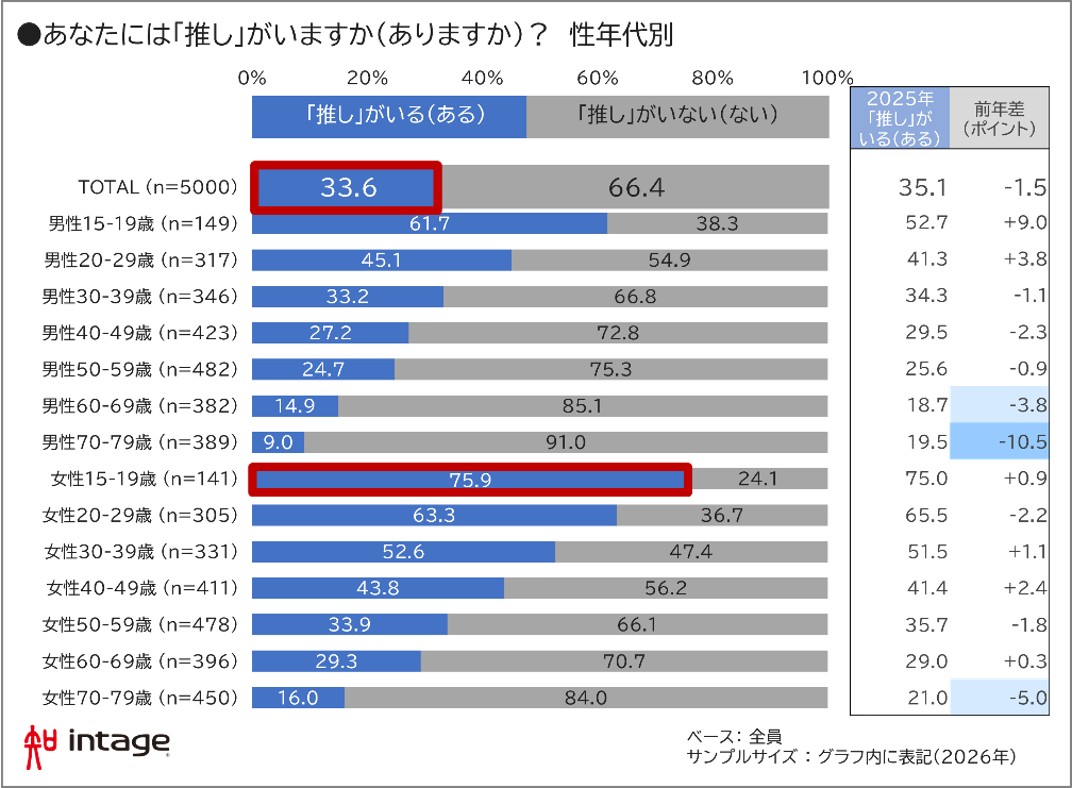
This chart displays the percentage of respondents who answered that they “have an oshi” across the overall sample and broken down by gender and age group using blue and gray horizontal bars. The right side lists the corresponding figures from the 2025 survey alongside the year-over-year change. The chart clearly displays the sample size (n) and question text for each row: while 33.6% of the general population aged 15–79 reported having an oshi, the figure reached 75.9% among females aged 15–19, highlighted by a red outline. In contrast, among males in that exact same 15–19 age group, the figure stood at 61.7%. This visually demonstrates a gap of more than 14 percentage points between young men and young women of the very same generation.
The 75.9% figure for females aged 15–19 represents responses within that specific age and gender cohort. It cannot be conflated with the entirety of Gen Z, nor does it represent the percentage of individuals who have made an actual purchase or attended an event. Even in this highest-indexing demographic cohort, roughly one out of four young women answered that they do not have an oshi.
Furthermore, the same Intage study reveals that preferred genres of fandom differ considerably across gender and age. For instance, among young men aged 15–19, the leading categories were “Anime” at 22.1% and “YouTubers / VTubers” at 16.8% (compared to 16.9% in the prior year). Again, this reflects the response pattern strictly within 15-to-19-year-old males, not the youth demographic as a whole. Nor does a genre ranking highly within an age group guarantee that every teenage boy standing in front of you enjoys anime or VTubers. While macro-level demographic patterns offer a valuable starting point for campaign planning, planners must remember that they can never serve as proof of an individual’s personal preferences.
Do Not Treat Average Expenditure as an Individual Youth Budget
The 3rd Oshikatsu Survey by CDG and Oshicoco (in Japanese) was administered between January 15 and 22, 2026, among 23,125 male and female residents of Japan aged 15 to 69, weighted to match national demographic population estimates. Among respondents actively engaging in oshikatsu, the average annual expenditure for calendar year 2025 (January through December) was 209,716 yen, while the median stood at 40,000 yen.
This expenditure figure is not limited to youth cohorts; it covers the broader population. Moreover, simply dividing an annual average by 12 does not mean that individual fans have that amount of disposable income to spend every month. Nor can one deduce from the median alone that most consumers are tightly clustered right around the 40,000 yen mark.
When establishing price points for a campaign, marketing teams should avoid taking annual expenditure as a flat budget or as a benchmark for reasonable pricing. Instead, they should focus on what participation choices their campaign can offer. Survey data should be treated as context for designing accessible entry points—including purchasing individual items or participating as a spectator without buying—rather than assuming high-ticket bundles are universally acceptable.
Misconceptions to Avoid
- Treating the high 75.9% rate among 15–19 female respondents as representative of all Gen Z
- Equating the survey rate of "having an oshi" directly with the commercial paying customer base
- Setting campaign prices by treating the annual average of ~210,000 yen as a baseline budget
- Assuming an individual fan's tastes match whatever genre ranks highest for their age group
Constructive Analytical Approaches
- Documenting the survey year, age bracket, gender, sample size, and exact question wording
- Separating whether someone has an oshi from their actual purchase behavior and participation modes
- Accounting for the gap with the 40,000 yen median by offering lower-priced, low-barrier tiers
- Using demographic trends strictly as working hypotheses and narrowing down by participation context
Deconstructing “Gen Z”: Specifying Contexts of Participation
When building an enterprise campaign, teams must define not just an age group, but the concrete context in which consumers are invited to participate.
Even within the exact same age bracket, someone who wants to browse merchandise in a physical store requires completely different logistical guidance than someone who prefers streaming content from home. We can break these down into three primary participation contexts to identify the essential operational considerations for each:
1. In-Store and Venue-Based Experiences
This context covers initiatives that encourage physical foot traffic, such as themed collaboration cafes, pop-up stores, and exhibition spaces. Here, the priority is verifying whether the campaign provides flexible options for both solo attendees and groups.
For example, planners should anticipate visitors who arrive alone or who wish to photograph food or merchandise without showing their own faces. The campaign team needs to assess whether the venue layout and wayfinding signage make it comfortable for solo visitors to enter, whether crowd levels and numbered admission ticket (seiriken) conditions are clear before purchase, and whether photo spots are situated so visitors can take pictures without feeling self-conscious under the gaze of surrounding crowds. Avoiding formats that require group pairs or mandate loud vocal participation in the store lowers psychological hurdles and broadens overall engagement.
2. Online Viewing and Information Gathering
This context covers digital environments that can be accessed regardless of geographic location, including dedicated campaign landing pages, official social media accounts, and live video streams. Here, brands must establish a clear functional division between discovery posts on social media and the official landing page that houses comprehensive terms and conditions.
Even when fans first discover an initiative via short-form video or image posts, the moment they actively consider participating or making a purchase, they immediately search for definitive logistics: campaign dates, pricing, whether items are in stock or made-to-order (juchuu seisan), shipping fees, and terms of service. Dishing out information piecemeal across social media feeds causes fans to lose track of critical details when they search back later, often leading them to abandon participation altogether. Campaigns must be designed so that regardless of which marketing channel visitors arrive from, they can effortlessly navigate to a centralized official page where all logistical conditions are consolidated in one place.
3. Retail Merchandise and Goods Purchases
This context focuses on retail product sales, whether hosted on e-commerce platforms or at physical counters. Broad annual spending figures offer no insight into how much money a fan can commit to a single activation. Brands must consider who can realistically participate, evaluated on a product-by-product basis.
If a lineup consists exclusively of expensive box sets or “blind” randomized (random) items that require collecting every variant, it quickly prices out students on limited allowances and fans who only wish to support one specific member or character. A sustainable approach involves curating a tiered lineup: everyday, low-priced entry goods, individual items where fans can choose their specific favorite, and high-spec commemorative items for fans with greater financial flexibility.
Consolidating Essential Information for Informed Decision-Making
To ensure fans can freely choose between visiting a venue, purchasing individual goods, or tuning in online, campaign terms must be organized transparently. Brands can achieve this by summarizing event locations, dates, pricing, shipping fees, made-to-order and restock plans, and photography/posting policies in a single centralized hub.
For instance, fans who cannot spare the time to visit a physical store need to know upfront whether an online mail-order (tsuhan) option will be offered. Likewise, shoppers who want to calculate their total outlay before committing need visibility into shipping costs and payment processing fees. Alongside the creative appeal of limited-edition novelty perks, the foundational details necessary for making an informed decision must be clearly positioned on that same landing page.
- 011. Identify Target Audiences and ContextsMove beyond generational labels to hypothesize how audiences will participate across retail, online, or merchandise touchpoints
- 022. Structure Tiers and PricingProvide varied access levels—such as spectating, entry-level individual items, and venue visits—to accommodate varying budgets and geography
- 033. Disclose Full Terms UpfrontConsolidate dates, pricing, order limits, inventory policies, and fan-art or photography rules on an official hub
- 044. Evaluate Multi-Tier MetricsAssess results beyond top-line revenue by analyzing response rates across engagement tiers and tracking customer support inquiries
Marketing tactics that rely on pressure sales—artificially heightening urgency with “limited edition” and “now or never” claims that strip away the customer’s time to think—might generate short-term transactions, but they frequently leave behind lingering fatigue and distrust. As discussed in detail in our editorial column on fandom fatigue (oshikatsu-zukare), providing upfront clarity regarding sales windows, estimated total costs, made-to-order and restock availability, and photography or social sharing rules forms the bedrock of trust in fan marketing.
Evaluating Performance and Applying Learnings to Future Initiatives
Once a campaign concludes, marketing teams should review performance directly against their original hypothesis: “Who do we want to participate, in which situations, and how?”
If a retail store event was designed with dedicated, low-friction pathways for solo visitors, the team should analyze visitor distribution by time slot and review customer feedback regarding how accessible the space was for individuals. If a merchandise campaign featured tiered price bands, the team should look beyond aggregate gross sales to analyze whether entry-priced items attracted first-time buyers and younger demographics, and examine the sales ratio between standalone item selection and bundled sets.
Crucially, determining whether first-time or younger fans participated cannot be judged from gross revenue figures alone. By reviewing engagement volume across distinct participation tiers and cataloging the most common questions received by customer support, teams can segment their records as far as reasonably possible and use those insights to refine the rules, conditions, and messaging of their next campaign.
For a broader perspective on the total market size and definitional boundaries of the enthusiast economy including youth demographics, see our comprehensive analysis in The Market Size of Oshikatsu (2026 Edition). For step-by-step methodologies on putting fandom concepts into practice, explore our guide to Oshikatsu Marketing.
FAQ
Does the 'ages 15–19' segment in survey data mean the exact same thing as Gen Z as a whole?
No, they are not identical. The definition of Gen Z is based on birth year ranges, whereas survey cohorts such as 'ages 15–19' are defined by age at the specific time of research. Marketers must verify the exact survey year, age bracket, gender breakdown, and question phrasing before drawing conclusions.
Does a single, uniform oshikatsu campaign work for all young audiences?
No. Age alone does not determine whether someone has an oshi, what genre they follow, or what budget they have. In Intage's January 2026 survey, 75.9% of females aged 15–19 and 61.7% of males aged 15–19 reported having an oshi. This simply measures whether an affinity exists, not that everyone in that demographic will buy the same products.
Can the annual average expenditure on oshikatsu be used directly as the budget for a campaign?
No. In the survey conducted by CDG and Oshicoco, active fans spent an annual average of 209,716 yen in 2025, but the median was 40,000 yen. Furthermore, this survey covers fans across all age groups, and an annual total cannot be converted into an individual's budget for a single campaign. Budgets must be evaluated alongside the specific context of participation and audience constraints.
Should campaigns targeting youth prioritize Instagrammability and exclusive perks above all else?
Assuming that all young fans demand social-media-ready aesthetics or limited-edition items is risky. It is critical to first specify the intended context of participation—whether in-store experiences, online viewing/information gathering, or merchandise sales—and design pathways that welcome solo visitors and casual observers.
What metrics should brands look at when evaluating the performance of an oshikatsu campaign?
Rather than looking solely at short-term sales figures, it is essential to evaluate multiple angles aligned with your initial hypotheses: customer response at each tier of participation, how easily conditions could be verified on the official page, customer support inquiry themes, and repeat participation in future activations.


