
What Is a Gefura (Game Flag)? Japan's Handheld Soccer Flags, Explained
Gefura ゲーフラ · Game flag
You see them in Japanese stands: handmade flags with a player’s name painted on. If you’ve wondered, “Could I make one?”, the gefura is for you. Here is where the name comes from, how it differs from banners, and what to prepare and which rules apply when you raise one.
What Gefura Means
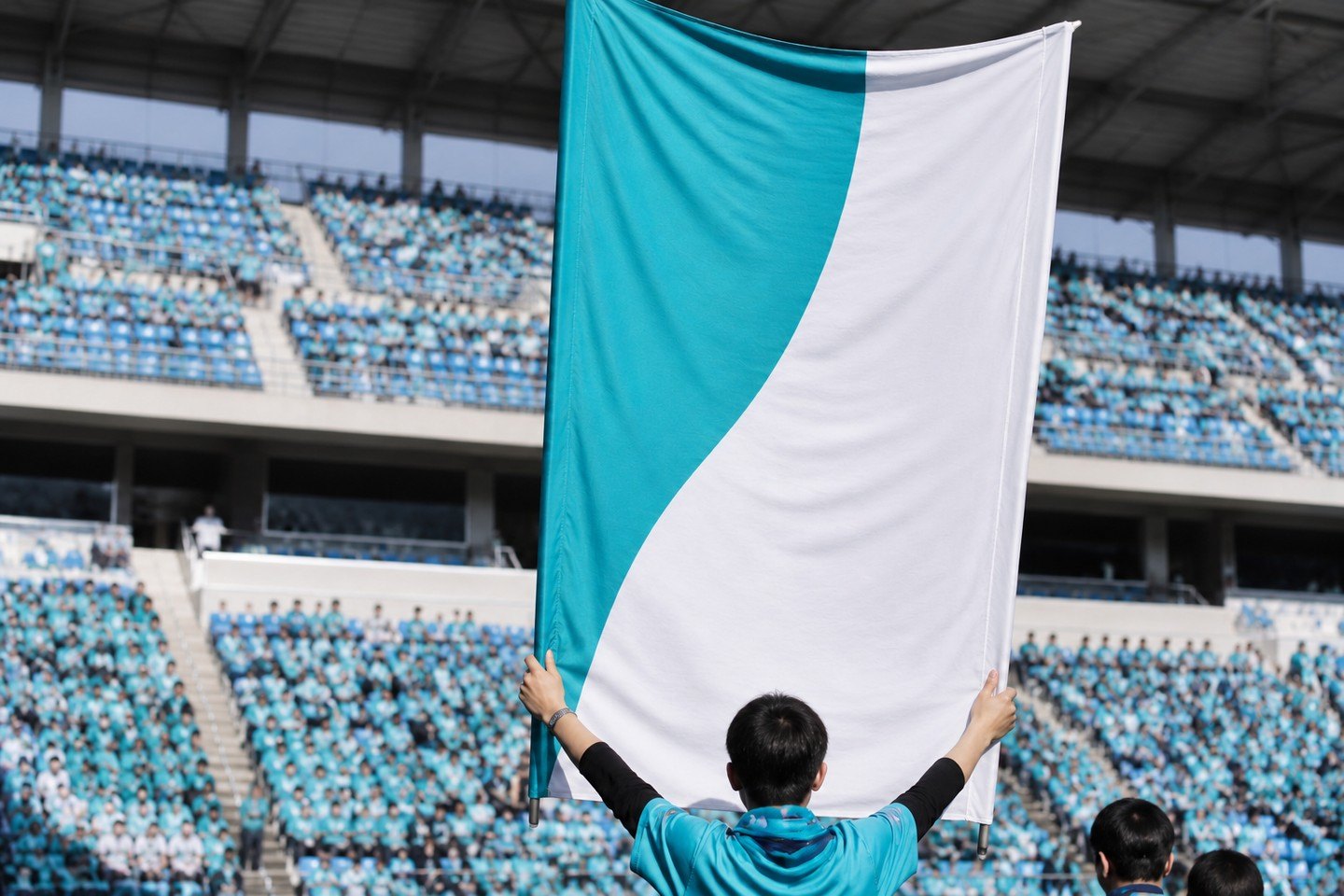
Gefura (ゲーフラ, “game flag”) is a handheld cheering flag that spectators hold up with both hands during a soccer match. Thin poles run through the left and right sides of the fabric, and a player’s name, jersey number or a short phrase is painted large enough to read from a distance. The flag is far smaller than a banner, but it makes clear who is holding it up, and for whom.
A debut, a return after a long absence, a homecoming from another club, a milestone in appearances. The day a new gefura appears is usually a day when a chapter in your favorite player’s story turns.
GefuraHandheld, two poles, both hands
- FabricStretched between two poles
- Few wordsA name, a number, a short phrase
- Strong contrastLettering far from the background in brightness
- Venue-ready sizeHeight, width and pole rules
- Easy to foldCarry it in a pole case
Its area is small, but it says who is cheering and for whom.
Where the Name Comes From
The name is most often explained as a shortening of “gate flag,” from the way fabric stretched between two poles looks like a gate. Another explanation takes it as short for “game flag,” so there is more than one theory. The abbreviation isn’t understood as-is in the English-speaking world, so it’s natural to think of it as a term that grew up in Japanese stadiums.
How It Differs From Banners, Flags and Uchiwa
| Item | Shape and how it is held | How it is raised |
|---|---|---|
| Gefura | Fabric stretched between two poles, lifted with both hands | In permitted areas, raised and lowered to suit the moment |
| Banner (odanmaku) | A long piece of fabric fixed to a fence or railing | Advance application and designated locations are often required |
| Flag (furaggu) | Fabric on a single pole, waved | Detailed limits on size and where it can be used |
| Cheering board | Lettering attached to a board or panel | Some venues don’t allow hard materials |
| Cheering fan (uchiwa) | A handheld, palm-sized fan | Stadiums require checking the rules |
All of them are cheering goods with writing on them, but clubs’ guidance lists them as separate items. Treat “can I bring it in?” and “where can I raise it?” as different questions and you’ll forget fewer checks.
Examples
- “The gefura with my oshi’s jersey number is done. It debuts at tomorrow’s home game.”
- “I only raise it during the player entrance, then fold it at my feet.”
- “The forecast says strong wind, so I’m going to check how I’ve attached the poles again.”
- “I separated the lettering color from the background, and someone said they could read it from the opposite stand.”
- “The person in the next seat asked, ‘Whose gefura is that?’ and we got talking.”
Five Things to Decide Before Making One
- Cut the words. From far away, a few words are all anyone can read. A player’s name and number alone get your intent across
- Make the contrast strong. If you use an oshi color, the further apart the brightness of the background and the lettering, the more readable it is
- Match the dimensions and poles to the venue. Maximum height and width, pole thickness and whether metal is allowed differ by club
- Secure a seat where you can raise it first. If your seat is in a zone where flags can’t be used, the flag has no role on the day
- Design for folding and carrying, too. Think from the start about its folded size, a case for the poles, and how to handle it in the rain
On top of the prohibitions that apply across the J.League, Japan’s professional soccer league, each club sets its own display areas and application procedures. The safest course is to read both the J.League rules and manners for spectators (in Japanese) and the event notice issued by that day’s home club.
- 01Read the rulesThe club's page on displayed items
- 02Submit the designBefore you make it
- 03Wait for approvalGamba Osaka: approximately two to three weeks
- 04Receive confirmationKyoto Sanga emails it; check required documents
- 05Pass the checkStaff may inspect on the day
An application made just before a match will not be in time.
The Application Process
At some J.League clubs, certain banners, flags and gate flags need an advance application, depending on their dimensions and any exemptions. Gamba Osaka requires a design application before you make the item, so check the relevant club’s procedure first.
- Read the club’s official page on displayed items. Check the size that triggers an application (some clubs apply the rule to items 500 mm by 500 mm or larger), where items may be displayed, and what is prohibited
- Submit the design before you make it. The usual format is to send your name, address and contact details, the type and size of the item, an image of the design and the intent behind it (Gamba Osaka, application for displayed items, in Japanese)
- Wait for approval. In some cases it takes two to three weeks from review to reply. An application made just before a match won’t be in time
- Receive confirmation. Kyoto Sanga emails a confirmation document when display is approved. Check which documents the relevant club requires you to bring
- Have the real item checked on the day. Even if your application was approved, staff may inspect the actual item. Some clubs also ask you to show your fan club membership card and season sticker (Kyoto Sanga F.C., advance application for displayed items; Yokohama F. Marinos, spectator rules, both in Japanese)
No club allows displays that make a political, ideological or religious claim, that are discriminatory, insulting or violent, or that aren’t recognized as meant to support the players or the team. Whether you must show an actual ID differs by club, so bring exactly what the application page lists. The J.League’s official site also has a gefura-making workshop (in Japanese) that is a useful reference before you start.
When to Raise It, and the View Behind You
Hold it up high for long and the pitch vanishes from the seats behind you. The basic rhythm is to raise it when everyone around you does: the players’ entrance, right after a goal, a substitution call. When you’re not using it, lay it at your feet and check that the tips of the poles aren’t sticking out toward the next seat.
Even within the goal-ura, the stand behind the goal, there are sometimes separate areas where you can raise flags and areas where you watch seated. On a windy day the fabric catches far more force than you’d expect, and you need to be ready to decide not to raise it. Just as there are days you don’t join the chants, not raising a flag is one form of a person’s support too.
Checking Designs and Rights
Before putting in a player’s name or number, read the rules the club publishes on making cheering goods. Emblems, sponsors’ logos, official photos and existing characters each have rights holders, and being handmade doesn’t make them free to reproduce. If you build it from your own words and generic shapes, you can use it for years without worry.
Once it’s finished, open it out at home and check the ends of the poles, the seams and whether the paint is dry. On public transport, fold the fabric and put the poles in a case. When you post photos, check that faces of people behind you and details printed on tickets haven’t slipped into the frame. If you’re bringing one as an away supporter, remember too that the visiting club’s rules aren’t necessarily the same as those of your home club.
Notes From The Oshi Lab: A Mirror of What Spectators Care About
The gefura is a tool for saying what ready-made goods can’t. A store-bought towel or replica jersey carries the club’s official words; this flag carries a sentence one spectator chose alone, and the writer stands where you can see their face. The sight of individual words lined up across the stands shows, even to an outside observer, that cheering does not consist only of repeating the same motion.
From the club’s side, a handmade flag is also a mirror of where spectators’ attention is pointed. Which names are increasing, and at what milestones a new flag appears, tell you about support for players from a different angle than merch sales do. On the other hand, once the number and size of flags start to look like a pecking order among spectators, first-time visitors feel awkward about holding nothing. Can a club publish its display rules clearly while also laying out guidance for enjoying the same match from a seat with no props? That decides how wide the entrance to supporter culture is.
Related Terms
FAQ
What is a gefura?
A gefura ("game flag") is a small cheering flag that soccer spectators hold up with both hands. Fans paint player names, jersey numbers or messages to the club on it.
Can I hold up a gefura in any seat?
No. Size, pole material, and the seats and times where flags may be raised differ by club and venue, so you need to check the official rules for that match.
Can I make one using my favorite player's photo?
Even if it is just for your own enjoyment, check the terms of use for official photos and logos. You can also stick to your own lettering and designs.
Can I get one if I am not good at crafts?
Some businesses print on fabric, and some fans order one by specifying the dimensions and material. Even with a finished flag, though, you still have to check for yourself that it meets the venue's rules.
Can I bring one to an away game?
The dimensions and display areas set by the club you are visiting aren't necessarily the same as those at home. It is safest to read the event notice for that match first.


