
What Is Oshikatsu Consulting? What You Can Ask For, Example Costs, and How to Choose a Firm
You want to bring oshikatsu (推し活, actively supporting a favorite person or work) into your business, but you do not know what fans want. You have ideas for products or events, but cannot decide how to move forward. Oshikatsu consulting is a way to bring these problems to outside specialists, starting from the research and planning stages.

When looking for an advisor, it is easier to choose if you first separate what your company is struggling with from how much you want to hand over. Coming up with ideas and making products and running events require different experience and different costs.
This article is for people at companies considering outside help for the first time. It covers the work you can ask for, example costs and how to compare quotes, the process from consultation to execution, and what to compare when choosing an advisor.
What You Can Ask an Oshikatsu Consultant For
Oshikatsu is the activity of supporting and enjoying a favorite person, work, or team. Companies get involved by making related products, inviting people to use their stores or facilities, and organizing projects fans can take part in.
Consulting helps gather the information needed to move such a business forward and decide on plans and ways to proceed. We have summarized the work you can ask for, by the kind of problem a company has.
- 011. You want to know what fans want or struggle withInterviews and research
- 022. You want to think up products or services that suit your companySorting out your strengths and the situations where they are used
- 033. You want campaigns that lead to visits or purchasesThinking through target groups and announcements
- 044. You want to turn an event or service into realitySorting out conditions for production and operations
- 055. You cannot decide whether to continueAnalyzing results and sorting out issues
Created by The Oshi Lab
Whether a firm also takes on production and on-the-day operations depends on the firm and the contract.
Even among “oshikatsu consultants,” each firm’s strengths differ
Even when firms all advertise oshikatsu consulting, the work they describe differs from firm to firm.
Pencil, for example, describes diagnosing what a client company’s products mean to its customers and designing the path from first contact with customers to their participation in oshikatsu (Pencil). PNCA, meanwhile, plans, manufactures, and sells oshikatsu merchandise, and also describes joint development of oshikatsu-related products, event planning including negotiating collaborations with idols, and managing social media on clients’ behalf (PNCA).
This is not a comparison of which is better. Whether you want more people to support your own brand or want to make products for fans of a particular work changes the experience and support you should look for.
Three Situations Where Outside Advice Helps
Oshikatsu projects can sometimes be run in-house. Even so, in situations like the following, consulting outside specialists makes things easier.
1. No one in-house knows what fans want
How people enjoy oshikatsu varies greatly with what they support. Idol fans and sports fans spend money in different situations and are happy about different things. If no one in-house knows the field well, getting help starting with fan interviews and research keeps you from deciding plans based on assumptions.
2. You are collaborating with a work for the first time
Projects using works or characters involve steps that ordinary product development does not, such as applying to rights holders, licensing fees, and design supervision. Asking someone experienced how to proceed makes it easier to estimate the schedule.
3. The plan is decided, but there are not enough people to carry it out
Even with a proposal in hand, producing products, preparing venues, running the day itself, and handling inquiries take people. You can decide what your team can handle and ask for help only with what is missing.
Benefits of Outside Help and Points to Watch
The benefits of outside help are borrowing the perspective of people who know other companies’ examples and fans’ behavior, and moving forward without adding staff. Being able to hand over parts that need specialized knowledge, such as research and measuring results, is another advantage.
On the other hand, besides the cost, the thinking behind plans and the data on results tend not to stay inside the company. Even for parts you hand over, have the advisor record why they chose a plan and what the results were, so you can use them in the next project.
Choosing Between Consultants, Research Firms, and Production Companies
Compare advisors not just by what they call themselves but by the work they can take on.
You have not decided what to do
- Someone who can take on everything from research to choosing a plan
- Or ask for advice only on the points you are unsure about
You know what needs to be done
- A research firm if what you want to find out is clear
- A production or operations company if the specifications are set
One company may play several of these roles. Sorting out the work you can do in-house first lets you judge whether you really need to hand everything over.
Cost Ranges: Comparing Four Firms’ Public Information
In November 2026, we checked the official websites of four firms that take on consulting in the oshikatsu and entertainment fields. Few firms publish prices; most quote after hearing what you need.
| Firm | Main support | Published prices |
|---|---|---|
| Firm A (oshikatsu-specialist consulting) | Product development for oshikatsu audiences, trend advice | Online consultation ¥15,000 per hour, in-person consultation ¥30,000 per hour, document preparation ¥40,000 per document, ongoing work or projects from ¥100,000 |
| Firm B (manga and IP tie-up support) | Planning, production, and supervision management for collaborations with works | Several million to tens of millions of yen overall. In the firm’s own cases, ¥7 million to ¥10 million per anime season, including ¥300,000 to ¥3 million for production and ¥0 to ¥1 million for supervision and progress management |
| Firm C (oshikatsu consulting) | Diagnosing customer relationships, designing the path to oshikatsu participation | Not published (individual quotes) |
| Firm D (oshikatsu merchandise, events, social media) | Joint product development, event planning, managing social media on clients’ behalf | Not published (individual quotes) |
The official websites we checked were Space-J for Firm A, Synfield (IPField) for Firm B, Pencil for Firm C, and PNCA for Firm D. Firm A’s page does not say whether its prices include tax.
- 01Projects including a collaboration with a workSeveral million to tens of millions of yen (licensing fees, production, supervision, and more)
- 02Ongoing support and projectsFrom ¥100,000 (varies with length and scale)
- 03Preparing documentsAbout ¥40,000 per document
- 04A single consultationAbout ¥15,000 to ¥30,000 per hour
A guide based on two firms' published prices, not an industry-wide market rate or average.
What the published prices show is that the cost jumps by orders of magnitude depending on what you ask for. If you want “advice on how fans enjoy things,” a single consultation may be enough; if you want to “make a product in collaboration with a work,” you need to budget several million yen or more, including licensing and supervision fees. For firms that do not publish prices, give each the same conditions, get quotes, and compare.
Breaking down costs when production and execution are included
The biggest factors in cost are the scale of research, the scope of planning, what is produced, where it takes place, and the operating team. In a quote, check what is included under each of these five items.
- 011. ResearchHow participants are recruited, number of people, incentives, analysis
- 022. Planning and adviceWhat the proposal covers, documents, meetings, scope of revisions
- 033. Production and use of materialsWhat is produced, conditions for using works and materials
- 044. Execution and operationsVenue, setup, staffing, reception, sales
- 055. After executionShipping, storage, removal, inquiries, analysis of results
Created by The Oshi Lab
Checking the costs of consulting and planning separately from the costs of production and execution makes the overall budget easier to see. Ask under what conditions the total changes, including tax, travel expenses, extra revisions, and how cancellations are handled.
Compare quotes on the same scope
For example, suppose Proposal A is “create a plan using research results the company has already collected,” and Proposal B is “interview fans anew, test the plan on a small scale, and analyze the results” (a hypothetical example for illustration).
Even if B costs more, the work included is different, so you cannot call it overpriced on price alone. For a company whose research is already done and that has in-house staff to carry out the plan, A may be enough. Give each firm the same goals and conditions, then line up “work included,” “work not included,” and “work left to your company” on a single page to make comparison easier.
For monthly contracts, check the scope of consultation and how much document preparation and research is included. For per-project contracts, make clear what has to be delivered for the work to be complete. If there are fees based on results, also check what counts as a result and whether there are fixed costs.
What to Do In-House and What to Hand Over
You do not need to hand everything over. Separating work your own people can do from work that benefits from outside specialists lets you move forward while keeping costs down.
Easy to do in-house
- Writing down your strengths and facilities
- Interviewing current customers
- Small prototypes and time-limited trials
- Recording results
Easier with outside help
- Research covering many people
- Negotiating with rights holders and managing supervision
- Producing products and promotional materials, running events
- Designing how to measure results and analyzing them
For example, you could first ask current customers in-house about oshikatsu, and only after finding that there seems to be interest, ask outside help for planning or research. Even if someone in-house knows oshikatsu well, it is important not to leave decisions to that person alone and to check the views of other fans too.
What to Share When You First Ask for Advice
You can ask for advice without a finished proposal. Having the following information ready makes it easier to decide the scope of the consultation.
- Your current business: products, stores, facilities, usual customers
- This project’s goal: thinking up a new product, making use of quiet hours, attracting first-time customers, and so on
- What you are struggling with: not knowing the target, not being able to choose a plan, not having enough people to carry it out, and so on
- Timing, budget, and who is in charge: conditions that are decided and conditions that are not yet decided
For example, if you say, “We want to rent out hotel meeting rooms as places to photograph merchandise, but we do not know if anyone wants to use them,” you can start with a consultation to research demand (an example for illustration). Also check in advance whether the first consultation costs money.
From Consultation to Execution

Generally, the process goes as follows. Confirm the actual steps with your advisor.
- Explain your current situation
- Decide what work to ask for
- Compare proposals and quotes
- Carry out research, planning, and testing
- Review the results
How long it takes depends on the time needed to recruit interviewees, approvals from rights holders and within the company, and the production and manufacturing process. Rather than only sharing the date you want to start, also sharing what you can decide by when makes it easier to build a realistic schedule.
Also Check the Work That Remains After the Proposal
Episode 20 of The Oshi Lab podcast featured “PQuuut,” a service from KAZAORI, the company that runs The Oshi Lab. It is a system that completes balloons according to fan support collected online and turns them into venue decorations (The Oshi Lab Podcast Episode 20, PQuuut official site). This is an example from the company that runs The Oshi Lab and does not show results of consulting for other companies.
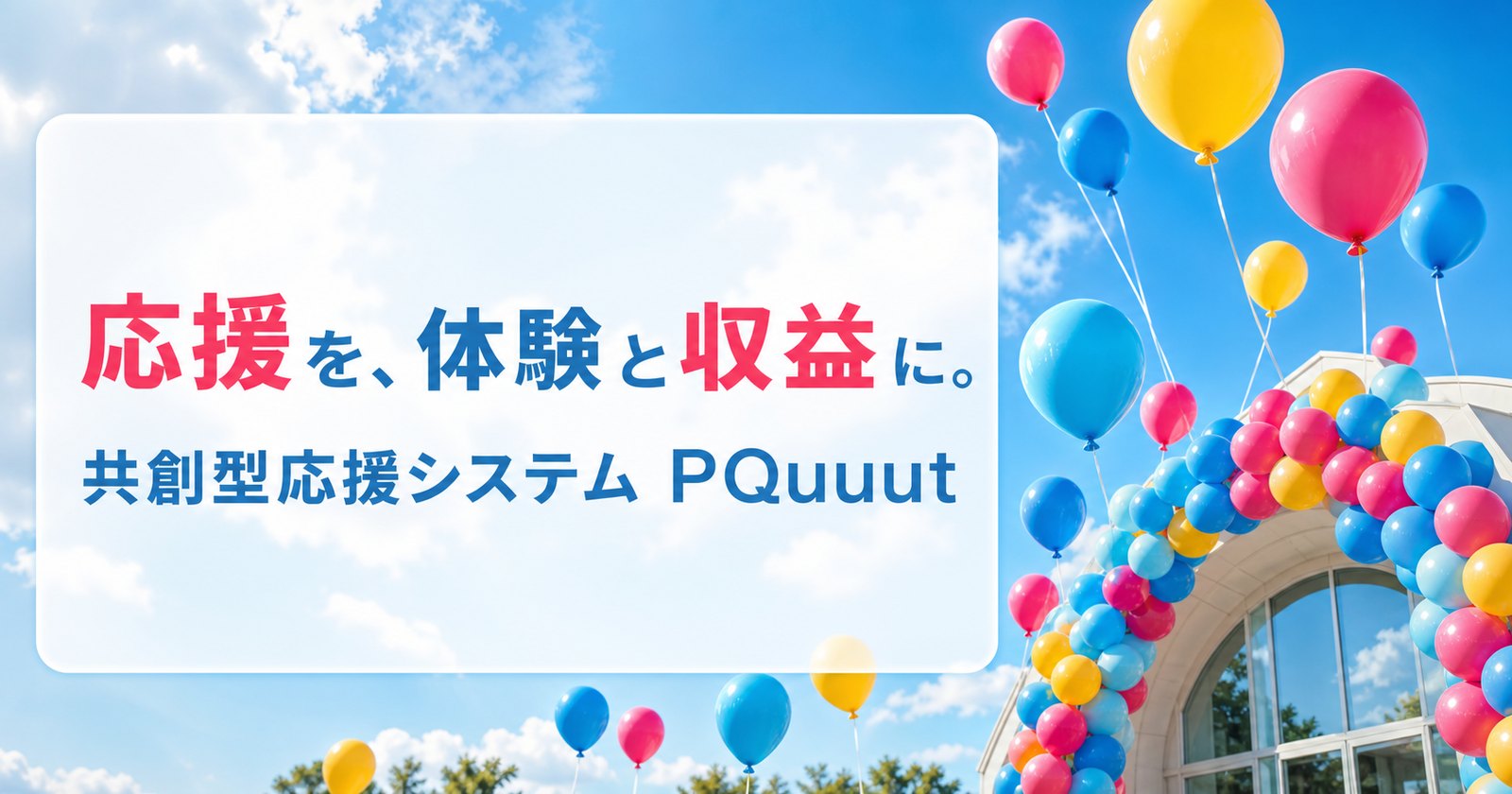
The image on the official site shows colorful balloons and the words “Turning support into experiences and revenue.” It is a system in which online support takes visible form as venue decorations.
Projects like this do not end with setting up online registration. Someone has to decide what to install at the venue and when, check with the venue, pass information to the people producing it, and guide participants.
When you hand work over, check whether it covers “giving advice,” “making proposals,” or “actually doing the work.” If this scope is vague, after receiving a proposal you may find that your company cannot provide the people or budget needed.
Five Things to Check Before Signing a Contract
1. Who owns the rights to proposals and designs
If you want to keep using proposals, designs, or photos created by an outside firm, decide in the contract which party holds the rights.
2. Who handles negotiations with the rights holders of a work
Collaborations with works involve applying to rights holders, paying licensing fees, and exchanges for supervision. Check whether the advisor will handle this on your behalf or whether your company will deal with them directly.
3. How fans’ personal information is handled
If you collect fans’ information through questionnaires or interviews, decide the purpose of collection, how it is stored, and what happens after it is used.
4. What is to be kept confidential
When sharing unannounced plans or your company’s sales figures, it is common to sign a confidentiality agreement (a non-disclosure agreement).
5. Costs if the content changes partway through
As a project progresses, you may want to change the target or the product. Checking at the start where additional work begins and how much the cost increases gives peace of mind.
Common Mistakes
- The only goal is “getting attention”: Even if a project gets attention, you will not know whether it led to visits or purchases. Decide at the start what the project is meant to confirm.
- Not allowing time for rights-holder approvals: In collaborations with works, design supervision can take time. Work backward from the release date and build a schedule with room to spare.
- Judging fans’ voices by one person’s opinion: Do not treat the opinion of a knowledgeable employee or a single fan as the wishes of all fans.
- No one is assigned after the proposal is received: If your company lacks the people or budget to carry out the proposal, the project stalls. Think through execution from the consultation stage.
Five Points for Comparing Advisors
1. Do they have experience with the work you want to ask for?
Do not settle for an introduction saying they worked on a big event; ask which parts they handled, such as research, planning, production, or operations. How they handled projects in industries and budgets similar to yours is also useful.
2. Do they have a way to confirm what fans want?
An advisor’s staff being knowledgeable fans is different from being able to grasp what this project’s target group wants. Check whom they will ask, what they will ask, and how.
3. Can they explain why they chose a plan?
Ask not just how many ideas they have but how they narrowed them down in light of cost, timing, and fans’ wishes. Keeping the reasons for rejected ideas lets you revisit them when conditions change.
4. Is it clear what they are responsible for and what work stays with your company?
Check separately who handles reviewing materials, coordinating with rights holders, and responding to inquiries. Even for work handed over, your company may still need to provide materials and get internal approvals.
5. Can the results be checked and used for the next decision?
Do not settle for words like “it will get attention” or “you will gain fans”; ask what they will check and when. An advisor who can discuss what to investigate if results fall short of expectations will help you decide what to do afterward.
Lab note: Oshikatsu consulting is still a field where names and content do not line up consistently from firm to firm. That is exactly why The Oshi Lab believes the best preparation, before choosing an advisor, is to separate “what your company wants to decide” from “what you want someone else to do.”
If You Consult KAZAORI
KAZAORI runs The Oshi Lab’s research and media, the support system PQuuut, and a balloon decoration business. The specific scope and costs are confirmed according to the content of each consultation.
If you are considering it, please tell us about your current business, what you are struggling with, and your preferred timing through KAZAORI’s contact page.
FAQ
What can I ask an oshikatsu consultant to do?
You can ask for research into what fans want, planning products or services that suit your company, designing campaigns that lead to visits or purchases, organizing event production and operations, and reviewing results afterward. How far a firm goes depends on the firm and the contract.
How much does it cost?
It varies widely with what you ask for. In public information checked in November 2026, a single consultation cost about ¥15,000 to ¥30,000 per hour, ongoing support started from ¥100,000, and projects including a collaboration with a work ran from several million to tens of millions of yen. Most firms do not publish prices and quote after hearing the details.
Can I ask for advice even if neither the plan nor the budget is decided?
Some advisors start by organizing your current situation. It is fine to say that things are undecided. Tell them separately whether you want a proposal to help set the budget or a plan within a budget that is already fixed.
Is there any point in hiring outside help if someone in-house knows oshikatsu well?
You can make use of that person's knowledge and ask outside help only for what is missing, such as research and comparing plans, or production and operations. It is important not to leave decisions to one knowledgeable employee alone and to check the views of other fans too.
If I ask for advice, do I have to sign a contract?
Check in advance whether the first consultation costs money and at what point a contract begins. It helps to think of consulting and ordering work as separate steps.


