

Pokémon Pilgrimage: PokéPark, Local Parks, and Official Shops in Kyoto and Shibuya
At PokéPark KANTO in Yomiuriland, Tokyo, visitors can walk through a forest to look for Pokémon, then explore a town plaza and shops. They can also visit parks across Japan where Pokémon have been welcomed as local mascots, including Lucky in Fukushima, Lapras in Miyagi, and Slowpoke in Kagawa.
Pokémon began as games about collecting, raising, and trading Pokémon while going on adventures. Today, visitors can explore an outdoor permanent attraction inspired by that world, municipal Pokémon parks created through regional partnerships, and official shops with exclusive experiences. This guide covers 10 places around Japan, from parks featuring Sandshrew in Tottori and Quaxly in Toba to a kimono-clad Pikachu in Kyoto and custom T-shirt printing in Shibuya.
10 places to meet Pokémon | Map of parks and official attractions
PokéPark is a place to walk through a forest and town. At the parks, visitors can see and play on Pokémon-shaped playground equipment. The shops in Kagawa, Kyoto, and Shibuya each have their own displays and experiences. Use the map at each location to check where it is.
① PokéPark KANTO
An outdoor permanent attraction inside Yomiuriland amusement park in Inagi, Tokyo. Walk through the Tama Hills forest and town to encounter more than 600 Pokémon.
Explore PokéPark KANTO② Lucky Park in Namie
A park centered on Lucky, Fukushima Prefecture’s support Pokémon, opened on the grounds of Roadside Station Namie in December 2021.
Explore Lucky Park in Namie③ Slowpoke Park (Hidamari Park Ayagawa)
A park at Hidamari Park Ayagawa in Ayagawa, Kagawa, with playground equipment and benches shaped like Slowpoke, the Pokémon who promotes Kagawa’s udon culture.
Explore Yadon Park④ Pokémon Center KAGAWA
An official shop on the first floor of Marugamemachi Green’s East Building in Takamatsu. It features Slowpoke and Pikachu displays and Shikoku’s first Pokémon Card Station.
Explore Pokémon Center Kagawa⑤ Lapras Park in Kasenuma
A park in Moririn Kase-numa Park in Rifu, Miyagi, opened in October 2025 with a slide and other play equipment featuring Lapras, Miyagi Prefecture’s support Pokémon.
Explore Lapras Park in Kase-numa⑥ Lapras Park in Sendai
A park opened in April 2026 in the Fujitsuka district of Kaigan Park in Wakabayashi Ward, Sendai, with a large Lapras slide and other playground equipment.
Explore Lapras Park in Sendai⑦ Sandshrew Park (Tottori Sand Dunes Children’s Kingdom)
Inside Tottori Sand Dunes Children’s Kingdom in Tottori City, this park has playground equipment and a sandpit inspired by Sandshrew and Alolan Sandshrew, Tottori’s hometown ambassadors.
Explore Sandshrew Park⑧ Quaxly Park in Toba
A park in Toba Port’s Sadahama New Port Green Space, north of Toba Marine Terminal, with a sky rope and swings featuring Quaxly, Mie Prefecture’s support Pokémon.
Explore Mijumaru Park in Toba⑨ Pokémon Center KYOTO
An official shop on the second floor of SUINA Muromachi at Kyoto Keizai Center. A Maiko Pikachu and a Ho-Oh statue welcome visitors at the entrance.
Explore Pokémon Center Kyoto⑩ Pokémon Center SHIBUYA
An official shop on the sixth floor of Shibuya PARCO, home to Pokémon Design Lab, where visitors combine designs on a touchscreen to create an original T-shirt.
Explore Pokémon Center ShibuyaPokéPark KANTO | A forest in the Tama Hills and a Pokémon town
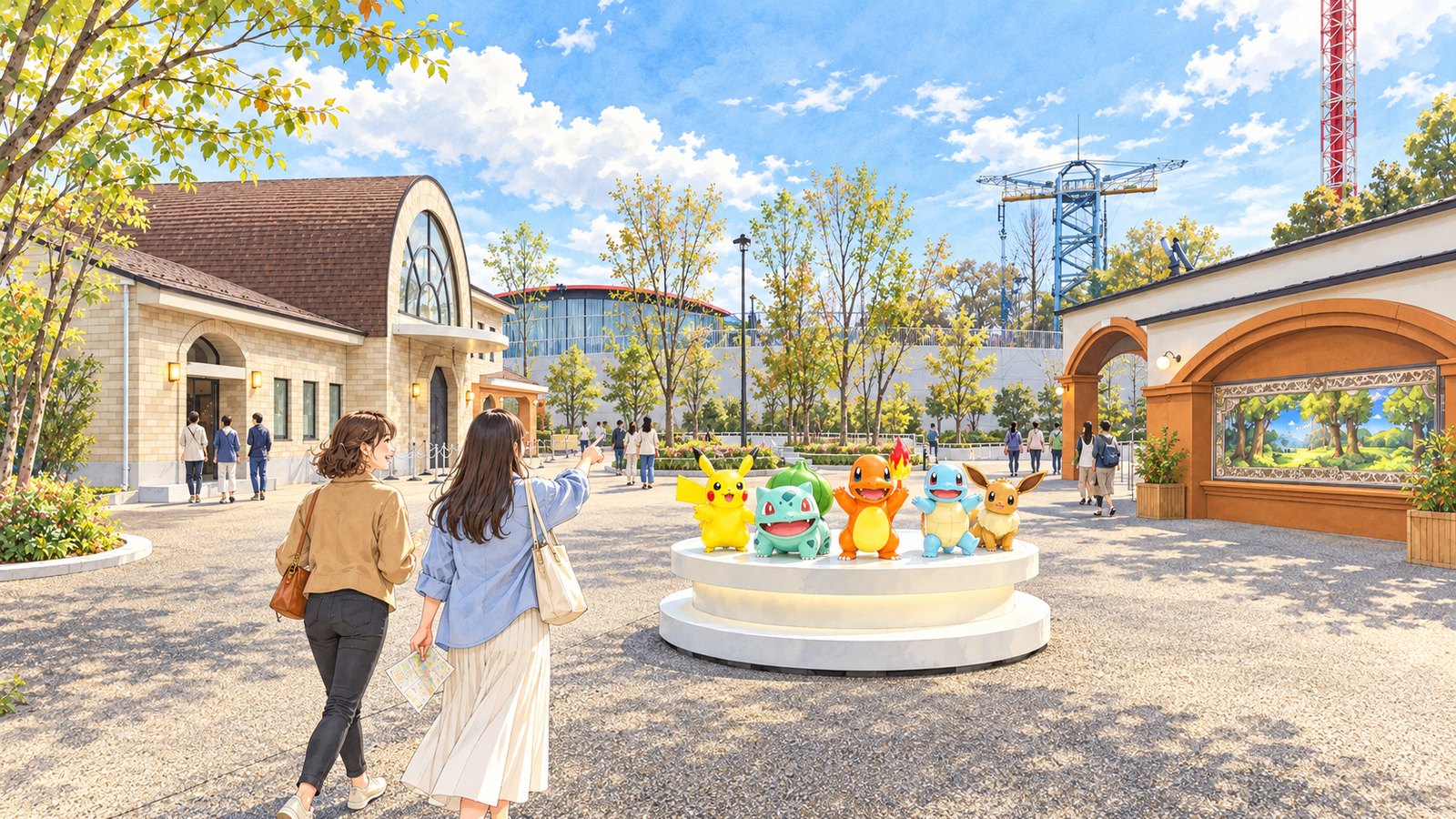
PokéPark KANTO is an outdoor permanent attraction inside Yomiuriland amusement park in Inagi, Tokyo. Using the terrain of the Tama Hills, it offers encounters with more than 600 Pokémon across a forest and a town. Bulbasaur, Charmander, and Squirtle greet visitors in the entrance plaza—the first three Pokémon of the Kanto region, recalling the beginning of an adventure in the games.
The forest trail is about 500 meters long. As visitors walk its slopes, grassy areas, tunnels, and rocky sections, they encounter Pokémon living in ways suited to the terrain. Look beneath the grass or up among the rocks to observe the different habitats represented throughout the forest.
In town, visitors can explore a Pokémon Center, a Poké Mart, a market, and a Gym. At the Pokémon Center, Lucky and a recovery-machine display welcome visitors; in the plaza, a fountain featuring Primarina serves as a landmark. This area brings to life places you stop at along the way during an adventure in the games.
The town has two attractions. One is a ride powered, in the story, by more than 30 Electric-type Pokémon. The other is a merry-go-round with carriages shaped like Ponyta and Rapidash and balloons featuring Eevee. The rides connect Pokémon types and appearances with how the attractions work.
Tickets cover either both the forest and town or the town only. Some tickets allow one forest entry at a reserved time; others include benefits and let visitors enter without choosing a time. Choose the access area when purchasing. All tickets include admission to Yomiuriland, but the two town rides cost extra. Prices vary by visit date, so select the date and ticket type together on the reservation screen.
In Japan, residents must register as a member and verify a domestic mobile phone number by SMS to purchase tickets. Overseas residents have a separate official sales channel.
The forest has steep slopes and a staircase with 110 steps. Entry restrictions apply to children under five and their accompanying visitors, as well as people who cannot climb the 110 steps. For visits with young children, the Kayatsuri Town Pass, which covers only the town area, is the ticket type that allows the whole party to enter.
The attraction is inside Yomiuriland at 4015-1 Yanokuchi, Inagi. From Keio-Yomiuriland Station, visitors can take a gondola toward the amusement park and enter the attraction through Yomiuriland’s admission gate.
- Location
- Inside Yomiuriland amusement park, 4015-1 Yanokuchi, Inagi, Tokyo
- Connection to the work
- An outdoor permanent attraction inspired by the Kanto region’s forest and town, with more than 600 Pokémon to encounter
- Admission and access
- Ticket required (includes Yomiuriland admission); Pokémon Forest restricts entry for children under five and people unable to climb its 110-step staircase
- Access
- From Keio-Yomiuriland Station, take a gondola or bus to Yomiuriland’s admission gate
Sources: PokéPark KANTO — Attraction and Pokémon Forest/Sedge Town (in Japanese) / PokéPark KANTO — Ticket types, prices, and forest restrictions (in Japanese) / PokéPark KANTO — Visit us (in Japanese) / PokéPark KANTO — Official trailer announcement (in Japanese)
Lucky Park in Namie | A Pokémon park at a roadside station
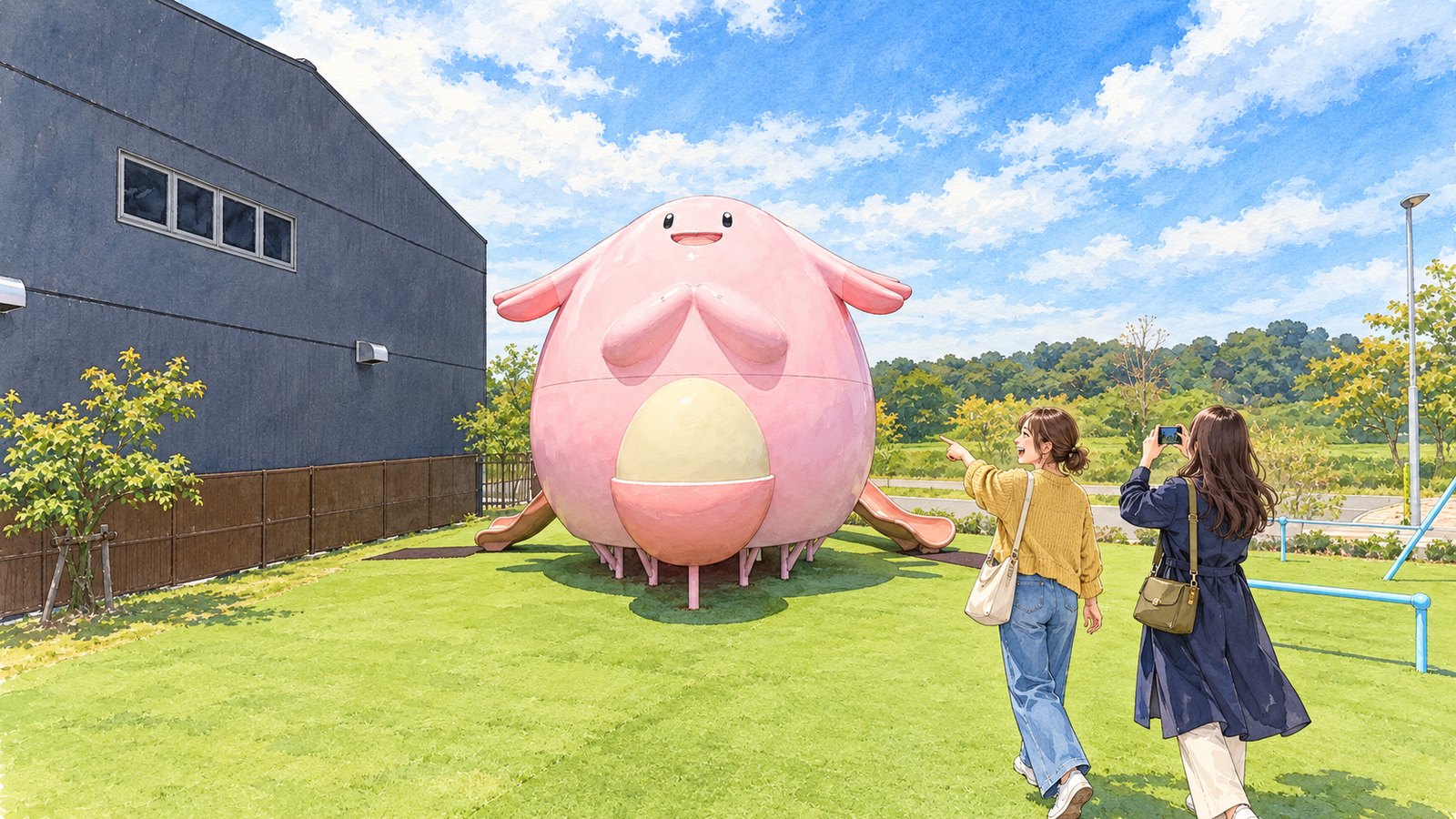
Lucky Park in Namie is on the grounds of Roadside Station Namie in Namie, Fukushima Prefecture. It opened on December 12, 2021, as Japan’s first park themed around Pokémon. The Pokémon Company donated the play equipment, bringing together a roadside stop for shopping and rest breaks and a place where children can play.
The star is Lucky, known for its pink body and the egg in its pouch. The park has a Lucky combination play structure and swings, plus swings shaped like Cleffa and Igglybuff. Lickitung, Wingull, Happiny, Pikachu, and other Pokémon also inspire the equipment. Children can play while looking for their favorites.
There is also a Poké Lids manhole cover illustrated with Pokémon on the roadside-station grounds. Namie’s design shows Lucky riding in a boat. Unlike the three-dimensional play structures, it brings Pokémon and the local area together in a single illustration. Visitors can enjoy the different interpretations in the park and on the ground beneath their feet.
The Lucky play equipment grew out of a partnership between Fukushima Prefecture and The Pokémon Company to support recovery and regional development. A Pokémon said to bring happiness welcomes people to the roadside station, making the park a place to stop by before or after shopping.
The address is 60 Chimeiji, Kiyohashi, Namie. It is about a 15-minute walk from JR Namie Station. Located within the grounds of Roadside Station Namie, the park is easy to visit before or after shopping and a meal.
- Location
- 60 Chimeiji, Kiyohashi, Namie, Futaba District, Fukushima Prefecture (inside Roadside Station Namie)
- Connection to the work
- Park and Poké Lids location themed around Lucky, Fukushima Prefecture’s support Pokémon
- Visitor information
- Free admission; open access from the grounds of Roadside Station Namie
- Access
- About a 15-minute walk from Namie Station on the JR Joban Line
Sources: Fukushima Prefecture — Lucky Park in Namie (in Japanese) / Namie Town — Lucky Park and Poké Lids (in Japanese) / Pokémon Local Acts — Fukushima × Lucky (in Japanese) / Pokémon Daisuki Club — Partnership-signing report (in Japanese)
Yadon Park | A play area on the site of a former pond in Ayagawa
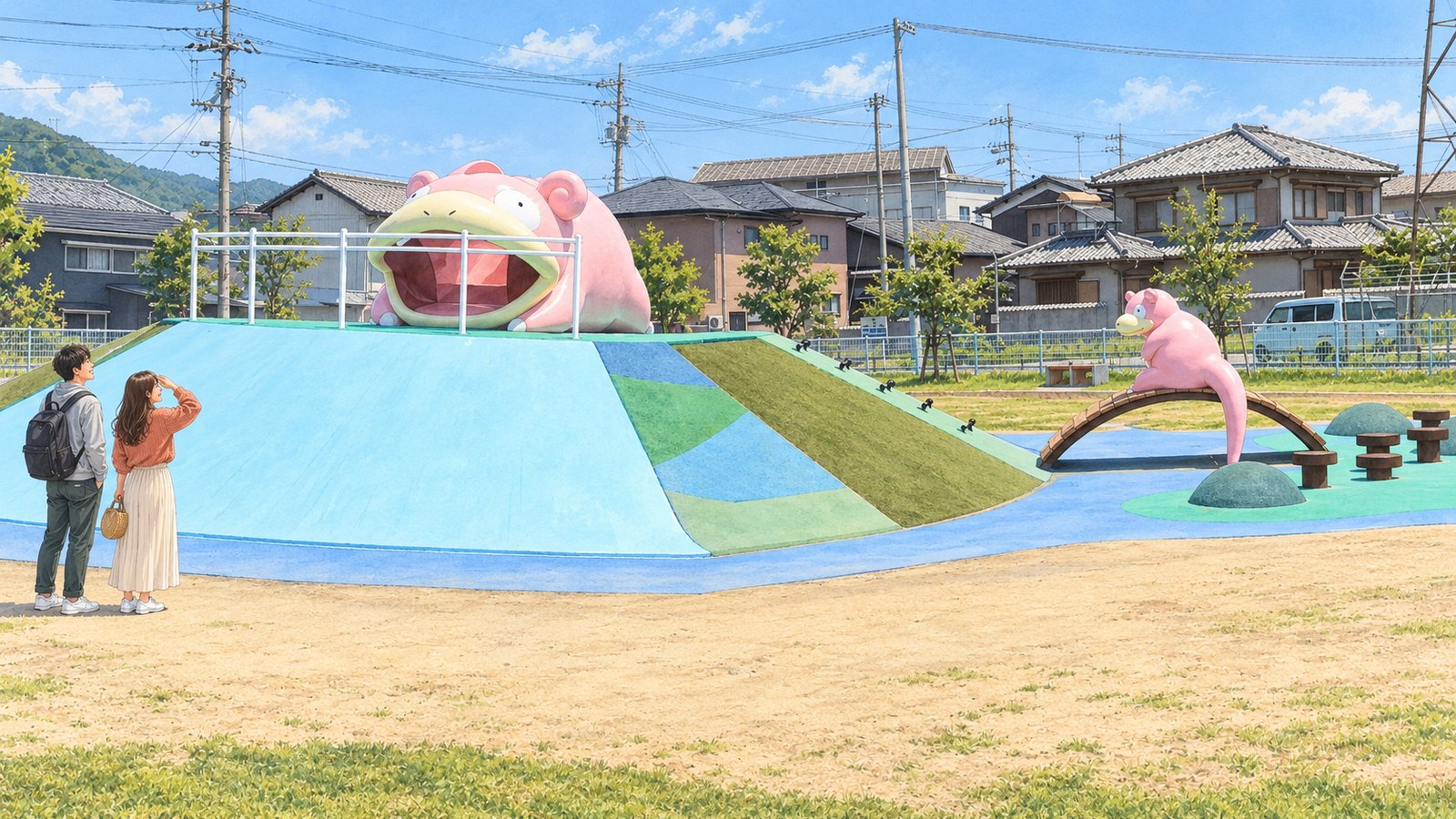
Slowpoke Park in Ayagawa, Kagawa, is officially named Hidamari Park Ayagawa. Built on reclaimed land at Kobumo Pond, it opened on April 14, 2023. Across about 4,300 square meters are play structures featuring Slowpoke, the Pokémon who promotes Kagawa as the “Udon Prefecture.” The park is part of a regional-development agreement between Kagawa Prefecture and The Pokémon Company.
The play structures have names: “Everyone’s Slowpoke,” “Slowpoke’s Home,” “Slowpoke’s Well,” and “Slowpoke by the Waterside Hill.” Each features Slowpoke in a different setting, such as a home, a well, or the water’s edge.
The park also has a Slowpoke-themed bench, a three-seat swing, and a Pikachu bench. The Omnis Spinner, a rotating play structure, and the three-seat swing are inclusive equipment designed for children to play together. Instructions and recommended ages are posted for each item.
The park is at 253-7 Kayahara, Ayagawa, about 300 meters south of Kotoden Ayagawa Station—a walk of about five minutes. It is open from 7 a.m. to 8 p.m. and has 18 parking spaces. Because it borders a residential area, visitors may not cut through private roads or park in the surrounding neighborhood.
Advance permission from Ayagawa Town is required for commercial photography or filming, or for exclusive use of the park. Ordinary visits and use for a photo shoot or event follow different procedures.
- Location
- Hidamari Park Ayagawa, 253-7 Kayahara, Ayagawa, Ayauta District, Kagawa Prefecture
- Connection to the work
- Park with large play structures and benches shaped like Slowpoke, the Udon Prefecture PR Pokémon
- Hours and parking
- 7 a.m.–8 p.m.; free admission; 18 parking spaces (commercial filming and exclusive use require advance town approval)
- Access
- About a five-minute walk from Ayagawa Station on the Takamatsu-Kotohira Electric Railway Kotohira Line
Sources: Ayagawa Town — Park overview, play equipment, and rules (in Japanese) / Kagawa Tourism Association — Slowpoke Park overview (in Japanese) / Pokémon Local Acts — Kagawa × Slowpoke (in Japanese)
Pokémon Center Kagawa | Slowpoke and the flavors of Kagawa at an official shop
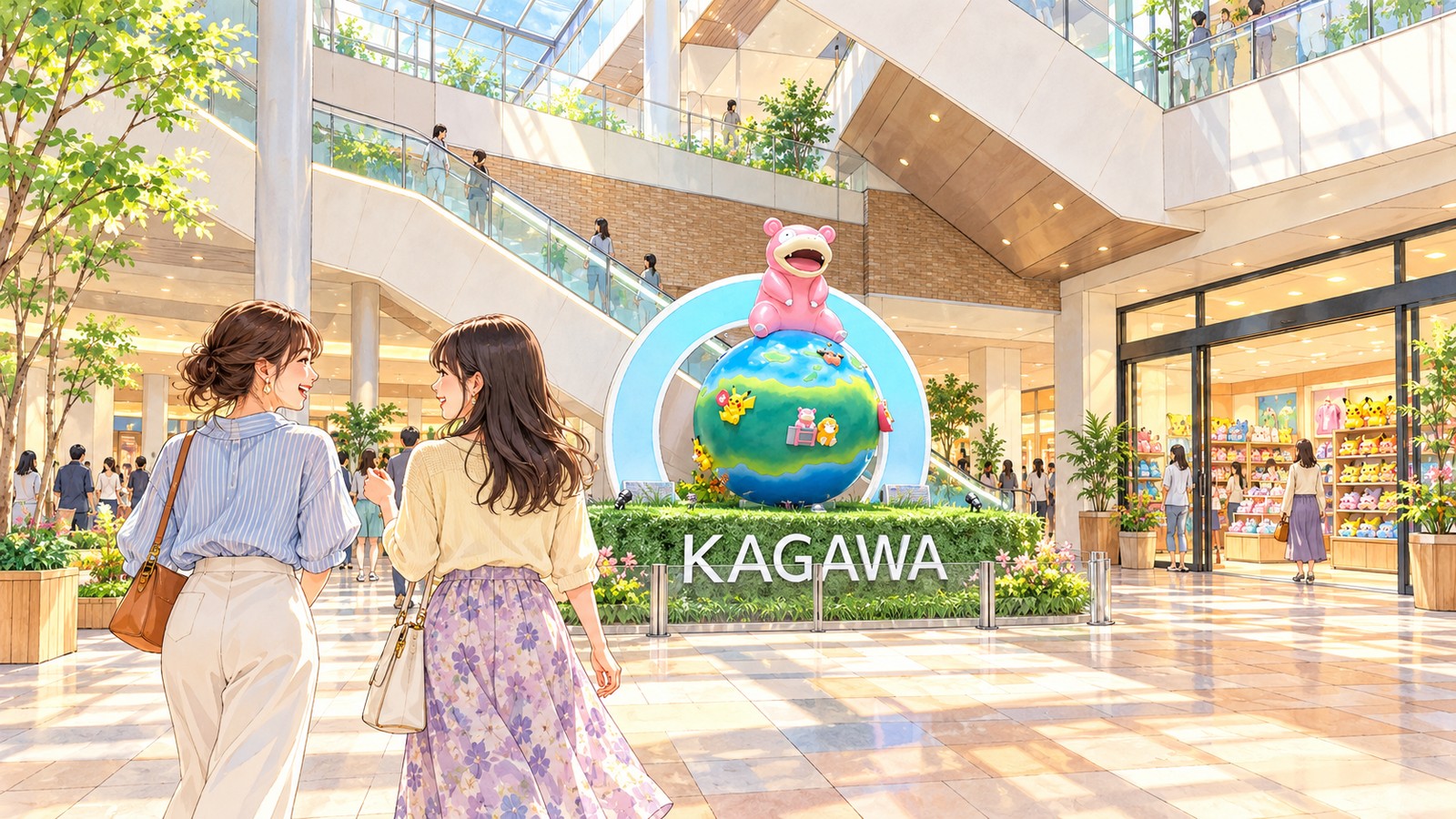
Pokémon Center KAGAWA opened on October 24, 2025, on the first floor of the East Building at Marugamemachi Green in Takamatsu. At the entrance, a relaxed Slowpoke welcomes visitors alongside Pikachu, who is getting sleepy after seeing Slowpoke. Slowpoke, the star of Ayagawa’s park, also brings a touch of Kagawa to the official shop in the prefectural capital.
The Pokémon Card Station is the first permanent space of its kind in Shikoku. It hosts trading-card classes and battle events, welcoming everyone from beginners learning the rules to players who enjoy competing. Dates and participation requirements are set for each event on the store calendar.
Opening merchandise also reflected Kagawa. Items included a Pikachu plush holding udon, a Smoliv olive-oil bottle, and a Slowpoke’s Well key chain. There were also an udon-bucket design and a Horsea soy-sauce dispenser. These goods combine Pokémon designs with local foods and tableware, making the region part of the subject matter.
These were commemorative products for the store’s 2025 opening; current stock varies by item. Visitors can see Slowpoke and Pikachu at the entrance, join a card-game event, and choose goods inspired by Kagawa—an experience distinct from playing on the park equipment.
The store is on the first floor of the East Building at Marugamemachi Green, 8-23 Marugamemachi, Takamatsu. It is open from 10 a.m. to 8 p.m. The walk takes about 15 minutes from JR Takamatsu Station or seven minutes from Kotoden Kawaramachi Station.
- Location
- 1F East Building, Marugamemachi Green, 8-23 Marugamemachi, Takamatsu, Kagawa Prefecture
- Connection to the work
- Official shop with Slowpoke and Pikachu displays and Shikoku’s first Pokémon Card Station
- Hours
- 10 a.m.–8 p.m. (participation requirements for card events vary by date)
- Access
- About a seven-minute walk from Kotoden Kawaramachi Station or a 15-minute walk from JR Takamatsu Station
Sources: Pokémon Center official — Store information (in Japanese) / Pokémon official — Store opening (in Japanese) / Pokémon official — Opening merchandise (in Japanese) / The Pokémon Company — Trading-card business (in Japanese)
Lapras Park in Kase-numa | Meet Lapras in the greenery of Rifu
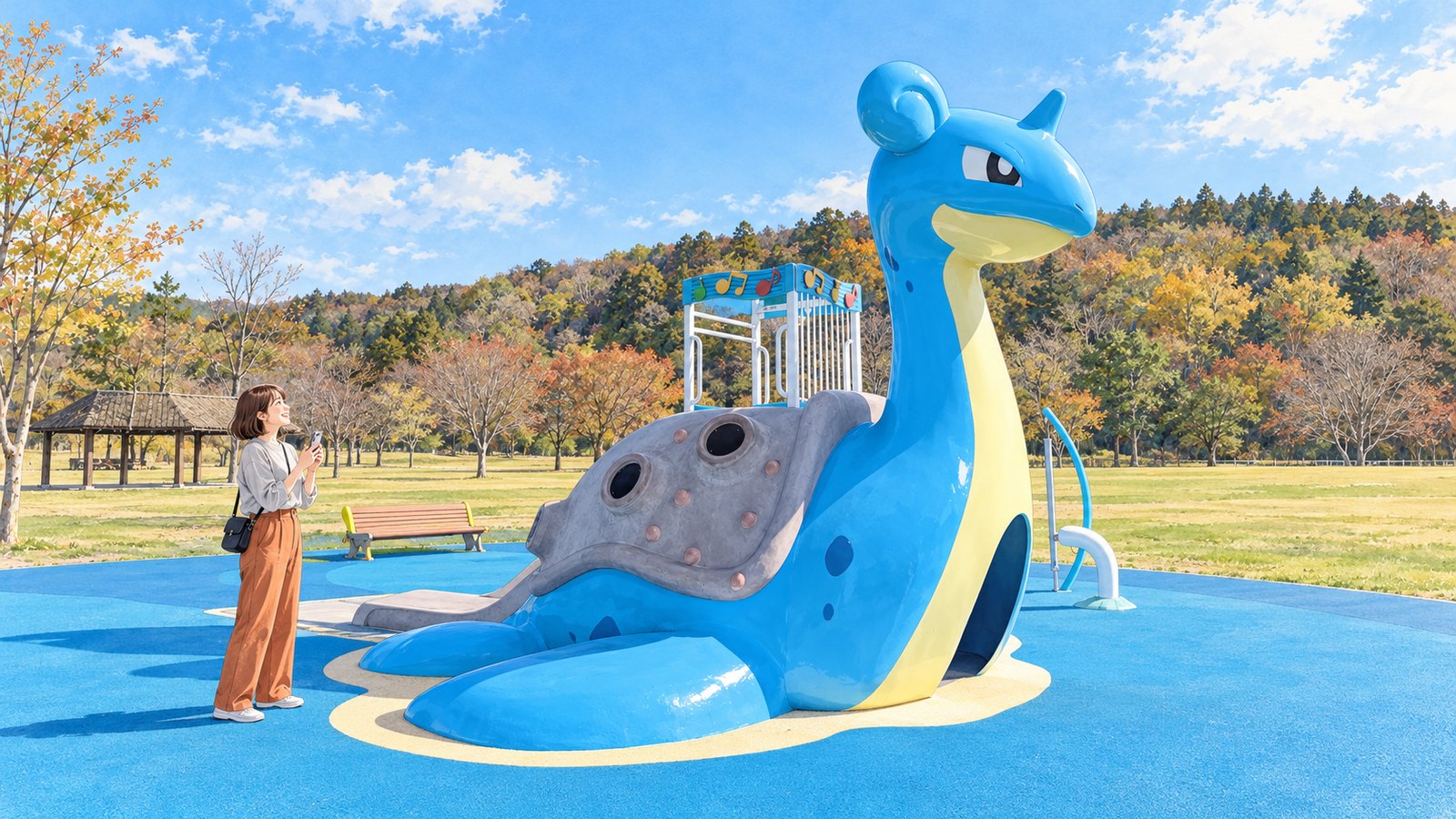
Lapras Park in Kasenuma opened in October 2025 inside Moririn Kase-numa Park in Rifu, Miyagi. It is a place to find playground equipment shaped like Pokémon, centered on Lapras, Miyagi Prefecture’s support Pokémon.
The centerpiece is a slide built on the back of a giant Lapras. Blue slides extend down both sides of its grayish-purple shell, with stairs behind it for climbing up. The playground structure turns Lapras sailing across the sea into a place where children can climb and slide.
The park is at 7-1 Shin-Tsutsumishita, Kase, Rifu, Miyagi District. It is about an 18-minute walk from JR Shin-Rifu Station or 24 minutes from Rikuzen-Sanno Station. Admission is free. Hours are 8 a.m.–6 p.m. from April through September and 8 a.m.–5 p.m. from October through March. It closes December 29 through January 3.
In fall 2026, the park joined a Miyagi Prefecture stamp rally along with the Lapras Park in Sendai. The prefecture now has two parks centered on Lapras in different locations.
- Location
- Inside Moririn Kase-numa Park, 7-1 Shin-Tsutsumishita, Kase, Rifu, Miyagi District, Miyagi Prefecture
- Connection to the work
- Park with a large slide and other play equipment featuring Lapras, Miyagi Prefecture’s support Pokémon
- Hours and closure dates
- April–September: 8 a.m.–6 p.m.; October–March: 8 a.m.–5 p.m.; closed December 29–January 3; free admission
- Access
- About an 18-minute walk from JR Shin-Rifu Station or a 24-minute walk from Rikuzen-Sanno Station on the JR Tohoku Main Line
Sources: Lapras + Miyagi Journey — Lapras Park guide (in Japanese) / Miyagi Prefecture — Moririn Kase-numa Park information (in Japanese) / Miyagi Prefecture — Lapras stamp rally information (in Japanese)
Lapras Park in Sendai | A play area in the Fujitsuka district of Kaigan Park
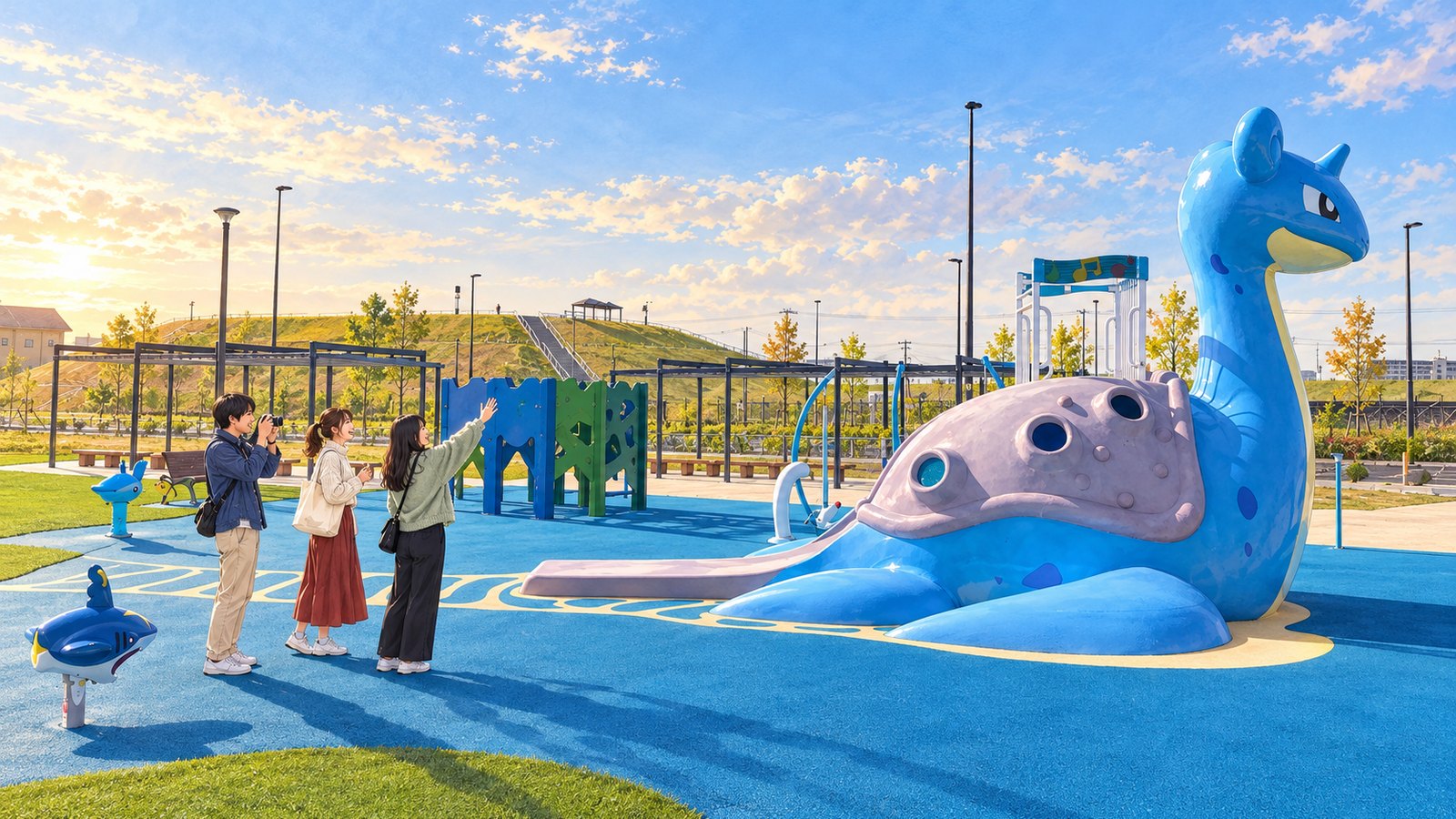
Lapras Park in Sendai opened on April 23, 2026, in the Fujitsuka district of Kaigan Park in Wakabayashi Ward, Sendai. Following the Rifu park, another place to see Lapras playground equipment has opened in Miyagi Prefecture.
Here, too, a giant Lapras is the star of the playground. Visitors climb the stairs behind it and slide down the blue slides attached to both sides of its shell. The same play structure looks different from below, looking up at Lapras’s face and neck, and from above on its back.
To reach the Fujitsuka district of Kaigan Park in Wakabayashi Ward, take the bus bound for “Kaigan Park Fujitsuka/Lapras Park” from Stop 5 in front of Sendai Station; the ride takes about 40 minutes. Get off at “Kaigan Park/Lapras Park,” just beside the park. It is also about 30 minutes by bus from Yaku-shido Subway Station.
The park is free, open 24 hours, and has no regular closure days. Unlike the Kasenuma park in Rifu, where hours change by season, this Lapras Park has different visiting conditions.
- Location
- Fujitsuka district of Kaigan Park, Wakabayashi Ward, Sendai, Miyagi Prefecture
- Connection to the work
- Park with a Lapras slide and other playground equipment, featuring Miyagi Prefecture’s support Pokémon
- Hours and closure days
- Open 24 hours; no regular closure days; free admission
- Access
- About 40 minutes by bus from Stop 5 in front of Sendai Station; get off at Kaigan Park/Lapras Park
Sources: Lapras + Miyagi Journey — Lapras Park guide (in Japanese) / Sendai City — Lapras Park opening announcement (in Japanese) / Miyagi Prefecture — Lapras stamp rally information (in Japanese)
Sandshrew Park | Find two forms of Sandshrew at Tottori Sand Dunes Children’s Land
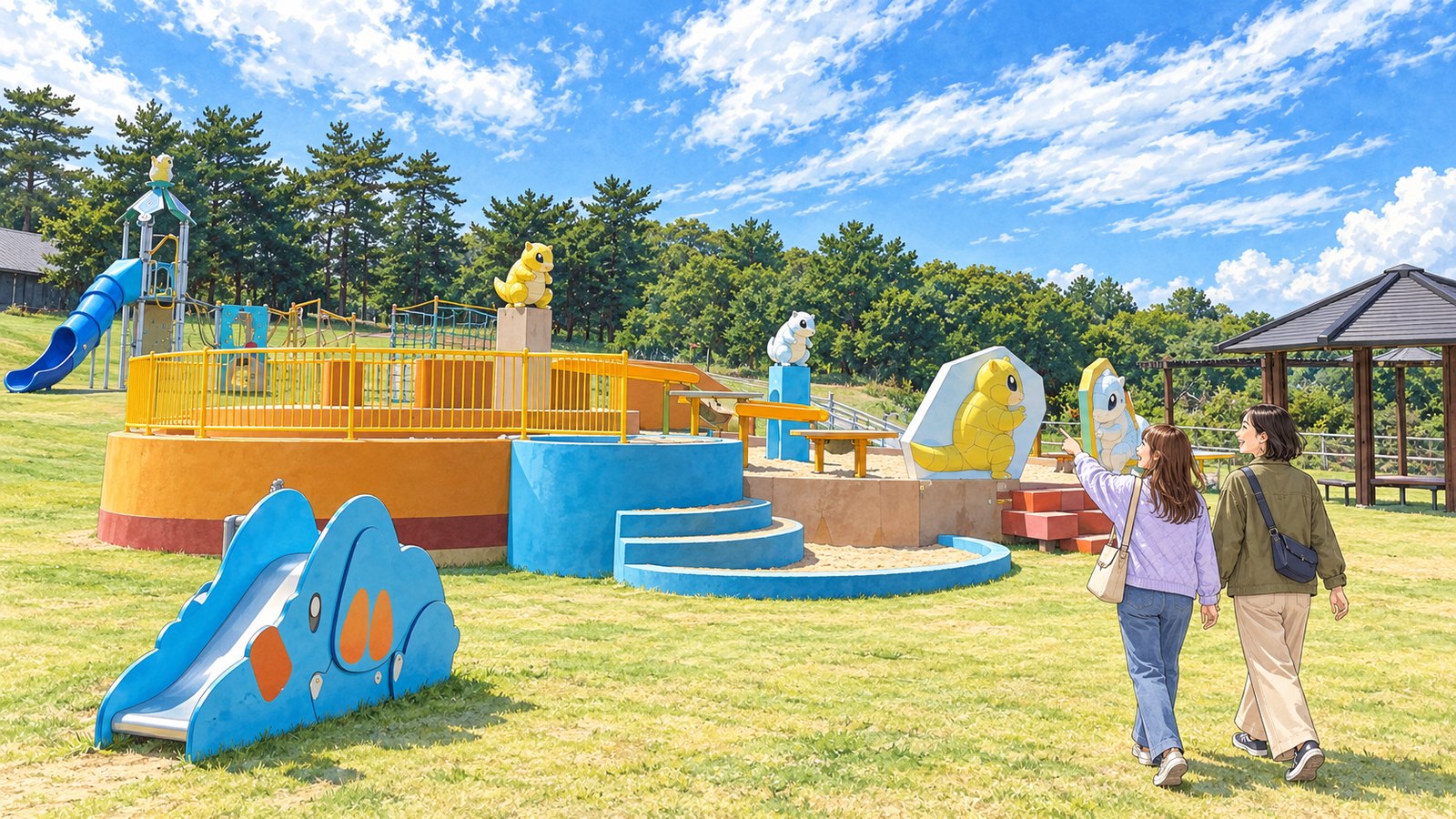
Tottori Sand Dunes Children’s Kingdom in Tottori City has a park themed around Sandshrew and Alolan Sandshrew, Tottori’s hometown ambassadors. The play equipment was installed on May 5, 2023, to coincide with the park’s 50th anniversary.
Sandshrew and Alolan Sandshrew share the same name but have different forms. The park has spring riders and seesaws shaped like each one, so visitors can compare the two forms through the play equipment.
In the round sandpit surrounded by a yellow fence, blue stairs and play equipment incorporate Sandshrew and its Alolan form. Visitors can take in the whole arrangement around the sandpit as well as the individual small rides shaped like Sandshrew.
The park is inside Tottori Sand Dunes Children’s Kingdom at 1157-1 Hamasaka, Tottori City. The seesaw and small spring riders are designed for ages 3–6, with a load limit of 40 kilograms. Adults can view the design and layout; children should use each piece according to its posted age range.
The park is open from 9 a.m. to 5 p.m., with last entry at 4:30 p.m. Regular admission is ¥500 for high school students and adults, ¥200 for junior high students, and free for elementary school children and younger. Winter rates apply in January and February. It is generally closed on the second Wednesday of each month (or the following day when it is a holiday) and from December 29 through January 1. It is open every day in August.
From Tottori Station, take a bus toward the sand dunes and Iwai for about 15 minutes, get off at Kodomo no Kuni Entrance, and walk about 10 minutes. The Pokémon play equipment is inside Children’s Kingdom, so enter through the main gate and head to Sandshrew Park.
- Location
- Inside Tottori Sand Dunes Children’s Kingdom, 1157-1 Hamasaka, Tottori City, Tottori Prefecture
- Connection to the work
- Park with play equipment and a sandpit featuring Sandshrew and Alolan Sandshrew, Tottori’s hometown ambassadors
- Hours and admission
- 9 a.m.–5 p.m. (last entry at 4:30 p.m.); generally closed the second Wednesday of each month and December 29–January 1; ¥500 for high school students and adults, ¥200 for junior high students, free for elementary school children and younger
- Getting there
- About 15 minutes by bus from JR Tottori Station; get off at Kodomonokuni Iriguchi, then walk about 10 minutes.
Sources: Tottori Sand Dunes Children’s Land — Play Equipment (in Japanese) / Official Tottori Sand Dunes Children’s Land (in Japanese) / Tottori Sand Dunes Children’s Land — Admission (in Japanese) / Tottori Sand Dunes Children’s Land — Access (in Japanese)
Mijumaru Park in Toba | Meet shell-carrying Quaxly in a harbor green space
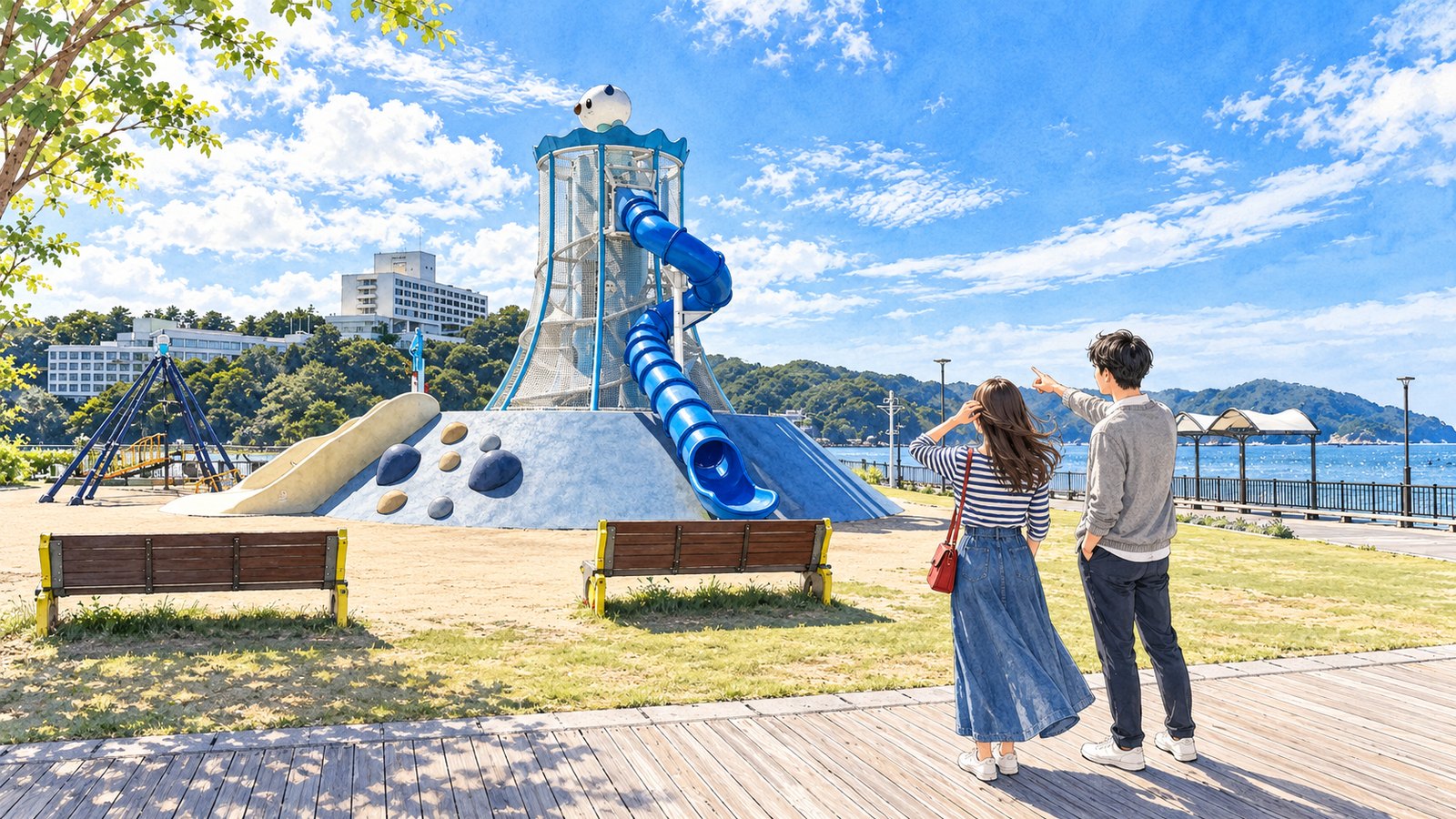
Mijumaru Park in Toba is located in Satahama Shinko Green Space, north of Toba Marine Terminal in Toba, Mie Prefecture. It opened on July 14, 2025, with play equipment featuring Mie’s support Pokémon, Quaxly.
The park’s Toba-inspired equipment includes a dugong swing and the “Quaxly Sky Rope,” a ride where children hold a rope and slide down. Quaxly’s design is paired with the feeling of playing in the sea breeze. A swing with a distinctly Toba design is also installed.
Quaxly carries a shell called a “scallop shell” on its belly. Mie has abundant seafood, including pearl oysters and other shellfish, which helped connect the shell-carrying Pokémon with the prefecture. The name also echoes “Mie” and the possible reading “Miju.” Seeing Quaxly at this harbor park brings the selection’s local roots to mind.
Regular boats to Toba’s four inhabited islands depart from the adjacent Toba Marine Terminal. The Habataki, launched in September 2024, is decorated with Quaxly inside and out. There is also a Quaxly bus stop at the terminal, bringing the same Pokémon into harbor transport as well as the park’s play equipment.
The park sits along the coast in Toba 1-chome and is about a 10-minute walk from JR and Kintetsu Toba Station. Its usual hours are 9 a.m. to 7 p.m.; look for it north of Toba Marine Terminal.
- Location
- Satahama Shinko Green Space, Toba Port, Toba 1-chome, Toba, Mie Prefecture (north of Toba Marine Terminal)
- Connection to Pokémon
- A harbor green space with play equipment featuring Mie’s support Pokémon Quaxly, plus Quaxly-decorated ferries and a bus stop
- Hours
- 9:00 a.m.–7:00 p.m.; free admission
- Getting there
- About a 10-minute walk from JR or Kintetsu Toba Station
Sources: Mie Prefecture — Mijumaru Park Opening Announcement (in Japanese) / Kanko Mie — Mijumaru Park (in Japanese) / Kanko Mie — Habataki Ferry (in Japanese) / Kanko Mie — Quaxly Bus Stop (in Japanese) / Kanko Mie — Park Details (in Japanese)
Pokémon Center Kyoto | Maiko Pikachu and Ho-Oh
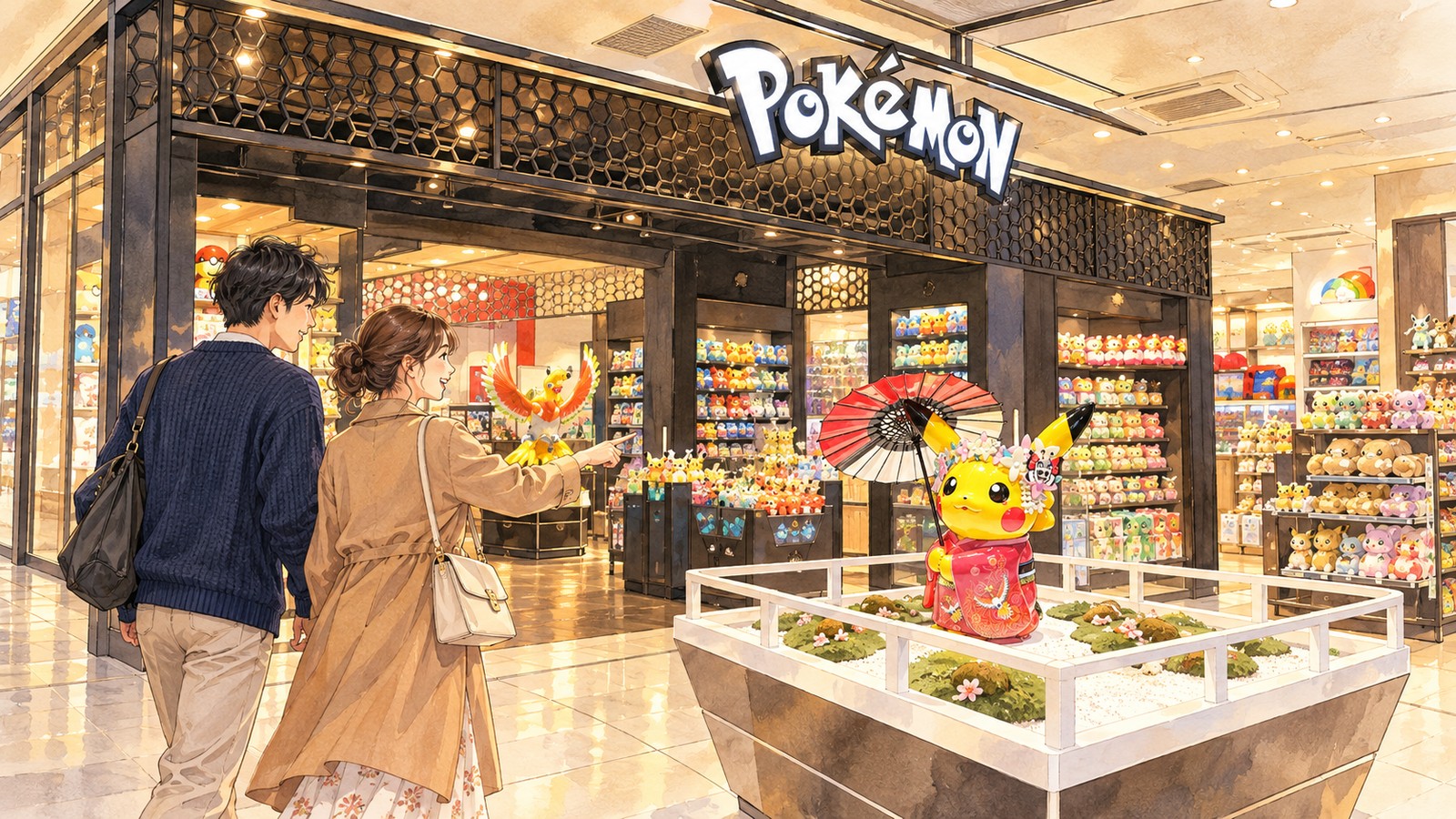
Pokémon Center Kyoto moved to the second floor of SUINA Muromachi and reopened on March 16, 2019. The official shop incorporates a traditional Kyoto aesthetic, with an interior based on black and white.
Maiko Pikachu greets visitors at the entrance in a red kimono and obi patterned with Ho-Oh, holding a Japanese umbrella decorated with Poké Balls. Behind it, Ho-Oh spreads its wings amid black latticework and a white ceiling. The kimono and umbrella give the shop a distinctly Kyoto character.
The store is on the second floor of Kyoto Keizai Center SUINA Muromachi, at 78 Kankoboko-cho, Shijo-dori Muromachi Higashi-iru, Shimogyo-ku, Kyoto. It is open from 10 a.m. to 8 p.m. and directly connected to Exit 26 at Shijo Station on the subway and Karasuma Station on the Hankyu line.
- Location
- 2F, Kyoto Keizai Center SUINA Muromachi, 78 Kankoboko-cho, Shijo-dori Muromachi Higashi-iru, Shimogyo-ku, Kyoto, Kyoto Prefecture
- Connection to Pokémon
- An official shop with a Kyoto-inspired design and entrance statues of Maiko Pikachu and Ho-Oh
- Hours
- 10:00 a.m.–8:00 p.m.
- Getting there
- Directly connected to Exit 26 at Shijo Station on the Kyoto Municipal Subway Karasuma Line and Karasuma Station on the Hankyu Kyoto Line
Sources: Official Pokémon Center — Kyoto Store (in Japanese) / Pokémon Daisuki Club — Kyoto Store Introduction (in Japanese) / Pokémon Daisuki Club — Relocation Announcement (in Japanese)
Pokémon Center Shibuya | Make your own T-shirt at the Design Lab
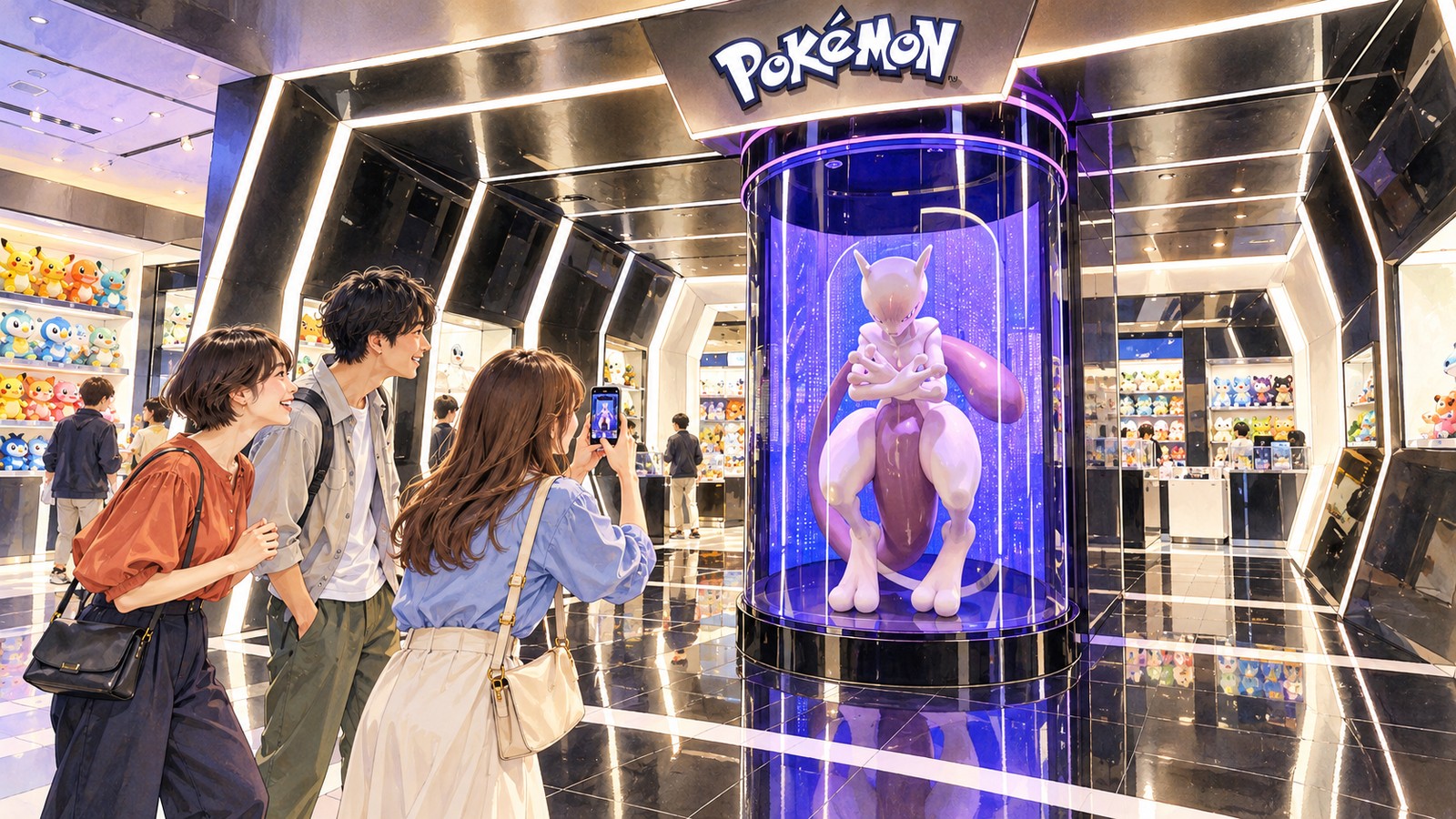
At Pokémon Center Shibuya on the sixth floor of Shibuya PARCO, visitors can make an original T-shirt at the Pokémon Design Lab. On a large touchscreen, they combine Pokémon art, stamps, and text to create a design and purchase the finished item.
In May 2025, 122 Alolan Pokémon were added, including variations in appearance. Visitors choose their favorites and arrange them on screen, making this a different kind of shopping experience from picking a ready-made product off a shelf. Adult and children’s sizes are available, so you can take home a shirt bearing your own design.
According to the October 2026 visitor information, design time is limited to 20 minutes after your turn is called, and pickup is about an hour or more after completing the design. Advance lotteries or numbered tickets may be used on busy days.
The store is on the sixth floor of Shibuya PARCO, 15-1 Udagawacho, Shibuya, about a five-minute walk from Shibuya Station. Hours are 10 a.m. to 9 p.m. Plan to complete the experience, including pickup, during store hours.
- Location
- 6F, Shibuya PARCO, 15-1 Udagawacho, Shibuya, Tokyo
- Connection to Pokémon
- An official shop with the Pokémon Design Lab, where visitors can make original T-shirts
- Hours and activity time
- 10:00 a.m.–9:00 p.m. (design time up to 20 minutes; pickup about an hour or more after completion)
- Getting there
- About a five-minute walk from JR, private railway, and subway lines at Shibuya Station
Sources: Official Pokémon Center — Shibuya Store (in Japanese) / The Pokémon Company — Official Shops (in Japanese) / Official Pokémon — Design Lab Design Update (in Japanese) / Pokémon Center Shibuya — Design Lab Visitor Information (in Japanese)
Learn more about Pokémon | An adventure that began in Pallet Town
Search for Pokémon in the forest, take a break in town, then head out to meet more. The forest-and-town setting of PokéPark echoes the order of an adventure in the games. The locations also reflect the play style introduced in 1996 and how Chansey and Slowpoke became connected with their regions.
The protagonist of Red and Green and Professor Oak
The first games, Pokémon Red and Green, were released for Game Boy on February 27, 1996. The player character lives in Pallet Town in the Kanto region. After receiving a Pokémon from Professor Oak, they set out on an adventure.
The basic gameplay is to catch, train, and battle wild Pokémon. Each Pokémon has a type, and matchups such as Water being strong against Fire affect battles. Rather than choosing one powerful Pokémon, players consider how their team matches up against an opponent. Learning about the Pokémon they collect helps them move forward.
At PokéPark, visitors can search for Pokémon in the forest and stop at a Pokémon Center or shop in town. As in Red and Green, where players travel from tall grass into towns, the layout lets visitors move on foot between places to explore and places to rest.
These 10 locations include official facilities modeled on the world of the games and parks and shops created in partnership with local governments. Visiting them offers a different kind of connection to Pokémon than touring real-world places that inspired fictional towns.
Differences between Red and Green gave players a reason to trade
In Red and Green, encounter rates differ, and some Pokémon appear in only one version. Trading with someone playing the other version became a way to expand the collection. The original games support trades using a Game Boy series Link Cable.
Trading requires another player. You send over a Pokémon caught in your game and receive one raised by someone else, creating an opportunity to connect beyond the game itself. Collecting, training, and battling are joined by communication and exchange as core parts of play.
Red and Green can also trade with Blue and Pokémon Yellow. Even when players own different versions, they can continue collecting together.
How the games made it possible to keep playing as generations grew up
In a Nintendo interview about developing Pokémon Black and White, the team describes rethinking familiar conventions to make a new game for the same Nintendo DS system. One change was adding the option to display kanji alongside hiragana. The text settings offered choices so players who had grown up with the series could keep playing as they got older.
Game Freak, which develops the games; Nintendo, their publisher; and The Pokémon Company, which manages the brand, have distinct roles. The Pokémon Company is involved in donating park equipment and working with local governments, while game introductions describe development and publishing information.
- Adventure and exploration
Search the forest, then head to town
The route from tall grass into town in Red and Green echoes the forest-and-town layout of PokéPark.
- Collecting and battling
Choose cards and merchandise
This connects with battles at the Card Station in Kagawa and making T-shirts at the Design Lab in Shibuya.
- Local partnerships
Learn about Pokémon and the places they represent
Chansey in Fukushima and Slowpoke in Kagawa, for example, appear in park equipment and merchandise that reflect each Pokémon’s traits and the region’s products and scenery.
Sources: Official Pokémon — Red and Green Overview and Trading (in Japanese) / The Pokémon Company — Video Game Business (in Japanese) / Nintendo — Iwata Asks: Black and White, Part 1 (in Japanese)
Why Chansey and Slowpoke became local mascots
Chansey was selected for Fukushima and Slowpoke for Kagawa because of links between each Pokémon’s traits or name and the prefecture. Chansey’s association with happiness echoes the “福” (fuku, good fortune) in Fukushima, while Slowpoke sounds like udon. Knowing these connections helps explain why they became the parks’ featured Pokémon.
Chansey’s egg and the “fuku” in Fukushima
Chansey is the Egg Pokémon, #113 in the National Pokédex. It is a Normal type, 1.1 meters tall and weighing 34.6 kilograms. Its evolutionary line runs from Happiny to Chansey and then Blissey. Happiny’s appearance in Namie Town’s park makes sense in light of this connection.
In February 2019, Chansey was appointed Fukushima’s support Pokémon. One reason for the choice is its association with bringing happiness, which connects to the “fuku” (good fortune) in Fukushima. Chansey’s nutritious eggs were also linked with the prefecture’s abundant agricultural products. The Pokémon’s traits, not only its cute appearance, are used to introduce the prefecture.
On February 18 of the same year, Fukushima Prefecture and The Pokémon Company signed a partnership agreement. Its goals include promoting tourism, expanding consumption of products from the prefecture, and supporting recovery from the Great East Japan Earthquake and other disasters. At the signing ceremony at the prefectural office, the governor gave Chansey a name tag. Their work together as Fukushima’s support Pokémon began before the park was built.
A park opened in Namie Town in 2021. About three years after the 2019 partnership agreement, a roadside station gained a place where visitors could play on equipment featuring Chansey.
Slowpoke, udon, sweets, and the rain legend
Slowpoke is the Dopey Pokémon, #079 in the National Pokédex. It is a Water/Psychic type, 1.2 meters tall and weighing 36.0 kilograms. In December 2018, it was appointed to Kagawa Prefecture’s Udon Prefecture PR Team. The similarity between “udon” and “Yadon” (Slowpoke’s Japanese name) makes the connection easy to understand.
The connection goes beyond the name. Slowpoke’s tail is said to taste sweet, linking it with Kagawa sweets such as wasanbon sugar and rare sugars. A legend that its yawn brings rain is also associated with Kagawa, which has faced water shortages. The selection draws on several links between the Pokémon’s lore and local character.
The connection with Kagawa also appears in play equipment inspired by wells and water in Ayagawa Town, and in opening-commemorative merchandise at Pokémon Center Kagawa, including Pikachu holding udon. Visitors encounter local stories about water and food while playing or shopping.
Sources: Pokémon Local Acts — Fukushima × Chansey (in Japanese) / Pokémon Daisuki Club — Partnership Signing Ceremony Report (in Japanese) / Pokémon Local Acts — Kagawa × Slowpoke (in Japanese) / Ayagawa Town — Park Overview, Equipment, and Rules (in Japanese) / Official Pokémon — Opening Merchandise (in Japanese) / Fukushima Prefecture — Video Celebrating Lucky Park (in Japanese) / Official Fukushima & Chansey Website (in Japanese) / Udon Prefecture × Slowpoke — Slowpoke Paradise in Kagawa (in Japanese)
The world of Pokémon across games, anime, and cards
Since the release of Red and Green, Pokémon has expanded into the trading card game, television anime, and movies. Pokémon appear across these formats, but the players’ roles and the stories’ protagonists are not the same.
Follow Liko and Roy’s adventures in the anime
The protagonists of the Pokémon television anime are Liko, a girl from the Paldea region, and Roy, a boy from the Kanto region. In the games, players control the protagonist themselves; in the anime, they follow the two as they meet Pokémon and take action.
The protagonist of Netflix’s Pokémon Concierge is Haru, a new concierge working at a Pokémon resort on a southern island. The series follows her daily encounters with Pokémon at work, offering a look at their lives distinct from stories centered on adventure or battles.
Learn about the 60-card deck at the Card Station
The Pokémon Trading Card Game adapts collecting and battling from the video games to cards. A standard deck has 60 cards; combinations, the hand you draw, and the chance involved in shuffling all play a role. Instead of directly controlling Pokémon in a game, players decide what to do next with the cards in hand.
Cards feature a wide range of artwork, even for the same Pokémon. Players can enjoy both building decks for battles and collecting illustrations of their favorite Pokémon. The rules for cards permitted in official events are updated periodically.
The Card Station at Pokémon Center Kagawa is a place to experience this play in person. Introductory lessons and battle events serve different purposes for participants.
A game that studies Pokémon through photos and a forest setting
New Pokémon Snap is a game about studying Pokémon in their natural habitats and creating a personal Photodex. Rather than battling, its focus is on observing where Pokémon live and how they behave.
Pokémon in the forest at PokéPark are also shown alongside places such as grassy areas and rocky ground. Observing the environments they live in is a pleasure shared by New Pokémon Snap and the on-site forest.
Sources: The Pokémon Company — Video Game Business (in Japanese) / The Pokémon Company — Trading Card Game Business (in Japanese) / Official Pokémon — TV/Movie (in Japanese) / Official Pokémon — Open Introduction (in Japanese)
From 1996 onward, Pokémon expanded beyond games
The series’ history includes new game releases, store openings, partnerships with local governments, and park openings. These are some of the major milestones from the first game in 1996 to the opening of the current facilities.
A timeline of adventures, connections, and places to visit
- 1996
February 27 Pokémon Red and Green released for Game Boy. Adventures in the Kanto region and link-cable trading begin.Games - 1996
October Pokémon Trading Card Game released, bringing collecting and battles to cards.Cards - 1997
April Pokémon television anime begins airing, expanding the stories into animation.Anime - 1998
April The first Pokémon Center Tokyo opens, creating a physical store for Pokémon merchandise.Stores - 1998
July The first theatrical Pokémon movie is released, bringing the stories to cinemas after television.Movies - 1999
November Pokémon Gold and Silver released, continuing the series after the first games.Games - 2000
October The company changes its name to The Pokémon Company as its business expands to overall Pokémon brand management.Business - 2002
November Pokémon Ruby and Sapphire released.Games - 2005
March Pokémon The Park 2005 opens for a limited time at a satellite site of Expo 2005 Aichi.Events - 2016
July Pokémon GO launches, bringing the Pokémon games into a new format.Releases - 2018
December Slowpoke is appointed to the Udon Prefecture PR Team.Local partnerships - 2019
February 18 Fukushima Prefecture and The Pokémon Company sign a partnership agreement; Chansey begins serving as Fukushima’s support Pokémon.Local partnerships - 2021
December 12 Lucky Park opens at Roadside Station Namie.Parks - 2023
April 14 Yadon Park opens in Ayagawa Town.Parks - 2025
July 14 Mijumaru Park in Toba opens.Parks - 2025
October Lapras Park in Kesennuma opens.Parks - 2025
October 24 Pokémon Center Kagawa opens in Takamatsu.Stores - 2026
April 23 Lapras Park in Sendai opens.Parks
The official PokéPark trailer shows how the forest and town fit together
The official PokéPark KANTO trailer shows the forest, a town market, Pokémon Centers, Gyms, and battle courts in a 90-second continuous shot. Released November 11, 2025, it was created as an impression of the site during development and conveys the intended layout through connected scenes.
Look up Chansey and Slowpoke in the Official National Pokédex 1996–2026
For anyone who wants to look up a Pokémon’s name or characteristics after seeing it on a trip, the Official National Pokédex 1996–2026 is a useful reference. Compiled by Hidesuke Motomiya and One-Up, supervised by The Pokémon Company, and produced with support from Game Freak, it was published by Overlap on August 7, 2026. ISBN 978-4-8240-1717-8; B5 size, 448 full-color pages.
It covers 1,025 Pokémon as of the end of March 2026, with types, classifications, height and weight, Abilities, Pokédex entries, English names, and evolution lines. The indexes are arranged by number and Japanese syllabary, so readers can look up a Pokémon they spot in a park or search by National Pokédex number. It also helps explain the evolution from Happiny to Chansey and Chansey’s type.
The book also includes columns on Mega Evolution, regional forms, and Terastallization, explaining why the same Pokémon can appear in different forms. It is available through the publisher’s product page and the standard Amazon product page.
Sources: The Pokémon Company — Official History (in Japanese) / Official Pokémon — Red and Green Overview and Trading (in Japanese) / Pokémon Local Acts — Fukushima × Chansey (in Japanese) / Pokémon Local Acts — Kagawa × Slowpoke (in Japanese) / PokéPark KANTO — Official Trailer Announcement (in Japanese) / Overlap — Bibliographic and Product Information (in Japanese)
Field notes | Business perspective: Turn local character into play equipment and products
In Fukushima, Chansey’s association with good fortune and its egg-related lore connect with local agricultural products. In Kagawa, Slowpoke’s name, sweet tail, and rain legend connect with udon, sweets, and water. These concrete local ties let the themes extend to park equipment and store merchandise.
A useful lesson for local governments and companies is to choose a character based on an explainable connection to the place, rather than popularity alone. Visitors interact differently with play equipment, Poké Lids, and products. Designing around both local character and what visitors can enjoy on site makes it possible to offer distinct experiences in different locations.
Sources: Pokémon Local Acts — Fukushima × Chansey (in Japanese) / Pokémon Local Acts — Kagawa × Slowpoke (in Japanese) / Namie Town — Lucky Park and Poké Lid (in Japanese) / Ayagawa Town — Park Overview, Equipment, and Rules (in Japanese) / Official Pokémon — Opening Merchandise (in Japanese)
Sources
- PokéPark KANTO — About the Facility: Pokémon Forest / Sedge Town (in Japanese)
- PokéPark KANTO — Ticket Types and Prices / Forest Restrictions (in Japanese)
- PokéPark KANTO — Visit Us (in Japanese)
- PokéPark KANTO — Official Trailer Announcement (in Japanese)
- Fukushima Prefecture — Lucky Park in Namie (in Japanese)
- Namie Town — Lucky Park and Poké Lid (in Japanese)
- Pokémon Local Acts — Fukushima × Chansey (in Japanese)
- Pokémon Daisuki Club — Partnership Signing Ceremony Report (in Japanese)
- Ayagawa Town — Park Overview, Equipment, and Rules (in Japanese)
- Kagawa Prefecture Tourism Association — Yadon Park Overview (in Japanese)
- Pokémon Local Acts — Kagawa × Slowpoke (in Japanese)
- Official Pokémon Center — Store Information (in Japanese)
- Official Pokémon — Opening Introduction (in Japanese)
- Official Pokémon — Opening Merchandise (in Japanese)
- Official Pokémon — Red and Green Overview and Trading (in Japanese)
- The Pokémon Company — Video Game Business (in Japanese)
- The Pokémon Company — Trading Card Game Business (in Japanese)
- Official Pokémon — TV/Movie (in Japanese)
- Nintendo — Iwata Asks: Black and White, Part 1 (in Japanese)
- The Pokémon Company — Official History (in Japanese)
- Overlap — Bibliographic and Product Information (in Japanese)
- Lapras + Miyagi — Lapras Park Guide (in Japanese)
- Miyagi Prefecture — Moririn Kase-numa Park Guide (in Japanese)
- Miyagi Prefecture — Lapras Stamp Rally Information (in Japanese)
- Sendai City — Lapras Park Opening Announcement (in Japanese)
- Tottori Sand Dunes Children’s Land — Play Equipment (in Japanese)
- Official Tottori Sand Dunes Children’s Land (in Japanese)
- Tottori Sand Dunes Children’s Land — Admission (in Japanese)
- Tottori Sand Dunes Children’s Land — Access (in Japanese)
- Mie Prefecture — Mijumaru Park Opening Announcement (in Japanese)
- Kanko Mie — Mijumaru Park (in Japanese)
- Kanko Mie — Habataki Ferry (in Japanese)
- Kanko Mie — Quaxly Bus Stop (in Japanese)
- Kanko Mie — Park Details (in Japanese)
- Official Pokémon Center — Kyoto Store (in Japanese)
- Pokémon Daisuki Club — Kyoto Store Introduction (in Japanese)
- Pokémon Daisuki Club — Relocation Announcement (in Japanese)
- Official Pokémon Center — Shibuya Store (in Japanese)
- The Pokémon Company — Official Shops (in Japanese)
- Official Pokémon — Design Lab Design Update (in Japanese)
- Pokémon Center Shibuya — Design Lab Visitor Information (in Japanese)
- Fukushima Prefecture — Video Celebrating the Opening of Lucky Park: “Fukushima & Chansey: Exciting Memories” (in Japanese)
- Official Fukushima & Chansey Website (Fukushima Prefecture) (in Japanese)
- Udon Prefecture × Slowpoke — Slowpoke Paradise in Kagawa (Kagawa Prefecture) (in Japanese)
- Kagawa Prefecture — Official X Account Policy for Udon Prefecture Slowpoke Club! (in Japanese)
Event dates, opening hours, and ticket information are current as of writing. Check each official website for the latest information before your visit.
FAQ
Is PokéPark KANTO inside Yomiuriland?
It is inside Yomiuriland amusement park in Inagi, Tokyo. Every PokéPark ticket includes admission to Yomiuriland, but access to the Forest and Town varies by ticket type, and the two Town attractions cost extra.
Can young children enter the PokéPark Forest?
The Forest has steep slopes and 110 steps, and entry is restricted for children under five and their companions, among others. Families with young children can use the Kayatsuri Town Pass, which covers only the Town area.
Where is Lucky Park?
It is on the grounds of Roadside Station Namie at 60 Chimyoji, Kiyohashihata, Namie, Fukushima Prefecture. It is about a 15-minute walk from JR Namie Station.
What is the nearest station to Yadon Park, and when is it open?
The park is about 300 meters south of Kotoden Ayagawa Station, around a five-minute walk. It is at 253-7 Kayahara, Ayagawa, and is open from 7 a.m. to 8 p.m.
Can I play the Pokémon Trading Card Game at Pokémon Center Kagawa?
The store has Shikoku’s first Pokémon Card Station, with space for lessons and battle events. Event content and eligibility vary by date.
Where are the Lapras Parks in Miyagi Prefecture?
There are two: Lapras Park in Kase-numa, inside Moririn Kase-numa Park in Rifu Town, and Lapras Park in Sendai, in the Fujitsuka district of Kaigan Park, Wakabayashi Ward. Hours and closing days vary by location.
Which store lets visitors make an original T-shirt?
Pokémon Center Shibuya on the sixth floor of Shibuya PARCO. At the Pokémon Design Lab, visitors combine art, stamps, and text. Design time is up to 20 minutes, and pickup is about an hour or more after finishing.
Why are Chansey associated with Fukushima and Slowpoke with Kagawa?
Chansey was chosen for its association with bringing happiness, the “fuku” in Fukushima, nutritious eggs, and local agricultural products. Slowpoke’s Japanese name sounds like udon, and its sweet tail and rain-related lore connect with Kagawa.
Are the parks and shops modeled on locations from the games or anime?
These parks and shops were developed through official partnerships between Pokémon and local governments or as permanent attractions where visitors can experience the world of the series. They are different in nature from real places used as backdrops for specific game or anime scenes.
Does the Pokédex include all new information from 2026?
The Official National Pokédex 1996–2026 covers information through the end of March 2026, including 1,025 Pokémon. It does not include announcements made after that date.


