
Concert Rubber Band Culture and How to Choose: Clasps, Patterns, Keepsakes, and Support in Official Images
Fans wear rubber bands printed with the name of a concert or music festival on their wrists or attach them to their bags. Some choose them for their colors and patterns, while others keep them as souvenirs of the shows they attended. Although they are small items of merchandise, comparing official product photos reveals distinct differences in how they fasten and how their lettering is displayed.

In this article, we use the history of wristbands worn to express support for a cause and official music festival merchandise as starting points to examine the shapes, selection points, storage methods, and organizer communications for concert rubber bands—often called rababan in Japanese fan culture.
How a Yellow Wristband Showed a Way to Wear Support
One documented historical example is the yellow “LIVESTRONG” wristband. According to the Livestrong Foundation’s 20th-anniversary overview, the organization partnered with Nike to launch the wristband in May 2004, selling each band for one dollar to help fund support activities for cancer survivors.
What is notable about this example is that in addition to buying a product, wearing it allowed people to visibly express their support. However, we cannot say that all modern music merchandise grew directly out of this wristband. Even when bands look similar in shape, it is necessary to check individually when each item was made, the purpose of its sale, and how its proceeds are used.
At concerts and festivals in Japan as well, products that commemorate an event name sometimes appear alongside products that promote a support initiative. Rather than lumping them together and assuming that every rubber band contributes to a donation or that every band is merely a souvenir without looking at those differences, distinguishing between them is the starting point for understanding both the history of wristbands and current merchandise projects.
Clasps and Marbled Patterns Seen in Official Product Images
The Sky Jamboree 2026 official merchandise guide (in Japanese) features both clear and marbled rubber bands.
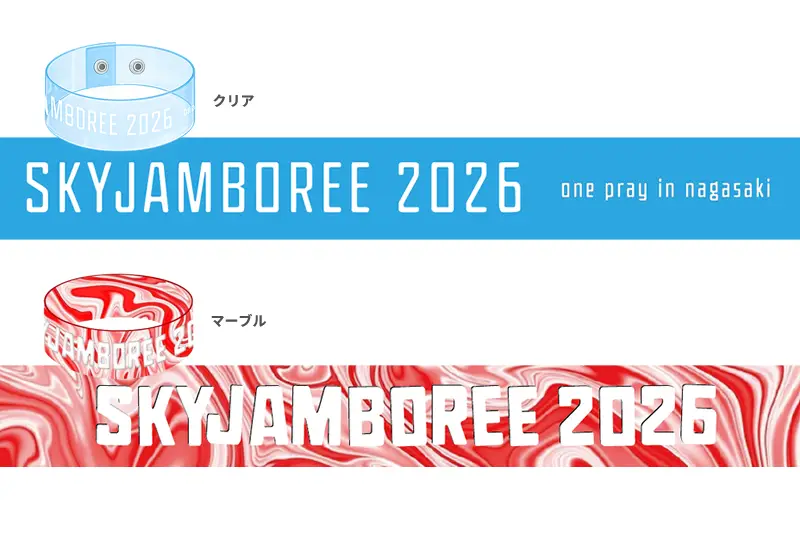
In the photo of the clear band, you can see the overlapping ends where the band fastens and a round snap clasp. On the red-and-white marbled band, the white event name is printed over the swirled pattern. Even under the same product name of “rubber band,” you can see that fans can choose between different fastening styles and different ways the lettering stands out.
What we can read from a photograph are details like the shape, color scheme, and printed names. A photo alone cannot tell us what specific resin a transparent band is made from, how far it stretches, or how many years it can be stored. To know the material, dimensions, and how to put it on, you need to check the product specifications section or the instructions included with the item.
Items printed with a year serve as a helpful cue to remember that specific edition of the festival when looking back later. At the same time, there is no need to limit the days you wear it to the year the event took place. It is up to each owner to choose whether to buy a new band, keep using an older one, or preserve the memory through photographs.
Visible in Official Photos
- Overall band shape and whether it uses an overlapping clasp or closed loop
- Color schemes, clear finishes, and marbled patterns
- Placement of event names, years, and exterior or interior text
Requires Specifications or Organizers' Notes
- Exact resin or rubber material, dimensions, and how much it stretches
- Care, cleaning, and storage precautions for that material
- Pickup location, order windows, and charity proceeds handling
Source: The Oshi Lab's summary of the article
Check the Word “Charity” and the Details of the Support Separately
The same official merchandise page also lists a “Charity Rubber Band” featuring the name of the band go!go!vanillas alongside the festival name.
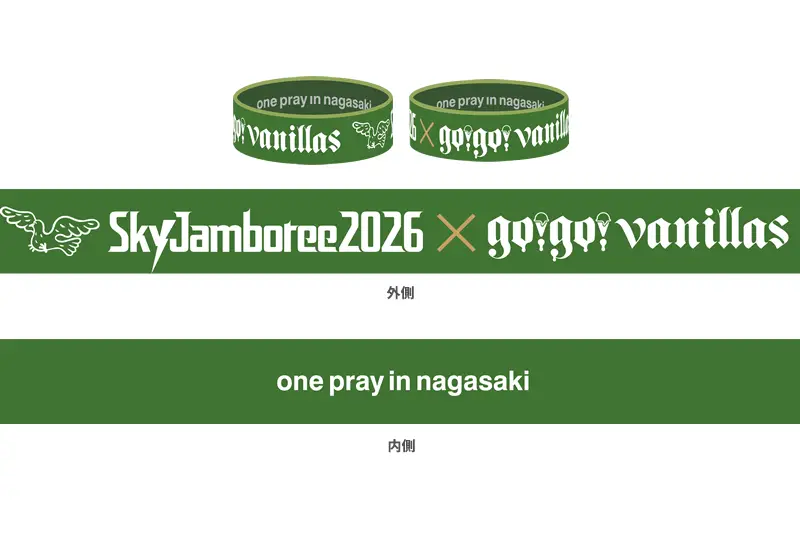
The names of the festival and the artist are placed on the outside of the band, while another short phrase is printed on the inside. The image shows how the design separates the outer surface—which is visible to people around you when worn on the wrist—from the inner surface, which you can read yourself when you take the band off.
However, you cannot assume from the word “charity” in a product name alone that the entire purchase price will be donated or that funds will go to a specific organization. To understand the recipient, the portion of the price covered, the campaign period, and how results will be reported, read the separate explanation provided by the organizer.
When companies or events create merchandise intended to support a cause, they should likewise explain the design details and the handling of proceeds separately. When fans decide what to buy, it is important that they can clearly see what activity the product supports and how it is involved.
Admission Wristbands and Commemorative Merchandise Serve Different Roles
At festival venues, wristbands are often used to manage admission and re-entry. Wearing a rubber band bought at a merchandise booth does not serve as proof of admission to the venue.
| Type | Primary Role | Guidance for Attendees to Read |
|---|---|---|
| Admission wristband | Managing entry eligibility and attendance dates | Exchange location, wearing rules, and conditions for loss or re-entry |
| Commemorative merchandise rubber band | Recording attendance at a show; styling with outfits or bags | Size, material, how to put it on, and sales terms |
| Merchandise promoting support for a cause | Participating in or expressing support for an explained initiative | Details of the support, how funds are handled, and reporting of results |
This table organizes the primary uses of each band. In practice, ways of enjoying them can overlap—for instance, a product that promotes support for a cause can also serve as a concert souvenir. Even so, it is important not to confuse the procedures required to enter a venue with the enjoyment of choosing merchandise.
Even with Online Purchases, Check Where You Will Pick Up the Item
On the Map Design GALLERY sales page (in Japanese), which was linked from the official Sky Jamboree 2026 site, online pre-orders were combined with on-site pickup. This is a clear example of why buyers should not assume an online listing works like standard home-delivery mail order, and instead need to read all the way through to the pickup location and schedule. That online sale has now ended.
From the perspective of merchandise planners, even for an inexpensive item, an attendee’s preparation does not end with paying the price of the product. Depending on the setup, buyers may need to set aside time for pickup, travel to the pickup point or venue, and save their exchange confirmation instructions.
When organizers gather the following details in one place in their instructions, it becomes much easier for attendees to plan the order of their preparations:
- Whether the item will be shipped home or picked up at a store or venue
- The period when orders can be placed and the period when items can be picked up
- The email or order information required at pickup
- How order changes, cancellations, or missed pickups are handled
- Who to contact if a buyer notices missing or damaged items
Providing not only product names and color photos, but also clear instructions on what to bring and where to go, is what makes merchandise guidance complete. Past sales pages that remain online can serve as useful reference material for understanding how a specific event operated, but their terms should not be reused or assumed as current purchasing conditions.
- 01Delivery or Pickup MethodClarify upfront whether orders ship to homes or require store or venue pickup
- 02Order and Pickup WindowsState both the ordering period and the specific dates and times for collection
- 03Required Proof at HandoverSpecify which confirmation emails or order records attendees need to save and bring
- 04Changes, Missed Pickups, and SupportExplain rules for cancellations or uncollected items and the contact point for defects
Source: The Oshi Lab's summary of the article
Look at Size and Fastening Styles When Stacking or Styling Bands
Layering multiple colors, lining up bands from different years of the same event, or attaching them to a bag to carry around—wearing rubber bands on the wrist is not the only way to enjoy them. Depending on the combination you choose, even the exact same product can take on a different look.
However, not all bands have the same circumference or stretch the same way. A closed-loop band that slips over the hand and a clasp-style band that opens and snaps shut also differ in how you put them on and take them off. Rather than judging from a photo alone that a band can be forcefully stretched over your hand or strap, read the product instructions before using it. When attaching a band to a bag, pay close attention to places where it might catch on objects or where a clasp might come undone.
Nor does the number of bands lined up on an arm or bag directly measure how many shows someone has attended or how strongly they support an artist. Some fans buy merchandise online without going to the venue, some treasure items passed down from others, and some enjoy concerts without buying commemorative goods at all. It is important not to make assumptions about a person’s experience based solely on the visible merchandise they carry.
Think About Storage Based on the Product’s Material and Condition
Even among items called rubber bands, the material, printing method, and clasp structure vary from product to product. Explanations regarding the degradation of urethane rubber cannot be applied directly to products made of silicone or other resins. Likewise, one should not make uniform guarantees about how many years a band will last or claim that placing a desiccant packet in storage will prevent any change in quality.
When thinking about how to store your bands, start by reading the care instructions on the product or its packaging. After that, review the band’s actual condition and how it is positioned.
| What to Check | How to Review and Adjust |
|---|---|
| Material and care labels | Check the cleaning and storage methods recommended for that specific product |
| Dirt, stickiness, cracks, or clasp wear | Do not force continued wear; adjust how you use or keep the item based on its condition |
| Storage that leaves the band pulled tight | Choose a placement that follows the instructions and does not put constant tension on the band |
| Contact with other merchandise | Periodically check surfaces that press together and the condition of the printed lettering |
| How you want to preserve memories | Decide which items to use and which to set aside, and make use of photos or notes as well |
Before applying solvents to an unfamiliar material or scrubbing it hard, check the guidance from the manufacturer or seller. If an item you own becomes worn or damaged, it is also entirely up to you whether or not to buy a replacement of the same item. If you are sorting through your collection, our guides on how to let go of merchandise and approaches to merchandise storage can also serve as helpful references.
The Oshi Lab Note: Pair Even Small Merchandise with Clear Explanations of Shape and Use
A concert rubber band is an item of merchandise that lets fans keep an event name or color scheme close at hand. When organizers clearly communicate the specific purpose of each item—whether as a concert keepsake, an everyday accessory, or an expression of support for a cause—even people seeing the merchandise for the first time can easily find a reason to choose it.
Price is not the only detail that merchandise planners should verify. By organizing information in the order a buyer will actually use it—covering materials, dimensions, whether the band opens and closes, exterior and interior printing, how to purchase and pick up the item, and explanations for any support initiatives—planners can build much clearer guidance. For product photography as well, rather than only showing the loop at an angle, consider compositions that clearly reveal the clasp mechanism and the placement of the lettering.
After sales conclude, recording questions or confusion about putting the bands on, taking them off, or storing them is also valuable. Those records become practical material for explaining product features to both fans who preserve their bands as keepsakes and fans who wear them repeatedly.
For consultations on merchandise planning and sales operations design, contact KAZAORI Co., Ltd. (in Japanese). Related articles: What Is a Rababan (Concert Rubber Band)? / What Is Merch Trading? / How to Let Go of Merch / Merch Storage Ideas
FAQ
Are all concert rubber bands made of the same material?
You cannot tell from the product name alone. Check the material, printing method, and clasp details for each individual product. Explanations about how urethane rubber degrades cannot be applied directly to silicone or other resin products.
Does wearing a merchandise rubber band get me into the venue?
Commemorative merchandise and admission wristbands serve different purposes. To enter or re-enter a venue, follow the instructions on your ticket and the guidance from the event organizer.
If an item is labeled as charity merchandise, is the full purchase price donated?
You cannot determine the donation amount or recipient from the product name alone. Check the official explanation provided by the organizer regarding the details of the support, the portion of proceeds included, the campaign period, and how results will be reported.
How should I store rubber bands if I want to keep them for a long time?
Check the material and the care instructions for the specific product, and think about how to position it based on its condition—such as not leaving it stretched out by force. No uniform guarantee can be made that adding a desiccant will prevent changes in material quality or that a band will remain usable for any set number of years.


