

Ryotaro Shiba Pilgrimage: 12 Literary and Historical Sites in Six Cities
A wall lined with all 1,296 installments of Clouds Above the Hill; the Akiyama brothers’ home, restored after it was lost in an air raid; and the study where Ryotaro Shiba kept colored pencils. Matsuyama, Yokosuka, Higashiosaka, Himeji, Kochi, and Nagasaki offer places that illuminate both the novel’s characters and the author’s work.
Visit the three protagonists of Clouds Above the Hill in Matsuyama, then board the flagship where Saneyuki served in Yokosuka. Trace the author’s study and family lineage in Higashiosaka and Himeji, then walk the birthplace of Ryoma and the bases of his associates in Kochi and Nagasaki. Across 12 sites in six cities, exhibits connect the places with scenes from the works. The four Matsuyama facilities are within reach of one another by streetcar and on foot.
12 Places in Matsuyama, Yokosuka, Higashiosaka, Himeji, Kochi, and Nagasaki
① Clouds Above the Hill Museum
A museum introducing the work and the Meiji era through the Akiyama brothers and Shiki.
Learn more about the Clouds Above the Hill Museum② Akiyama Brothers’ Birthplace
Their family home was destroyed in an air raid. Today, a reconstructed house and exhibits trace the brothers’ lives.
Learn more about the Akiyama Brothers’ Birthplace③ Shiki Memorial Museum
From the novel’s characters to a literary figure’s work to reshape haiku and tanka.
Learn more about the Shiki Memorial Museum④ Shikido
A reconstruction of the Minatomachi home where Shiki lived until age 17, beside Masunadaiji Temple.
Learn more about Shikido⑤ Mikasa Memorial Ship
The flagship at the Battle of Tsushima. Visitors can go up to the bridge where Saneyuki Akiyama served as a staff officer.
Learn more about the Mikasa Memorial Ship⑥ Shiba Ryotaro Memorial Museum
A memorial museum featuring the author’s study and an 11-meter-high atrium bookshelf.
Learn more about the Shiba Ryotaro Memorial Museum⑦ Himeji Literature Museum
A memorial room introducing Shiba’s family lineage and ties to Harima through manuscripts and illustrations.
Learn more about the Himeji Literature Museum⑧ Sakamoto Ryoma Memorial Museum
A place to compare Ryoma as portrayed in novels with the historical figure known through surviving documents.
Learn more about the Sakamoto Ryoma Memorial Museum⑨ Ryoma Statue at Katsurahama
A statue facing the Pacific, built in 1928 with donations from a group of young volunteers.
Learn more about the Ryoma statue at Katsurahama⑩ Ryoma’s Birthplace Memorial Museum
A museum in Kami-machi, where Ryoma was born, introducing his family and the town’s everyday life.
Learn more about Ryoma’s Birthplace Memorial Museum⑪ Kameyama Shachu Memorial Museum
A memorial museum arranged to resemble the base of Kameyama Shachu, formed by Ryoma and his companions.
Learn more about the Kameyama Shachu Memorial Museum⑫ Kazagashira Park
A literary monument inscribed with a passage from the “Raging Waves” chapter of Ryoma Goes His Way, and a statue of Ryoma overlooking Nagasaki Harbor.
Learn more about Kazagashira Park
1### Clouds Above the Hill Museum | See the Scale of the Newspaper Serial on a Wall
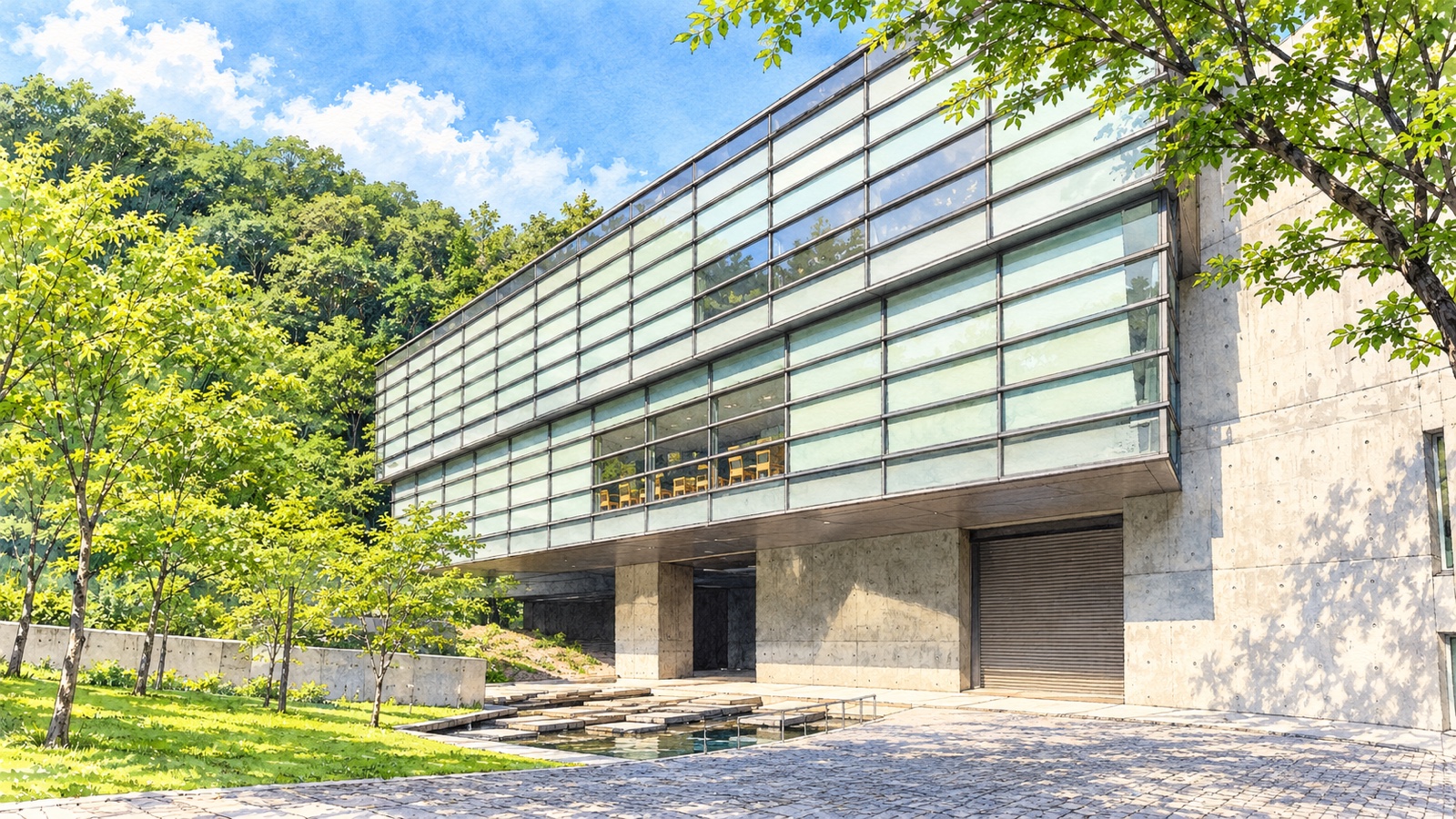
The Clouds Above the Hill Museum, dedicated to Shiba’s novel, stands at the foot of Matsuyama Castle. Gallery 2 on the fourth floor introduces the Akiyama brothers Yoshifuru and Saneyuki, Shiki Masaoka, their families and stories, and objects they used.
Nearby, the “Newspaper Wall” displays all 1,296 installments serialized in the Sankei Shimbun evening edition from April 22, 1968, through August 4, 1972. The illustrations are by Kenji Shimotakahara. Including the time spent planning, Shiba worked on the novel for about 10 years, covering nearly his entire forties.
The first book edition comprised six volumes; the current Bunshun Bunko paperback set has eight. The first book volume was published in April 1969, while the newspaper serial was still running. The wall displays not pages divided from a completed book, but the novel as it reached readers day by day, with its ending still to come.
The 19th special exhibition, “Meiji-Era Intelligence in Clouds Above the Hill,” runs from February 24, 2026, through January 3, 2027. Against the backdrop of rising tensions in East Asia following the First Sino-Japanese War and the Triple Intervention, it focuses on people involved in politics, diplomacy, and the military from the latter half of the 1880s through the 1890s.
The building was designed by Tadao Ando. It has one basement level and four floors above ground, with an inverted triangular form that widens five degrees as it rises toward the sky. A continuous ramp connects the floors. Built facing both the castle hill and the city, it also displays photographs of Meiji-era Matsuyama and Shiki’s haiku along the ramp.
Sources:Clouds Above the Hill Museum: Architectural overview
The 19th special exhibition
Open 9 a.m.–6:30 p.m.; last admission at 6 p.m. The galleries cost 500 yen for adults and 250 yen for high school students and visitors 65 or older; admission is free for junior high school students and younger. The second-floor hall, shop, and library are free. Generally closed Mondays.
About a two-minute walk from Okaido streetcar stop and about five minutes from the Akiyama Brothers’ Birthplace. There is no parking for general visitors.
- Location
- 3-20 Ichiban-cho, Matsuyama City, Ehime Prefecture
- Connection to the work
- A museum dedicated to Clouds Above the Hill, with serialized newspaper pages and materials on its three protagonists
- Hours
- 9 a.m.–6:30 p.m.; last admission at 6 p.m. Generally closed Mondays.
- Admission
- 500 yen for adults; 250 yen for high school students and visitors 65 or older; free for junior high school students and younger
Sources:Clouds Above the Hill Museum: Access
Clouds Above the Hill Museum
Fourth-floor gallery guide
Special exhibition information
2### Akiyama Brothers’ Birthplace | Tracing Their Beginnings from the Reconstructed Home
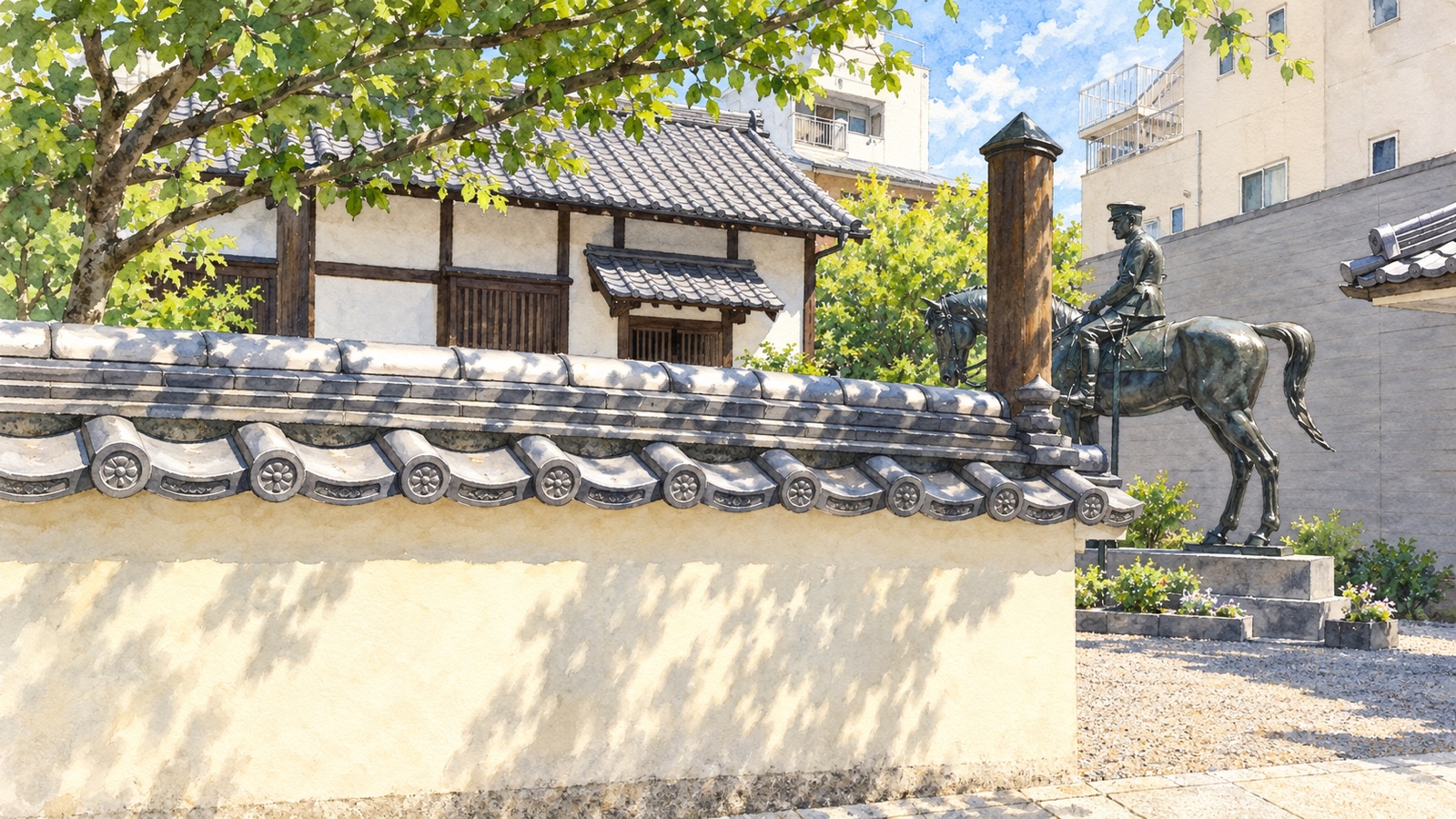
The Akiyama brothers were born in Kachomachi, the castle town of Matsuyama. Yoshifuru was born in 1859 and Saneyuki in 1868. The current house was reconstructed and opened to the public in January 2005 through donations from around Japan after the original family home was destroyed in the 1945 Matsuyama air raid.
The reconstruction drew on the layout of a lower-ranking samurai home, documents, and accounts. Exhibits inside include the brothers’ handwritten works and photographs. An inscription on the “Monument at the Former Residence of the Akiyama Brothers,” erected in 1937, records how Matsuyama volunteers worked to preserve the home after Yoshifuru’s death and entrusted its management to the Matsuyama Doshokai association.
Yoshifuru left for Osaka at age 16 in 1875, initially intending to become a teacher. Saneyuki left for Tokyo eight years later to study literature. Although the brothers went on to become generals in the army and navy, respectively, they had different plans when they left this house.
At age 65, Yoshifuru returned to Matsuyama and commuted from this house for six years as principal of the former Hoku-Yo Middle School. It is connected to today’s Ehime Prefectural Matsuyama Kita High School. The Tokiwa Doshokai, which manages the birthplace, is also a youth-education organization continuing the Tokiwa dormitory supervised by Yoshifuru and the Matsuyama Doshokai established by Saneyuki and others. In Tokyo, it still operates the Tokiwa Gakusha residence for male students.
Source:Tokiwa Doshokai: The birthplace and the brothers’ early lives
About a three-minute walk from Okaido streetcar stop and about five minutes from Okaido bus stop. The official inquiry desk is open 10 a.m.–5 p.m.; closed Mondays.
- Location
- 2-3-6 Kachomachi, Matsuyama City, Ehime Prefecture
- Connection to the work
- A reconstructed home of Yoshifuru and Saneyuki Akiyama, protagonists of Clouds Above the Hill
- Nearest station
- About a three-minute walk from Okaido streetcar stop on the Iyo Railway
- Hours
- 10 a.m.–5 p.m.; closed Mondays
Sources:Official Akiyama Brothers’ Birthplace website
Location and visitor information
3### Matsuyama Municipal Shiki Memorial Museum | From Shiki in the Novel to the Literary Figure’s Work
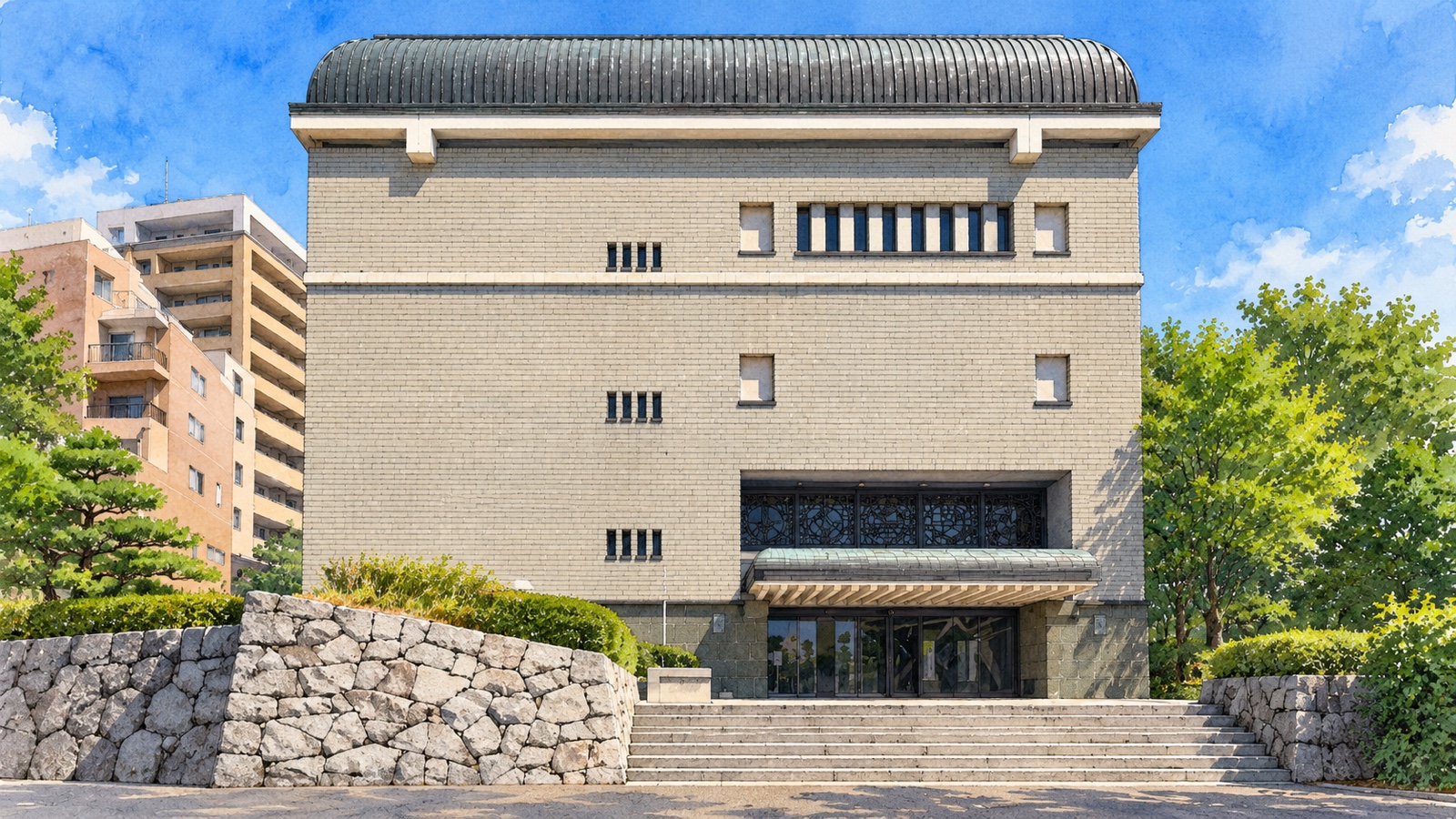
Adjacent to Dogo Park, the Matsuyama Municipal Shiki Memorial Museum introduces Masaoka Shiki’s life alongside the history of Matsuyama. The permanent exhibition spans the second and third floors. The second floor covers his family, student years, and work as a newspaper journalist; the third focuses on his literary reforms and work during illness.
From October 7, 2026, through March 15, 2027, the special exhibition area on the third floor presents the second half of “Newly Acquired Materials: Shiki and His Family and Relatives—Yae, Ritsu, Kanjiyama Ohara, and Takusen Kato.” In addition to his mother and younger sister, the exhibition features his maternal grandfather and uncle.
In 1883, Shiki went to Tokyo at the invitation of his uncle, Takusen Kato. The following year, he entered the preparatory school for the University of Tokyo. After coughing up blood in 1889, he began using the pen name Shiki. This exhibition looks at a life where education, illness, and literature intersected, through his relationships with family and relatives.
Sources:Shiki Memorial Museum: Second special exhibition of newly acquired materials
Clouds Above the Hill Museum: Shiki’s biography
Free tours of the permanent exhibition with an instructor can be reserved for groups as small as one. Audio guides cost 100 yen each and cover about 30 key exhibits in roughly 30–40 minutes. The first-floor audiovisual room also shows “A Message from Nobosan,” a roughly 20-minute summary of Shiki’s life, mainly on holidays.
Source:Shiki Memorial Museum: Permanent exhibition and visitor guide
Admission is 500 yen for adults, free for elementary, junior high, and high school students, and 250 yen for visitors 65 or older. Hours are 9 a.m.–6 p.m. May–October and 9 a.m.–5 p.m. November–April; last admission is 30 minutes before closing. About a five-minute walk from Dogo Onsen or Dogo Koen station.
The usual route through the paid galleries is via stairs from the second to the third floor. To use the elevator, press the call button at the end of the second-floor gallery to contact a staff member.
- Location
- 1-30 Dogo Park, Matsuyama City, Ehime Prefecture
- Connection to the work
- A museum introducing the life and literature of Masaoka Shiki, one of the protagonists of Clouds Above the Hill
- Hours
- 9 a.m.–6 p.m. May–October; 9 a.m.–5 p.m. November–April; last admission 30 minutes before closing
- Admission
- Permanent exhibition: 500 yen for adults, 250 yen for visitors 65 or older; free for elementary, junior high, and high school students
Sources:Shiki Memorial Museum: Visitor information
Access
Matsuyama City: Shiki Memorial Museum information
4### Shikido | The Home Where Shiki Lived Until Age 17, Reconstructed on Temple Grounds
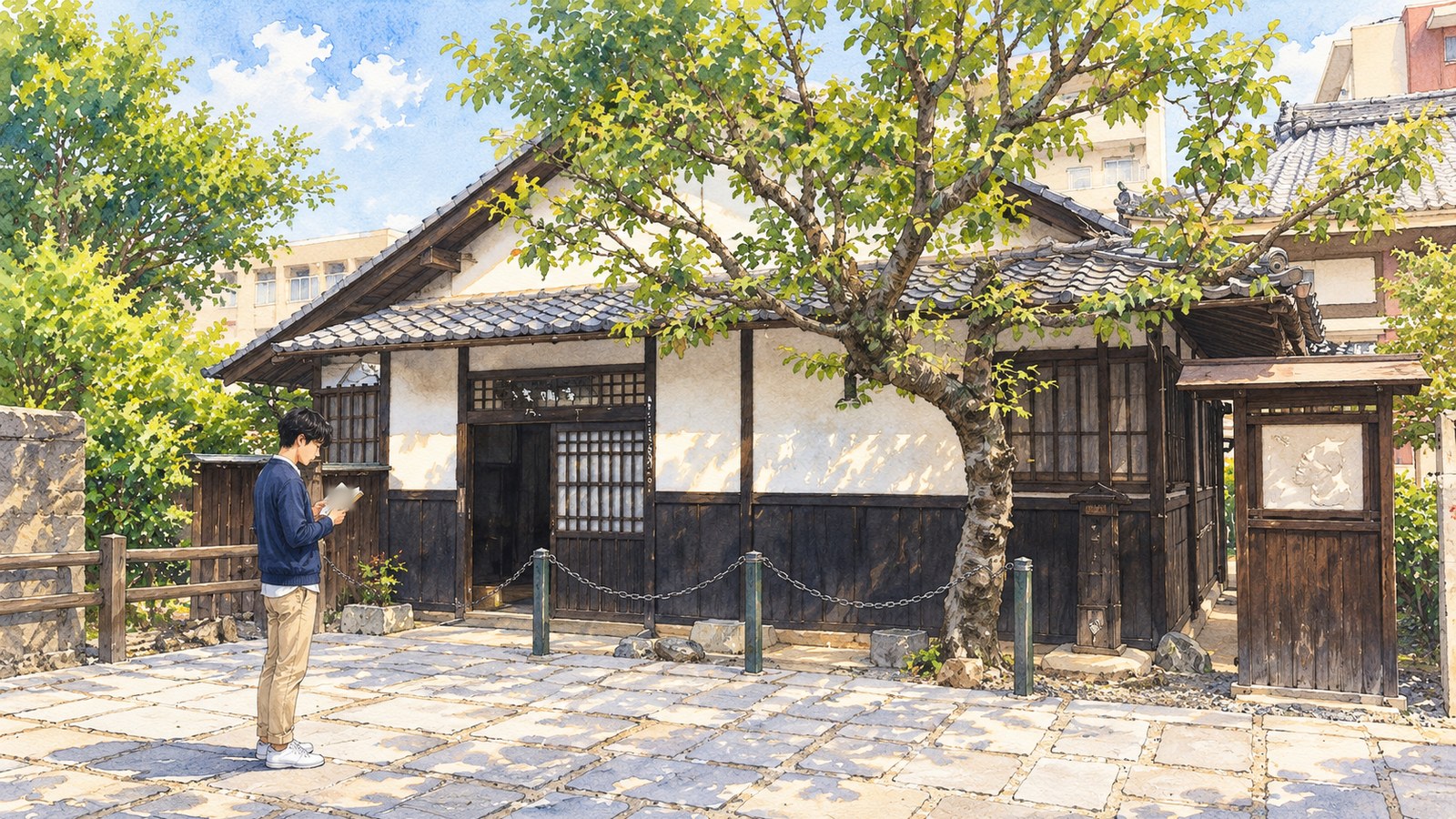
Shikido is a reconstruction of the Minatomachi home where Masaoka Shiki lived until age 17, before moving to Tokyo. It stands beside Masunadaiji Temple and represents Shiki’s childhood home among the three protagonists of Clouds Above the Hill. Inside are Shiki’s calligraphy and personal belongings; the grounds also contain a memorial pagoda for hair from his head and the Masaoka family cemetery.
Matsuyama City includes Shikido on its Clouds Above the Hill Field Museum walking map, alongside the Clouds Above the Hill Museum and the Akiyama Brothers’ Birthplace. Visiting the brothers’ home and Shiki’s on the same day makes it possible to compare on a map where the three grew up in Matsuyama.
The posted hours are 9 a.m.–5 p.m. (admission until 4:40 p.m.); it is listed as open every day.
- Location
- 16-3 Suehiro-cho, Matsuyama City, Ehime Prefecture (Masunadaiji Temple)
- Connection to the work
- A reconstruction of the home where Masaoka Shiki, one of the protagonists of Clouds Above the Hill, lived until age 17
- Hours
- 9 a.m.–5 p.m. (admission until 4:40 p.m.); open daily
Source:Matsuyama City: Clouds Above the Hill Field Museum walking map (July 2026 edition)
5### Mikasa Memorial Ship | The Flagship Aboard Which Saneyuki Served as a Staff Officer
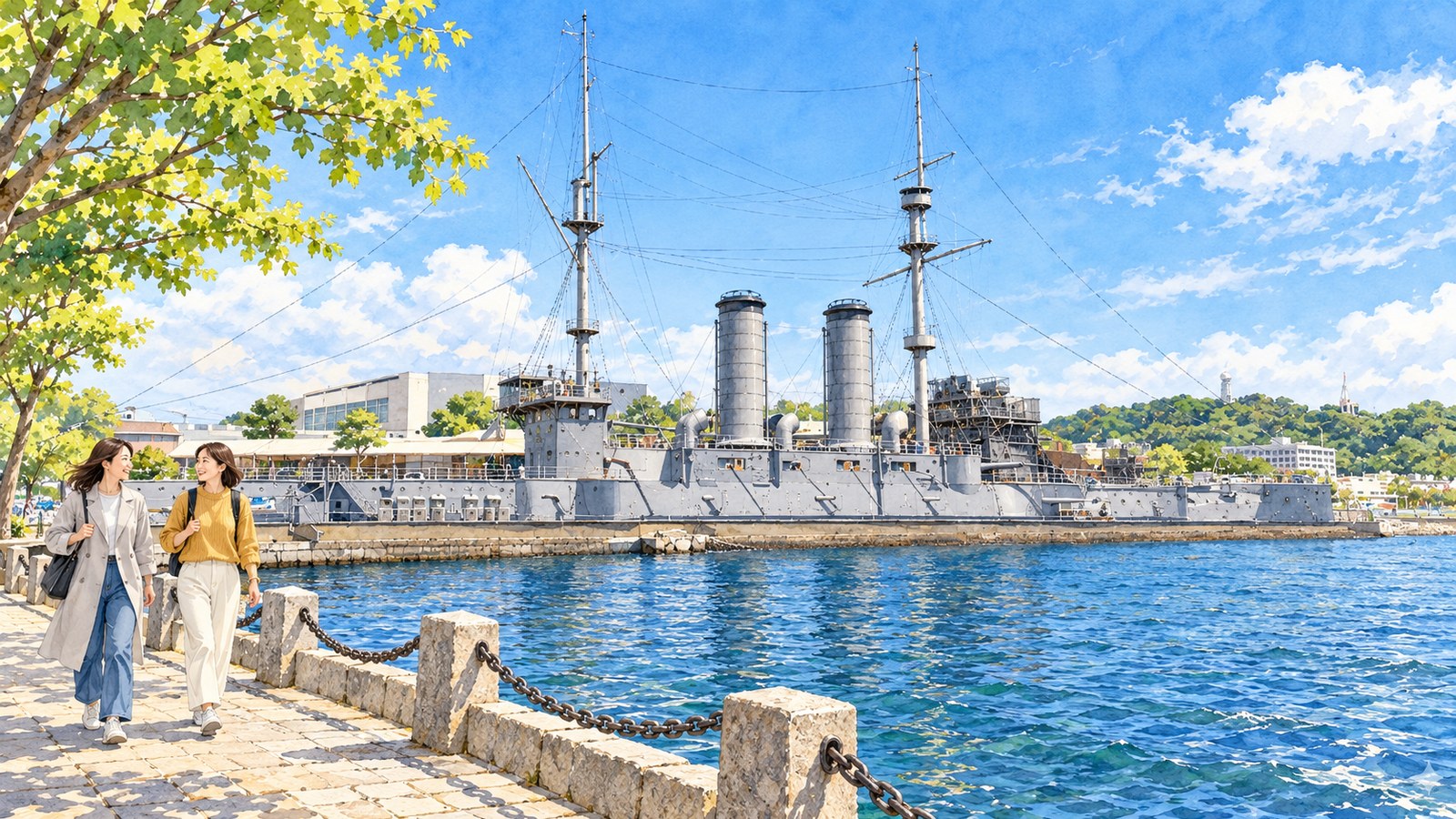
Near the end of Clouds Above the Hill, Saneyuki Akiyama serves as a staff officer for the Combined Fleet during the Battle of Tsushima. The flagship Mikasa is preserved as a memorial ship in Mikasa Park in Yokosuka.
Mikasa, completed in Britain in 1902, was the flagship of the Combined Fleet under Admiral Heihachiro Togo during the Russo-Japanese War. Preserved as a memorial ship in 1926, it has received a maritime heritage award as the world’s oldest surviving steel battleship. After falling into disrepair following World War II, its bridge was restored.
Shotaro Tojo’s painting of the bridge just before the naval battle depicts Admiral Togo, Chief of Staff Tomosaburo Kato, Captain Hikojuro Ijichi, staff officer Saneyuki Akiyama, and the Z flag. Visitors can see aboard the ship where the characters they read about were positioned.
Hours are 9 a.m.–4:30 p.m. November–February, 9 a.m.–5 p.m. in March and October, and 9 a.m.–5:30 p.m. April–September. Last boarding is 30 minutes before closing. Closed December 28–31. Admission is 800 yen. A 15-minute walk from Keikyu Yokosuka-Chuo Station.
- Location
- 82-19 Inaoka-cho, Yokosuka City, Kanagawa Prefecture (inside Mikasa Park)
- Connection to the work
- The Combined Fleet’s flagship, aboard which Saneyuki Akiyama served as a staff officer in Clouds Above the Hill
- Admission
- 800 yen for adults, 200 yen for elementary and junior high school students. Closed December 28–31.
Sources:Official Mikasa Memorial Ship website: Visiting hours and admission
Mikasa Memorial Ship: Ship history and bridge painting
Mikasa Memorial Ship: Access
6### Shiba Ryotaro Memorial Museum | A View Through the Window into the Study and a Space Where Books Rise Up
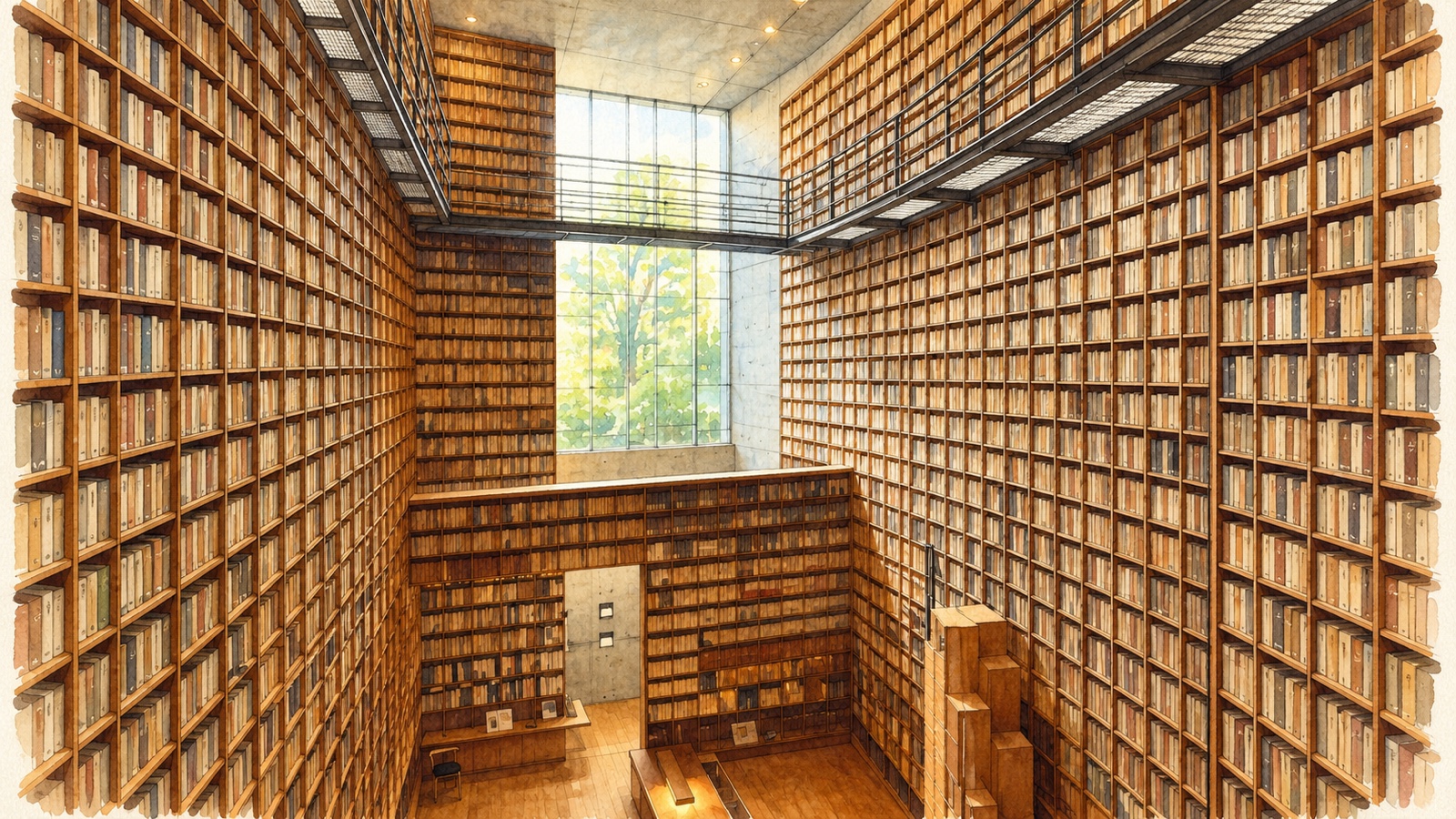
At the Shiba Ryotaro Memorial Museum in Higashiosaka, visitors can view the author’s former study through a window from a garden path beside his home. His fountain pen and colored pencils used for revisions remain on the desk. The study’s interior is not open for visitors to enter.
A video shown repeatedly in the first-floor lobby offers views of the books that remain in the home’s library, hallway, and entryway. The exhibition building has an 11-meter atrium with a large bookshelf holding about 20,000 books. It creates a space that evokes the approximately 60,000 books in the author’s personal collection.
A “Dialogue Notebook” on a table by the large bookshelf invites visitors to write down their impressions. Books cannot be taken from the shelves. Visitors looking for a particular work can ask at the bookshop, which stocks paperback editions of Shiba’s works currently in print. Books purchased there come with a memorial museum book cover.
This memorial museum was also designed by Tadao Ando. In addition to the garden that opened with the museum, a new garden designed by Ando was completed in spring 2010. The lobby displays sketches, drawings, photographs taken during construction, and a 1:100 scale model. Donated in 2012, the model is made from katsura wood and cork, among other materials.
Source:Shiba Ryotaro Memorial Museum: About the architecture
Open 10 a.m.–5 p.m.; admission desk closes at 4:30 p.m. Admission is 800 yen for adults, 400 yen for junior and senior high school students, and 300 yen for elementary school students. Closed Mondays; if Monday is a holiday, open that day and closed the next day. Also closed September 1–10 and December 28–January 4. Individual visitors do not need a reservation.
About an eight-minute walk from Yaenosato Station and 12 minutes from Kawachi-Kosaka Station on the Kintetsu Nara Line. About 18 minutes from JR Kawachi-Eiwa Station on the JR Osaka Higashi Line.
- Location
- 3-11-18 Shimo-Kosaka, Higashiosaka City, Osaka Prefecture
- Connection to the work
- A memorial museum where visitors can view Shiba Ryotaro’s home study and a large bookshelf with about 20,000 books
- Hours
- 10 a.m.–5 p.m.; admission desk closes at 4:30 p.m. Closed Mondays; if Monday is a holiday, closed the next day.
- Admission
- 800 yen for adults; 400 yen for junior and senior high school students; 300 yen for elementary school students
Sources:Shiba Ryotaro Memorial Museum: Video of the author’s books
Admission and access
Shiba Ryotaro Memorial Museum: Visitor guide
7### Shiba Ryotaro Memorial Room at Himeji Literature Museum | Ties to Harima, Where His Family Lived for Generations
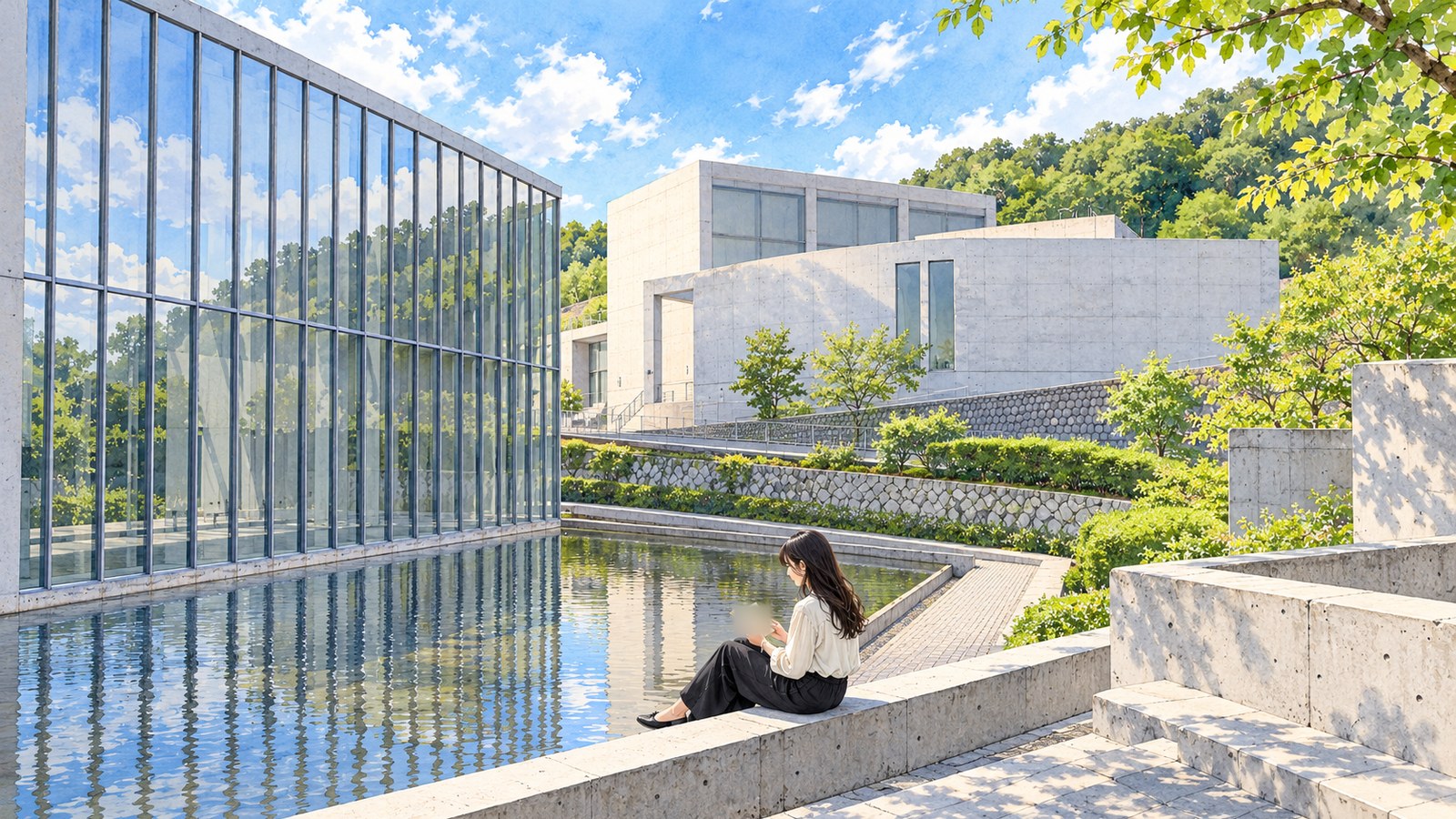
The Shiba Ryotaro Memorial Room is on the first floor of the South Building at Himeji Literature Museum, and admission is free. Shiba was born in Osaka, but his family lived in Banshu Hiro-mura (present-day Hirohata, Himeji) through his grandfather’s generation; they are said to be descendants of Banshu followers of the Pure Land True Sect.
The memorial room introduces Shiba’s ties to Harima through manuscripts, illustrations, historical materials, and graphics, including his Tales of Harima Province, about Kuroda Kanbei. A special corner, “Considering the People of Banshu,” is also featured.
The museum is open 10 a.m.–5 p.m.; admission ends at 4:30 p.m. Closed Mondays (open if Monday is a holiday), the day after a holiday, and December 25–January 5. From the Shinki Bus Terminal in front of JR and Sanyo Himeji stations, take a bus about six minutes to Ichinohashi Bungakukan-mae and walk north for about four minutes.
- Location
- 84 Yamanoi-cho, Himeji City, Hyogo Prefecture (first floor, South Building)
- Connection to the work
- A memorial room introducing Shiba’s family lineage and ties to Harima, including manuscripts and illustrations for Tales of Harima Province
- Admission
- The memorial room is free; closed Mondays (open if Monday is a holiday).
Sources:Himeji Literature Museum: Shiba Ryotaro Memorial Room
Himeji Literature Museum: Visitor information
Himeji Literature Museum: Access
8### Kochi Prefectural Sakamoto Ryoma Memorial Museum | “Ryoma” in the Novel and “Ryoma” Who Left His Letters Behind
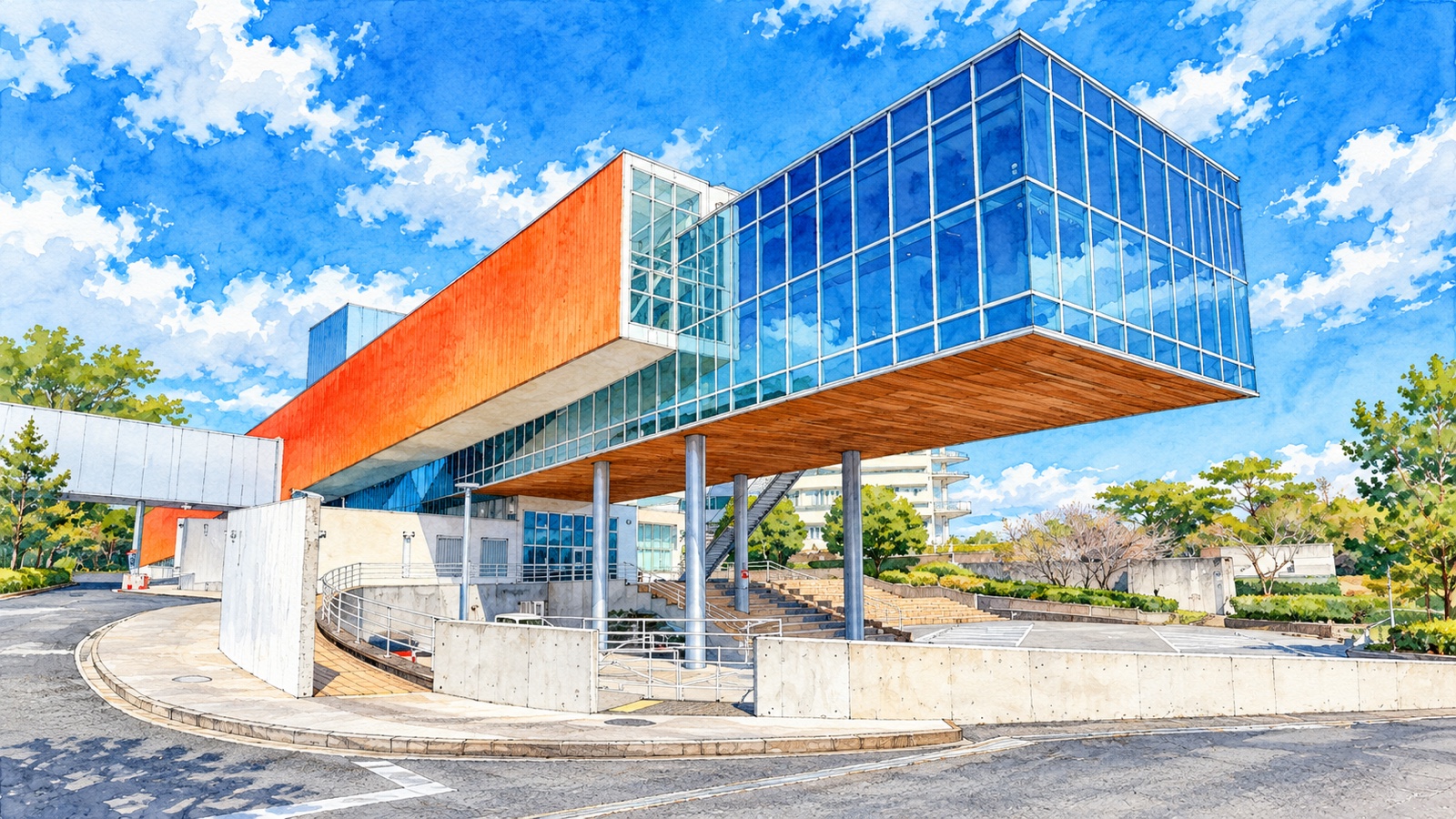
The Kochi Prefectural Sakamoto Ryoma Memorial Museum introduces Ryoma’s life through materials centered on his letters. Original letters from the museum’s collection are displayed for limited periods. From October 10 through December 6, 2026, the museum is showing two letters to Kenzo Hayashi dated November 10 and 11, 1867. They were written just days before Ryoma was assassinated on November 15.
The museum is located on the site of Urado Castle. It is not a facility preserving Ryoma’s birthplace. It opened in 1991 and was renovated in 2018, when a new building was added to the existing museum.
From July 1 through December 31, 2026, a special audio guide in the Tosa dialect, voiced by actor Shin Tamura, is also available to borrow. A script prepared by curators introduces 21 objects from Ryoma’s point of view over about an hour. The fee is 500 yen, separate from admission. The guide includes replicas of his father’s letter of advice, a letter to Shojiro Goto, and a folding screen from the scene of his assassination.
Source:Sakamoto Ryoma Memorial Museum: Special audio guide in the Tosa dialect
The museum uses the spelling “Ryoma” with the character 龍 because there are no examples of Ryoma himself using 竜. Its FAQ explains that Shiba’s novel Ryoma Goes His Way uses 竜 to distinguish the author’s portrayal from the historical figure.
Open 9 a.m.–5 p.m.; last admission at 4:30 p.m. Admission is 900 yen during special exhibitions and 500 yen during other periods; free for high school students and younger. Allow about 90 minutes to see the new and main buildings. During a special exhibition, there is no discounted ticket for the permanent exhibition alone.
From the bus terminal at JR Kochi Station, take a Tosaden Kotsu bus toward Katsurahama, get off at Ryoma Kinenkan-mae, and walk about two minutes. The museum lists the bus fare as 800 yen. If walking from Katsurahama, the route uses the steep steps and slopes of the Tsubaki no Komichi trail and takes more than 10 minutes uphill.
- Location
- 830 Urado Shiroyama, Kochi City, Kochi Prefecture
- Connection to the work
- A memorial museum displaying original letters and related materials from Sakamoto Ryoma, protagonist of Ryoma Goes His Way
- Hours
- 9 a.m.–5 p.m.; last admission at 4:30 p.m.
- Admission
- 900 yen during special exhibitions; 500 yen during other periods; free for high school students and younger
Sources:Sakamoto Ryoma Memorial Museum: Visitor information
Public transit and the route from Katsurahama
Sakamoto Ryoma Memorial Museum: About the facility
Exhibition guide
Questions about Ryoma
9### Katsurahama and the Sakamoto Ryoma Statue | A 5.3-Meter Statue Overlooking the Pacific
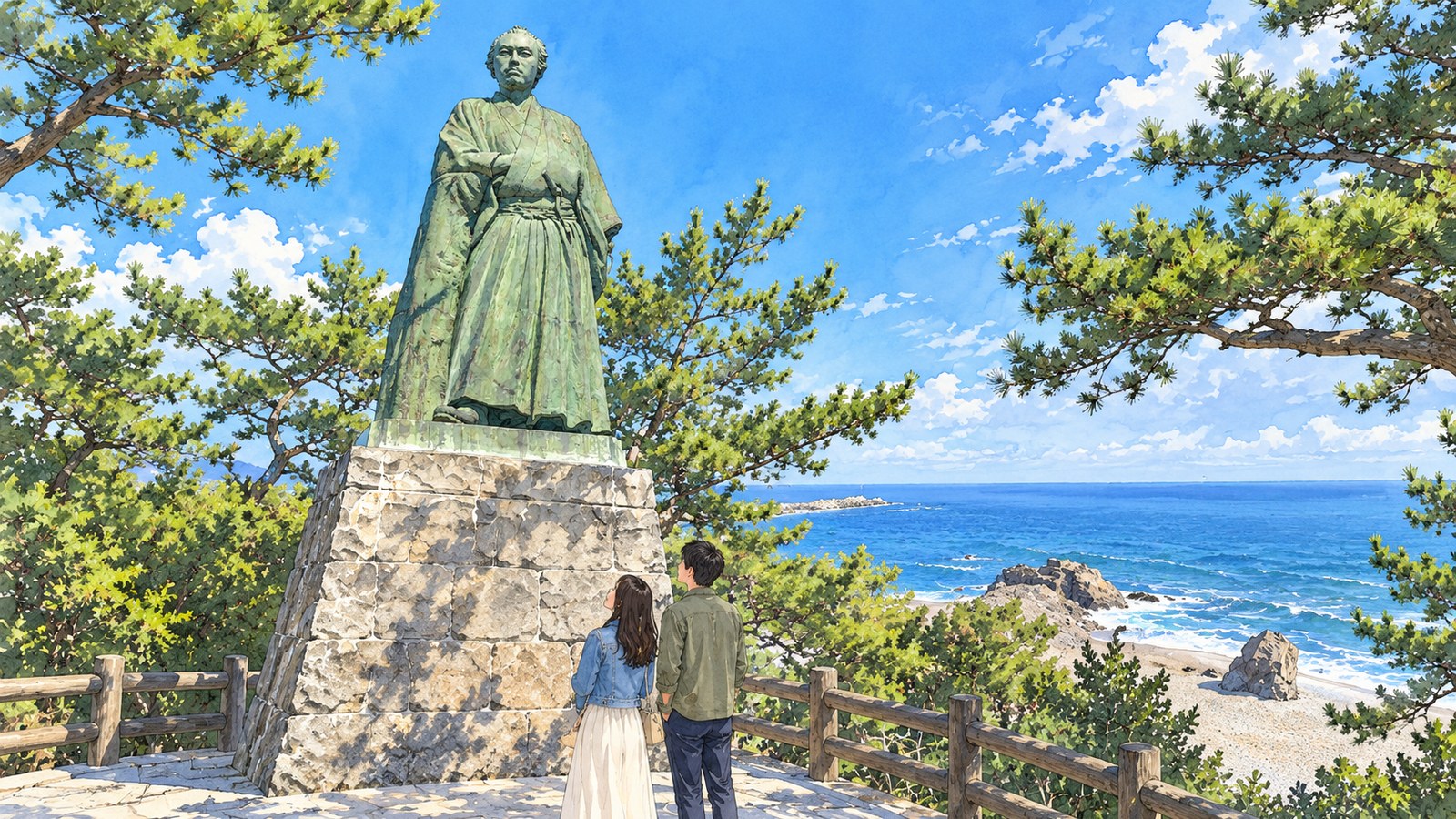
On a hill at Katsurahama, down a walking path from the Sakamoto Ryoma Memorial Museum, stands a statue of Ryoma facing the Pacific. To pass on his achievements to future generations, young volunteers in Kochi Prefecture raised funds and built it in 1928.
The statue is 5.3 meters tall, about 13.5 meters including its base. Ryoma wears hakama and boots, with one hand tucked into his kimono as he looks out to sea. Katsurahama is known for its moonlit views and is mentioned in the Yosakoi Bushi folk song. The area also has an observation deck, walking paths, and souvenir shops.
From JR Kochi Station, take a Tosaden Kotsu bus toward Katsurahama; the ride takes about 40 minutes.
- Location
- Katsurahama Park, Urado, Kochi City, Kochi Prefecture
- Connection to the work
- A bronze statue of Sakamoto Ryoma, protagonist of Ryoma Goes His Way
- Access
- About 40 minutes from JR Kochi Station on a Tosaden Kotsu bus toward Katsurahama
Sources:Kochi City: 2026 visitor guide (Katsurahama and the Sakamoto Ryoma statue)
10### Ryoma’s Birthplace Memorial Museum | Seeing His Beginnings Through His Family and Neighborhood
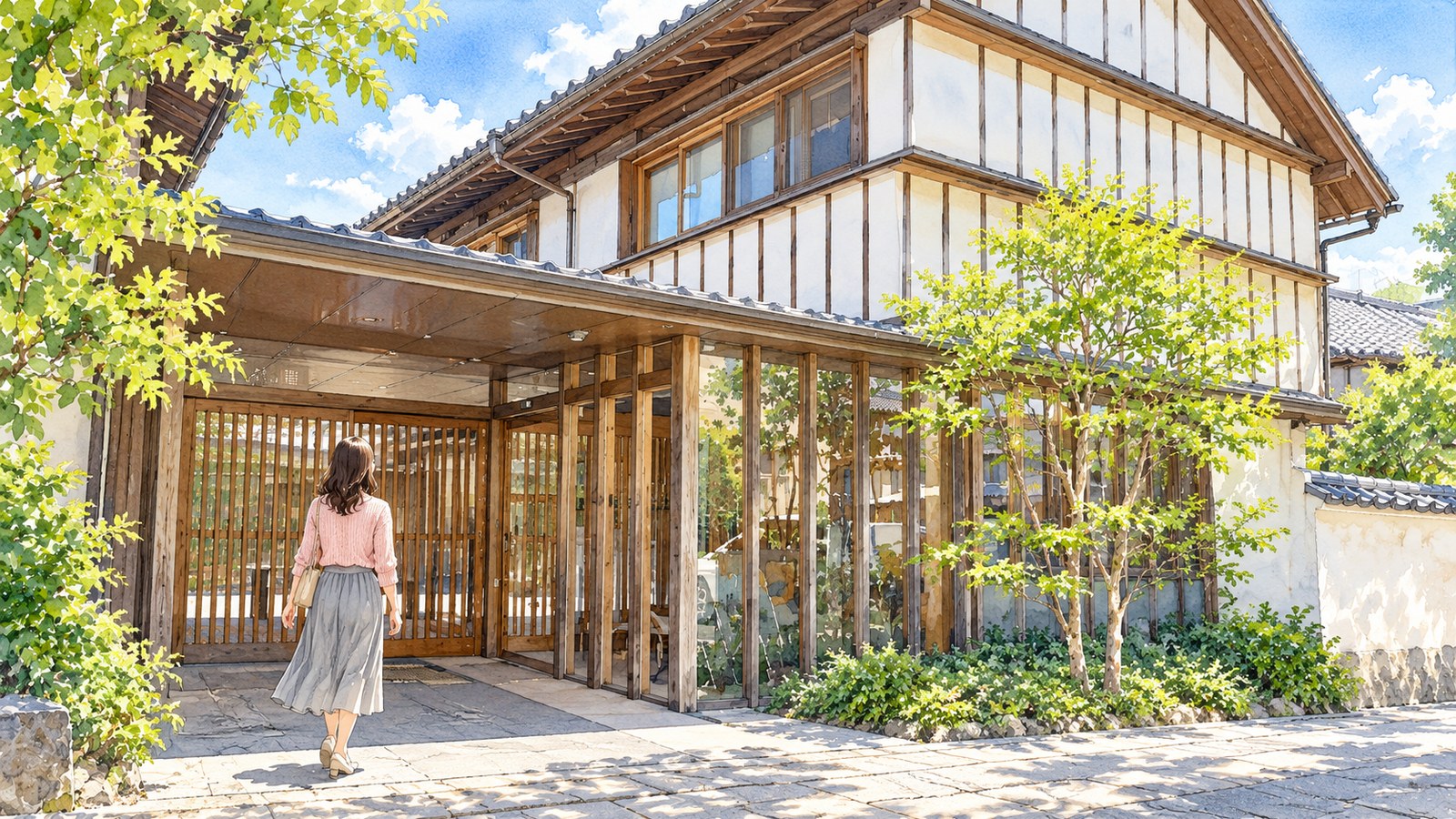
Kochi City’s Ryoma’s Birthplace Memorial Museum opened in 2004 in Kami-machi, the castle town where Ryoma was born. It introduces the family and neighborhood that shaped his character.
On the first floor, a semi-three-dimensional model recreates the old streets of Kami-machi, and a film titled “A Day in the Sakamoto Household” depicts family life. There is also a space inspired by an annex to the Sakamoto home where visitors can leave written messages.
The exhibition building is open year-round from 8 a.m. to 7 p.m., with last admission at 6:30 p.m. Admission is 370 yen for adults and free for high school students and younger. For the streetcar, transfer at Harimayabashi and get off at Kamimachi 1-chome. Showing the stub from this museum at Nagasaki City’s Kameyama Shachu Memorial Museum cuts that museum’s admission in half.
- Location
- 2-6-33 Kami-machi, Kochi City, Kochi Prefecture
- Connection to the work
- A museum built in the birthplace neighborhood of Sakamoto Ryoma, protagonist of Ryoma Goes His Way
- Hours
- 8 a.m.–7 p.m. (last admission at 6:30 p.m.); open year-round
Sources:Ryoma’s Birthplace Memorial Museum: Visitor information
The museum: First-floor exhibition building
The museum: From Kochi Station
11### Nagasaki City Kameyama Shachu Memorial Museum | The House That Served as Ryoma and His Companions’ Base
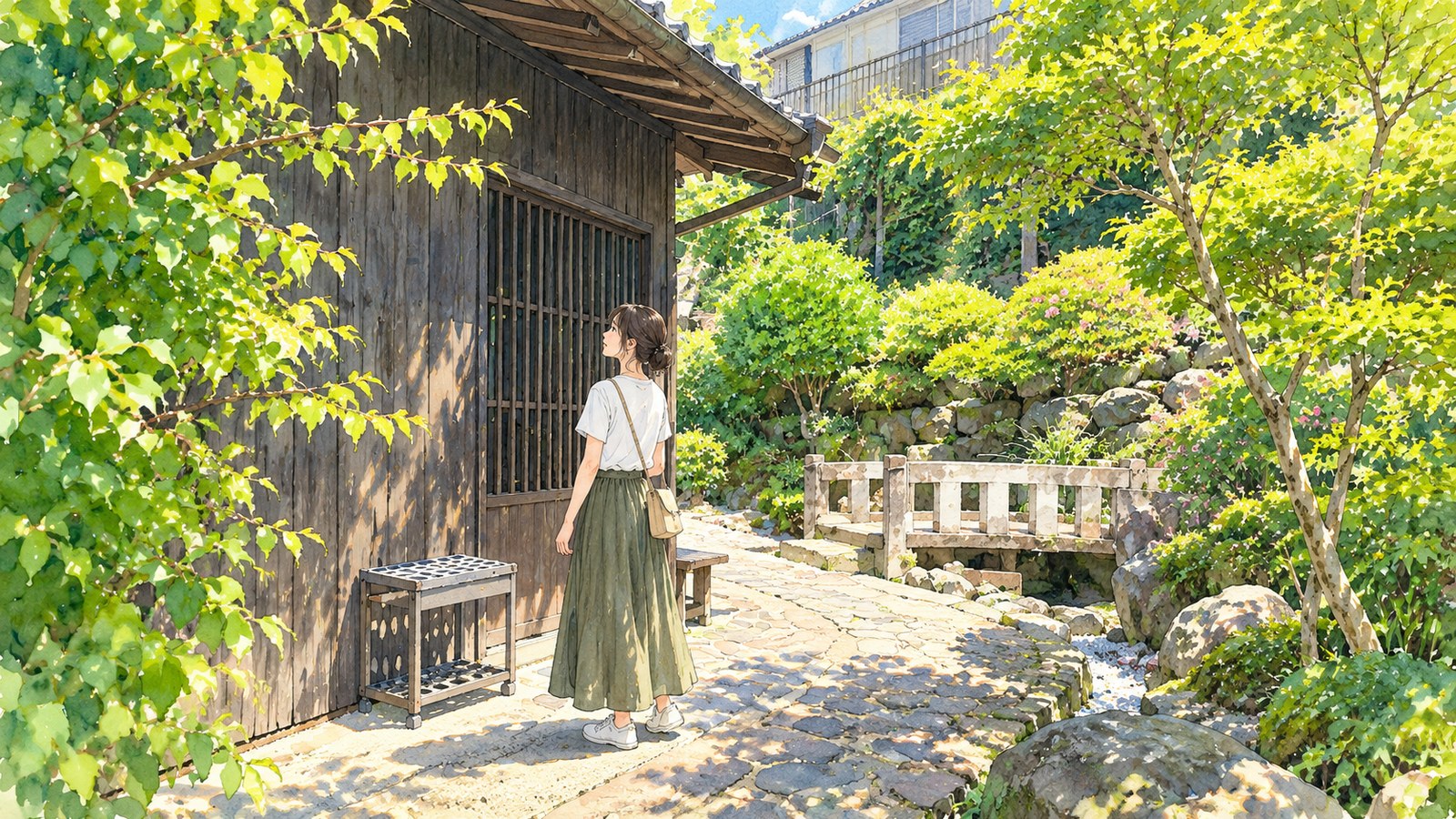
In 1865, Sakamoto Ryoma and more than 20 associates formed Kameyama Shachu, a trading company and private navy, with support from the Satsuma Domain and Nagasaki merchant Eizō Kozone’s family. The house they rented as their base had belonged to a craftsman who worked in Kameyama-yaki pottery. The group came to be called Kameyama Shachu, after the local place name and the word shachu, meaning a group of associates.
Nagasaki City restored the surviving building to resemble its historical appearance and opened it as a memorial museum on August 1, 2009. Exhibits include a replica of Ryoma’s boots, reproductions of letters, and photographs of the activists. Visitors can also go up the stairs to a mezzanine-level hidden room said to have been used for secret meetings. Honorary director Tetsuya Takeda notes that he has been a Ryoma fan ever since reading Ryoma Goes His Way at age 18.
Open daily 9 a.m.–5 p.m.; last admission at 4:45 p.m. Admission is 650 yen for adults and 320 yen for elementary, junior high, and high school students. Showing a ticket stub from the Kochi Prefectural Sakamoto Ryoma Memorial Museum gives a 20% discount.
- Location
- 2-7-24 Irabayashi, Nagasaki City, Nagasaki Prefecture
- Connection to the work
- A museum in the former base of Kameyama Shachu, founded in Nagasaki by Sakamoto Ryoma, protagonist of Ryoma Goes His Way
- Hours
- 9 a.m.–5 p.m. (last admission at 4:45 p.m.); open daily
Sources:Nagasaki City official tourism site: Kameyama Shachu Memorial Museum
Nagasaki City: Admission discounts
12### Kazagashira Park | A Literary Monument Inscribed with a Passage from Ryoma Goes His Way
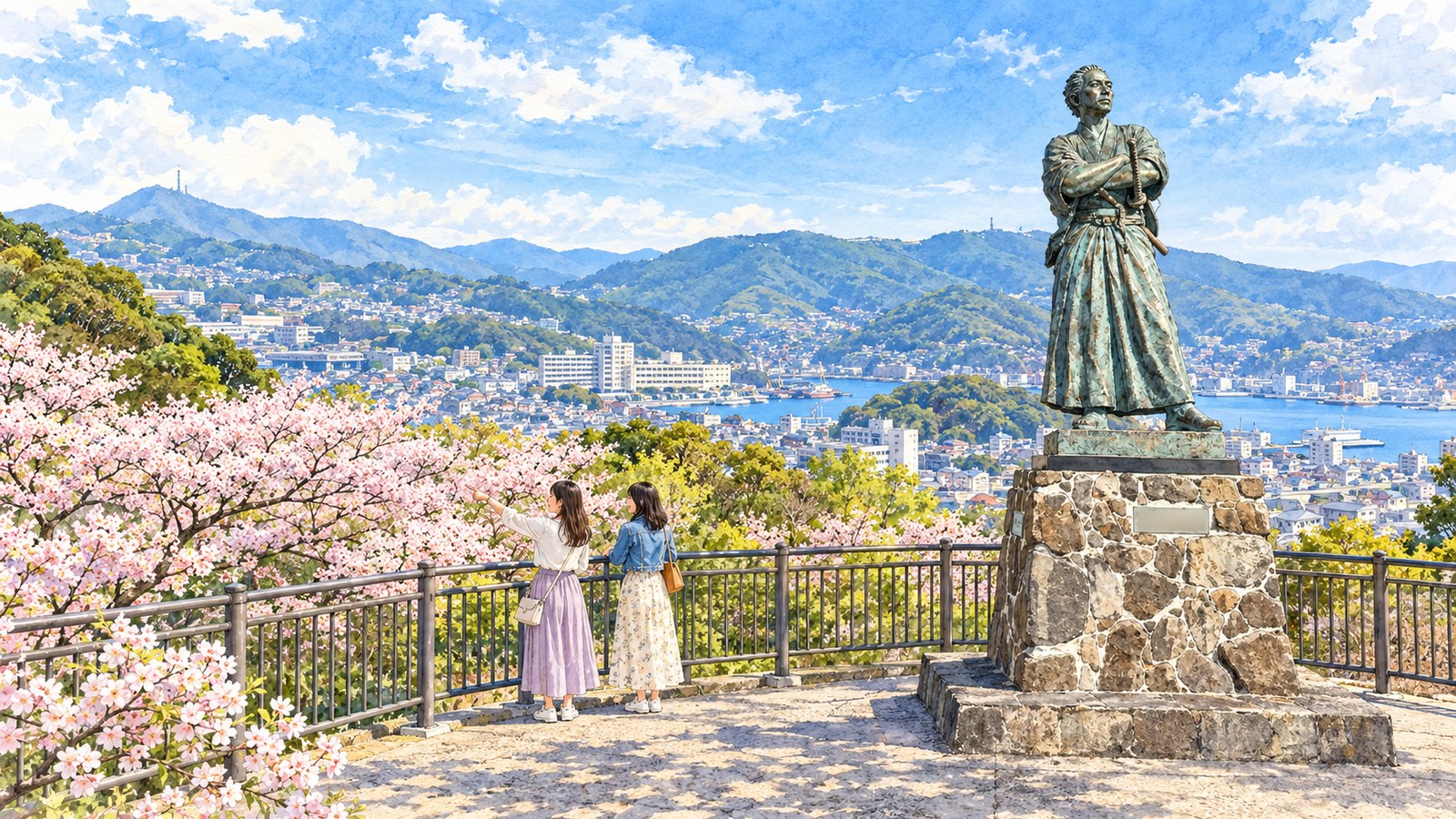
Climb the stone steps of Ryoma-dori from Kameyama Shachu to reach Kazagashira Park, at an elevation of 151.9 meters. The park has a bronze statue of Sakamoto Ryoma, built in 1989, and a literary monument to Ryotaro Shiba’s Ryoma Goes His Way, erected on February 1, 1998.
The monument is inscribed with a passage from the “Raging Waves” chapter of Ryoma Goes His Way. In the scene, Ryoma arrives at Nagasaki Harbor by ship from Satsuma and tells Yonosuke Mutsu (later known as Munemitsu), who would become foreign minister, that Nagasaki is a “land of hope” and would one day become a foothold for Japan’s restoration. The monument was erected by the Kameyama Shachu ba Ikasu Kai, a group working to make use of Kameyama Shachu’s historic remains in community development.
The statue of Ryoma, about 3.2 meters tall, stands at the observation deck overlooking Nagasaki Harbor. From Nagasaki Station, take a Nagasaki Bus toward Kazagashirayama for about 20 minutes, then walk five minutes from Kazagashirayama bus stop.
- Location
- Kazagashira Park, Irabayashi 3-chome, Nagasaki City, Nagasaki Prefecture
- Connection to the work
- A literary monument to Ryotaro Shiba inscribed with a passage from “Raging Waves” and a statue of Sakamoto Ryoma
- Access
- A five-minute walk from Kazagashirayama bus stop on the Nagasaki Bus line
Sources:Nagasaki City: Kazagashira Park
Official Nagasaki City tourism site: Ryoma-dori and the Sakamoto Ryoma statue
From Three Lives to Scenes in the Works
A Story of Three People Who Left the Same City for Different Paths
The three protagonists of Clouds Above the Hill all leave Matsuyama for Tokyo or Osaka and pursue different fields. Saneyuki transfers from Tokyo’s First Higher School to the Naval Academy and studies tactics in the United States in 1897. Shiki moves from philosophy to Japanese literature at the Imperial University, then joins the Nippon newspaper company and leaves university.
During the First Sino-Japanese War, Yoshifuru serves as a cavalry battalion commander, while Saneyuki is a navigator aboard the gunboat Tsukushi. Shiki, meanwhile, travels to the front as a newspaper correspondent. The novel brings together again, through the same war, the lives of three people whose paths diverged between military service and literature.
Yoshifuru Akiyama
The elder brother, born in 1859 in Kachomachi in the Matsuyama castle town. He served in the First Sino-Japanese War as a cavalry battalion commander and, after returning to Matsuyama at age 65, was principal of the former Hoku-Yo Middle School for six years.
Saneyuki Akiyama
The younger brother, born in 1868. He transferred from Tokyo’s First Higher School to the Naval Academy and served in the First Sino-Japanese War as a navigator aboard the gunboat Tsukushi. In 1897, he studied tactics in the United States.
Masaoka Shiki
He left Matsuyama for Tokyo like the Akiyama brothers, transferred from philosophy to Japanese literature at the Imperial University, and then joined the Nippon newspaper company. He also went to the front as a newspaper correspondent during the First Sino-Japanese War.
Sakamoto Ryoma
A Tosa native, born in 1835, and protagonist of Ryoma Goes His Way. The novel writes his name with the character 竜; the museum that preserves his letters uses 龍.
Ryotaro Shiba
A writer who studied Mongolian at Osaka University of Foreign Studies and was conscripted into an armored regiment during student mobilization. After the war, he continued working as a reporter at the Sankei Shimbun while writing fiction. He began serializing Ryoma Goes His Way in 1962.
Sources:Clouds Above the Hill Museum: About the novel
Hyogo Prefectural Museum of Art: Ryotaro Shiba’s biography
After Reading Ryoma Goes His Way, Read Ryoma’s Own Words
Ryoma Goes His Way is a long novel about the second son of a Tosa low-ranking samurai family who crosses domain boundaries, builds relationships, and enters the politics of the final years of the shogunate. The Bunshun Bunko paperback edition has eight volumes. At the museum in Kochi, exhibits include reproductions of the advice Ryoma’s father gave him before he left to study swordsmanship at age 19, and a letter to Shojiro Goto sent shortly before the restoration of imperial rule.
A document that readers may want to compare with the novel’s young Ryoma is “A General Guide to Training,” which his father gave him in 1853. It sets out advice for a son leaving home for Edo. The original is held by the Kyoto National Museum; the Kochi museum displays a reproduction.
Source:Sakamoto Ryoma Memorial Museum: Materials introduced in the audio guide
Source:Bungeishunju: Ryotaro Shiba’s works
The Final Letters Looked Toward Ezo
The two letters to Kenzo Hayashi shown in the original-document exhibition in Kochi in fall 2026 reveal that Ryoma was still looking toward Ezo in his final days. A curator at the Hokkaido Sakamoto Ryoma Memorial Museum explains that the two planned to avoid losing people in domestic war and instead send them to Ezo to study naval tactics.
In the November 10 letter, after plans for the Taikyokumaru ship he hoped to use fell through, Ryoma asks Hayashi to realize the idea by another means if possible. In the letter the following day, he says he had been considering the Ezo plan for some time and agrees with it.
Even after the restoration of imperial rule, he continued not only to think about a new government but also to plan to send a ship and people north. Letters written days before his death describe work beyond a political turning point. Readers who know the story ends in assassination can encounter a document that points toward a plan that was not yet finished.
Sources:Explanation by a museum in southern Hokkaido: Ryoma and Hokkaido
Kochi Prefectural Sakamoto Ryoma Memorial Museum: Upcoming original-letter display
Looking at the People Around the Three Broadens the Story
In the TV drama Clouds Above the Hill, Shiki’s younger sister Ritsu follows Saneyuki and sees him off as he leaves by ship. A comparison by the Bunshun Bunko editorial team explains that the two interact less often in the novel.
In Volume 1, “Hototogisu,” Ritsu tells Shiki that Saneyuki is coming to visit. Shiki thinks his sister has blushed, while Ritsu feels her brother is the one who seems pleased. In a short exchange where the siblings read one another’s expressions, the novel hints at Ritsu’s feelings for Saneyuki; the TV drama adds actions by Ritsu to depict her love.
Source:Bunshun Bunko editors: Comparing Ritsu and Saneyuki in the novel and TV drama
Shiki Read the Word for Baseball as “Noboru”
Shiki encountered baseball in 1884, while attending Tokyo’s First Higher School. In July 1889, he brought a bat and ball back to Matsuyama and taught students at Matsuyama Middle School. In 1896, in his Nippon newspaper column Shora Gyokueki, he explained the rules, equipment, and how to play.
In recognition of his role in spreading baseball through newspapers and literature, Shiki was inducted into the Japanese Baseball Hall of Fame in 2002. In the novel, he is a young man absorbed in writing, but he was also someone who brought equipment for a new sport back to his hometown.
In Fudemakase (1890), Shiki used the pen name “Noboru” written with the characters 野球, inspired by the name Noboru that was used for him as a child. This should be distinguished from the idea that Shiki coined the Japanese word for the sport, yakyu. His writing about baseball and the playful pen name are separate parts of his work.
Source:Japanese Baseball Hall of Fame and Museum: Masaoka Shiki
From the Entrance Design to the Haiku Magazine
The entrance doors of the Shiki Memorial Museum use a design from the cover of Hototogisu, a haiku magazine. The museum’s guide sheet places a photograph of the doors beside the cover so visitors can compare their shared lattice-like pattern at the top.
The magazine Hototogisu was founded in Matsuyama in 1897 and edited by Kyokudo Yanagihara. In October 1898, it moved to Tokyo, where Kyoshi Takahama became editor. It grew into a magazine carrying not only haiku but also art and prose. Shiki and his fellow poets who published in the Nippon newspaper became known as the Nippon school, and readers also contributed to the magazine.
The same guide sheet presents three poems: “Summer grasses—someone playing baseball, far away”; “Again and again I ask how deep the snow has grown”; and “The gifts are all given—Christmas.” The first poem looks from a distance toward someone beyond the summer grass. In the second, instead of going outside to look, the speaker repeatedly asks about the depth of the snow. Each poem changes the distance of the gaze and the way the speaker learns about the outside world.
Baseball and Christmas were both new words introduced to Japan in the Meiji era. In Shiki’s haiku, traditional seasonal subjects coexist with the games and celebrations of his time.
Source:Shiki Memorial Museum: Guide sheet, “New Haiku”
Byōshō Rokushaku | Sending Essays to the Newspaper Until the End
From 1895, Shiki suffered from spinal tuberculosis while continuing to reform haiku and tanka. In 1902, he continued publishing his essays Byōshō Rokushaku (“Six Feet of Sickbed”) in the newspaper until two days before his death. In his final years, he sent words to his readers through the page from the confined space of his sickbed.
The third floor of the Shiki Memorial Museum presents literature from this period of illness. Its layout traces the latter half of his life, from the young newspaper reporter who went to the front on the second floor to the period when he wrote about the world around him.
Source:Matsuyama City: Shiki’s life and Byōshō Rokushaku
In Ryoma’s Letters, Even His Signature and Addressees Are Fascinating
One source for reading Ryoma’s name as “Ryōma” is a letter he sent to his niece Harui on January 20, 1867. At the end, he wrote “riyofu yori,” which in modern kana spelling corresponds to “ryō.” A letter to a relative where he wrote part of his name in kana helps establish the reading.
The reason Ryoma tucked a hand into his kimono in the famous standing portrait is not known for certain. The memorial museum lists theories—that he was holding a gun, concealing an injury from the Teradaya incident, or holding a book—but says the truth remains unclear.
Since multiple prints can survive from the same photograph, the number of surviving copies does not match the number of different images. The museum groups the images into six types and, based on clues such as the platform and a level change in the studio floor, considers Hikoma Ueno’s studio in Nagasaki a likely location for the standing portrait and others. Even objects and flooring visible at the edge of a photograph can help identify where it was taken.
Source:Sakamoto Ryoma Memorial Museum: Notes on Ryoma’s name and photographs
From Tank Regiment to Newspaper Office: Becoming a Writer of History
Ryotaro Shiba studied Mongolian at Osaka University of Foreign Studies and, during student mobilization, joined the 19th Tank Regiment in Kakogawa. After military service in Manchuria, he returned to Japan and was in Sano, Tochigi Prefecture, when the war ended in 1945. The author who depicted Meiji-era military figures in his novels had himself spent part of his early twenties in the army.
After the war, he worked for the Shin-Nihon Shimbun in Kyoto and moved to the Sankei Shimbun in 1948. He continued as a newspaper reporter while writing novels, won the Naoki Prize for The Castle of the Owl, and left the paper in 1961. In 1962, serialization began for both Ryoma Goes His Way and Moeyo Ken (Burning Sword). Before arriving at the study preserved in his memorial museum, he had spent years studying foreign languages, serving in the military, and working at newspapers.
Source:Hyogo Prefectural Museum of Art: Ryotaro Shiba’s biography
The Journey of the Works, Connecting Reading with Travel
- 1923Ryotaro Shiba is born in Osaka.Writer
- 1960Wins the Naoki Prize for The Castle of the Owl.Work
- 1966Receives the Kikuchi Kan Prize.Work
- 1968Serialization of Clouds Above the Hill begins in a newspaper.Serial
- 1969The first volume of Clouds Above the Hill is published.Book
- 1972Newspaper serialization of Clouds Above the Hill concludes.Serial
- 1991Sakamoto Ryoma Memorial Museum opens.Facility
- 1996Ryotaro Shiba dies.Writer
- 1998A literary monument to Ryoma Goes His Way is erected at Kazagashira Park in Nagasaki.Memorial
- 2004Ryoma’s Birthplace Memorial Museum opens in Kami-machi, Kochi.Facility
- 2005The Akiyama brothers’ family home is reconstructed and opened to the public.Facility
- 2009Nagasaki City Kameyama Shachu Memorial Museum opens.Facility
- 2009–2011NHK’s special drama Clouds Above the Hill airs.Screen adaptation
- 2018Sakamoto Ryoma Memorial Museum is renovated.Facility
- February 24, 2026–January 3, 2027The Clouds Above the Hill Museum’s 19th special exhibitionSpecial exhibition
Ryotaro Shiba was born in Osaka in 1923. In 1960, he received the 42nd Naoki Prize for The Castle of the Owl, and in 1966 he received the Kikuchi Kan Prize for works including Ryoma Goes His Way and Kunitori Monogatari. Clouds Above the Hill was serialized in newspapers from 1968 to 1972, and its first book volume appeared in 1969 while the series was still running.
The Kochi Prefectural Sakamoto Ryoma Memorial Museum opened in 1991. After Shiba died in 1996, his legacy continued through the reconstruction of the Akiyama brothers’ home in 2005, the NHK special drama Clouds Above the Hill (2009–2011), and the renovation of the Sakamoto Ryoma Memorial Museum in 2018.
Sources:Biographical notes on the works and author
Bunshun Bunko: Clouds Above the Hill, Volume 1
History of the Sakamoto Ryoma Memorial Museum
Books to Read Before or After Your Trip and Videos for Exploring the Cities
Both Clouds Above the Hill and Ryoma Goes His Way are published in eight volumes by Bunshun Bunko. The first follows three young men from Matsuyama; the second centers on a young man leaving Tosa. For readers who want a shorter work, the linked short-story collection The Toyotomi Family, currently featured at the memorial museum, is another option.
The Shiba Ryotaro Memorial Museum in Higashiosaka sells some hardcover and English-translated editions as well as paperbacks. In February 2026, the museum also announced the start of sales for an English translation of Ryoma Goes His Way. Revenue from books, merchandise, and the cafe supports museum operations.
Shiba Ryotaro Memorial Museum: Paperback list
Clouds Above the Hill Museum: 360-degree video
Seeing a Work Before It Was Finished Through Manuscripts and Illustrations
Through October 25, 2026, the Shiba Ryotaro Memorial Museum is holding “The Toyotomi Family and Related Works as Portrayed by Ryotaro Shiba.” The Toyotomi Family was serialized in Chuo Koron for 11 months starting in September 1966. Each installment depicted a member of the Toyotomi clan, including Hideyoshi’s younger brother, wife, and nephew.
The exhibition included Shiba’s handwritten manuscript for “Yamato Dainagon,” the fifth story about Hidenaga, and the January 1967 issue of Chuo Koron in which it appeared. It also presented illustrations for “Hideyori” and “Inside the Storehouse” from The Citadel, by Eiichi Mitsui, and an illustration for “Kichiroku” from Kunitori Monogatari, by Kan Kazama. These were announced as first-time displays.
Taiko Ki follows Hideyoshi’s rise toward unifying the country, while The Citadel depicts Lady Yodo, Hideyori, and the Siege of Osaka. The exhibition placed these longer works about Hideyoshi’s rise and the end of the Toyotomi family alongside short stories portraying individual family members.
Sources:Shiba Ryotaro Memorial Museum: Special exhibition
The museum: Exhibition dates
After Ryoma Goes His Way, Another Protagonist in the Same Era
From September 15, 2020, through March 14, 2021, the museum held a special exhibition titled “Where Did Toshizo and Ryoma Cross Paths? Moeyo Ken and Ryoma Goes His Way.” Toshizo Hijikata and Sakamoto Ryoma were both born in 1835. Their novels also began serialization in the same year, 1962: Moeyo Ken in Shukan Bunshun and Ryoma Goes His Way in the Sankei Shimbun.
The former exhibition included Shiba’s manuscript and research notes for “One Sleeve,” a passage in Ryoma Goes His Way where the two men cross paths, as well as a map of Kyoto. It also displayed Bankoku Koho, the book Ryoma mentions after his sword and pistol, and Hohei Kokoroe, a manual on infantry tactics that Hijikata reads intently.
One book deals with international law; the other translates a Dutch army drill manual. In Shiba’s novels, the books the two men pick up also reflect how each tried to respond to a changing era. These are not current exhibits, but the museum’s record of the past exhibition identifies specific scenes and materials for comparison.
Sources:Shiba Ryotaro Memorial Museum: Past exhibition on Moeyo Ken and Ryoma Goes His Way
In City Videos, Move Your Own Point of View
The Clouds Above the Hill Museum’s 360-degree video relay project was researched, filmed, and edited on location by students from the city. In fiscal year 2023, Saibi High School covered Hojo and Kazahaya, the Matsuyama Madonna Ambassador covered Dogo Onsen, and interns covered the area around Matsuyama Castle.
In “Matsuyama Saiko!” (Matsuyama Is the Best!), made by the interns, viewers can drag the screen to change direction. The video offers a look around the area of Matsuyama Castle, where both the museum and the Akiyama Brothers’ Birthplace are located, before visiting in person.
Matsuyama City project: 360-degree video around Matsuyama Castle
Clouds Above the Hill Museum: About the video project
Lab Notes | A Business Perspective: Opening a Study That Visitors Cannot Enter Through Video
The Shiba Ryotaro Memorial Museum in Higashiosaka uses a seven-minute video to show books in a home that visitors cannot enter. The Shiki Memorial Museum connects its entrance doors to a magazine cover in a guide sheet, while student-made 360-degree videos introduce Matsuyama. Each uses another medium to convey places visitors cannot directly enter or connections that may be difficult to notice at a glance.
For museum and literary-tourism projects, opening every space is not the only way to reach readers. A video can show the arrangement of books in a study; a printed guide can connect an architectural design to the image that inspired it. Matching the medium to the story helps preserve spaces while making them accessible to visitors, bringing them closer to what an author saw and wrote about.
FAQ
Can visitors enter the study at the Shiba Ryotaro Memorial Museum?
Visitors can view it through a window from a path in the garden. The interior is not open to visitors. You can see the desk and writing tools from the garden-side window.
Is the Akiyama brothers’ birthplace the original house?
The original home was destroyed in an air raid. The current building was reconstructed and opened to visitors in 2005.
Is admission to the Shiki Memorial Museum free for high school students?
Admission to the permanent exhibition is free for elementary, junior high, and high school students. It costs 500 yen for adults and 250 yen for visitors 65 or older; special exhibitions may have separate fees.
Which original letters by Ryoma can I see?
The museum displays original letters from its collection for limited periods. From October 10 through December 6, 2026, it is showing two letters to Kenzo Hayashi dated November 10 and 11, 1867. Later displays are listed on the museum’s “Schedule of Ryoma’s Original Letters” page.
Do I need to visit all six cities in one trip?
No. Matsuyama, Yokosuka, Higashiosaka, Himeji, Kochi, and Nagasaki can each be visited as a separate trip. Choose based on what you want to read: Matsuyama and Yokosuka for the characters of Clouds Above the Hill; Higashiosaka and Himeji for the author’s workplace and family roots; or Kochi and Nagasaki to move from Ryoma Goes His Way to historical documents. For more sites, see the Clouds Above the Hill Museum, Akiyama Brothers’ Birthplace, Shiki Memorial Museum, Shiba Ryotaro Memorial Museum, and Sakamoto Ryoma Memorial Museum.
Can I take books from the large bookshelf at the Shiba Ryotaro Memorial Museum and read them?
The large bookshelf is an exhibit displaying the collection. Visitors cannot take books off the shelves. Works for purchase are available at the bookshop in the lobby.
Is the route from Katsurahama to the Sakamoto Ryoma Memorial Museum flat?
The route includes stone steps and steep slopes and takes more than 10 minutes uphill. If you take a route bus, the Ryoma Kinenkan-mae stop is about a two-minute walk from the museum.


