

Yasunari Kawabata Pilgrimage: Snow Country and The Dancing Girl of Izu
At YUKIGUNI-KAN in Yuzawa, Niigata, part of the room where a woman said to have inspired Komako in Snow Country lived has been preserved. At Takahan, the inn where Yasunari Kawabata stayed, visitors can see his writing room, Kasumi-no-ma. In Izu, you can visit a literary museum with manuscripts and personal effects, as well as a monument in Yugashima whose unveiling Kawabata himself attended.
2026 marks 100 years since The Dancing Girl of Izu was first published. Shizuoka is hosting events that combine performances of the story with film screenings and walks. Inns and literary museums in Yugashima and Yuzawa preserve records of the journeys behind the two novellas, handwritten manuscripts, and traces of film shoots.
Nine places connected with Snow Country and The Dancing Girl of Izu
① YUKIGUNI-KAN
An exhibit recreating Komako’s room and Japanese paintings depicting Snow Country.
Explore YUKIGUNI-KAN② Takahan, the Snow Country Inn
The room where Snow Country was written, open to overnight guests along with the literary archive room.
Explore Takahan, the Snow Country Inn③ Izu Museum of Modern Literature
A literary museum featuring manuscripts and materials from writers connected with Izu.
Explore the Izu Museum of Modern Literature④ The Dancing Girl of Izu Monument
A literary monument in the story’s setting, whose unveiling the author himself attended.
Explore The Dancing Girl of Izu Monument⑤ Yasunari Kawabata Literature Museum
Trace the writer’s life and work in Ibaraki, where he spent his boyhood.
Explore the Yasunari Kawabata Literature Museum⑥ The Great Cedar at Suwa Shrine
A cedar about 400 years old, said to be where Komako cooled off in Snow Country.
Explore the Great Cedar at Suwa Shrine⑦ Amagi Tunnel
A tunnel known as a setting in The Dancing Girl of Izu, with stonework even inside.
Explore Amagi Tunnel⑧ Shokei Falls
A statue of the dancing girl stands along the trail that passes seven waterfalls.
Explore Shokei Falls⑨ Sumiyoshi Taisha
A literary monument to Kawabata, who was born in Osaka. An information sign also introduces the Sorihashi Bridge.
Explore Sumiyoshi TaishaIn Yuzawa, the setting of Snow Country, you can walk to a museum and an onsen inn that opens Kawabata’s writing room to overnight guests. Amagi and Yugashima, associated with The Dancing Girl of Izu, lie in the central and eastern parts of the Izu Peninsula in Shizuoka. Amagi Pass has a stone tunnel known as a setting in the story, and Kawazu Seven Waterfalls has a statue of the dancing girl. Ibaraki, Osaka Prefecture, where Kawabata spent his boyhood, has a museum about his life; Sumiyoshi Taisha in Osaka City, where he was born, has a literary monument.
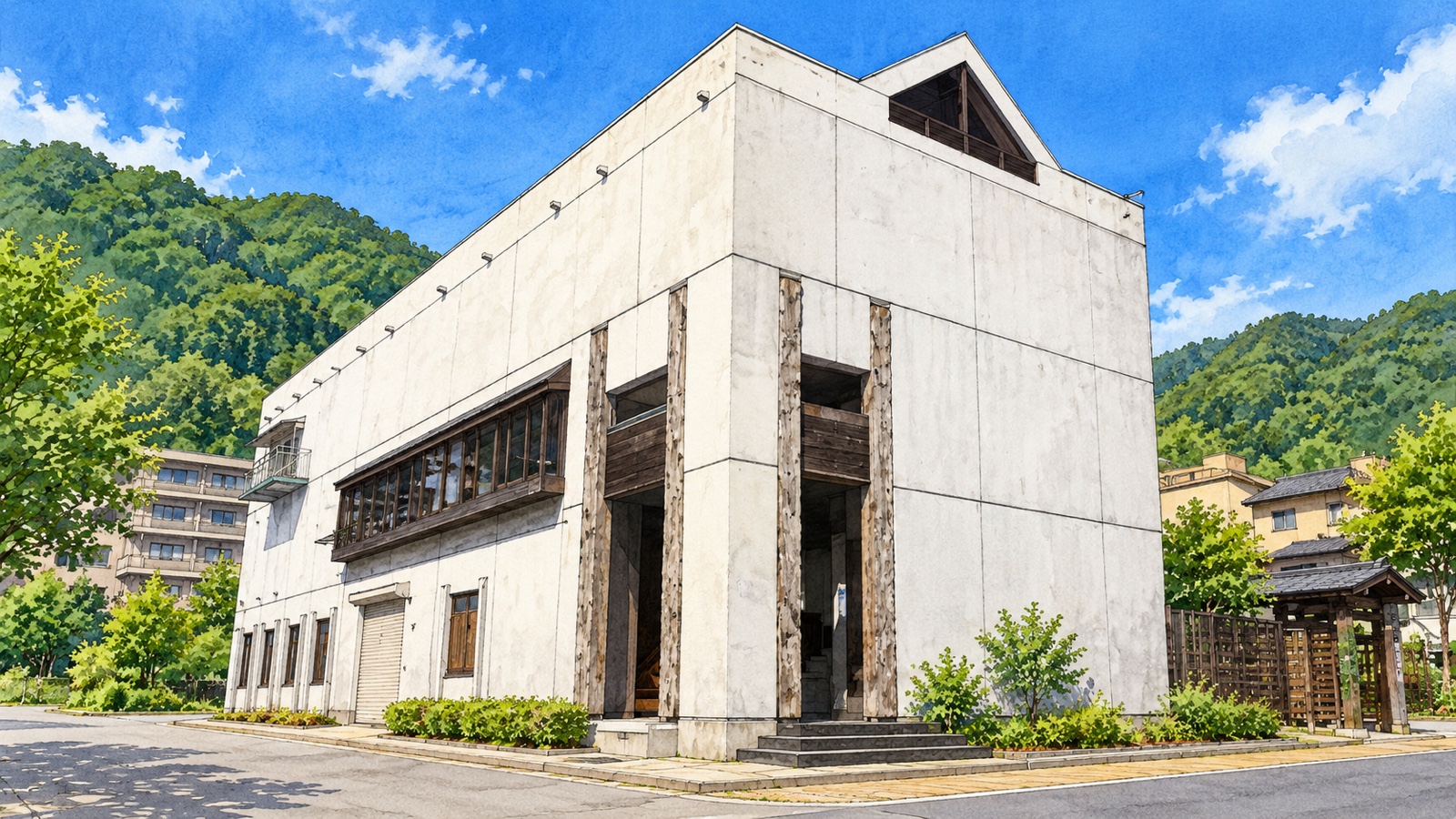
1YUKIGUNI-KAN | The room where the woman said to have inspired Komako lived
The “Komako’s Room” exhibit at Yuzawa Town History and Folklore Museum YUKIGUNI-KAN recreates part of the second floor of Toyotaya, where geisha Matsue lived. Toyotaya sold tobacco and sweets and also farmed; it rented its second floor as a geisha lodging house.
When Toyotaya was demolished during redevelopment in town, part of the room was preserved and moved to the museum in 1992. The facility took the name YUKIGUNI-KAN in 2000. Around the time an exhibit was held in memory of Matsue, who had died the year before, the public was invited to suggest a nickname, and the museum was named after the novel.
The museum has a gallery of Japanese paintings based on Snow Country and displays clothing and tableware used by Kawabata. Items include Oshima and Ojiya pongee, Satsuma jofu ramie, teacups, a sake flask, and a Tiffany watch he used while traveling. They offer a different view of the writer’s everyday belongings from the preserved writing room.
During renovations in 2024, “Komako’s Room” was moved from the second floor to the first, and multilingual information and AR interpretation were added. Alongside the literary exhibits, the museum also holds folk tools that tell the story of work and daily life in this snowy region.
Open 9:00 a.m.–5:00 p.m.; last admission at 4:30 p.m. Admission is ¥500 for adults and ¥250 for elementary and junior high school students. The person with a disability certificate or Mirairo ID and one caregiver are admitted free. Closed Wednesdays, or the following day when Wednesday is a holiday.
- Location
- 354-1 Yuzawa, Yuzawa Town, Minamiuonuma District, Niigata Prefecture
- Connection to the work
- A museum that recreates the Toyotaya room where Matsue, said to have inspired Komako in Snow Country, lived.
- Hours and closing days
- 9:00 a.m.–5:00 p.m.; last admission at 4:30 p.m. Closed Wednesdays, or the following day when Wednesday is a holiday.
- Admission
- ¥500 for adults; ¥250 for elementary and junior high school students
Sources:YUKIGUNI-KAN newsletter — “Komako’s Room” and the museum’s history 、YUKIGUNI-KAN — Visitor information 、2024 renovation announcement
2Takahan, the Snow Country Inn | Kasumi-no-ma, where Kawabata wrote
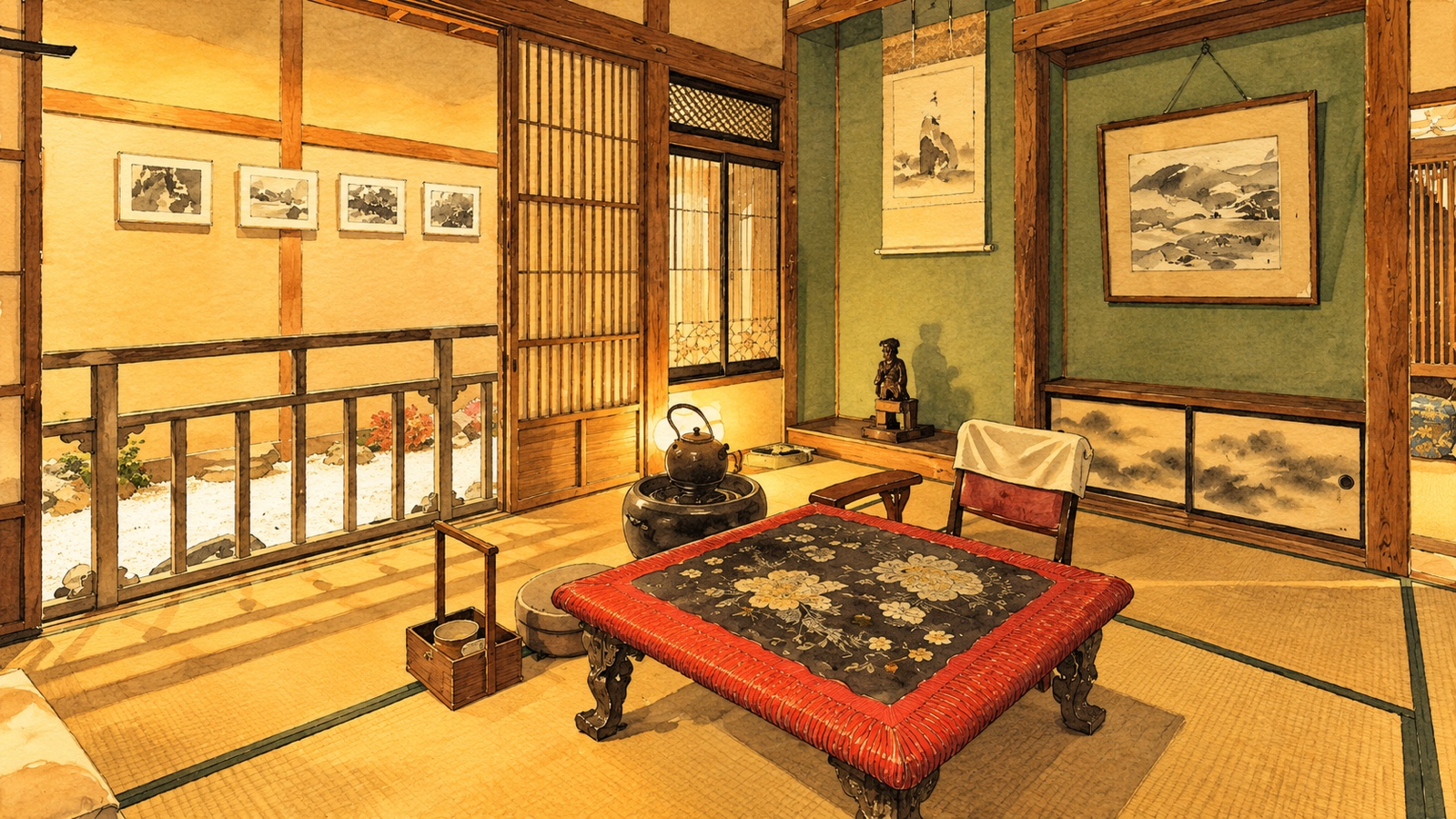
According to Takahan’s official information, Kawabata worked on Snow Country in Kasumi-no-ma from late autumn 1934 through 1937. The room has been preserved at the inn and, along with the literary archive room, is open to overnight guests.
The archive room holds works by Kawabata, Hiroshi and Akiko Yosano, Hakushu Kitahara, and others, along with art by Hakutei Ishii and Shigeru Nakazawa. A folding screen by Gentaro Kumagai, designated a cultural property of Yuzawa Town, is also among the collection. Visitors can see both the handwriting of literary figures who stayed at the inn and works of art.
Snow Country is screened in the inn’s theater at night. The official information lists a daily 8:00 p.m. start, a running time of about 2 hours 15 minutes, and reservations at the front desk. If you plan to watch after dinner, you can build the screening into an overnight stay.
Only overnight guests may visit Kasumi-no-ma and the literary archive room.
- Location
- 923 Yuzawa, Yuzawa Town, Minamiuonuma District, Niigata Prefecture
- Connection to the work
- An inn that preserves Kasumi-no-ma, the writing room where Yasunari Kawabata worked on Snow Country from late 1934 through 1937.
- Visitor access
- Visits to Kasumi-no-ma and the literary archive room are limited to overnight guests.
- Screening at the inn
- Snow Country is screened daily from 8:00 p.m. for about 2 hours 15 minutes. Reserve at the front desk.
Sources:Takahan — The world of Snow Country and the theater 、Takahan — Literary archive room and Kasumi-no-ma
3Izu Museum of Modern Literature | Manuscripts by writers connected with Amagi
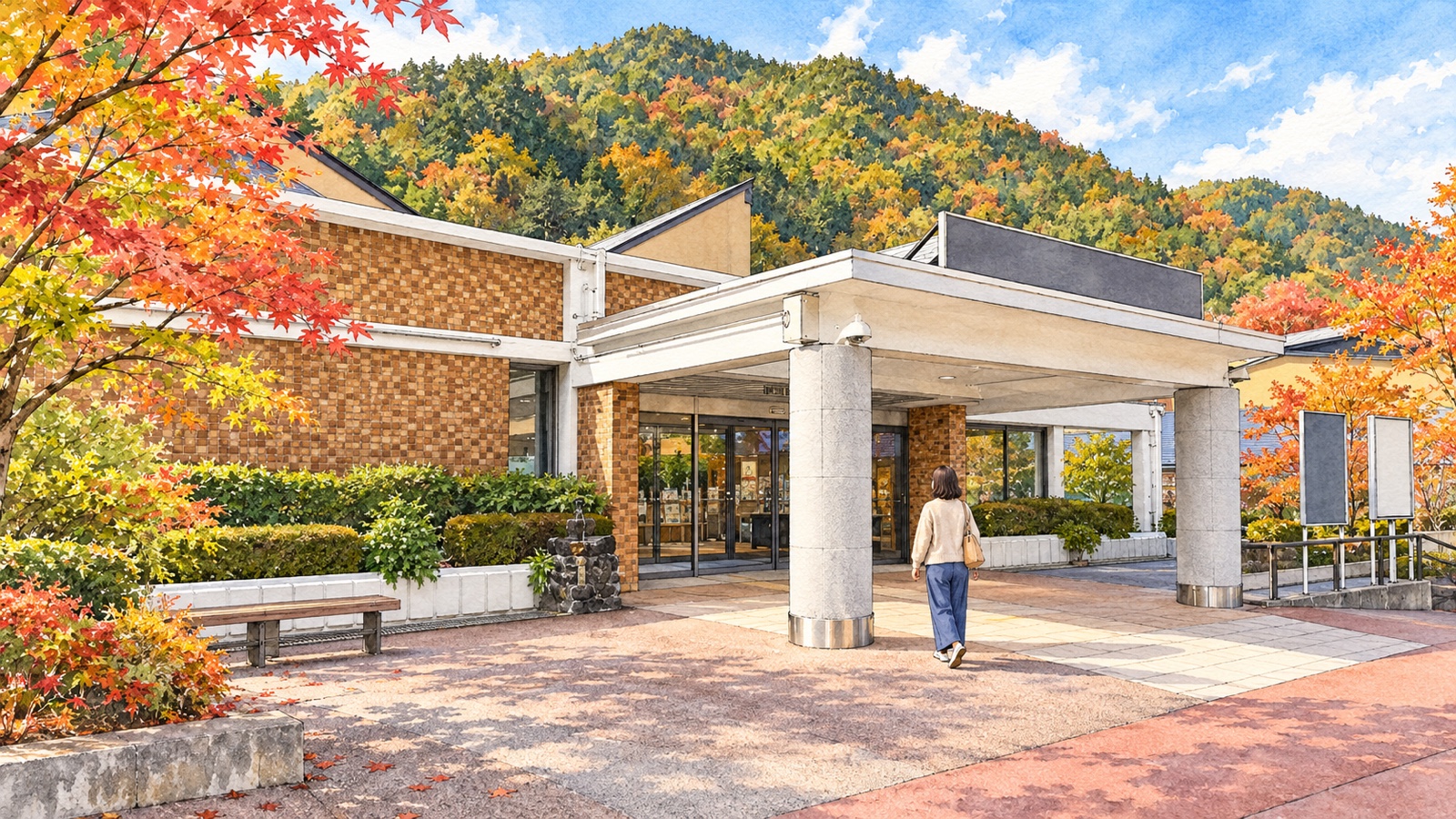
The Izu Museum of Modern Literature is inside the Showa-no-Mori Hall at the Amagi-goe roadside station. It introduces manuscripts and personal belongings of writers who visited Izu or came from the area, including Yasunari Kawabata. Yugashima also preserves traces of writers such as Riichi Yokomitsu, Akiko Yosano, Motojiro Kajii, and Yasushi Inoue.
Amagi, which Kawabata visited repeatedly, was also a gathering place for writers. Yokomitsu and Kawabata belonged to the literary magazine Bungei Jidai, and Kajii visited Kawabata while he was staying in Yugashima. The exhibits here extend beyond The Dancing Girl of Izu to the writers who worked in the same hot-spring town.
The building’s Mori no Joho-kan (“Forest Information Center”) is free to enter and introduces Amagi’s plants, animals, and forests. Admission to the literary museum is ¥300 for adults and ¥100 for children. Cash only; electronic money is not accepted. Open 8:30 a.m.–4:30 p.m.; generally closed on the third Wednesday of each month.
The courtyard has a wasabi field, a waterwheel, and the relocated former home of Yasushi Inoue. The hall brings together literary exhibits, a forest exhibit, and a courtyard; the trees change color in autumn.
- Location
- Inside Showa-no-Mori Hall, Amagi-goe roadside station, 892-6 Yugashima, Izu, Shizuoka Prefecture
- Connection to the work
- A literary museum showing manuscripts and personal items of writers connected with Amagi-Yugashima, including Yasunari Kawabata.
- Hours and closing days
- 8:30 a.m.–4:30 p.m.; generally closed on the third Wednesday of each month
- Admission
- ¥300 for adults and ¥100 for children; cash only. The adjoining Forest Information Center is free.
Sources:Izu City tourism information — Showa-no-Mori Hall 、Izu City — Amagi-Yugashima and literature 、Kawabata Yasunari Memorial Society — Chronology
4The Dancing Girl of Izu Monument in Yugano | Where Kawabata attended its unveiling
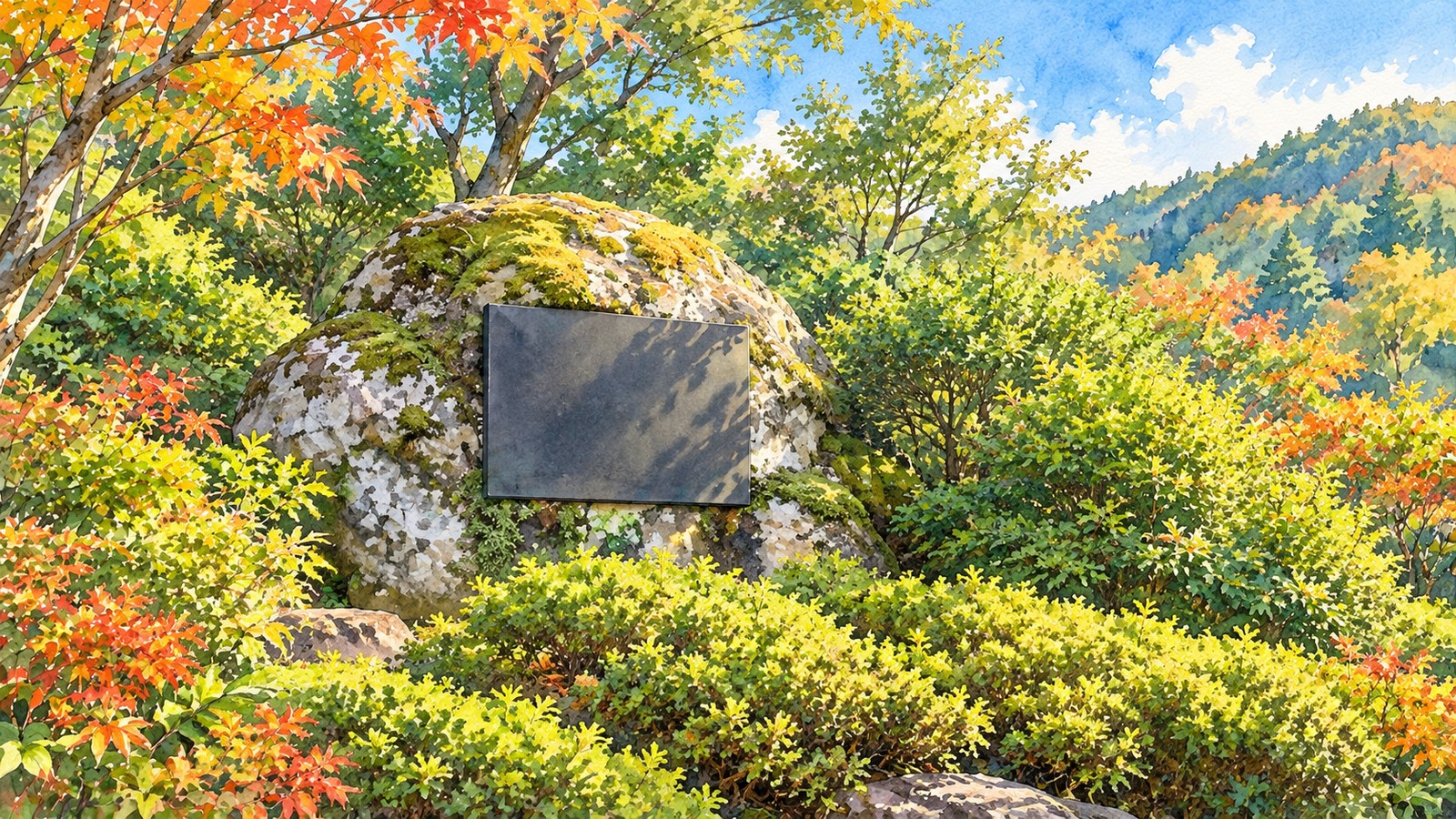
The literary monument in Yugano Onsen, Kawazu Town, was erected on November 12, 1965. It stands beside Fukudaya, an inn connected with Kawabata, and the author himself attended the unveiling ceremony. The monument is inscribed with a passage about Yugano from The Dancing Girl of Izu.
About 40 years after the novella was published and nearly half a century after his first trip to Izu, Kawabata returned to this place commemorating the work. Its history includes the author himself standing beside a monument built by later readers and local residents.
The monument stands outdoors beside Fukudaya. The tourism association lists parking for 20 cars.
- Location
- Beside Fukudaya, Yugano, Kawazu, Kamo District, Shizuoka Prefecture
- Connection to the work
- A monument to The Dancing Girl of Izu; Yasunari Kawabata himself attended its unveiling on November 12, 1965.
- What to see
- An outdoor stone monument inscribed with a passage about Yugano from The Dancing Girl of Izu.
- Facilities
- Parking for 20 cars
Sources:Kawazu Town Tourism Association — The Dancing Girl of Izu Monument
5Ibaraki City Yasunari Kawabata Literature Museum | A model of his boyhood home and a recreation of his Kamakura study
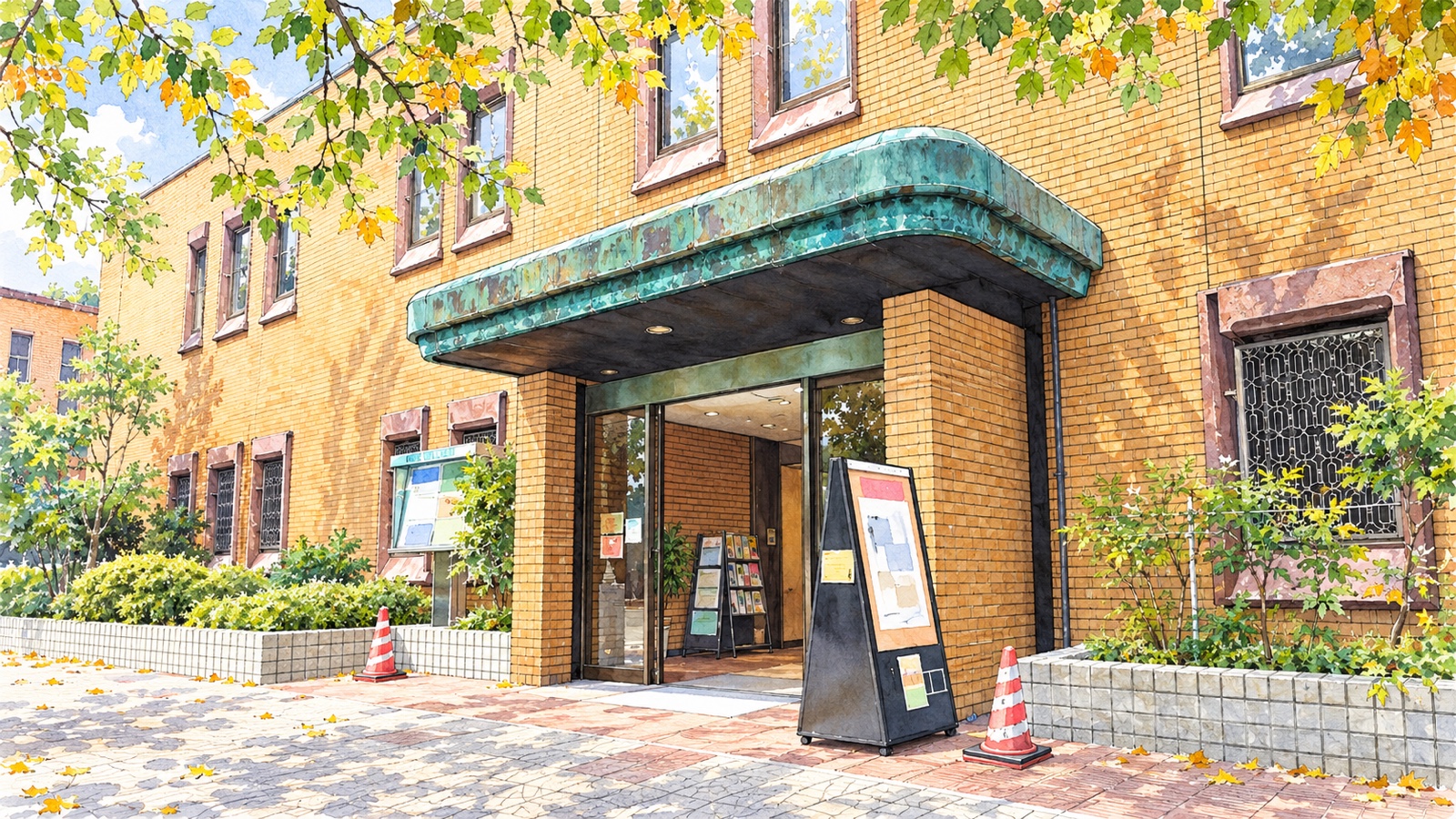
The Yasunari Kawabata Literature Museum in Ibaraki, Osaka Prefecture, has exhibits recreating the home where he lived as a boy and his study at his home in Kamakura. Through manuscripts, letters, books, calligraphy, and personal belongings, the museum introduces his work from childhood through his later years.
One impetus for opening the museum came at a 1977 “Junior High School Students’ Meeting with the Mayor,” where students called for a place to study Kawabata. The museum opened in May 1985. It was established in the town where the writer, also an honorary citizen, grew up, to share his story.
Some materials require an application to view. The Osaka Prefectural Library’s facility information also notes that audio and braille books can be borrowed through other libraries. The museum has a collection for visitors who want to move from seeing the exhibits to reading Kawabata’s works.
Admission is free; open 9:00 a.m.–5:00 p.m. Generally closed on Tuesdays, the day after national holidays, during the New Year period, and for a materials inventory period in early February. It is about 1 km from JR Sojiji Station, 1.3 km from Hankyu Ibaraki-shi Station, and 1.4 km from JR Ibaraki Station.
From October 4, 2026, through January 31, 2027, the memorial room is hosting “Yasunari Kawabata Chronicle 1926–27.” It focuses on Kawabata when he was young and publishing The Dancing Girl of Izu, and displays his handwritten manuscript “Present and Future” and a letter to Zenjiro Konishi postmarked January 19, 1928. The exhibition covers a period when he also became involved in film production and expanded his work into newspaper serials.
During this exhibition, the museum will open on Tuesday, November 3, and close the following day, November 4. It has announced that it will close from December 28 through January 5 for the New Year holidays.
- Location
- 2-11-25 Kaminakajo, Ibaraki, Osaka Prefecture
- Connection to the work
- A public literary museum in Ibaraki, where Kawabata spent his boyhood, displaying manuscripts, letters, and a recreation of his Kamakura study.
- Hours and closing days
- 9:00 a.m.–5:00 p.m.; generally closed Tuesdays, the day after national holidays, during the New Year holidays, and in early February. Free admission.
- Access
- About 1 km from JR Sojiji Station, 1.3 km from Hankyu Ibaraki-shi Station, and 1.4 km from JR Ibaraki Station
Sources:Osaka Prefectural Library — Yasunari Kawabata Literature Museum 、Ibaraki City newsletter — The museum’s origins and Kawabata’s boyhood 、Ibaraki City — Fall 2026 themed exhibition 、Ibaraki City — Visitor information for the literature museum
6The Great Cedar at Suwa Shrine | A roughly 400-year-old cedar where Komako cooled off
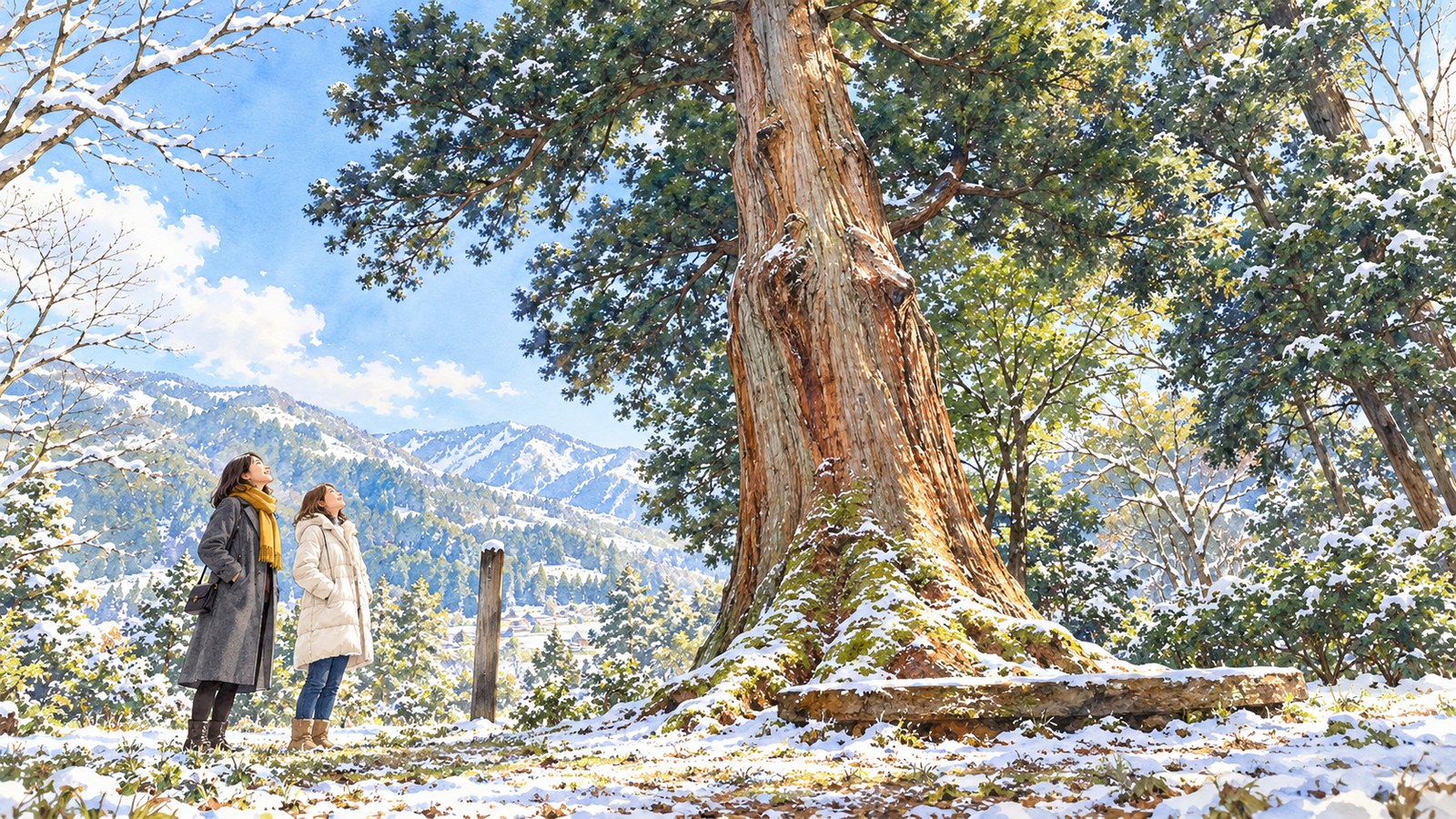
Suwa Shrine in Yuzawa, Yuzawa Town, has a great cedar estimated to be about 400 years old. It is said that the spot beneath this tree, where Snow Country heroine Komako cooled off, was also where Yasunari Kawabata developed the idea for the work. The tree is designated a natural monument by Yuzawa Town. It is about a 25-minute walk from the west exit of Echigo-Yuzawa Station.
- Location
- 901 Yuzawa, Yuzawa Town, Minamiuonuma District, Niigata Prefecture
- Connection to the work
- Said to be the great cedar beneath which Komako cooled off in Snow Country.
- Nearest station
- About a 25-minute walk from the west exit of JR Echigo-Yuzawa Station
- What to see
- A cedar estimated to be about 400 years old and designated a natural monument by Yuzawa Town.
Sources:Niigata Tourism Navigator — Great Cedar at Suwa Shrine
7Amagi Tunnel | A mountain-pass tunnel lined with stone even on the inside
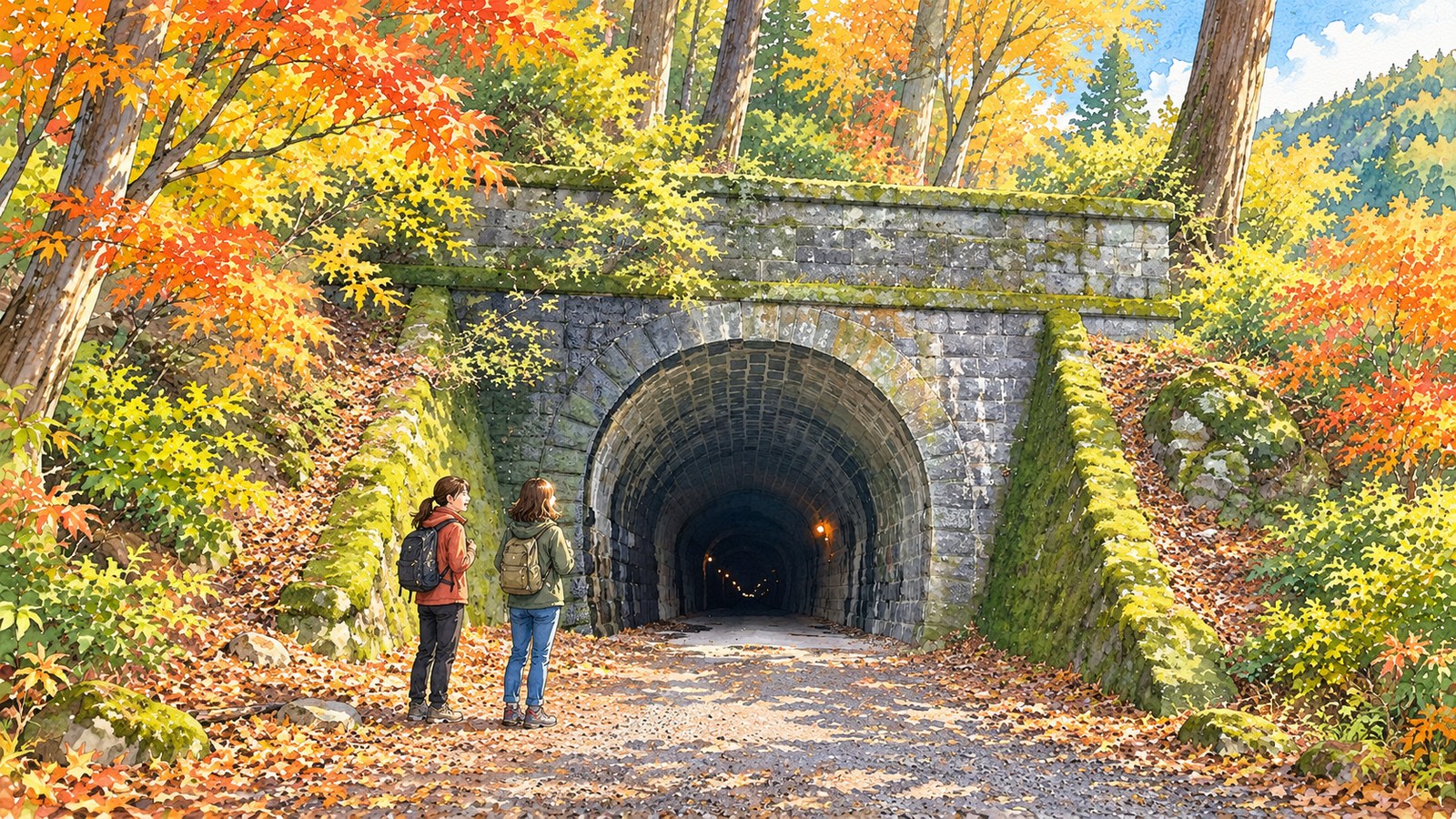
Amagi Tunnel passes beneath Amagi Pass on the border of Izu City and Kawazu Town. Completed in 1904, it is a 446-meter stone tunnel. Stonework lines not just the entrance but the interior as well; it is described as the longest stone tunnel from the Meiji era.
Shizuoka Prefecture’s civil engineering heritage guide calls it a tunnel famous as a setting in The Dancing Girl of Izu. It was also selected as one of Japan’s 100 Best Roads. The tunnel is on the old route of National Route 414 and is also called the Old Amagi Tunnel to distinguish it from the newer Amagi Tunnel.
- Location
- Old route of National Route 414, on the border of Izu City and Kawazu Town, Shizuoka Prefecture
- Connection to the work
- A tunnel at Amagi Pass known as a setting in The Dancing Girl of Izu
- Dimensions
- Completed in 1904; 446 meters long; stone-lined interior
Sources:Shizuoka Prefecture — Amagi Tunnel
8Kawazu Seven Waterfalls and Shokei Falls | Waterfall with a statue of the dancing girl
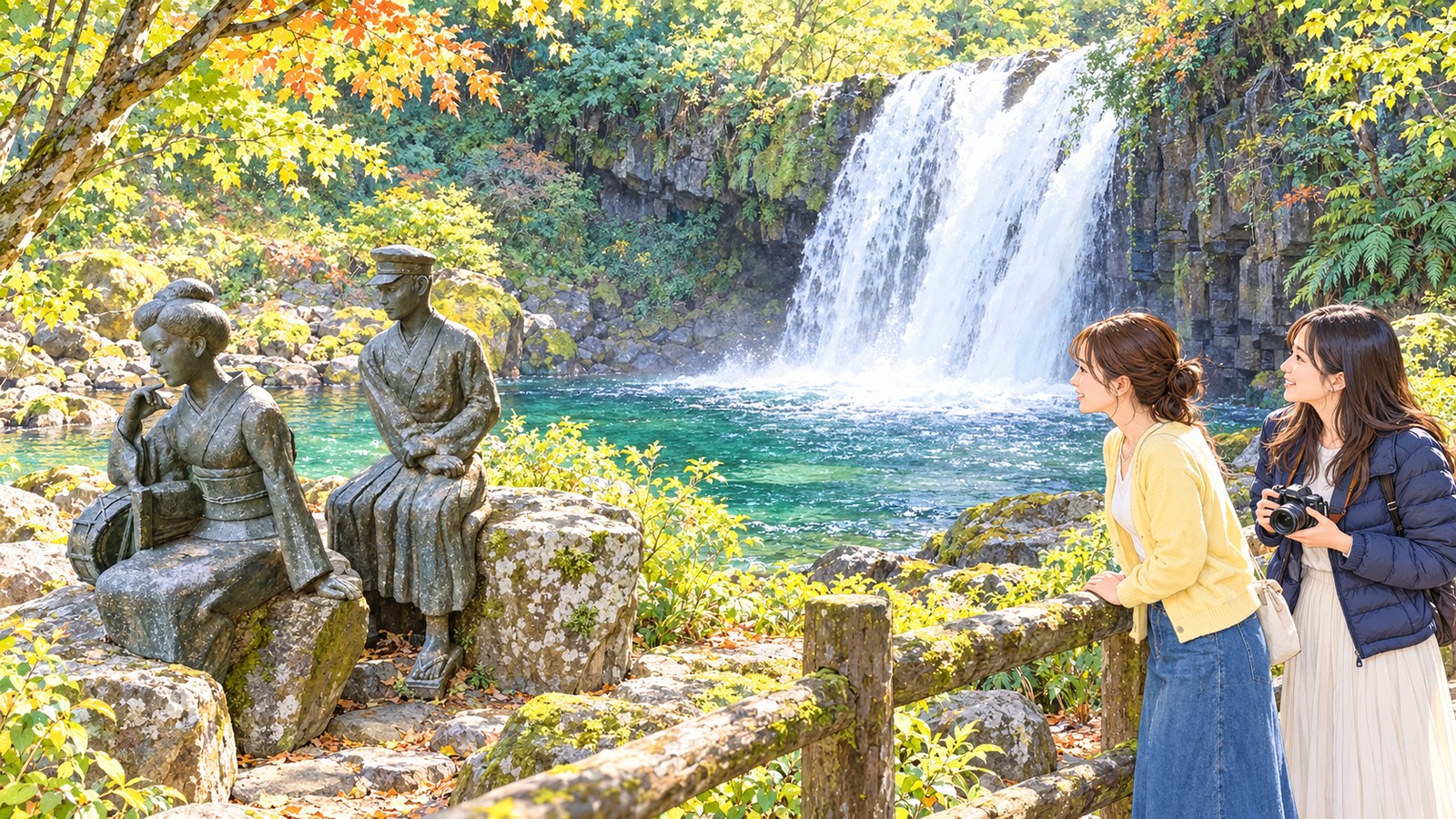
Kawazu Seven Waterfalls in Nashimoto, Kawazu Town, is the collective name for seven waterfalls along the Kawazu River. The river carved them by smoothing lava that flowed from an eruption about 25,000 years ago. They are also one of the geosites in the Izu Peninsula UNESCO Global Geopark, recognized in 2018.
A statue of the dancing girl stands beside Shokei Falls, one of the seven. The walking trail around the falls is 850 meters long and takes about an hour one way. Improvements in 2013 added a viewing deck extending over the plunge pool at Kama Falls and the suspension bridge Kawazu Odoriko Takimi-bashi.
- Location
- Nashimoto, Kawazu, Kamo District, Shizuoka Prefecture
- Connection to the work
- A statue of the dancing girl stands beside Shokei Falls.
- What to see
- An 850-meter trail past seven waterfalls and the Kawazu Odoriko Takimi-bashi bridge
- Access
- About 25 minutes by bus from Kawazu Station on the Izukyu Line
Sources:Shizuoka Prefecture — Kawazu Seven Waterfalls Landscape Plan
9Yasunari Kawabata Literary Monument at Sumiyoshi Taisha | A monument to a writer born in Osaka
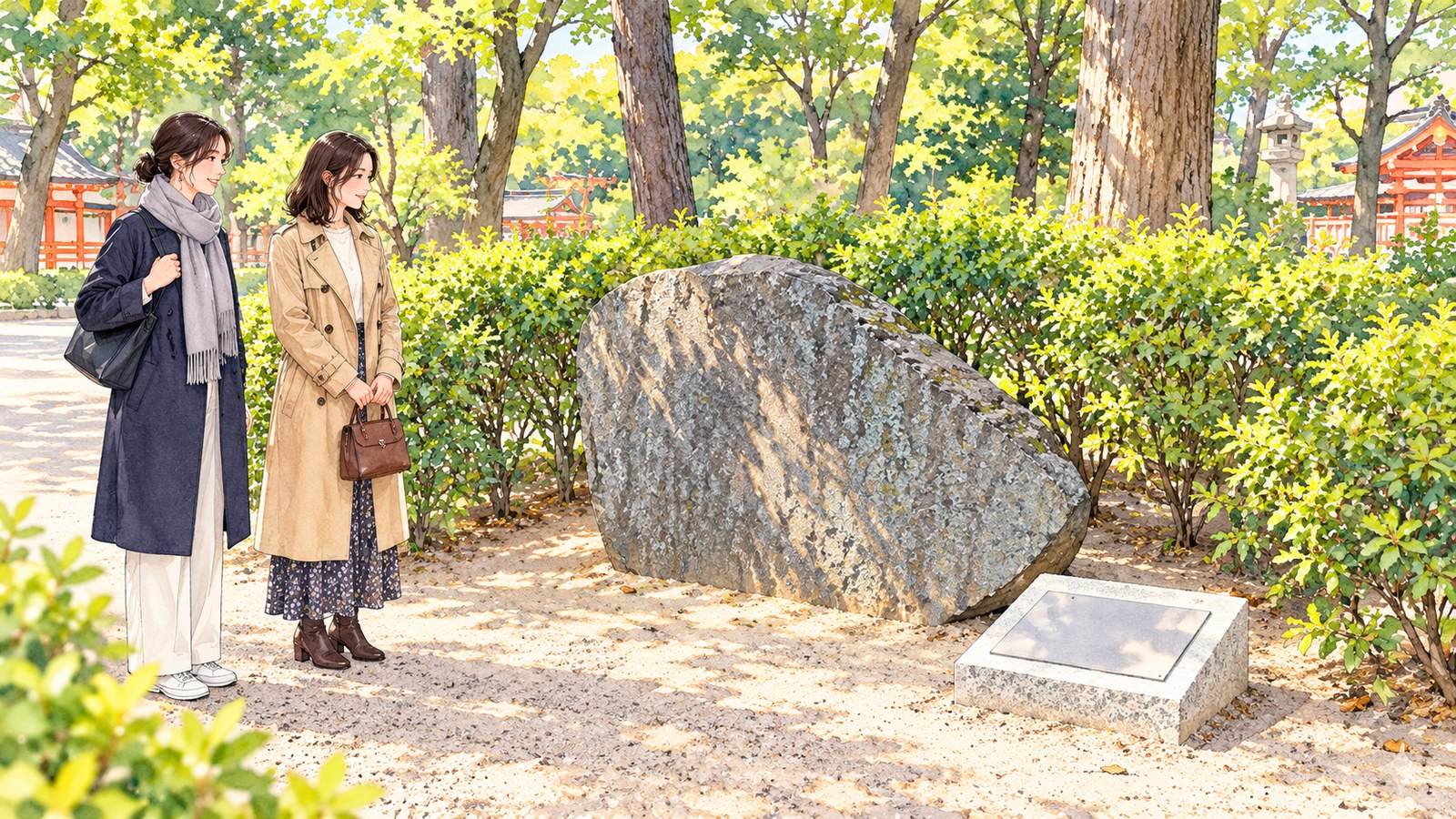
A literary monument to Yasunari Kawabata stands on the grounds of Sumiyoshi Taisha in Sumiyoshi Ward, Osaka. Kawabata was born in 1899 in 1-chome Konohana-cho, Kita Ward, Osaka City, now 1-chome Tenjinbashi in Kita Ward.
Osaka City’s guide to literary monuments also introduces “Sorihashi,” a short story published in the magazine Fūsetsu in 1947. One of the three stories “Sorihashi, Shigure, and Sumiyoshi,” it is said to be “a home of Kawabata’s literature” and is connected to his Nobel Prize lecture “Japan, the Beautiful and Myself.”
- Location
- On the grounds of Sumiyoshi Taisha, 2-chome Sumiyoshi, Sumiyoshi Ward, Osaka City, Osaka Prefecture
- Connection to the work
- A literary monument to Yasunari Kawabata, who was born in Osaka
- Nearest stations
- Torii-mae Station on the Hankai Line and Sumiyoshi-taisha Station on the Nankai Main Line
Sources:Osaka City — Yasunari Kawabata Literary Monument
The train in Snow Country and the people who live in Yuzawa
Komako, whom Shimamura visits, and Yoko, whom he meets on the train
In Snow Country, Shimamura is a traveler who goes from Tokyo to a hot-spring town. He meets Komako in the fresh green season, then boards a train again at the end of the same year to see her. On board, he becomes interested in Yoko, who is accompanying a sick man.
The story is not told only through the midwinter whiteness suggested by its title. Shimamura meets Komako amid fresh greenery, and she plays the shamisen well. For Shimamura, the hot-spring town is a place to visit; for Komako, it is where she works and lives. That difference in distance is reflected in their relationship.
Source:Shinchosha — About Snow Country
Yoko’s voice is directed toward her younger brother, who works for the railway
At the beginning of the novel, Yoko opens the train window and calls to the stationmaster. She asks about her younger brother, who has just started working there. The stationmaster talks about heavy snow, avalanches, stranded trains, and young employees wearing thick winter clothes. Just after the famous sentence about the tunnel, the winter landscape is described through the railway workers’ jobs.
Shimamura, listening to her voice, is also drawn to Yoko’s reflection in the train window. When he wipes the fogged glass, the eyes of the woman across from him appear. Looking directly at her would feel awkward, but he can keep watching through the window while pretending to admire the evening scenery. Yoko adjusts the sick man’s scarf, and Shimamura watches the movement of her hands.
Yoko’s attention is on her brother and the sick man, while Shimamura is captivated by her beauty. The tension in this opening comes from the gap between the actions of someone caring for another and the feelings of someone watching. Shinchosha’s online preview includes the scene from Yoko opening the window and calling out through Shimamura following her reflection in the glass.
Source:Shinchosha — Snow Country preview
The Joetsu Line changed the distance between Tokyo and Yuzawa
Kawabata first visited Yuzawa in June 1934. Three years earlier, in 1931, the Shimizu Tunnel had opened and the Joetsu Line was completed. According to the YUKIGUNI-KAN newsletter, a trip that had previously taken two days from Tokyo via Nagano Prefecture took about four hours and 40 minutes from Ueno.
At first, Kawabata was cautious about publicly identifying Yuzawa as the setting of the work. In a 1948 essay he indicated that he would not disclose the location, but he mentioned Yuzawa in the afterword to the 1952 Iwanami Bunko edition. The novel itself does not name the hot-spring town; he described its connection to the place in writings outside the story.
Yuzawa has also changed since the time when the work was written. Around the old Nunoba ski area, there were once terraced fields and mulberry groves, with paths used by local residents. Beneath today’s streets lined with the station plaza and lodging facilities lies a history shaped by the railway, ski tourism, and redevelopment.
Source:YUKIGUNI-KAN newsletter — Kawabata’s account of Yuzawa and Snow Country
A snow cape is made to fit its wearer, using materials and finger measurements
The folk artifacts at YUKIGUNI-KAN include straw crafts made in the region. A newsletter from August 2026 profiled the work of Morio Kobayashi. Without drawing a pattern, he used the distance between his thumb and middle finger as a measuring unit, then wove a cape to fit the wearer’s body.
One material is hiroro, the local name for Miyama-kansuge sedge that grows in the mountains. It makes a light cape but takes time to gather. Michishiba, which could be collected near homes, was also used, balancing the available materials with comfort.
A senakoji is a tool worn against the back when carrying a load, easing slippage and pressure on the body. The gear for cattle and horses was not the same: straw sandals were made for cattle with cloven hooves, while horses wore boots covering the hoof. The newsletter even records the final step of laying out items woven in winter on the spring snow.
Source:YUKIGUNI-KAN newsletter — Morio Kobayashi’s straw crafts
The Japanese painting gallery has 14 works depicting Snow Country
The first-floor gallery at YUKIGUNI-KAN displays 14 Japanese paintings depicting scenes from the novel. The works include Tatsuo Takayama’s Moon over Snow Country and Chusaku Oyama’s Kanjincho; multiple painters interpreted the same novel in their own compositions. The museum also displays Kawabata’s handwritten opening of the novel.
The museum’s folk-life exhibit follows work through the seasons: preparing rice fields in spring, sericulture in summer, harvesting and threshing in fall, and straw work and snow clearing in winter. A relocated living room has an irori hearth and household tools from the Meiji and Taisho eras through the early Showa period. Visitors can trace not only the people and scenery depicted in paintings but also the work that sustained the community through the year.
Source:YUKIGUNI-KAN — Japanese paintings and folk-life exhibits
From a journey in Izu to a novella
From a meeting in 1918 to publication in 1926
In autumn 1918, when he was a student at the First Higher School, Kawabata traveled alone through Izu. His experience of joining a troupe of traveling performers along the way led to The Dancing Girl of Izu. The novella’s narrator is also a student traveling alone who is drawn to a dancer.
That experience did not immediately become the novella in its present form. In summer 1922, while staying at Yumotokan in Yugashima, he wrote 107 manuscript sheets titled “Memories of Yugashima.” He revised it in 1926 and published The Dancing Girl of Izu. About four years passed from the trip to the first draft and another four before publication.
Yumotokan was not an inn he visited just once. Kawabata returned in 1919 and continued going to Yugashima for about ten years. After graduating from university in 1924, he also spent longer stretches at the inn, making it a place where he could write on an ongoing basis.
Sources:Yumotokan — Kawabata Yasunari and the inn’s history
Ibaraki City — Yasunari Kawabata chronology
From boyhood in Ibaraki to a student traveling alone
Kawabata lost both parents when he was young and grew up at his grandparents’ home in Ibaraki. His experience after his grandfather died in 1914 later became A Diary of My Sixteenth Year. The Ibaraki literature museum’s account describes a work that records not only the affection of days spent nursing his grandfather but also anxiety and aversion.
His boyhood also included time spent with books and art. The city newsletter recounts how he climbed trees to read, sat on embankments with a book, and drew pictures. After entering his middle school dormitory, he bought so many books that he ran up a bill at a bookstore. Before he became a great novelist, he was a student eager for one book after another.
The model of his family home at the Ibaraki literature museum evokes this boyhood. Seen alongside the recreation of his Kamakura study, it traces a path from a boy reading in Osaka to a writer who moved to Tokyo, published in magazines, and kept writing at inns around the country.
Sources:Ibaraki City newsletter — A Diary of My Sixteenth Year
Ibaraki City newsletter — Yasunari Kawabata and Ibaraki
Kawabata, Yokomitsu, and Kajii’s work intersected at the hot-spring inn
In 1924, Kawabata helped launch Bungei Jidai with Riichi Yokomitsu and others. Around the time he published The Dancing Girl of Izu, he was working with fellow writers who were exploring new forms of literature. In January 1927, Motojiro Kajii visited Kawabata in Yugashima; that March, Kinseido published the collection The Dancing Girl of Izu.
Yumotokan preserves rooms used by Kawabata as well as materials related to Kajii. The tanka poet Bokusui Wakayama also stayed at the inn in spring 1922. According to the inn’s guide, the transom in the “Yamazakura” room where Wakayama stayed was used in the design of the first edition of The Dancing Girl of Izu. The inn’s architectural details were carried into the book’s appearance.
Yasunari Kawabata
A writer who lost both parents when young and grew up at his grandparents’ home in Ibaraki. His solo trip to Izu in 1918 led to The Dancing Girl of Izu, and his stays in Yuzawa from 1934 led to Snow Country.
Riichi Yokomitsu
A writer who joined the literary magazine Bungei Jidai with Kawabata and others in 1924. He was among the writers exploring new forms of literature.
Motojiro Kajii
A writer who visited Kawabata in Yugashima on New Year’s Day in 1927. Yumotokan also preserves materials related to Kajii.
Bokusui Wakayama
A tanka poet who stayed at Yumotokan in spring 1922. The transom in the “Yamazakura” room where he stayed was used in the design of the first edition of The Dancing Girl of Izu.
Sources:Kawabata Yasunari Memorial Society — Chronology
Yumotokan — Writers who stayed at the inn and related materials
The Dancing Girl of Izu reimagined on screen and stage
The first film adaptation was a silent movie starring Kinuyo Tanaka as the dancer
The 1933 film The Dancing Girl of Izu (Koi no Hana Saku Izu no Odoriko) was the first screen adaptation of the novella. Directed by Heinosuke Gosho, it starred Kinuyo Tanaka as the dancer and Den Obinata as the student. The National Film Archive of Japan describes it as the oldest surviving silent film by Gosho.
Gosho reportedly later said he had wanted to make a sound film, but the completed work is silent and black-and-white. The archive’s commentary draws attention to its rapid editing. Unlike later film adaptations, which let audiences hear the dialogue, this version uses changes in the image and the actors’ presence to depict the feelings between the student and the dancer.
Source:National Film Archive of Japan — The Dancing Girl of Izu (Koi no Hana Saku Izu no Odoriko)
In Hibari Misora’s starring version, the music was composed after walking through Izu
The second film adaptation was the 1954 version directed by Yoshitaro Nomura. Seventeen-year-old Hibari Misora played the dancer, and Akira Ishihama played the student. Composer Chuji Kinoshita explored the roads from Shuzenji and wrote both lyrics and music for songs including the theme songs “The Dancing Girl of Izu” and “Village of Hot Springs,” as well as “Yugashima Ondo” in the film.
The scenery was both a backdrop for filming and a place Kinoshita actually walked to create the music. Misora’s singing and music with carefully varied instrumentation accompany the black-and-white images. A novella about a dancer became a film featuring the voice of a lead actor also known as a singer.
Source:National Film Archive of Japan — Yoshitaro Nomura’s adaptation
The version starring Sayuri Yoshinaga opens with an older professor recalling the past
In the 1963 version directed by Katsumi Nishikawa, a man who has become a university professor goes to Izu and recalls a meeting from his youth. Shigeaki Uno played the older professor, Hideki Takahashi played him as a student, and Sayuri Yoshinaga had two roles: a present-day girl and Kaoru, the dancer in his memories.
According to Nikkatsu, the present-day scenes are in black and white and the memories are in color. The time of a young man’s journey is layered with memories formed decades later. Kawabata visited the film set and praised the finished work. The National Film Archive also recounts that Nishikawa was bewildered when the author spoke so highly of the film in various places.
Nikkatsu’s official trailer shows the two characters played by Yoshinaga and Takahashi, along with scenes from their journey through Izu. The film runs 87 minutes.
Sources:Nikkatsu — 1963 version of The Dancing Girl of Izu
National Film Archive of Japan — Structure and production of the 1963 version
The version starring Momoe Yamaguchi was filmed in Izu over three days
The Ibaraki literature museum notes that The Dancing Girl of Izu was adapted into a film six times between 1933 and 1974. After Kinuyo Tanaka and Hibari Misora, Haruko Wanibuchi played the dancer in 1960, followed by Sayuri Yoshinaga in 1963, Yoko Naito in 1967, and Momoe Yamaguchi in 1974.
The Momoe Yamaguchi version was also directed by Katsumi Nishikawa. The lead actor’s schedule limited the production to three days of filming in Izu. Locations in Okutama and at a studio were also used. The Izu scenery in the film was not made entirely from on-location filming on the Izu Peninsula.
Film locations changed with each era and director, but the literary monument in Yugano still stands. Kawabata himself traveled there to attend its unveiling in 1965.
Source:Ibaraki City newsletter — The film The Dancing Girl of Izu and Yasunari Kawabata
SPAC’s 2026 production also opens the story from the traveling performers’ perspective
Shizuoka’s theater company SPAC is reviving The Dancing Girl of Izu in fall 2026, with Junnosuke Tada writing and directing. Katsuyuki Motohiro supervises the video. The stage production pairs Izu footage with enka, J-pop, and rap. The director explains that he developed the perspective of the traveling performers—often placed on the sidelines as the student looks on—through drag queens and live rap.
Since its premiere in 2023, the production has been staged at theaters in Shizuoka and Izu, an outdoor venue during the Kawazu Cherry Blossom Festival, and a tatami room at Shuzenji Onsen. Like the troupe in the story, the production has traveled from venue to venue.
As of October 18, the remaining weekend public performances were scheduled for October 31 and November 1, both starting at 1:30 p.m. The venue is Shizuoka Performing Arts Center inside Granship, and the show runs 130 minutes. On October 31, a talk about the adaptation by Junko Fukuda was also scheduled. Public reservations by phone or at the box office were also being accepted for performances on October 28 at 1:30 p.m. and November 5 at 6:00 p.m.
Source:SPAC — The Dancing Girl of Izu, fall 2026
How the works were written and remembered in the places connected with them
- 1899Yasunari Kawabata is born in Osaka CityLife
- 1904Amagi Tunnel is completedLocal history
- 1917Graduates from Ibaraki Middle School and enters the First Higher SchoolLife
- Autumn 1918Travels in Izu and joins a troupe of traveling performersJourney
- 1924Joins the launch of Bungei JidaiWriting
- 1926Publishes The Dancing Girl of IzuWork
- Late autumn 1934 onwardContinues writing Snow Country at TakahanWriting
- 1935Serialization of Snow Country beginsWork
- 1937First book edition of Snow Country is publishedPublication
- 1947Publishes the short story “Sorihashi”Work
- 1965Attends the unveiling of the Yugano literary monumentCommemoration
- 1968Receives the Nobel Prize in LiteratureAward
- 1983Yuzawa Town History and Folklore Museum opensFacility
- 1985Ibaraki City Yasunari Kawabata Literature Museum opensFacility
- 1992Komako’s Room is installed at the Yuzawa museumExhibit
- 2024YUKIGUNI-KAN is renovatedFacility
- 2026100 years since The Dancing Girl of Izu was publishedCommemoration
Snow Country continued to be written after its first book edition
Snow Country began appearing in installments in 1935, and its first book edition was published by Sogensha in June 1937. But Kawabata had not finished writing it. According to the chronology from the Kawabata Yasunari Memorial Society, he published “Zoku Yukiguni” (“Snow Country Continued”) in the October 1947 issue of the magazine Shosetsu Shincho. Thirteen years after he began, the work reached a provisional conclusion.
The period from late autumn 1934 through 1937 that Takahan cites corresponds to the writing that led to the first book edition. The story continued after the war, and Kawabata went on writing it. The tale that began at an inn during a journey remained part of the author’s work long after he left Yuzawa.
Sources:Kawabata Yasunari Memorial Society — Chronology, 1934–1947
Takahan — Kawabata’s stays
The postwar Shincho Bunko began with Snow Country
Snow Country also has a place in the history of paperback publishing. According to Shinchosha, the first title in the Shincho Bunko series after it resumed postwar publication was Yasunari Kawabata’s Snow Country, released in July 1947. Shincho Bunko began in 1914, experienced a suspension in publication, and entered its fourth era in 1947—a period that continues today.
The publisher explains that the sequence is also recorded by the submission number “1” at the bottom of the book’s title page. It was not only a long-selling work; it was also the first book through which Shincho Bunko brought paperbacks back to readers after the war.
The current Shincho Bunko edition of The Dancing Girl of Izu includes the title novella as well as “The Hot-Spring Inn,” “Lyric,” and “Of Birds and Beasts.” Read on for Kawabata’s descriptions of hot-spring towns and short stories that portray the inner lives of different characters.
Shinchosha — Book information for Snow Country
Shinchosha — Stories included in The Dancing Girl of Izu
Sources:Shinchosha — History of Shincho Bunko
In Izu’s centennial year, pair a film with a roughly 4-kilometer walk
On November 21, 2026, a film screening and guided walk are scheduled to mark 100 years since The Dancing Girl of Izu was published. Participants will meet at Yuzuru Memorial Hall next to Amagi Hall. After check-in from 9:10 a.m. and a film from 9:30 to 11:00 a.m., the group will walk about 4 kilometers along the Odoriko Trail.
The event is limited to the first 20 applicants, with a minimum of 10 participants. The application deadline is November 15. The ¥2,000 fee does not include lunch or bus fare. The walk will be canceled in rainy weather. Because the program includes both a film and a mountain trail walk, it requires a separate reservation from a regular visit to the literature museum.
Snow Country, whose first book edition was published on June 12, 1937, will reach its 90th publication anniversary in 2027. The YUKIGUNI-KAN newsletter notes that the year will also mark 55 years since Kawabata’s death.
Sources:Izu City tourism information — 100th-anniversary event
YUKIGUNI-KAN newsletter — Record of Snow Country’s first publication
Oshi Lab note | A business perspective: Time at the inn and literary experiences
Takahan offers overnight guests access to the preserved writing room, literary materials, and evening film screenings. The experience goes beyond a tour, letting guests spend more than two hours with the work after dinner. The inn’s connection to literature shapes a specific way to spend time inside the building.
SPAC has taken its production beyond the theater to hot-spring inns and cherry blossom festivals. The 2026 theater lobby also features a tourism tour inspired by The Dancing Girl of Izu, developed by local high school students and Tokai Bus. It connects the venue where people see the work with plans to visit the actual places afterward.
Sources:Takahan — Literature and the theater
SPAC — Performance and lobby exhibit
About the sources
Facility information is based on information from operators, municipalities, and tourism associations. Accounts of the writing and publication history draw on materials from the Kawabata Yasunari Memorial Society and publishers. The film adaptations are covered using information from production companies and the National Film Archive of Japan; the 2026 performance is based on SPAC announcements. Dates, hours, and visitor conditions reflect each facility’s official information as of October 2026.
FAQ
Can I visit Kasumi-no-ma as a day visitor?
Takahan’s current official information says visits to Kasumi-no-ma and the literary archive room are limited to overnight guests. Reservations for the Snow Country screening at the inn’s theater are handled at the front desk.
Is Komako’s Room at YUKIGUNI-KAN Kawabata’s writing room?
It recreates a room at Toyotaya where geisha Matsue, said to have inspired Komako, lived. Kawabata’s writing room, Kasumi-no-ma, is preserved at Takahan.
How much is admission to YUKIGUNI-KAN?
Admission is ¥500 for adults and ¥250 for elementary and junior high school students. The person with a disability certificate or Mirairo ID and one caregiver are admitted free. The museum is open 9:00 a.m.–5:00 p.m., with last admission at 4:30 p.m.
Does the Izu Museum of Modern Literature accept cashless payments?
Izu City’s tourism information says admission is cash only. It costs ¥300 for adults and ¥100 for children. The Forest Information Center in the same Showa-no-Mori Hall is free.
Which stations are within walking distance of the literature museum in Ibaraki?
According to the Osaka Prefectural Library, it is about 1 km from JR Sojiji Station, 1.3 km from Hankyu Ibaraki-shi Station, and 1.4 km from JR Ibaraki Station. The address is 2-11-25 Kaminakajo, Ibaraki; admission is free.
Where is the statue of the dancing girl in The Dancing Girl of Izu?
It stands beside Shokei Falls, one of the Kawazu Seven Waterfalls in Kawazu Town. The trail around all seven waterfalls is 850 meters long and takes about an hour one way.
When did Kawabata attend the unveiling of the Yugano literary monument?
He attended the unveiling ceremony on November 12, 1965. The monument stands beside Fukudaya and is inscribed with a scene from Yugano in The Dancing Girl of Izu.
Were all film versions of The Dancing Girl of Izu shot in Izu?
It varies by film. The 1974 version starring Momoe Yamaguchi was filmed in Izu for only three days and also used locations in Okutama and a studio, according to Ibaraki City’s literature museum.


