
Oshikatsu & Travel Agencies: Connecting Creative Works and Places Through JTB's Location Support

How can the creative world of a work or an artist be connected to real-world regions and landscapes? For travel agencies and businesses involved in regional tourism, a central planning question is what kind of guidance to provide when fans of a work become interested in a specific place. We previously organized the topic of sacred-site pilgrimages (seichi junrei) from a regional revitalization perspective in Oshikatsu & Local Governments, and tie-ups involving transportation networks themselves in Oshikatsu & Railways and Airlines. In this article, based on publicly announced facts, we take a closer look at how location scouting cooperation—where a travel company gets involved right from the production stage of a creative work—differs from subsequent sacred-site visitor guidance and commercial travel product development.
How Travel Companies Get Involved Goes Beyond Selling Tours
When people think of the intersection between oshikatsu (activities dedicated to supporting one’s favorite artist, character, or idol) and travel agencies, what usually comes to mind first is the sale of transportation and lodging packages for concert travel, or bus tours visiting the real-world settings of an anime or story. In actual project planning, however, there are cases where a travel agency’s expertise is utilized even before any travel product goes on sale—specifically, during the creative production process that gives shape to a work’s world and atmosphere.
A concrete example of this is “PROJECT Stargazer (in Japanese),” a joint project with Studio STELLAR (featuring VTuber and artist Hoshimachi Suisei) announced by major Japanese travel agency JTB on June 30, 2026. The project launched on June 29, and the announcement revealed that JTB cooperated with location scouting for the music video of her new song Hoshi o Miru Shojo (“The Girl Who Watches the Stars”), which premiered the same day on her official YouTube channel, “Suisei Channel.”
What is especially noteworthy here is that the role JTB took on was not “selling a tour to take fans to an existing sacred site,” but rather the production process of “researching domestic and international locations that fit the world of the song and cooperating in its creation.” In the artist’s personal comment included in the announcement, she mentions the wilderness of Kazakhstan, which clearly illustrates JTB’s specific role in scouting locations for production so that landscapes rarely encountered in everyday life could be incorporated into the work.
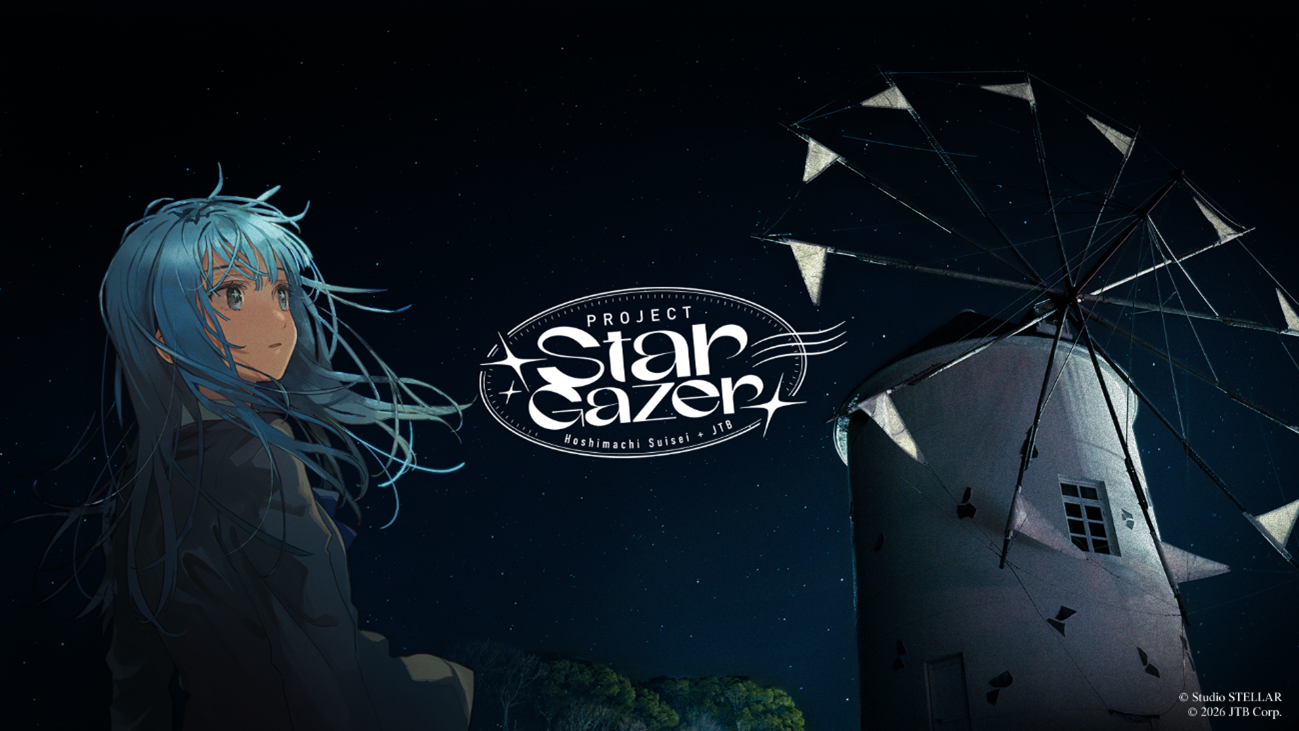
Looking at the released announcement visual, Hoshimachi Suisei is positioned on the left against a dark starry sky, with the Stargazer logo in the center and structures resembling a tower and antennas on the right. Beneath the central logo sits the credit “Hoshimachi Suisei × JTB,” creating a single composition that links the artist’s character, the project title, the travel company’s name, and an evocative landscape.
When interpreting this visual and the announcement details, however, it is necessary to separate the creative world being expressed from the travel services that can actually be arranged at the present time. From this image alone, it is impossible to identify where the depicted tower and antenna-like structures are actually located, or whether they are places where general travelers are permitted to enter and look around. Furthermore, as of the June 30, 2026 announcement, no purchasable packaged tours for fans, specific travel dates, pricing, or conditions for independent visits to the filming locations have been presented; future developments are scheduled to be announced on the official website.
The Three Stages: Location Cooperation, Sacred-Site Guidance, and Travel Commercialization
When travel companies and project planners connect creative content with real-world places—and when fans read an announcement and decide how to act—distinguishing among three separate stages helps prevent confusion: “location cooperation for production,” “sacred-site guidance for fans,” and “commercialization into purchasable travel products.”
- 011. Location Research & Production CooperationSearching domestically and internationally for places that match the world of a song or video to support creative production
- 022. Project Announcement & Sharing the WorldviewShowing the connection between the work and the company through visuals and music videos while previewing future developments
- 033. Reviewing Sacred-Site Guidance & Tour CommercializationExamining whether general entry is possible and what transportation and lodging conditions apply (this does not mean JTB has announced a tour product)
Source: The Oshi Lab’s summary of the article
The first stage is location scouting, just like what was carried out for the music video of Hoshi o Miru Shojo. At this stage, the priority is whether a location visually matches the creative world of the song. Vast, extraordinary landscapes—such as the wilderness of Kazakhstan mentioned in the artist’s comment—may be selected, but that selection is made strictly for the sake of artistic expression in the work.
The second stage is announcing the launch of the joint project and sharing its world with fans. Just like the PROJECT Stargazer key visual, presenting the character, the landscape, and the company name side by side sparks anticipation among fans wondering what kinds of developments will unfold next. At this point in the timeline, recruitment for specific tours or visitor guidance for the actual location may not have begun yet.
The third stage is providing guidance for fans to actually visit the site in person, or building and selling commercial travel products. If a specific location is to be introduced as a destination for a sacred-site pilgrimage (seichi junrei) or sold as a tour package, practical operational design becomes indispensable: verifying whether general travelers can enter safely, whether there are facilities capable of receiving visitors, how transportation and lodging inventory will be secured, and how the tour price should be set. A press release stating that a company “cooperated with location scouting” is not synonymous with saying “a tour allowing anyone to visit the exact same place has gone on sale.” Accurately grasping this boundary line is the starting point for both fans and project planners.
The Fan’s Perspective: What to Check When an Announcement or Video Sparks Interest in Visiting a Location
Next, let us organize how fans who support a creative work or artist should approach the situation when they feel drawn to the setting of a joint project or music video.
When striking landscapes or buildings appear in a favorite artist’s video and a major travel agency is credited alongside them, it is completely natural to hope, “I want to go see that scenery for myself someday,” or “Maybe an official tour will be released.” Before immediately deciding on a place seen in a video as your next travel destination, however, there are several verification steps to keep in mind.
First, distinguish between “initiatives currently open for applications” and “future plans” in the text of the official announcement. In the PROJECT Stargazer announcement as well, what was disclosed as of June 30 was the launch of the project, the location scouting cooperation for the music video, and the plan to announce future developments on the official website. At a stage where travel dates, prices, and application terms have not yet been released, waiting for official follow-up news is the most reliable course of action.
Second, do not guess local public access conditions based solely on the scenery shown in a video or key visual. For instance, after seeing the tower and antenna-like structures drawn on the right side of the announcement visual or the landscapes inside the music video, some people might consider identifying the spot on their own and traveling there independently. However, a location used during filming or production cooperation is not necessarily open to general tourists. It may be a restricted-entry zone, a facility requiring advance permission, or an area where tourism infrastructure simply does not exist.
Third, verify travel arrangements and local conditions carefully whenever overseas landscapes are involved. Although the artist’s comment in the announcement mentioned the wilderness of Kazakhstan, if you become interested in an overseas location and consider visiting individually or with a group, far more advance verification is required than for a standard tourist destination. Beyond the basics of travel planning—such as whether transportation routes to the area and lodging arrangements are even feasible—you need to confirm through official guidance and public information sources whether the target location is open to the general public and what admission rules or local regulations apply. Because current travel advisories and safety conditions for specific countries or regions can change depending on the time of year, it is important not to make decisions based solely on the imagery of a creative work. Instead, choose your actions based on whether official guidance has been issued, or whether all the conditions required to visit safely through standard travel arrangements are in place. When preparing for concert travel (ensei) or sacred-site visits, always make checking publicly confirmed conditions your top priority.
The Travel Company and Planner’s Perspective: Bridging Shared Worldviews and Experience Design
Now, let us shift our perspective to travel agencies and regional tourism planners to consider the practical issues involved in teaming up with a creative work or artist to build a project.
The travel company’s role confirmed in this case study is researching locations suitable for creative production. This differs from the business of providing tour dates and pricing, both in terms of the counterparts consulted and the conditions verified. Separating use for filming from visits by general travelers—and preparing the specific information required for each—is a core planning issue.
Location Cooperation for Creative Production
- Research landscapes and facilities domestically and internationally that fit the world of the song or video
- Select locations according to production schedules, filming needs, and creative expression requirements
- Selected sites are not necessarily places where general travelers are permitted to enter
Sacred-Site Guidance & Tour Commercialization for the Public
- Secure schedules, transportation, and lodging inventory so participants can travel and stay safely
- Clarify public opening conditions, admission rules, and visitor capacity for facilities
- Establish tour prices and booking terms, and organize clear guidance on official websites
Source: The Oshi Lab’s summary of the article
When considering a visitor initiative, planners must verify the site’s management authority, the scope of public access, and the availability of transportation, accommodations, and rest areas. Even if a location could be used for filming a video, that does not guarantee general participants can walk through it in the same way. JTB’s announcement materials do not present public visitor reception conditions or commercial travel products. On the planning side as well, teams should avoid announcing travel destinations or schedules based solely on an announcement visual.
Separately from the announced plans for PROJECT Stargazer, if guiding visitors to an actual filming location proves difficult in a company’s own project, another option is to consult with the rights holders and land managers to consider an exhibition at an alternative venue or an online initiative instead.
For consultations regarding oshikatsu experience design for travel products and tourism initiatives, please contact KAZAORI Co., Ltd. (in Japanese). Feel free to also try our Oshi Support Level Check (Free Diagnostic).
Related articles: Oshikatsu & Local Governments / Oshikatsu & Railways and Airlines / What Is Anime Pilgrimage (Seichi Junrei)? / Concert Travel (Ensei) Packing Checklist
FAQ
Has a tour package been released for 'PROJECT Stargazer' by JTB and Hoshimachi Suisei?
As of JTB's announcement on June 30, 2026, no purchasable travel products, tour dates, prices, or visiting conditions for the filming locations have been presented. What has been publicly announced is the launch of the project and JTB's cooperation with location scouting for the music video 'Hoshi o Miru Shojo' ('The Girl Who Watches the Stars'), released on June 29, with future developments scheduled to be shared on the official website.
What is the difference between location scouting cooperation and commercializing a sacred-site pilgrimage tour?
Location cooperation is a stage that supports creative production by researching domestic and international locations that fit the world and atmosphere of a song or video. By contrast, commercializing a travel product refers to the stage of securing transportation, accommodations, and local activity slots, and establishing bookable dates, pricing, safety management, and admission conditions so that general participants can reserve and purchase the trip.
Can fans immediately visit the places shown in a music video or announcement key visual?
Even when landscapes or structures are depicted in a video or key visual, their actual locations are not necessarily made public, and whether general public entry or sightseeing is permitted is a separate question entirely. Rather than trying to identify and head to a site on your own before official guidance is released, it is necessary to check official information regarding public access and admission rules.
What is the strength of having a travel agency involved in a creative work or artist project?
Rather than only selling pre-existing tour packages, a travel agency can provide its research capabilities regarding domestic and international regions and facilities right from the production stage. By participating from the initial phase of searching for landscapes that match a work's creative vision, the agency can build a foundation that connects to future information sharing and related initiatives.
What should project planners keep in mind when expanding from location cooperation into tourism guidance?
Planners must not confuse filming permission granted during production with the conditions required to receive an unspecified large number of visiting fans after release. When private land, specialized facilities, or remote overseas areas are involved, guidance must be designed by separating each stage: whether people can travel to the area, whether they can tour the site, and whether it can be arranged as a commercial travel product.


