
The MLB Fan Business: Giveaways, Sponsorships, and Fan Guidance Through Official Bobblehead Images
The matchup on the field and which players are in the lineup are not the only reasons people choose which game day to attend. In Major League Baseball (MLB), nodding figurines known as bobbleheads and stadium giveaway items tied to specific themes also serve as a reason to head to the ballpark. What event planners and marketers in oshikatsu (fan support activities) can learn from this is how to communicate the appeal of a giveaway item together with the exact conditions required to receive it.

Looking at official product images and giveaway guides from the Los Angeles Dodgers, this article organizes how a player’s memorable moments, corporate sponsors, tickets, and game-day operations connect with one another. Having a free giveaway item on offer is separate from the overall experience of attending a game being free of cost.
Turning Memories of a Play into a Bobblehead, Seen Through Official Images
The official 2026 Dodgers bobblehead lineup features a “Greatest Game” model of Shohei Ohtani.
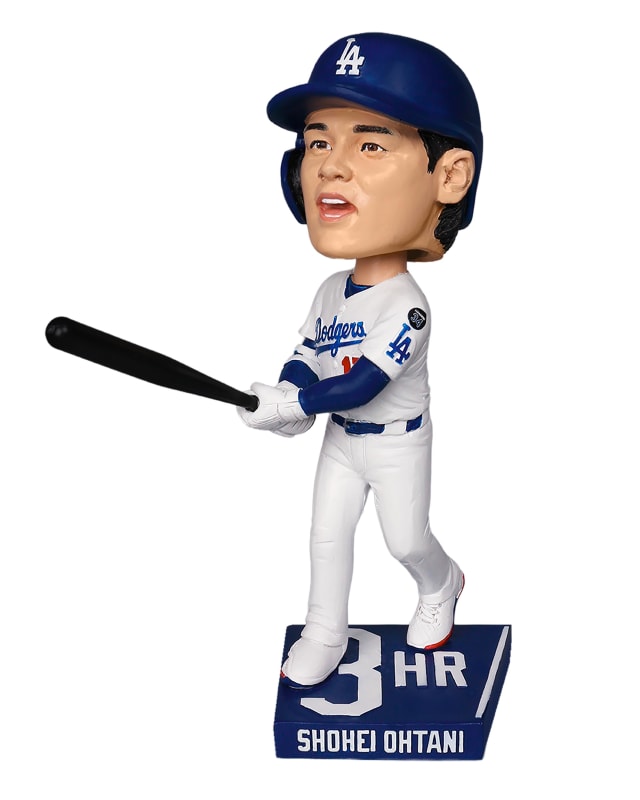
The pedestal in the image carries the text “3HR” alongside the player’s name, showing not only the player in uniform, but also which specific performance the figure is meant to recall. For people who already know the player, it brings back the memory of that day; for people seeing it for the first time, it becomes a prompt to look up what kind of game it was.
When companies plan commemorative items, they too can go beyond simply putting a face or a name on a product and explain what the item commemorates. When choosing a motif from a debut appearance, a statistical record, or a team milestone, planners verify both the event being referenced and the supervision and approval of the rights holders. It is also important not to assume that attaching a popular player’s name alone will automatically increase attendance or sales.
Separating General Giveaways from Sales, and Standard Tickets from Special Packages
Not all stadium giveaways work the same way. Presenting a promotion that distributes items to a capped number of attendees at the gate and a promotion that requires purchasing a designated ticket under the same broad label of “comes with merchandise” invites misunderstanding.
The Dodgers’ official announcement for the second half of the 2026 promotional schedule also outlines conditions such as the number of items distributed. When planning a trip to a game, fans need to read the specific notes for each eligible game rather than looking only at the schedule gallery images.
| What to Verify | Details to Include in Fan Guidance |
|---|---|
| Eligible games | Date, opponent, and game start time |
| Eligible tickets | Whether a standard admission ticket qualifies or a designated ticket package is required |
| Pickup conditions | Eligible recipients, quantity limits, entry gates, and distribution hours |
| Policies for children and companions | Age requirements and quantity limits per person |
| In case of changes | Cancellations, postponements, item substitutions, and contact information |
This table is The Oshi Lab’s summary of how game-day guidance can be organized. It does not mean that uniform giveaway rules apply across every team. Whether an already-purchased ticket includes a promotional item must be checked against both the ticket type and the specific promotion’s terms.
Gate Giveaway (Quantity-Capped)
- Distributed up to a set number of attendees on the eligible game day
- Requires checking entry gates, distribution hours, and age or per-person rules
- Arriving early requires following pre-gate waiting area and safety instructions
Designated Ticket Package
- Requires purchasing a specific designated ticket rather than a standard ticket
- Presenting it simply as "includes merchandise" alongside gate giveaways causes confusion
- Eligibility must be verified across both the ticket type and the promotion rules before buying
Source: The Oshi Lab’s summary of the article
Even when arriving early to receive an item, visitors must follow rules regarding waiting areas before gates open and safety instructions. Clear guidance that can be read before purchasing a ticket is essential to prevent misunderstandings where someone travels to the ballpark assuming they are guaranteed to get an item, only to find out they did not meet the conditions.
Seeing a Sponsor’s Name Is Separate from Knowing How Costs Are Divided
Some giveaway promotions carry the name of a corporate sponsor. When an official announcement displays a company’s name, fans can see who is supporting the promotion.
However, the presence of a sponsor’s name alone does not allow us to conclude that the company paid for all of the manufacturing, shipping, and staffing costs. The terms of a sponsorship contract and the credit shown to fans are two different pieces of information. Likewise, the fact that a fan keeps a take-home item for a long time should be kept distinct from measured results showing how many years an advertising effect lasts.
If clubs in Japan adapt this model, they can separate and examine the following costs and operational roles:
- Product planning, design, rights clearance, and supervision
- Manufacturing, quality inspection, shipping, and storage
- Game-day distribution staff, waiting line management, and directional signage
- Locations and durations for displaying the sponsor’s name
- Handling leftover inventory, damaged items, and inquiries about distribution rules
If planners estimate only the unit cost of the physical goods, on-site operational work at the venue can balloon later on. Organizers should also communicate clearly to sponsoring companies what costs they are covering and what kind of fan touchpoints the promotion provides. How many items were handed out, how much exposure the sponsor received, and how satisfied attendees felt are each separate metrics to verify.
League-Wide Attendance Figures Do Not Reveal the Impact of a Single Promotion
An official 2025 MLB announcement reported total league attendance for that year at 71,409,421.
While this figure shows the overall scale of the season, it does not represent an increase driven solely by bobblehead giveaways. It includes repeat visits by the same individuals, meaning it differs from the number of unique visitors who actually came to the ballpark. Without aligning conditions such as the game date, seat supply, team performance, opponent, and promotional campaigns, it is impossible to isolate the effect of a giveaway item alone.
To evaluate a giveaway day, planners check whether attendees are first-time visitors, what prompted them to buy a ticket, and whether they ran into trouble during item pickup or entry. Even when comparing a promotion day against a standard game day, planners look at differences in the day of the week, the matchup, seat categories, and ticket prices. Selling out a game and leaving first-time visitors excited to come back again are not the same outcome.
What Kind of Guidance Helps Fans Discovering MLB Through Shohei Ohtani?
When a specific player serves as the entry point, people with little prior knowledge of the league or the ballpark will also visit. Someone who becomes interested because of a Shohei Ohtani figurine does not necessarily already know the Dodgers’ ticket categories or gate entry procedures.
What those visitors need is practical guidance on how to get to the stadium, how to display mobile tickets, bag policies, and transportation back after the game. A player’s scheduled appearance in the lineup and the scheduled distribution of a giveaway item must also be verified separately. Promotional product images should not be used as a guarantee that the featured player will play on the giveaway day.
For fans traveling from overseas, guidance also needs to account for the local time at the venue versus Japan time, preparation for cashless payment and mobile connectivity, and how to carry the item home after receiving it. Helping visitors look at their overall travel budget and choose a manageable game day is part of preparing to welcome interest in limited-edition items. Our Overseas Game Attendance Guide also organizes what to check before heading to an international venue.
Avoid Turning Cheering Styles into a Question of Whether Japan or the US Is Better
Collecting bobbleheads, wearing a replica jersey, enjoying ballpark food, and focusing closely on the plays on the field—both MLB and Nippon Professional Baseball (NPB) in Japan offer multiple ways to enjoy a game. Reducing either culture to “just showing up for free giveaways” or “measuring devotion by how much money fans spend” overlooks how fans actually behave.
For cheering songs, vocal cheering, photography, signs or items held up in the stands, and rules on food, drinks, and bags, visitors should check the regulations for the specific stadium and seating section they are visiting. Memorizing every unfamiliar cheering song does not need to be treated as a prerequisite for attending a game. At the same time, that does not mean visitors are free to move around anywhere they please without restriction.
What companies and organizers should compare is not national personality traits, but rather what kind of guidance proves helpful when fans are choosing a ticket, entering the venue, and picking up merchandise. Helping newcomers appreciate local ballpark customs and giving first-time visitors clear, easy-to-follow information can go hand in hand.
Post-Giveaway Touchpoints for Event Planners to Review
Even after fans receive a giveaway item, organizers can provide options tailored to their level of interest, such as video recaps of the game, player introductions, and upcoming schedules. However, buying the next item or signing up for a membership should not be treated as the only desirable fan behavior.
- 011. Commemorative meaningDid first-time visitors also understand what moment or play the item commemorates?
- 022. Pickup and line guidanceWere attendees able to navigate pickup rules and waiting lines without confusion?
- 033. Game and ballpark experienceDid visitors also enjoy the game itself and the overall stadium experience?
- 044. Next information needsWhat information do attendees want to know next, such as video recaps or schedules?
- 055. Sharing the record remotelyDid the record of the promotion also reach fans who could not attend in person?
Source: The Oshi Lab’s summary of the article
What we can learn from MLB’s giveaway culture is not just how to showcase limited-edition merchandise on a grand scale. It is how to express the memory of a game through a product, and how to give the people drawn in by that item clear guidance on the conditions for attending as well as ways to enjoy what comes next.
For consultations on fan engagement and oshikatsu initiatives for sports organizations and clubs, please contact KAZAORI Inc. (in Japanese). Related articles: Pro Baseball and Oshikatsu / J.League and Oshikatsu / What Is a Bobblehead? / What Is a Giveaway Promotional Day?
FAQ
What is a bobblehead?
A bobblehead is a figure built with a head that sways or nods, and in MLB it is also used as a stadium giveaway item featuring players and other subjects. This article looks at a Shohei Ohtani model officially introduced by the Dodgers.
If I buy a ticket, am I guaranteed to receive the giveaway item?
The conditions vary depending on the promotion. Before purchasing, check the team's official guide for eligible games, quantities, ticket types, age rules, and pickup locations. Standard admission tickets and special ticket packages do not necessarily share the same conditions.
Does the sponsor pay for the entire cost of the giveaway item?
Simply seeing a sponsor's name displayed does not tell us the exact scope of what they cover, such as manufacturing costs or distribution staffing. Event planners organize costs and roles through contracts, keeping those arrangements separate from the guidance shown to fans.
If attendance is high on a giveaway day, does that mean the promotion succeeded?
Planners also check what prompted fans to attend, whether they are first-time visitors, whether there was congestion during item pickup, and how satisfied fans feel or whether they are interested in returning. Without controlling for conditions like the day of the week, the opponent, and ticket prices, attendance cannot be judged as the effect of the giveaway alone.


