
Oshikatsu Benefits: Paid Leave, Subsidies, and Corporate Program Design

Taking time off to attend a live concert, or receiving a corporate subsidy toward domestic and international travel expenses. Across contemporary Japan, corporate employee benefit programs designed to support employee oshikatsu (推し活, dedicated fan support activities directed toward one’s favorite celebrity, character, artist, or performer) are taking diverse, creative forms. However, the internal preparations and day-to-day operational burdens required on the front lines differ substantially depending on whether an organization chooses to establish an entirely new category of special paid leave or simply creates operational frameworks that make it easier for staff to string together existing vacation entitlements into extended blocks.
To assist human resources and labor management specialists who are currently evaluating the introduction or revision of such workplace policies, this article breaks down eligible employee scopes, allotted days, and disbursement conditions based on recent empirical survey data and official announcements from five pioneering Japanese firms.
How Widespread Are Corporate Programs Supporting Oshikatsu?
According to a 2026 survey conducted by Mynavi Career Research Lab (in Japanese), 11.0% of the 816 corporate mid-career hiring managers surveyed responded that their workplace has an official program or system in place to support employees’ oshikatsu. When examined by overall workforce size, the reported implementation rate was 3.6% among enterprises with 50 or fewer employees, 9.1% among mid-sized companies with 51 to 300 employees, and 16.6% among larger corporations with 301 or more employees. It is essential to recognize that these figures represent the percentage among the surveyed sample of hiring personnel, rather than an exhaustive census-level adoption rate across all Japanese enterprises.
The survey was conducted between July 1 and July 7, 2026, targeting a nationwide sample of 20,545 full-time regular employees aged 20 to 59 alongside the 816 corporate hiring managers. Among the full-time employees surveyed, 32.3% reported that they are currently actively participating in oshikatsu.
| Survey Metric | Target Respondent Group | Measured Result |
|---|---|---|
| Company maintains systems supporting employee oshikatsu | 816 mid-career recruitment managers | 11.0% |
| Currently actively engaging in oshikatsu | 20,545 regular employees | 32.3% |
| Motivated to work hard at their job for the sake of oshikatsu | Regular employees active in oshikatsu | 62.8% |
| Finds a company that accommodates oshikatsu appealing | Regular employees active in oshikatsu | 56.4% |
| Average monthly personal expenditure on oshikatsu | Regular employees active in oshikatsu | 14,125 yen |
Crucially, the final three metrics in the table reflect only the responses of individuals who actively engage in fan activities, rather than the entire full-time workforce sample. While these data points provide valuable clues regarding employee interest in workplace support systems, the study itself does not provide empirical verification that introducing such benefit programs will directly decrease employee turnover rates or measurably improve workplace productivity.
Evaluating Support Mechanisms: Leave, Expenses, and Working Hours
Corporate case studies reveal distinct strategic approaches: granting dedicated special leave, mandating or encouraging the continuous use of multi-day leave, subsidizing out-of-pocket activity costs, and adjusting work schedules to permit early departures. By comparing these options against your organization’s specific operational realities, labor managers can identify hidden hurdles that cannot be understood from flashy policy titles alone.
Facilitating Leave
- Distinguish between creating new special leave and encouraging consecutive blocks of existing leave
- Determine annual day allotments, application lead times, and workflow handover procedures
Subsidizing Activity Expenses
- Define qualified expenditure categories, disbursement ceilings, and annual usage limits
- Establish clear receipt verification protocols and personal data privacy standards
Adjusting Working Hours
- Enable early departures on designated weekdays or past specific clock times
- Balance shift coverages and redistribute day-to-day duties among team members
Even for leave policies that do not incur direct cash stipends or allowances, securing substitute coverage and adjusting shift rosters remain absolute operational requirements. Before assuming that a policy “can be implemented at zero cost,” HR planners must thoroughly resolve who will take over the absent employee’s duties and how those responsibilities will be practically managed on the floor.
Five Corporate Case Studies from Official Announcements
Dream Vision: Special Leave Determined on an Annual Calendar Basis
On November 28, 2025, Dream Vision Co., Ltd. (Yume Tenbo), an apparel e-commerce enterprise, announced the official launch of its Oshikatsu Leave policy (in Japanese). The policy covers all corporate employees who meet specified employment requirements, allowing them to apply at their discretion throughout the operating year.
The leave allocation is set at approximately 2 to 3 days per year. Importantly, this is not a permanent, fixed addition of three days each year; rather, it is a discretionary special leave allowance whose exact number of days is determined by corporate leadership each fiscal year in adjustment with the company’s overall annual working calendar. Furthermore, eligible purposes are defined broadly: in addition to attending fan events and engaging in oshikatsu, employees can use these days for general physical and mental refreshment or self-directed learning and skill development. It serves as an illustrative case of an organization adopting a recognizable “Oshikatsu Leave” moniker while intentionally framing eligible usage criteria to encompass broad personal well-being.
K Village: Two Tailored Stipends with Out-of-Pocket Expenditure Thresholds
K Village Co., Ltd., a provider of Korean language and culture services, launched its “#Oshikan Support” (推し活/Oshikatsu + 韓国/Kankoku support) benefit program in July 2025, and subsequently announced on February 10, 2026, that total cumulative usage had surpassed 100 claims (in Japanese).
| Allowance Name | Qualification Criteria | Disbursement Amount & Frequency |
|---|---|---|
| Korea Travel Allowance (Tokan Teate) | Travel to South Korea with airfare paid out-of-pocket by the employee | 10,000 yen per trip; up to once in the 1st half and once in the 2nd half of the fiscal year |
| Entertainment Oshikatsu Allowance | Attendance at entertainment events with ticket costs of 8,000 yen or more (tax included) paid out-of-pocket | 10,000 yen per claim; up to once in the 1st half and once in the 2nd half of the fiscal year |
If an employee maximizes both categories across both halves of the corporate fiscal year, their theoretical maximum annual support totals 40,000 yen. This is not a blanket, unconditional 40,000 yen cash handout disbursed across the board to every staff member. Furthermore, corporate reports confirm that claims have been successfully filed not only by full-time regular staff, but also by part-time hourly workers (arubaito) and corporate executive directors.
It is worth noting that the published figure of “100 claims” represents cumulative transaction counts, rather than 100 distinct individual employees. Looking beyond initial launch announcements to track continuous, real-world claim volumes provides an invaluable benchmark when evaluating policy efficacy in your own organization.
NS Group: Mandatory Blocks of Five Consecutive Days and Proprietary Facility Discounts
On March 19, 2025, NS Group, an operator of multi-entertainment facilities, hotels, and event spaces, announced its National Concert Tour Travel Consecutive Leave System alongside internal fan benefits (in Japanese).
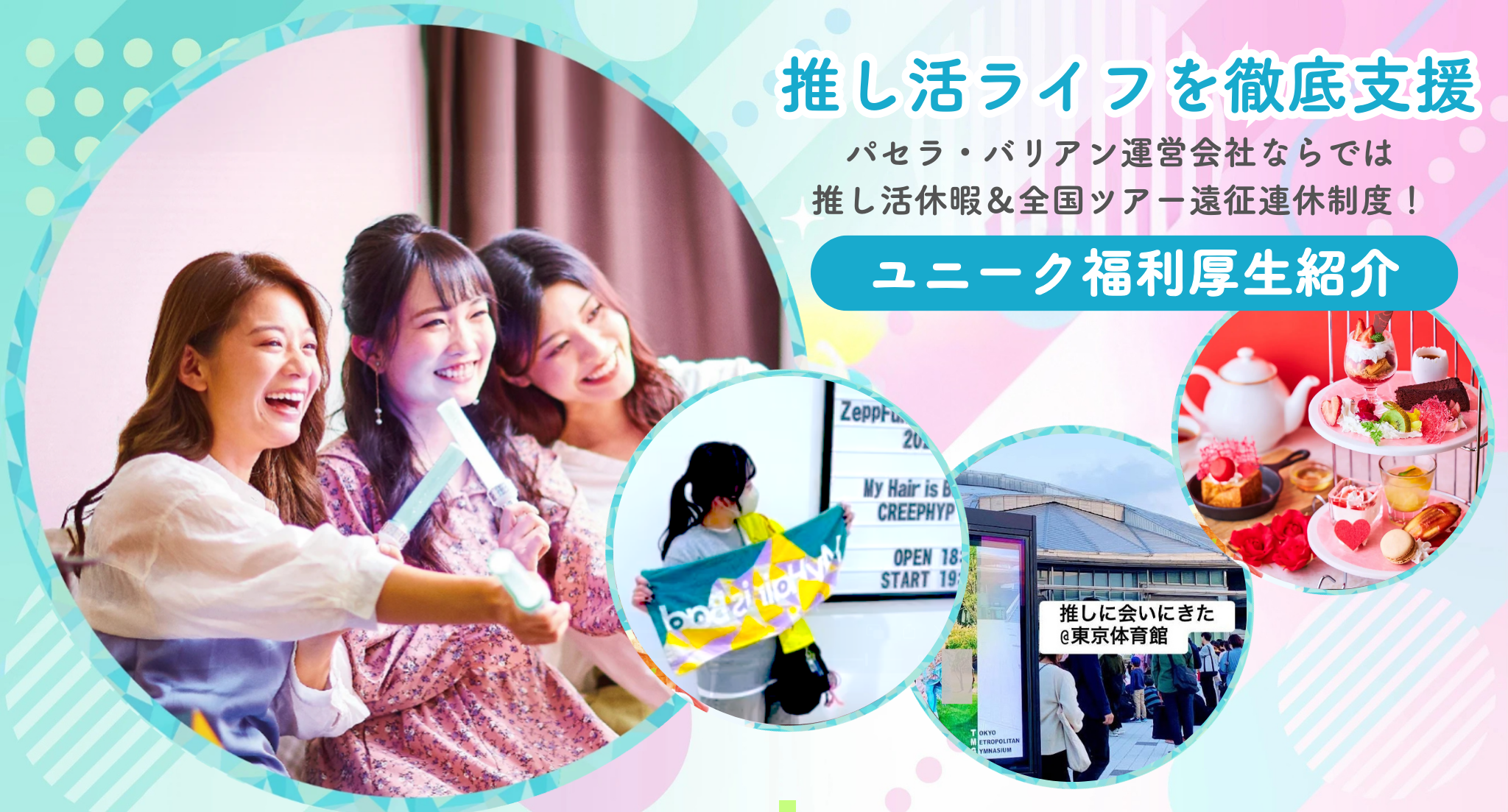
The official announcement material juxtaposes photographs of interior hotel decorations, luggage travel, and dessert afternoon tea courses. This promotional visual combines two fundamentally separate corporate initiatives into a single public presentation: an operational mechanism making it easier to take extended consecutive leave, alongside employee-exclusive discounts across the company’s proprietary commercial venues.
The “National Concert Tour Travel Consecutive Leave System” (Zenkoku Tsua Ensei Renkyu Seido) is officially described as a policy that mandates employees to schedule and take consecutive leave blocks of five days or more at least once per year. The announcement does not state that the company is granting five additional days of newly created paid vacation to all staff. Instead, it obligates the packaging of existing leave entitlements. The company’s press materials also noted an internal operational penalty imposed on managers if their direct subordinates fail to take this required block of leave—a distinct operational mechanism unique to the firm.
Simultaneously, the announcement highlighted a corporate benefit launched in January 2025 that grants employees a 50% discount on “Oshikatsu Afternoon Tea” packages hosted at the company’s entertainment venues. This reflects a two-pronged strategy: accommodating extended travel for fandom pilgrimages and away-game concert tours (ensei) while simultaneously subsidizing accessible leisure experiences at company facilities closer to home.
GCREST: One-Day Leave Tied to an Oshi’s Anniversary
On December 4, 2017, mobile game developer GCREST, Inc. announced “STYLE Plus,” a revised employee welfare and benefits program (in Japanese) that took effect that month. One core pillar was the “Oshi-men Leave” (Oshimen Kyuka), which granted employees one day of leave to celebrate their favorite character or performer’s commemorative anniversary or birthday, accompanied by celebratory financial support. Subsidy assistance for attending events geared toward female audiences was listed separately as a distinct benefit program.
Because this corporate disclosure dates back to December 2017, current operational conditions at the firm may differ, and the original press release did not specify the details of the celebratory support. Nonetheless, the policy serves as a helpful reference illustrating how corporate leave can be designed around an anniversary.
favy: Post-4:00 PM Wednesday Activity Subsidies
Food-tech and restaurant marketing company favy, Inc. published an official corporate blog post on April 1, 2023 (in Japanese), detailing a unique support policy offering expense subsidies of up to 2,000 yen per instance, usable up to five times per fiscal year, for personal activities pursued after 4:00 PM on designated working Wednesdays.
Under favy’s guidelines, the scope of an eligible “oshi” is exceptionally broad: it encompasses real living people, inanimate physical objects, 2D fictional characters, and 3D performers alike, even explicitly citing dining out with one’s spouse, domestic partner, or children as a qualifying activity. A notable characteristic of this program is that it was designed and formalized directly through internal employee proposals and company-wide voting. Rather than requiring staff to take full-day leaves of absence, favy’s model illustrates how organizations can effectively blend partial-day working hour adjustments with modest, targeted expense reimbursements. Please note that the specified weekday and financial parameters reflect corporate conditions published as of April 2023.
Practical Steps When Designing a Workplace Program
- 01Clarify Objectives and Target ScopeDecide whether to support only fandom, or broadly include general wellness and family time
- 02Select the Appropriate Support MechanismMatch special leave, consecutive blocks, expense stipends, or hour shifts to working styles
- 03Standardize Application and Handover WorkflowsEstablish receipt checks, privacy boundaries, and substitute staffing protocols
- 04Review Labor Regulations and Track UsageVerify labor rules and tax obligations, refining the policy through ongoing employee feedback
When structuring an internal policy, corporate managers must clarify the targeted worker categories and permissible usage scope alongside monetary allowances and leave days. HR leaders must decide whether eligibility is strictly limited to permanent regular full-time staff (seishain) or open to contract workers and part-time hourly employees (arubaito), and whether the program strictly targets pop-culture fandom or also accommodates broader professional self-development and personal recuperation. Rather than fixating prematurely on choosing a catchy marketing label, drafting concrete terms becomes much simpler once you establish precisely who the company wants to empower and what tangible opportunities you aim to facilitate.
On the front lines of daily operations, careful preparation is required to bridge the gap between being nominally entitled to apply and actually feeling empowered to take time off. Management must anticipate calendar seasons when vacation applications inevitably cluster, standardize handover checklists for pending tasks, and establish clear methods for securing temporary coverage. Beyond budgetary outlays, HR teams must safeguard against placing an unfair coordination burden onto shift supervisors or surrounding colleagues who remain in the office.
Application paperwork should be intentionally streamlined to request only the objective evidence necessary to verify qualification criteria. Verifying that a concert ticket met the 8,000 yen expenditure threshold is fundamentally different from compelling an employee to reveal the specific identity of their favorite performer or justify the intimate details of their personal hobby to their direct supervisor. To ensure psychological safety for workers who prefer to keep their personal fan hobbies private in the workplace (oshi-bare), companies should clearly delimit what information is collected and restrict which internal personnel have permission to review application records.
Finally, before implementing new leave categories or modifying existing schedules, corporate labor specialists must review the proposed changes against statutory Rules of Employment (shugyo kisoku), while consulting tax professionals to determine the tax treatment of allowances. Following official rollout, HR departments should not merely count approved claims; they should actively gather qualitative feedback regarding why certain employees hesitated to apply or what operational frictions occurred during shift coverage. These ground-level insights provide the foundational evidence required to refine the policy into a sustainable benefit matched to your workforce’s genuine scale and operational rhythm.
Related Reading: Understanding Internal Workplace Oshikatsu / What Is Oshikatsu Marketing? / How Large Is the Oshikatsu Market? / Column: Understanding Fan Burnout (Oshikatsu-zukare)
FAQ
How many companies currently have employee benefit programs supporting oshikatsu?
According to a survey conducted in July 2026 by Mynavi Career Research Lab, 11.0% of the 816 mid-career hiring managers who provided valid responses reported that their workplace offers systems supporting employee oshikatsu (fan support activities). Broken down by workforce size, the adoption rate stood at 3.6% for companies with 50 or fewer employees, 9.1% for those with 51 to 300 employees, and 16.6% for organizations with 301 or more employees.
What distinct mechanisms exist for oshikatsu leave?
Corporate policy design varies substantially by company. In Dream Vision's corporate announcement, employees receive roughly 2 to 3 days of special leave determined each fiscal year based on annual working calendar adjustments. GCREST announced in 2017 a 1-day leave entitlement tied to an oshi's anniversary or birthday. Meanwhile, NS Group's corporate announcement outlines an operational model that mandates taking consecutive leave of at least 5 days at least once per year.
Under what specific conditions are oshikatsu allowances disbursed?
Disbursement conditions are strictly established within each published corporate policy. K Village announced that it grants a 10,000 yen stipend per trip to South Korea (up to once each in the first and second halves of the fiscal year) when airfare is paid out-of-pocket, as well as a 10,000 yen entertainment stipend (likewise up to once per half-year) for participating in entertainment events with self-paid tickets costing 8,000 yen or more including tax. Under favy's system as of April 2023, employees could receive reimbursements of up to 2,000 yen up to 5 times per year for fan activities undertaken after 4:00 PM on designated working Wednesdays.
Are these benefit programs limited strictly to idol or anime fandom?
Several documented case studies adopt deliberately broad eligibility definitions. Dream Vision explicitly incorporates general personal refreshment and self-improvement alongside fan activities and event attendance. Similarly, favy's April 2023 announcement covers passions regardless of whether the focus is human, fictional 2D characters, or inanimate objects, citing dining out with spouses, partners, or children as an eligible activity.
What operational challenges must companies consider beyond direct financial costs?
Beyond direct expenditures, companies must establish shift coordination frameworks and secure backup personnel to handle employee absences and early departures. They must also define procedural privacy rules regarding how much personal detail about private hobbies must be disclosed during applications, and resolve equity questions regarding whether to extend eligibility to contract and part-time workers alongside permanent regular employees.


