
Oshikatsu & Department Stores: Reading Exhibition and Merch Rules from Official Event Banners
In the special event halls of department stores and commercial facilities, anime and character exhibition-style events as well as limited-time pop-up shops are regularly held. For fans visiting as part of their oshikatsu (activities supporting one’s favorite character or creator) to see franchise displays and pick up venue merchandise, understanding admission rules and ticketing conditions that differ from everyday shopping beforehand helps prevent confusion on the day. Likewise, for facility managers and event planners, figuring out how to communicate essential information and organize visitor flow within a limited run and finite floor space is an important practical consideration.

Here, taking our cues from the public release announced on September 9, 2025, by Daimaru Matsuzakaya Department Stores for the “TV Anime SAKAMOTO DAYS FES” held at the Matsuzakaya Ueno store, we break down how information is divided on promotional banners, the admission rules governing exhibition areas and merchandise sales, and how standard department store perks apply differently at special events. Although this exhibition was a past event that ran from September 25 to October 7, 2025, and the fees and terms listed reflect that specific case at the time of its announcement, it offers concrete points of reference for fans preparing to attend an event and for planners designing announcement copy.
Reading Promotional Banners: How Franchise Appeal and Event Details Are Separated
When looking at an event announcement, the first thing that catches the eye is the key visual or promotional banner. For fans, it serves as an entryway to see their favorite series or characters, while simultaneously acting as an information board telling them when and where to go.
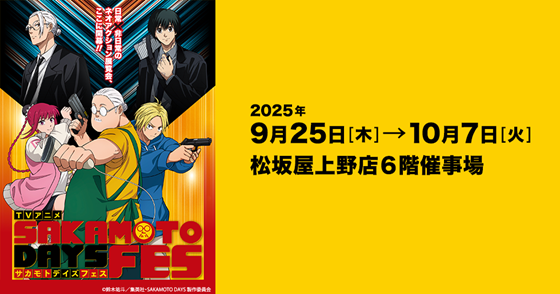
Looking at this banner, the character illustration and event title are positioned on the left side, while the right side uses a yellow margin to prominently display the event details: “September 25 – October 7, 2025” and “Matsuzakaya Ueno Store, 6th Floor Event Hall.” Note that this image is not a live-action photograph of the interior of the venue; rather, it is a promotional graphic designed to separate the artwork aimed at series fans from the practical schedule and location details needed for travel and entry.
From the perspective of a fan reading the announcement, when you spot an image on a social media timeline or an event listing page, having the dates and location buried in tiny text inside the illustration forces you to click through to the details page just to read them. When the visual roles are divided between left and right like this, you can immediately recognize from the title and artwork that the event is for a series you follow, and then glance right next to it at the margin to check the dates against your calendar. Because department stores are often divided across multiple buildings and floors, having “6th Floor Event Hall” clearly stated also makes it much easier to choose the right elevator or escalator on the day of your visit without getting lost.
Shifting our perspective, let us consider what this layout means from the standpoint of an event planner or facility coordinator designing the promotion. Layering too much text directly on top of the franchise key visual not only covers up the artwork that fans are looking forward to seeing, but also reduces readability. By building a dedicated, distinct margin for event logistics right into the banner from the start, planners can deliver the dates and venue name in large, easy-to-read lettering without detracting from the artwork. Even at the stage of creating a promotional image, this approach deliberately separates the eye-catching visual role from the informational signboard role within the same frame.
Why You Need to Check Specifications and Admission Rules in Detail Beforehand
On an ordinary day, a department store is a place where anyone can walk freely through the sales floors during business hours and bring items they like to the register. However, exhibition-style events held inside a special event hall operate under independent management rules that differ from those of regular retail floors.
Let us look specifically at the conditions announced for the “TV Anime SAKAMOTO DAYS FES” at Matsuzakaya Ueno in the September 9, 2025 Daimaru Matsuzakaya Department Stores press release (in Japanese). The venue featured photo spots and three-dimensional displays alongside the sale of event merchandise. The main conditions established for this event were as follows:
- Event Dates and Hours: September 25 – October 7, 2025. Regular admission ran from 10:00 a.m. to 6:00 p.m. (closing at 7:00 p.m.), while on the final day only, admission ended at 2:00 p.m. (closing at 3:00 p.m.).
- Admission Fees: General admission and university students: 1,500 yen in advance / 1,800 yen same-day; junior high and high school students: 1,000 yen in advance / 1,200 yen same-day; elementary school students: 600 yen in advance / 800 yen same-day; preschool children: free.
- Ticket Slots and Sales: Partially operated on a designated date-and-time reservation system with limited quantities. Same-day tickets were sold only when remaining slots were available.
- Accompanying Guardian Rules: Children of elementary school age and younger were required to be accompanied by a guardian aged 18 or older, and the accompanying guardian also needed an admission ticket.
- Inside-Venue Rules: No re-entry permitted. An admission ticket was also required to enter the merchandise area.
- Discounts and Specific Perks: Standard department store member perks and discounts were excluded. Holders of eligible disability certificates were still required to purchase a ticket, though one accompanying caregiver was admitted free of charge.
The reason to look up these specifications in advance is that they significantly change your itinerary for the day, your budget, and how you coordinate meetups with companions. For instance, if you assume, “Since the event closes at 7:00 p.m., arriving around 6:30 p.m. should give me enough time just to buy merch,” and head to the store, you will find that admission actually cut off at 6:00 p.m.—or at 2:00 p.m. on the final day—meaning you cannot get inside at all. Similarly, even if you think, “I want to skip the exhibition and just drop by the merchandise area,” an admission ticket is required to enter the merchandise section, and if the designated date-and-time slots are sold out, you will not be able to buy a same-day ticket either.
Shopping on Regular Department Store Floors
- In principle, entry, exit, and movement between floors are free during business hours
- Visitors pay only when purchasing merchandise
- Standard department store member perks and discount terms apply according to store policy
Special Hall Exhibition Events (Conditions in This Case)
- Event-specific admission cutoffs apply, such as last entry at 2:00 p.m. and closing at 3:00 p.m. on the final day
- Partially date-and-time designated with limited quantities; same-day tickets sold only when tickets remain
- No re-entry allowed, and an admission ticket is also required to enter the merchandise area
- Standard department store member perks are excluded, and individual rules specific to the event apply
As this comparison shows, even within the exact same department store building, the space beyond the doors of the event hall operates much closer to a theater performance than a standard retail floor. Rather than guessing from a banner or photo that you can simply walk right in and shop, reading down to the fine print in the official release protects a fan’s own time and transit fare.
How Fans Should Check and Prepare Across Different Scenarios
When fans planning to visit an exhibition actually put together their schedule, the points they need to check vary depending on when they are going and whether anyone is joining them. Based on the Matsuzakaya Ueno case above, here is how the decision-making process breaks down across three common scenarios.
1. Deciding Which Day and Time Slot to Attend (Opening Day, Weekends/Holidays, and the Final Day)
The first thing to check is whether your preferred date and time fall under a designated date-and-time slot, and whether advance tickets are still available. If limited-quantity advance tickets sell out, same-day tickets are sold only when slots remain, meaning there is a real possibility that you could travel to the venue and not be able to get in. Furthermore, if you plan to attend on the final day, you must watch out for the fact that admission closes at 2:00 p.m. (with the venue closing at 3:00 p.m.)—four hours earlier than on regular days (when admission closes at 6:00 p.m. and the venue closes at 7:00 p.m.). If you are traveling from afar or combining the visit with other plans, always calculate your arrival time backward from the last admission time, not the closing time.
2. Attending with Children or an Accompanying Caregiver
When visiting as a family, check not only the pricing tiers for each age bracket, but also the accompaniment rules. In this case study, admission was free for preschool children and 600 yen in advance (800 yen same-day) for elementary school students, but the rules stipulated that “children of elementary school age and younger must be accompanied by a guardian aged 18 or older,” and furthermore that “an admission ticket is also required for the accompanying guardian.” You cannot send a child into the exhibition alone while a parent waits on a bench outside. Similarly, if you hold an eligible certificate such as a disability certificate, do not assume the standard rules of public facilities or permanent exhibitions apply automatically; read the specific provisions for the event. In this instance, the individual rule stated that “holders of eligible certificates must also purchase a ticket, though one accompanying caregiver is admitted free of charge.”
3. Viewing the Exhibition Inside the Venue Before Buying Merchandise
On the day of the event, you will be moving through the space under two strict conditions: no re-entry permitted and an admission ticket is required for the merchandise area. Once you step outside the venue, you cannot go back inside even if you suddenly remember an item you forgot to buy. As for whether photography is allowed at the displays and photo spots, visitors follow the specific instructions posted inside the venue. Using the restroom before entering and organizing your list of target merchandise and budget in hand before passing through the entrance gate is the most practical way to prepare.
- 011. Check Venue Location and HoursConfirm the floor number and the difference between regular days and the final day for last admission and closing times
- 022. Check Ticket Types and Sales RulesReview advance vs. same-day price differences, designated date/time slots, quantity limits, and same-day ticket availability rules
- 033. Check Accompaniment and Discount RulesVerify guardian requirements and guardian tickets for elementary schoolers and younger, exclusions of store member perks, and terms for certificate holders and caregivers
- 044. Prepare for On-Site Visitor FlowPlan purchases before entering, keeping in mind that the merch area requires an admission ticket and re-entry is not allowed
Considerations for Department Stores When Designing Event Announcements
Now let us look at these dynamics from the perspective of a department store or event organizer. When adopting conditions such as partial date-and-time designations or a no-re-entry policy, ticket sales, admission reception, and guidance to the merchandise area all need to be aligned under those exact same terms. Publicly released press announcements are pre-event guides and do not detail the exact on-site foot traffic lines or crowd conditions on the day. Therefore, when planning an event in-house, organizers must individually design where and how admission tickets will be checked according to the size of the floor and the layout of the exhibition and retail sections.
Next, organizers should cross-reference the services of permanent retail floors against the specific terms of the special event. How member perks and accompanying guests are handled is vital information that visitors want to confirm before purchasing a ticket. By clearly separating which discounts apply and which are excluded—and explicitly stating the respective terms for eligible certificate holders and their accompanying caregivers—organizers can make these rules available both at the on-site ticket window and in advance, for example on the ticket purchase page.
What appears in large text on a promotional banner is the franchise title, the dates, and the venue. Rather than cramming every single detail—such as last admission cutoffs, discount exclusions, and re-entry policies—into the image itself, planners can design a clear path that leads readers from the banner directly to the event overview and ticketing guide. Whether the event actually increased foot traffic around regular sales floors or boosted purchases elsewhere in the store is a separate matter to be verified through dedicated measurement.
Related articles: What Is Oshikatsu Marketing? / What Is Fan Marketing? / How to Plan a Collaboration Cafe and Successful Case Studies / Oshikatsu Market Size (2026 Edition)
FAQ
How does an exhibition-style event in a department store event hall differ from shopping on a regular sales floor?
Exhibition-style events may require purchasing an admission ticket or reserving a designated date and time, and a ticket may also be required just to enter the merchandise area. In addition, event-specific conditions may exclude standard department store member perks, making it essential to check official announcements in advance.
What admission fees and conditions were set for the TV anime SAKAMOTO DAYS FES held at Matsuzakaya Ueno?
In Daimaru Matsuzakaya Department Stores' announcement on September 9, 2025, admission was listed as 1,500 yen in advance and 1,800 yen on the day for general admission and university students; 1,000 yen in advance and 1,200 yen on the day for junior high and high school students; 600 yen in advance and 800 yen on the day for elementary school students; and free for preschool children. Children of elementary school age and younger needed to be accompanied by a guardian aged 18 or older, and the accompanying guardian also needed an admission ticket.
What should fans and event planners pay attention to when looking at an event announcement banner?
Look not only at the character visuals, but also at where the information needed for travel and entry—such as the event dates and the floor number of the venue—is placed. In the Matsuzakaya Ueno example, the character artwork and event title were placed on the left, while the event dates and venue were displayed prominently in a separate yellow space on the right.
Do I still need an admission ticket if I only want to use the merchandise area at the venue?
It depends on the rules of each event, but at the TV anime SAKAMOTO DAYS FES at Matsuzakaya Ueno, an admission ticket was required even to enter the merchandise area, and re-entry was not permitted. It is important to check before heading out whether you can use the merchandise shop on its own.
Can department store shareholder benefits, member discounts, or disability certificates be used at special hall events?
Standard department store perks do not necessarily apply as-is. In the Matsuzakaya Ueno example, standard department store member discounts and perks were excluded, and holders of eligible disability certificates were still required to purchase a ticket, while one accompanying caregiver could enter for free under the event's specific rules.


