
Oshikatsu and Food Collaborations: Reading Pompompurin Outer Bags and Individual Wrappers

In the snack aisles of Japanese supermarkets and drugstores, limited-time packages decorated with popular characters are an everyday sight. For fans engaging in oshikatsu (activities supporting one’s favorite character or idol), these collaborations are accessible projects they can pick up during routine grocery shopping. For food manufacturers, they offer an opportunity to reach new customer segments by using an existing snack brand as a point of contact.
At the same time, a food packaging collaboration does not end with the illustration printed on the outside of the bag. With rice crackers (beika) and snacks that contain individually wrapped pieces inside a larger family bag, the overall experience includes how the product is eaten after opening, how individual pieces are shared with people nearby, and how product labeling is read and checked.
In this article, using the public product information from the August 17, 2026 Sanrio official news announcement for Kuriyama Beika’s “2026 Sanrio Characters Seto Shio” as a concrete reference point, we examine how to read a packaging design that places characters on both the large outer bag and the individual inner wrappers. In the first half, we look at how fans choose the product, enjoy it at home, and share it with others; in the second half, we shift perspectives to food company product planners to consider how specifications should be communicated and how informational displays are structured.
A Two-Stage Design That Delivers Characters on Both the Outer Bag and Individual Wrappers
When looking at a food packaging collaboration, paying attention not only to the front design of the outer bag but also to the individual inner wrappers—the unit handled after opening—makes it much clearer how the product is actually used in daily life.
In an announcement page on the official Sanrio news site (in Japanese) dated August 17, 2026, Kuriyama Beika’s “2026 Sanrio Characters Seto Shio” (a limited-time collaboration featuring Pompompurin) is introduced as being on sale at supermarkets, drugstores, and other retailers nationwide (as of the announcement date).
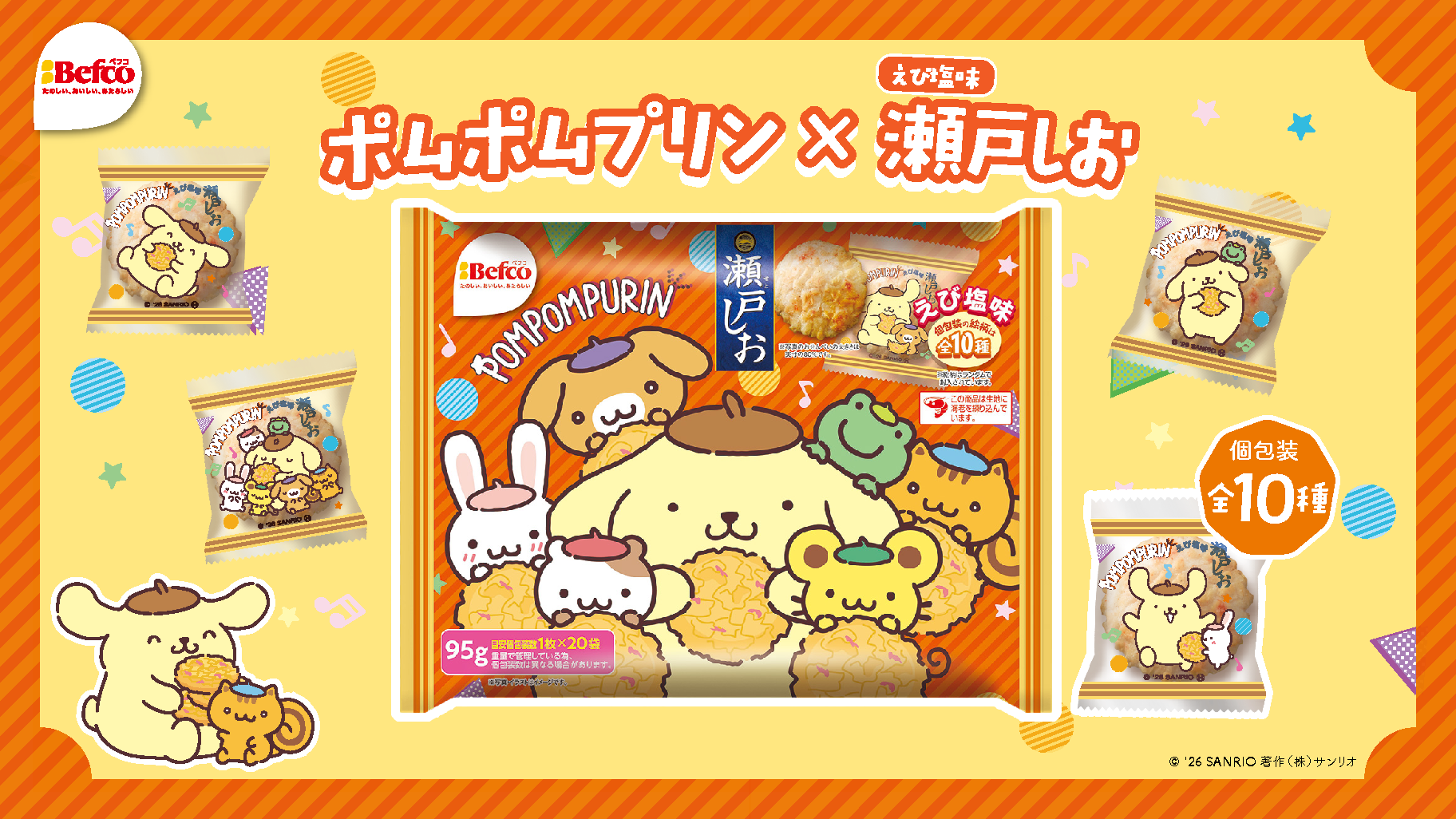
Observing this promotional image, we see the large outer bag placed in the center with an orange striped pattern, prominently featuring Pompompurin and his “Team Purin” friends. Around the bag, four sample designs from the inner wrappers are highlighted alongside a notice stating that there are 10 individual wrapper designs in total.
When a product has character artwork printed only on the large outer bag, the visual presence of the character stays with the outer bag as soon as someone opens it at home, transfers the contents into a bowl, or takes out a piece to eat. By contrast, when characters are also printed on each individual wrapper as in this example, the character remains right in the person’s hand just before eating after the outer bag is opened, or stays with each cracker when handed out one by one at work or at a gathering with friends.
The promotional image also directly includes the flavor (“shrimp salt flavor”), the net contents (“95 g (estimated count: 1 cracker × 20 packs)”), a note stating that the designs are packed at random and cannot be chosen, and the copyright notice. Even though there are 10 different wrapper illustrations, the rice cracker inside does not change flavor from one picture to the next; every pack contains the same shrimp salt flavor. Separating visual variety from the underlying culinary specifications of the food is the starting point for accurately reading a packaging collaboration.
Why It Matters to Check Specifications and Notes: Random Assortment and Weight-Based Packaging
When fans spot a collaboration snack like this in stores or on an announcement page, alongside appreciating the cute artwork, it is helpful to check the specification notes regarding net weight and how the pieces are packed. The public information for “2026 Sanrio Characters Seto Shio” contains key numbers and conditions that help set realistic expectations before buying.
First, regarding price and volume, the product is listed with a suggested retail price of 321 yen (tax included), a net weight of 95 g, and an estimated count of 1 cracker × 20 packs (these figures represent the official announcement as of August 17, 2026, and do not guarantee actual retail prices at individual stores or current stock availability). What stands out here is that the announcement does not flatly promise “contains 20 packs.” Instead, it uses the weight in grams (95 g) as the standard, lists “estimated count: 1 cracker × 20 packs,” and adds a note in the image explaining that “because packaging is managed by weight, the actual number of packs may vary.”
For this product, weight-based labeling and an estimated pack count are presented side by side. Rather than treating the number 20 as an absolute premise when shopping, readers should take the accompanying note into account as well.
Another important specification is the condition governing the 10 individual wrapper designs. The official announcement explicitly states that the illustrations are included at random and cannot be chosen. Hearing that the estimated count is 20 packs and there are 10 designs in total, it is easy to assume mathematically that buying a single bag will yield two of each design, or at least that one bag will contain a full set of all 10 types. However, because the wrappers are packed at random, there is no guarantee that all 10 designs will appear in a single bag. Certain illustrations may be duplicated multiple times, while other designs may not appear in that bag at all.
Reading and understanding these specifications prior to purchase helps fans avoid the misconception that “one bag should give me a complete set,” as well as the pressure to keep buying extra bags beyond what they can reasonably eat just to pull a specific wrapper design. The number of bags purchased or the number of wrapper variations collected is not a measure of how much someone cares about their favorite character. Fans can decide whether and how much to buy by considering how many snacks they already have at home and their realistic plans for eating them.
What the Outer Bag and Inner Wrapper Artwork Show
- Team Purin is illustrated at the center of an orange-striped outer bag that stands out on store shelves
- The individual inner wrappers feature 10 designs in total, keeping characters in hand as crackers are taken out one by one
- When handing out crackers individually to others, the character packaging is shared along with the snack
What the Specification Labels and Notes Reveal
- Even though there are 10 wrapper designs, the cracker inside is uniformly shrimp salt flavor
- The net weight is standardized at 95 g, while 1 cracker × 20 packs is an estimated count under weight-based management
- Wrapper designs are packed at random and cannot be selected, with no guarantee of getting all 10 types in one bag
Source: The Oshi Lab's summary of the article
Decisions by Occasion: Preparing to Eat at Home Versus Sharing with Others
Large-bag snacks with character designs on individual wrappers are generally used in two main everyday situations by fans. One is eating them little by little at home or at one’s own desk; the other is sharing a few packs at a time with friends, family, or coworkers. Each occasion calls for checking different details.
When eating the snacks yourself at home, the main points to check are the post-opening storage instructions and the expiration date. A 95 g bag (an estimated 20 packs) is not necessarily finished in a single sitting. Even though each cracker is individually wrapped, keeping the remaining pieces protected from moisture after opening the outer bag requires following the storage instructions printed on the outer packaging. When fans come across a favorite wrapper illustration, they may feel tempted to put off eating it and keep it on hand as a collectible, but the item inside is still food. Planning ahead so that everything is eaten before the expiration date is essential.
On the other hand, handing out crackers one by one to people around you requires an extra step of consideration. Having illustrations of Pompompurin and his friends on each individual wrapper makes it easy to pass them to friends who like the same character or distribute them during a break at work. However, not every food product can be safely eaten by every person without issue.
Whenever giving food to someone else, checking product labels in advance—such as the ingredient list, allergen disclosures, expiration date, and storage instructions—is an important general precaution. If you plan to share individual packs with others, it is helpful to keep the product labeling accessible to the recipient as well, such as by bringing the large outer bag along or taking a record of the outer package information before disposing of it. Checking how much detail is printed on the individual wrapper itself, and never deciding on your own whether someone else can safely eat the product, is equally important.
For Food Company Planners: What It Means to Design an Outer-Bag and Individual-Wrapper Collaboration
Shifting perspectives to food manufacturers and product planners, let us look at how a collaboration combining an outer bag and individual wrappers is structured and how it should be communicated to consumers.
When a company runs a character collaboration on an existing flagship snack (in this case, “Seto Shio Shrimp Salt Flavor”), switching not only the large outer bag but also the inner wrapper film to character designs serves a clear planning purpose. Changing the outer package is a mechanism to make shoppers stop in front of the store shelf, whereas changing the individual inner wrappers turns the moments when the product is consumed at home or within a social group after purchase into ongoing touchpoints with the design.
Planners structure the product by defining the respective roles of the outer bag that catches the eye on the shelf and the individual wrapper that stays in the consumer’s hand at the time of eating. When preparing multiple individual wrapper designs, planners are expected to communicate not just the total number of variations, but also the actual packaging and assortment conditions.
At the same time, whenever a food company announces a collaboration involving randomly packed individual wrappers, careful information design is indispensable to prevent consumer misunderstandings or excessive purchasing. As shown by the promotional image and text in the official Sanrio news release, the following points need to be communicated together as a set within a single promotional graphic and product description:
First, clearly state the basic specifications of the food itself (shrimp salt flavor, 95 g) so it is obvious that the flavor does not change depending on the wrapper illustration. Second, when the product is packed by weight, list the piece count as an “estimated count (1 cracker × 20 packs)” and attach a clear note explaining that the exact number of packs may vary due to weight management. Third, right alongside the appeal of having 10 individual wrapper designs in total, place a visually prominent notice stating that “designs are packed at random and cannot be chosen.”
If a company heavily promotes only the headline number—“10 Designs in All!”—while leaving it vague that the wrappers are randomly packed and that a single bag may not contain every design, buyers may end up frustrated after opening the bag to find that “all 10 types weren’t inside” or “there weren’t exactly 20 packs.” Embedding the notes about weight-based management and random assortment directly inside the promotional image alongside the sample wrapper illustrations is a practical safeguard ensuring that the exact conditions are accurately conveyed even if the image alone is shared on social media.
- 01Clear Specification and Note Disclosure by the CompanyState the flavor, 95 g net weight, estimated 20 packs, weight-management note, and 10 random non-selectable designs in both the promo image and text
- 02Pre-Purchase Check by FansUnderstand that one bag is not guaranteed to hold all 10 designs and that pack counts are estimates, deciding purchases based on how much can be eaten
- 03Opening the Package and Keeping Label InformationCheck ingredients, allergens, expiration date, and storage instructions on the outer bag, keeping outer-bag details available if sharing
- 04Eating at Home and Sharing with OthersEnjoy the character artwork remaining on individual wrappers while respecting recipients' dietary and allergen needs when sharing
Source: The Oshi Lab's summary of the article
When food companies review a collaboration plan, they examine the placement of disclosures and the content of promotional announcements alongside sales volume. Key questions include whether the net weight and estimated pack count, as well as the total number of designs and random assortment conditions, are clearly distinguished, and whether product label details remain verifiable even after individual packs are handed out to others. How the character is presented and how food safety and specification information are communicated belong within the exact same planning conversation.
Related articles: What Is Oshikatsu Marketing? / Gen Z Oshikatsu Consumption / What Is Fan Marketing? / What Are Random Goods (Blind-Pack Merchandise)?
FAQ
What are the characteristics of snacks that feature characters on both the outer bag and the individual inner wrappers?
On store shelves, the artwork on the large outer bag catches the eye, and even after opening the bag to take out crackers one by one or share them with others, the character designs on the individual wrappers remain in hand. This creates a structure where the character experience does not end the moment the outer package is opened.
If there are 10 individual wrapper designs in total and an estimated 20 packs per bag, will buying one bag get me every design?
There is no guarantee that a single bag will contain all 10 designs. The official announcement for Kuriyama Beika's '2026 Sanrio Characters Seto Shio' explicitly notes that the individual wrapper designs are packed at random and cannot be chosen, and that the exact number of packs may vary because packaging is managed by weight.
Does the flavor inside change when the character on the wrapper is different?
Having multiple individual wrapper designs does not necessarily mean the flavor inside changes with each illustration. The '2026 Sanrio Characters Seto Shio' crackers featured here are all announced as shrimp salt flavor (95 g net weight) regardless of the wrapper design.
What should fans check before sharing collaboration snacks with friends or coworkers?
Beyond enjoying the artwork on the individual wrappers, it is important to check the product labeling on the outer bag in advance, including the ingredient list, allergen information, expiration date, and storage instructions. Keeping the outer bag or recording its label details before throwing it away helps when explaining the product to the people you share it with.
What should food companies clearly state when announcing a collaboration product with randomly packed individual wrappers?
Before purchase, companies need to clearly present the net weight (in grams alongside the estimated pack count), the possibility that the piece count may vary due to weight-based packaging, the total number of individual wrapper designs, a notice that wrappers are randomly packed and cannot be selected, the suggested retail price, and the sales channels.


