
AI and Oshikatsu: Can You Make Your Oshi's Voice or Art With AI? Official AI, AI Characters and Copyright
Have you ever asked AI to help design a cheering fan with your oshi’s name on it, or to plan your route to a concert venue? Have you ever wanted to talk to an AI that speaks in your oshi’s voice, or to make an image in your oshi’s art style with AI?

In oshikatsu (推し活, actively supporting a favorite person, character or work, called your oshi), the ways fans relate to AI widened into three in 2026. Fans use AI for research and creative work, artists and streamers provide official AI approved by the person themselves, and some fans support AI characters as their oshi. Large AI services such as Grok, Meta and OpenAI have also started to appear before users in the form of characters.
During the same period, the Japanese government and industry groups issued a series of positions on two practices: making a person’s voice or likeness with AI without permission, and making images with AI that resemble anime or manga characters. This article introduces each of these developments together with images and videos from the cases, and sums up what to check before you use AI.
AI and oshikatsuThe test is whether the person and the rights holder approve
- Fans use AI as a toolResearch, create, talk
- Official AI provided by the artist's sideRecreating the person's voice, chatting when they are offline
- Fans support AI charactersAI-voiced VTubers, characters from major AI services
What Fans Use AI For
The number of people using generative AI grew sharply over the past year. Generative AI is AI that creates text or images in response to instructions. In a survey by the NTT DOCOMO Mobile Society Research Institute, the share of people aged 15 to 69 across Japan who use it rose from 27% in February 2025 to 51% in February 2026.
How fans use AI for oshikatsu was surveyed in June 2025 by Oshicoco, a company that publishes information about oshikatsu. In the company’s survey, 47% said they had used AI for oshikatsu. The respondents were people who follow the company’s Instagram account, so the figure does not show the share among all fans. There were 1,107 valid responses.
When respondents were asked to choose one main use, the results were as follows.
- 35%
- Writing novels or stories
- 33%
- Researching oshikatsu
- 21%
- Making images
- 11%
- Planning what to say at events
Figures from Oshicoco's survey conducted in June 2025. Respondents chose one of four options.
We group the ways fans use AI into three: research, create and talk.
Research: From Travel Routes to Your Oshi’s Latest News
Fans use AI to plan routes for ensei, trips to faraway venues to attend concerts, and to compare stores when buying CDs. Oshicoco’s analysis is that in oshikatsu, where fans need to gather event and sales information quickly, the speed of AI search has become a strong ally.
LINE Yahoo’s AI “Agent i” added an “oshikatsu” feature in September 2026. The AI organizes and delivers the latest news, events, tickets and merchandise information about your favorite artists and characters. On November 10, Agent i also released a smartphone app and added a feature that notifies you of new information about keywords you register. Using AI to handle reservations and purchases on your behalf is covered as number one in The Oshi Lab’s Oshikatsu Business Forecast 2027.
Create: From Fan Designs to Official AI Merchandise
This includes designing the lettering on cheering fans held up toward your oshi at concerts and touching up photos to post on social media. Writing novels and stories, the most common use in the 2025 survey, also counts as creating. In its trend forecast for the second half of 2026, Oshicoco named “oshikatsu × AI” as one of its keywords. It reported that more people are using AI to edit photos of plush toys and merchandise, to design cheering fans and to organize travel plans.
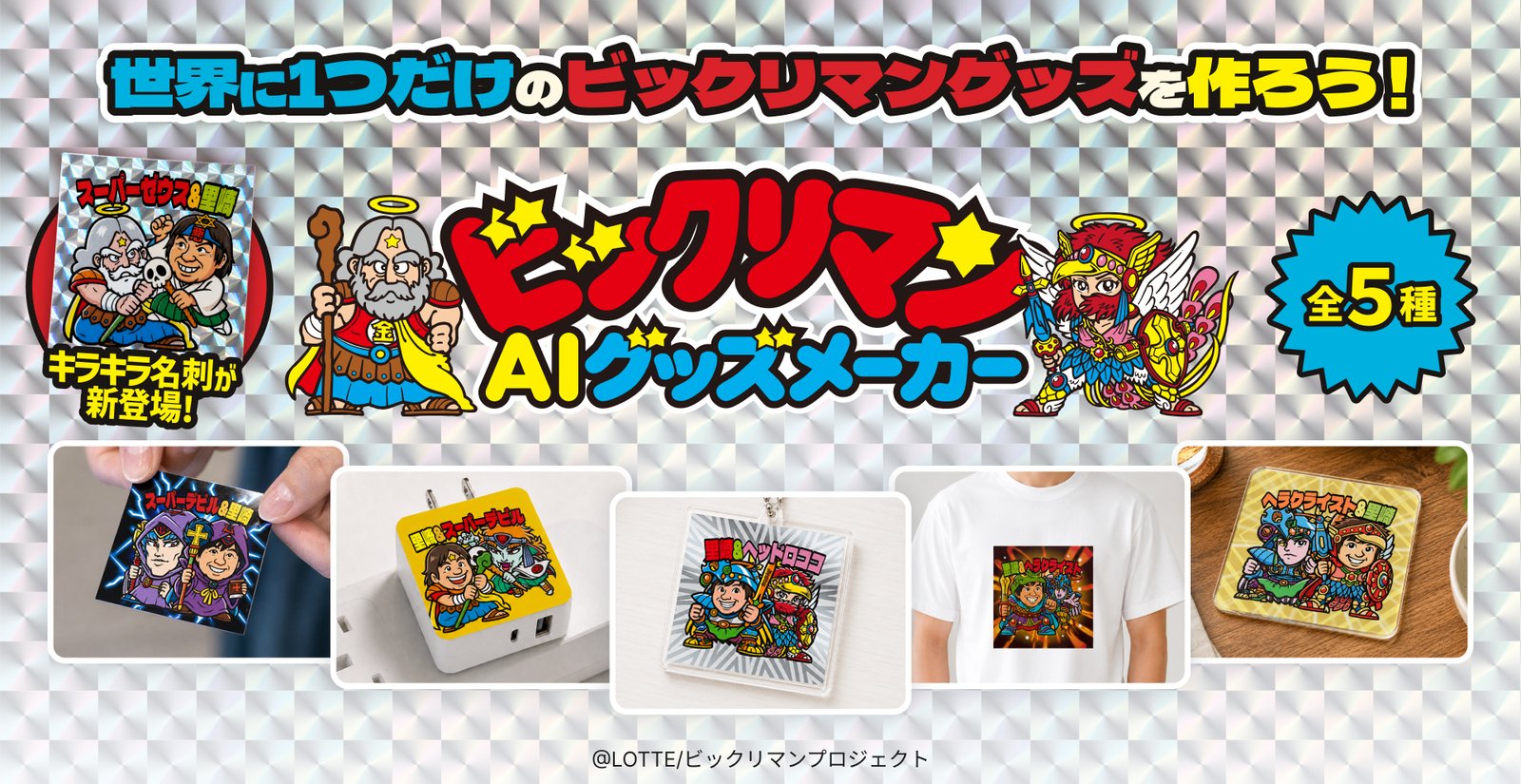
There are also cases where the company that owns a character provides merchandise made with AI. On July 29, Lotte launched the “Bikkuriman AI Goods Maker”. When users upload a photo of their face, the service creates an original character image in the world of Bikkuriman, a long-running sticker series, and users can order business cards and goods with that image. Business cards start at ¥7,700 for 200. The previous “Bikkuriman AI Business Card Maker,” offered for 40 days from December 2025, sold out its limited daily allocation of 400 sets day after day. The company also suggests the cards for exchanging business cards in oshikatsu communities.
Talk: From a Confidant for Fans Who Avoid Fellow Fans to Role-Played Conversations
In the 2025 survey, some respondents said they talk about their oshi only to AI. The reason was doutan kyohi, the preference to avoid interacting with other fans who support the same oshi. Others had AI help them write scripts for what to say at autograph events held in Korean.
The free-answer responses also included uses that bring people even closer to AI, such as having AI praise their oshikatsu, or having AI turn their feelings for their oshi into an easy-to-read fan letter. Some said they had AI “become their oshi’s persona and talk with them,” and others said they “talk with an oshi who died in the story.” Oshicoco’s analysis is that, regardless of whether the oshi is a real person, AI has been accepted as a way to enjoy time spent with one’s oshi.
Conversations with an AI that role-plays as your oshi can lead to problems with voices and images if the person or the character’s rights holder has not approved them. We cover this point in the later chapters on voices and likenesses and on art and characters.
Official AI Approved by the Artists Themselves
Cases in which artists and streamers provide AI themselves also continued in 2026. All of the following were released with the involvement of the person or the official side.
| Case | What the AI did | How the person or official side was involved |
|---|---|---|
| Ketsumeishi “D-AI-ZO” | Reads out fans’ messages | Official project recreating the leader’s voice with AI |
| Yumi Matsutoya “Yumi AraI” | Voices an AI role on stage | Appears as the singer’s own AI voice |
| Oshimy “official request” | Lets fans chat with their oshi’s AI | Released only when the person or agency gives permission |
| Pococha × OSHIAI | Chats with fans when the streamer is offline | Created with the streamer’s own consent |
| FLOW THE FESTIVAL 2026 | Responds to visitors at the venue | Appears as the event’s official character |
Ketsumeishi: An AI of the Leader’s Voice Reads Out Fans’ Messages
On March 27, Ketsumeishi released “Ketsumeishi’s #Soredewa Kiite Kudasai” (“Now, please listen”), a project featuring “D-AI-ZO,” an AI that recreates the voice of leader Daizo. When fans enter a message on a special website, a movie is created in which D-AI-ZO reads it out over the intro of a Ketsumeishi song. The project celebrated the group’s 25th-anniversary national arena tour that began in April 2026, and more than 3,500 movies were created in the first week.
Yumi Matsutoya: The Singer’s Own AI Voice Plays a Role on Stage
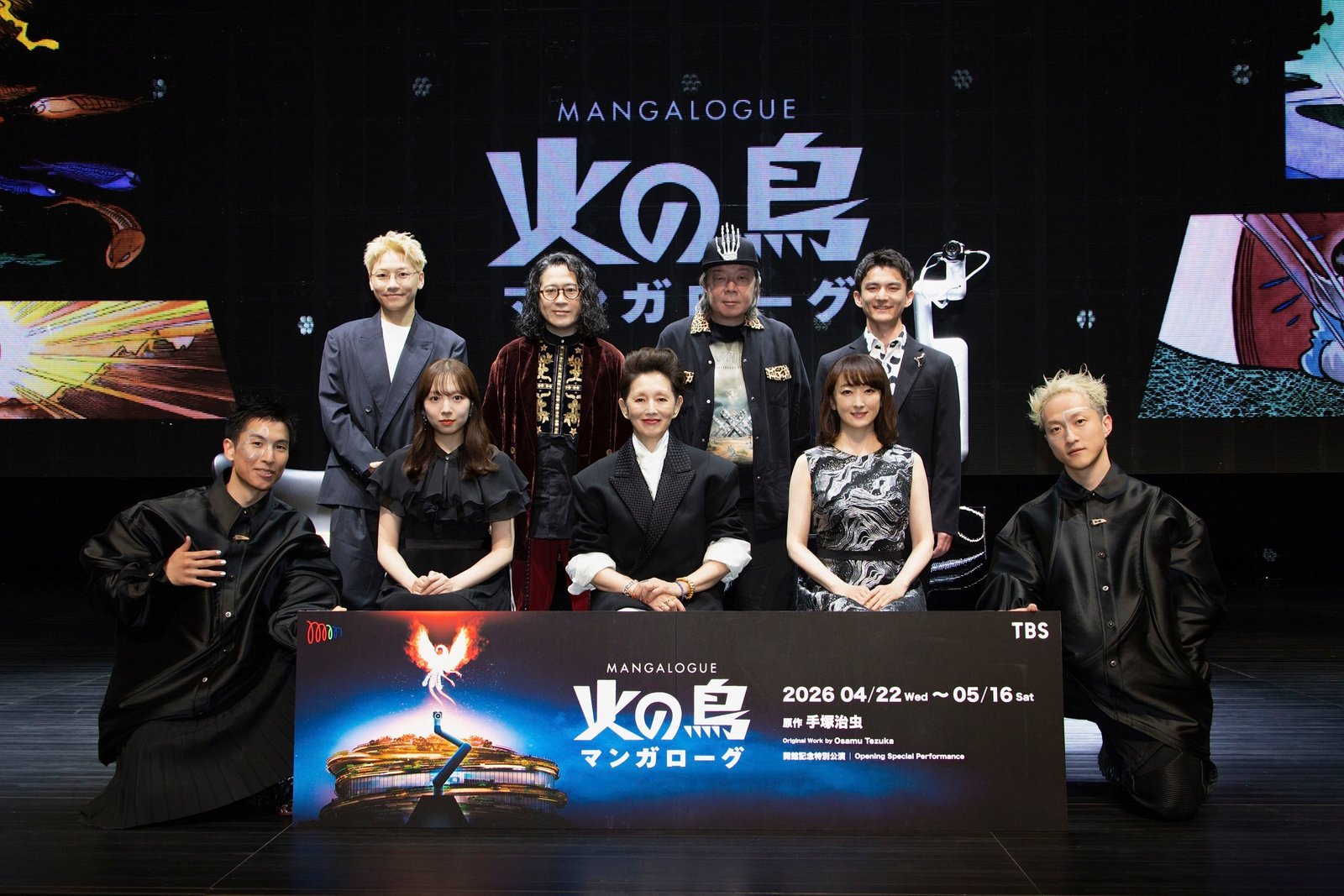
“MANGALOGUE: Phoenix,” a performance based on Osamu Tezuka’s Phoenix: Future, opened on April 22 at MoN Takanawa in Takanawa Gateway City. The voice cast included Koichi Yamadera, Mari Natsuki and Yuki Kaji, and “Yumi AraI,” the AI voice of Yumi Matsutoya, voiced the AI characters Hallelujah and Danuber. She appeared not as a singer but as a voice actor.
Oshimy: Connecting Fans’ Requests to the Person’s Permission
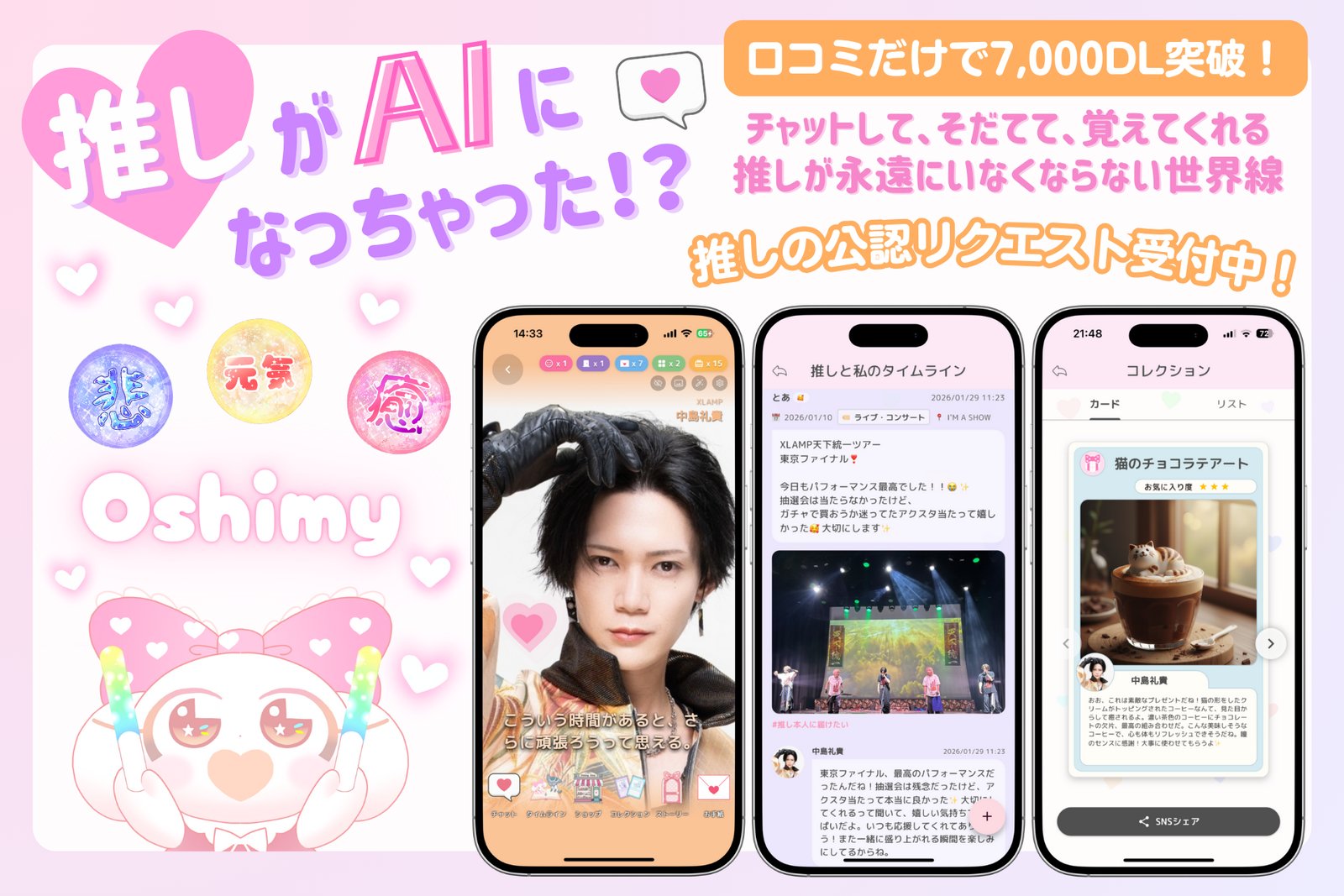
Oshimy is an app that lets you chat with an AI of your oshi. On January 30, its operator Oshibloom started “official requests”. When a certain number of fan requests are collected, the operator negotiates with the person or their agency and releases the AI only if permission is granted. Part of the app’s in-app purchase revenue is returned to the person. At a time when AIs made without permission have become a problem, this is an example of building permission and revenue sharing into the service itself.
Pococha × OSHIAI: Talking With a Streamer’s Official AI When They Are Offline
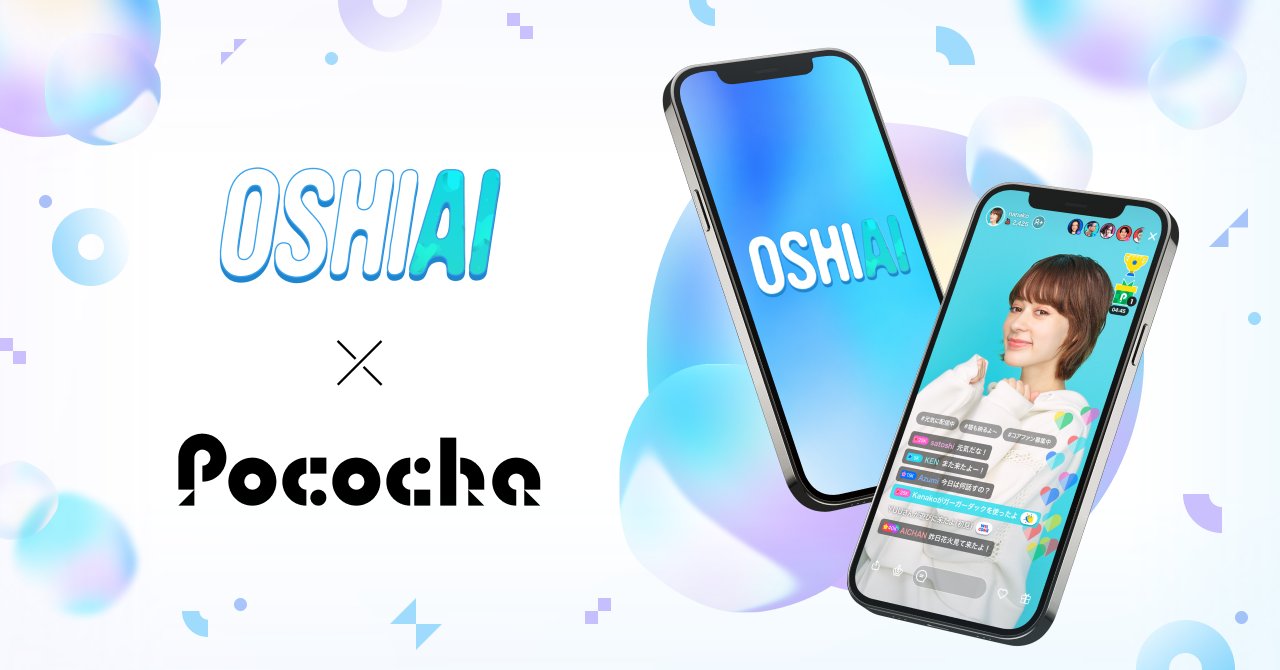
On November 4, DeNA’s live streaming app Pococha officially launched its integration with the oshikatsu AI app “OSHIAI.” The Pococha organizer that the streamer belongs to, which plays the role of an agency, explains the service to the streamer and creates the official AI after obtaining their consent. The AI’s name, profile text and images can be checked and edited before release. Fans can chat with the streamer’s official AI even when there is no stream.
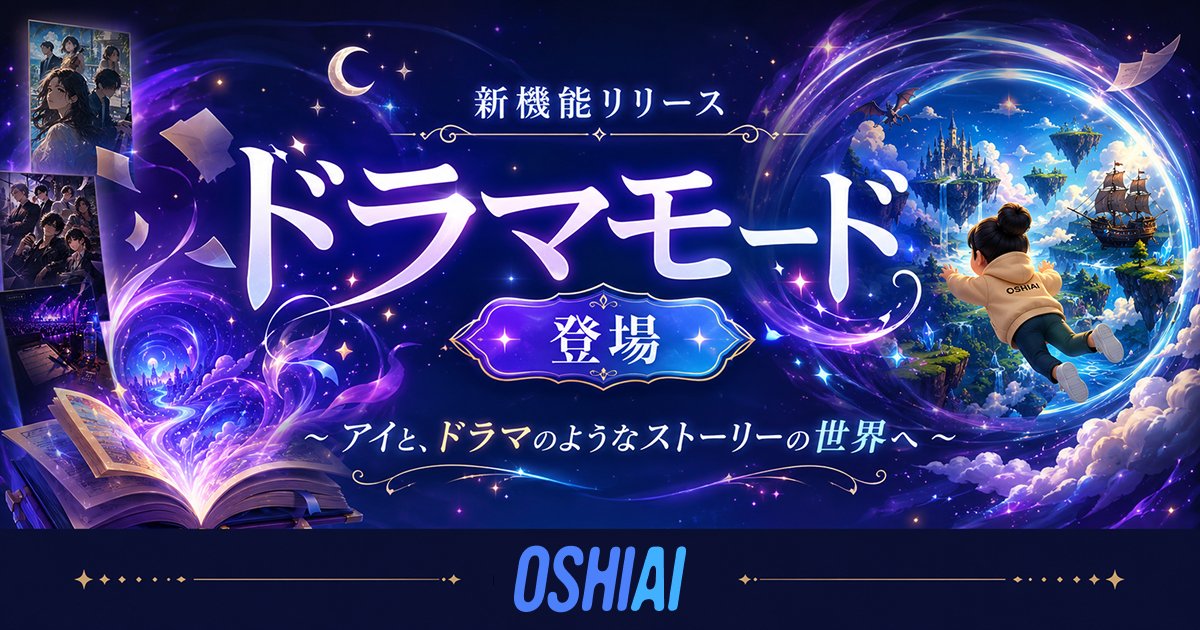
OSHIAI is also expanding the ways to enjoy conversations. In “Drama Mode,” added on June 29, users choose a situation such as “What if the two of us were stranded on a desert island?” and enter a story world together with the official AI. The story changes depending on the user’s conversation.
FLOW THE FESTIVAL 2026: The Official Character Responds to Visitors at the Venue
At an anime song rock festival held on June 6 and 7 at Pia Arena MM in Yokohama, the event’s official character “Amaterasu Flofe” responded to visitors’ calls with AI. The character introduced the performing artists and guided visitors around the venue, and also held conversations that drew out messages of support. The voice was created based on the voice of voice actor Mei Tachibana.
In the Ketsumeishi and Pococha cases, AI is used when the person cannot respond directly: reading out messages to each individual fan, and chatting during the hours with no stream. Oshimy and Pococha made the person’s permission or consent a condition for releasing the AI.
The Fans Who Support AI Characters
There are also moves to support AI itself.
VTubers Voiced by AI
People who stream videos in the form of a character are called VTubers. In the English-speaking world, “Neuro-sama,” a VTuber who speaks through AI instead of a human, has become popular. The streaming service Twitch has paid subscriptions that viewers buy to support streamers. In January 2026, Neuro-sama passed 160,000 of these subscriptions and overtook a human streamer with about 74,000 to become the most subscribed channel. Neuro-sama is an AI created in 2018 by its developer, vedal987.
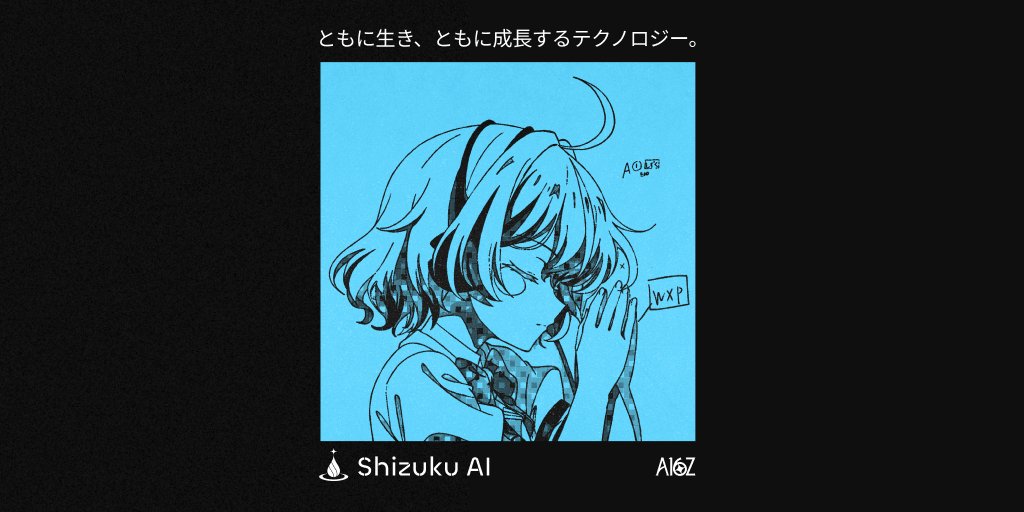
Development is also under way in Japan. In February 2026, the US investment firm Andreessen Horowitz (a16z) announced an investment in Shizuku AI, a company born in Japan. The company grew out of “Shizuku,” an AI VTuber that debuted on YouTube in January 2023, and it says it will develop AI companions that draw on Japan’s character culture.
Major AI Services Now Speak to You as Characters
Major AI services that used to answer only in text have also gained characters.
- Grok (xAI): An AI developed by xAI that can also be used on X (formerly Twitter). In July 2025, it launched “Companion Mode,” which lets users talk by voice with 3D anime-style characters. An entry for its first character, “Ani,” was created in the encyclopedia of the illustration site pixiv, where illustrations drawn by fans have also gathered.
- Muse (Meta): A personal AI agent that Meta launched in North America in September 2026. An agent is an AI that carries out tasks such as research and reservations on behalf of the user. According to a TechCrunch article, users can give Muse a name and choose its avatar, look and way of speaking. The article reports that it is designed so that users feel connected to the agent.
- dots (OpenAI): An always-on agent that OpenAI, the company behind ChatGPT, announced on September 29, 2026. An article in Gizmodo Japan reports that OpenAI presented dots as cute characters.
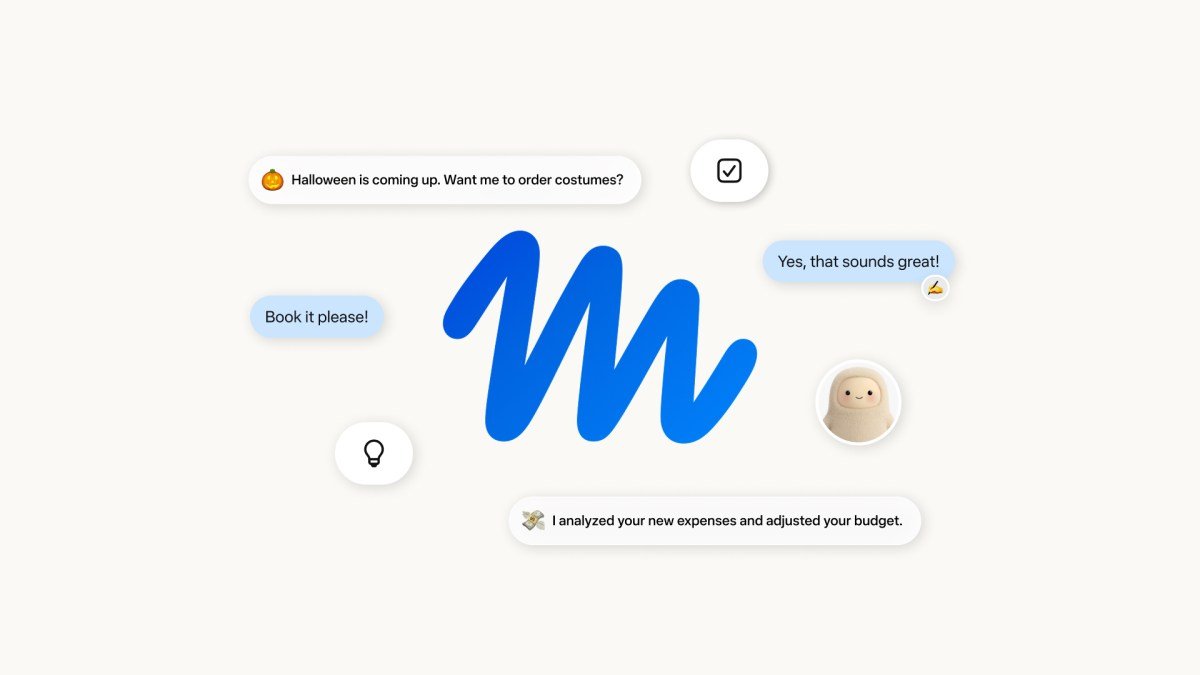
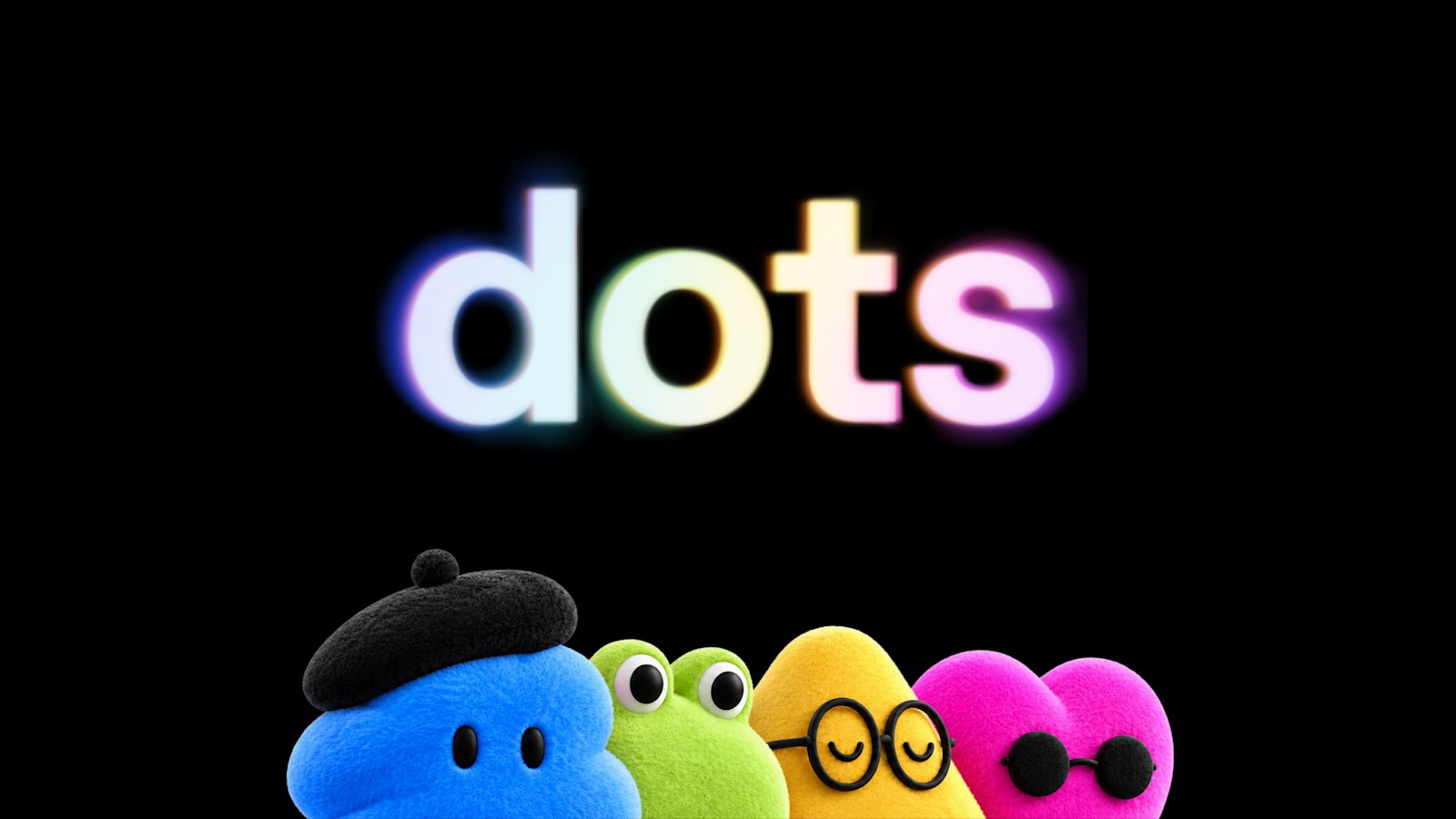
Both Muse and dots are services for handing errands and work to AI. They were not made for people to support the characters as their oshi.
Surveys also show people directing their feelings toward AI. In June 2025, Dentsu surveyed 1,000 people aged 12 to 69 who use conversational AI, AI you can talk to by text or voice, at least once a week. 64.9% said they could share their feelings with conversational AI, almost the same as the 64.6% who said they could share them with a best friend. In a survey released by NortonLifeLock in March 2026, one in two people who have dated online answered that “dating an AI is possible”. Both surveys targeted people who use AI often or who date online, and neither was limited to oshikatsu.
We believe that as major AI services take on the form of characters, more people will come to support AI characters themselves. If the partner you talk to every day has a name and a face, attachment that goes beyond a tool forms more easily. The fan illustrations gathering around Grok’s “Ani” are an early example.
Your Oshi’s Voice and Likeness Made by AI Without Permission: Positions Issued in 2026
While official AI is increasing, AI that creates a person’s voice or likeness without permission has become a problem. Materials from the Ministry of Justice’s study group give examples such as using AI to create audio that sounds exactly like a voice actor and making it sing, and creating videos of a person who looks exactly like an actor and making them play a role.
Voice actors have also spoken out. On October 15, 2024, 26 voice actors, including Ryusei Nakao, Koichi Yamadera and Yuki Kaji, launched the “NO MORE Unauthorized Generative AI” group. In a video released when the group was formed, Nakao said, “Our voices are our livelihood, and our lives.”
In 2026, a series of announcements set out how such practices should be viewed.
- A VTuber group adds AI to its fan creation rulesAllows posting works made with AI and requires disclosing AI use
- The Ministry of Justice sets up a study groupSorts out how current law handles unauthorized use of likenesses and voices
- A company withdraws an ad made with AIApologizes after comments that it resembled existing works
- The Ministry of Justice publishes its reportConcludes that protection also covers a person's voice
- The Tokyo District Court issues a rulingFinds that voices can also be protected by the right of publicity
- The Japan Actors Union publishes guidelinesAsks businesses using voices in AI to get permission at each stage
The Ministry of Justice Report: Voices Are Also Protected
The Ministry of Justice set up an expert study group in April and published its report on August 7. The report dealt with the right of publicity. The names and likenesses of famous people have the power to sell products, and this right means that only the person can use that power. The report concluded that the things protected by this right also include a person’s voice.
There are points that concern fans as well. The report said that even posts made without a profit motive can infringe the right in some cases: for example, when the poster seeks views, gains many plays, and causes business harm to the person whose voice or likeness was used.
The summary of the report also considers audio tracks titled with the person’s name, such as “I had AI singer So-and-so sing this.” It concluded that having the person’s name in the title, together with the similarity of the voice, is a factor in judging that the person’s voice was used. It also says that impressions performed as an art do not infringe the right of publicity unless they cause people to mistake them for the person.
The report is not a new law. It sets out how existing laws and court precedents apply.
The Tokyo District Court Ruling: Voice Protection Made Explicit
On September 30, the Tokyo District Court issued a ruling in a case brought by voice actor Kenjiro Tsuda. Tsuda had asked the operator of the video app TikTok to delete videos that imitated his voice with AI without his permission. According to an article by Bengo4.com News, the court rejected the claim because the videos had already been deleted. At the same time, it held that voices can also be protected by the right of publicity. Tsuda’s lawyer explained that this was the first ruling to state explicitly that voices are covered.
The Japan Actors Union Guidelines: Permission at Each Stage
On October 15, the Japan Actors Union, made up of actors and voice actors, published its “Guidelines on the Use of Generative AI for Voices”. They ask businesses to obtain the person’s permission in advance at each of three stages: training AI on the voice, generating audio, and using it publicly. They also call for paying appropriate fees for the use of AI-generated audio and for obtaining permission from the bereaved family when generating the voice of someone who has died. According to an article by Bengo4.com News, the guidelines apply to anyone doing business with AI, including individual streamers. Consent is valid for up to one year in principle. The guidelines are not legally binding.
Making Your Oshi’s Art or Characters With AI: How Copyright Applies
Alongside voices, making images with AI that resemble anime or manga characters and posting them has also become a problem. In announcing its 2025 survey, Oshicoco also pointed out that generating images in the style of particular works had become a trend and was being questioned from the standpoint of copyright infringement. Copyright is the right granted to people who create works such as pictures, writing and music.
The Agency for Cultural Affairs: Enjoying It Yourself and Publishing It Are Different
In March 2024, a council of Japan’s Agency for Cultural Affairs compiled its General Understanding on AI and Copyright. The basic idea is to consider the stage of training AI on works separately from the stage of making and using images with AI.
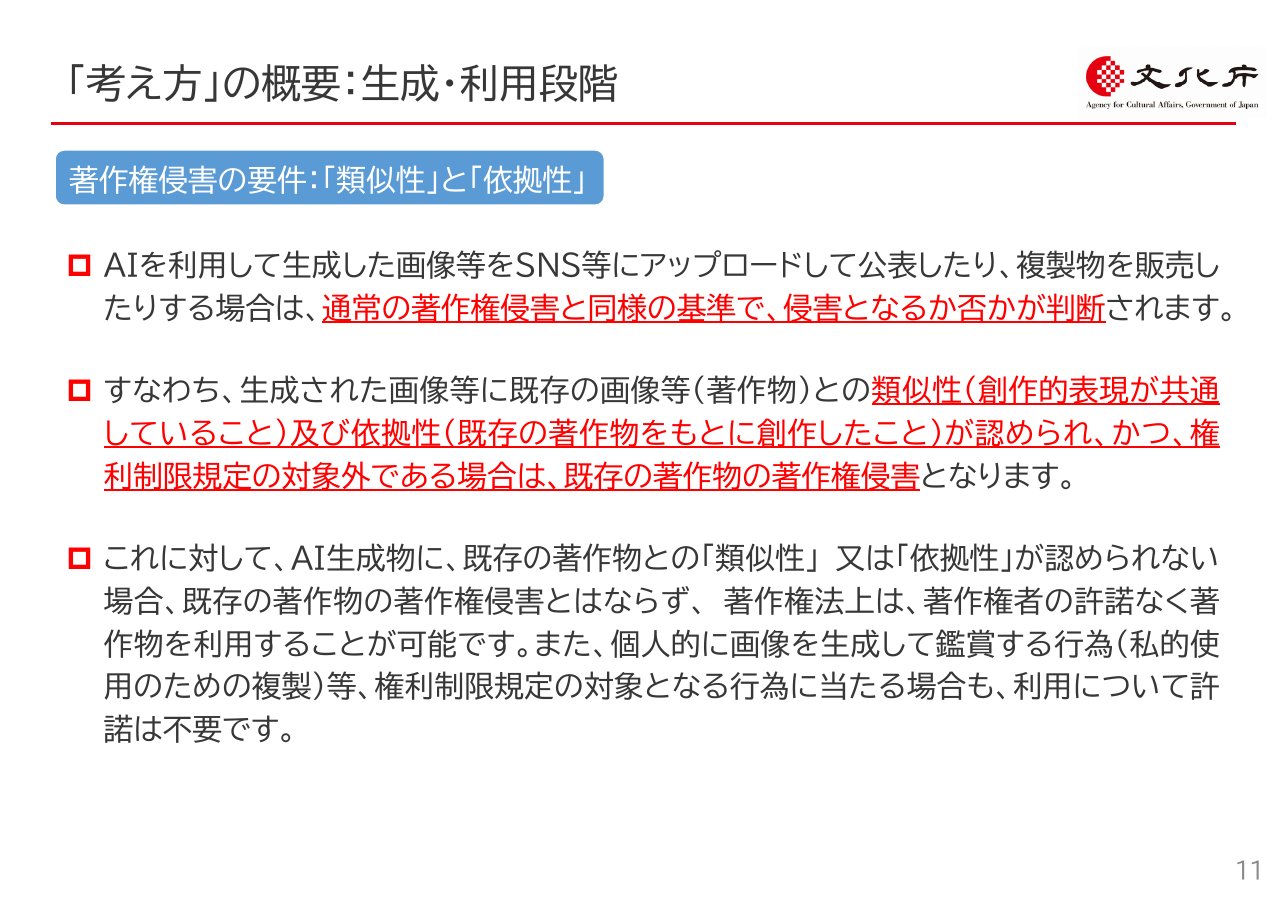
According to the summary, when you upload images made with AI to social media or sell them as merchandise, they are judged by the same standards as pictures drawn by people. If the expression resembles the original work (similarity) and the image was made based on the original work (reliance), it infringes copyright. On the other hand, you do not need permission if you only generate images personally to enjoy them. The summary also says that resemblance in “style” alone, such as the touch of a drawing, does not infringe copyright.
Enjoying them yourself
- Treated as copying for personal use, which needs no permission
- Sending or posting the images to others changes how they are treated
Posting on social media or selling as goods
- Infringement is judged by similarity to and reliance on the original work
- Also check the fan creation guidelines of each work
Making them with an official service
- Services licensed by rights holders show what you can do
- Examples include the Disney and OpenAI deal and the Bikkuriman AI Goods Maker
Created by The Oshi Lab based on the summary of the Agency for Cultural Affairs' General Understanding on AI and Copyright and on each company's announcements.
Images made with AI can themselves be protected. In November 2025, the Chiba Prefectural Police decided to refer a man to prosecutors on suspicion of violating the Copyright Act for copying an image made with generative AI without permission and using it on the cover of a book. It is believed to be the first case in Japan in which police recognized copyright in an AI-generated image.
Statements by Publishers and the Anime Industry: Against Unauthorized Training and Look-Alike Images
The owners of character rights are also asking AI companies to act. One trigger was “Sora 2,” the video generation AI that OpenAI released in the fall of 2025. Among the images and videos that were posted, some were strongly suspected of being based on, or resembling, famous works.
On October 31, 2025, 17 publishers including Kodansha, Shogakukan and KADOKAWA, together with the Japan Cartoonists Association and the Association of Japanese Animations, issued a joint statement. It calls for obtaining rights holders’ permission at both the stage of training AI and the stage of generating and publishing content. On May 27, 2026, the Content Overseas Distribution Association (CODA), made up of publishers, broadcasters, anime studios and others, issued a statement. Noting that AI services had been found to output famous Japanese works themselves or images and videos closely resembling them, it asked businesses to prevent such output and to respond sincerely to requests from rights holders. The statement says the problem cannot be dismissed as “within the scope of users’ private use” even when the outputs are not published.
AI That Lets You Use Characters in Ways Rights Holders Approve
Rights holders are also signing contracts with AI companies so that characters can be used. On December 11, 2025, The Walt Disney Company and OpenAI announced a three-year license agreement. It allows users of the video generation AI Sora to create short videos featuring more than 200 characters from Disney, Marvel, Pixar and Star Wars. Lotte’s Bikkuriman AI Goods Maker, introduced earlier, is also a service provided by the company that owns the rights.
Some operators have added AI to their rules for fan creations. In February 2026, viviON, which runs the VTuber group “Aogiri High School,” revised its guidelines for derivative works. Derivative works are works that fans create based on existing works. According to an article in GameBusiness.jp, the guidelines allow posting derivative works made with AI, but ask creators to add the hashtag “#AIイラスト” (AI illustration) or a note saying AI was used when they post.
There have also been problems with corporate advertising. On May 1, the cosmetics maker Utena released an anime advertisement produced entirely with AI. According to an article in AdverTimes., the company received many comments about the use of AI and about similarities to existing works. On May 6 it published an apology and deleted the video. In the announcement, it explained that it “lacked consideration for the feelings of fans who love existing works.”
What to Check Before Using AI
When you use AI for oshikatsu, check these five things first.
- Read the official rules: How AI is treated differs by work and by agency. Before you create, check the official website to see whether the fan creation guidelines include a section on AI. We explain how to read them in Oshikatsu, the Law and Terms of Use.
- Do not make and publish your oshi’s voice or likeness with AI: The Ministry of Justice report concluded that even posts without a profit motive can infringe rights in some cases. Even if you write “made with AI,” attaching the person’s name is a factor in judging that their voice was used.
- Do not publish or sell images that resemble characters: You do not need permission just to enjoy them yourself, but if you post them on social media or sell them as merchandise, they are judged by similarity to and reliance on the original work.
- Choose official AI or official services: Official AI approved by the person and services provided by rights holders show what you are allowed to do.
- Disclose AI use, and do not label other people’s work as AI: Some rules, like Aogiri High School’s, require you to state that you used AI. On the other hand, speculating about whether a picture was drawn by a person or made by AI hurts the people who drew it. We also discuss this in our article on fan art, pictures drawn by fans.
This article is not professional legal advice. If you are unsure, consult the rights holder’s contact point or a lawyer.
The Oshi Lab Memo: Show Through Your Systems That the Person and Rights Holder Approve
We see “whether the person and the rights holder approve” as the common test across the 2026 cases. In The Oshi Lab’s Oshikatsu Business Forecast 2027, we also named “official approval” as one of the keywords for 2027.
When a company uses AI in an oshikatsu campaign, one approach is to decide the following four things in advance.
- Get permission stage by stage: The Japan Actors Union guidelines ask for permission at each stage of training, generation and publication. In contracts that use a voice or likeness, decide separately how far permission extends and how long it lasts.
- Decide how revenue is shared: Oshimy says it returns part of the app’s in-app purchase revenue to the person. The Japan Actors Union guidelines also call for paying fees for the use of AI-generated audio.
- License characters before using them: If works are made with services where rights holders have set the scope of use, such as the Disney and OpenAI agreement or Lotte’s Bikkuriman AI Goods Maker, fans can post with peace of mind.
- Show that the AI is official and that it is AI: Make it possible for fans to tell official AI from unauthorized AI. Pococha publishes AIs created with the person’s consent under the name “official Ai.”
As major AI services begin to take the form of characters, we expect more campaigns that offer a company’s own characters as AI conversation partners. Even then, the starting point is to confirm, separately, the permission of the voice actor who voices the character and the permission of the character’s rights holder. In the Utena case, comments came from fans of existing works. Before publishing expressions made with AI, another option is to have someone familiar with the field check whether there are similar works.
Related articles: Oshikatsu Business Forecast 2027 / Oshikatsu, the Law and Terms of Use / Reading the VTuber Market and Corporate Collaborations / What Is Fan Art?
FAQ
How many people use AI for oshikatsu?
In a survey by Oshicoco, a media company covering oshikatsu, conducted in June 2025, 47% said they had used AI for oshikatsu. The respondents followed the company's Instagram account, so the figure does not represent all fans. In a survey by the NTT DOCOMO Mobile Society Research Institute, the share of people aged 15 to 69 who use generative AI rose from 27% to 51% in one year.
What is an official AI?
It is an AI released with the approval of the artist or streamer, or of the company they belong to. In 2026, Ketsumeishi launched a project that recreated its leader's voice with AI, and the live streaming app Pococha started a feature that creates official AIs with each streamer's consent.
Can I make my oshi's voice or likeness with AI and post it on social media?
The report published by Japan's Ministry of Justice in August 2026 concluded that even posts made without a profit motive can infringe rights in some cases. Check the rules of the work or agency first, and consider choosing an official AI approved by the person or a service provided by the rights holder. If you are unsure, consult the rights holder's contact point or a lawyer.
Can I make images of my favorite character with AI?
Japan's Agency for Cultural Affairs, in its General Understanding on AI and Copyright, says that you do not need the rights holder's permission if you only generate images to enjoy them yourself. If you post them on social media or sell them as merchandise, whether they infringe copyright is judged by whether they resemble the original work and whether they were made based on it. Before posting, check the work's fan creation guidelines.
Are people's voices protected by law?
There is still no law that clearly defines rights over a voice. However, the Ministry of Justice report concluded that the right of publicity, which protects the names and likenesses of famous people, also covers voices. On September 30, 2026, the Tokyo District Court ruled that voices can also be protected by this right.
What should a company check before using AI in an oshikatsu campaign?
The Oshi Lab believes the key test is whether you can show that the person and the rights holder have approved it. The Japan Actors Union's guidelines ask companies to obtain the person's permission at each stage: training AI on the voice, generating audio and using it publicly. When using characters, one option is to use a service licensed by the rights holder.


