

Drive My Car Pilgrimage: 10 Hiroshima and Seto Inland Sea Locations
Beyond a glass passage lined with silver pipes, the Seto Inland Sea opens up. The “Ecorium” at Hiroshima City’s Naka Incineration Plant, featured in Drive My Car, is a public passage open without a reservation. Here, visitors can encounter the film’s scenery at an active waste-incineration plant.
From this passage, associated with conversations between Yusuke and Misaki, travel to Hiroshima’s theaters, seaside, and island port towns. Visit 10 filming locations to trace the city’s architecture and the scenery of the Seto Inland Sea.
Hiroshima’s Theaters, Seaside, and Islands: 10 Filming Locations
① Naka Incineration Plant
The glass passage leading to the sea appears in the film. Access along part of the seawall is currently restricted due to construction.
Learn more about the Naka Incineration Plant② International Conference Center Hiroshima
A conference facility in the city center that recalls scenes from the theater festival.
Learn more about the International Conference Center Hiroshima③ Grand Prince Hotel Hiroshima
The hotel’s porte-cochère and top-floor bar were used in filming.
Learn more about the Grand Prince Hotel Hiroshima④ Mt. Ogonzan
The mountain from which visitors can see the nighttime view of the Niho Junction featured in the film.
Learn more about Mt. Ogonzan⑤ Mitarai Historic Townscape
Walk the port town, once a waiting place for favorable tides and winds, using public roads and facilities open to visitors.
Learn more about Mitarai’s historic townscape⑥ Aster Plaza
A cultural complex with rehearsal rooms and halls that supported the theater-festival scenes.
Learn more about Aster Plaza⑧ Akinada Bridge
The route the red Saab takes to the islands of the Seto Inland Sea, with a seaside park offering a view of the bridge.
Learn more about Akinada Bridge⑨ Orizuru Tower
An observation facility next to the Hiroshima Peace Memorial (Atomic Bomb Dome), where the scene of the red Saab driving over Aioi Bridge was filmed.
Learn more about Orizuru Tower⑩ Koya Service Area
The filming location for the scene where Yusuke rests with coffee and bread on his way to Hiroshima.
Learn more about Koya Service Area
1Hiroshima City’s Naka Incineration Plant | The Glass Passage Leading to the Sea
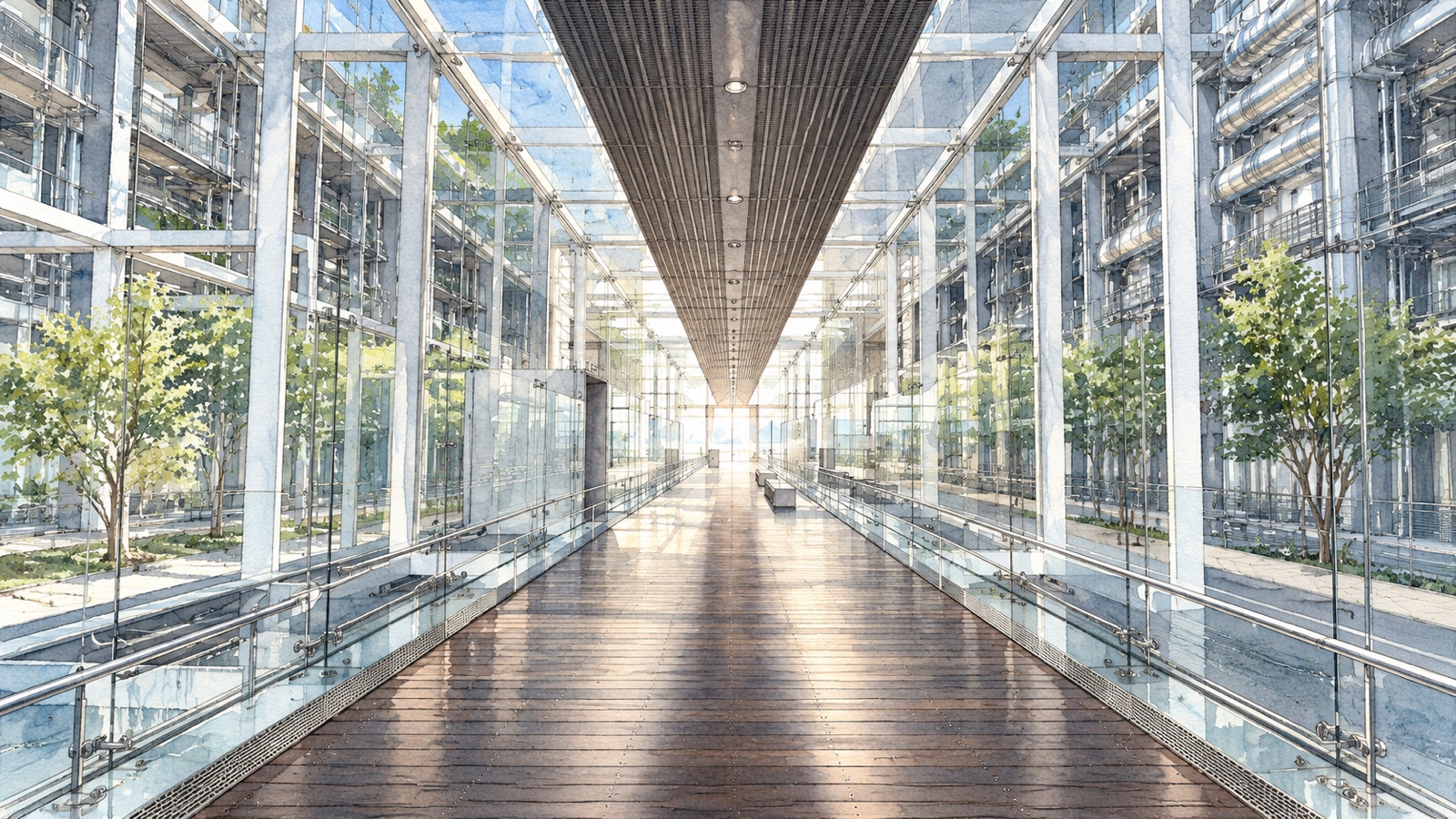
The Naka Incineration Plant is an active facility that burns household waste. Designed by architect Yoshio Taniguchi, it was completed in February 2004. At the center of the building, the glass-walled “Ecorium” passage runs from the city side through to the sea. On both sides of the passage are spaces with metal pipes and machinery.
The Ecorium is open from 9 a.m. to 4:30 p.m. Visitors can enter without a reservation, except from December 29 through January 3. The entrance is on the second floor. Registration for interior plant tours, which allow visitors to see the machinery up close, is handled separately. If you only want to see the passage featured in the film, head to this public walkway.
As of October 2026, access to parts of the south and west seawalls is restricted because of construction. Hiroshima City says the work is scheduled from early May 2026 through mid-February 2027.
Taniguchi did not hide the metallic materials associated with an incineration plant; instead, he designed the building to show its machinery. At the same time, he introduced plantings behind glass and a view through to the sea. Hiroshima Prefecture’s architectural overview explains that the design places an axis through the building between the city and the sea. That layout brings the silver equipment and seascape into the same line of sight.
For an interior plant tour as well, individual visitors and groups of fewer than 10 can visit freely on weekdays by registering at the sixth-floor office. Registration is from 9 a.m. to 4 p.m., except on public holidays, during the year-end and New Year period, and on August 6. Guided tours and groups of 10 or more require a separate advance application. A holiday tour for up to 25 visitors is also offered on the third Sunday of every even-numbered month.
By public transit, take Hiroshima Bus Route 24 toward Yoshijima Eigyosho and get off at Minami-Yoshijima, about a five-minute walk away. From the Peace Memorial Park area in central Hiroshima, the plant is farther toward the sea.
- Location
- 1-5-1 Minami-Yoshijima, Naka Ward, Hiroshima City, Hiroshima Prefecture
- Connection to the film
- A filming location visited by Yusuke and Misaki, featuring the central glass Ecorium passage
- Public hours
- The Ecorium is open 9 a.m.–4:30 p.m. without a reservation; closed December 29–January 3.
- Access
- About a five-minute walk from the Minami-Yoshijima stop on Hiroshima Bus Route 24
Sources:Hiroshima City: Visitor information, updated August 2026
Hiroshima City: Seawall access restrictions
Hiroshima Prefecture: Architectural overview of the Naka Incineration Plant
Hiroshima City: Entrance to visitor information for the Naka Incineration Plant
Official Hiroshima Prefecture Tourism Website: Facility information
2Peace Memorial Park and International Conference Center Hiroshima | A Theater-Festival Setting in the City Center
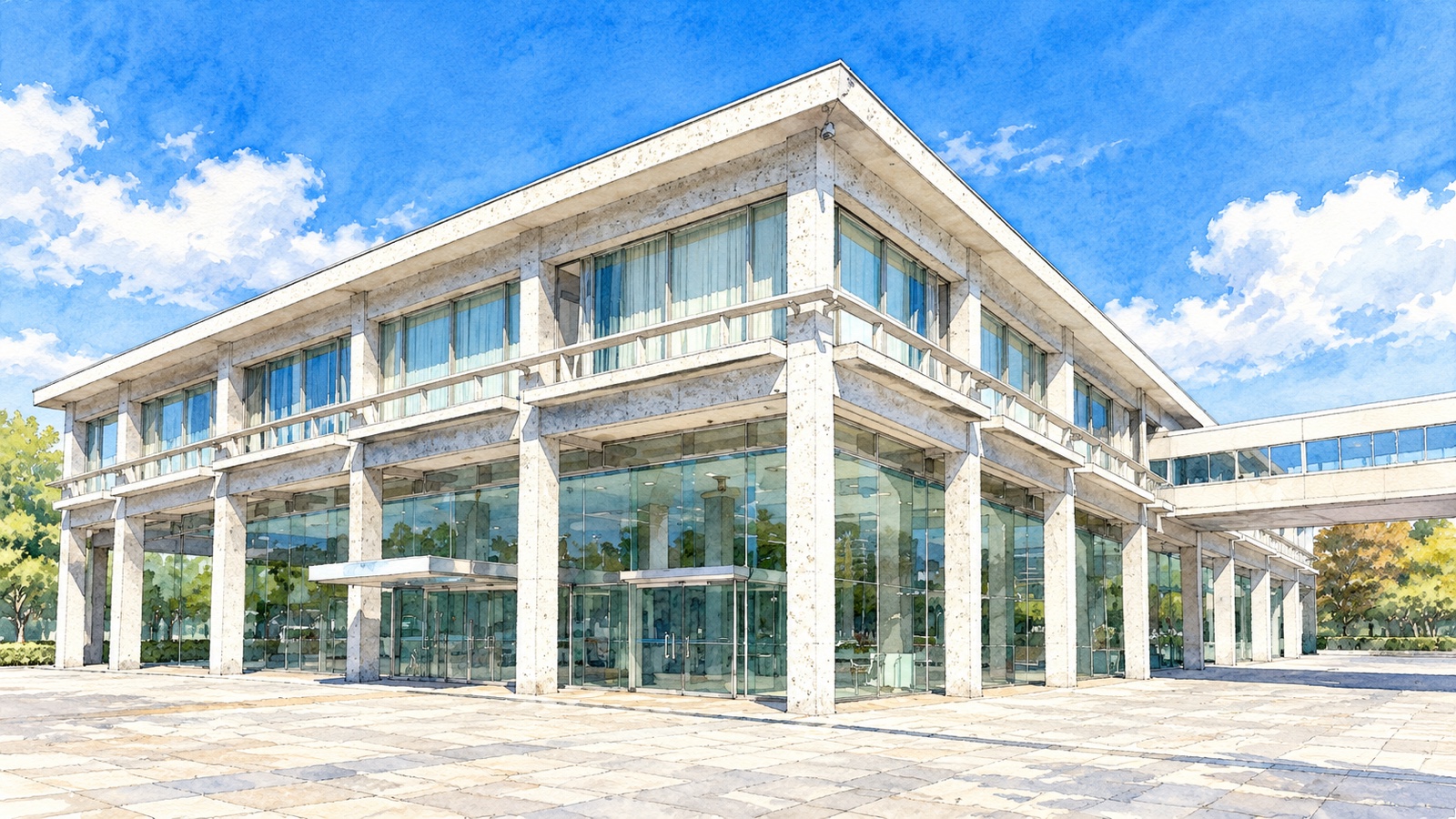
International Conference Center Hiroshima, on the south side of Peace Memorial Park, appears as the venue for the theater festival that Yusuke is asked to direct. Hiroshima Prefecture’s location guide also identifies the roadway leading underground and the circular approach as filming locations. The film uses not only wide shots of the large building but also the route where a car drops off a passenger.
Hiroshima City Hall, designed by Kenzo Tange, was built on this site in 1955. The present conference center replaced it in 1989, the centennial year of Hiroshima City. Beside the Hiroshima Peace Memorial Museum, the center contributes to scenes in the city center alongside the rivers and bridges.
The halls and meeting rooms are rented out for events. When visiting as a filming location, distinguish between areas that require an event ticket and places where you can view the exterior. The underground roadway is not a pedestrian sightseeing route, so view it from outside.
- Location
- 1-5 Nakajima-cho, Naka Ward, Hiroshima City, Hiroshima Prefecture
- Connection to the film
- The theater festival directed by Yusuke and the roadway approach were filming locations.
- Architecture
- A convention facility in Peace Memorial Park, completed in 1989
- Visitor guidance
- The halls and meeting rooms are rented out for events; view the exterior and areas open to the public.
Sources:Hiroshima City: City newsletter introducing film locations
Official Hiroshima Prefecture Tourism Website: Filming locations
3Grand Prince Hotel Hiroshima | The Top-Floor Bar Where the Conversation Takes Place
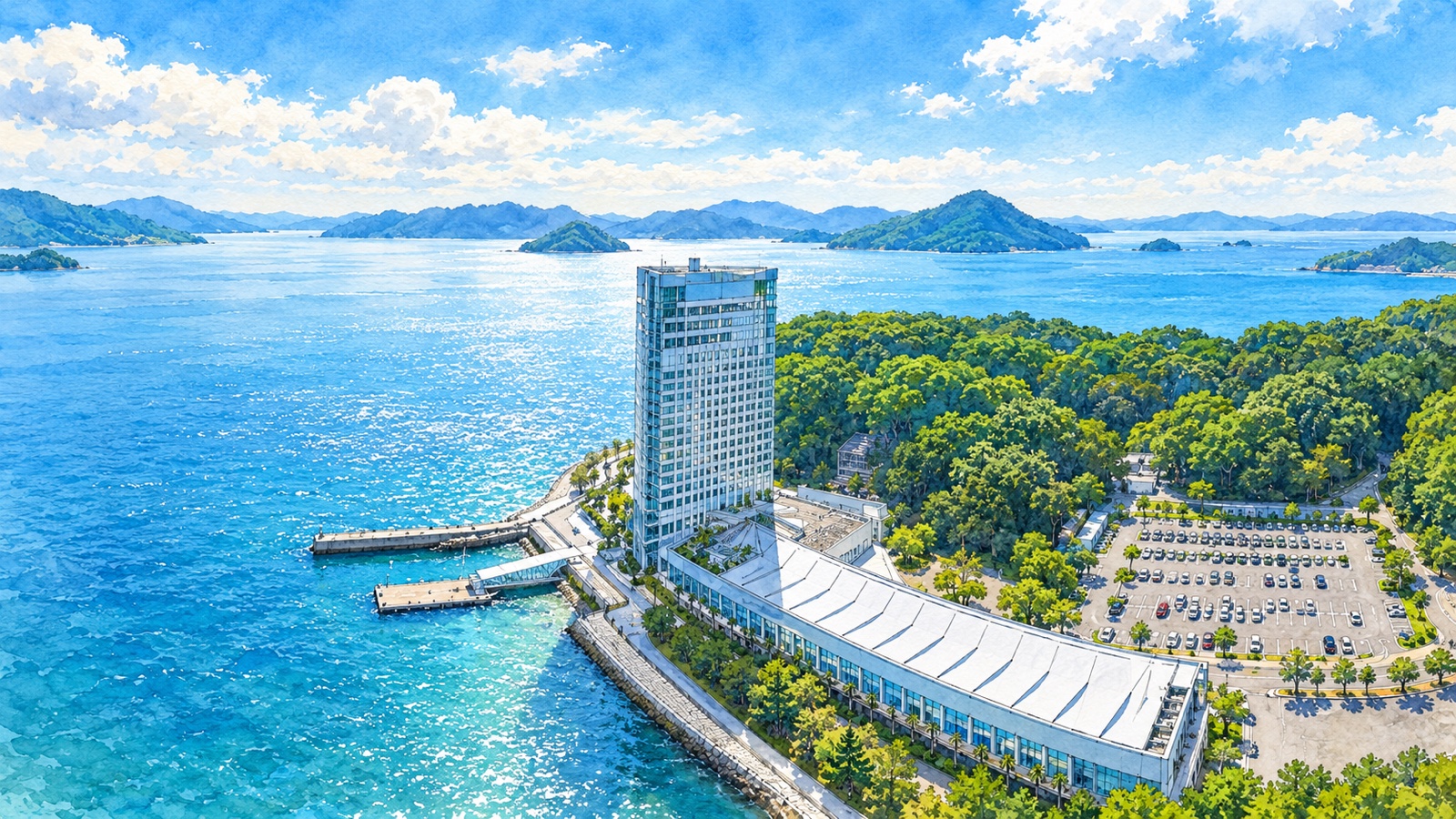
The 23rd-floor Sky Lounge Top of Hiroshima at the Grand Prince Hotel Hiroshima was used for filming. The production’s requirements for the bar scene included both the counter inside and the hotel’s porte-cochère. They needed a location that could connect the seaside hotel with the scenes of the red Saab carrying people.
According to the hotel representative who arranged filming, the shoot took place after business hours. The hotel’s public-relations representative also appeared as a bartender. The production did not use the hotel as its accommodation base; the hotel’s role was to provide a filming location.
The bar is currently open from 5:30 to 10:30 p.m., with last orders for drinks at 10 p.m. From Sunday through Thursday, food is generally available until 9 p.m., while some snacks can be ordered until 10 p.m. The dinner buffet has separate hours; the fall 2026 plan offers a 90-minute seating from 5:30 to 9:30 p.m. The hotel’s dining guide handles bar and dining reservations separately.
The hotel does not say that counter seating can be reserved under the same conditions as during filming. Visit to enjoy food and drinks at a 23rd-floor venue overlooking the sea and city at night. The hotel is on the coast of Motoujina in southern Hiroshima, as is the Naka Incineration Plant, but a river and port facilities lie between the two.
- Location
- 23rd floor, Grand Prince Hotel Hiroshima, 23-1 Motoujina-cho, Minami Ward, Hiroshima City, Hiroshima Prefecture
- Connection to the film
- The bar scene was filmed at the porte-cochère and the 23rd-floor Sky Lounge Top of Hiroshima.
- Bar hours
- 5:30–10:30 p.m.; last order for drinks at 10 p.m.
- What to see
- A top-floor lounge overlooking the Seto Inland Sea and Hiroshima at night
Sources:Seibu Location Services: Interview with a filming-location partner
Official information for Top of Hiroshima
4### Mt. Ogonzan | Looking Out over the City You Drove Through
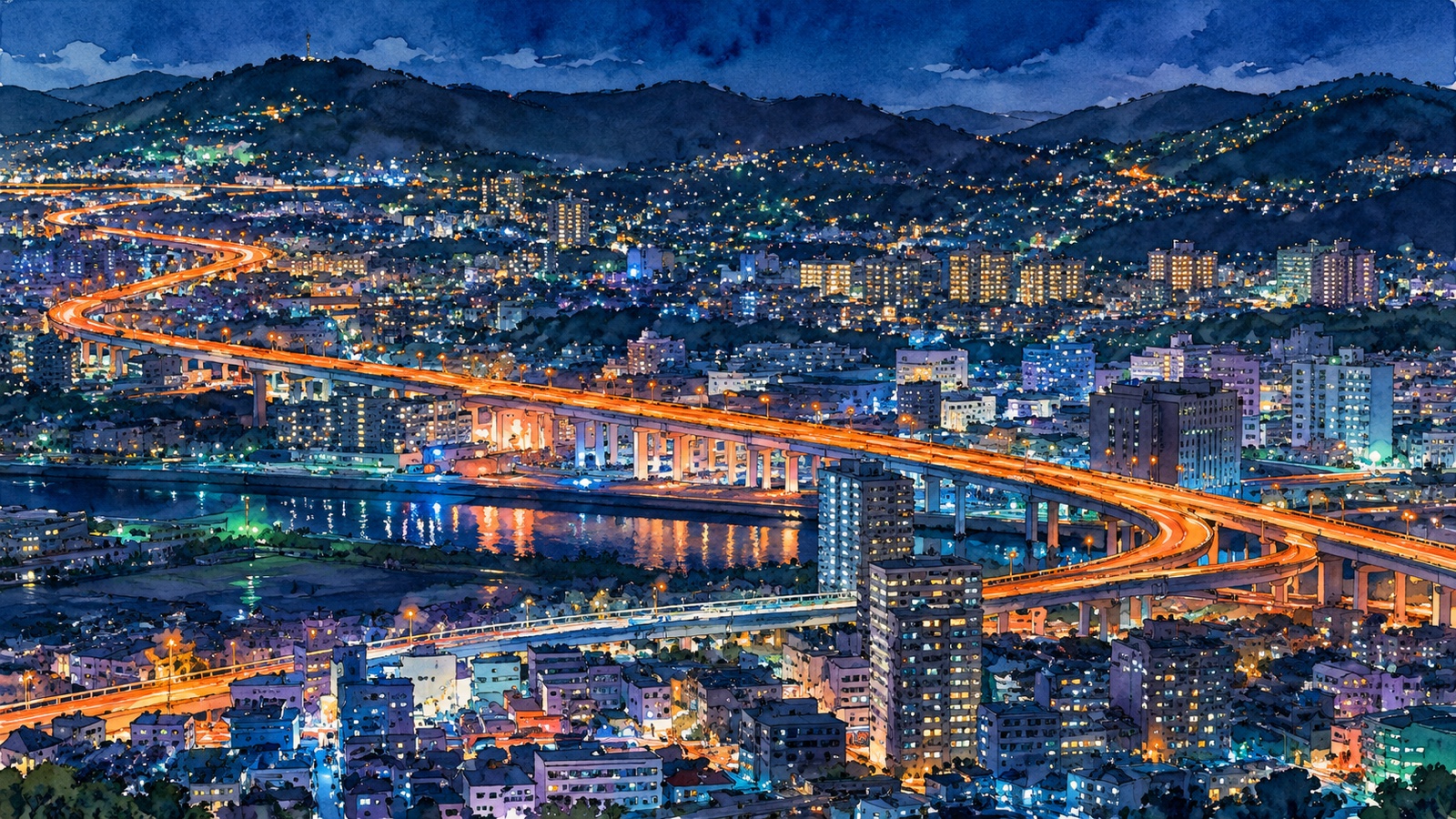
Mt. Ogonzan is 222 meters high. In a film-location guide produced with the Hiroshima Film Commission, the Hiroshima Expressway Routes 3 and 4 visible from the summit are connected with the driving scenes in the film. From this viewpoint, roads seen from inside a car can be viewed as part of the city below.
The summit observation deck looks toward the nighttime scenery of Niho and Ujina Bridge, which extends toward the port. The view helps you understand Hiroshima’s coastal geography, where an expressway runs between residential neighborhoods and factories before crossing the bridge. The coastal road network forms the backdrop for the film’s alternating views of bright city lights and dark sea.
Mt. Ogonzan was once an island called Nihoshima. Hiroshima City’s walking guide says a mountain castle overlooking the sea stood here during the Sengoku period. The mountain is now surrounded by the city, but its earlier geography helps explain why the summit offers a broad view of the sea.
For visitors on foot, the city guide estimates about 30 minutes from the Higashi-Hon’ura bus stop to a fork in the road and another 40 minutes to the summit. This is not an observation spot that can be reached with a short climb from the trail entrance. From Hiroshima Station, take Bus Route 4 toward Niho Shako. The road also has nighttime vehicle restrictions, so plan a drive for the night view according to posted road guidance.
- Location
- Ogonzan-cho, Minami Ward, Hiroshima City, Hiroshima Prefecture
- Connection to the film
- A 222-meter viewpoint overlooking Hiroshima Expressway Routes 3 and 4, seen in the film’s driving scenes
- View
- From the summit, a broad view of the expressway toward Niho and Ujina Bridge
- Access
- About a 70-minute walk from the Higashi-Hon’ura stop on Hiroshima Bus Route 4 to the summit
Sources:Hiroshima City: Walking guide to Mt. Ogonzan
Official Hiroshima Prefecture Tourism Website: Mt. Ogonzan
Hiroshima Expressway Public Corporation: Roads and views featured in the film
5### Osakishimojima Island and the Mitarai Preservation District | A Port Town Where the Pace of Life Changes
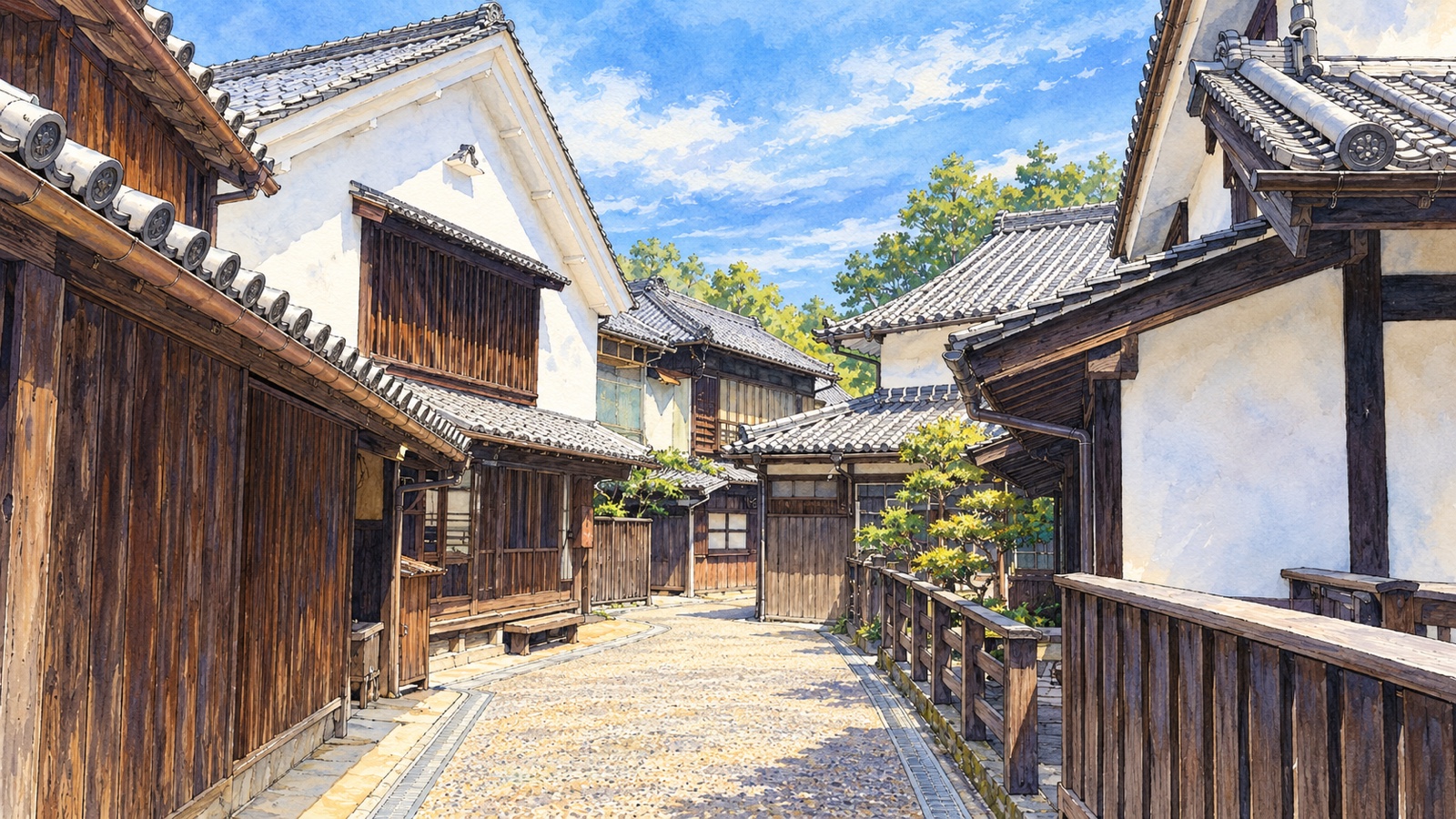
Mitarai on Osakishimojima Island served as the port town where Yusuke stays in the film. It is on a different island from central Hiroshima, and the red Saab’s journey expands from urban roads to routes along the sea. The Kure-area filming-location guide lists both Mitarai and the Akinada Bridge on the way there.
Mitarai’s townscape took shape from the mid-17th century as a port where ships traveling the Seto Inland Sea stopped over. Merchants’ houses, teahouses, inns for sailors, and other businesses that welcomed ships waiting for favorable winds and tides are clustered on limited land. The town was expanded through several landfill projects, and narrow residential lanes branch from its central street.
The harbor still has structures such as the large breakwater, a stone bridge, a tall stone lantern, stone seawalls, and stepped gangways where people board and leave boats. The shape of the town is defined not only by its houses but also by civil-engineering structures adapted to the sea level and the passage of vessels. In 1994, Mitarai was designated an Important Preservation District for Groups of Historic Buildings.
The Mitarai Rest House, where visitors can get information for a walk, is at 65 Mitarai. The prefectural tourism site lists the tourism association’s hours as 9 a.m.–4:30 p.m., closed Tuesdays. The entire town is not gated, nor does it have one opening time. Residents continue their daily lives even when the information center is closed, so do not block home entrances or narrow lanes to take photos.
- Location
- Mitarai, Yutaka-cho, Kure City, Hiroshima Prefecture
- Connection to the film
- The filming location for the Seto Inland Sea port town where Yusuke stays in the film
- Cultural designation
- Important Preservation District for Groups of Historic Buildings, designated in 1994
- Visitor information
- Mitarai Rest House, 65 Mitarai; 9 a.m.–4:30 p.m., closed Tuesdays
Sources:Kure City: Mitarai Preservation District for Groups of Historic Buildings
Hiroshima Prefecture: Filming locations in the satoyama and satoumi landscapes
Mitarai Preservation District visitor information
6### JMS Aster Plaza | A Place for Rehearsals and Performances Supporting Theater in Hiroshima
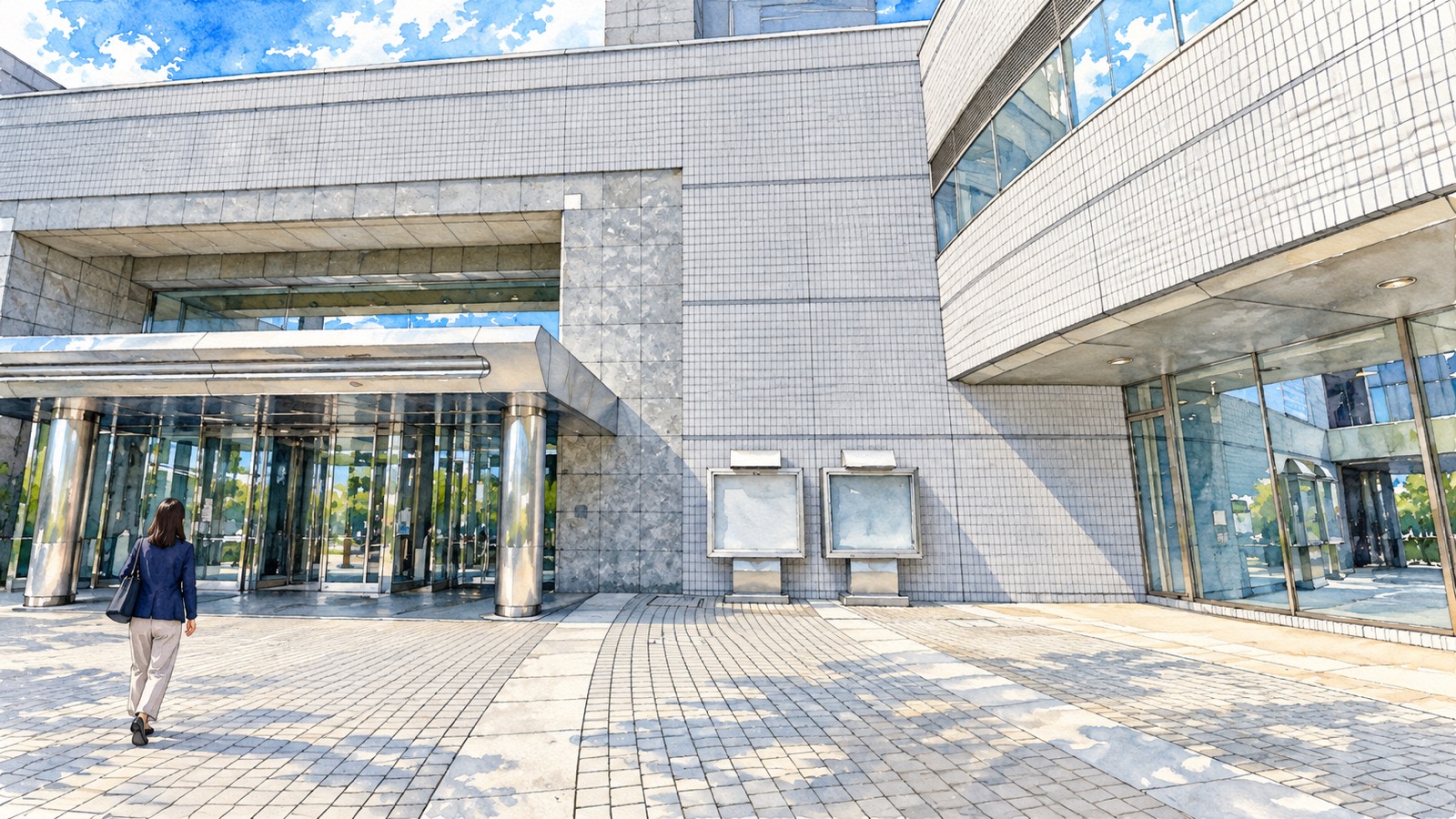
Hiroshima City’s filming-location guide also lists JMS Aster Plaza in Kako-machi. South of the International Conference Center, it is a cultural facility with halls, rehearsal rooms, a library, accommodations, and more. It is also in central Hiroshima.
The building has not only a large and medium hall, but also rehearsal rooms, music rooms, and spaces for dance practice. It provides places for performers to prepare their voices and bodies that are not visible to the audience on opening night. The actual facility corresponds to the rehearsal time that Drive My Car depicts alongside the finished stage production.
Aster Plaza also supports theater productions based in Hiroshima. Its Theater Attraction Hiroshima program continues to present productions with actors and directors selected through open calls. A revival of the play Atosaki, featuring Riho Fukuna, is scheduled for February 19–23, 2027. As of October 2026, tickets are scheduled to go on sale December 12.
This is not a theater temporarily built for the film; it remains a place where theater is made in Hiroshima. Visiting a space that appeared in the film can be paired with seeing another production born here from the audience. Rehearsal rooms and halls inside are for facility users; there is no regular tour for film-location visitors.
From Hiroshima Station, the streetcar stops Funairi-machi and Shiyakusho-mae are about 400 and 600 meters away, respectively. Kako-machi on Hiroshima Bus Route 24 is about 200 meters away. It is conveniently located on the same Route 24 that serves the Naka Incineration Plant.
- Location
- 4-17 Kako-machi, Naka Ward, Hiroshima City, Hiroshima Prefecture
- Connection to the film
- A cultural facility listed in Hiroshima City’s official filming-location guide
- Facilities
- Large and medium halls, rehearsal rooms, practice rooms, a library, and more
- Access
- About 200 meters from Kako-machi on Hiroshima Bus Route 24, and about 400 meters from Funairi-machi on the streetcar line
Sources:Hiroshima City: Film-location guide
JMS Aster Plaza: Facilities
Organizer’s programs and performance information
Access
7### Higashihiroshima Arts & Culture Hall Kurara | Filming a Stage Scene with 400 Extras
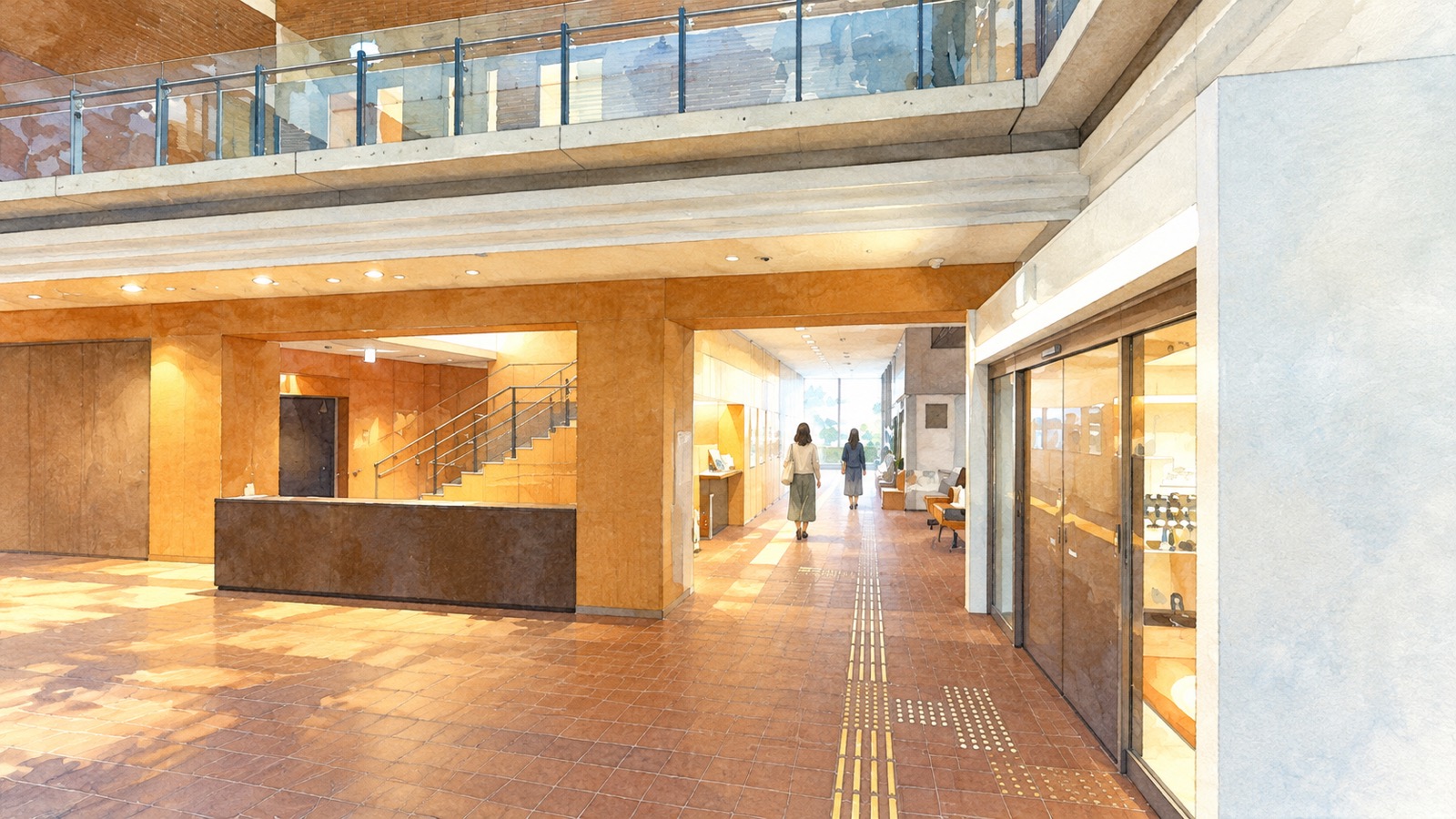
Kurara, used as the venue for Yusuke and his colleagues’ production, is a hall that opened in Saijo, Higashihiroshima City, in 2016. In the film, locations that make up the same theater festival are actually spread across two cities: Hiroshima and Higashihiroshima.
According to an announcement for a screening at Kurara, 400 extras took part in filming in the large hall. Local people filled the audience as well as appearing on stage, supporting the performance scene. The four-level large hall has 1,206 seats, including six wheelchair spaces. Balconies extend on both sides, creating a layout that surrounds the stage.
The hall has a proscenium stage, framed like a picture, and can accommodate both theater and music. For musical performances, reflectors are used to adjust the stage’s depth and acoustics. The height of the audience seating and its distance from the stage, which remain visible in the film, reflect the features of this hall.
On October 16, 2022, Kurara hosted a screening of Drive My Car in the large hall where filming had taken place. The screening was held twice, at 10:30 a.m. and 2:30 p.m.; the announcement also mentioned photo panels in the foyer showing the shoot. This was a past screening organized after the film received awards, not an announcement that the panels remain on permanent display.
Kurara is about a four-minute walk from JR Saijo Station. The facility estimates about 40 minutes by train from JR Hiroshima Station to Saijo. JR Higashi-Hiroshima Station on the Sanyo Shinkansen is elsewhere, about a 15-minute taxi ride away. Choosing a hotel or train based only on the station name “Higashi-Hiroshima” can leave you far from a place you thought was within walking distance.
There is no parking lot on the grounds for general visitors; use a partner parking facility. To receive two hours of free parking while using Kurara, present your parking ticket at the general reception desk. Reception is open 9 a.m.–7 p.m. and is closed during the year-end and New Year holidays and on maintenance days. Entry times and ticket prices for performances vary by event.
- Location
- 7-19 Saijo Sakae-machi, Higashihiroshima City, Hiroshima Prefecture
- Connection to the film
- The large hall where a stage-performance scene was filmed with 400 extras
- Nearest station
- About a four-minute walk from Saijo Station on the JR Sanyo Main Line
- Reception hours
- 9 a.m.–7 p.m.; performance entry times and ticket prices vary by event.
Sources:Hiroshima Prefecture: Film-location guide
Filming-location screening, October 2022
Kurara: Hall guide
Access and partner parking
8### Akinada Bridge and Shirasaki Park | The Route of the Red Car Crossing to the Islands
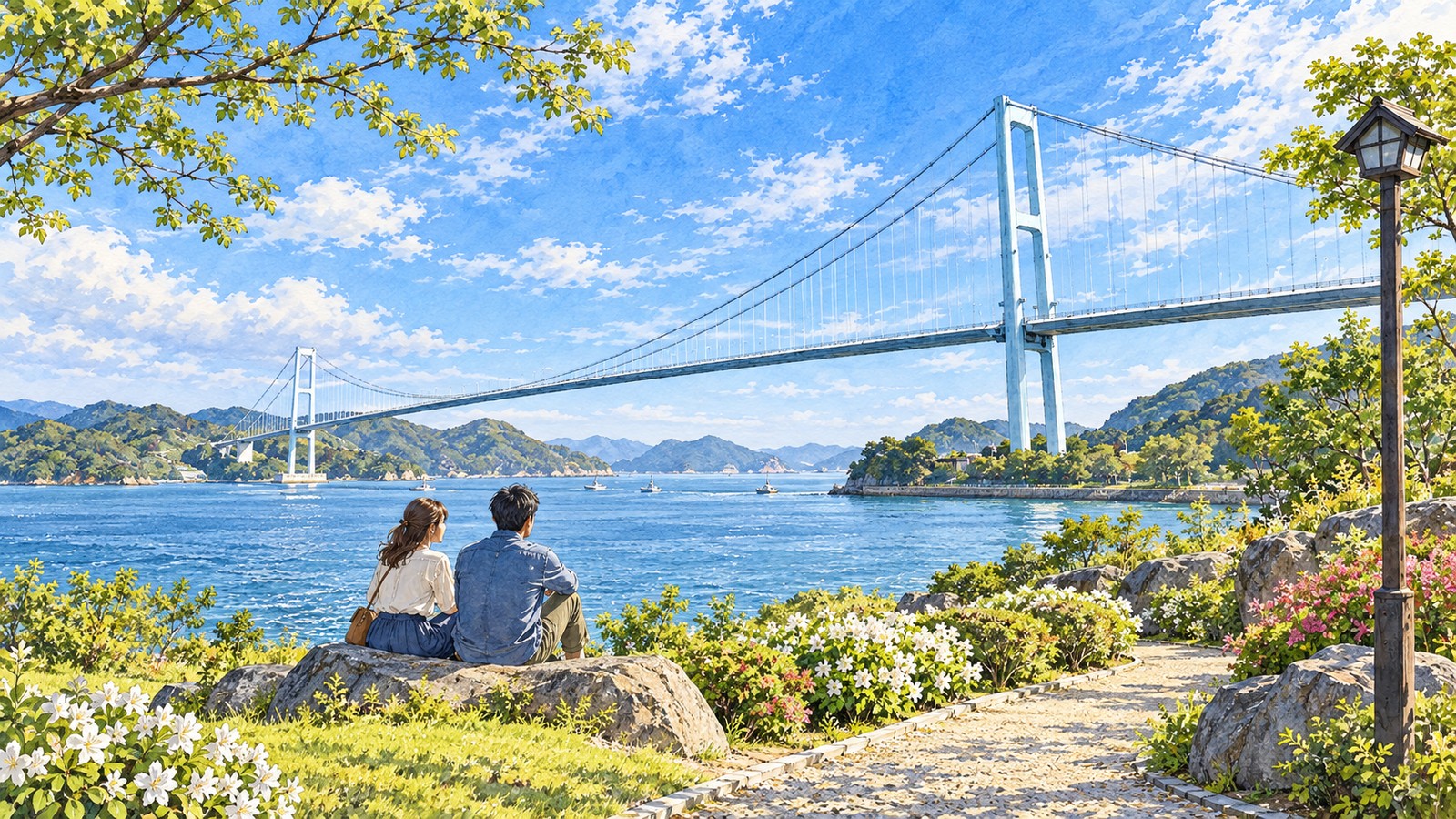
Akinada Bridge is a suspension bridge linking the mainland with Shimokamagari Island. It marks the entrance to the Akinada Tobishima Kaido, the route toward Mitarai. The Kure-area location guide lists the bridge alongside Mitarai as a filming location for Drive My Car.
The bridge opened on January 18, 2000. It is 1,175 meters long, and its towers rise about 130 meters above sea level. Crossing the Strait of Meneko, it is the closest to the mainland of the seven bridges connecting seven islands along the route. It also serves as a landmark for tracing the car’s journey to the islands in the film.
For a view of the bridge, Shirasaki Park on the Shimokamagari Island side is a good place to stop. It has a rest area, gazebo, restrooms, and parking, with views of the strait. The road authority lists parking for eight standard vehicles, two large vehicles, and one vehicle with an accessible space. From the island-side parking lot, visitors can take in the bridge and strait at a relaxed pace.
Akinada Bridge is a toll road. One-way tolls are 730 yen for standard cars and 570 yen for kei cars. Payment is by cash or coupon ticket; ETC, credit cards, and electronic money are not accepted. The toll booth is on the mainland side, so pay before crossing to the islands and after crossing on your return.
Pedestrians and cyclists can cross for free. However, traffic restrictions apply in strong winds. The road authority says pedestrians and two-wheeled vehicles are prohibited when the 10-minute average wind speed reaches 15 meters per second or higher. Check bridge traffic information as well as the weather on the islands, since it directly affects whether you can cross.
- Location
- Shirasaki Park, Shimojima, Shimokamagari-cho, Kure City, Hiroshima Prefecture
- Connection to the film
- A suspension bridge at the entrance to the Akinada Tobishima Kaido, crossed on the way to Mitarai
- Toll
- One-way: 730 yen for standard cars and 570 yen for kei cars; cash or coupon tickets only. Pedestrians and cyclists cross free.
- Viewpoint
- Shirasaki Park on the Shimokamagari Island side has a rest area, restrooms, and parking.
Sources:Kure Region: Filming-location guide
Akinada Bridge and Shirasaki Park
Toll rates
Pedestrian and cyclist information
Road traffic information
9### Orizuru Tower | Where the Red Saab Crossing Aioi Bridge Was Filmed
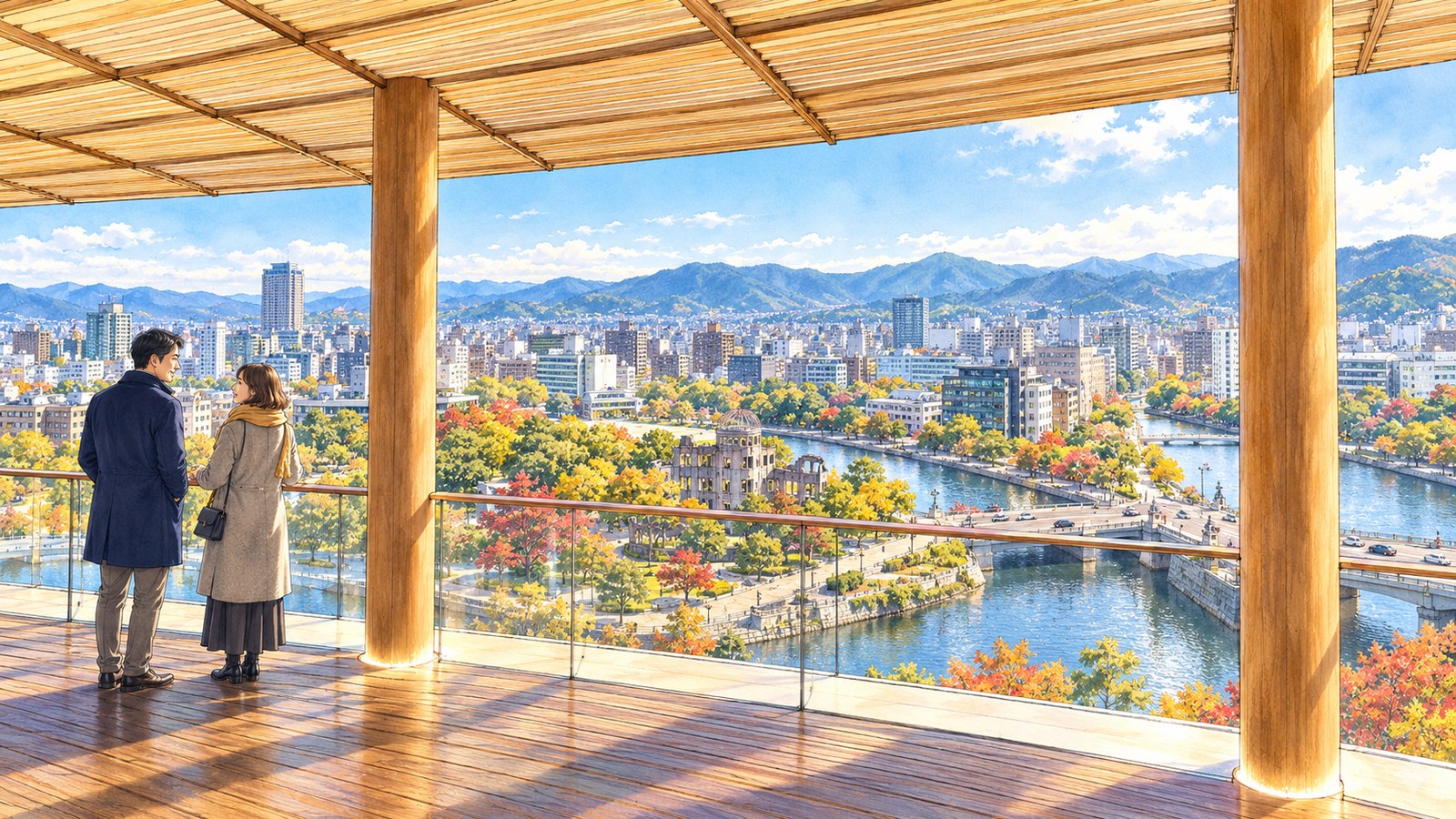
According to the Hiroshima Film Commission’s location map, the scene of the red Saab 900 driving across Aioi Bridge was filmed from Orizuru Tower. The facility stands next to the Hiroshima Peace Memorial (Atomic Bomb Dome). From its rooftop observation deck, Hiroshima no Oka, visitors can see the Atomic Bomb Dome, Peace Memorial Park, and Mt. Misen on Miyajima in the distance.
You can also walk up to the rooftop by way of the sloping walkway Sanpo-zaka, which traces Hiroshima’s history. Admission to the observation deck is 2,200 yen for adults, 1,400 yen for junior and senior high school students, and 900 yen for elementary school students. Regular hours are 10 a.m.–6 p.m.; same-day tickets are sold and entry is allowed until 30 minutes before closing. The tower is just steps from Genbaku Dome-mae streetcar stop.
- Location
- 1-2-1 Otemachi, Naka Ward, Hiroshima City, Hiroshima Prefecture
- Connection to the film
- Filming location for the scene of the red Saab driving across Aioi Bridge (Hiroshima Film Commission location map)
- Observation deck
- 2,200 yen for adults; 1,400 yen for junior and senior high school students; 900 yen for elementary school students
Sources:Hiroshima Film Commission: Digital location map
Orizuru Tower: Admission
Orizuru Tower: Access
10### Koya Service Area (Outbound) | Where Yusuke Takes a Break with Coffee and Bread
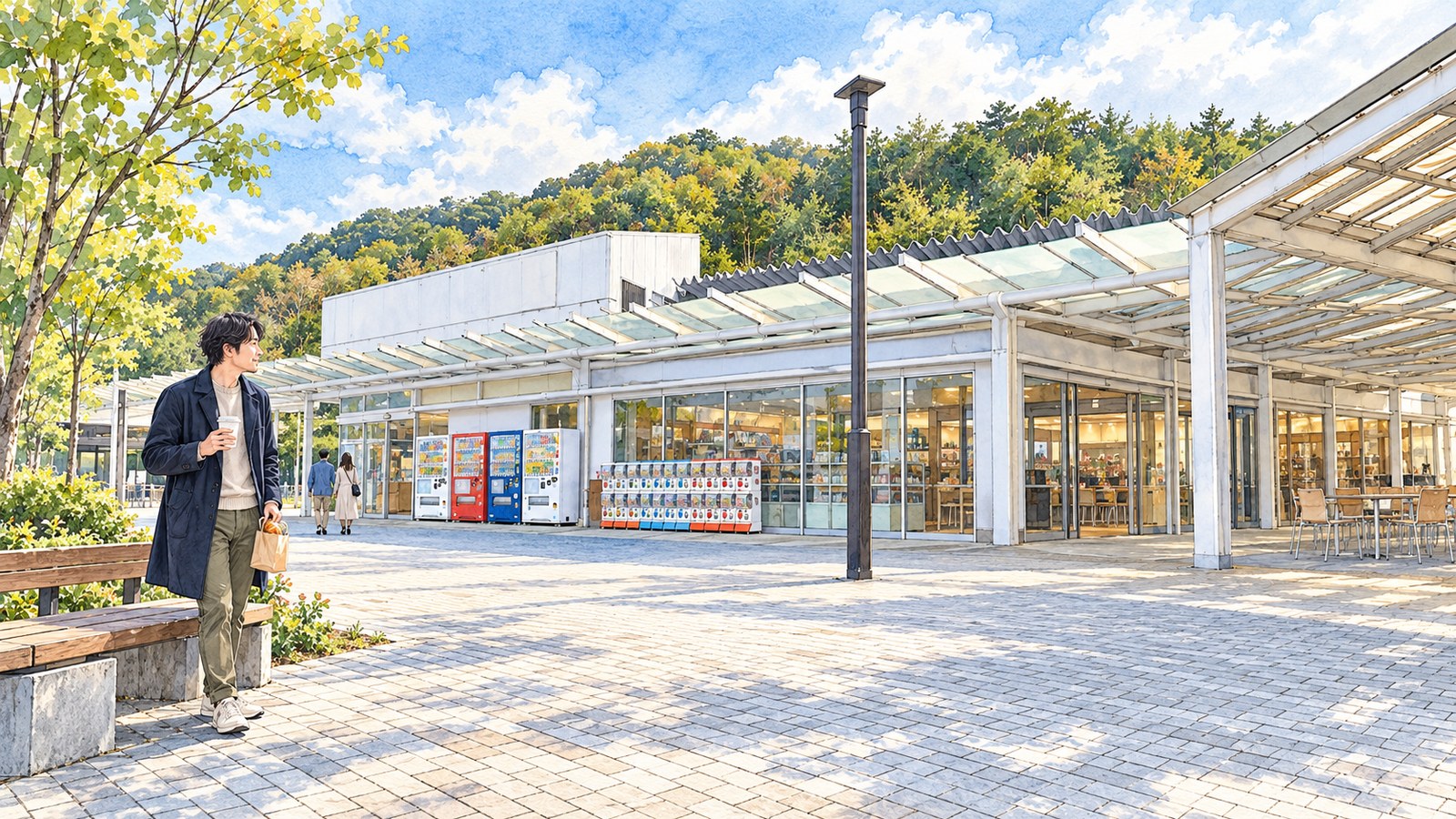
The outbound Koya Service Area on the Sanyo Expressway is the filming location for a scene where Yusuke takes a break. The location map describes him resting with coffee and bread before driving the red Saab toward Hiroshima for the international theater festival.
The service area is in Higashihiroshima City and has a food court, restaurant, and souvenir shops. The outbound side serves traffic heading toward Hiroshima, making it a place to stop on a journey in the same direction as Yusuke’s in the film.
- Location
- Koya Service Area (outbound), Sanyo Expressway, Higashihiroshima City, Hiroshima Prefecture
- Connection to the film
- Filming location for the scene where Yusuke rests, then drives to Hiroshima
- Use
- Accessible from the outbound lanes of the Sanyo Expressway, toward Hiroshima
Sources:Hiroshima Film Commission: Digital location map
DoraPla: Koya Service Area (outbound) facilities
Why Did Hiroshima Become a Setting for the Story?
Words Shared While Showing the Filming Location Became Part of the Screenplay
In an interview published by Seibu Location Services, a Hiroshima Film Commission representative describes how the filming locations were chosen. Filming was initially planned for Busan, South Korea, but travel became impossible. As the production searched for locations in Japan, it came to Hiroshima, the representative says.
As the production decided to move to Hiroshima, the Film Commission introduced the Naka Incineration Plant. The representative recalled that the director was initially reluctant to shoot without properly learning about Hiroshima’s history. The explanation of the plant’s glass passage and the axis running from Peace Memorial Park to the sea helped prompt the choice of setting.
The representative says a screenplay set in Hiroshima arrived about two weeks after the location visit. Hiroshima was not simply substituted for another city; words exchanged during the tour became part of the script. The Naka Incineration Plant was not an attraction added after filming began, but a building connected to the decision to make the film in Hiroshima.
Source:Seibu Location Services: Behind the choice of filming locations
The Location Map Reflects the Perspective of People Who Supported Production
On July 19, 2021, the Hiroshima Film Commission announced the release of its location map, ahead of the film’s domestic opening on August 20. It brought together roads driven by the red Saab 900, photographs, and filming anecdotes, linking scenes in the film with places around the region.
In June 2022, the filming support effort received the Japan Film Commission’s JFC Award for Best Project. The cited contributions included attracting the production before the screenplay was complete, coordinating with local businesses and transportation providers, and creating the map after release. The award explanation noted that the support went beyond providing filming locations once.
Sources:Report on receiving the JFC Award
Hiroshima Film Commission: Digital location map
Conversations in the Car and Words on Stage
What Yusuke and Misaki Each Carry with Them
Yusuke Kafuku, played by Hidetoshi Nishijima, is a stage actor and director who has lost his wife, Oto. At a theater festival in Hiroshima, he meets Misaki Watari, a driver played by Toko Miura. As they spend time together in the same car, the story gradually brings them into contact with each other’s past.
The play Yusuke works on in Hiroshima is Anton Chekhov’s Uncle Vanya. The actors do not all speak the same language. Rehearsals that include Korean Sign Language, alongside spoken languages, become another major part of the film beside the conversations in the car.
Hidetoshi Nishijima
He played Yusuke, a stage actor and director grieving the loss of his wife, Oto. He has said that during read-throughs he avoided strong emotional coloring and continued reading while aligning punctuation and pace.
Toko Miura
She played Misaki, a quiet personal driver. She has said she obtained a driver’s license for the role and focused on driving in a way that would make her passenger comfortable.
Masaki Okada
He played Takatsuki, a key figure who sets much of the story in motion.
Reika Kirishima
She played Oto, Yusuke’s wife, who leaves a secret behind before her sudden death.
Ryusuke Hamaguchi
The director, who fell in love with the original work, was eager to adapt it and also wrote the screenplay. He had planned from the screenplay stage to gradually change the seat where Yusuke sits in the car.
Haruki Murakami
The author of the original short story “Drive My Car.” It appears in the collection Men Without Women, and the film also incorporates elements of “Scheherazade” and “Kino” from the same book.
Source:Official film website: About the film
The Seat Where Yusuke Sits Changes Little by Little
Yusuke first sits behind the front passenger seat, where he can observe Misaki’s driving and expression. He then moves behind the driver’s seat, and eventually sits beside her in the front. The director has said he planned these changes from the screenplay stage. The sequence expresses a shift from a position where Yusuke can watch her to one where he can trust her without watching, and finally to sitting alongside her, in the car’s confined space.
Source:Kobe Planet Film Archive: Interview with director Ryusuke Hamaguchi
Misaki’s Quietness Grows from the Work of Driving
Toko Miura obtained a driver’s license for the role of Misaki. In an interview with Tokyo Joshi Eiga-bu, she said the director asked her to treat driving practice as part of developing the role, and that she came to understand the character by engaging with driving itself.
Miura has said she liked cars even before getting her license. The first step in preparing for the role was learning to drive the car carrying Yusuke naturally. She said that rather than consciously acting to suppress emotion while driving, she focused on making her passenger comfortable.
With this explanation in mind, even the moments when Misaki says little have a practical dimension to them. She does not interrupt the other person’s silence, jolt him with sudden maneuvers, and gets him where he needs to go. Miura developed the role both by imagining the character’s past and by acquiring the practical skill of driving.
Source:Tokyo Joshi Eiga-bu: Interview with Toko Miura
A Read-Through Is Also Time Spent Listening to the Other Person’s Voice
Hidetoshi Nishijima has said that in read-throughs with Hamaguchi, he first read the text accurately without adding strong emotion. They aligned punctuation and pace, and through repetition the words began to enter the body. If a comma in the script becomes a period, the place to pause for breath changes too.
During rehearsal, they also acted out past events that do not appear in the film. When the director asked questions, Nishijima answered not as himself but as Yusuke. It was preparation to create the sense that the character had lived on other days, rather than building him only from dialogue in the finished scenes.
Nishijima has also reflected on rehearsing with actors from different countries who speak different languages. They moved from receiving cues for lines they did not understand to learning their meaning and listening to them again. This process overlaps with Yusuke’s work as a director in the film and with the actual preparation for filming.
Source:Eiga.com: Interview with Hidetoshi Nishijima
In the Sign-Language Scenes, You Can Feel Language in the Body
Yurim Park, who played Yoon-a, began learning Korean Sign Language after she was cast. Director Hamaguchi has discussed how the production pause caused by the pandemic gave her an extended period to keep practicing. On set, Naoki Watanabe from the assistant-director team and others supported communication among the different languages.
Yoon-a’s sign language is not spoken Japanese translated into hand movements. The actor who does not speak had the same rehearsal time as the other actors and delivered her lines through bodily movement. Nishijima has recalled that movements held back during read-throughs took on great force in the final performance.
Sources:Interview with director Ryusuke Hamaguchi
Interview with Hidetoshi Nishijima
Moving Between the Original Short Story and the 179-Minute Film
The original “Drive My Car” is included in Haruki Murakami’s short-story collection Men Without Women. The film also incorporates elements of “Scheherazade” and “Kino,” from the same collection.
Sources:Bunshun Bunko: Men Without Women
Official film website: About the original story
Taking in the Music and Scenery at a Slower Pace
Two Themes Expand the Film’s Sense of Time
Eiko Ishibashi’s score was built around two main themes. The music heard at the beginning and the end does not introduce a different story; instead, the same material is adjusted through changes in tempo and instrumentation to suit the film’s sense of time.
Ishibashi has said that at first she composed music based on the screenplay’s hard-boiled atmosphere. In conversations with the director, they discussed keeping the score from clinging too closely to the images and instead letting it sound at a distance nearer to the audience. Delays in filming extended the preparation period; she said melodies sometimes came to her after stepping away for a while from the screenplay and footage.
For recording, she gave the musicians concise scores and recorded several different patterns. She took home alternate performances, such as variations in the drums, and assembled them. Rather than having everyone follow a single finished form in advance, the process left choices open and brought the music closer to the film.
Source:CINRA: Eiko Ishibashi talks about film and music
Why the Nighttime View from the Car Window Became a Dark Background
Filming long conversations inside the car required it to keep moving at a steady speed. The director has explained that on brightly lit city streets, traffic lights would cause stops and slowdowns, affecting both editing and the actors’ concentration. A highway was chosen, leading to shots where faces emerge against the darkness outside the windows.
The director himself watched a monitor in a narrow space at the back of the Saab so he could speak directly to the actors. Rather than giving instructions by radio from a separate vehicle outside, he prioritized being close enough to speak in person immediately after a take. Behind the quiet, sustained conversations were decisions about where to drive and where crew members could be positioned.
Source:Director Ryusuke Hamaguchi on filming inside the car
The Trailer Shows the Distance Between the Red Car and Hiroshima
In distributor Bitters End’s 90-second trailer, the red car on Hiroshima’s roads alternates with rehearsals for the play. The straight passage at the Naka Incineration Plant, short exchanges inside the car, and lines from the play overlap. The trailer conveys that the film is not only about Hiroshima’s scenery but also moves between travel and rehearsal.
Bitters End, the film distributor: Official 90-second trailer
The Journey of the Film’s Arrival in Hiroshima
- 1994Mitarai is designated an Important Preservation District for Groups of Historic Buildings.Local history
- February 2004The Naka Incineration Plant building is completed.Architecture
- 2013Haruki Murakami’s short story “Drive My Car” is published.Original story
- April 2014The short-story collection Men Without Women is published.Original story
- October 2016A paperback edition of the collection is published.Original story
- July 2021Wins four awards at Cannes, including Best Screenplay.Film
- July 19, 2021Hiroshima Film Commission announces the release of its location map.Local project
- August 20, 2021The film opens in Japan.Film
- February 2022International edition video release.Home video
- March 2022Wins the Academy Award for Best International Feature Film.Film
- May 2026–mid-February 2027 (scheduled)Construction and access restrictions on parts of the Naka Incineration Plant seawalls.On site
Sources:Bungeishunju: Book information
Hiroshima Film Commission: 2021 announcement
TC Entertainment: International-edition Blu-ray release information
Official Hiroshima Prefecture Tourism Website: Academy Award and filming locations
Lab Notes | Hospitality That Took Shape After Filming
According to the hotel’s account, after the film became an Academy Award nominee in 2022, staff created a cocktail inspired by the red Saab. They served it in the bar used for filming and recalled receiving many orders after the awards.
On the day of the awards ceremony, hotel staff watched the announcement with the Film Commission and reporters in a hotel room. In addition to drinks, they prepared a paper confetti ball that could appear in press photographs. Their relationship continued from providing a filming location to creating a place for the community to celebrate the film’s award.
What stands out in this example is the use of an actual filming venue and the experience of the people who work there, rather than a large-scale recreation of a fictional town. People who have seen the film can visit the real bar and encounter the memories of those who welcomed the production. Connections created after filming help sustain a lasting relationship between a film and a hotel.
Source:Seibu Group: Interview with the filming-support and hotel representatives
FAQ
Do I need a reservation to visit the Naka Incineration Plant?
No reservation is needed for the Ecorium passage, which is open from 9 a.m. to 4:30 p.m. It is closed during the year-end and New Year holidays. Interior plant tours led by staff and group tours have different application procedures.
Can I take a bus almost to the top of Mt. Ogonzan?
Hiroshima City’s walking directions estimate about 70 minutes from the Higashi-Hon’ura stop to the summit. They do not describe a bus route that goes up the mountain. If you walk, allow time for the round trip.
Is Kurara in Hiroshima City?
No. It is in Higashihiroshima City. The nearest station is Saijo on the JR Sanyo Main Line, about a four-minute walk away. The facility estimates about 40 minutes by train from Hiroshima Station to Saijo.
Can I use ETC on Akinada Bridge?
No. Payment is by cash or coupon ticket; the one-way toll for a standard car is 730 yen. The road authority also says credit cards and electronic money are not accepted.
Can I walk freely along the Naka Incineration Plant’s seaside, as in the film?
Access to parts of the south and west seawalls is restricted because of construction through mid-February 2027. The Ecorium glass passage featured in the film is open without a reservation from 9 a.m. to 4:30 p.m.
Is Mitarai close to central Hiroshima?
Mitarai is on Osakishimojima Island and requires a different scale of travel from sightseeing in central Hiroshima. Hiroshima Prefecture’s tourism guide estimates about 90 minutes by bus from JR Kure Station and about 60 minutes from JR Hiro Station.
Can I visit the same seat used during filming at the hotel?
The current venue accepts reservations, but it does not say that you can reserve the same seat used during filming. Make a reservation to use the bar or dine, and contact the venue about any seating preference.


