

Akihabara Arcade Pilgrimage: 7 Retro Game Centers in Tokyo and Osaka
White arcade cabinets with joysticks and buttons, large machines with three screens side by side, and crane games for grabbing prizes: game centers in Takadanobaba, Ikebukuro, and Akihabara bring together different eras of play. This route includes a shop keeping old games running, events tied to reissued products, a new arcade opened in 2026, a retro-game floor in Akihabara, and an arcade cafe in front of Osaka Station.
Seven Places to Meet Old Games in Takadanobaba, Ikebukuro, Akihabara, and Osaka
① Takadanobaba Mikado
Play an old game as a new experience today.
Explore Takadanobaba Game Center Mikado② Ikebukuro Mikado
A place to play in Ikebukuro, continuing the former Rumble Plaza.
Explore Ikebukuro Game Center Mikado⑤ RETRO:G
A floor dedicated to retro games, with cabinets from the 1980s through the 2000s.
Explore RETRO:G (GiGO Akihabara Building 3)⑥ Super Potato
Play nostalgic arcade cabinets on the fifth floor above the store.
Explore Super Potato Akihabara⑦ KITTE Osaka
An arcade cafe connected to the station, where you can play retro games with a meal.
Explore GiGO Arcade Cafe KITTE Osaka1 Takadanobaba Game Center Mikado | An arcade built by an owner who collects circuit boards
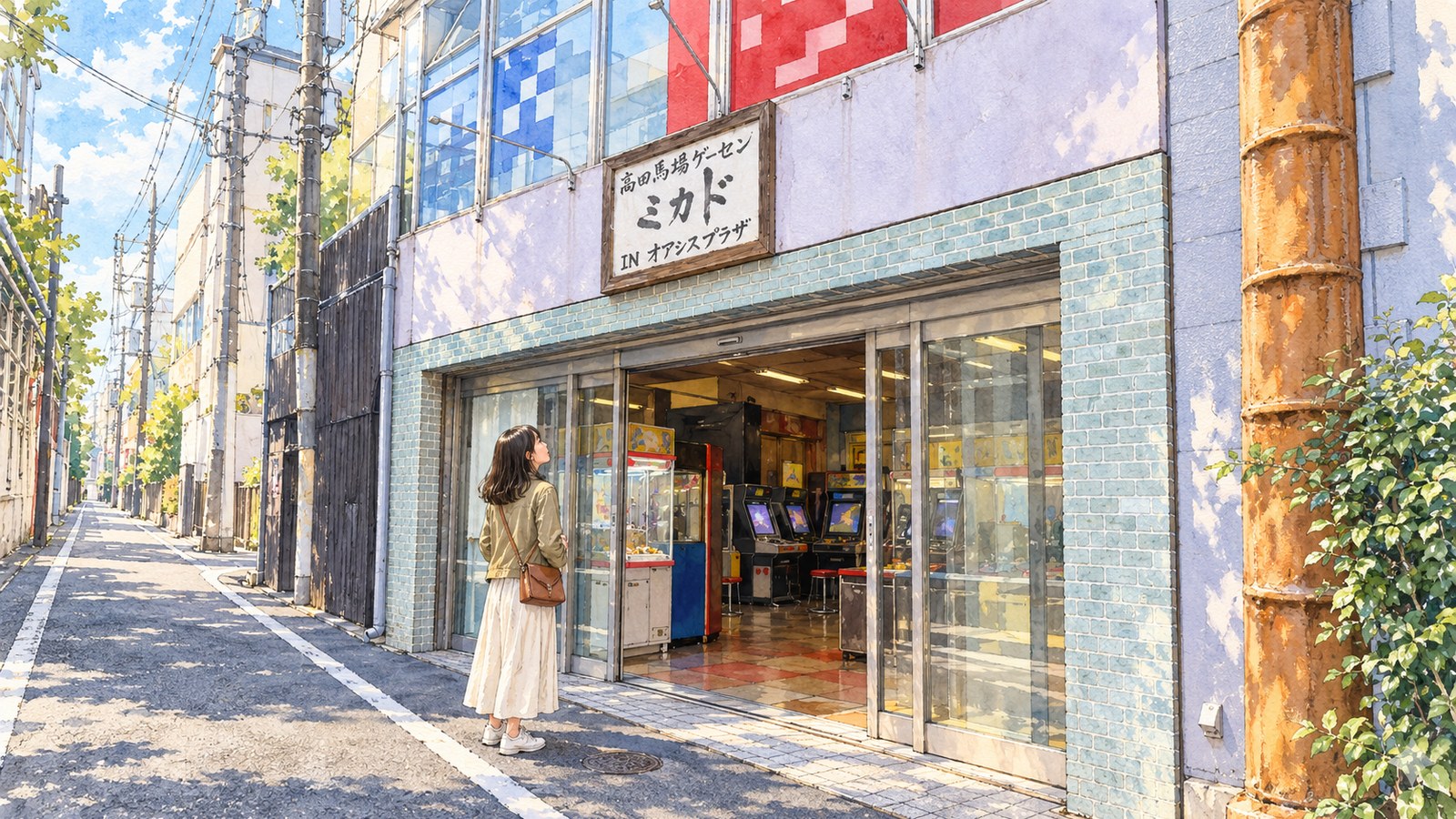
Takadanobaba Game Center Mikado occupies the first and second floors of the Oasis Plaza Building. It is about a 30-second walk from the Toyama Exit of JR Takadanobaba Station. Official hours are 10 a.m.–midnight. Owner Minoru Ikeda has built a place where visitors can play older arcade games using circuit boards he has collected since childhood.
From September 11–27, 2026, Taito and INH held “Super Real Arcade Collection Part 2.” The event made 10 titles planned as downloadable add-ons for the home-use EGRET II mini playable together on actual EGRET II arcade cabinets. The home software is scheduled for release on March 25, 2027. About six months before release, visitors had a chance to play using the arcade’s screens and controls.
People who keep playing Thunder Blaster
In an October 2026 interview, owner Ikeda named Irem’s Thunder Blaster as one of the arcade’s popular games. Pressing the button repeatedly fires a bomb; a rapid-fire feature may seem to make progress easier, but the game is still difficult. He said some fans aim to reach the score limit in a single loop.
In the same interview, Ikeda spoke fondly of Mr. Do! vs. Unicorn. As a child, he repeatedly watched skilled classmates and older kids play. Although he learned how to earn bonus points, he rarely got a turn himself and never had enough time to play. A reissue of a nostalgic game can mean more than regaining old skills: it can also be a chance to start playing something you could not enjoy back then.
Source: Gamer — October 2026 interview with Minoru Ikeda and Kenichi Ishiguro (in Japanese)
- Location
- Oasis Plaza Building, 1-2F, 4-5-10 Takadanobaba, Shinjuku, Tokyo
- What to expect
- A game center run by owner Minoru Ikeda, with retro games, shooters, and fighting games kept playable using circuit boards he has collected
- Hours and access
- 10 a.m.–midnight; about a 30-second walk from the Toyama Exit of JR Takadanobaba Station
- Fall 2026 event
- “Super Real Arcade Collection Part 2” ran on the first floor from September 11–27, 2026.
Sources: Takadanobaba Game Center Mikado — Store information (in Japanese) / Mikado — Access to each location (in Japanese) / Taito — September limited-time event and dates (in Japanese)
2 ② Ikebukuro Game Center Mikado | A second location continuing Rumble Plaza
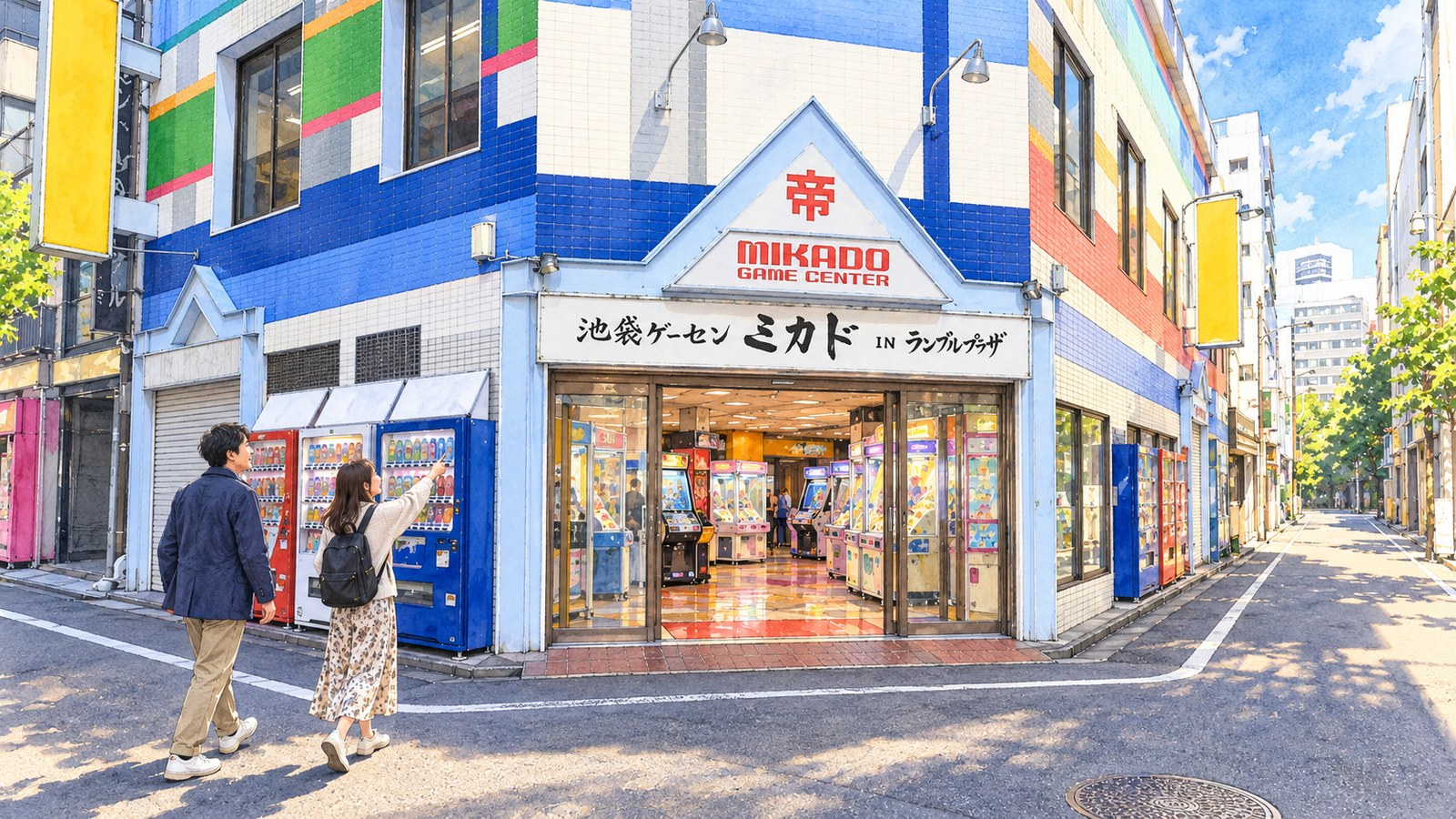
Ikebukuro Game Center Mikado is in Higashi-Ikebukuro 1-chome, about a three-minute walk from Ikebukuro Station’s East Exit. Official hours are 10 a.m.–midnight. The second Mikado location officially opened on October 21, 2018, taking over the site of the former Rumble Plaza arcade.
In an interview at the time of the opening, owner Ikeda said the building’s owner had asked about the arcade closing, and he took over the space. Mikado began operating about three weeks before the official opening while arranging the interior. The arcade needed equipment repairs, network updates, and disposal of unwanted items, so taking over an existing business did not make the work easy.
Mikado also wanted to see whether its approach in Takadanobaba—reusing circuit boards, holding events and tournaments, and livestreaming—would work in another neighborhood. At the same time, Ikeda said he wanted to keep a place for people to drop in between tasks, play a little Shanghai II, and head home.
Filming game screens for the Hi Score Girl anime
Mikado also helped film gameplay for the anime Hi Score Girl, based on Rensuke Oshikiri’s manga. A 2018 report described how the arcade borrowed a pre-update Mortal Kombat 3 circuit board from the United States for filming. After all that effort to prepare it, only the title screen appeared in the show.
Mikado-chan, the mascot of the Ikebukuro location, was also drawn by Rensuke Oshikiri. The connections between the work and the real arcade continue through a manga about game centers, real hardware used in its anime adaptation, and a shop mascot created by the manga artist.
Source: Famitsu — Interview with owner Ikeda at the Ikebukuro location opening (in Japanese)
- Location
- 1-42-19 Higashi-Ikebukuro, Toshima, Tokyo
- What to expect
- Mikado’s second location, opened October 21, 2018, in the former Rumble Plaza; features Mikado-chan, a mascot drawn by Rensuke Oshikiri
- Hours and access
- 10 a.m.–midnight; about a three-minute walk from Ikebukuro Station’s East Exit
Sources: Ikebukuro Game Center Mikado — Store information (in Japanese) / Famitsu — Report on the opening and interview with owner Ikeda (in Japanese)
3 ③ Akihabara Hey | From retro video games to large cabinets
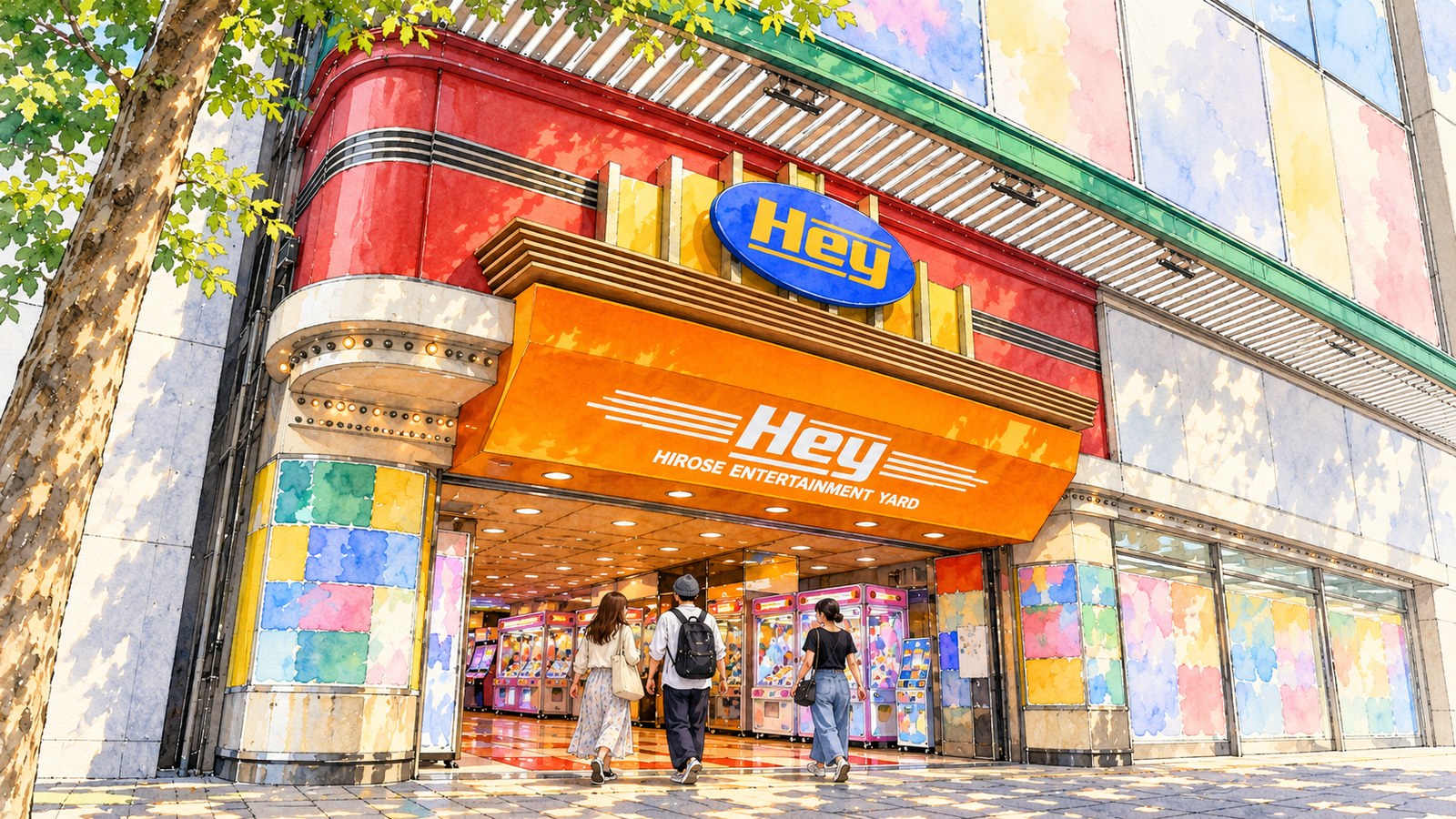
Akihabara Hey is a Taito game center on floors 1–4 of the Hirose Head Office Building. It is about a two-minute walk from the Electric Town Exit of JR Akihabara Station. The large orange sign makes it easy to find. Hours are 10 a.m.–11:30 p.m. daily, year-round.
The arcade has retro video games, rhythm games, large video-game cabinets, and prize games. The building has an elevator, and the official store page also lists cashless payment and Wi-Fi.
In 2026, Hey celebrates its 25th anniversary. A summer retail event was held on the fourth floor on August 14, with new products, reissues, and a clearance sale of remaining stock from earlier events. That day, Taito also released mini acrylic stands featuring past Taito corporate logos and arcade logos. It was an event that turned the company and store signs into commemorative merchandise, alongside the games.
- Location
- Hirose Head Office Building, 1-4F, 1-10-5 Sotokanda, Chiyoda, Tokyo
- What to expect
- A Taito arcade with retro video games, rhythm games, large video-game cabinets, and prize games (25th anniversary in 2026)
- Hours and access
- 10 a.m.–11:30 p.m. daily, year-round; about a two-minute walk from the Electric Town Exit of JR Akihabara Station
Sources: Taito — Official Hey store information (in Japanese) / Taito — Hey’s 25th anniversary and new store information (in Japanese)
4 ④ Hey2 | A new place to try crane games, added in 2026
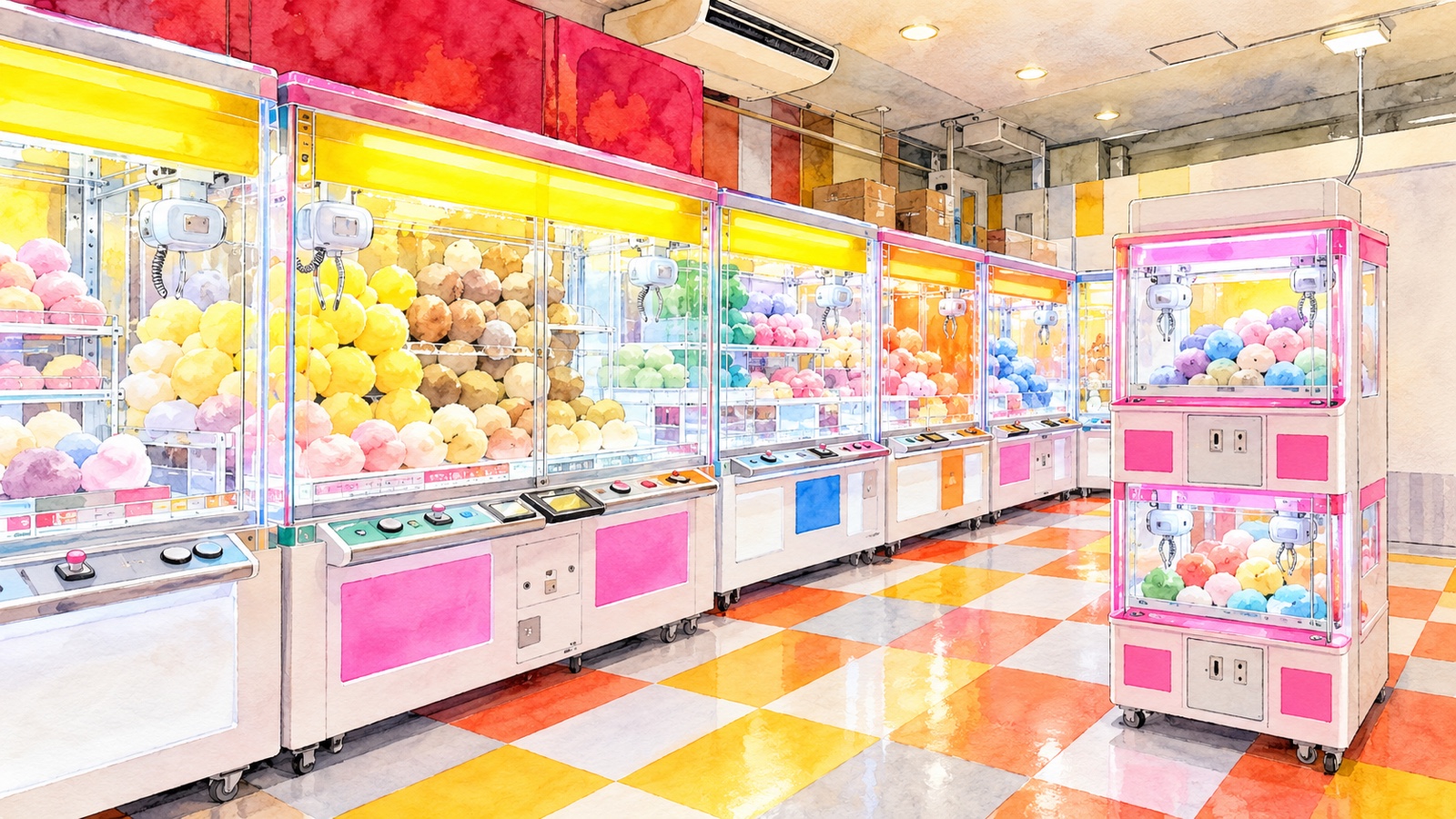
On August 8, 2026, Hey2, an arcade focused on crane games, opened next door to Hey. It is on the first floor of the Hirose Head Office Building No. 2. While Hey has video and rhythm games, Hey2 is primarily set up for prize-catching machines.
- Location
- Hirose Head Office Building No. 2, 1F, 1-11-12 Sotokanda, Chiyoda, Tokyo
- What to expect
- A new crane-game-focused arcade that opened next to Akihabara Hey on August 8, 2026
- Hours and closing days
- 10 a.m.–11:30 p.m., open daily
Source: Taito — Hey2 opening and store overview (in Japanese)
5 ⑤ RETRO:G (GiGO Akihabara Building 3) | A dedicated floor for retro games, from the world’s oldest arcade title
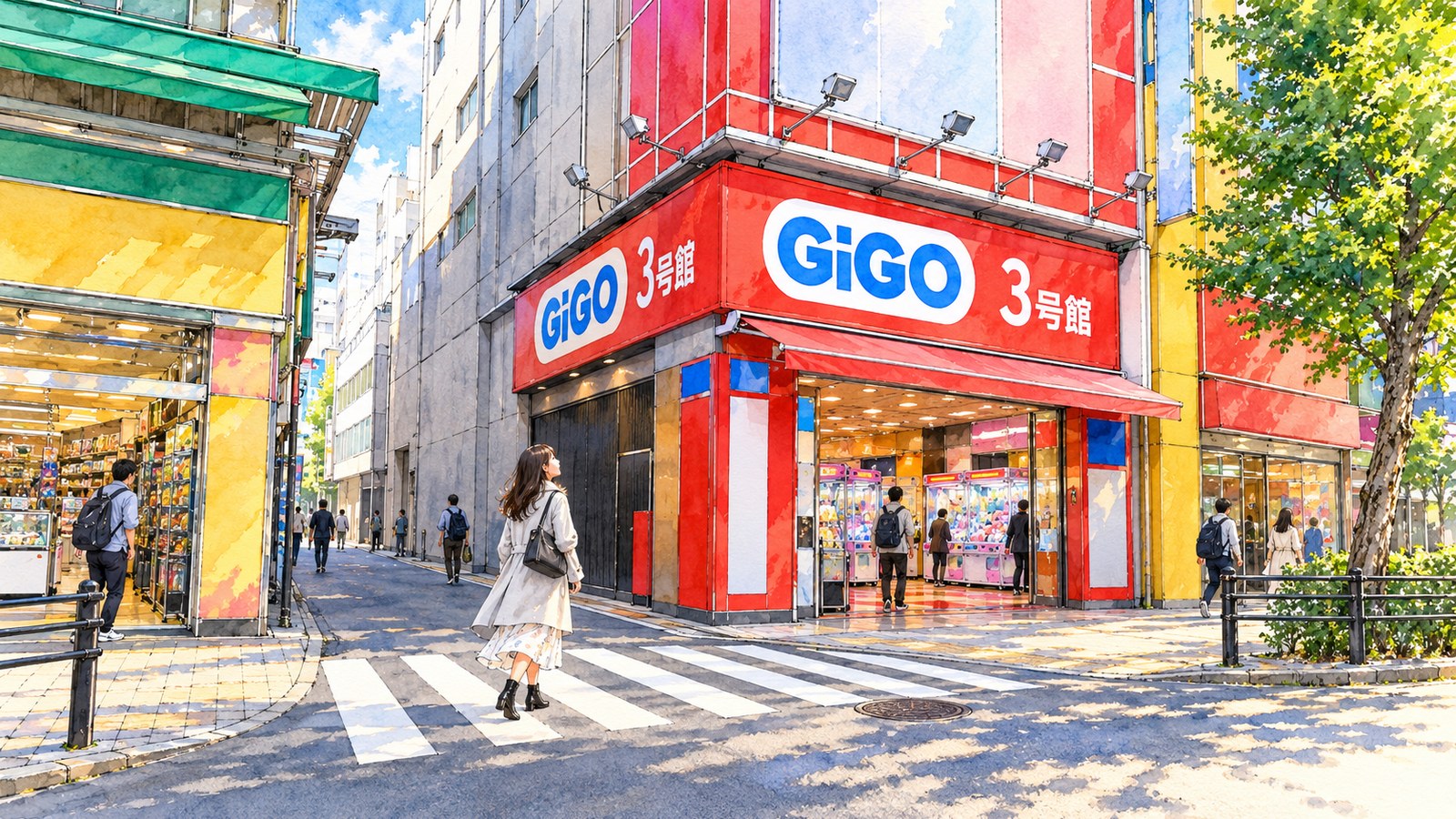
GiGO Akihabara Building 3, with its red exterior, stands at the next corner north along the same Chuo-dori avenue as Hey. Its sixth floor is RETRO:G, a floor dedicated to retro games. It opened on July 21, 2021, in what was then Sega Akihabara Building 3. The arcade, which had already featured many classic titles, expanded them into a dedicated floor.
The name combines “Retro” and “Trilogy.” The operator explains that it sees the history of arcades as a trilogy of past, present, and future, and wants to pass arcade culture on to later generations. Its concept is “a place to experience the energy and games of the arcade’s golden age.” It focuses on titles from the 1980s through the 2000s.
The opening lineup included Computer Space (1971), considered the world’s oldest arcade game. Nintendo’s Donkey Kong and Namco’s New Rally-X, both released in 1981, were available on original tabletop cabinets.
- Location
- GiGO Akihabara Building 3, 6F, 1-11-11 Sotokanda, Chiyoda, Tokyo
- What to expect
- A retro-game floor opened July 21, 2021, with playable arcade games mainly from the 1980s through the 2000s
- Hours and access
- 10 a.m.–11:30 p.m. daily; about a three-minute walk from the Electric Town Exit of JR Akihabara Station
Sources: GiGO — Official RETRO:G page (in Japanese) / GiGO — GiGO Akihabara Building 3 store information (in Japanese) / Denfami Nico Gamer — Opening announcement and lineup (in Japanese)
6 ⑥ Super Potato Akihabara | Play arcade cabinets above the game shop
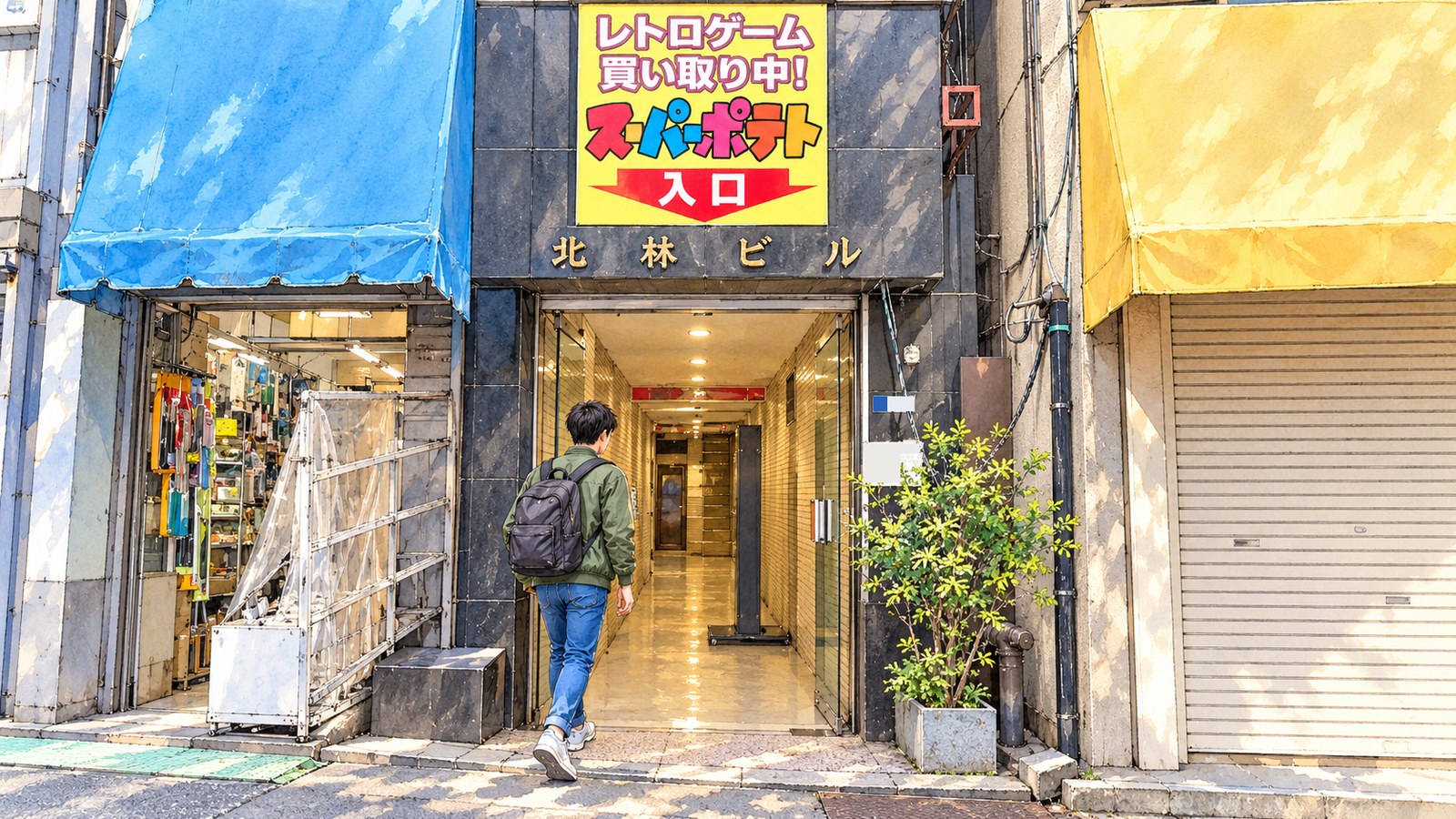
This specialty retro-game shop occupies floors 3–5 of the Kitabayashi Building. Floors 3 and 4 sell games and consoles, from the Famicom and Mega Drive to rarer systems such as the Pyuuta and handheld LCD games. A yellow sign with the store name hangs above the building entrance.
The fifth floor, at the top, is an arcade lined with nostalgic cabinets. The Chiyoda City Tourism Association says games start at ¥100 per play. Many support two-player competition. The same floor also has a dagashi snack shop and a rest area. Home consoles and arcade cabinets share the same building.
- Location
- Kitabayashi Building, 3–5F, 1-11-2 Sotokanda, Chiyoda, Tokyo
- What to expect
- Retro-game sales on floors 3 and 4; a retro arcade and rest area on floor 5 (with a dagashi snack shop)
- Hours
- 11 a.m.–8 p.m., open daily year-round
Sources: Super Potato — Akihabara store information (in Japanese) / Chiyoda City Tourism Association — Super Potato Akihabara (in Japanese)
7 ⑦ GiGO Arcade Cafe KITTE Osaka | Retro games and food at a station-connected cafe

GiGO’s arcade cafe on the sixth floor of KITTE Osaka combines dining, drinks, and games. It is about a one-minute walk from the west ticket gate at JR Osaka Station. Its concept is “A new way to enjoy yourself: drinking, eating, and playing!” Visitors can play darts before lunch or enjoy retro games while having drinks with friends.
RETRO:G’s official page calls this its “Osaka location,” alongside the Akihabara store. In Akihabara, an entire arcade floor is devoted to games; in Osaka, dining and games come together in one space. The same retro-game name has taken two different forms.
- Location
- KITTE Osaka, 6F, 3-2-2 Umeda, Kita, Osaka
- What to expect
- A cafe and restaurant combined with amusement games; RETRO:G’s Osaka location
- Hours and access
- 11 a.m.–11 p.m. daily (food last order 10 p.m.; drinks last order 10:30 p.m.); about a one-minute walk from the west ticket gate at JR Osaka Station
Sources: GiGO — GiGO Arcade Cafe KITTE Osaka store information (in Japanese) / GiGO — RETRO:G in Akihabara and Osaka (in Japanese)
Why old games can still feel new to play
Arcade cabinets, circuit boards, and controls: what each does
An arcade cabinet is the outer structure of a game machine, housing its screen and controls. A circuit board is the electronic board inside that runs the game. The control panel has a joystick and buttons that receive the player’s input. Game titles and machine names are listed separately because they refer to different things.
In an October 2026 interview, owner Ikeda said it has become difficult to find donor circuit boards for parts to repair old game boards. Previously, a cheap board could be bought and parts transferred, but there are fewer now and prices have risen. Kenichi Ishiguro, who works in game-history research and ports, explained that some games were designed for CRT monitors and cannot simply be displayed on an LCD. Storage space for boards, replacement parts, and screen life are all conditions for keeping games running.
Source: Gamer — Interview with Minoru Ikeda and Kenichi Ishiguro (in Japanese)
Rotate the screen and switch joystick directions
The EGRET II arcade cabinet debuted in 1996. The EGRET II mini recreates its shape at tabletop size, with a 4:3 LCD screen that rotates between vertical and horizontal orientations. Its joystick can also switch between four-way and eight-way movement.
Four-way controls move up, down, left, and right; eight-way controls also allow diagonal movement. Switching the screen orientation and control style lets one cabinet run games with different play styles. Taito says it developed a new LCD with this aspect ratio and built in a rotation mechanism.
At its launch on March 2, 2022, the EGRET II mini included 40 games from 1978’s Space Invaders through titles released in 1997. Additional software has since expanded the library. Mikado’s 2026 tie-in event placed the original full-size cabinet beside the tabletop device to explain it. The product combines a cabinet recreation with ports of arcade games.
Source: Taito — Development and release of the EGRET II mini (in Japanese)
When new strategies keep emerging, a release date does not tell you how old a game feels
In a 2020 interview, owner Ikeda recalled that when arcades rapidly replaced older titles with new releases, a game could remain available for only a short time. Keeping an older game running at Mikado can lead to discoveries about its techniques and strategies that players missed when it first came out. Research by players continues even though the game’s program remains unchanged.
He said younger players can access more information online than earlier generations, who relied on old magazines and word of mouth. The year someone starts playing an old game does not have to match the year they learn its strategies. Even in a fighting game released decades ago, a new player can become a formidable opponent.
Source: Minoru Ikeda — Why players keep exploring strategies in old games (in Japanese)
How developers and arcades shape the way we see the screen
- 1978Space Invaders debutsGame
- October 1986Darius is first shown at the Amusement Machine ShowGame
- February 1987Darius begins running in arcadesGame
- 1996The EGRET II cabinet debutsHardware
- 2001NECCA opens in the same building as HeyArcade
- 2004Minoru Ikeda establishes a company and produces music and strategy videosBusiness
- Around 2006Takes over an arcade in Shinjuku and operates MikadoArcade
- 2009Mikado moves to TakadanobabaArcade
- October 21, 2018Ikebukuro Game Center Mikado officially opensArcade
- August 29, 2020A Star Hunting Story tournament is officially streamed remotelyStreaming
- March 2, 2022The home-use EGRET II mini is releasedHardware
- July 31, 2025Natsuge Mikado in the Shiratori Kaikan closesArcade
- August 8, 2026Akihabara Hey2 opensArcade
- September 11–27, 2026Ten titles from Part 2 run for a limited time; the event has now endedEvent
- Scheduled for March 25, 2027Arcade Collection Part 2 is scheduled for releaseHardware
Tomohiro Nishikado
A developer who joined Taito as an electrical-circuit designer, then moved from electromechanical games using moving mechanisms to video games. He created Space Invaders (1978) and Space Cyclone (1980).
Minoru Ikeda
Owner of Game Center Mikado. After graduating from high school, he worked at a game center and founded a company in 2004. After producing soundtracks and strategy DVDs, he opened an arcade where customers can play from his circuit-board collection.
The feel of Space Invaders, created by Tomohiro Nishikado
Space Invaders debuted in 1978. Its developer, Tomohiro Nishikado, joined Taito as an electrical-circuit designer and worked on electromechanical games using moving mechanisms before taking on video games. He learned programming again when production required it, handling everything from planning to programming on his own.
Nishikado recalled that he also had to build the systems needed to run the games. When Yuichi Toyama later worked on a reissue, he said reproducing the sound was a challenge. On the original machines, the sound could change depending on the condition of the same cabinet and how long it had been powered on. For the reissue, Masahiro Ishikawa of Taito’s sound team ZUNTATA decided how the sound should be recreated.
Sources: Famitsu — Development interviews with Tomohiro Nishikado and Yuichi Toyama (in Japanese) / Taito — Official company timeline (in Japanese)
How tabletop cabinets spread to coffee shops
Nishikado said the Space Invaders tabletop cabinet was not originally designed specifically for coffee shops. The operator’s idea was to make it compact so more machines could fit into a small space, and coffee shops adopted it as a result. Looking down at a game on a table created a different playing posture from standing in front of a cabinet.
The game’s popularity also affected the machines’ interiors. The coin box was enlarged to about four times the usual capacity, but the developer recalled that it still was not enough. Places to play also expanded from bowling alleys and corners of hot-spring resorts to “Invader Houses” filled with games.
Nishikado said that even during the boom, he was thinking about improving the graphics performance of the next circuit board. Promotion and manufacturing to spread a finished game and meet demand took place alongside development work to create the next screen.
Source: Famitsu — Interview with Tomohiro Nishikado and Yuichi Toyama (in Japanese)
Reissuing the voice-enabled Space Cyclone
Space Cyclone (1980) was also created by Tomohiro Nishikado. It was developed using the Space Invaders circuit board and made use of its sound capabilities. A woman who sat next to Nishikado during development provided the voice. When the enemies descend to the bottom of the screen and the rocket is complete, a voice announces that it is ready to launch.
Nishikado said he repeatedly adjusted the game based on feedback from skilled test players, and later felt he had made it too difficult. Yuichi Toyama, who worked on its home reissue, said few copies had shipped and he had not even heard of the game as a child in Nagasaki. Taito’s surviving circuit board was sent to the development company, enabling the port.
For a reissue, the number of circuit boards that survive matters as much as a game’s popularity. Even a game that had a small release can be experienced firsthand—its graphics, sound, and difficulty—if its hardware still works. Space Cyclone is an example of a developer’s memories meeting a surviving circuit board.
Source: Famitsu — Development and porting of Space Cyclone (in Japanese)
Mikado began as a project by someone who loved games
After graduating from high school, owner Ikeda began working at a game center. When he started a company in 2004, he did not have the funds to open a location, so he produced manufacturer-authorized soundtrack CDs and strategy DVDs. After about two years of work drawing on his experience editing music and video, he bought the Shinjuku Kabukicho arcade where he had been a hired manager, around 2006.
In 2009, the building’s lease ended after the property was sold, and Mikado moved to Takadanobaba. Ikeda’s work expanded from collecting circuit boards for games he loved to producing music and strategy videos and operating an arcade.
Source: Famitsu — Owner Ikeda looks back on Mikado’s beginnings (in Japanese)
Games gathered from hot-spring towns, and Darius from Sendai
Owner Ikeda also traveled to hot-spring towns around Japan looking for old games. To acquire an Out Run cabinet that had remained at an arcade, he brought a newer Ridge Racer and negotiated an exchange. By matching the needs of people looking to dispose of old machines with those searching for them, he moved the cabinets to a new home.
Mikado’s Darius cabinet had been used at the Sendai arcade Playland F1-R. Owner Ikeda was offered the machine by its owner and went to inspect it. It was worn and expensive, and he hesitated, but he decided to buy it because Darius was essential to opening the arcade.
Darius was first shown at the Amusement Machine Show in October 1986 and began running in arcades in February 1987. Taito marks October 7, the date of its debut, as a milestone. The work of passing on a large cabinet and recording the date its game was created keeps one machine’s history alive.
Sources: Famitsu — Owner Ikeda on acquiring the cabinet (in Japanese) / Taito — Darius announcement and arcade debut (in Japanese)
Gradius III disappears from arcades, leading to a circuit-board purchase
Owner Ikeda first began buying game boards after his favorite Gradius III disappeared from arcades. A technique for becoming invincible had been found, reducing the number of arcades keeping the game running, so he decided he needed to own a board himself.
But when he played it at home, the room’s fluorescent light reflected off the screen, and it did not feel like playing at an arcade. He said he ended up returning to game centers. Owning the board also helped him understand its settings switches and internal mechanisms. The machines he collected to play later became a source of knowledge for building an arcade.
In a 2018 interview, Ikeda said Mikado uses circuit boards so customers can play, not simply to display them. Darius, which was quickly replaced by a newer release when it first came out, has remained playable at Mikado for years. A game’s release date and the years it has been played at a particular arcade are separate histories.
Source: Famitsu — Owner Ikeda on collecting circuit boards and running Mikado (in Japanese)
Hey’s history also reflects how people play in the city
Taito’s official timeline records the opening of NECCA, an internet cafe with high-performance PCs, in 2001, including a location in the building where Hey is now. At a time when home internet and PC setups were less common, a different kind of gaming venue using computers shared a building with an arcade.
Sources: Taito — Timeline entry on its 2001 venue (in Japanese) / Taito — Hey2 opening announcement (in Japanese)
Streams do not show only perfect play
Mikado’s streams do not always show only impressive strategies. In a 2018 interview, owner Ikeda said that to make viewers want to play, he sometimes shows himself struggling through a game on purpose. Rather than ending with admiration for perfect technique, the stream shows the challenge, including mistakes.
Some customers aim for the top score in the country, while others return to games they could not finish when they were young. Some revisit a title they initially dismissed when it was released. The work of introducing games on video not only preserves old footage; it can also prompt someone to put a coin into the game today.
Source: Famitsu — About streaming shoot-’em-ups (in Japanese)
Watch a tournament continue remotely beyond the arcade
Mikado’s official channel has footage of a remotely streamed Super Street Fighter II X tournament held at Star Hunting Story on August 29, 2020. Commentary was added from a location separate from the arcade where the players competed, and the matches were delivered to viewers.
Sources: Game Center Mikado official website — Streaming channel (in Japanese) / Interview with owner Ikeda about remote commentary (in Japanese)
Natsuge Mikado closes as home reissues expand
Natsuge Mikado closed on July 31, 2025
The Mikado x Natsuge Museum arcade, known as Natsuge Mikado, in Shiratori Kaikan in Takadanobaba closed on July 31, 2025. It was a different location from Takadanobaba Game Center Mikado in the Oasis Plaza Building.
The official closure announcement cites the end of its lease and says some cabinets would be moved to the Takadanobaba and Ikebukuro locations. It also expresses the intention to restart somewhere else.
Source: Natsuge Mikado — Official closure announcement (in Japanese)
Keep playing games at the arcade and at home in different ways
Released on March 2, 2022, the EGRET II mini is a home-use device that recreates the 1996 arcade cabinet at tabletop size. Its small screen rotates so players can play games in either vertical or horizontal orientation. It brings the cabinet’s distinctive feature from the arcade to a home desk.
Scheduled for release on March 25, 2027, Arcade Collection Part 2 includes 10 titles from Universal and Irem. It is an add-on software pack bringing together games from early-1980s action to 1990s shooters and side-scrolling beat-’em-ups.
Sources: Taito — EGRET II mini release and design (in Japanese) / Taito — Part 2 planned release and game lineup (in Japanese)
Akka & Blue moves from smartphone to arcade
Akka & Blue is a Tanosimasu shoot-’em-up released for iOS and Android in 2017. The arcade version was released as Akka & Blue Type-R. Unlike a port that takes a game from the arcade to home, this is an example of a game born on smartphones becoming a game played with a joystick and buttons at an arcade.
Owner Ikeda also helped launch exA-Arcadia, an arcade circuit-board system based on PC technology that can run four games. In a 2018 interview, he talked about the response to a location test of Akka & Blue Type-R at Mikado and said he sensed demand among customers who play shoot-’em-ups.
A game center does more than buy finished games; it can also give customers a chance to try works in development. The response from players who gather at the arcade can be sent back to developers before a product is released. Mikado’s work includes both keeping old circuit boards running and helping new games reach arcade players.
Source: Famitsu — New arcade hardware and location testing (in Japanese)
A fall 2026 event runs 10 games at once
Titles shown at “Super Real Arcade Collection Part 2” included Cheeky Mouse (1980), Lady Bug (1981), Snap Jack (1982), and Mr. Do! vs. Unicorn (1983). All are Universal action games. The event brought together different titles released in successive years for visitors to play in one arcade.
A distinctive feature of the event was that the games ran on original Taito arcade cabinets, taking coins and operating like a regular arcade—not on demo machines for a home reissue. It was held on the first floor of the Takadanobaba location for 17 days, linking the publisher’s announcement of the collection with hands-on play in an arcade.
Source: Taito — Dates, venue, and titles in the joint event (in Japanese)
The building where Hey began also housed a PC gaming space
Akihabara Hey began with a few game machines placed there on a rental basis. Later, it rented floors 2–4 of the building, with floors 2 and 3 as the arcade and floor 4 as NECCA. Opened in July 2001, NECCA was a high-performance PC gaming venue inspired by PC bangs that had spread in South Korea.
The same building, which also hosted home-game events, brought together real arcade machines and PC games. For Hey’s 25th-anniversary campaign in 2026, capsule toys featuring past Hey logos were also released. Alongside the games’ histories, the signs of the arcade people visited have accumulated their own history.
From Darius’s dedicated board to game-music albums
Darius, known for its large three-screen cabinet, was first shown at the Amusement Machine Show in October 1986 and began running in February of the following year. At the time, developers created dedicated circuit boards for each game. Taito recalls that the cost of manufacturing proprietary chips became an issue, and it later moved toward developing boards that could be used for multiple games.
The music also reached beyond the arcade. The name of Taito’s sound team, ZUNTATA, first appeared publicly on the June 1987 release of TAITO GAME MUSIC VOL. 2: DARIUS. The team itself was formed in 1983. The culture of listening to in-game music on an album and the immersive experience of sitting inside a large cabinet came together with this game.
How arcade players’ response led to more Densha de Go! units
Densha de Go!, released in March 1997, was not originally expected to be mass-produced. Taito’s retrospective says some people inside the company doubted it would sell, so the initial production run was limited. Popularity in arcades and coverage on television led to additional orders every month.
This is an example of players’ responses after inserting a coin changing how many units were made next. Mikado’s support for location tests of new games is also part of this back-and-forth between development and arcades. The business keeps old games playable and also gives people a place to try upcoming releases and send feedback to their makers.
Sources: Taito — 70 years of company history (in Japanese) / Taito — Hey’s 25th anniversary and Hey2 opening (in Japanese)
Research note | A business perspective: give people a reason to play in arcades through reissues
Taito and Mikado’s September 2026 event made 10 titles from a reissue planned for the following year playable on actual cabinets in advance. The useful idea was not simply to show the product but to give people time to operate the games and see what made them fun.
The original cabinets were run in the arcade to coincide with sales of the home reissue. The event connected a home product with play at a physical location using the same group of titles. A store with a long-collected circuit-board library and equipment to run it could offer hands-on access to all 10 games together.
Source: Taito — Joint event with Mikado (in Japanese)
FAQ
Which exit is closest to Takadanobaba Mikado?
It is about a 30-second walk from the Toyama Exit of JR Takadanobaba Station. It is about 45 seconds from Exit 1 of Tokyo Metro and about a one-minute walk from the Waseda Exit of the Seibu Shinjuku Line.
Are Takadanobaba Mikado and Natsuge Mikado the same arcade?
No. Natsuge Mikado in Shiratori Kaikan closed on July 31, 2025. Takadanobaba Game Center Mikado is on the first and second floors of the Oasis Plaza Building.
When did Ikebukuro Mikado open?
It officially opened on October 21, 2018. It took over the Rumble Plaza arcade near Ikebukuro Station’s East Exit and began operating about three weeks before the formal opening while the interior was being arranged.
Are the games at Hey and Hey2 different?
Hey has retro video games, rhythm games, large video-game cabinets, and more. Hey2, which opened in August 2026, focuses on crane games. The two locations are next to each other.
When did the Arcade Collection Part 2 event take place at Mikado?
It ran at the Takadanobaba location from September 11–27, 2026. The home-use add-on software is scheduled for release on March 25, 2027.
Where else can I play older games besides Mikado and Hey?
In Akihabara, RETRO:G on the sixth floor of GiGO Akihabara Building 3 is dedicated to retro games, and Super Potato Akihabara has an arcade on its fifth floor. In Osaka, GiGO Arcade Cafe KITTE Osaka on the sixth floor of KITTE Osaka, directly connected to JR Osaka Station, is RETRO:G’s Osaka location.
What are Hey and Hey2’s hours?
Both are open daily from 10 a.m. to 11:30 p.m. Hey is on floors 1–4 of the Hirose Head Office Building, and Hey2 is on the first floor of the adjacent Building No. 2.
Can the EGRET II mini screen be rotated vertically?
Yes. The screen rotates to support games in both vertical and horizontal orientations. The home-use device recreates Taito’s 1996 EGRET II arcade cabinet at tabletop size.


