
Film "Kokuhou" Pilgrimage Guide: Izushi Eirakukan, Biwako Otsukan, Kyoto Kaburenjo Theaters & Dojo-ji Temple
In the theatrical film Kokuhou, kabuki actor Kikuo Tachibana steps onto the stage at the historic playhouse Izushi Eirakukan, while lakeside Biwako Otsukan provides the grand exterior of the fictional kabuki theater 'Hinomoto-za,' and Kyoto's Pontocho and Kamishichiken Kaburenjo theaters serve as backstage dressing rooms and stages. The story of Kikuo competing in art alongside his master's biological son, Shunsuke Ogaki, was brought to the screen by combining active traditional theaters and public cultural facilities across western Japan.
At Restaurant Hyakkaen in Yawata, Kyoto—where a key dining scene was filmed—visitors can sit down to enjoy hamburger steak and omurice, while Hotel Ito in Wakayama Prefecture lets diners look out from its top-floor restaurant over the same cityscape of Iwade seen in Kikuo's rooftop dance scene, and Dojo-ji Temple shares the ancient legend behind the kabuki dance drama performed on screen. Here we guide you through all 11 filming locations, exhibition venues, and repertoire landmarks along with their visitor rules.
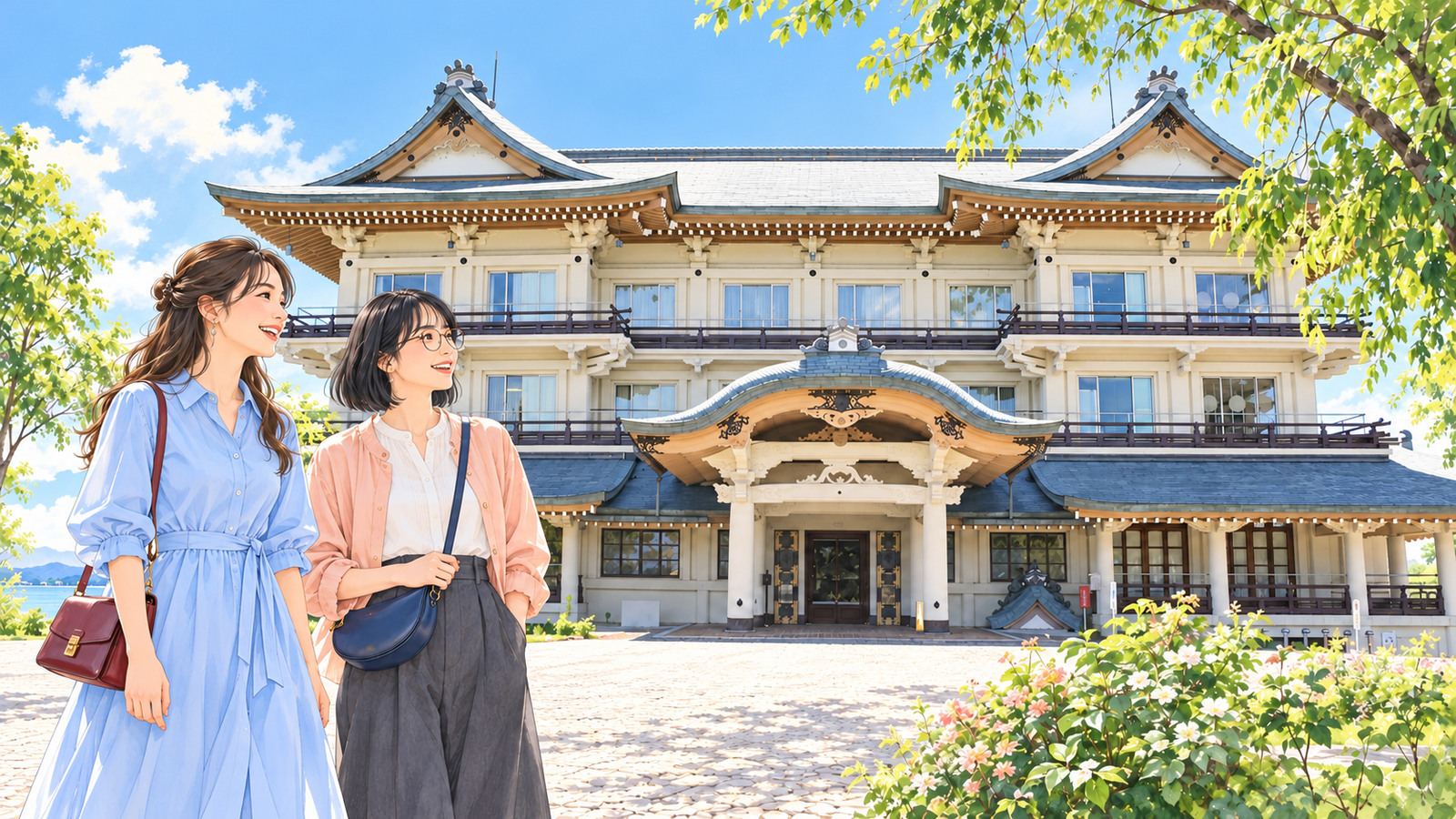
Visiting the Theaters, Bridges, Diner, and Temple Tied to the Film’s Kabuki Repertoire
① Biwako Otsukan · Otsu, Shiga
Filming location for the exterior of Hinomoto-za and lobby rehearsal scenes, where visitors can also dine overlooking Lake Biwa.
Read the Complete Pilgrimage Guide & Access Notes for Biwako Otsukan (Otsu, Shiga)② Izushi Eirakukan · Toyooka, Hyogo
The historic playhouse where Kikuo and Shunsuke's 'Futari Fujimusume' dance and dressing room scenes were filmed; offers public tours and special film exhibits.
Read the Complete Pilgrimage Guide & Access Notes for Izushi Eirakukan (Toyooka, Hyogo)③ Izushi Karo Yashiki · Toyooka, Hyogo
A public heritage residence in Izushi hosting a special Kokuhou film exhibition alongside nearby Eirakukan.
Read the Complete Pilgrimage Guide & Access Notes for Izushi Karo Yashiki (Senior Retainer's Residence) (Toyooka, Hyogo)④ Tamate Bridge · Kashiwara & Fujiidera, Osaka
The suspension bridge with white towers and red railings where scenes from the protagonists' youth and adulthood were filmed.
Read the Complete Pilgrimage Guide & Access Notes for Tamate Bridge (Kashiwara & Fujiidera, Osaka)⑤ Kamishichiken · Kyoto, Kyoto
Filming site for the stage of Naniwa-za, rehearsals, and the audience seating during 'Sonezaki Shinju.'
Read the Complete Pilgrimage Guide & Access Notes for Kamishichiken Kaburenjo Theater (Kyoto, Kyoto)⑥ Pontocho · Kyoto, Kyoto
Used for the stage door and backstage dressing rooms of Naniwa-za; hosts traditional Kyoto dance performances during seasonal runs.
Read the Complete Pilgrimage Guide & Access Notes for Pontocho Kaburenjo Theater (Kyoto, Kyoto)⑦ Bunraku Theatre · Osaka, Osaka
Filming site for the backstage corridor scene where Kikuo walks toward the stage dressed for 'Sagi Musume'; hosts bunraku performances and free exhibitions.
Read the Complete Pilgrimage Guide & Access Notes for National Bunraku Theatre (Osaka, Osaka)⑧ Restaurant Hyakkaen · Yawata, Kyoto
The classic Western-style diner where Kikuo and Akiko eat together on screen, serving iron-plate hamburger steak and omurice.
Read the Complete Pilgrimage Guide & Access Notes for Restaurant Hyakkaen (Yawata, Kyoto)⑨ Imamiya Shrine · Kyoto, Kyoto
A historic shrine in Murasakino, Kyoto used for location filming; visitors can stroll the approach and worship freely.
Read the Complete Pilgrimage Guide & Access Notes for Imamiya Shrine (Kyoto, Kyoto)⑩ Hotel Ito · Iwade, Wakayama
Filming site for the rooftop dance and guest room scenes; while the rooftop is off-limits, guests can dine at the top-floor restaurant.
Read the Complete Pilgrimage Guide & Access Notes for Hotel Ito (Iwade, Wakayama)⑪ Dojo-ji Temple · Hidakagawa, Wakayama
The temple tied to the legend behind 'Futari Dojoji,' where visitors can listen to live picture-scroll storytelling of Anchin and Kiyohime.
Read the Complete Pilgrimage Guide & Access Notes for Dojo-ji Temple (Hidakagawa, Wakayama)
1Biwako Otsukan: Exterior of ‘Hinomoto-za’ and Lobby Rehearsal Scenes
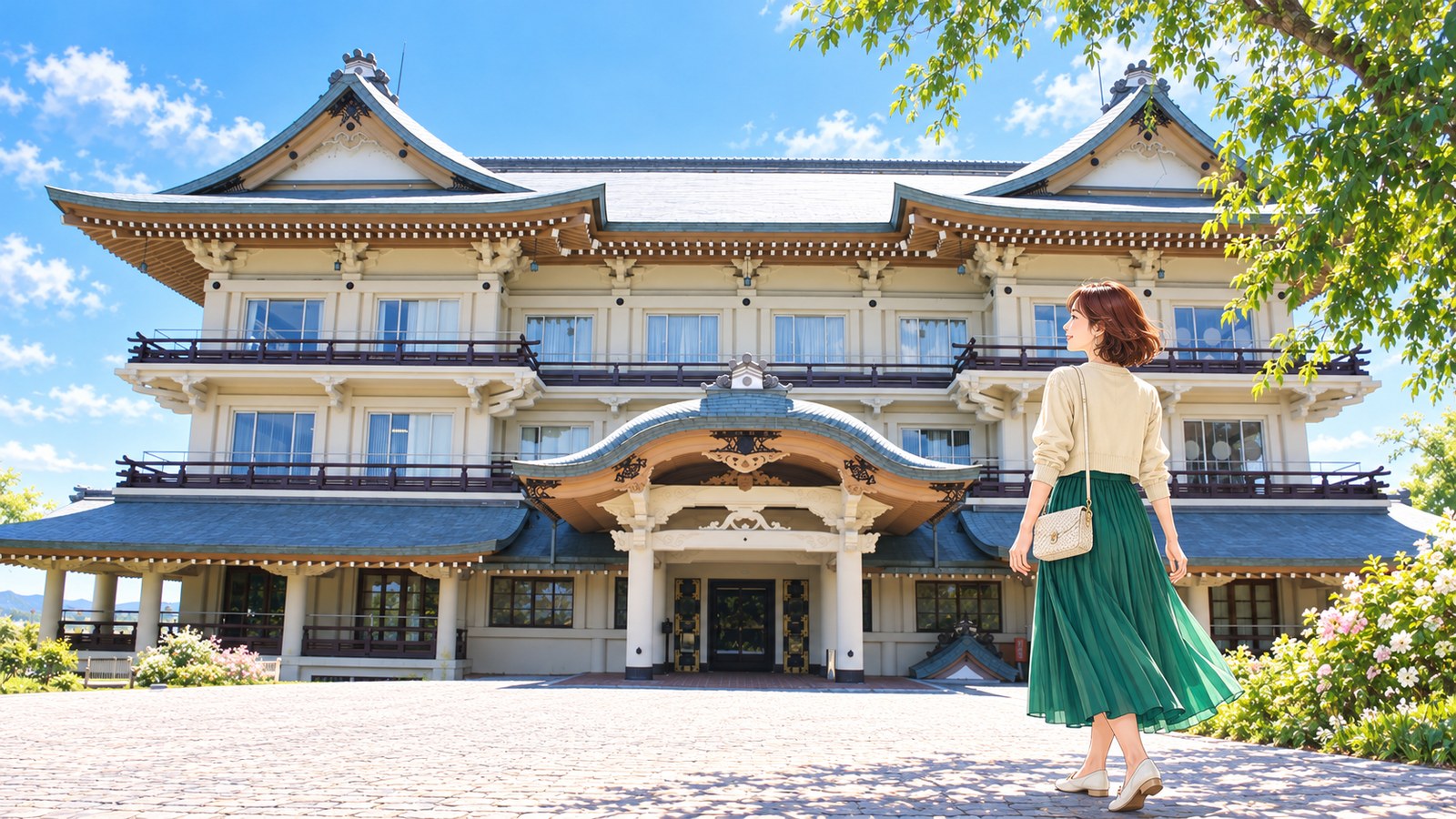
Located on the shore of Lake Biwa in Otsu, Shiga Prefecture, Biwako Otsukan appears in the film as the kabuki theater 'Hinomoto-za,' providing both the grand theater exterior and the lobby space where actors rehearse.
Originally built as the former Biwako Hotel, the building was designed by the Okada Architectural Office—which also designed Tokyo's Kabukiza Theatre. Pairing traditional Japanese tiled roofing on the outside with Western-style architectural detailing inside right beside the lake, its unmistakable theater-like silhouette was a key reason it was chosen as a filming location.
Today the building operates as a public cultural facility housing a restaurant and rental rooms, and visitors can also stroll through the lakeside English Garden next door (separate admission fee required).
Following the film's theatrical release, a panel exhibition of scene photographs was held in the 1st-floor lobby; please note that this location panel exhibition has now concluded.
Sources: Shiga Prefecture — Kokuhou Filming Locations in Shiga / Biwako Otsukan Official Website
2Izushi Eirakukan: The Historic Playhouse Where Kikuo and Shunsuke Dance ‘Futari Fujimusume’
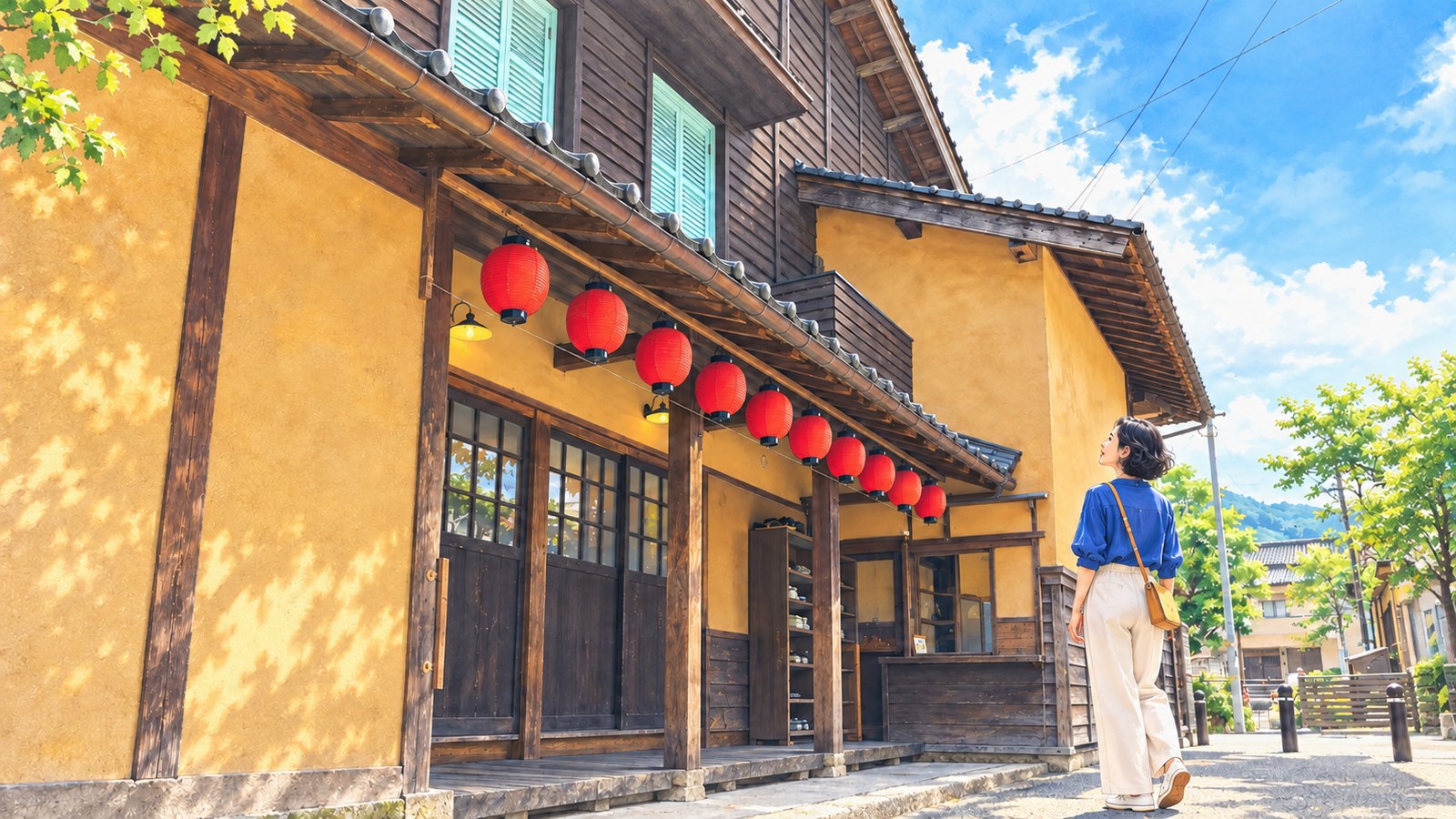
At Izushi Eirakukan in Toyooka, Hyogo Prefecture, the production filmed the stage sequence in which Kikuo and Shunsuke dance 'Futari Fujimusume' together as well as backstage dressing room scenes. An active historic playhouse that still stages live kabuki performances today, Eirakukan welcomes general sightseeing tours on days when no performances or private rentals are taking place.
A special Kokuhou exhibition has also resumed inside the playhouse, allowing visitors to view props and materials used in the production.
Since its reopening celebration performances in 2008, Eirakukan has hosted annual regional kabuki runs. At the 15th Eirakukan Kabuki in 2025, performers Kataoka Ainosuke VI and Nakamura Kazutaro spoke warmly about the playhouse's appearance in the film and their attachment to the historic theater.
Because visitor access differs between non-performance tour days and ticketed performance days—and general tours are suspended on regular closing days, performance dates, and private rental days—always check the official Eirakukan calendar before visiting (address: 17-2 Yanagi, Izushi-cho, Toyooka).
Sources: Kansai Wide-Area Filming Location Map / Tajima Izushi Tourist Association — Special Film Exhibition / Shochiku — 15th Eirakukan Kabuki / Toyooka City — Stage & Dressing Room Filming at Eirakukan
3Izushi Karo Yashiki: Special Film Exhibition Held Alongside Eirakukan
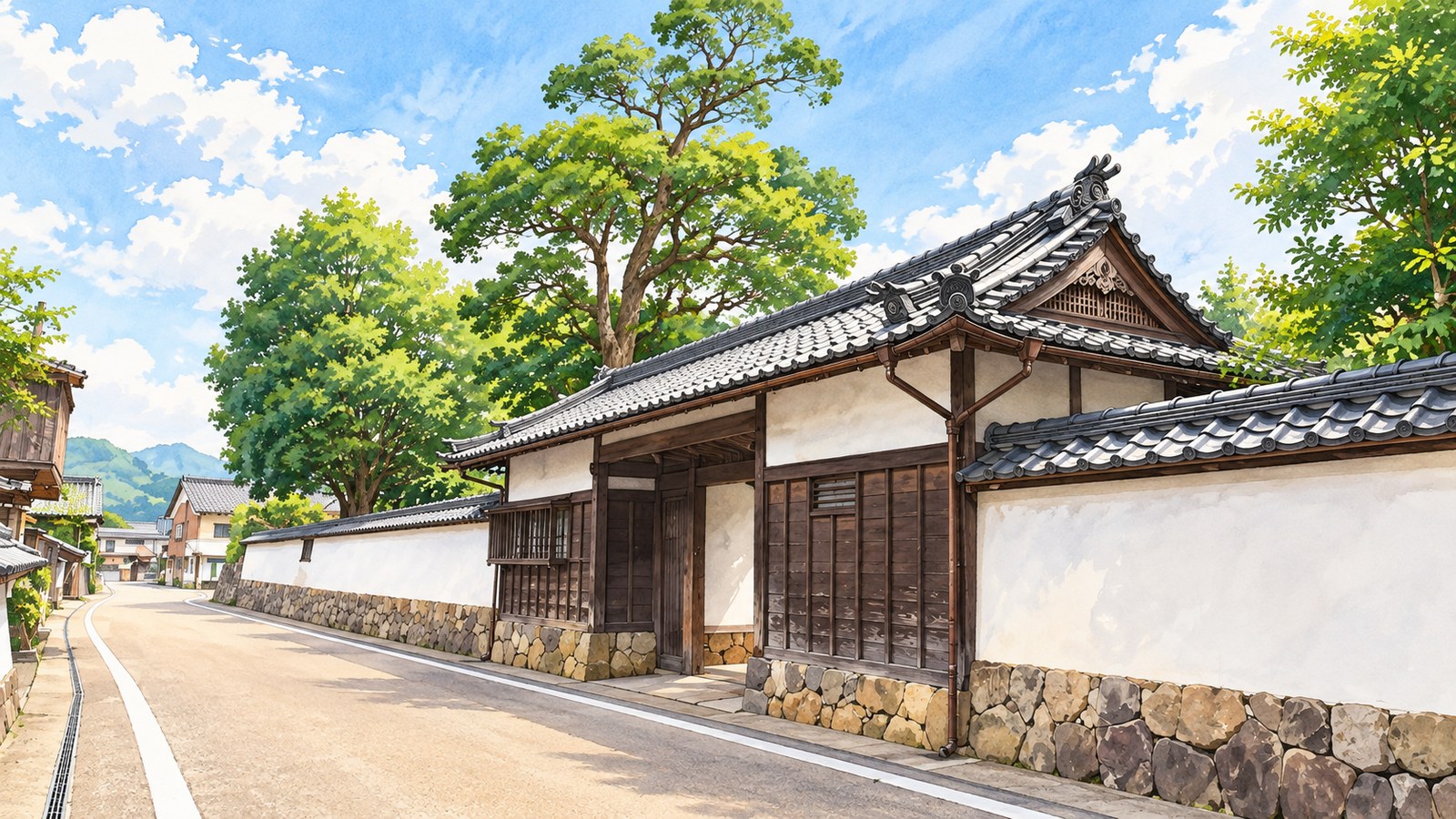
Located a short walk away in the same castle town, Izushi Karo Yashiki (the Senior Retainer's Residence) hosts a parallel special exhibition of Kokuhou materials alongside Izushi Eirakukan.
Framed by white earthen walls and a traditional nagayamon gate, this public heritage building preserves the residence of a high-ranking Edo-period samurai. Although it appears single-story from the street, a hidden staircase inside leads to a low-ceilinged second floor, and visitors can also view historical maps of the Izushi castle town and daimyo procession regalia.
Located at 98-9 Uchimachi, Izushi-cho, Toyooka, the residence operates on different hours and closing days from Eirakukan, so check the tourist association's latest exhibition schedule before visiting.
Sources: Tajima Izushi Tourist Association — Special Kokuhou Exhibition / Izushi Karo Yashiki Facility Guide
4Tamate Bridge: The White-Towered, Red-Railed Suspension Bridge Over the Ishikawa River
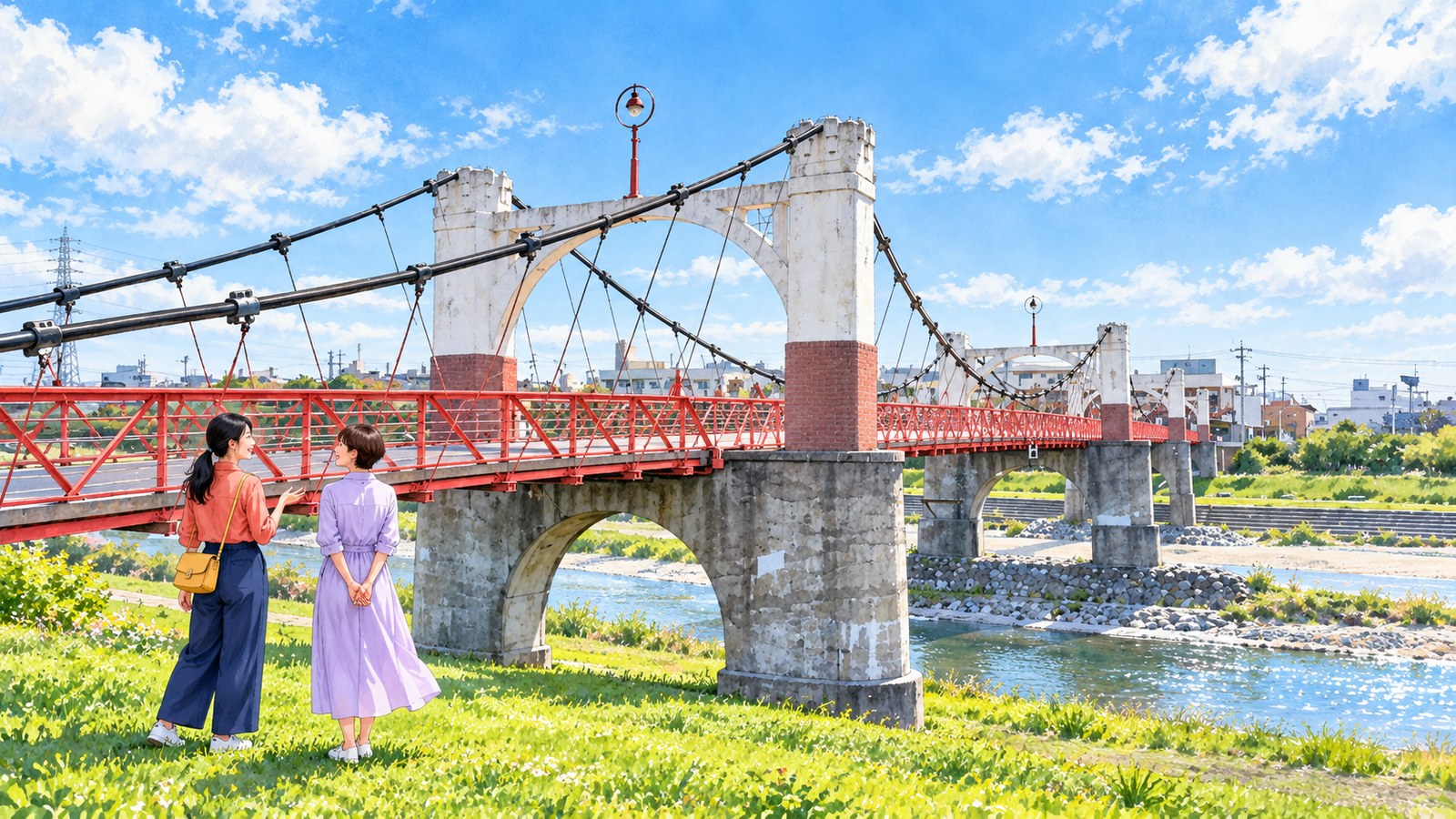
Spanning the Ishikawa River between Kashiwara City and Fujiidera City in Osaka Prefecture, Tamate Bridge is a suspension footbridge crowned by white towers. Used as an outdoor filming location for Kokuhou—and highlighted in Kashiwara City's municipal newsletter—its open views of river and sky offer a striking contrast to the film's interior theater scenes.
Supported by four pairs of white castle-like towers with bright red railings, the bridge was originally constructed to carry visitors from Domyoji Station to the former Tamateyama Amusement Park, and continues to serve local commuters and students every day even after the park's closure.
From the deck of the bridge, visitors can look out along the flowing Ishikawa River and both banks; when taking photographs, always leave plenty of room for local pedestrians and cyclists crossing the bridge.
Sources: Kashiwara City — Tamate Bridge / Koho Kashiwara (June 2025 Issue) — Kokuhou Filming Location Feature
5Kamishichiken Kaburenjo: Actors in Rehearsal and the Audience Seats for ‘Sonezaki Shinju’
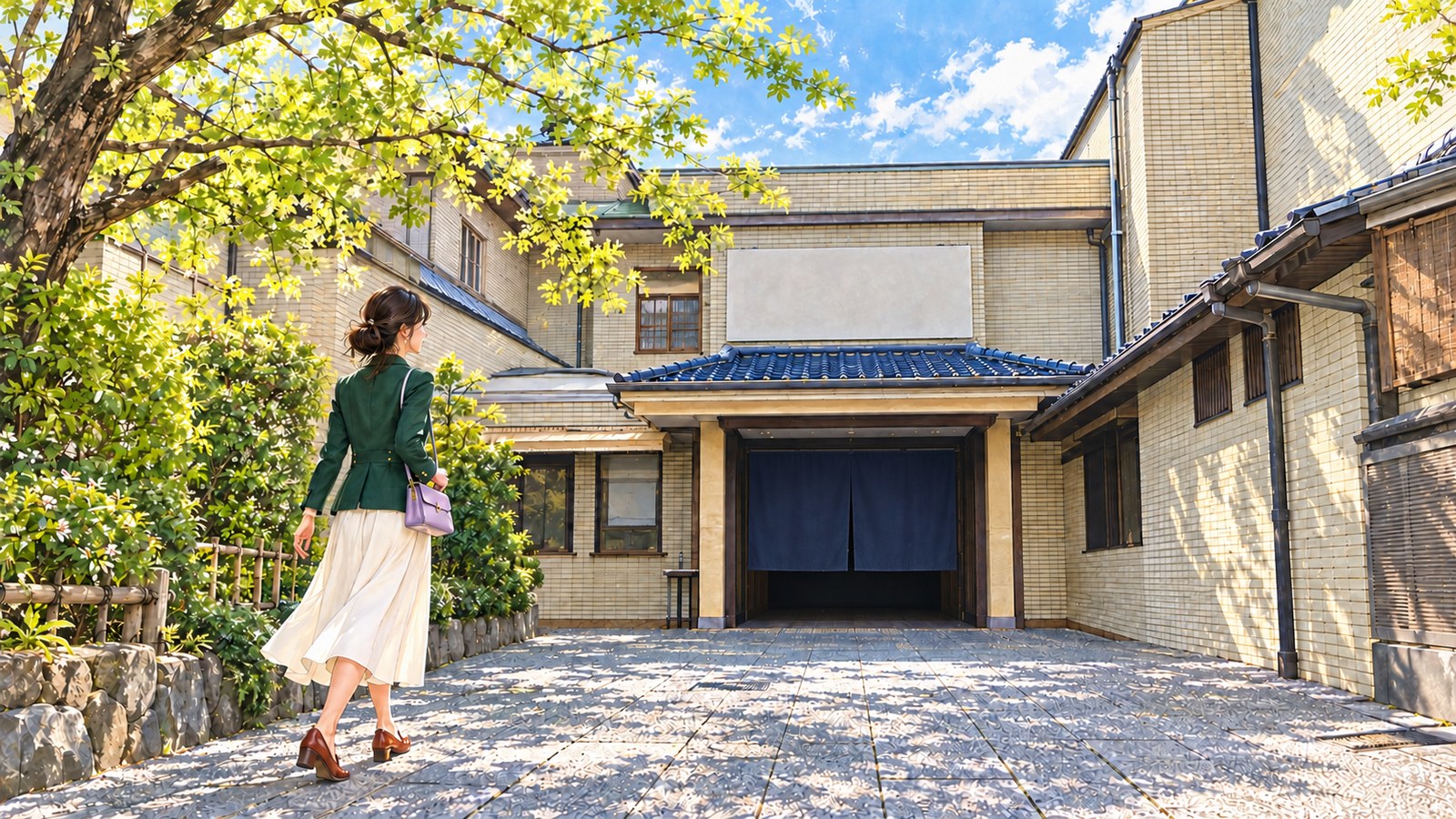
At Kamishichiken Kaburenjo Theater in Kyoto, the production filmed stage and wing sequences set inside the fictional 'Naniwa-za' theater—including actors rehearsing on stage and the scene in which Shunsuke and Kikuo's childhood friend Harue Fukuda watch Kikuo perform 'Sonezaki Shinju' from the audience seats, capturing both the performer's perspective and the spectator's gaze within the same theater.
Extending east of Kitano Tenmangu Shrine, Kamishichiken is one of Kyoto's historic hanamachi (geiko and maiko districts), and its Kaburenjo theater is where geiko and maiko present the fruits of their daily training in seasonal dance performances.
Right next to the theater within the same grounds stands the small shrine Mitsumori Daimyojin, which also connects to the scene where Harue visits the rehearsal hall. In everyday operation, visitors can view the exterior of the theater, while entry inside the auditorium is limited to scheduled dance performances and special openings.
Sources: Kyoto Media Support Center — Kamishichiken Filming Scenes / Kyoto Prefecture Tourism Federation — Kamishichiken Guide
6Pontocho Kaburenjo: Stage Door and Dressing Rooms of ‘Naniwa-za’
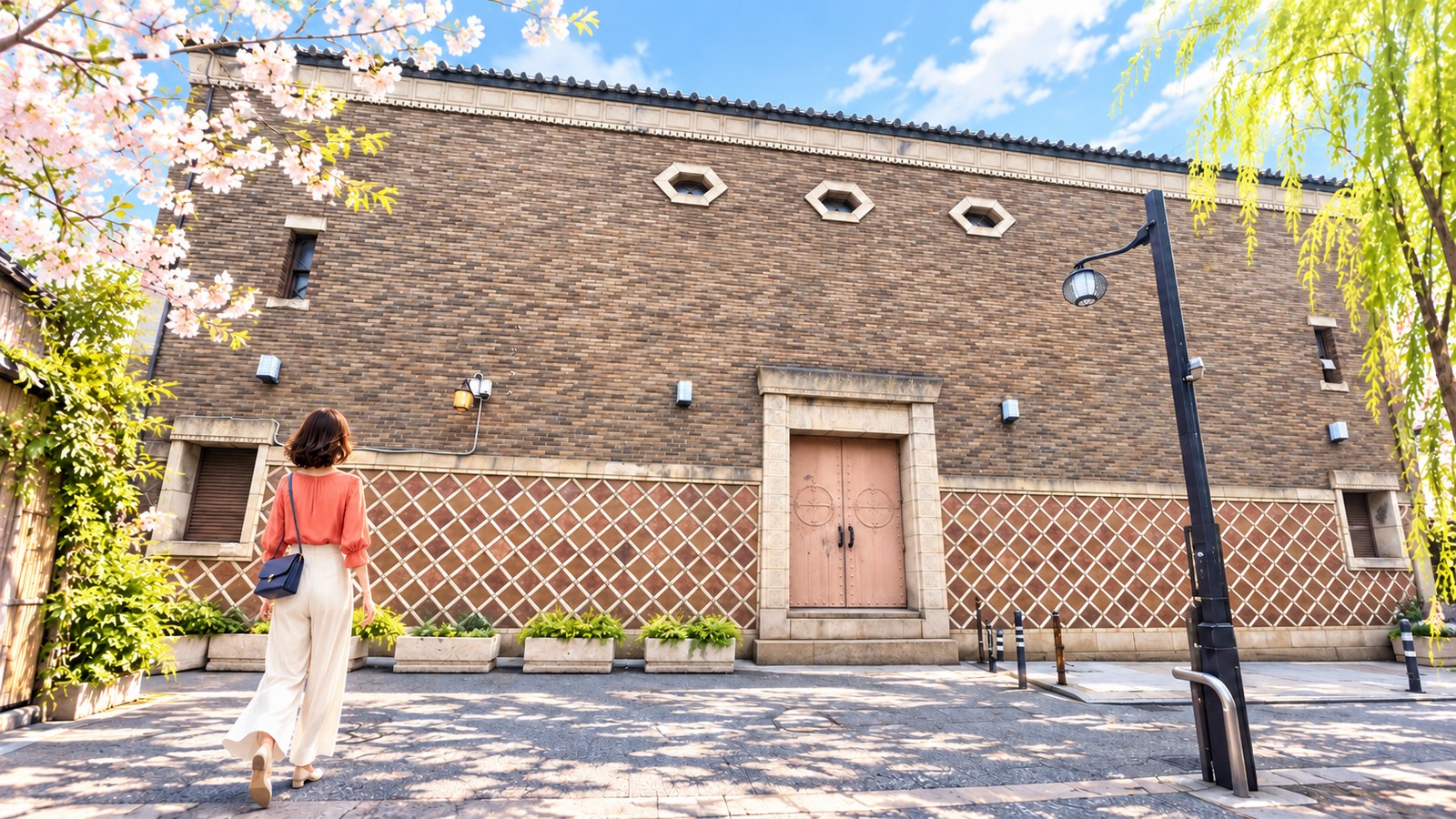
Kyoto's Pontocho Kaburenjo Theater served as the stage door and backstage dressing rooms of 'Naniwa-za' in the film, appearing when young Kikuo and his master's wife Sachiko Ogaki step out of a car to enter the stage door, as well as in dressing room scenes featuring the adult Kikuo and his master Hanjiro Hanai.
Completed in 1927, Pontocho Kaburenjo serves as the home venue for the 'Kamogawa Odori' and 'Suimeikai' dance performances staged by the geiko and maiko of Pontocho. Although portrayed as a kabuki theater on screen, in real life it is a cornerstone of Kyoto's hanamachi dance culture.
Standing in front of the building lets visitors match the entrance architecture with the scenes of characters arriving at the theater. Because backstage dressing rooms are working spaces for performers and not open for general sightseeing, interior visits are limited to attending scheduled performances or public events.
Sources: Kyoto Media Support Center — Kokuhou Filming Locations / Pontocho Kabukai Official Website
7National Bunraku Theatre: Walking Backstage in Costume as ‘Sagi Musume’
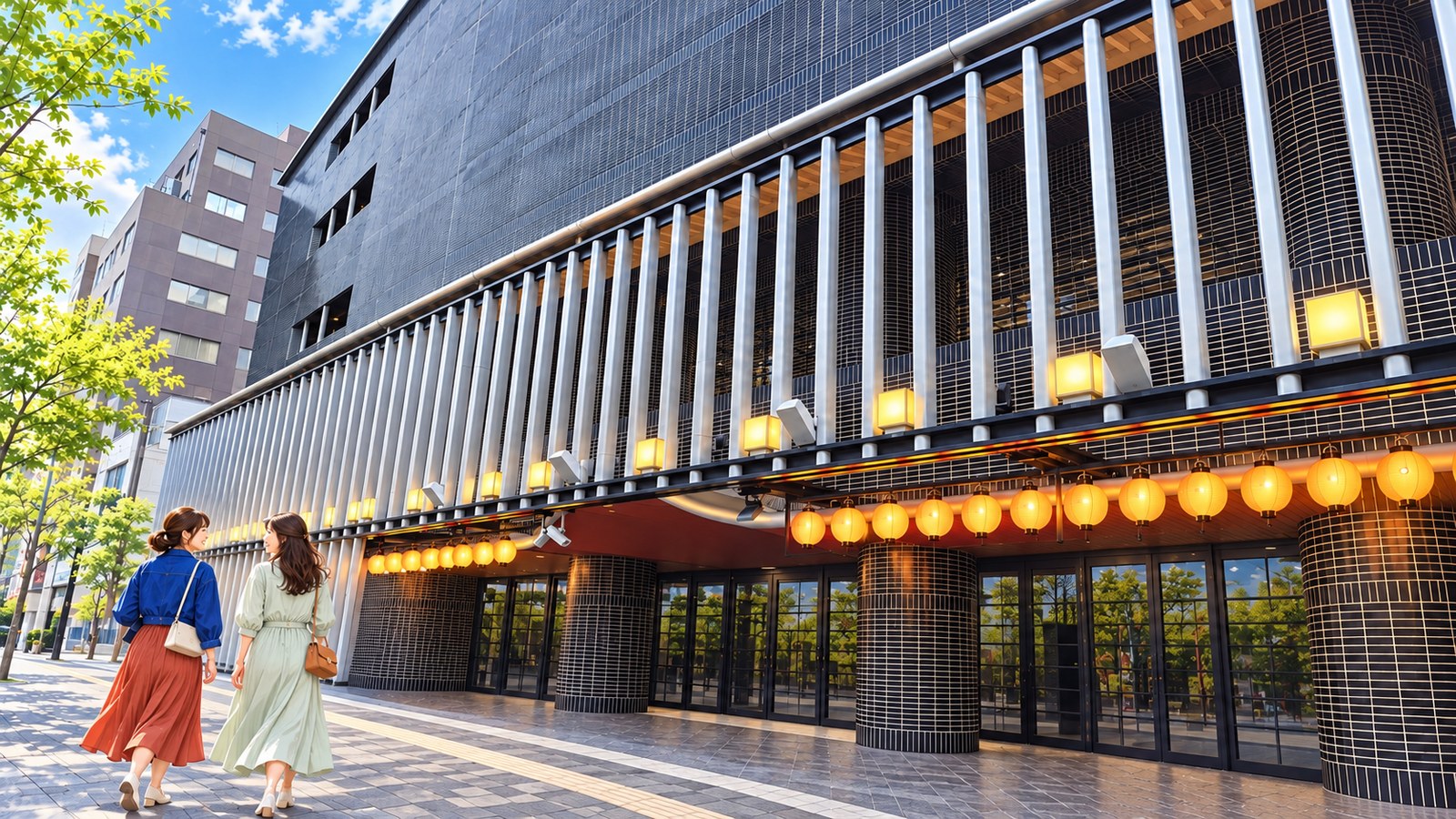
At the National Bunraku Theatre in Nipponbashi, Osaka, the production filmed the dramatic backstage sequence in which Kikuo, dressed in the white costume of 'Sagi Musume' (The Heron Maiden), walks toward the stage.
The National Bunraku Theatre is Japan's premier venue dedicated to bunraku puppet theatre and traditional performing arts. While bunraku portrays human drama through three-person puppeteers, a chanter (tayu), and shamisen music rather than live actors, classic works such as 'Sonezaki Shinju' are performed across both bunraku and kabuki.
Inside the building, alongside the main auditorium and small hall, an exhibition room displays puppets and stage materials on scheduled opening days (note that the backstage corridor used for filming is not part of the public exhibition route).
Located at 1-12-10 Nipponbashi, Chuo Ward, Osaka, the theatre sells tickets by program for stage performances while announcing exhibition room schedules separately by theme; check both calendars before visiting.
Sources: Kansai Wide-Area Filming Location Map / National Bunraku Theatre Official Site / National Bunraku Theatre — Facility Guide
8Restaurant Hyakkaen: The Retro Western Diner Where Kikuo and Akiko Share a Meal

At Restaurant Hyakkaen in Yawata, Kyoto Prefecture, the crew filmed the scene where Kikuo and Akiko—the daughter of a kabuki actor—share a casual meal together. In the scene, Ryo Yoshizawa (playing Kikuo) eats a hamburger steak platter with fried shrimp, while Nana Mori (playing Akiko) eats omurice.
Opened in 1964 as a roadside drive-in, Hyakkaen is a classic Western-style Yoshoku diner that still preserves its original U-shaped counter lined with retro blue and orange stools—providing an everyday setting where the two characters sit together in street clothes away from stage costumes and makeup.
Served sizzling on an iron plate, the restaurant's hamburger steak is topped with rich house demi-glace sauce, which is also ladled generously over its signature omurice. Visitors can dine on the exact dishes featured in the film; check the restaurant's latest notices for operating hours and daily serving limits.
Located at 14-1 Yawata Ikenokubi in Yawata City along the old Keihan National Highway, Hyakkaen is an active neighborhood restaurant, so plan your visit around ordering a meal rather than sightseeing alone.
Source: Kyoto City Tourism Association — Feature Interview on Restaurant Hyakkaen
9Imamiya Shrine: The Historic Murasakino Shrine Used for Kyoto Location Filming

Imamiya Shrine in Kita Ward, Kyoto was also used for Kyoto location filming on Kokuhou, supported by the City of Kyoto alongside Pontocho and Kamishichiken Kaburenjo. Located in the quiet Murasakino district away from the downtown theater quarter, it offers a serene atmosphere.
Founded to pray for the pacification of epidemics, Imamiya Shrine welcomes visitors to walk its tree-lined approach and worship freely, with famous aburi-mochi sweet-rice-cake teahouses standing right outside its east gate. Located at 21 Murasakino Imamiyacho, Kita Ward, Kyoto (right by the 'Imamiya Jinja-mae' city bus stop), the shrine precincts are open for worship and the shrine office operates from 9:00 to 17:00.
Sources: Kyoto Media Support Center — Filming Support Record / Kyoto City Official Travel Guide — Imamiya Shrine
10Hotel Ito: The Rooftop Where Kikuo Dances and Views Over Iwade City

Hotel Ito in Iwade, Wakayama Prefecture served as the filming location for the striking sequence in which Kikuo continues dancing atop the roof of a regional hotel.
Inside one of the hotel's guest rooms, the production also filmed the scene where entertainment company employee Takeno comes to wake a sleeping Kikuo.
While the rooftop used for filming is strictly off-limits to the general public, visitors can dine at the top-floor restaurant 'Chatelaine,' whose outdoor terrace looks out in the exact same direction over Iwade City as the rooftop in the film.
Source: Wakayama Official Tourist Guide — Filming Scenes & Visitor Access at Hotel Ito
11Dojo-ji Temple: Hearing the Picture-Scroll Legend Behind the Bell of ‘Futari Dojoji’

Located in Hidakagawa Town, Wakayama Prefecture, Dojo-ji Temple is the historic temple where the legend behind 'Futari Dojoji'—one of the key kabuki dance dramas performed by Kikuo and Shunsuke in the film—took shape. Behind the stage scene in which the dancers climb toward the great temple bell lies the folktale of Kiyohime, whose spurned passion transforms her into a giant serpent that coils around the temple bell where the monk Anchin has hidden.
At Dojo-ji Temple, visitors can listen to live 'etoki seppo' (picture-scroll sermons), in which a resident priest unrolls illustrated scrolls to narrate the story of Anchin and Kiyohime—offering a vivid way to understand why the shirabyoshi dancer on stage harbors such intense resentment toward the temple bell.
Individual visitors can request and listen to the picture-scroll storytelling on the day of their visit without an advance reservation.
Sources: Wakayama Official Tourist Guide — Futari Dojoji & Etoki Seppo / Dojo-ji Temple Official Website
Deeper into the Work: Characters and the World of Kabuki in Kokuhou
Here we look back at the scenes performed at these locations through the lifelong bond and rivalry between Kikuo and Shunsuke, followed by a guide to the six kabuki plays featured in the film and the actors who brought them to the screen.
Kikuo and Shunsuke: A Boy Taken into a Kabuki House and a Boy Born into One
Kokuhou traces the life of kabuki actor Kikuo Tachibana. Born into a yakuza family in Nagasaki before losing his father in a gang conflict, young Kikuo is taken in by Hanjiro Hanai, the head of a prestigious Kamigata (Kyoto–Osaka) kabuki lineage, where he meets Hanjiro's biological son, Shunsuke Ogaki.
Training side by side under the same master, Kikuo and Shunsuke grow up as close peers—yet their positions within the kabuki household could not be more different. While Shunsuke was born to inherit his father's art and prestigious stage name, Kikuo enters the customs and stage world of a kabuki family as an outsider, testing their friendship when their master must choose a successor.
In kabuki, a hereditary stage name passed down across generations is called a myoseki, and the ceremonial succession to that name is called shumei. In the film, Kikuo performs under the stage name Toichiro Hanai, while Shunsuke performs as Hanya Hanai.
Kikuo Tachibana
The protagonist, played in adulthood by Ryo Yoshizawa (and in youth by Soya Kurokawa). Recognized for his rare gift by Hanjiro, he takes the stage as an onnagata (specialist in female roles).
Shunsuke Ogaki
Hanjiro's biological son, played in adulthood by Ryusei Yokohama (and in youth by Keitatsu Koshiyama). Both Kikuo's closest friend and his fiercest rival on the same stage.
Hanjiro Hanai
A leading star of Kamigata kabuki, played by Ken Watanabe. He serves as master to both Kikuo and Shunsuke and is Shunsuke's father.
Sachiko Ogaki
Hanjiro's wife and Shunsuke's mother, played by Shinobu Terajima. While upholding the household, she also recognizes Kikuo's extraordinary talent.
Harue, Akiko, and Fujikoma: The People Who Shape Kikuo’s Life Offstage
Mitsuki Takahata plays Harue Fukuda, Kikuo's childhood friend from Nagasaki who follows him to Osaka and works at a snack bar in Minami—remaining someone who knows Kikuo from before he entered the world of kabuki.
Nana Mori plays Akiko, the devoted daughter of kabuki actor Sengoro Azuma, while Ai Mikami plays Fujikoma, a Kyoto geiko who recognizes Kikuo's talent while he is still little known.
Takahiro Miura (playing Takeno) and Kyusaku Shimada (playing Umeki) portray an employee and the president of Sanyu, the theatrical company responsible for producing kabuki runs and giving young actors their stage opportunities.
Sources: Kokuhou Official Movie Website — Story & Character Profiles / Official Movie Glossary of Shumei & Kabuki Terms
Six Kabuki Plays Featured in the Film and the Actors Who Brought Them to Life
Six classic kabuki works appear in the film: 'Futari Fujimusume,' 'Futari Dojoji,' 'Sonezaki Shinju,' 'Sagi Musume,' 'Renjishi,' and 'Seki no To'—spanning lovelorn women, parent-and-child lions, and the spirits of cherry blossoms and white herons.
Futari Fujimusume & Futari Dojoji: Spirits of Wisteria and a Woman’s Lingering Resentment Toward a Temple Bell
- Dance of the Wisteria Spirits
Futari Fujimusume
On a stage where cascading wisteria intertwines with a giant pine tree, two maidens dance out their longing for the ones they love.
- Legend of the Temple Bell
Futari Dojoji
Visiting a temple for a bell dedication ceremony, shirabyoshi dancers perform while concealing the vengeful spirit of a woman consumed by resentment toward the bell.
Sonezaki Shinju & Sagi Musume: Onnagata Roles Portraying Women Consumed by Love
- Tokubei and Ohatsu
Sonezaki Shinju
Cheated by a friend and robbed of his honor, the shop clerk Tokubei and the courtesan Ohatsu convey their unspoken resolve through delicate gestures.
- Spirit of the White Heron
Sagi Musume
The spirit of a white heron who has fallen in love with a human appears as a maiden in pure white robes, dancing out the torment of unfulfilled love.
In kabuki, an onnagata conveys a woman's inner life through the angle of the neck and shoulders, the placement of the hands, the glide of each step, and expressive pauses—skills Kikuo masters across decades on stage in Kokuhou.
Renjishi & Seki no To: A Parent-Child Lion Trial and a Battle with the Cherry Blossom Spirit
- Parent and Cub Lions
Renjishi
Depicts the legend of a parent lion casting its cub into a deep ravine to test its strength, celebrated for the dynamic swinging of long manes.
- Barrier Guard & Cherry Spirit
Seki no To
On snowy Mount Osaka, Otomo no Kuronushi—disguised as the barrier guard Sekibei—attempts to fell a giant cherry tree to seize the realm, only for the spirit of the cherry tree to appear as the courtesan Sumizome.
Source: Kokuhou Official Movie Website — Guide to the Six Kabuki Plays (Supervised by Ryuichi Kodama)
Kabuki Direction and Filmmaking: Nakamura Ganjiro IV’s Guidance and Director Lee Sang-il’s Vision
Kabuki instruction for the film was led by Nakamura Ganjiro IV, who also appears on screen as Sengoro Azuma, Akiko's kabuki-actor father—contributing both as a master passing down traditional stage movement to the cast and as a key character within the story.
Director Lee Sang-il—who previously adapted Shuichi Yoshida's novels Villain (Akunin) and Rage (Ikari)—had envisioned making a film centered on an onnagata actor ever since the release of Villain, long before encountering the novel Kokuhou.
The screenplay was written by Satoko Okudera, with cinematography by Sofian El Fani and production design by Yohei Taneda.
Sources: Official Movie Website — Cast & Crew Comments / Director Lee Sang-il Interview
From Original Novel to Theatrical Film, Exhibitions, and Home Video
Kokuhou is adapted from Shuichi Yoshida's two-volume novel—Volume 1 (Youth Arc) and Volume 2 (Hanamichi Arc)—which chronicles Kikuo's decades-long life from entering a kabuki household in his youth through countless encounters, partings, and triumphs on stage.
- Sep 2018Original two-volume hardcover novel is publishedOriginal Work
- 2019Original novel wins the 14th Chuo Koron Literary PrizeAward & Honor
- Sep 7, 2021Two-volume Asahi Bunko paperback edition is releasedPrint Book
- Mar 2024Location filming takes place in Kyoto CityLocation Filming
- May 18, 2025Screened in the Directors' Fortnight section at the Cannes Film FestivalInternational Film Festival
- Jun 6, 2025Theatrical release across JapanTheatrical Film
- Nov 2025Kansai Wide-Area Filming Location Map is publishedLocal Tie-Up Project
- Jan 7–28, 2026Film and photography exhibitions held at Ginza Sony Park (concluded)Special Exhibition
- Feb 19, 2026Film and Shiga Prefecture, Higashiosaka City & Toyooka City win Location Japan Grand PrixRegional Collaboration
- Jun 6, 2026Unlimited streaming begins on Prime VideoStreaming Release
- Dec 2, 2026 (scheduled)Scheduled release of Blu-ray and DVD editionsHome Video Release
January 2026 Film Exhibition: Spatial Audio of the Theme Song and On-Set Photography
From January 7 to January 28, 2026, Ginza Sony Park in Tokyo hosted the special 'Kokuhou Film Exhibition.'
On the 3rd floor, an immersive theater space presented the theme song 'Luminance'—composed by film score composer Marihiko Hara, with lyrics by Miu Sakamoto and vocals by Satoru Iguchi of King Gnu—paired with film footage and spatial audio.
Simultaneously on the 4th floor, photographer Toshiya Arai exhibited photographs taken across five days of Ryo Yoshizawa's 513-day preparation and filming period (both the film exhibition and photo exhibition have now concluded).
Source: Ginza Sony Park — Archive of the Kokuhou Film Exhibition
Reading the Original Novel and Rewatching the Film
Readers who want to experience the original story can start with the Asahi Bunko paperback edition Kokuhou Vol. 1: Youth Arc, which traces Kikuo and Shunsuke's formative years before continuing into Vol. 2: Hanamichi Arc.
The film began streaming on Prime Video on June 6, 2026; check the service's title page for current streaming terms.
The Blu-ray and DVD editions are scheduled for release on December 2, 2026, featuring an audio commentary by kabuki supervisor Nakamura Ganjiro IV, Nakamura Kazutaro, and director Lee Sang-il.
Sources: Asahi Shimbun Publications — Kokuhou Vol. 1: Youth Arc / Amazon — Streaming Launch Notice / Official Movie Site — Blu-ray & DVD Release
Lab Note | From a Business Perspective: Connecting Filming Location Guides to Real On-Site Experiences
Across the locations of Kokuhou, visitors can enjoy very different experiences—from touring a historic playhouse and dining at a retro Yoshoku restaurant to hearing picture-scroll storytelling at a temple. Shiga Prefecture rolled out location maps and exhibitions, and in 2026 the film together with Shiga Prefecture, Higashiosaka City, and Toyooka City won the Grand Prix at the 16th Location Japan Awards.
For regional tourism organizers, Kokuhou demonstrates the value of pairing each scene's story context with clear guidance on what visitors can actually experience on site—directing guests toward active restaurants, public playhouse tours, and temple storytelling even where backstage or rooftop filming zones remain closed.
Source: Shiga Prefecture — 16th Location Japan Grand Prix Award Announcement
Official Sources & Primary References
- Official Film Website & Guide
- Official Movie Site — Repertoire & Glossary
- Kansai Wide-Area Filming Location Map
- Kyoto City — Filming Locations
- Izushi Tourist Association — Special Exhibition
- Wakayama Prefecture — Filming Locations & Temple Legend
- Asahi Shimbun Publications — Novel & Awards
- Asahi Shimbun Publications — Hardcover Record
- Directors' Fortnight — 2025 Screening Record
- Kyoto City — March 2024 Filming Record
- Shiga Location Office — Map Release
- Shiga Prefecture — 2026 Location Japan Award
Exhibition dates, opening hours, admission fees, and ticket details are current at the time of writing. Always check the official websites for the latest schedule updates before setting out on your pilgrimage visit.
FAQ
Can visitors tour the interiors of the theaters featured in the film?
Access rules vary by venue. Izushi Eirakukan welcomes general public tours on days when no performances or private rentals are scheduled. Pontocho and Kamishichiken Kaburenjo in Kyoto can be viewed from the outside, but interior access is limited to scheduled performances and special public openings.
Is the movie panel exhibition at Biwako Otsukan still on display?
The filming location panel exhibition in the lobby has ended, but visitors can still view the historic building exterior and dine at the on-site restaurant.
Can I go up to the rooftop of Hotel Ito?
No, the rooftop used for filming is closed to the general public. However, from the terrace of the top-floor restaurant Chatelaine, diners can look out over the same view of Iwade City seen in the rooftop scene.
Was the film shot at Dojo-ji Temple?
Dojo-ji Temple is not a filming location, but the historic temple where the legend behind the kabuki dance drama 'Futari Dojoji' performed in the film originated. Visitors can hear live picture-scroll storytelling ('etoki seppo') recounting the tale of Anchin and Kiyohime.
Can I eat the dishes from the film at Restaurant Hyakkaen?
Yes. In Kikuo's dining scene, a hamburger steak topped with fried shrimp was served alongside omurice. Check the restaurant's latest updates for daily operating hours and dish availability.
Are Kikuo Tachibana and Toichiro Hanai two different characters?
They are the same person. Toichiro Hanai is the kabuki stage name taken by Kikuo Tachibana, while Shunsuke Ogaki performs under the stage name Hanya Hanai.
Is the original novel completed in a single volume?
No, Shuichi Yoshida's original novel is published in two volumes: Volume 1 (Youth Arc) and Volume 2 (Hanamichi Arc).
Is the Kokuhou exhibition in Ginza still open?
No. The film and photography exhibitions at Ginza Sony Park closed on January 28, 2026.
Have the Blu-ray and DVD editions been released?
As of October 2026, the Blu-ray and DVD editions are scheduled for release on December 2, 2026. Check the official movie website for edition details and bonus features.
More in Pilgrimage

We Made a Beautiful Bouquet Pilgrimage Guide: Chofu's Bookstore, Station Plaza & Tama River

Takarazuka Revue Pilgrimage Guide: Grand Theater, Hana-no-Michi, Costumes & Former Music School
