
Concert T-Shirts: A Guide to Fit, Wear, Care, and Keepsakes
Wearing it at the venue, styling it with your everyday wardrobe, or setting it aside as a keepsake of the performance—a live concert T-shirt serves both as a piece of clothing and as a record that preserves the name and date of that day. Even with the exact same graphic design, there is no single right way for a buyer to use it.

When you look at official product photos, some shirts convey the atmosphere of the event through a large illustration, while others place patterns on one side and the lineup of performers on the other. From how to read product photos to choosing the right size and caring for your shirt after wearing it, this guide organizes the key points to check so you can enjoy live concert T-shirts on your own terms.
Comparing a Large Illustration and a Small Logo in Official Photos
The official merchandise guide for Sky Jamboree 2026 (in Japanese) features the color variations and two-sided design of the “Singer & Cat T-Shirt.”
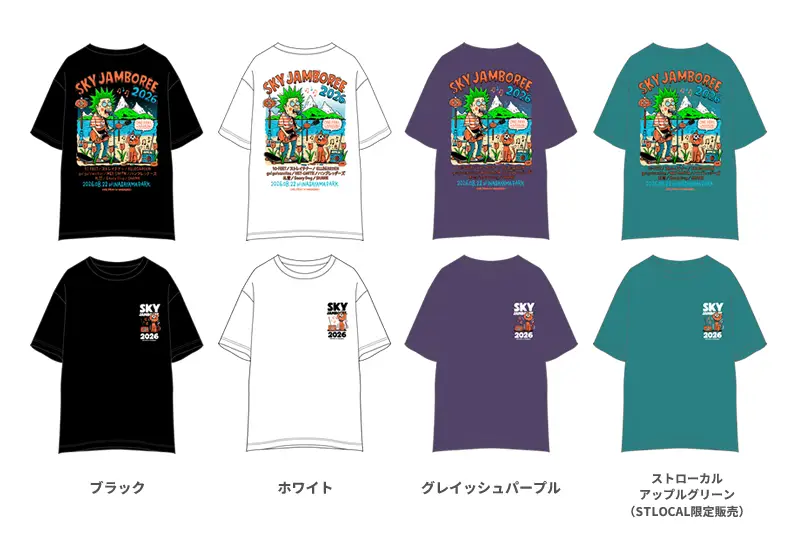
The side with the large illustration depicts the name and year of the festival along with figures holding musical instruments and a cat. The other side leaves generous open space around a small chest logo. Even within a single shirt, the impression you get changes depending on which side is facing forward or being viewed.
Alongside black and white, purple-toned and green-toned base colors are lined up. Even when the artwork is identical, how the design looks changes depending on the contrast in brightness between the base fabric and the lettering or illustration. Anyone looking to coordinate the shirt with an outfit can think not only about which graphic they like best, but also about how the shirt pairs with the jackets, cardigans, or bottoms they usually wear.
This image serves as a record of a 2026 product. Because the image also includes a colorway marked as exclusive to a specific sales location, it is important to distinguish between seeing a full row of color samples and being able to choose every color across all sales channels. Even when you come across product photos from past events, that does not necessarily mean the same items can currently be ordered.
One Side to Show Off a Pattern, Another to Preserve the Performers’ Names
The “Monogram T-Shirt” from the same festival takes a different approach to layout.
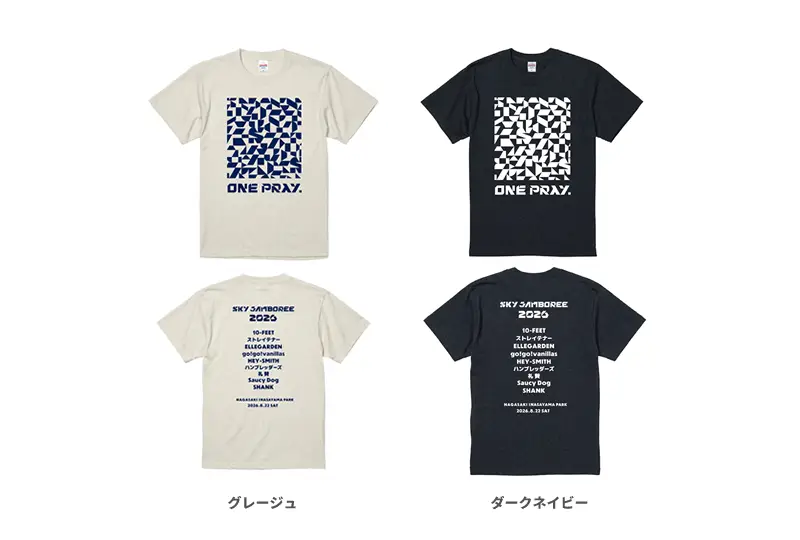
On one side, a repeating geometric pattern and short text catch the eye. On the other side, the festival name, year, participating artists’ names, venue location, and date are lined up together. As you can tell from the photo, concert T-shirts are not limited to designs that display titles in huge letters; there are also shirts where the details of the performance become clear when you step closer to read them.
For merchandise planners, a key question to consider is how to fit both an everyday-friendly design and commemorative event details onto a single shirt. There is no fixed rule saying that making the event name smaller guarantees people will wear the shirt in daily life, or that printing the date in large letters guarantees strong sales. Showing prototypes that vary what information goes where—and asking fans which side they like and in what situations they would want to wear it—helps inform the next round of design decisions.
“Wearing” and “Keeping” Can Shift Even Within the Same Person
There is no need to divide buyers strictly into two separate types: people who wear their shirt on the day of the show and people who store it unworn. The same fan might wear a shirt from one concert all the time while keeping a shirt from another concert strictly as a souvenir. It is also completely fine to display a shirt for a while and then start wearing it later on.
| Way to Enjoy | What to Check Before Buying | What to Think About After Buying |
|---|---|---|
| Wearing at the show or as everyday clothes | Actual measurements, fabric material, print placement, and how easily it layers | Washing according to the care label and drying thoroughly after wear |
| Keeping as a souvenir of the performance | Event name, date, performer names, and artwork that brings back favorite moments | Storage methods that allow you to check the condition of the item |
| Displaying in your room | Which side you want visible, unfolded dimensions, and where to hang or frame it | Wall or frame conditions, sunlight exposure, and steps for rotating displays |
| Archiving alongside photos and records | Which performance or sales campaign the item belongs to | How to organize photo dates and purchase records together with the shirt |
How many times you wear a shirt or how many shirts you buy is not a measure of how strongly you support an artist. Some fans attend live shows without buying any merchandise, while others cannot make it to the venue and enjoy ordering items online instead. It is also important not to make assumptions about whether someone attended a concert just by looking at their T-shirt.
Choosing It as Clothing
- Check actual measurements such as length and chest width
- Picture how it layers with clothes you already own
- Read the care instructions for washing and handling the print
Choosing It as a Keepsake
- Look at the event name, date, and artwork you love
- Decide whether to display it unfolded or store it folded
- Keep a record of the item's condition and the performance details
Source: Compiled by The Oshi Lab from the article text
Compare Against the Actual Measurements of Your Own Clothes, Not Just the Size Label
Before deciding on a shirt simply because “I always wear a medium” or “oversized fits are in style right now,” take a close look at the product’s size chart. Even among shirts labeled size M, the garment length, chest width, shoulder width, and sleeve length vary depending on the manufacturer and body style. Laying a comfortable T-shirt you already own flat on a surface, measuring it, and comparing those numbers against the chart using the same measuring method makes it much easier to picture the difference in fit.
Even if a shirt has a wide chest, the length might turn out to be longer than you hoped. If you plan to wear a jacket or shirt over it, you may also want to know how much of the graphic print will remain visible. When a size chart includes a diagram showing where each measurement is taken, check that diagram alongside the numbers. Be careful not to compare a flat-laid chest width directly against a body circumference measurement as if they were the exact same number.
Product images do not completely guarantee the exact shade of color that arrives or how the garment will look when worn. Read the listed color names, fabric composition, dimensions, and notes regarding slight manufacturing variations alongside the photos. Also check the seller’s policy on whether trying items on or exchanging sizes is permitted before making your choice.
Even When Ordering Online, Check Whether It Is Venue Pickup or Home Delivery
On the Map Design GALLERY sales page (in Japanese) linked from the official Sky Jamboree 2026 announcement, buyers were guided through a system where they reserved items online and picked them up on-site at the venue. That reservation window has now closed. It serves as a clear example that even when merchandise is lined up on an online store page, the fulfillment method is not always home delivery.
If you want to wear the T-shirt on the day of the concert, check not only the estimated delivery date, but also the pickup location, pickup hours, and whether there is a place available to change clothes. Check the merchandise sales start time and the time required to wait in the pickup line separately from the venue doors-open and show-start times. Plan your schedule so that you do not use up all of your travel and buffer time before the show starts just trying to pick up your T-shirt.
When you are on the fence about buying, there is no need to increase the number of shirts in your cart by telling yourself “I need a spare for storage too” or “I might never get another chance.” Think through your intended use and budget first, keeping in mind that choosing not to buy is always a valid option.
Do Not Misread Survey Figures on Overall Merchandise Spending as T-Shirt Spending
When looking at merchandise sales statistics, it is equally important to distinguish what the numbers actually cover. In a live event merchandise survey released by the Pia Research Institute in 2019 (in Japanese), 37.3% of respondents aged 18–69 living in Tokyo, Kanagawa, Chiba and Saitama who had attended a music or stage performance in person during the previous year reported buying event merchandise, and the average annual merchandise expenditure among those buyers was 22,386 yen. The survey was conducted from January 25 to January 28 of that same year and collected 916 valid responses.
This is a past survey covering live event merchandise as a whole. It is neither the average amount spent on T-shirts alone nor a figure representing live attendees across Japan in 2026. When businesses evaluate demand for their own products, they can use statistics like these to understand the broader market background, while separately examining their own sales volumes and how stock sells through across individual sizes.
Base Your Care Routine on the Fabric and Print Care Labels
When washing and drying a shirt after wearing it, follow the care label attached to that specific item. You cannot decide on a single washing method for everything based solely on general material names like cotton or polyester. If there are special precautions regarding how to handle the print, potential color transfer, or ironing, make sure to read through all of those details as well.
Even for a shirt kept purely for storage, leaving it inside its plastic bag does not automatically prevent deterioration. Check the condition of the shirt before putting it away, and arrange your storage so you can periodically inspect it for moisture, stress along folded creases, or contact with other items. If you use desiccants (moisture absorbers) or insect repellents, read the instructions on both the garment side and the storage product side.
If you stop wearing a shirt, your options include keeping it as is, turning it into loungewear at home, passing it along to someone else, or letting it go. Because cutting a shirt to frame it or remaking it into another item cannot be undone, think carefully about which lettering or shapes you want to preserve before deciding. Avoid looking solely at isolated examples of vintage T-shirts selling for high prices and assuming that keeping your own shirt in storage will turn it into an item that goes up in value.
- 01Choose the ProductRead the two-sided photos, actual measurements, materials, and sales conditions
- 02Prepare for the Day of the ShowConfirm whether it is home delivery or venue pickup, plus arrival and show times
- 03Use and Preserve ItFollow the care label and choose how to wear, store, or photograph the shirt yourself
Source: Compiled by The Oshi Lab from the article text
The Oshi Lab Note: There Is More to Learn Beyond the Number of Shirts Sold
For companies planning live concert T-shirts, alongside tracking sales figures by size, there are ways to find out which product photos helped buyers choose and whether fans ran into any trouble with pickup or finding a place to change. Clear guidance on actual measurements and garment care helps those who plan to wear the shirt, while an accessible record of event dates and official product names helps those who want to preserve it as a souvenir.
Not pushing every buyer toward the exact same use—and instead providing the information people need to choose how to enjoy the shirt after purchase—is also a vital part of merchandise planning. Leaving photos of both sides and essential specifications accessible on official pages gives fans a reliable reference point to verify the shirt in their hands even after the concert has ended.
For consultations on merchandise planning and sales design, contact KAZAORI Co., Ltd. (in Japanese). Related articles: What Are Concert Outfits (Sansen-Fuku)? / What Is Concept Coordination (Gainen Code)? / Oshi Merchandise Storage Ideas / How to Let Go of Oshi Merchandise
FAQ
Do I have to wear a concert T-shirt on the day of the show?
You can choose how you want to use the item yourself. Whether you wear it as your outfit for the show, style it as everyday clothing, or keep it as a souvenir, you do not have to lock yourself into just one choice forever. If the event organizers have posted guidelines regarding attire, be sure to check those conditions.
Should I just pick my usual size M or L?
Even when shirts share the same size label, the actual measurements differ from product to product. Check where the garment length and chest width are measured on the size chart, and compare those numbers against a comfortable T-shirt you already own using the exact same measuring method.
Can I currently order the official T-shirts shown in this article?
We feature product photos from Sky Jamboree 2026 here as reference material for comparing designs. Because the reservation window for the announced on-site venue pickup has already closed, please check the official announcements separately for current sales availability.
If I leave a shirt sealed in its bag, will it stay in great condition for a long time?
Leaving a shirt inside its original bag does not guarantee that it will never deteriorate. Read the care instructions for the fabric and print, and store the shirt in a way that lets you check its condition both before putting it away and while it is in storage.
Is the 22,386 yen average from the Pia Research Institute survey the amount spent on T-shirts alone?
That figure comes from a 2019 survey covering live event merchandise as a whole, and it represents the average annual spending among people who bought merchandise. It is neither the amount spent on T-shirts alone nor a number representing event attendees nationwide in 2026.


