
Nippon Budokan Pilgrimage Guide: The Octagonal Roof, Tayasumon Gate & Live Music History Since The Beatles
Crowning the very top of Nippon Budokan's great roof is an ornamental giboshi finial whose silhouette resembles a giant onion. Immortalized in the rock band Bakufu-Slump's signature song 'Ookina Tamanegi no Shita de' ('Under the Big Onion'), this iconic building hosted five historic performances by The Beatles in 1966, and in the years that followed, artists such as Cheap Trick and Bob Dylan recorded live albums here that reached listeners all around the world.
From the sweeping eight-sided roof and the historic Tayasumon Gate at the park entrance to the tall trees of Kitanomaru Park, visitors can walk the exact approach that concertgoers take on show days and admire from the outside the arena where their favorite musicians have stood on stage. In the second half of this guide, we trace the milestone debut shows, farewell concerts, and live audio and video recordings born inside Nippon Budokan.
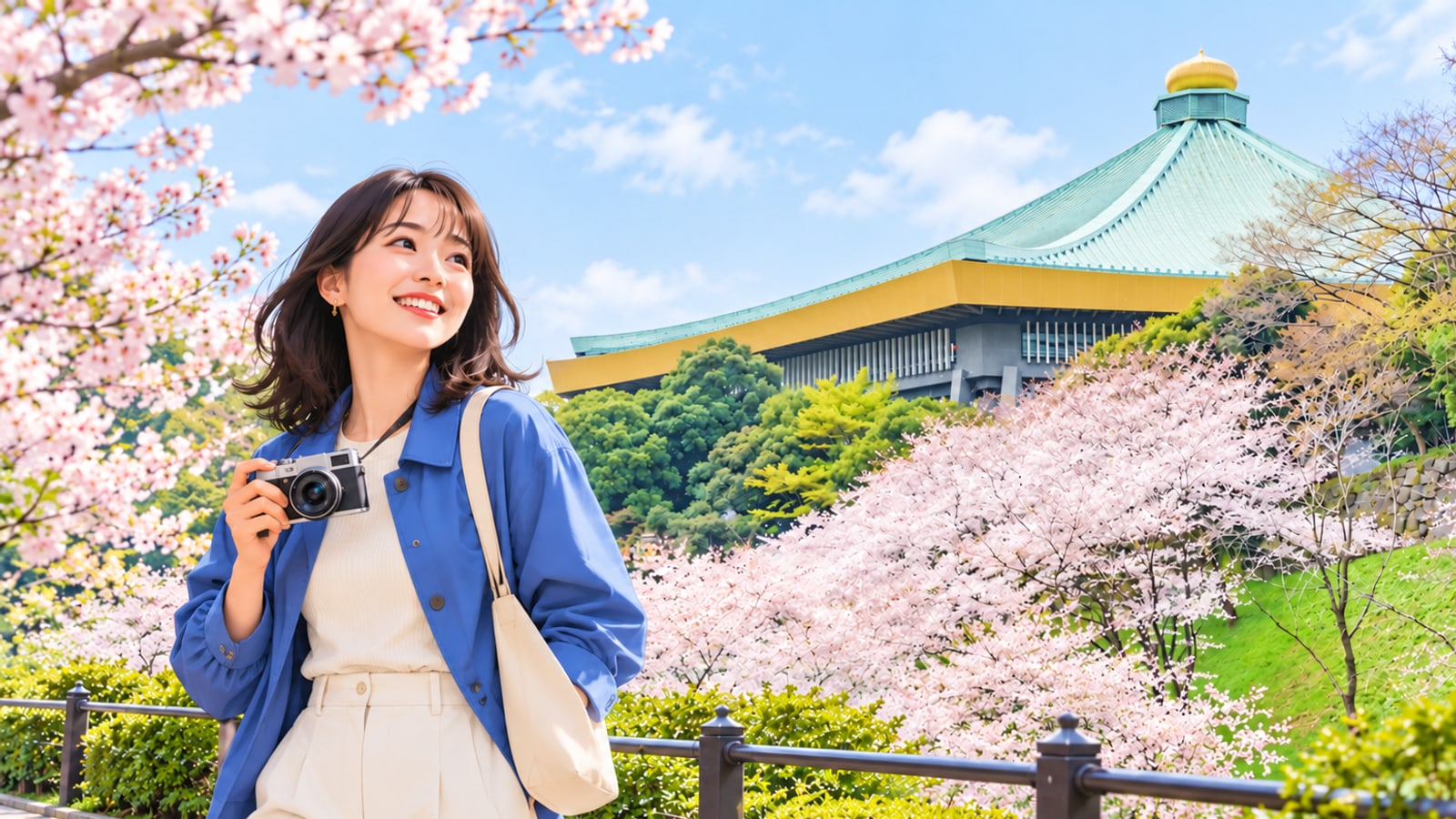
The Architecture of Nippon Budokan and Landmarks Around Kitanomaru Park
① Nippon Budokan · Chiyoda Ward, Tokyo
Built for 1964 Olympic judo and home to historic music performances since The Beatles in 1966.
Read the Complete Pilgrimage Guide & Access Notes for Nippon Budokan (Chiyoda Ward, Tokyo)② Tayasumon Gate · Chiyoda Ward, Tokyo
An Important Cultural Property Edo Castle gate built in 1636 standing at the entrance to Kitanomaru Park.
Read the Complete Pilgrimage Guide & Access Notes for Tayasumon Gate & Kitanomaru Park (Chiyoda Ward, Tokyo)③ Kudanshita Stn. · Chiyoda Ward, Tokyo
The railway station at the foot of the slope featured in 'Ookina Tamanegi no Shita de.'
Read the Complete Pilgrimage Guide & Access Notes for Kudanshita Station (Chiyoda Ward, Tokyo)
1Nippon Budokan: A History of Martial Arts and Live Music Beneath an Octagonal Roof
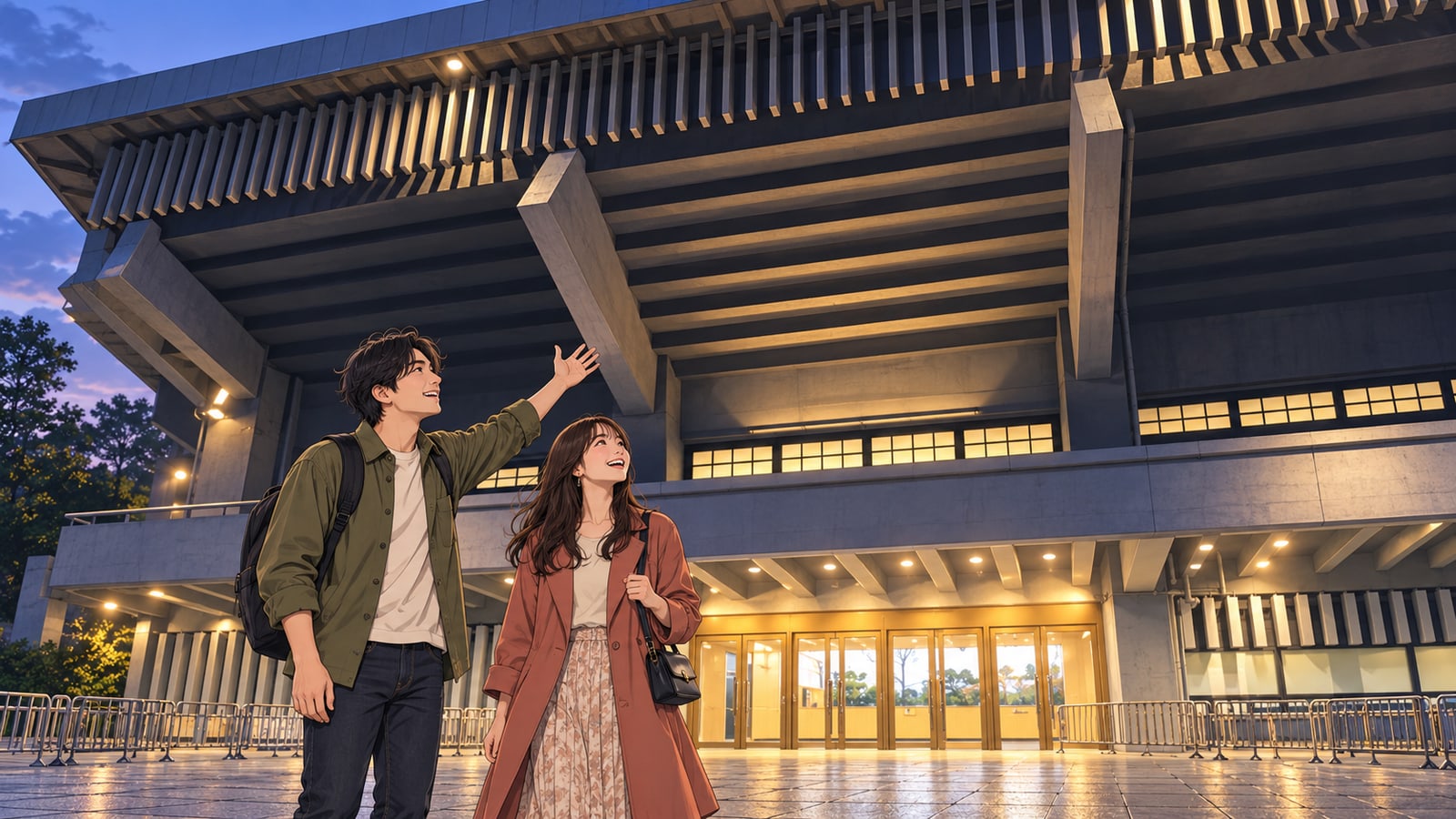
Nippon Budokan was constructed to serve as the judo competition venue for the 1964 Tokyo Olympic Games. Standing amidst the greenery of Kitanomaru Park, the main hall is built on a regular octagonal plan modeled after the octagonal Yumedono (Hall of Dreams) at Horyuji Temple in Nara, and is topped at the apex of its roof by an ornamental giboshi finial.
Construction work began in October 1963 and was completed in September 1964; after officially opening its doors on October 3, 1964 and hosting the Olympic judo competitions across four days from October 20 to 23, the arena went on to serve as a venue for concerts and cultural events alongside its core mission of promoting traditional Japanese martial arts through tournaments and classes.
Built with three floors above ground and two basement floors beneath, the main arena has a maximum seating capacity of 14,501 people; for live concerts and stage productions, however, the layout of the audience seats changes according to how the stage and production equipment are positioned, so actual attendance capacity varies from event to event.
Located at 2-3 Kitanomaru Park, Chiyoda Ward, Tokyo, Nippon Budokan is reached on foot from Kudanshita Station on the Tokyo Metro Tozai Line, Tokyo Metro Hanzomon Line, and Toei Shinjuku Line. Visitors can freely view the exterior of the building from Kitanomaru Park at any time, while entering inside the hall requires following the admission conditions for a scheduled martial arts tournament or concert, as no general public sightseeing tours are conducted inside the facility.
Sources: Nippon Budokan — Construction & Mission / Historical Timeline / Facility Overview / Chiyoda City Tourism Association — Architectural Features / Facility FAQ
2Tayasumon Gate & Kitanomaru Park: The 1636 Edo Castle Gate Standing Outside the Arena
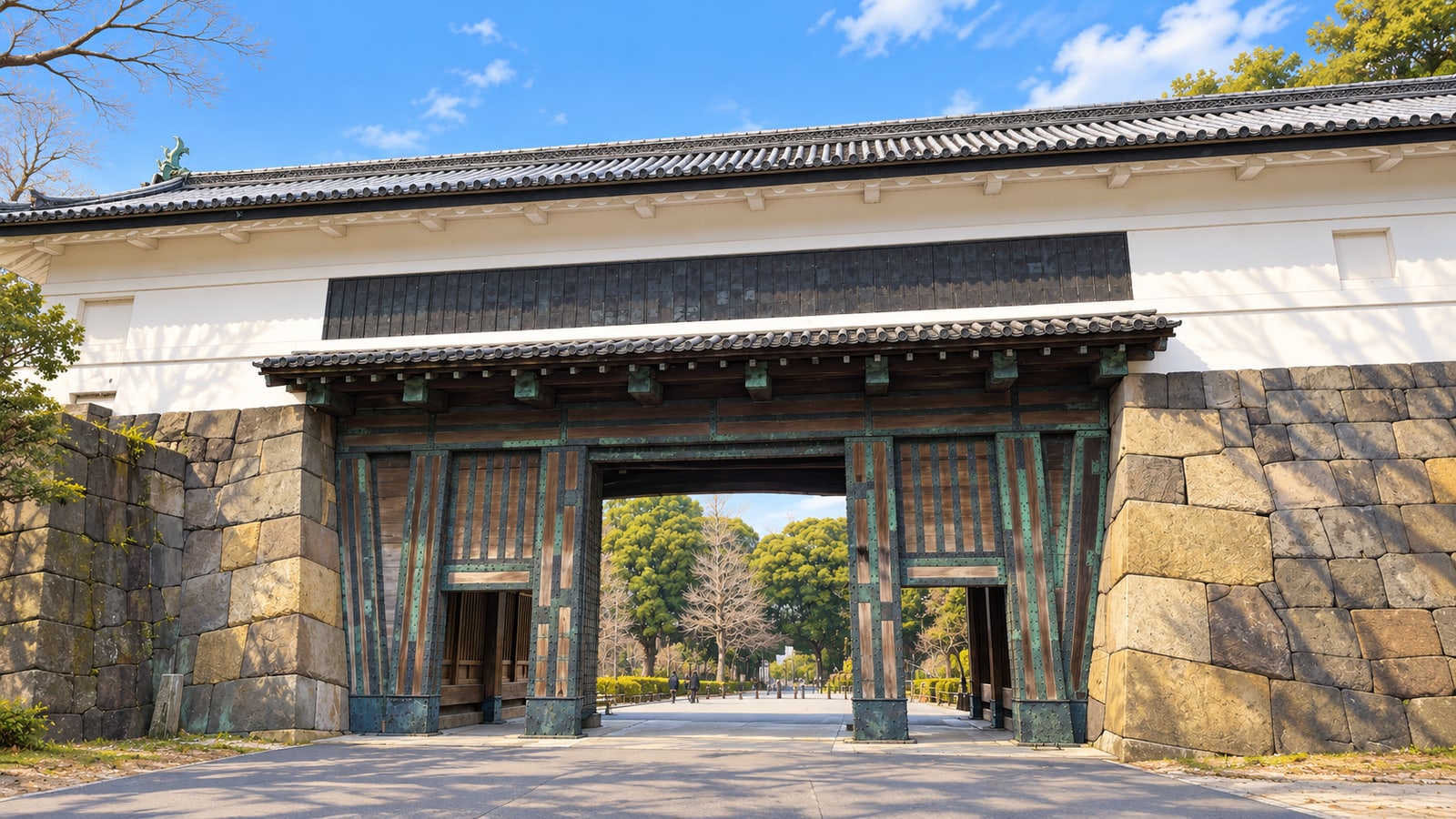
Standing on the Kudanshita side of the park, Tayasumon Gate is a historic gate of Edo Castle built in 1636 and designated an Important Cultural Property of Japan in 1961. Situated right at the entrance to Kitanomaru Park where Nippon Budokan stands, it is the gateway through which concertgoers and visitors pass on their way to the arena.
Tayasumon Gate is composed of two distinct gates arranged in a traditional masugata defensive square: visitors pass first through the outer Koraimon gate into a rectangular courtyard enclosed on all four sides by high stone walls, then turn at a right angle to pass beneath the larger Yaguramon turret gate topped by an upper wooden structure.
Kitanomaru Park is a lush forested park encompassing both Nippon Budokan and the Science Museum, and the official walking map published by the park administration clearly marks the positions of Tayasumon Gate and the park's other entrances.
For visitors who wish to enter Kitanomaru Park without encountering steps, the recommended barrier-free route leads from Exit 6 of Kudanshita Station along the sidewalk to the Tayasumon Gate entrance; travelers can check distances and walkway conditions in advance on the park management's barrier-free access map.
Sources: Chiyoda Ward — Kitanomaru Scenery & Tayasumon Gate / Agency for Cultural Affairs — Former Edo Castle Tayasumon / Two Gates & Masugata Layout / National Gardens Association — Kitanomaru Park Map / Barrier-Free Guide
For visitors looking for a place to take a break inside the park before doors open, the Kitanomaru Rest House stands at 1-1 Kitanomaru Park; because its operating hours change in accordance with concert start times at Nippon Budokan, visitors can check the facility's daily schedule on the day of their visit.
Sources: National Gardens Association — Kitanomaru Rest House / Nippon Budokan — Visitor Information
3Kudanshita Station: The Foot of the Slope Featured in ‘Ookina Tamanegi no Shita de’
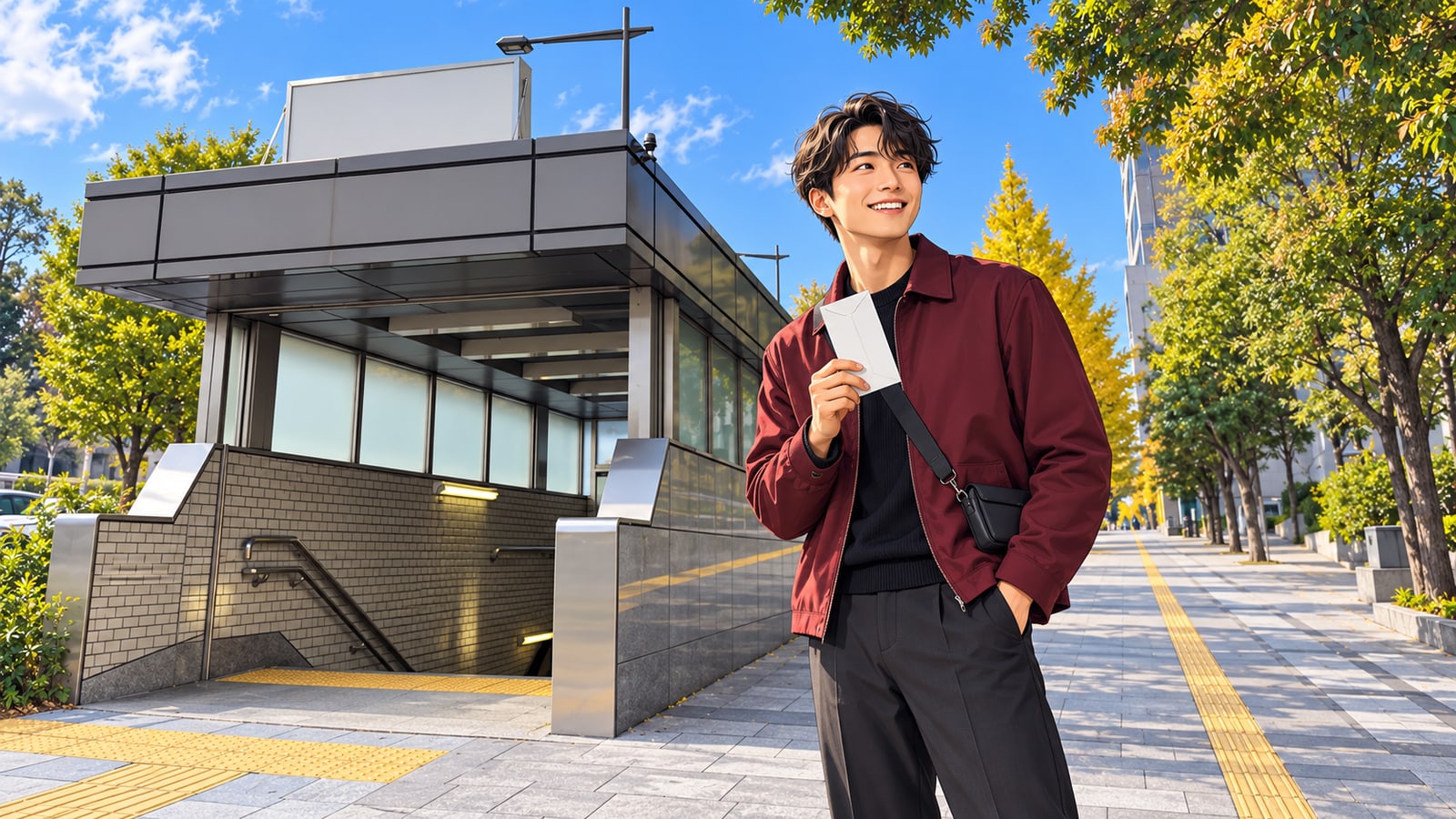
Kudanshita Station is the railway station that appears in Bakufu-Slump's song 'Ookina Tamanegi no Shita de ~Harukanaru Omoi~,' whose lyrics vividly depict the sloped street climbing from the station toward Nippon Budokan.
Because of this close connection between the song and the neighborhood, Tokyo Metro adopted 'Ookina Tamanegi no Shita de ~Harukanaru Omoi~' as the platform departure melody for the Tozai Line at Kudanshita Station in 2015; arranged by keyboardist Minoru Mukaiya, the Tozai Line departure melodies introduced that year were composed so that listening to the melodies of consecutive stations in the direction of train travel links them together into a single piece of music.
Served by the Tokyo Metro Tozai Line, Tokyo Metro Hanzomon Line, and Toei Shinjuku Line at 1-6-1 Kudan-Minami, Chiyoda Ward, Kudanshita Station guides visitors bound for Nippon Budokan and Kitanomaru Park toward Exit 2, and operating hours for each station exit can be checked on the station guide.
Sources: Tokyo Metro — Departure Melody Selection & Arrangement / Sunplaza Nakano-kun — The Song & Budokan / Kudanshita Station Exit Guide / Park Barrier-Free Map
Deeper into Live History: Legendary Performances Recorded at Nippon Budokan
From here, we introduce the artists who have stood on stage at Nippon Budokan and the landmark concerts preserved on audio recordings and home video—tracing debut performances and anniversary stages from overseas rock bands to Japanese rock vocalists and idol groups.
The Beatles: The Venue’s First Rock Concerts in June–July 1966
The very first rock concerts ever held at Nippon Budokan were performed by the British rock band The Beatles, who took the stage from June 30 to July 2, 1966 and played a total of five concerts across three days.
Those concerts took place less than two years after Nippon Budokan opened in October 1964: an overseas rock band was stepping onto the floor of a hall built specifically for judo, kendo, and traditional Japanese martial arts. At the time, there was vocal opposition to playing rock music inside a venue regarded as a sacred hall for martial arts, a situation that guitarist George Harrison also looked back on in later years.
The Beatles performed 11 songs at each show, opening with 'Rock and Roll Music,' moving through songs including 'Yesterday,' and closing the set with 'I'm Down.'
Sources: The Beatles Official — 60th Anniversary of First Japan Tour / The Beatles Official — Budokan Concerts / 50-Year History of Nippon Budokan / Universal Music — 1966 Setlist / The Beatles Official — Tokyo Concert Reflections
The Night Paul McCartney Returned 49 Years Later
Paul McCartney, who first stood on the Nippon Budokan stage as a member of The Beatles in 1966, returned to the venue on April 28, 2015 for his first concert at Budokan in approximately 49 years.
On that night, he performed The Beatles' song 'Another Girl' live in concert for the very first time, and during 'Let It Be' wristbands worn by the audience lit up in unison so the entire seating bowl became part of the visual staging.
Sources: Paul McCartney Official — Return to Budokan / 2015 Japan Tour Archive
Deep Purple: Made in Japan, Recorded Across Tokyo and Osaka
The rock band Deep Purple's classic live album Made in Japan is a work recorded during their August 1972 concert tour of Japan, capturing three nights on tape: August 15 and 16 at Festival Hall in Osaka, and August 17 at Nippon Budokan in Tokyo.
On the original album release, the tracks recorded at Nippon Budokan were 'The Mule' and 'Lazy,' while recordings from the Osaka concerts were used for the remaining songs; on the expanded edition released in 2025, listeners can also hear the Nippon Budokan performances of 'Highway Star,' 'Smoke on the Water,' and 'Child in Time,' expanding the recorded archive of that same Tokyo concert decades later.
Sources: Deep Purple Official — Recording Made in Japan / 2025 Expanded Edition Tracklist
Queen: From Their First Japan Tour to Their Return with Adam Lambert
It was also at Nippon Budokan that the British rock band Queen performed their very first concert in Japan upon arriving for their debut Japan tour in April 1975.
In September 2016, the band returned to hold concerts at Nippon Budokan as Queen + Adam Lambert, coming back in a new formation to the very same arena where they had played their first Japanese show.
Sources: Queen Official — 50 Years of Japan Tours / 2016 Nippon Budokan Concerts
Bob Dylan: Two Nights from His 1978 First Japan Tour Expanded into a Complete Edition Nearly Half a Century Later
Singer-songwriter Bob Dylan arrived in Japan for his first concert tour in 1978, performing eight concerts at Nippon Budokan and recording the two nights of February 28 and March 1 onto 24-channel analog tape.
Selecting 22 tracks from those recordings, the live album Bob Dylan at Budokan was released first in Japan in November 1978 and released overseas in April of the following year; in 2023, The Complete Budokan 1978 compiled all 58 songs from both nights—including 36 previously unreleased tracks—to preserve the entire two-night run including performances omitted from the original album.
Source: Bob Dylan Official — The Complete Budokan 1978
Bob Dylan’s At Budokan: The 2-CD Edition Recreating the Original 1978 Japanese LP Packaging
Among the releases of Bob Dylan's concert recording At Budokan is the 2-disc Blu-spec CD2 edition released on April 23, 2014 (catalog number SICP-30498–30499), a limited-production release that uses the 2013 remastered audio housed in a miniature LP paper jacket.
The outer packaging faithfully reproduces the LP jacket and obi strip originally released in Japan in 1978 along with the inner sleeves—preserving an album that was launched from Japan bearing the venue's name in its original period design, accompanied by new liner notes and a new Japanese translation by Goro Nakagawa.
Disc 1 includes songs such as 'Mr. Tambourine Man' and 'Like a Rolling Stone,' while Disc 2 includes 'Blowin' in the Wind' and other classics.
Sources: Sony Music — 2014 Paper-Sleeve Edition / Original Japanese LP Reproduction & Tracklist
Cheap Trick: How a Live Album Made for Japan Became a Multi-Platinum Hit in America
The American rock band Cheap Trick's live album At Budokan was recorded at their Nippon Budokan concerts on April 28 and 30, 1978. Initially produced as a 10-song release exclusively for the Japanese market, the album spread across the United States through imported copies and radio broadcasts, leading to an official US release in February 1979.
Reaching as high as No. 4 on the US album chart and selling more than three million copies, a live record capturing the band's playing and the cheers of the Japanese audience became one of Cheap Trick's biggest hits; a later 30th-anniversary edition added video footage of the April 28 concert, preserving that day's stage in both sound and picture.
Sources: Sony Legacy — 35th Anniversary of At Budokan / 30th Anniversary Audio & Video Edition
BOØWY: Their First Solo Budokan Concert and Two Historic Live Recordings
The Japanese rock band BOØWY held their first solo concert at Nippon Budokan on July 2, 1986—a performance remembered alongside vocalist Kyosuke Himuro's famous call to the audience, 'Welcome to Live House Budokan!'
The audio recorded on that day was released in later years as "GIGS" JUST A HERO TOUR 1986 NAKED, letting listeners hear their debut Budokan show on record; in 2026, a 40th-anniversary remastered edition was announced, with the 2-CD set scheduled for release on October 28, 2026.
Home video releases also preserve BOØWY's Nippon Budokan concerts held on December 10, 1986 and February 24, 1987, pairing an approximately 50-minute program edited from both shows with the complete approximately 93-minute recording of the December 10, 1986 concert—leaving behind both the audio of their first Budokan concert and live video from subsequent dates at the same venue.
Sources: Universal Music — 40th Anniversary of First Budokan Concert / 2026 Remastered Edition Announcement / Budokan Concert Video Releases
Eikichi Yazawa: His 100th and 150th Nippon Budokan Concerts
Rock vocalist Eikichi Yazawa has built an unmatched history of concerts at Nippon Budokan, reaching his 100th career performance at the venue on December 16, 2007—a milestone night also preserved as a live video release.
His 150th career Budokan concert was originally scheduled for December 20, 2022, but had to be canceled due to throat trouble; he subsequently achieved his 150th performance at the rescheduled make-up concert held on December 14, 2023.
The Blu-ray and DVD capturing the footage of that 150th Nippon Budokan concert were released on March 13, 2024.
Sources: Eikichi Yazawa Official — 100th Budokan Concert / Rescheduled 150th Concert / 150th Concert Home Video
Princess Princess: From the First All-Female Band Concert at Budokan to Their Final Three Nights
In January 1989, Princess Princess stood on stage at Nippon Budokan as the first all-female band in history to headline the venue, performing across four days.
On May 29, 30, and 31, 1996, the band held their final concerts at the very same Nippon Budokan and disbanded, with all three farewell nights preserved in full on home video.
Sources: Sony Music — Kaori Kishitani Biography / 1996 Final Live Archive
YOASOBI: Welcoming Their First Live Audience at ‘NICE TO MEET YOU’
The music unit YOASOBI welcomed a live audience in person for the very first time at their two-day Nippon Budokan concerts 'NICE TO MEET YOU' on December 4 and 5, 2021; having held an audience-free livestream concert in February of that same year, Nippon Budokan became the first venue where they performed facing an actual audience in the seats.
The December 5 performance is recorded on the Blu-ray release THE FILM (released on March 23, 2022), allowing viewers to revisit 'Yoru ni Kakeru,' 'Kaibutsu,' 'Gunjou,' and the encore performance of 'Loveletter.'
Source: YOASOBI Official — THE FILM Concert & Tracklist
AiNA THE END: Crafting Her First Solo Budokan Show ‘ENDROLL’ Through Song and Dance
Singer AiNA THE END held her first solo concert at Nippon Budokan on September 11, 2024; on a stage titled 'ENDROLL,' she performed song and dance alongside a live band and dancers, singing 'Heart ni Heart' for the first time during the encore.
That night is preserved on the DVD and Blu-ray release AiNA THE END ENDROLL, released on March 19, 2025.
Sources: avex — 'ENDROLL' Concert Report / AiNA THE END Official — Concert Video
Group and Solo Stages Created by Idols at Nippon Budokan
Momoiro Clover Z & Shiori Tamai: From an Album Celebration Tour to a Six-Character Solo Musical Stage
The idol group Momoiro Clover Z held a tour concert for their album Shukuten ('Celebration') at Nippon Budokan on May 15, 2022, and out of the 17 shows across 14 venues nationwide on that tour, the Nippon Budokan stage was chosen to become the live video release.
The concert unfolded following the exact running order of the album tracks, with the members appearing in costumes based on ceremonial white.
At the solo concert held at Nippon Budokan by group member Shiori Tamai on May 6, 2025, a multi-level stage set modeled after a six-color apartment building appeared on stage; structured as a musical in which Tamai portrayed six different female characters under general director Wally Kinoshita and music director Satoshi Takebe, the show combined singing and acting before an audience of roughly 8,500 people.
Sources: King Records — Momoiro Clover Z 'Shukuten' Budokan Concert / Shiori Tamai 2025 Solo Concert
=LOVE: Their First Two-Day Budokan Concerts and the January 17 Home Video Release
The idol group =LOVE held their first concerts at Nippon Budokan across two days on January 16 and 17, 2021, and the performance from January 17 is preserved on the Blu-ray and DVD release You all are My ideal ~Nippon Budokan~, released on June 30 of that same year.
The recorded tracklist lines up 'Oshi no Iru Sekai,' 'Shukipi,' and 'Seishun "Subliminal"' all the way through the encore songs '866,' 'Start!,' and '=LOVE,' letting fans trace the full January 17 setlist on video after visiting Nippon Budokan.
At their March 2, 2023 Nippon Budokan concert, a venue-exclusive campaign also allowed fan-club members to scan a QR code on display panels at the hall to receive a ticket-style smartphone wallpaper—leaving a digital souvenir of the day they came to the venue.
Sources: =LOVE Official — First Budokan 2-Day Concerts / Concert Video & Tracklist / 2023 Tour Venue Campaign
FRUITS ZIPPER: A 360-Degree Center Stage for Their Debut Budokan Concerts
The idol group FRUITS ZIPPER held their first concerts at Nippon Budokan across two days on May 18 and 19, 2024, placing the stage in the center of the arena floor surrounded 360 degrees by audience seats and drawing approximately 24,000 fans across the two days.
This 2nd-anniversary live concert was also released on Blu-ray and DVD on September 18 of that same year.
Source: ASOBISYSTEM — Budokan Concerts & Home Video Release
The Great Roof Celebrated in Song and Film and the Arena’s Renovations
‘Ookina Tamanegi no Shita de’: How the Ornamental Roof Finial Became a Meeting Place in Song and Film
The rock band Bakufu-Slump's song 'Ookina Tamanegi no Shita de' is closely tied to Nippon Budokan: the ornamental giboshi finial crowning the top of the building's roof is shaped like an onion, and the band's 2024 best-of album pairs this song with 'Aa! Budokan.'
In the 2025 feature film Ookina Tamanegi no Shita de inspired by the song, Nippon Budokan is again woven into the story as the place where the two leads promise to meet for the first time 'under the big onion'—turning the roof ornament that visitors can look up at from outside into both a song title and a cinematic meeting place.
Sources: Sony Music — Bakufu-Slump Best Album / Official Movie Site — Ookina Tamanegi no Shita de / Chiyoda City Tourism Association — Giboshi Finial
Mamoru Yamada’s Architectural Design and the Silhouette of the Great Roof
The building's architectural design was created by Mamoru Yamada's architectural office, whose proposal was selected through a design competition: atop a regular octagonal floor plan rests a sweeping great roof evoking the gentle slopes at the foot of Mount Fuji, crowned at its peak by the giboshi finial.
Sources: 50-Year History of Nippon Budokan — Design Model / Chiyoda City Tourism Association — Architectural Form
From Copper Plates to Stainless Steel: Renovating the Great Roof and Arena Seating
On February 7, 1979, the floor of the main arena hall was completely relaid and a rising stage mechanism and electronic scoreboard were newly installed.
During the 2020 expansion and renovation work, the interior facilities were modernized while inheriting the building's opening-day exterior appearance, lighting up the new exterior illumination on September 29 and resuming public operations on October 4, 2020.
In the 2020 renovation, the copper roofing plates covering all eight faces of the roof were replaced with stainless steel finished in the same patina-green hue in order to reduce the weight of the roof while enhancing durability and waterproofing; the golden giboshi finial at the apex retained its original 1964 body with its outer surface newly repainted.
The illumination of the great roof was designed by lighting designer Motoko Ishii's office, while inside the building the main arena ceiling was reinforced, hall lighting was converted to LEDs, and air-conditioning and heating systems were newly installed in the lobbies.
In areas directly serving visitors, the stone paving at the southwest and northwest entrances was leveled and fitted with access ramps, roughly 30 wheelchair spaces and companion seats were provided on the 1st floor, and restrooms were equipped with movable partitions that allow stall allocations to be adjusted according to the male-to-female ratio of each event.
Source: Nippon Budokan — Detailed Report on the 2020 Renovation
Source: Nippon Budokan — Facility Modernization Record
First Concerts, Live Albums, and Final Stages: Musical Milestones at Nippon Budokan
Ever since The Beatles performed here in 1966, Nippon Budokan has been used for overseas artists' debut Japan tours, Japanese bands' first solo arena concerts, and final farewell stages before disbanding; below we look back in chronological order at the concerts preserved on audio and video.
- Oct 3, 1964Nippon Budokan opensConstruction
- Jun 30–Jul 2, 1966The Beatles perform 5 concertsMusic Release
- Aug 17, 1972Deep Purple concert is recordedRecording
- Apr 1975Queen performs first Japan concertMusic Release
- Feb 28–Mar 1, 1978Bob Dylan's two nights are recordedRecording
- Apr 28 & 30, 1978Cheap Trick concerts are recordedRecording
- Feb 7, 1979Main floor relaid and rising stage installedRenovation
- Jul 2, 1986BOØWY holds first solo Budokan concertMusic Release
- Jan 1989Princess Princess holds first all-female band concert at BudokanMusic Release
- May 29–31, 1996Princess Princess holds final farewell concertsMusic Release
- Dec 16, 2007Eikichi Yazawa performs his 100th Budokan concertMusic Release
- Apr 28, 2015Paul McCartney returns to Budokan after ~49 yearsMusic Release
- Oct 4, 2020Reopens following major renovationRenovation
- Jan 16–17, 2021=LOVE holds first 2-day Budokan concertsMusic Release
- Dec 4–5, 2021YOASOBI holds first in-person concertsMusic Release
- May 15, 2022Momoiro Clover Z performs Shukuten tour concertMusic Release
- Dec 14, 2023Eikichi Yazawa performs his 150th Budokan concertMusic Release
- May 18–19, 2024FRUITS ZIPPER holds first Budokan concertsMusic Release
- Sep 11, 2024AiNA THE END holds first solo Budokan concertMusic Release
- 2025Feature film Ookina Tamanegi no Shita de opensVideo & Film
Lab Note | From a Business Perspective: How Concert Recordings Spread a Venue’s Name Worldwide
Cheap Trick's live album produced for Japanese fans spread to the United States through imported copies and radio airplay, leading to its domestic American release—an example of how the circulation of a live recording, alongside the concert itself, carried the venue name 'Budokan' to listeners overseas.
When introducing live albums to listeners, it is essential to clarify which concert date's performance is included on which edition: Deep Purple's album combines recordings from Tokyo and Osaka, while Bob Dylan's concerts saw their included tracklist expand dramatically on a complete edition decades later. By clearly separating concert dates from edition tracklists when linking a venue to recorded works, fans can choose the exact performance they want to hear.
Official Sources & Primary References
- Nippon Budokan — History
- Nippon Budokan — Visitor Guide
- Kitanomaru Park
- The Beatles at Budokan
- Deep Purple Live Recording
- Bob Dylan Live Recording
- Cheap Trick Live Album
Exhibition dates, opening hours, admission fees, and ticket details are current at the time of writing. Always check the official websites for the latest schedule updates before setting out on your pilgrimage visit.
FAQ
Was Nippon Budokan originally built as a music concert hall?
No. Nippon Budokan was constructed as the judo competition venue for the 1964 Tokyo Olympics. Since opening, it has hosted martial arts tournaments and training alongside concerts and cultural events.
Who performed the very first rock concert at Nippon Budokan?
The British rock band The Beatles performed the venue's first rock concerts from June 30 to July 2, 1966, staging a total of five shows across three days.
Can visitors take a sightseeing tour inside Nippon Budokan?
No general public sightseeing tours are offered inside the building. Entering the interior requires a ticket or credential for a scheduled tournament or concert, though anyone can view the exterior from Kitanomaru Park.
Is the seating capacity the same for every concert?
While the main arena has a maximum capacity of 14,501 people, actual concert capacity varies depending on stage and equipment configurations; check the event organizer's seating guide for each show.
Which train station is closest to Nippon Budokan?
Kudanshita Station on the Tokyo Metro Tozai and Hanzomon Lines and the Toei Shinjuku Line. Nippon Budokan is located at 2-3 Kitanomaru Park, Chiyoda Ward, Tokyo.
Is there a place to rest in the park before concert doors open?
Yes, the Kitanomaru Rest House inside the park offers a place to take a break, with operating hours adjusted according to Budokan concert schedules.
Can I watch =LOVE's first Nippon Budokan concert on video?
Yes. Their January 17, 2021 performance—the second night of their two-day debut run at the venue—is preserved on the Blu-ray/DVD release You all are My ideal ~Nippon Budokan~, including 'Shukipi,' 'Seishun "Subliminal"' and the encore.
More in Pilgrimage

Southern All Stars Pilgrimage Guide: 9 Locations in Chigasaki, Yokohama & Enoshima Tied to Songs & Film

GLAY Pilgrimage Guide: Hakodate Concert Venues, Costume Exhibits & 'White Road' Filming Spots
