

Where Tora-san Comes Home: 10 Pilgrimage Stops from Shibamata to His Travels
Walk the grounds of Shibamata Taishakuten and step into the world of the films at the Tora-san Museum. Tokyo’s Shibamata is the hometown that Tora-san, the traveling salesman Torajiro Kuruma in It’s Tough Being a Man, always returns to. The series returns again and again to this neighborhood and to destinations across Japan.
The full list has 10 stops: two in Shibamata, plus eight more, including Horyu-ji and Chion-ji from the first film, Otaru, where Tora-san walked with Lily and her companions, and Shimonada Station, where he wakes from a dream. Follow his travels from the temple grounds in Shibamata to port towns and railway stations across Japan.
Ten places tracing Tora-san’s homecomings and travels
From Shibamata in Tokyo, the route reaches Okayama, Ehime, Shizuoka, Kagawa, Nara, Kyoto, Hokkaido, and Nagano. The scenery brings memorable film scenes to mind, though many years have passed since filming and some places look different today. Each site has its own visitor rules, from an active but unmanned station and temple grounds to a garden that charges admission.
① Shibamata Taishakuten (Taishakutenji Temple)
Since the first film, when Torajiro Kuruma returned to his hometown after 20 years away, Shibamata Taishakuten (Taishakutenji Temple) has been portrayed throughout the series as the heart of the home where Gozen-sama and Tora-san’s family live.
Explore Shibamata Taishakuten (Taishakutenji Temple)② Katsushika Shibamata Tora-san Museum
The Katsushika Shibamata Tora-san Museum is a hub for exploring Shibamata. Visitors can see the Kurumaya set used at Shochiku’s Ofuna Studio and a recreated display of the Asahi Printing Company.
Explore Katsushika Shibamata Tora-san Museum③ Bicchu Kokubunji Ruins and Temple
Bicchu Kokubunji in Soja, Okayama, is where the opening of Film 32, Whistling Tora-san, was filmed. Tora-san spreads out a lunch in a plum grove and talks with a father and daughter who are traveling together.
Explore Bicchu Kokubunji Ruins and Temple④ Shimonada Station
Shimonada Station on the JR Yosan Line in Iyo, Ehime, looks out over the Seto Inland Sea. At the start of Film 19, Tora-san wakes from a dream when a station attendant calls out to him.
Explore Shimonada Station⑤ Horai Bridge
Horai Bridge crosses the Oi River in Shimada, Shizuoka. At the opening of Film 22, The Rumored Tora-san, Tora-san passes a Buddhist monk who tells him that his romantic fortunes are likely to bring trouble. The wooden pedestrian bridge stretches 897.4 meters.
Explore Horai Bridge⑥ Ritsurin Garden
Ritsurin Garden in Takamatsu, Kagawa, is a Japanese garden designated a Special Place of Scenic Beauty. In Film 46, Tora-san comes to meet Mitsuo, then explores the garden with Yoko, played by Keiko Matsuzaka, after they ride the Kotoden railway.
Explore Ritsurin Garden⑦ Horyu-ji Temple
Horyu-ji in Ikaruga, Nara, is where Gozen-sama and his daughter Fuyuko pose for a commemorative photo with the five-story pagoda behind them in the first film, It’s Tough Being a Man.
Explore Horyu-ji Temple⑧ Amanohashidate Chion-ji Temple
At the end of the first film, heartbroken Tora-san returns to his sales patter at a temple fair in the grounds of Chion-ji in Amanohashidate, Kyoto, selling used books alongside his younger brother-in-travel, Noboru.
Explore Amanohashidate Chion-ji Temple⑨ Otaru Canal District
In Film 15, Tora-san’s Love Song, Tora-san walks along the canal and hills of Otaru, Hokkaido, with Lily, a singer who travels from town to town, and Kenjiro Hyodo, an office worker.
Explore Otaru Canal District⑩ Bessho Onsen and Kitamuki Kannon
In Film 18, Tora-san’s Pure Love, Tora-san watches a traveling theater troupe perform near Kitamuki Kannon in Bessho Onsen, Ueda, Nagano. The temple town is where a comic mishap unfolds when he cannot pay the group’s banquet bill.
Explore Bessho Onsen and Kitamuki KannonShibamata Taishakuten (Taishakutenji Temple) | The heart of the hometown he returned to after 20 years
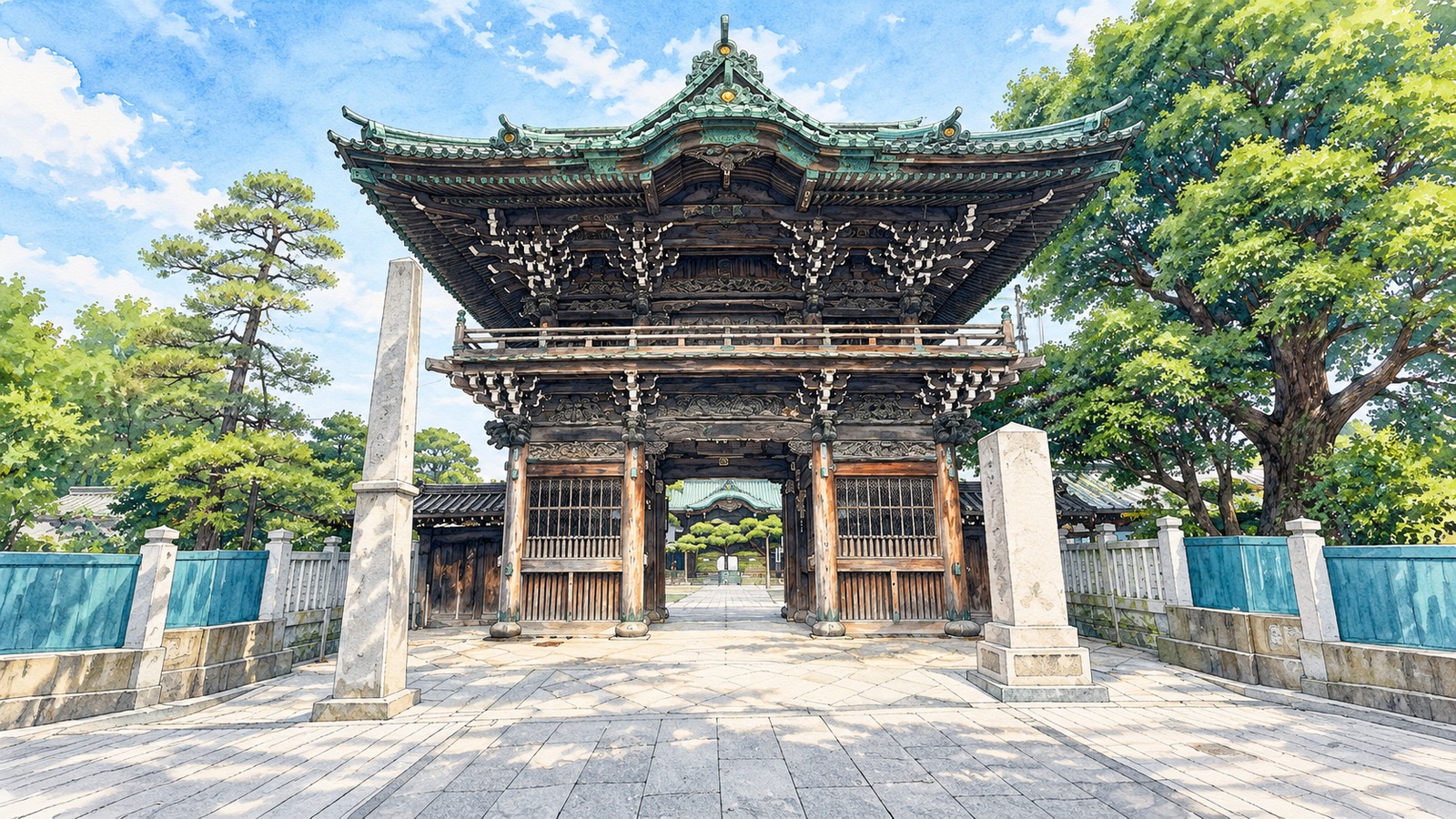
In the first film, released in 1969, Torajiro Kuruma returns to his hometown of Shibamata after 20 years away. At Shibamata Taishakuten (Taishakutenji Temple), the world of Gozen-sama, played by Chishu Ryu, and his daughter Fuyuko comes into view. Unlike a sightseeing spot Tora-san passes through on his travels, this is the place at the heart of the home where his family and childhood friends are waiting—and it remains central throughout the series.
Although everyone welcomes him warmly, Tora-san disrupts his younger sister Sakura’s arranged marriage meeting and leaves town again, unable to face the aftermath. Later, while traveling in Nara, he unexpectedly runs into Gozen-sama and Fuyuko and falls for her. Back in Shibamata, he begins visiting her at Taishakutenji again and again. The same temple grounds feel entirely different before and after his trip, reflecting the change in Tora-san’s steps and state of mind.
The approach from Shibamata Station on the Keisei Kanamachi Line, the Nitenmon Gate, and the temple grounds form one continuous landscape that carries the atmosphere of the films into the present. As you pass shops selling kusa dango rice dumplings and river fish dishes, the neighborhood feels so familiar that Tora-san might wander back at any moment.
The address is 7-10-3 Shibamata, Katsushika City, Tokyo. The temple grounds are free to enter. A ¥400 adult admission covers both the sculpture gallery, where visitors can see the relief carvings on the Taishakudo Hall, and Suikeien Garden.
Alongside the story memories of Gozen-sama striking the temple bell and Tora-san appearing on the grounds, the site itself is a cultural treasure: finely carved scenes from the Lotus Sutra and a Japanese garden viewed from its connecting corridors.
- Address
- 7-10-3 Shibamata, Katsushika City, Tokyo
- Connection to the film
- The temple portrayed throughout the series as the heart of Tora-san’s hometown, where Gozen-sama and Fuyuko live, from his return after 20 years in the first film onward
- Visiting conditions and admission
- Temple grounds are free to enter; the sculpture gallery and Suikeien Garden are covered by a combined adult admission of ¥400
- Getting there
- About a 3-minute walk from Shibamata Station on the Keisei Kanamachi Line
Sources: Shochiku’s official It’s Tough Being a Man website (in Japanese) / Katsushika Tourism Portal, Tora-san Museum (in Japanese) / Shibamata Taishakuten (Taishakutenji Temple) (in Japanese)
Katsushika Shibamata Tora-san Museum | Step inside the Kurumaya set used in the films
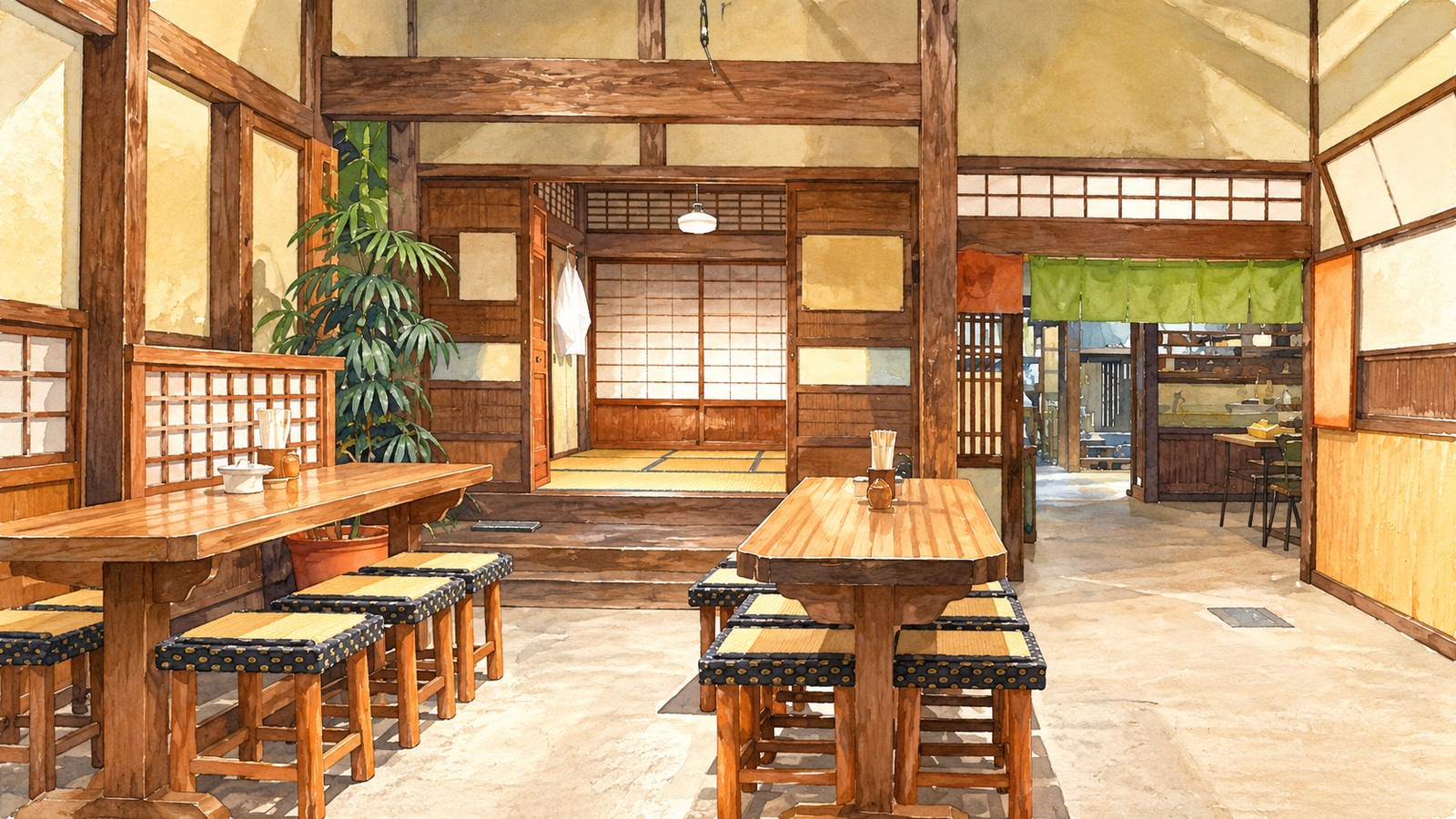
Just a short walk from Taishakuten, the Katsushika Shibamata Tora-san Museum displays the Kurumaya dumpling-shop set, moved here from Shochiku’s Ofuna Studio. This is a rare chance to see up close the set that was used in the actual films. The visit adds a new perspective to a walk through Shibamata: how the studio built the home Tora-san returned to.
Scenes from across the series play in Kurumaya’s living room, bringing the on-screen memories together with the space where Oichan, Obachan, Sakura, and Hiroshi gathered around the low table. The museum lets visitors compare the original Kurumaya set, a detailed miniature diorama of the Taishakuten approach as it looked in the 1950s, and a recreated display of the Asahi Printing Company.
The Asahi Printing Company exhibit, where company president Tako and Hiroshi worked, includes a real letterpress machine that evokes the feel of a neighborhood print shop of the time. A renovation in April 2025 also expanded the exhibits, including the ‘Hometown in the Heart’ street tracing the film heroines and travel memories, and an interactive display of a Showa-era black telephone.
The address is 6-22-19 Shibamata, Katsushika City, Tokyo. The museum is open from 9 a.m. to 5 p.m.; visitors are encouraged to arrive at least 30 minutes before closing. It is generally closed on the third Tuesday of each month (the following day when that Tuesday is a holiday; in December, the third Tuesday through Thursday). General admission is ¥500 with a combined ticket for the Yoji Yamada Museum.
The Yoji Yamada Museum is next door in the same building and can be visited as well. After experiencing the home Tora-san returns to, visitors can learn about the director and crew’s filmmaking through film-editing equipment and script materials.
- Address
- 6-22-19 Shibamata, Katsushika City, Tokyo
- Connection to the film
- A museum where visitors can see the Kurumaya set used at Shochiku’s Ofuna Studio and a recreated display of the Asahi Printing Company
- Hours and admission
- 9 a.m.–5 p.m.; generally closed on the third Tuesday of each month; ¥500 general admission with a combined Yoji Yamada Museum ticket
- Getting there
- About an 8-minute walk from Shibamata Station on the Keisei Kanamachi Line
Sources: Katsushika Tourism Portal, Tora-san Museum (in Japanese) / Katsushika Tourism Portal, Tora-san Museum (in Japanese)
Bicchu Kokubunji Ruins and Temple | Lunch in the plum grove with a traveling father and daughter
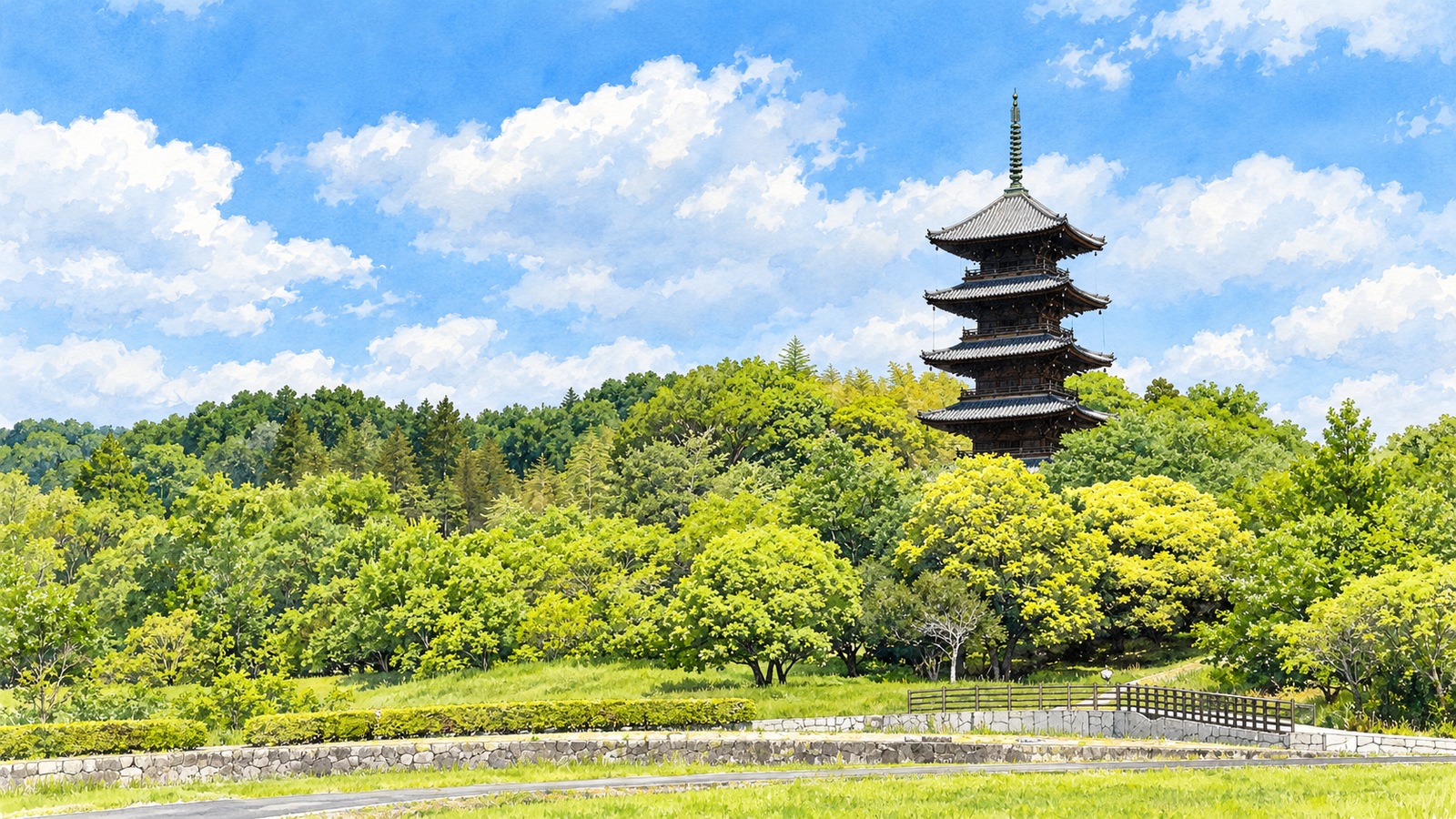
The opening of Film 32, Whistling Tora-san (released in 1983), shows Tora-san sharing a peaceful lunch in a flowering plum grove with a father and daughter on the road. Shochiku’s official filming-location guide identifies Bicchu Kokubunji in Soja, Okayama, as the setting for this scene. The father is played by Leonard Kum. In the peaceful landscape of the Kibi Road, two travelers meet by chance and share a warm moment in conversation.
Tora-san’s travels are memorable not only for their big commotions; even an ordinary meal or casual conversation can capture the character of a place. Picture who he was with and what they talked about on the hill among the blooming plum trees, and the quiet temple landscape suddenly feels familiar.
Today, the five-story pagoda, a nationally designated Important Cultural Property, is the landmark that rises above the area around Bicchu Kokubunji. Visitors can take a relaxed walk through the surrounding historic park, where foundation stones from the temple’s Nara-period founding remain. Plum trees bloom in early spring, just as they do at the start of the film.
The address is 1046 Kamibayashi, Soja, Okayama. Soja City’s tourism information gives 10 a.m.–4 p.m. as a general visiting window. The pagoda’s interior is not open to the public on a regular basis, so visits focus on the temple grounds and the exterior.
- Address
- 1046 Kamibayashi, Soja, Okayama
- Connection to the film
- The filming location at the start of Film 32, where Tora-san shares lunch and conversation in a plum grove with a father and daughter on the road
- Hours and areas open to visitors
- A general visiting window for the temple grounds is 10 a.m.–4 p.m.; the exterior of the Important Cultural Property pagoda and the historic park are open to visitors (the pagoda interior is closed)
Sources: Shochiku’s official It’s Tough Being a Man website (in Japanese) / Soja City (in Japanese)
Shimonada Station | The seaside platform where Tora-san wakes from a dream
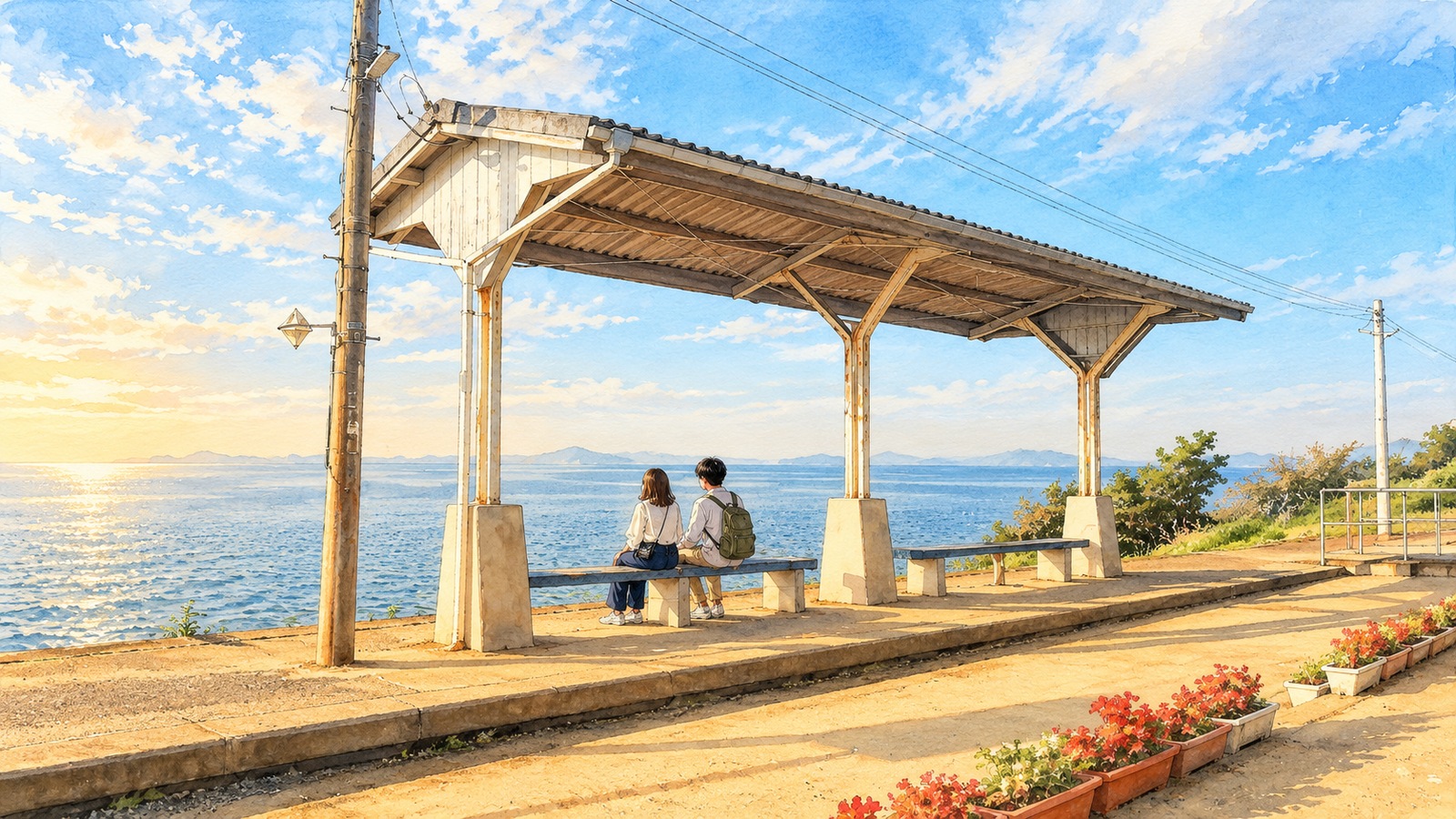
Film 19, My Uncle, the Prince (released in 1977), opens with Tora-san dozing on a bench at a seaside station. A station attendant calls to him, and he wakes from a dream. The striking opening was filmed at Shimonada Station in Iyo, Ehime, on the JR Yosan Line. The open platform faces the blue waters of the Iyo Sea, and a quiet moment passes as Tora-san sits alone during his travels.
The series’ familiar dream sequence gives way to a real destination where you can hear the waves. Rewatch the opening before your visit and you can picture Tora-san rubbing his eyes on the old waiting-room bench, along with his slightly absurd exchange with the station attendant.
Shimonada remains an active unmanned station used by local residents and travelers. Waiting for the next local train beneath the platform roof and feeling the sea breeze becomes part of the experience, echoing the opening scene.
The address is Okubo, Futami-cho, Iyo, Ehime. JR Shikoku reserves the parking spaces in front of the station for picking up and dropping off train passengers; visitor parking is not allowed. Check the local train timetable from the Matsuyama area in advance and arrive by rail—the fitting way to visit this filming location.
- Address
- Okubo, Futami-cho, Iyo, Ehime
- Connection to the film
- The seaside station at the opening of Film 19, where Tora-san is dozing on a bench until a station attendant calls out and wakes him
- Visitor information
- An active, unmanned station on the JR Yosan Line (the parking area is for dropping off and picking up train passengers; visitor parking is not allowed)
Sources: Shochiku’s official It’s Tough Being a Man website (in Japanese) / Shikoku Railway Company (in Japanese)
Horai Bridge | The long wooden bridge where a monk warned him about love
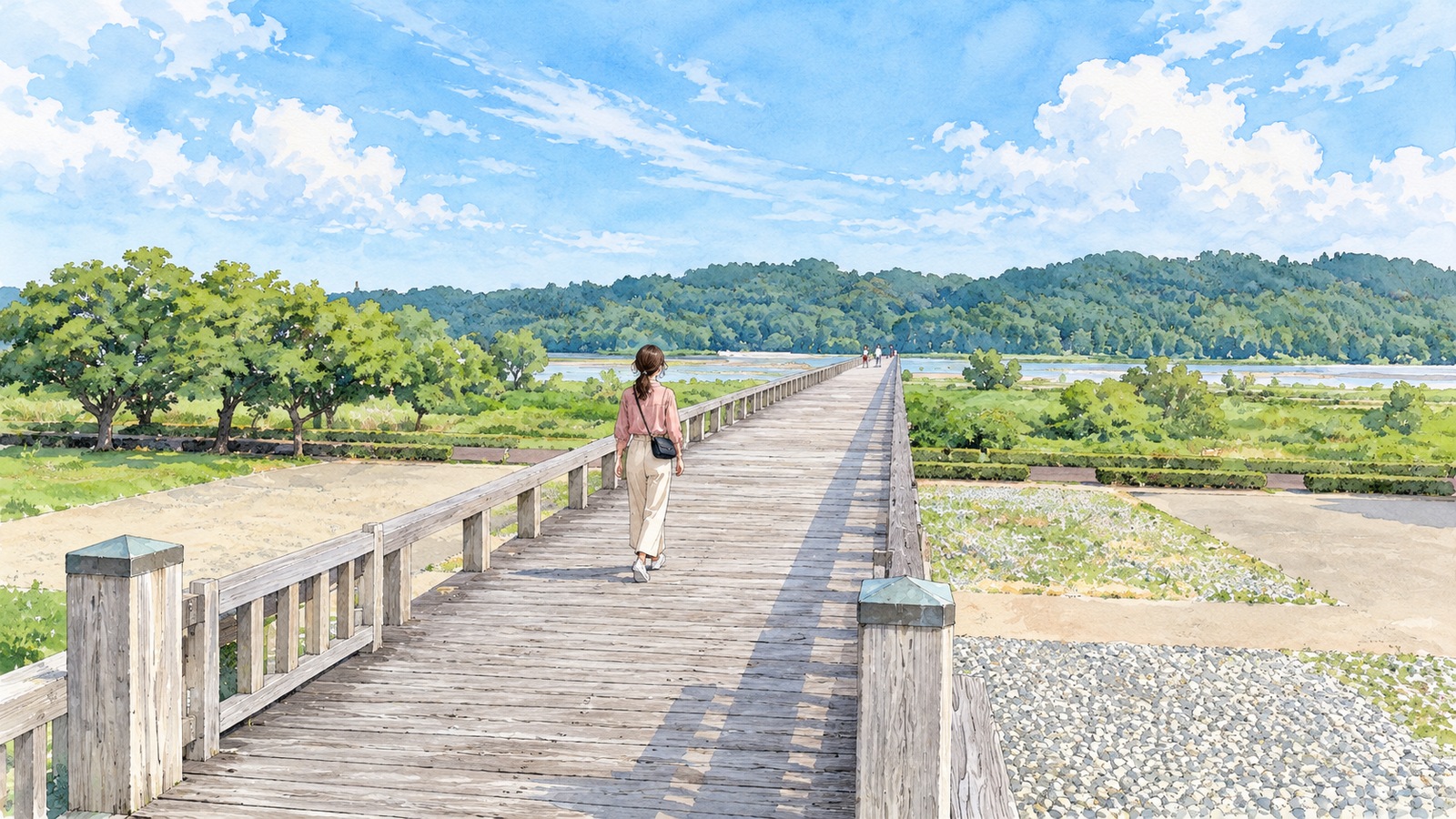
At the start of Film 22, The Rumored Tora-san (released in 1978), Tora-san crosses paths with a Buddhist monk on a long wooden bridge over a river. The monk, played by Hideji Otaki, humorously warns him that his fortune shows trouble in his relationships with women. The journey begins on Horai Bridge, which crosses the Oi River in Shimada, Shizuoka.
The 897.4-meter wooden pedestrian bridge invites you to feel the distance as you cross, one step at a time, noticing the boards beneath your feet. As you walk in the unobstructed river breeze and picture the scene where Tora-san stops to talk with the monk, it becomes clear how well this bridge works as a setting for two travelers to meet along a solitary road.
For audiences who know that Tora-san tends to fall in love and get his heart broken wherever he goes, the monk’s brief warning hints playfully at what lies ahead. Compared with his awakening at Shimonada Station, the scene shows how the series finds a different way to begin each journey.
The address is Minami 2-chome, Shimada, Shizuoka. This toll bridge is open to pedestrians and cyclists. The crossing fee is ¥100 for junior high school students and older, and ¥10 for elementary school students. The booth at the bridge entrance is staffed from 8:30 a.m. to 5 p.m.; outside those hours, visitors use the payment box. High water or strong winds may lead to access restrictions.
- Address
- Minami 2-chome, Shimada, Shizuoka (riverbank of the Oi River)
- Connection to the film
- The 897.4-meter wooden pedestrian bridge where Tora-san crosses paths with a monk at the start of Film 22, The Rumored Tora-san, and hears that love will bring him trouble
- Crossing fee and booth hours
- ¥100 for junior high school students and older; ¥10 for elementary school students. The booth is staffed from 8:30 a.m. to 5 p.m. (use the payment box outside those hours; access may be restricted during high water or strong winds)
Sources: Shochiku’s official It’s Tough Being a Man website (in Japanese) / Shimada Tourism Association (in Japanese)
Ritsurin Garden | A stroll through a Japanese garden with Yoko
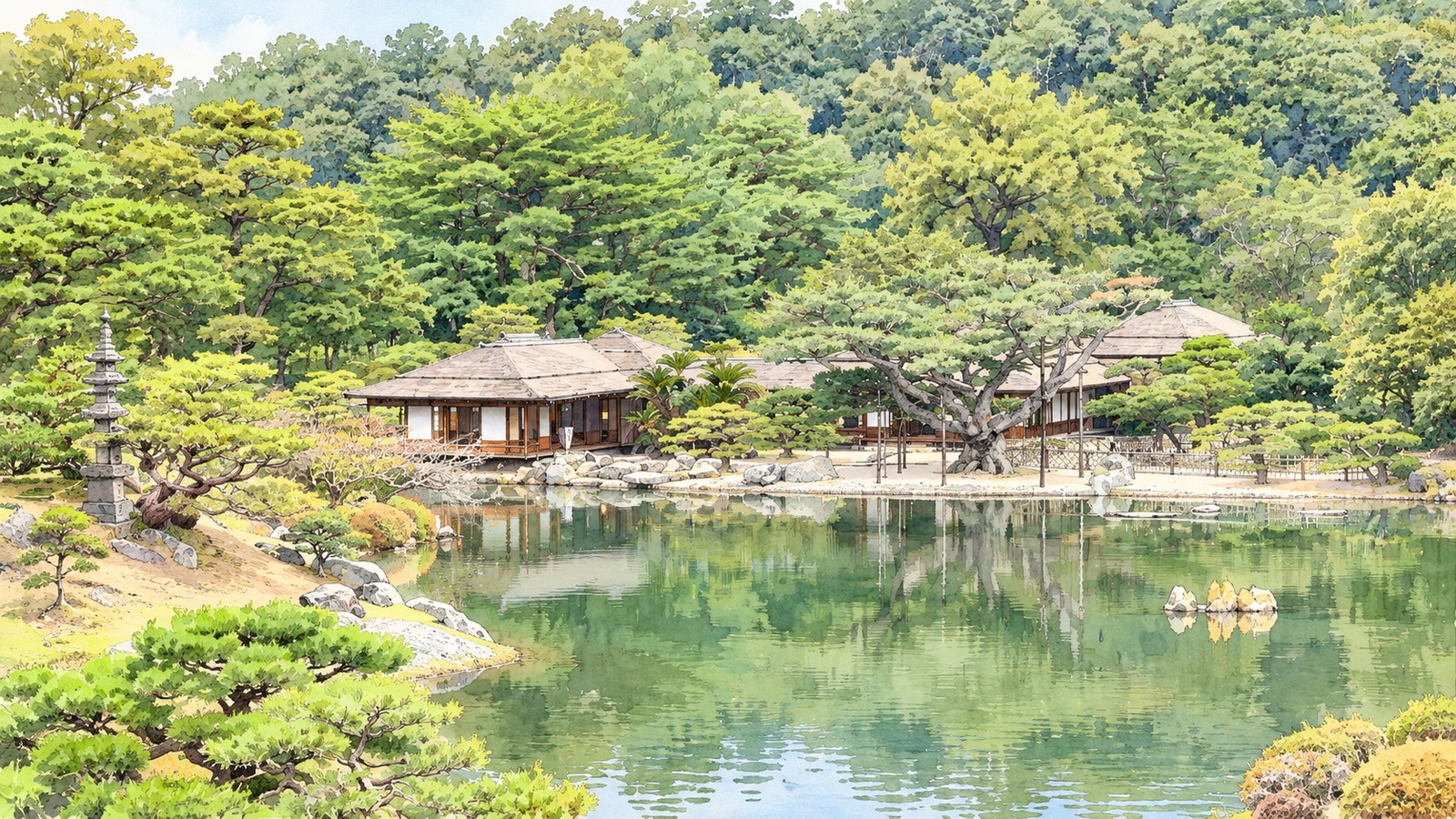
In Film 46, Tora-san’s Marriage (released in 1993), Tora-san crosses to Shikoku to bring home his runaway nephew Mitsuo. He rides the Kotoden (Takamatsu-Kotohira Electric Railroad) with the heroine Yoko Sakaide, played by Keiko Matsuzaka, and visits a beautiful Japanese garden. The filming location is Ritsurin Garden, a Special Place of Scenic Beauty in Takamatsu, Kagawa.
Yoko is a woman recovering from emotional exhaustion while living with her father on an island in the Seto Inland Sea. Tora-san arrives to search for Mitsuo, but soon settles into island life and walks through Takamatsu and its garden with Yoko. Their story has the gentle warmth of the series’ later films. The island and the garden in Takamatsu together shape the memory of this journey.
This expansive circuit-style garden, laid out with six ponds and 13 artificial hills against Mount Shiun as a borrowed landscape, is an ideal place to take a slow walk and recall the time the two spent together. Watch the pines reflect on the water and take in the teahouses as the light changes with the seasons.
The address is 1-20-16 Ritsurin-cho, Takamatsu, Kagawa. Admission is ¥500 for adults and ¥170 for elementary and junior high school students. The garden is open year-round, with hours set each month to match sunrise and sunset.
- Address
- 1-20-16 Ritsurin-cho, Takamatsu, Kagawa
- Connection to the film
- The Japanese garden designated a Special Place of Scenic Beauty where Tora-san, who came to bring Mitsuo home in Film 46, takes a walk with Yoko Sakaide (Keiko Matsuzaka)
- Opening hours and admission
- Open year-round (opening and closing times are set monthly to match sunrise and sunset); ¥500 for adults and ¥170 for elementary and junior high school students
Sources: Shochiku’s official It’s Tough Being a Man website (in Japanese) / Ritsurin Garden (in Japanese)
Horyu-ji Temple | Gozen-sama and Fuyuko pose for a photo in Nara
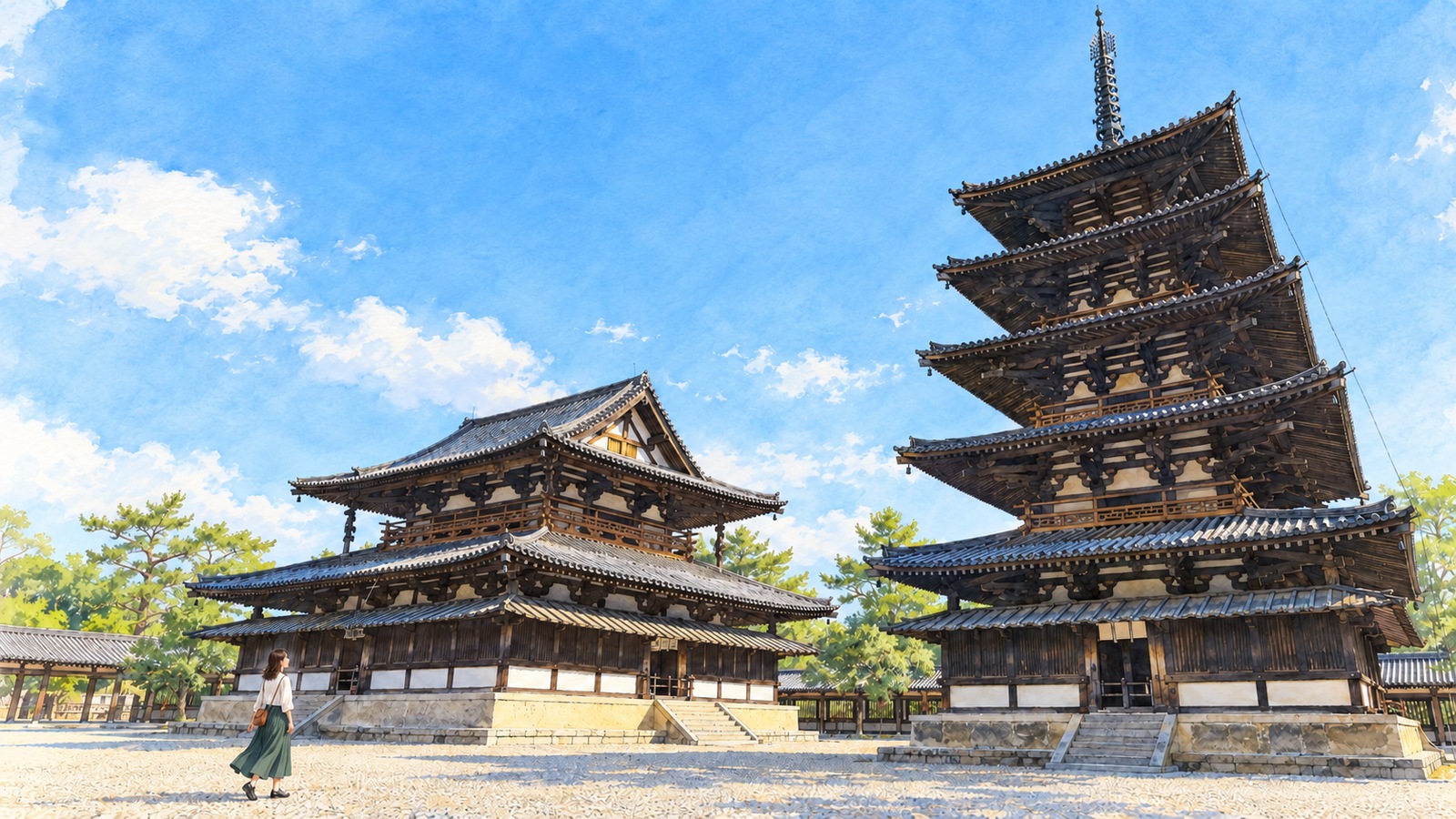
The landmark first film, It’s Tough Being a Man, released in 1969, includes a trip to Nara by Gozen-sama (Chishu Ryu), the priest from Shibamata Taishakuten, and his daughter Fuyuko (Sachiko Mitsumoto). They pose for a photo with a five-story pagoda behind them at Horyu-ji, in the historic area of Ikaruga.
The scene where Tora-san, having left Shibamata, unexpectedly runs into Gozen-sama and Fuyuko during his trip to Nara takes place in front of the Great Buddha Hall at Todai-ji, not at Horyu-ji.
Fuyuko, the heroine of the first film, is a childhood acquaintance from a well-to-do family. Their unexpected reunion during a trip to the old capital brings them together, and Tora-san’s devoted one-sided love continues after he returns to Shibamata. Horyu-ji’s quiet temple buildings capture the composed setting just before that romance begins in earnest.
The address is 1-1 Horyuji-sannai, Ikaruga, Ikoma District, Nara. Visiting hours are 8 a.m.–5 p.m. from February 22 through November 3 and 8 a.m.–4:30 p.m. from November 4 through February 21. In both periods, ticket sales close 30 minutes before the grounds. A combined admission covers the Western Precinct, Daihozoin, and Eastern Precinct.
- Address
- 1-1 Horyuji-sannai, Ikaruga, Ikoma District, Nara
- Connection to the film
- The filming location in the first film where Gozen-sama and his daughter Fuyuko pose for a photo with the five-story pagoda behind them during their trip to Nara
- Visiting hours
- 8 a.m.–5 p.m. February 22–November 3; 8 a.m.–4:30 p.m. November 4–February 21 (paid combined admission for the Western Precinct, Daihozoin, and Eastern Precinct)
Sources: Shochiku’s official It’s Tough Being a Man website (in Japanese) / Horyu-ji (in Japanese) / Shochiku Cinema Plus (in Japanese)
Amanohashidate Chion-ji Temple | Back to work at the end of Film 1
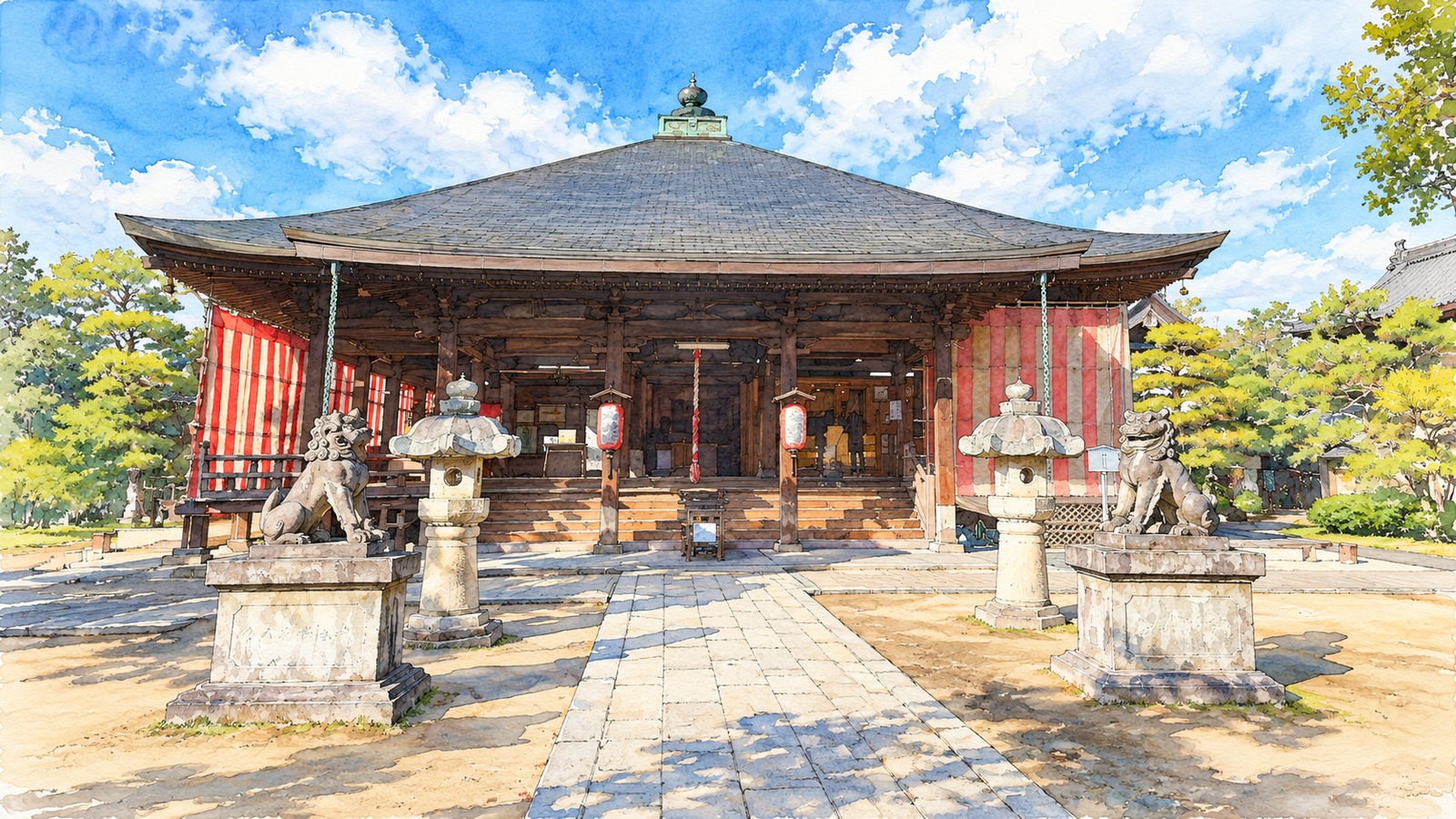
The final scene of the first film, It’s Tough Being a Man, was shot at Chion-ji Temple (Monju-do Hall) in Amanohashidate, Miyazu, Kyoto. Tora-san has set out on the road again. Alongside Noboru, his younger partner in the trade (played by Taisaku Akino), he energetically sells used books at the temple fair. After returning to Shibamata, falling in love with Fuyuko, and leaving town heartbroken, Tora-san is back at work on the road.
Tora-san’s signature tanka-bai is a way of selling goods by drawing passersby in with a rhythmic, persuasive pitch. At a temple fair bustling with worshippers, Kiyoshi Atsumi’s resonant voice and lively gestures shine. His sales patter sweeps away the sadness of lost love and defines how Torajiro Kuruma lives.
Horyu-ji in Nara and Chion-ji in Amanohashidate both appear in the first film, but they play contrasting roles in the story. Horyu-ji frames Gozen-sama and Fuyuko’s peaceful trip; Chion-ji marks Tora-san’s own fresh start. Seeing the two temples side by side reveals how the choice of locations reflects the first film’s dramatic arc.
The address is 466 Monju, Miyazu, Kyoto, about a three-minute walk from Amanohashidate Station on the Kyoto Tango Railway. The temple grounds are open to visitors. The used-book stalls seen in the film were part of the production, but visitors can enter Monju-do Hall, known as one of Japan’s Three Great Monju temples, and pass through the main gate while recalling the energy of the first film’s ending.
- Address
- 466 Monju, Miyazu, Kyoto
- Connection to the film
- The temple where heartbroken Tora-san and his younger partner Noboru sell used books at the fair in the final scene of the first film
- Visiting conditions and access
- Temple grounds are open to visitors; about a 3-minute walk from Amanohashidate Station on the Miyazu Line of the Kyoto Tango Railway
Sources: Shochiku’s official It’s Tough Being a Man website (in Japanese) / Kyoto Tourism Federation (in Japanese)
Otaru Canal District | Lily, Kenjiro, and Tora-san walk together
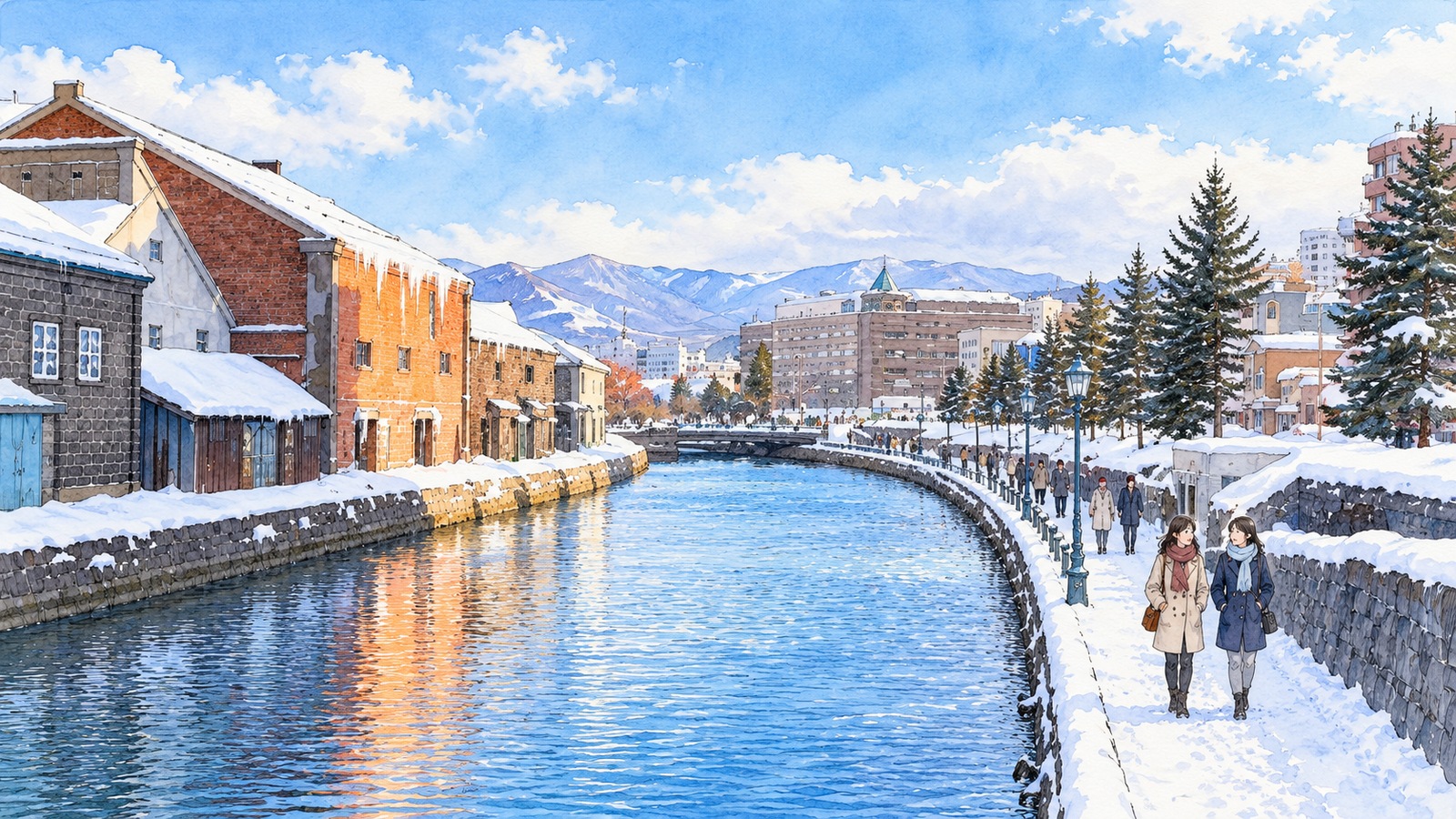
In Film 15, Tora-san’s Love Song (released in 1975), Tora-san travels through Hokkaido and walks around Otaru with Lily, a singer played by Ruriko Asaoka, and Kenjiro Hyodo, an office worker played by Eiji Funakoshi. Shochiku’s official filming-location guide features scenes of the trio visiting Otaru Canal, Gaijin-zaka (around Funamimizaka), and the harbor.
For Kenjiro, an executive who has vanished from his job to travel, Otaru is a city of memories: the place where his first love once lived. Lily, whom Tora-san had met again in Hakodate, joins him there. The three embark on an odd but warm journey as they help Kenjiro search for his first love. The northern port city brings together the bittersweet past and kindness of these adults.
Lily, who lives on the road much like Tora-san, is one of the series’ most popular heroines, thanks in part to their easy rapport. Watch Film 15 before visiting Otaru, and the stone warehouses along the canal and the sloping streets take on new meaning: you can picture the distance between the two as they walked beneath one umbrella.
Today, paths and gas lamps line Otaru Canal, around Minatomachi 5 in Otaru, Hokkaido, one of the island’s best-known visitor destinations. The stone warehouses along the water carry traces of the half-century that has passed, including changes from the waterfront as it appeared during filming in 1975.
- Address
- Around Minatomachi 5, Otaru, Hokkaido (Otaru Canal)
- Connection to the film
- The canal in the port city where Tora-san, Lily, a singer on the road, and office worker Kenjiro Hyodo walk together in Film 15
- Visitor information and access
- The canal paths are open at all times; about a 10-minute walk from Otaru Station on the JR Hakodate Main Line
Sources: Shochiku’s official It’s Tough Being a Man website (in Japanese) / Otaru Tourism Association (in Japanese) / Shochiku’s official It’s Tough Being a Man website (in Japanese)
Bessho Onsen and Kitamuki Kannon | A visit with a traveling theater troupe turns into a mishap
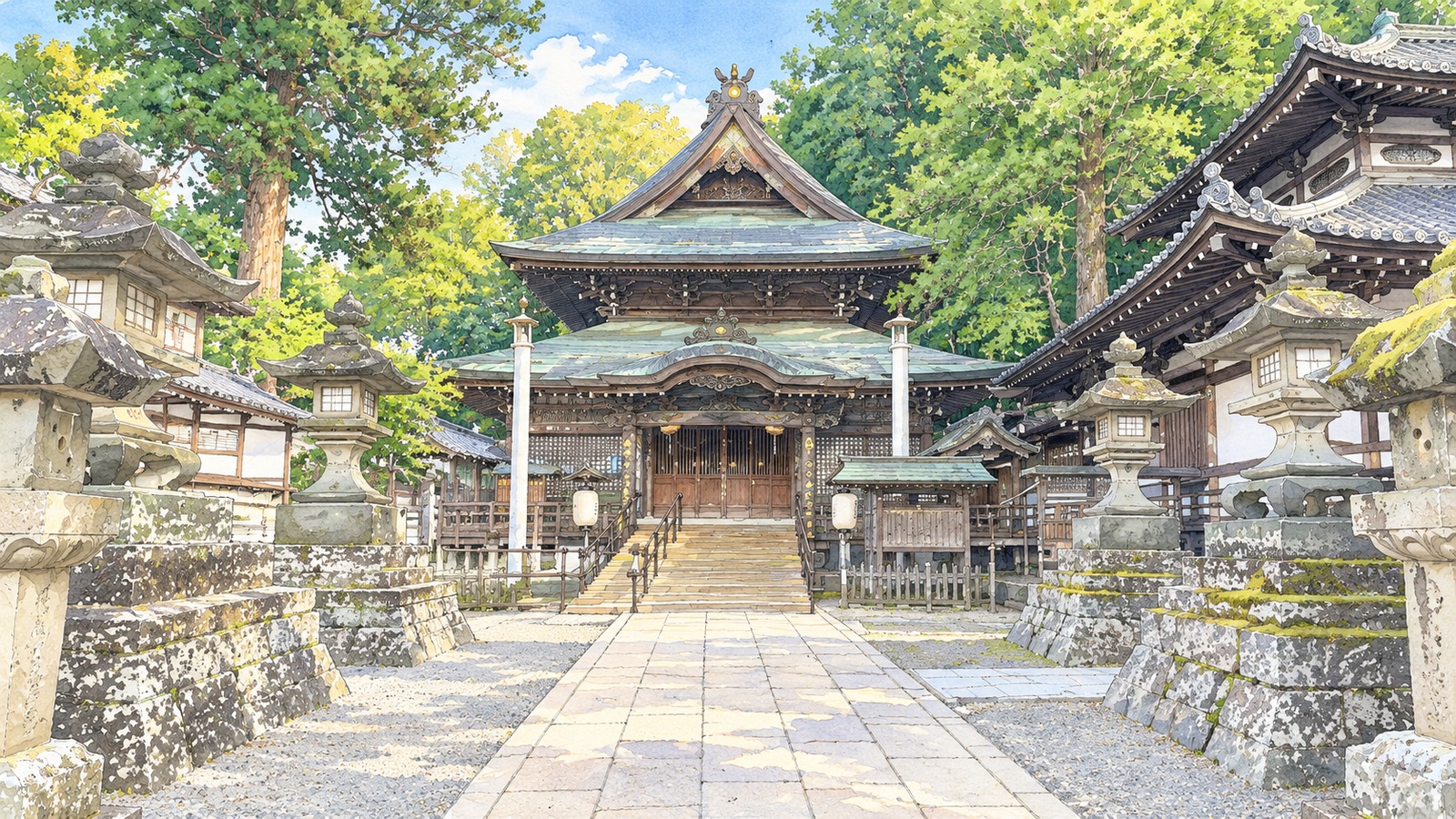
In Film 18, Tora-san’s Pure Love (released in 1976), Tora-san visits Bessho Onsen in Ueda, Shinshu, and watches the traveling theater troupe led by Kakuhachiro Bando, played by Yoshio Yoshida, perform in front of Kitamuki Kannon. Tora-san, a street vendor who travels from place to place, hits it off with the performers, who also move from town to town for their shows.
Feeling for the troupe leaders, Tora-san generously treats them to a banquet. When the bill arrives, however, he does not have enough cash, and the situation grows into a major commotion as he sends a telegram asking Sakura in Tokyo for help. His compassion for anyone in trouble collides with his reckless inability to keep track of money—a comic predicament that is pure Tora-san.
The makeshift theater seen in the film was a set built for filming. Today, the area around Kitamuki Kannon is a historic temple town where visitors can see the old Kannon Hall and explore Bessho Onsen’s public baths and streets.
The location is around Kitamuki Kannon Hall in Bessho Onsen, Ueda, Nagano. The main hall opens at 7 a.m.; closing time varies by season: 5 p.m. from May through September, 4:30 p.m. in April and October, and 4 p.m. from November through March. Goshuin stamp service begins at 8 a.m. As you walk uphill from Bessho-Onsen Station on the Ueda Electric Railway Bessho Line, recall the lively episode from the film.
- Address
- 1656 Bessho Onsen, Ueda, Nagano (around Kitamuki Kannon Hall)
- Connection to the film
- The temple town where Tora-san watches the Bando Kakuhachiro troupe perform and gets caught up in a banquet-bill mishap in Film 18, Tora-san’s Pure Love
- Hall hours and access
- Main hall open 7 a.m.–5 p.m. (until 4:30 p.m. in April and October; until 4 p.m. November–March); about a 10-minute walk from Bessho-Onsen Station on the Ueda Electric Railway Bessho Line
Sources: Shochiku’s official It’s Tough Being a Man website (in Japanese) / Kitamuki Kannon and Joraku-ji (in Japanese) / Kitamuki Kannon and Joraku-ji (in Japanese) / Shochiku’s official It’s Tough Being a Man website (in Japanese)
Getting to know Tora-san | The home he returns to and the road he keeps traveling
Even within one series, the setting plays a different role in each scene: a seaside station where Tora-san wakes from a dream, a wooden bridge where a monk offers him advice, or a daimyo garden where he walks beside a heroine. At the center of every scene is Torajiro Kuruma, played by Kiyoshi Atsumi. Knowing about the family in Shibamata and the companions he meets along the way adds another layer to a visit to these filming locations.
From Kiyoshi Atsumi’s memories to the Tora-san TV series
It’s Tough Being a Man began as a television drama on Fuji TV in 1968. Lead actor Kiyoshi Atsumi shared memories of the street vendors he had seen growing up in downtown Tokyo—their vivid sales patter and their way of life. Writer and director Yoji Yamada built the character of Torajiro Kuruma from those memories. The rhythm of Tora-san’s sales pitch reflects Atsumi’s own early experiences.
The television series ended with Tora-san being bitten by a habu snake on Amami Oshima and dying suddenly. Viewers flooded the broadcaster with protests and messages of grief. In response, Yoji Yamada proposed adapting the story for film, and Shochiku released the first movie on August 27, 1969. The long-running series of 50 films began with audiences’ longing to see Tora-san again after his on-screen death.
Rewatch the temple fair at Chion-ji in Amanohashidate, the final scene of the first film, and it becomes clear that Tora-san’s words do more than make people laugh and feel better: his patter is also how he earns a living. His booming voice, impeccable timing, and gaze on the passersby make this a scene that invites close attention to Atsumi’s craft, as well as to the filming location.
The family waiting at home: Sakura, Hiroshi, and Mitsuo
Chieko Baisho consistently plays Sakura, Tora-san’s younger half-sister, and Gin Maeda plays Hiroshi Suwa, the printing-plant worker who becomes Sakura’s husband. In the first film, Tora-san returns home and disrupts Sakura’s arranged marriage meeting, while Hiroshi, who works at the Asahi Printing Company next to Kurumaya, confesses his serious feelings for her. His sister’s new marriage and his own comic heartbreak unfold side by side.
Tora-san meddles in other people’s love lives without being asked, stirring things up with well-intentioned but unwelcome advice. Yet when he falls for someone himself, he can barely act naturally. The warmth of a hometown he can always return to gives him the freedom to travel, but once he is home, he quickly becomes a burden to his family. Shibamata’s scenes hold this contradiction, and the affection it inspires.
When Hiroshi confesses his feelings for Sakura in the first film, Tora-san jumps to the conclusion that she does not feel the same and tries to make Hiroshi give up. Later, he comforts the despondent Hiroshi in a bar, sounding like someone who has seen both the sweet and bitter sides of love. But when Tora-san’s own one-sided love for Fuyuko ends in heartbreak, his words of comfort to Hiroshi come back to him. The screenplay lets humor and pathos emerge from the same conversation.
After seeing those exchanges around the family table and in the bar, walk along the approach to Shibamata Taishakuten and Tora-san feels more familiar—not only as a warmhearted traveler, but as a boastful, lonely older brother. Sakura and Hiroshi accept his difficult personality in full, which gives the Kurumaya set its warmth.
In the later films, the growth and romantic life of Sakura and Hiroshi’s son, Mitsuo Suwa (Hidetaka Yoshioka), become another central thread. In Film 50, Tora-san, Welcome Back, released in 2019, the adult Mitsuo and his first love, Izumi (Kumiko Goto), talk about what their uncle might say if he were here now. Over the course of the series, the central character who once caused trouble on screen becomes someone who lives on in the hearts of the family left behind.
Lily and the companions met along the way
Lily (Ruriko Asaoka), who returns in Film 15, Tora-san’s Love Song, once married and settled down, but later returns to life as a traveling singer and meets Tora-san again in Hokkaido. With no permanent home and a life spent moving from town to town with a single bag, Lily is the heroine whose spirit is closest to Tora-san’s.
Kenjiro Hyodo (Eiji Funakoshi), who has left his job and family to search for the woman he first loved, joins Tora-san and Lily on their trip to Otaru in Film 15. A salaryman stepping away from a steady life walks beside Tora-san and Lily, born travelers. As the three follow the same canal, their different life paths bring the subtleties of life into view.
Lily returned in Film 25, Tora-san’s Tropical Fever, Film 48, Tora-san’s Red Hibiscus, and the 1997 special feature Film 49, Tora-san’s Tropical Fever Special. Their relationship does not end with a single encounter: years later, they meet again on the road or in Shibamata. Those reunions give the series its depth.
From comic chaos with a theater troupe to a quiet story of Aya
Film 18, Tora-san’s Pure Love, contrasts a slapstick comedy with a traveling theater troupe in Bessho Onsen in the first half with a quiet romance in Tokyo in the second. The heroine Aya Yagyu is played by celebrated actress Machiko Kyo, and her daughter Masako is played by Fumi Dan. Because Masako was the homeroom teacher at Shibamata Second Elementary School, where Mitsuo studies, Tora-san begins visiting the Yagyu family home.
Aya grew up in a distinguished family, went through a marriage and divorce to protect the household, and now lives quietly with a serious illness. Tora-san cannot miraculously cure her or resolve her circumstances. Still, Aya’s laughter at his unpretentious jokes and the brief calm they share are moving. The contrast between the comedy at Kitamuki Kannon in Bessho Onsen and the later quiet scenes in Shibamata and at the Yagyu home forms the structure of Film 18.
Following the directors, cinematography, and music
Yoji Yamada is the director most associated with the It’s Tough Being a Man series, but he did not direct all 50 films. The third film, Tora-san’s Lovesick, released in 1970, was directed by Azuma Morisaki. The fourth, New Tora-san, was directed by Shunichi Kobayashi, who had also worked on the television series. Yamada contributed to the original story and screenplay for both films.
Cinematographer Tetsuo Takaba, who captured Japan’s beautiful seasons and downtown atmosphere on film, and composer Naozumi Yamamoto, who wrote the memorable theme song and score, are also central to the series. Takaba worked on Films 1 through 47, then shared cinematography with Mutsuo Naganuma on Film 48; Masashi Chikamori was cinematographer on Film 50. The music was also handed down from Naozumi Yamamoto to his son, Junno-suke Yamamoto.
When you visit the filming locations, think beyond the actors’ performances. Recall where the camera framed a station platform or bridge, and at what moment the melody of the theme song began. Those details bring the film crew’s careful work into view.
Why make a 50th film?
In his director’s note for Film 50, Tora-san, Welcome Back, released in December 2019, Yoji Yamada reflects on the half-century-long series and the changes in Japanese society. The first film came out during the postwar economic boom. After 48 films, the series paused with Kiyoshi Atsumi’s death in 1996 and a special feature the following year.
More than 20 years passed. In a modern society where the future can feel uncertain and daily life can feel stifling, Yamada wanted to imagine how Tora-san would act and bring audiences encouragement. That wish led to the making of Film 50. The film does more than revisit beloved old footage; it looks at Tora-san again through the perspective of a family living in the present.
Production of Film 50 also involved digitally restoring all 49 previous films in 4K, including the special feature. That restoration technology brought faded film back with vivid color and sound, making it possible to create a story where the young Tora-san appears alongside Mitsuo and his family in the present day. The restoration also makes it possible to compare today’s filming locations with the scenes on screen in clear detail.
- Film 19, My Uncle, the Prince
Shimonada Station
On a quiet platform overlooking the sea, a station attendant calls out to Tora-san, waking him from a dream and into the reality of his travels.
- Film 22, The Rumored Tora-san
Horai Bridge
On the long wooden bridge over the Oi River, Tora-san crosses paths with a monk who warns that he will have trouble in love.
- Film 15, Tora-san’s Love Song
Otaru Canal District
A port town where the traveling singer Lily and office worker Kenjiro join Tora-san, and the three walk together with memories of a first love in mind.
Source: Official materials and visitor information
From television to 50 films: milestones in the series
This timeline traces the 1968 television drama and the first film released the following year, the release dates of the films featured at the pilgrimage locations in this article, the 4K digital restoration and Film 50, Tora-san, Welcome Back, and the Tora-san Museum renovation in 2025.
- 1968
The series begins as a television drama. The first film opens on August 27, 1969, beginning the story of Tora-san’s homecoming to Shibamata and his travels.Film - 1970
January 15 Azuma Morisaki directs Film 3, Tora-san’s Lovesick, released January 15. Shunichi Kobayashi directs Film 4, New Tora-san, released February 27.Film - 1975
August 2 Film 15, Tora-san’s Love Song, is released on August 2. The trip with Lily and Kenjiro becomes part of Otaru’s story.Film - 1976
December 25 Film 18, Tora-san’s Pure Love, is released on December 25. The story includes a visit with a traveling theater troupe in Bessho Onsen.Film - 1977
August 6 Film 19, My Uncle, the Prince, is released on August 6. Its opening, where Tora-san wakes from a dream at Shimonada Station, is filmed.Film - 1978
December 27 Film 22, The Rumored Tora-san, is released on December 27. The journey begins with Tora-san meeting a monk on Horai Bridge.Film - 1983
December 28 Film 32, Whistling Tora-san, is released on December 28. Tora-san shares a moment with a traveling father and daughter in the plum grove at Bicchu Kokubunji.Film - 1993
December 25 Film 46, Tora-san’s Marriage, is released on December 25. Tora-san goes to bring Mitsuo home, meets Yoko, and visits Ritsurin Garden.Film - 1995
December 23 Film 48, Tora-san’s Red Hibiscus, is released on December 23. The special feature Tora-san’s Tropical Fever Special follows as Film 49 on November 22, 1997.Film - 2019
All 49 previous films, including the special feature, are digitally restored in 4K. Film 50, Tora-san, Welcome Back, is released on December 27.Film - 2025
April The Tora-san Museum is renovated. New exhibits are added, and the museum continues to preserve and revisit the film’s home and everyday life.Exhibition
Source: Official materials and visitor information
What to watch before and after your trip | From a film tied to a place to Tora-san, Welcome Back
If you are new to the series, start with the film connected to the place you plan to visit. Choose Film 1 for Horyu-ji and Chion-ji, Film 15 for Otaru, or Film 19 for Shimonada Station. You do not have to watch all 50 films in order. Knowing just one story about who did what at a particular place can change how the landscape feels when you see it in person.
Choose your first film by the place you want to visit
The first film, It’s Tough Being a Man (1969), brings together Tora-san’s return to Shibamata after 20 years, Sakura and Hiroshi’s marriage, a trip to Nara and Horyu-ji, and Tora-san’s sales pitch at a fair in Amanohashidate and Chion-ji. Visit Shibamata Taishakuten or the living room in the Tora-san Museum after seeing the story from beginning to end, and you may feel as if the characters’ voices are still in the air.
Rather than watching only a short clip from a travel scene, take in the family conversations in Shibamata that come before and after it. The full story helps explain how Japan’s beautiful regional landscapes become settings for such warm humor and tenderness.
Choosing a Blu-ray edition of Film 50, Tora-san, Welcome Back
The standard Blu-ray of the series’ 50th film, Tora-san, Welcome Back (catalog no. SHBR-0616), was released on July 8, 2020. It includes the approximately 115-minute feature and about three minutes of video extras, such as a teaser and trailers. Watch at home as Mitsuo, now a novelist, looks back on his time with Tora-san.
Footage of a digitally restored young Tora-san and the heroines he met naturally intersects with Sakura, Hiroshi, Mitsuo, and Izumi as they grow older. The film quietly asks what one traveler left behind in the lives of those around him. It also invites you to compare the present-day landscapes at the filming locations with the familiar scenery on screen.
The special-edition Blu-ray, released the same day (catalog no. SHBR-0615), includes the feature on Blu-ray and a bonus DVD with about 110 minutes of behind-the-scenes footage, the premiere celebration, and other extras. The standard Blu-ray (SHBR-0616) and standard DVD (DASH-0074) are each single-disc editions with the feature only.
Source: Official materials and visitor information
The Oshi Lab’s research note | Pairing the real approach with preserved film sets
In Shibamata, visitors can walk along the approach and through the temple grounds where people still come and go. At the Tora-san Museum, they can see the film set and recreated diorama. The neighborhood and the studio-built world are preserved in separate places, giving visitors two ways to experience the setting that seemed continuous on screen.
Connecting a film to local businesses does not require preserving the streets exactly as they looked during filming. Visitors can experience today’s shops in a neighborhood that continues to change, then see period design and production records at a museum. Making those roles clear can support itineraries that explore both the places as they look now and the scenes they inspired, without asking shops to keep recreating the past.
Source: Official materials and visitor information
Sources
- Kyoto Tourism Federation (in Japanese)
- Shochiku Cinema Plus (in Japanese)
- Shochiku’s official It’s Tough Being a Man website — Film list (in Japanese)
- Horyu-ji Temple (in Japanese)
- Shimada Tourism Association (in Japanese)
- Kitamuki Kannon and Joraku-ji Temple (in Japanese)
- Kitamuki Kannon and Joraku-ji Temple — Directions and transportation (in Japanese)
- Soja City (in Japanese)
- Shochiku’s official It’s Tough Being a Man website — Filming locations by area (in Japanese)
- Shochiku’s official It’s Tough Being a Man website — It’s Tough Being a Man (in Japanese)
- Shochiku’s official It’s Tough Being a Man website — Tora-san’s Love Song (in Japanese)
- Shochiku’s official It’s Tough Being a Man website — Tora-san’s Pure Love (in Japanese)
- Shochiku’s official It’s Tough Being a Man website — My Uncle, the Prince (in Japanese)
- Shochiku’s official It’s Tough Being a Man website — The Rumored Tora-san (in Japanese)
- Shochiku’s official It’s Tough Being a Man website — Tora-san’s Lovesick (in Japanese)
- Shochiku’s official It’s Tough Being a Man website — Whistling Tora-san (in Japanese)
- Shochiku’s official It’s Tough Being a Man website — New Tora-san (in Japanese)
- Shochiku’s official It’s Tough Being a Man website — Tora-san’s Marriage (in Japanese)
- Shochiku’s official It’s Tough Being a Man website — Tora-san’s Red Hibiscus (in Japanese)
- Shochiku’s official It’s Tough Being a Man website — Tora-san’s Tropical Fever Special (in Japanese)
- Shochiku’s official It’s Tough Being a Man website — Tora-san, Welcome Back (in Japanese)
- Katsushika Tourism Portal — Tora-san Museum (in Japanese)
- Katsushika Tourism Portal — Tora-san Museum — Kurumaya filming set (in Japanese)
- Katsushika Tourism Portal — Tora-san Museum — Katsushika visitor information (in Japanese)
- Otaru Tourism Association (in Japanese)
- Shochiku’s official It’s Tough Being a Man website — Official Shochiku film site (in Japanese)
- Shochiku’s official It’s Tough Being a Man website — Tora-san in 4K! Screenings of the digitally restored films (in Japanese)
- Ritsurin Garden (in Japanese)
- Shochiku’s official It’s Tough Being a Man website — Tora-san’s Travels: Episode 1, A Trip to Shibamata, Katsushika (in Japanese)
- Shikoku Railway Company (in Japanese)
- Shibamata Taishakuten (Taishakutenji Temple) (in Japanese)
- Katsushika Tourism Portal — Tora-san Museum — Shibamata Taishakuten (in Japanese)
- Shochiku’s official Yoji Yamada website (in Japanese)
Opening dates, hours, and ticket prices are current as of writing. Check each official website for the latest information before your visit.
FAQ
Do I need to watch all 50 films before visiting these locations?
No. You can start with the film that features the place you plan to visit: the first film for Horyu-ji and Chion-ji, Film 15 for Otaru, or Film 19 for Shimonada Station, for example. Watching that one first makes it easier to recognize the scenes and conversations as you walk.
Is the Kurumaya set at the Tora-san Museum an original filming set?
Yes. The set for Kurumaya was moved from Shochiku’s Ofuna Studio, where it was used in the actual films. The museum also has a miniature diorama of the Taishakuten approach as it looked in the 1950s and a recreated Asahi Printing Company display, offering a close look at the films’ production design.
Does Tora-san reunite with Fuyuko at Horyu-ji in the first film?
Horyu-ji is where the priest Gozen-sama and his daughter Fuyuko pose for a commemorative photo. Tora-san unexpectedly runs into them during the same Nara trip at the Great Buddha Hall of Todai-ji.
Is there visitor parking at Shimonada Station?
JR Shikoku designates the parking spaces in front of the station for people picking up or dropping off train passengers; visitor parking is not permitted. You can reach the station on a local JR Yosan Line train from the Matsuyama area.
Did Yoji Yamada direct all 50 films in the series?
Yoji Yamada contributed to the original story and screenplay for every film, but he did not direct all of them. Higashi Morisaki directed Film 3, Tora-san’s Lovesick, and Shunichi Kobayashi directed Film 4, New Tora-san. Yamada directed the other 48 films, including the special feature.
Can visitors cross the Horai Bridge on foot or by bicycle at any time?
The wooden pedestrian bridge is open to walkers and cyclists for a fee: ¥100 for junior high school students and older, and ¥10 for elementary school students. Outside the booth’s staffed hours (8:30 a.m.–5 p.m.), visitors use the onsite payment box. High water on the Oi River, strong winds, or repair work may temporarily restrict access.
What is the difference between the standard and special-edition Blu-rays of Tora-san, Welcome Back?
The standard Blu-ray (SHBR-0616) is a single-disc release with the approximately 115-minute feature and about three minutes of extras, such as trailers. The two-disc special edition (SHBR-0615) also includes a bonus DVD with roughly 110 minutes of behind-the-scenes and event footage.
More in Pilgrimage

Umamusume: Pretty Derby Pilgrimage Guide: Kasamatsu Racecourse & Real Racehorse Landmarks in Japan

Nippon Budokan Pilgrimage Guide: The Octagonal Roof, Tayasumon Gate & Live Music History Since The Beatles
