

PERFECT DAYS Filming Locations: 11 Places in Shibuya, Asakusa, and Hikifune
He drives a small blue car to Shibuya and puts on a cassette. After work, he switches to his bicycle, takes a bath, has dinner, and falls asleep reading a used book. Koji Yakusho plays the cleaner Hirayama. His life is shaped by several familiar places. In Wim Wenders’s PERFECT DAYS, the light and the expressions around Hirayama seem to shift a little each time he returns to one of them.
Shibuya is home to THE TOKYO TOILET, the public-restroom project that gave rise to the film. In Asakusa, the shops where Hirayama buys books and eats remain in place; east of the Sumida River, in Hikifune, there is the bathhouse he visits after work. Shibuya’s parks and Asakusa’s streets hold the architecture and shops that shape Hirayama’s workplace and daily routine after work, along with traces of the books, music, and photographs around him.
Sources: Official film story; Taito City Film Commission
Eleven Places in Shibuya, Asakusa, and Hikifune
① Jingu-dori Park
Tadao Ando designed this circular restroom, marked by its broad eaves and vertical latticework.
Explore Jingu-dori Park② Nabeshima Shoto Park
Designed by Kengo Kuma, it links five small buildings clad in irregular cedar boards with a narrow path.
Explore Nabeshima Shoto Park③ Yoyogi Fukamachi
Min Tanaka’s character settles in this park. The colored-glass restroom was designed by Shigeru Ban.
Explore Yoyogi Fukamachi④ Yoyogi Hachiman
Three cylindrical forms stand against the forest of Yoyogi Hachimangu Shrine. Toyo Ito designed them.
Explore Yoyogi Hachiman⑤ Haru no Ogawa
Hirayama meets Aya, Takashi’s girlfriend, at this colored-glass restroom.
Explore Haru no Ogawa⑥ Nishihara 1-chome
Takashi’s childhood friend comes to visit him at this restroom, which resembles an andon, a traditional paper lantern.
Explore Nishihara 1-chome⑦ Nanago-dori
The restroom, shaped like a white shell, appears in a scene where Hirayama works late into the night.
Explore Nanago-dori⑧ Sakura Bridge
Filming took place here in October 2022; the bridge is one Hirayama crosses almost every day.
Explore Sakura Bridge⑨ Chikyu-do Bookstore
This is the used bookstore where Hirayama buys the paperbacks he reads before bed. The interior was used almost as it was for filming.
Explore Chikyu-do Bookstore⑩ Fukuchan
This basement eatery is where Hirayama orders his usual meal after work and a visit to the bathhouse.
Explore Fukuchan1Jingu-dori Park Restroom | Light and air pass beneath the rounded eaves
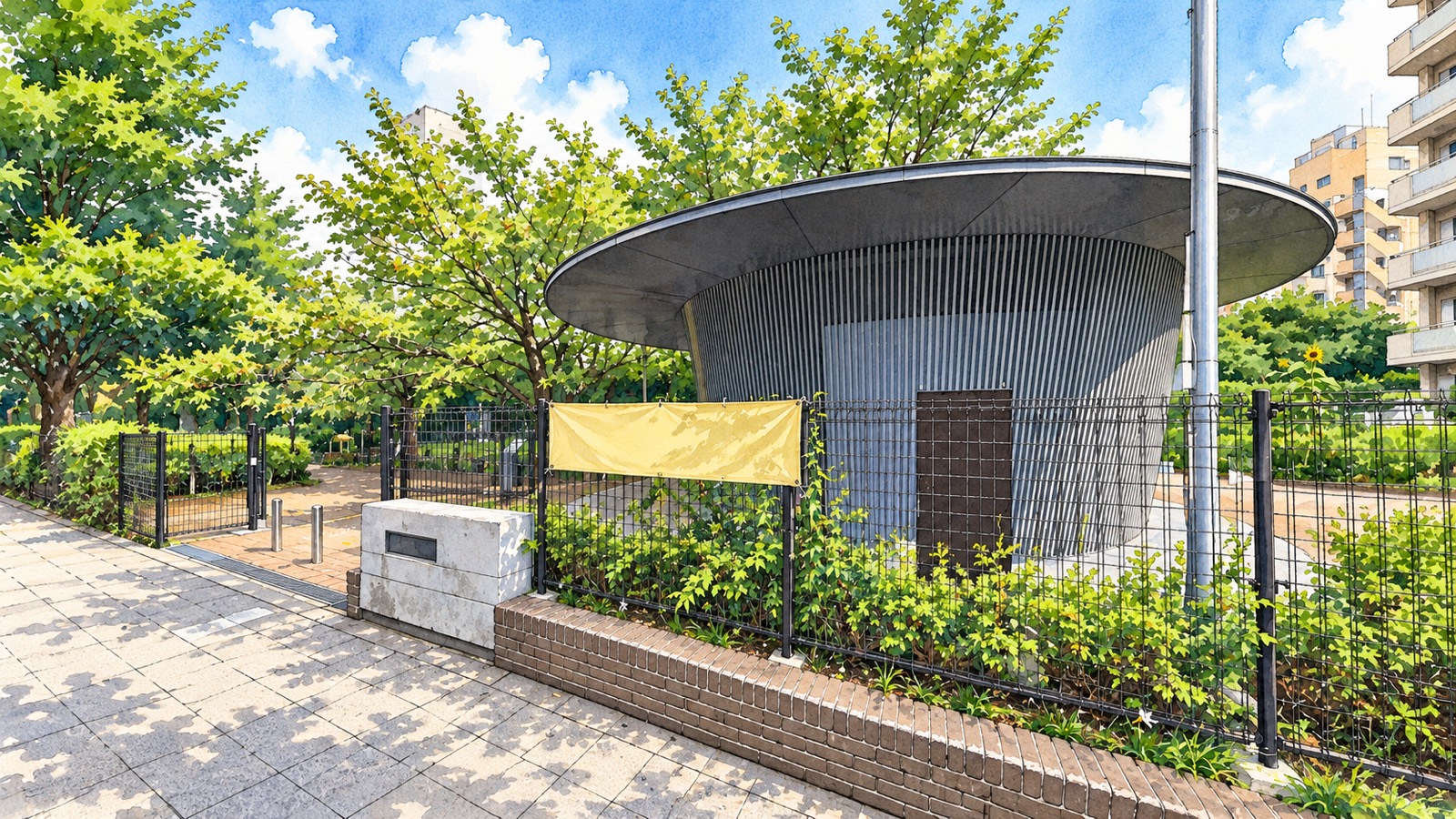
Jingu-dori Park lies between Shibuya and Harajuku stations. Tadao Ando designed the restroom called Amayadori: a circular structure with broad eaves and an outer ring of vertical slats. Gaps between the slats admit light and air without fully enclosing it.
There are entrances on the north and south sides. A handwashing area runs along the outer passage, with an accessible restroom at the center. The facility also has ostomy equipment, a baby chair, and a changing table. The walkway around the circular building is both a defining feature and a space that accommodates movement to and from the entrances.
The name Amayadori, chosen by the designer, evokes the shelter of an eave where someone passing through the park can pause for a moment. Made as part of THE TOKYO TOILET, the film follows Hirayama as he drives his small blue car from one public restroom to another across Shibuya, cleaning several in a day. The circular eaves, shadows cast by the slats, and cherry trees around the building give a sense of one of his workplaces.
- Location
- 6-22-8 Jingumae, Shibuya Ward, Tokyo
- Connection to the film
- One of the Shibuya public restrooms Hirayama cleans: Amayadori, designed by Tadao Ando
- Structure and facilities
- Circular building with broad eaves and vertical slats; two entrances, on the north and south sides, and a central accessible restroom equipped with ostomy facilities, a baby chair, and a changing table
Source: THE TOKYO TOILET: Jingu-dori Park
2Nabeshima Shoto Park Restroom | “Mori no Komichi” links five small buildings
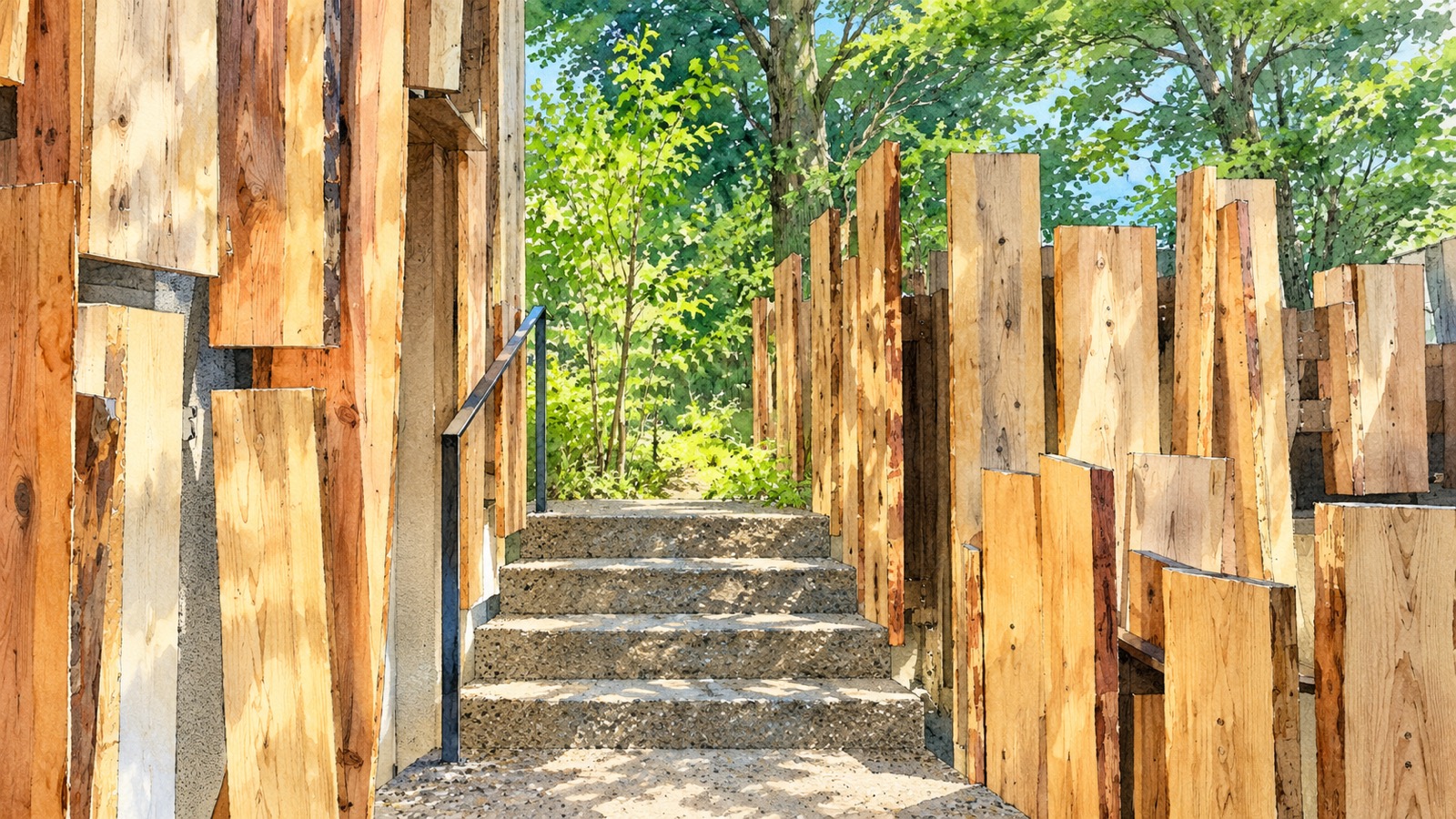
Shoto’s residential neighborhood is home to Nabeshima Shoto Park, where five small buildings designed by Kengo Kuma are connected by a narrow path. Rather than bringing everything together in one building, the “Mori no Komichi” design separates rooms of different sizes and uses. The small structures accommodate different needs, including wheelchair access, families with children, and people who want space to get ready.
The exterior is clad in cedar boards whose irregular edges resemble tree bark. About 240 boards, installed at varying angles, create shifting shadows across the walls visible from the street. Unlike a wooden wall made from uniform boards packed tightly together, each board’s shape and tilt stand out.
Inside, offcuts from trees such as cherry and reclaimed timber are also used. The materials retain differences in wood species and color rather than smoothing them away, echoing the irregular cedar boards outside. Here, the park’s trees and the buildings do not merge into one large outline; they overlap in smaller, distinct forms.
- Location
- 2-10-7 Shoto, Shibuya Ward, Tokyo
- Connection to the film
- Hirayama visits this public restroom to clean it. The “Mori no Komichi” was designed by Kengo Kuma.
- Architectural features
- Five small buildings for different uses are linked by a path; the exterior walls are clad in about 240 Yoshino cedar louvers.
Source: THE TOKYO TOILET: Nabeshima Shoto Park
3Yoyogi Fukamachi Mini Park | Min Tanaka’s movement and colored glass
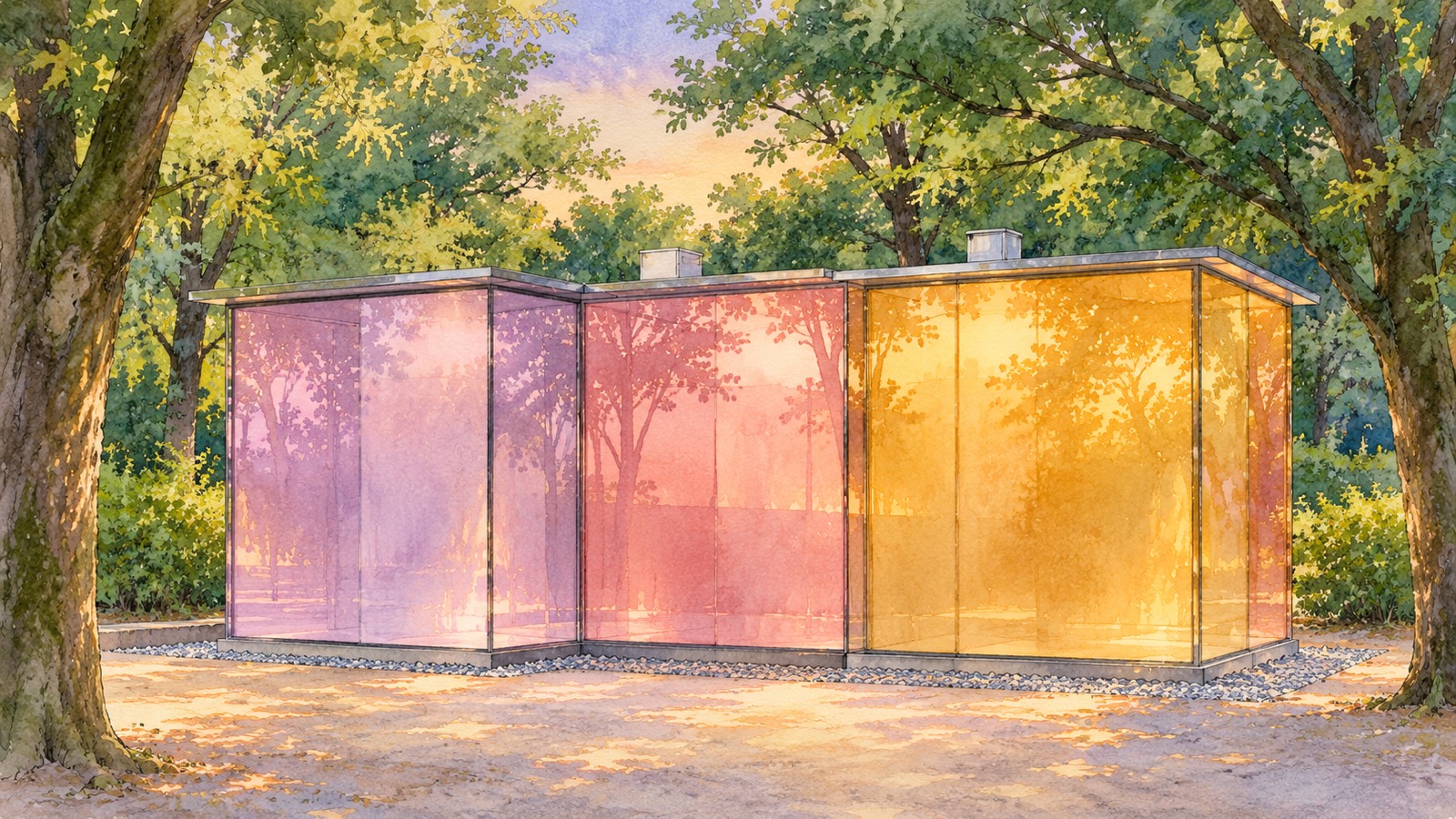
This is the park where the man played by Min Tanaka reaches toward the sunlight. The film’s official character profiles identify it as Yoyogi Fukamachi. He does not build a relationship with Hirayama through dialogue, but Hirayama regards him with quiet respect. Hirayama looks up at the trees while the man moves his body toward the light. Their connection exists beyond conversation.
The park restroom was designed by Shigeru Ban. It is known for colored glass in its outer walls that turns opaque when the doors are locked. The idea was to let people check the restroom’s cleanliness and see whether anyone might be inside before entering. At night, the light within spreads outward, illuminating the park like an andon, a traditional paper lantern.
The system that switches the glass between transparent and opaque has also changed in practice. In December 2022, the operators announced that the glass would be kept opaque after low temperatures caused delays in switching it. The transparent look seen in the film offers a way to understand the design, but peering into the stalls through the glass is not a reason to visit. The features to notice are the building’s layout and colors as seen from the park.
- Location
- Shibuya Ward, Tokyo, Tomigaya1-54-1
- Connection to the film
- The park where Hirayama comes to clean and where a homeless man, played by Min Tanaka, dances beneath the trees
- Architectural features
- A restroom with colored-glass outer walls designed by Shigeru Ban; in December 2022, it was fixed in the opaque state to address delays in switching during cold weather
Sources: Official film character profiles; THE TOKYO TOILET: Yoyogi Fukamachi Mini Park; December 2022 equipment update
4Yoyogi Hachiman Public Restroom | Three mushrooms at the forest entrance
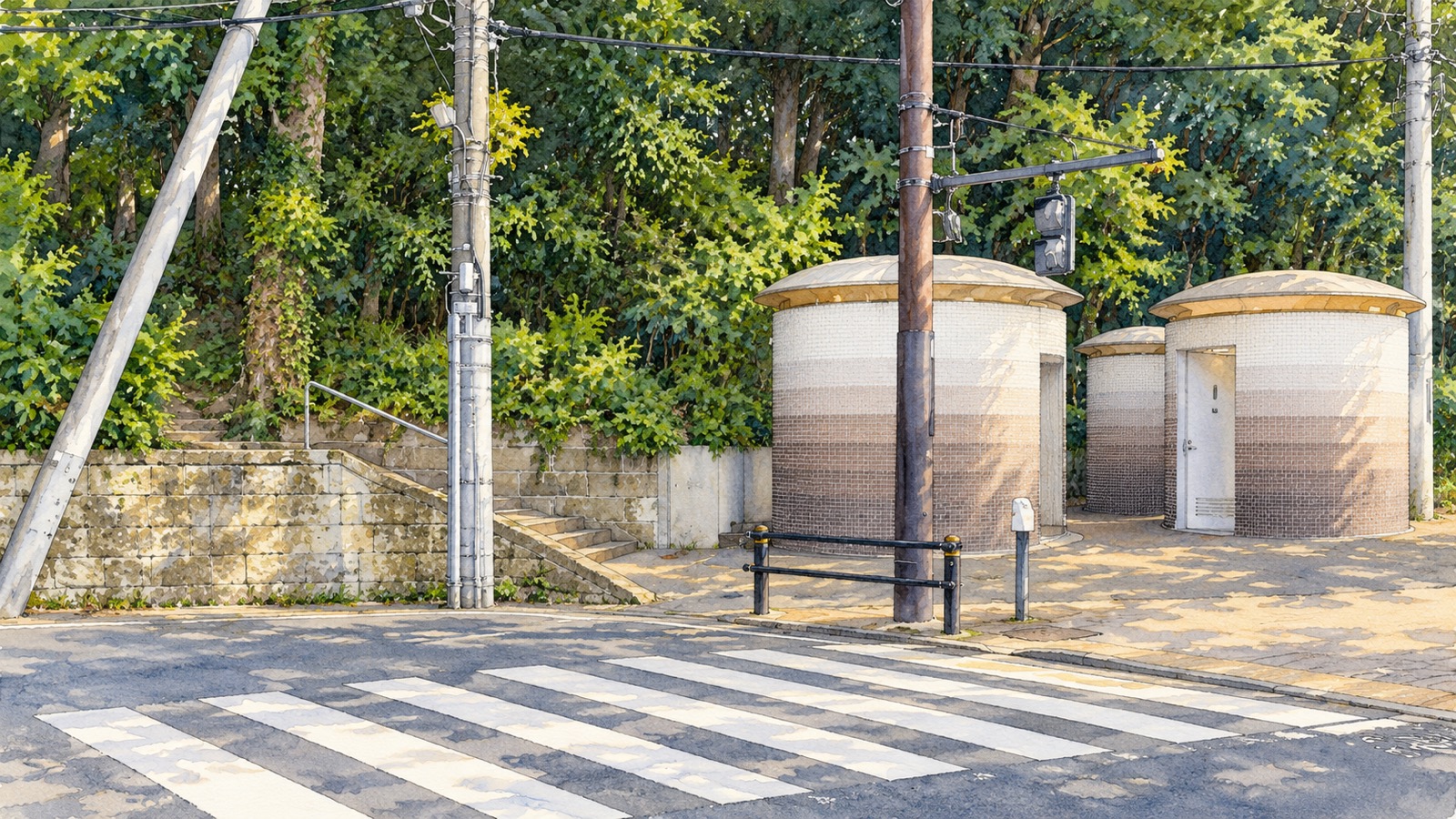
Along Yamate-dori, near the stairs leading up to the approach to Yoyogi Hachimangu Shrine, stands Toyo Ito’s “Three Mushrooms.” The three cylinders with rounded roofs resemble mushrooms growing out of the forest behind them. Of the 17 THE TOKYO TOILET sites that inspired the film, this one stands at the edge of the woods of Yoyogi Hachimangu Shrine.
The three structures separate the men’s, women’s, and accessible restrooms. Paths run between them, reducing dead ends. The individual rooms are spacious, and facilities for older visitors and families with children are distributed among the men’s and women’s restrooms instead of being concentrated in just one place.
Small round tiles cover the exterior, shifting gradually in color. Daylight enters through gaps beneath the roofs. The design addresses both how the building fits into the forest and how to keep its individual rooms from feeling closed in.
At Jingu-dori Park, circulation runs within a single circle; at Nabeshima Shoto Park, the buildings are spread out; here, people pass between three cylinders. The architects offer different answers to the same public-restroom brief. Those differences make each of Hirayama’s workplaces feel like a distinct place rather than one backdrop.
The stairs beside the restroom lead up to the grounds of Yoyogi Hachimangu Shrine. According to the film-information site Ji-Movie, the scene in which Hirayama eats lunch in dappled sunlight was filmed there.
- Location
- 5-1-2 Yoyogi, Shibuya Ward, Tokyo
- Connection to the film
- One of the Shibuya public restrooms cleaned by Hirayama and his coworker Takashi: “Three Mushrooms,” designed by Toyo Ito
- Architectural features
- Three cylindrical buildings with rounded roofs set against the forest of Yoyogi Hachimangu Shrine, with walkways between them
Source: THE TOKYO TOILET: Yoyogi Hachiman
5Haru no Ogawa Community Park Restroom | Hirayama meets Aya by the colored glass
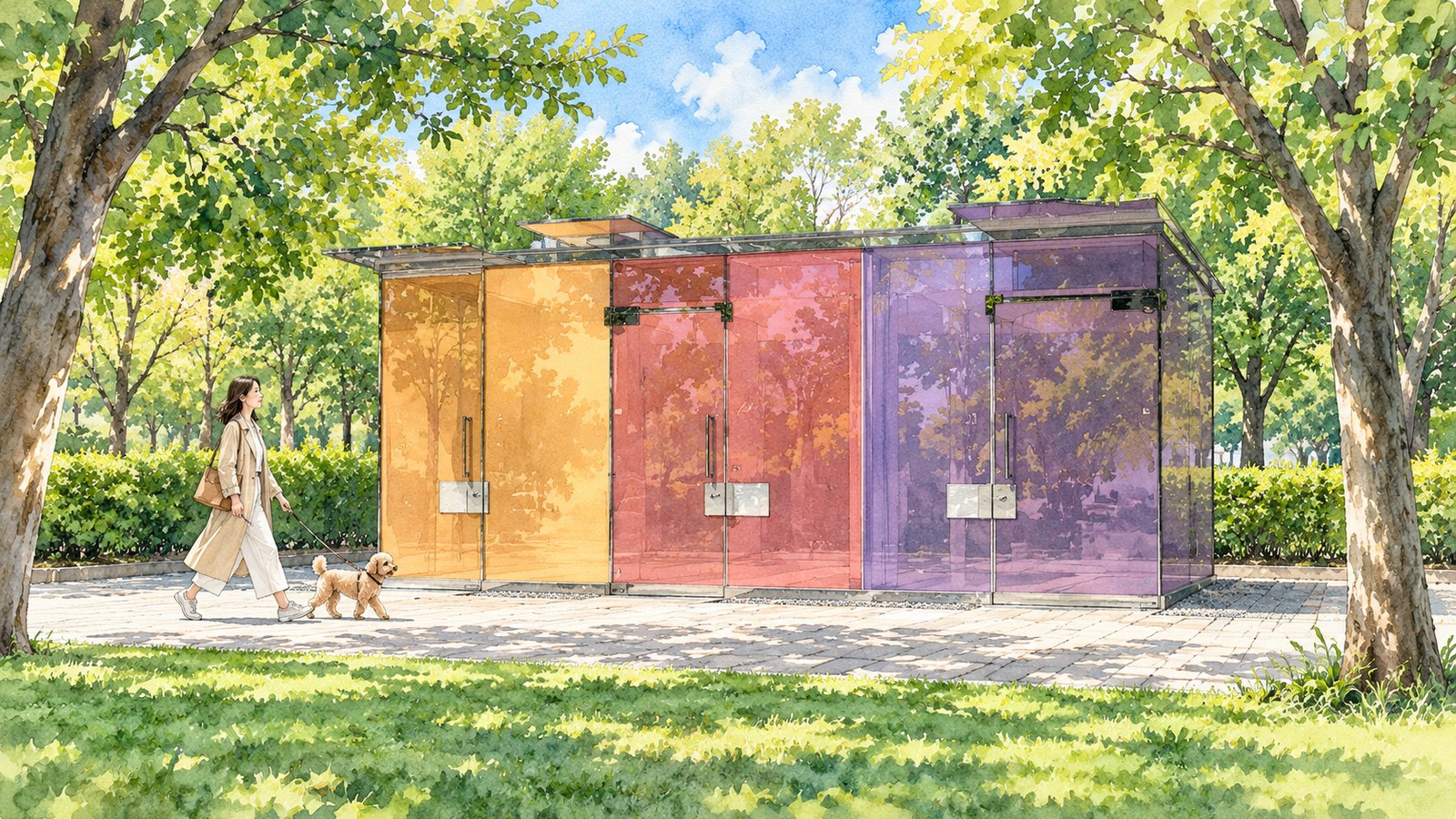
This restroom in Haru no Ogawa Community Park in Yoyogi 5-chome is also designed by Shigeru Ban. Like the restroom at Yoyogi Fukamachi Mini Park, its outer walls use glass that turns opaque when the doors are locked; only the glass colors differ. The system lets people check from outside whether the restroom is clean and unoccupied before entering. At night, the building lights the park like an andon.
According to MOVIE WALKER PRESS, this restroom appears in the scene where Hirayama meets Aya, his coworker Takashi’s girlfriend. The Yoyogi Fukamachi Mini Park restroom appears in a scene where a foreign woman asks how to use it; here, a building with the same system becomes the setting for a different encounter.
- Location
- 5-68-1 Yoyogi, Shibuya, Tokyo (Haru no Ogawa Community Park)
- Connection to the film
- The public restroom used for the scene where Hirayama meets Aya, his coworker Takashi’s girlfriend
- Architectural features
- Designed by Shigeru Ban. Colored-glass outer walls turn opaque when locked; the accessible restroom has ostomy facilities.
Sources: THE TOKYO TOILET | Haru no Ogawa Community Park ; MOVIE WALKER PRESS: Shibuya’s public restrooms in the film
6Nishihara 1-chome Park Restroom | “ANDON TOILET,” shaded by trees by day and glowing at night
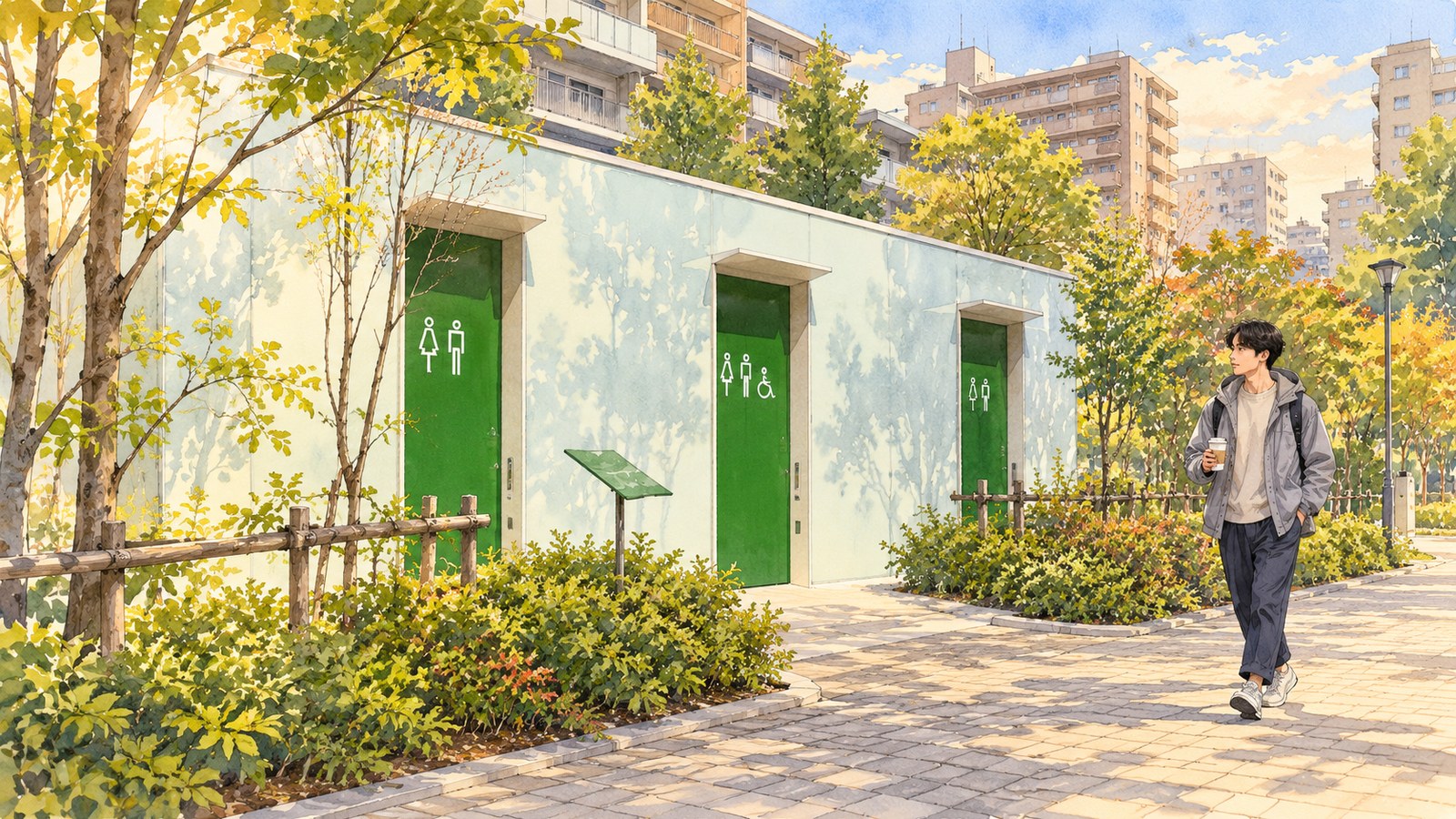
Takenosuke Sakakura designed this square restroom, which resembles an andon. Its outer walls are made of milky white frosted glass. By day, shadows from nearby plants fall across the walls; at night, the light inside illuminates the park like light passing through washi paper. An accessible restroom with a baby chair and ostomy equipment sits in the center of the front facade, flanked by restrooms for men and women.
The designer says the previous restroom saw few visitors and could even feel unwelcoming. The goal was to create a place people would want to use for reasons beyond the number of toilets or wait times, brightening the impression of the park as a whole. In the film, this is where Takashi’s childhood friend Dera-chan (Aoi Yoshida) comes to see Hirayama and Takashi while they are working.
- Location
- Shibuya Ward, Tokyo, Nishihara1-29-1 (Nishihara 1-chome Park)
- Connection to the film
- The public restroom used in the scene where Takashi’s childhood friend Dera-chan visits the two men at work
- Architectural features
- Designed by Takenosuke Sakakura. Milky white frosted-glass exterior walls glow like an andon at night.
Sources: THE TOKYO TOILET: Nishihara 1-chome Park ; MOVIE WALKER PRESS: Shibuya’s public restrooms in the film
7Nanago-dori Park Restroom | “Hi Toilet” opens by voice, as Hirayama works through the night
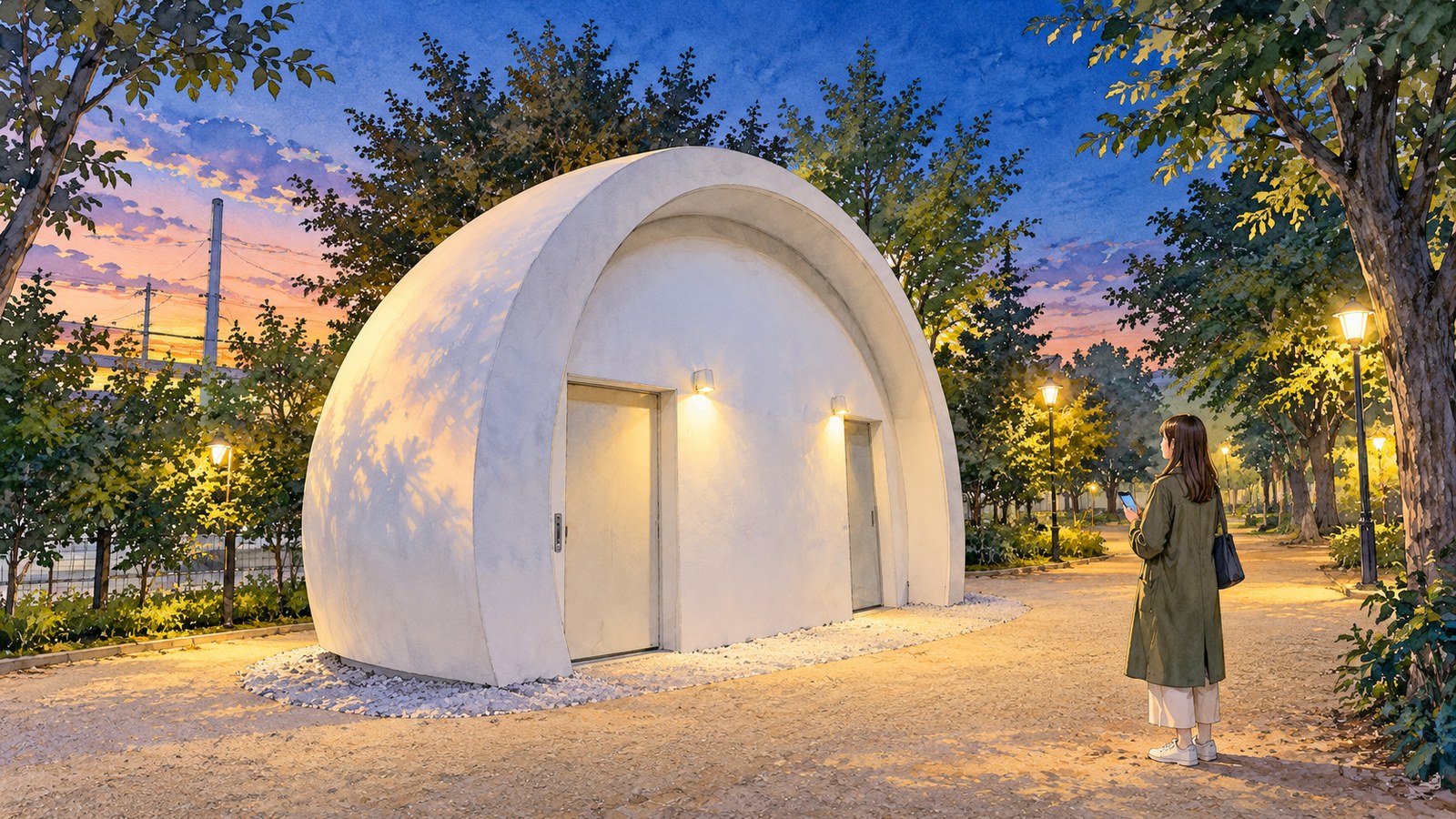
Hatagaya 2-chome is home to Nanago-dori Park and this restroom, shaped like a rounded white shell. It was created by creative director Kazoo Sato. Called “Hi Toilet,” it uses voice controls for everything from opening and closing the door to flushing. The voice-recognition system is installed in the accessible restroom on the left.
According to the official website, the project began with research into restrooms in Europe and North America. Many people were found to step on flush levers, open doors with toilet paper, and avoid touching surfaces with their hands. Three years of research and planning led to a restroom people could use without touching it. MOVIE WALKER PRESS says the exterior appears in the film after Takashi suddenly quits and Hirayama is shown working late to clean Takashi’s assigned area as well.
- Location
- 2-53-5 Hatagaya, Shibuya Ward, Tokyo (Nanago-dori Park)
- Connection to the film
- The public restroom exterior appears in the scene where Hirayama keeps cleaning into the night after Takashi quits.
- Architectural features
- Created by Kazoo Sato. “Hi Toilet” uses voice controls to open and close the door and flush.
Sources: THE TOKYO TOILET: Nanago-dori Park ; MOVIE WALKER PRESS: Shibuya’s public restrooms in the film
8Sakura Bridge | A path splits toward the two banks of the river
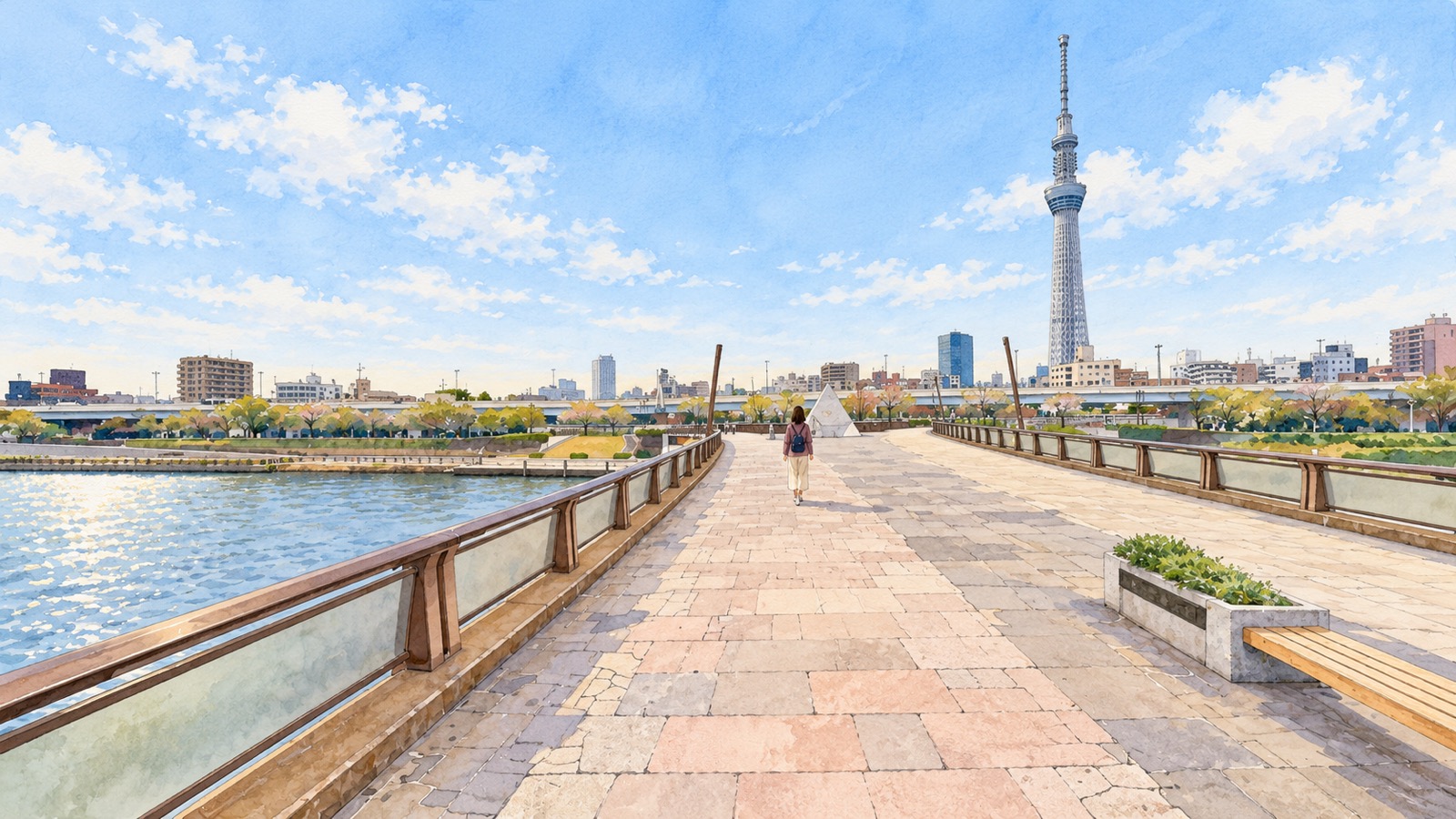
Sakura Bridge is a pedestrian-only bridge connecting the two parts of Sumida Park on either side of the Sumida River. From above, it forms an X where its paths cross at the center. Built in 1985 as a joint project by Taito and Sumida wards, the bridge connects Imado on the Asakusa side with Mukojima.
The Taito City Film Commission describes it as a bridge that Hirayama crosses almost every day. Filming took place over several days in October 2022. The townscape across the river and the evening sky take up much of the frame here.
Hirayama’s day working in Shibuya does not end at the architecture of his workplace. He returns to the eastern part of the city, crosses the river, shops, and eats. Sakura Bridge’s open views give that wider life a sense of space. The fine light seen from beneath the trees in a park feels different from the open sky above the river, where little blocks the view, even though both scenes are in Tokyo.
Hirayama lives alone in an old apartment in Oshiage. When he opens his apartment door in the morning and looks up, Tokyo Skytree rises beyond the sky; the tower is also visible across the river from Sakura Bridge.
- Location
- Near 1-1 Imado, Taito Ward, Tokyo (within Sumida Park)
- Connection to the film
- A pedestrian bridge where Hirayama rides his bicycle across the Sumida River on days off and after work, sometimes riding alongside his niece Niko
- Structure and opening
- Opened in 1985. An X-shaped pedestrian-only bridge connecting Taito and Sumida wards.
Sources: Taito City filming records; Official Taito City tourism information: Sakura Bridge
9Chikyu-do Bookstore | Buying a bedtime read in Asakusa
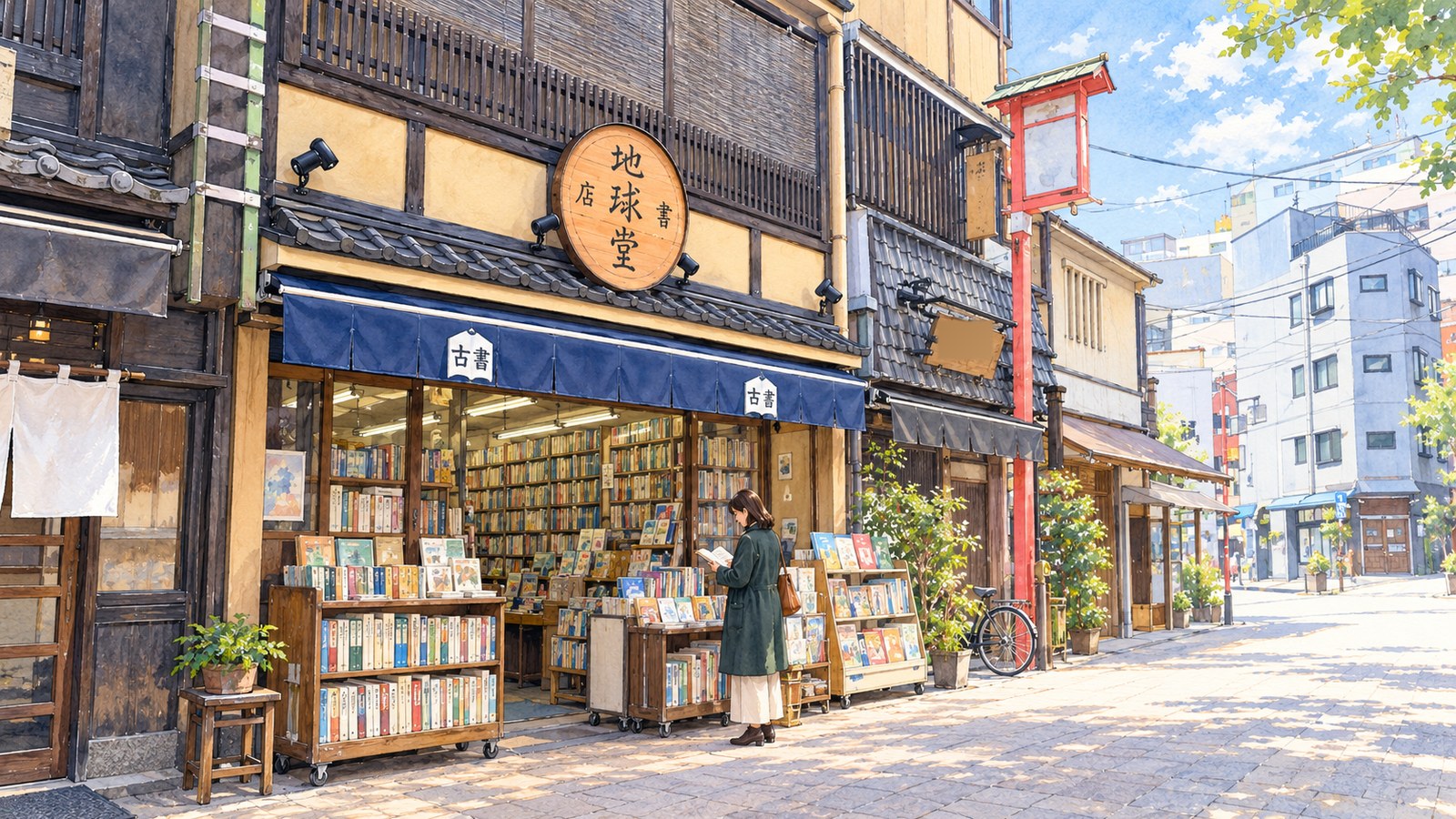
Denboin-dori’s Chikyu-do Bookstore is where the scene of Hirayama buying used books was filmed. According to Taito City’s filming records, the shop interior was used almost exactly as it was. The shelves on screen belong to a real bookstore that has operated in Asakusa for years, not a fictional shop built for the film.
The shopkeeper is played by Inuyama Inuko. When Hirayama brings his books to the counter, she adds a sharp, brief review of each one. Reading at night is time alone, but before a book reaches his hands, there is an exchange: he chooses it from the shelves and hears what the shopkeeper has to say.
The books Hirayama reads are William Faulkner’s The Wild Palms, Fumi Koda’s Trees, and Patricia Highsmith’s Eleven. None can be called a simple “comfort read.” Highsmith’s collection includes “The Terrapin,” a story about a boy who commits a brutal act. Hirayama’s calm life does not mean every story he reads is calm.
The Asakusa Merchants Association describes Chikyu-do as a used bookstore that has operated on Denboin-dori for more than 50 years. The sense of time that accumulates on screen was not created by set design alone. The years the neighborhood shop has actually been part of the street are there, too.
- Location
- 1-39-9 Asakusa, Taito Ward, Tokyo (Denboin-dori)
- Connection to the film
- Filming location for the scene where Hirayama browses for used books on his day off; the shop interior was used almost as it was.
- About the shop
- A used bookstore operating for more than 50 years on Denboin-dori in Asakusa.
Sources: Taito City filming records; Asakusa Merchants Association: Chikyu-do Bookstore; Official film site: Books featured in the film
10Fukuchan, Asakusa Underground Shopping Street | Hirayama’s usual stop after work
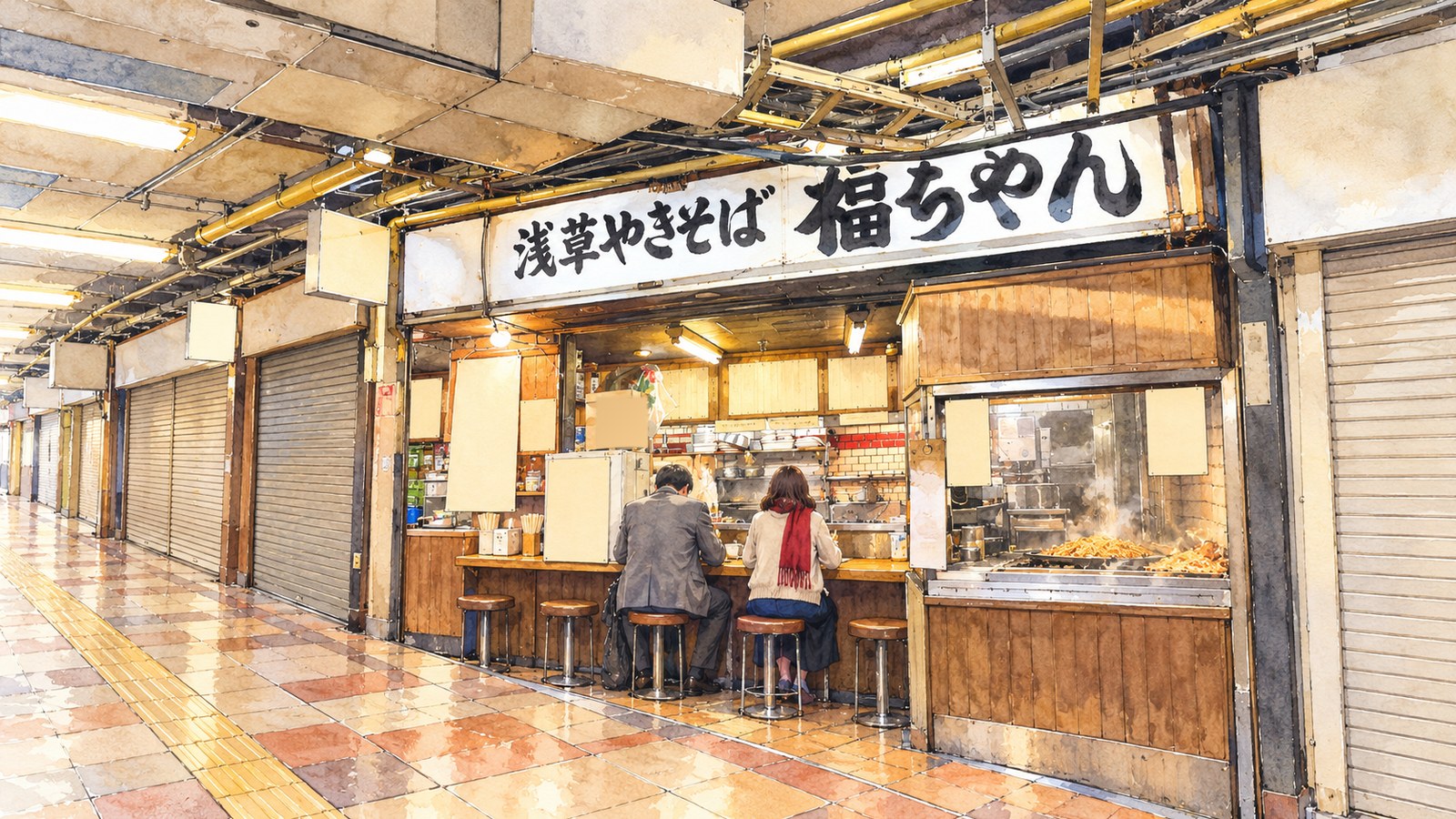
Fukuchan, in the underground shopping street in Asakusa 1-chome, is the filming location for the place where Hirayama stops after work. Taito City’s filming-location guide also lists the shop’s name and address. Unlike the used bookstore above ground or the riverside, this is a dense space lined with shops along an underground passage.
After work, Hirayama rides his bicycle to the bathhouse, then orders his usual meal at this underground eatery. The owner is played by Masahiro Koumoto. At work, Hirayama handles his tools alone and rarely has to explain himself to anyone. Here, he is welcomed as a regular and sits among the voices of other people.
Living alone, as the film portrays it, does not mean never meeting anyone. There is the shop owner, the bookseller, the man he sees in the park, and his coworker. Hirayama returns to places where other people are, even without becoming deeply involved in their lives. That distance makes it hard to describe his life only in terms of isolation. The restaurant is not a set preserved for the film; it remains open for regular business in the underground shopping street.
- Location
- Inside Asakusa Underground Shopping Street, 1-1-12 Asakusa, Taito Ward, Tokyo
- Connection to the film
- A filming location for the yakisoba eatery and izakaya where Hirayama stops after work and on his way back from the bathhouse, speaking with the owner played by Masahiro Koumoto
- Setting
- Open inside Asakusa Underground Shopping Street, directly connected to Tobu Asakusa Station and Tokyo Metro Asakusa Station on the Ginza Line
Source: Taito City Film Commission: Fukuchan
11Denki-yu | Where Hirayama soaks after work in Hirayama’s Hikifune bathhouse
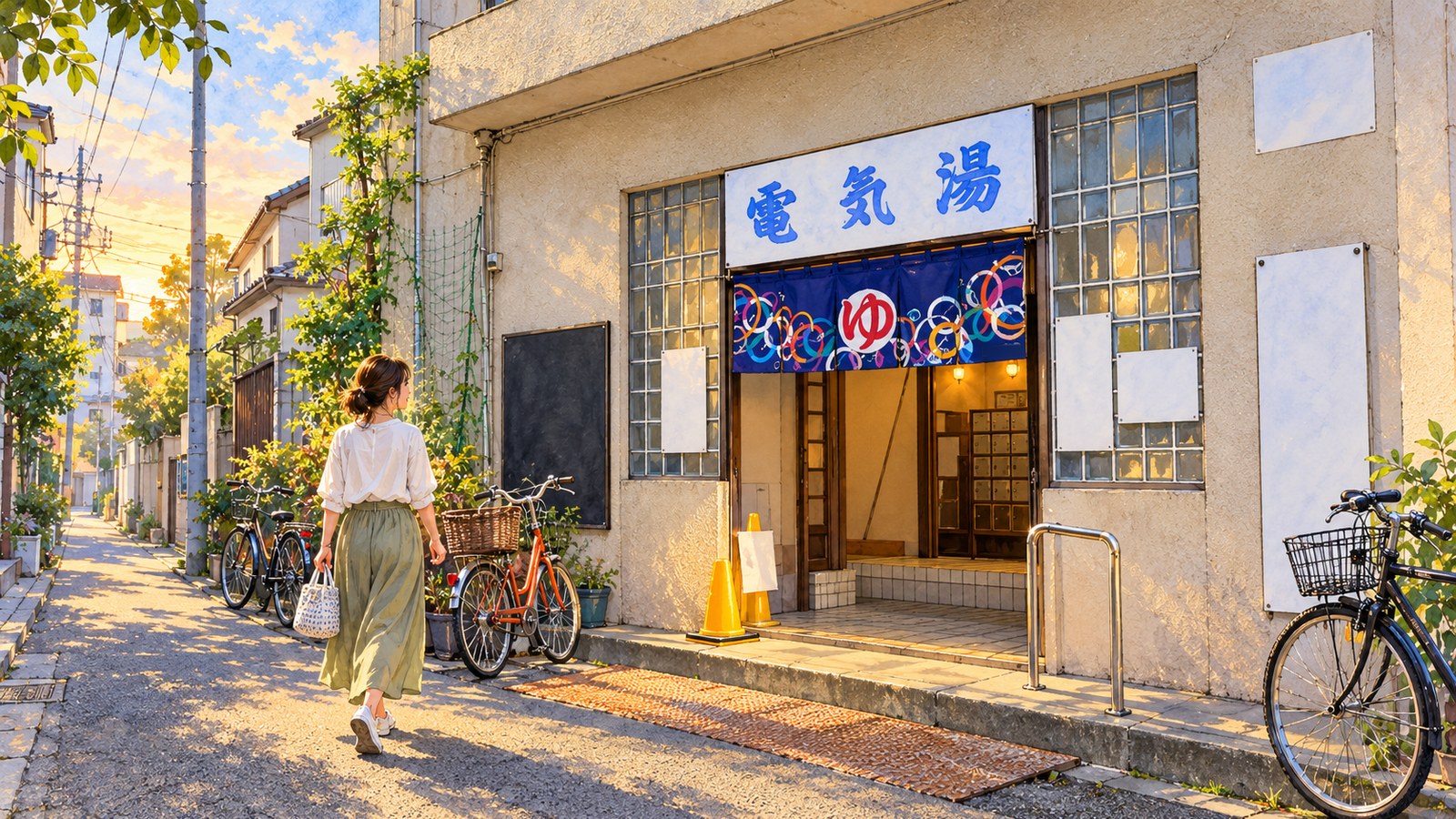
This bathhouse is about a five-minute walk from Keisei Hikifune Station, in Kyojima, Sumida Ward. Founded in 1922 as Kato-yu, it was renamed in 1948. A 2025 article in Nikkan Gendai identifies it as a PERFECT DAYS filming location, and Ji-Movie also lists it as the site of the bathhouse scene. After work, Hirayama rides his bicycle to the bathhouse, then heads to the underground eatery in Asakusa.
According to Nikkan Gendai, the bath has a mural of a red Mount Fuji on the far wall and an arched ceiling painted green and yellow. The bath is heated with well water. In October 2025, Denki-yu also held the “Life Stories of Kyojima” exhibition, displaying words and photographs from people who have lived in the neighborhood for many years. It is open from 3 p.m. to midnight, with morning bathing from 8 a.m. to noon on Sundays.
- Location
- 3-10-10 Kyojima, Sumida Ward, Tokyo (about a five-minute walk from Keisei Hikifune Station)
- Connection to the film
- Filming location for the bathhouse scene Hirayama visits after work
- Hours
- 3 p.m.–midnight; Sunday morning bathing, 8 a.m.–noon (according to Denki-yu’s 2025 information)
Sources: Nikkan Gendai: Denki-yu, the bathhouse used as a filming location; Ji-Movie: PERFECT DAYS filming locations; Denki-yu: Information on the “Life Stories of Kyojima” exhibition
From an architecture project to a film about one cleaner
The idea that turned four short films into one feature
The project began with a letter from Tokyo to director Wim Wenders. It invited him to visit the public restrooms and make whatever he liked, whether a photo book or a short film. Wenders came to Japan in May 2022 and met not only the buildings but also the cleaners who worked there.
The original plan called for four days of filming per restroom, for a total of 16 days across four short films. Wenders proposed using those 16 days to film a single story instead. Rather than introducing the buildings one by one, he would make the person who kept them clean the protagonist. That change meant the story also needed a home, a bookstore, places to eat, and a bridge beyond the park restrooms.
Wenders describes this process in a production note he contributed to the Osnabrück Film Festival. Takuma Takasaki and Wenders developed the screenplay through an initial meeting in Tokyo, collaboration in Berlin, and many exchanges by email and online. Filming took place in Tokyo over 16 days in October 2022.Takuma Takasaki and Wenders developed the screenplay through an initial meeting in Tokyo, collaboration in Berlin, and many exchanges by email and online. Filming took place in Tokyo over 16 days in October 2022.
Source: Osnabrück Film Festival: Wenders’s production notes
Hirayama | Test shoots became less frequent as the crew followed him
Co-writer and producer Takuma Takasaki wrote in an official film-site comment that test shoots gradually disappeared as filming progressed. The production shifted from explaining a character played by an actor according to a set plan to following the day of the Hirayama in front of the camera.
In an official Cannes interview, Wenders said that he spoke with Yakusho through an interpreter, while a sense of understanding through small gestures developed among the three of them and the cinematographer. Even with a prepared screenplay, there was room to respond to the people and places as they appeared during filming.
There are no long speeches explaining who Hirayama is. Instead, the weight falls on the way he picks up a tool, looks at the sky, or pauses after someone speaks. The director’s and co-writer’s accounts help us avoid mistaking the lack of dialogue for a lack of inner life.
Sources: Official film site: Takuma Takasaki’s comment; Cannes Film Festival: Interview with the director
“Hirayama”: how the name connects to Yasujiro Ozu
Wenders noted in a Cannes interview that filming in Tokyo took place 60 years after Ozu’s final film, An Autumn Afternoon. He also revealed that naming the protagonist Hirayama was no coincidence.
But the Tokyo of this film is not made up of locations chosen to recreate the look of an Ozu film. There are contemporary public restrooms, a small blue car, and a sky with Tokyo Skytree. The city at the time of filming and the films of the past that Wenders respects are connected through the protagonist’s name.
Old and new coexist in PERFECT DAYS not only in the city. Hirayama uses a film camera and cassette tapes, while his workplace includes restrooms with contemporary designs. That combination also shapes the film’s Tokyo, without fixing its protagonist in a single era.
Source: Cannes Film Festival: Interview with the director
Hirayama’s books, music, and photographs at home and in the car
What his choice of books tells us about Hirayama’s inner life
The book Hirayama reads is The Wild Palms, a novel in which two stories unfold in alternation. According to the official film site, when choosing the book Hirayama would read in bed, Wenders quickly suggested Faulkner. Even the dense lines of an old paperback were considered as part of the bedtime-reading scene.
Fumi Koda’s Trees contains short, observant pieces about trees. It echoes Hirayama’s photography and the plants he keeps in his room. Highsmith’s stories, by contrast, include unease and cruelty.
Putting these three books together keeps Hirayama from being reduced to a single explanation: a good person who likes a quiet life. The life we see is orderly, but the stories he reads contain turmoil and darkness. That range also resonates with the scene where his reunion with his sister hints at a past he has left behind.
Source: Official film site: How the books were chosen
The songs on the cassette tapes were chosen during the screenplay stage
According to the official film site’s music notes, the songs in the film were selected while the screenplay was being written. They were not added later to create a mood for a finished film. Instead, the story took shape alongside the question of what kind of listener Hirayama would be.
The soundtrack includes Lou Reed’s “Perfect Day,” Patti Smith’s “Redondo Beach,” Otis Redding’s “(Sittin’ On) The Dock of the Bay,” and the Kinks’ “Sunny Afternoon,” among others. “Aoi Sakana” by Sachiko Kanenobu is also among the tracks. This is not a nostalgic collection made up only of English-language songs; Japanese music is part of Hirayama’s choices, too.
Listening to a cassette involves a set of actions: choose a tape, put it in the player, and drive. The film’s music is tied to those hand movements and to the space inside the car. Remembering where and by whom a song is played brings us closer to Hirayama than simply listing the titles.
Source: Official film site: Music used in the film
A compact film camera and a night shot on digital
Hirayama uses a compact Olympus μ camera. In a conversation with Seigen Ono, Wenders said the cinematographer, Franz Lustig, recommended it. The camera becomes part of Hirayama’s everyday life, close at hand when he photographs sunlight filtering through the leaves.
The feature film itself, however, was shot digitally. That choice made it possible to film nights and dark places during the 16-day shoot. The filmmakers did not make every part of production analog just because their character favors analog objects.
Hirayama takes his developed film to a photo shop and picks up the finished prints. The shopkeeper is played by Motoyuki Shibata, known as a translator of American literature. The images of sunlight filtering through leaves that Hirayama keeps are on film, while the nighttime streets we see were shot digitally.
Sources: Eiga.com: Conversation between Wenders and Seigen Ono; Official film site: Cast
Mama’s bar, where Hirayama goes only on Sundays
Hirayama’s Sunday-only stop is the bar Kurenai no Hi Nov, where Sayuri Ishikawa plays Mama. Filming used a bar formerly located on the first floor of Todoroki Mansion in Asakusa 4-chome. Taito City’s filming records note that the traditional bathhouse Akebono-yu stood across the street. The bar used for filming moved from Asakusa 4-chome in February 2026 and no longer operates at that location.
According to the official film character profile, Mama opened her bar in Asakusa long after her divorce. She has regular customers and knows Hirayama likes her, but feels she is past the age of doing anything about it. Unlike Fukuchan, where Hirayama stops after work, this is a place he visits only on Sundays. Tomokazu Miura plays Mama’s former husband, Tomoyama, who, after falling ill, begins a journey to look back on his past and see how his former wife is doing.
The film’s music credits list the Animals’ “The House of the Rising Sun” and a Japanese-language version of the song with lyrics by Maki Asakawa. The song Hirayama listens to on cassette in his car in the morning becomes Mama’s song at the bar. Regular customers played by Agata Morio and Moro Morooka also appear in the bar scenes.
Sources: Taito City Film Commission: Nov; Official film site: Character profiles for Mama and Tomoyama; Official film site: Music credits
Niko and Keiko bring Hirayama’s past into view
Arisa Nakano plays Niko, Hirayama’s niece. After arguing with her mother, she left their home in Kamakura and visited her uncle for the first time in more than a decade. Yumi Aso plays Keiko, Hirayama’s younger sister and Niko’s mother. Her official character profile describes her guilt over being unable to do anything when her father and brother clashed.
Their arrival makes Hirayama’s life harder to explain through his present-day routines alone. Did he always want to do cleaning work and live by himself, or did he choose this life after something happened? The film does not explain his past through a long flashback. Instead, it lets that history emerge in the words his family directs at him and in his reactions.
His coworker Takashi is played by Tokio Emoto. Although he does the same work as Hirayama, he approaches it differently and speaks about money in a different way. Aya, played by Aoi Yamada, also does not behave the way Takashi hopes. The people around Hirayama are not there simply to praise his way of life.
Each time someone different enters his life, the routine of a familiar day shifts a little. How Hirayama responds to those disruptions becomes a major event in a film where the same morning keeps returning.
Hirayama
A cleaner of public restrooms in Shibuya, Tokyo. He wakes at the same time every morning, waters his plants, drinks canned coffee, and heads to work. He listens to music on cassette tapes and buys used books to read. He is played by Koji Yakusho.
Niko
Hirayama’s niece. After a fight with her mother, she leaves their home in Kamakura and visits Hirayama for the first time in more than a decade. Played by Arisa Nakano.
Keiko
Hirayama’s younger sister and Niko’s mother. Guilt over being unable to act when her father and brother clashed kept her from seeing her brother for more than a decade. Played by Yumi Aso.
Takashi
Hirayama’s coworker. He is easygoing, often complains that he is broke, and has recently become infatuated with Aya. Played by Tokio Emoto.
Mama
A woman who runs an izakaya in Asakusa and has feelings for Hirayama. Sayuri Ishikawa plays her.
Source: Official film site: Characters and cast
Places and production stories that continued after the film
- 1985Sakura Bridge opens as a pedestrian-only crossing over the Sumida RiverCity
- 2018The Nippon Foundation launches THE TOKYO TOILETArchitecture
- August 5, 2020Yoyogi Fukamachi Mini Park and the first restrooms openArchitecture
- September 7, 2020The Jingu-dori Park restroom opensArchitecture
- June–July 2021Nabeshima Shoto Park and Yoyogi Hachiman restrooms openArchitecture
- May 2022Director Wim Wenders visits Japan and meets the cleanersFilm
- October 202216 days of filming in TokyoFilm
- December 2022The glass at Yoyogi Fukamachi Mini Park is fixed in the opaque stateArchitecture
- March 24, 2023The Nishisando restroom opens, completing all 17 locationsArchitecture
- May 2023At Cannes, Koji Yakusho wins Best ActorFilm
- June 2023The Nippon Foundation transfers the restrooms to Shibuya WardArchitecture
- December 22, 2023The film opens in Japanese theatersFilm
- January 2024Nominated for the Academy Award for Best International Feature FilmFilm
- April 2024Shibuya Ward takes over maintenance and operationsArchitecture
- August 9, 2024Production journal Backlight publishedBook
Keeping the 17 sites ready for everyday use
THE TOKYO TOILET is a project launched in 2018 by the Nippon Foundation with support from Shibuya Ward and others. Sixteen architects and designers created 17 public restrooms across the ward. The facilities opened in stages, from the first sites such as Yoyogi Fukamachi Mini Park in August 2020 to Nishisando in March 2023. The facilities were transferred to Shibuya Ward in June 2023, and responsibility for their maintenance and other operations followed in April 2024. The project’s official maintenance overview describes daily cleaning, regular deep cleaning, specialized work on exterior walls and ventilation equipment, and inspections by third-party assessors.
Glass, stainless steel, and painted surfaces each call for different tools and cleaning products. Scrubbing hard just to make something look clean can damage the surface. Outdoor buildings also need attention beyond the area around the toilet bowls, including weather exposure and leaves that collect on the roof.
Beyond the work of the single cleaner shown in the film, many other specialists are involved. Hirayama’s use of his tools cannot be fully understood simply as an expression of a meticulous personality.
Sources: THE TOKYO TOILET: Opening dates for all 17 locations; THE TOKYO TOILET: Maintenance; The Nippon Foundation: Transfer of facilities and operations to Shibuya Ward
New buildings do not eliminate the challenges of cleaning
In a 2024 conversation published by the Nippon Foundation, toilet inspector Nobutaka Yamato and Mitsuharu Sato discuss maintaining public toilets. Sato has long been active on public-restroom issues. They note that while ceramic toilet bowls can last a long time, pipes, doors, ventilation, and other parts can still develop problems.
The two visited the restroom at Takenosuke Sakakura’s Nishihara 1-chome Park. Yamato praised it as a top-tier public restroom, noting that it is bright by day with natural sunlight and that at night the building glows like an andon, helping improve the safety of the surrounding area.
In the same conversation, Yamato recalled that he initially found the idea of treating public restrooms as tourist attractions surprising. More people now visit to see the architecture through the film, while others rely on the facilities in their everyday lives. Bringing together interest as a travel destination and its role as public infrastructure is one feature of the project.
Source: The Nippon Foundation: Conversation with Mitsuharu Sato and Nobutaka Yamato
Backlight: Two years of making the film, recorded in a book
A deeper look at the production can be found in Wim Wenders: Perfect Days Diaries — Backlight, published by Little More. Takuma Takasaki and Wenders created this book together; it covers about two years, from preparation through release.
Along with essays and production notes, it includes an interview with the director, photographs taken during filming, art-design materials, letters, and the screenplay. It offers another way to follow the thinking behind objects and places that may appear only briefly in the finished film.
The inclusion of both Japanese and English versions of the screenplay is also tied to how the film came together. A German director and a Japanese screenwriter developed a story set in Tokyo, with characters who speak Japanese. The book offers a way to read that collaboration on the page, beyond the impressions left by the finished film. It was published in August 2024 and runs 216 pages.
Source: Little More: Bibliographic information for Backlight
Release and awards
At the 76th Cannes Film Festival in 2023, Koji Yakusho won Best Actor for his performance in the film. It opened in Japanese theaters on December 22 that year and was later nominated for the Academy Award for Best International Feature Film at the 96th Academy Awards.
The official film site has published interview videos with Wenders, Koji Yakusho, and Min Tanaka. Yakusho discusses his approach to a role, something he does not often talk about, while Tanaka speaks from a dancer’s perspective about Yakusho’s performance and what was happening in the final scene.
Sources: Taito City: Release and Cannes award records; Little More: Film information; Official film site: Interviews
The Oshi Lab note | A project showcasing architecture includes the work of cleaning
PERFECT DAYS depicts public-restroom architecture alongside the daily cleaning work of Hirayama. The film shows not only the beauty of a design but also the movements of the people who keep a place usable every day. The used bookstore and eateries appear not as one-time attractions but as places in his everyday life that he returns to again and again.
This perspective can also inform projects that use architecture for tourism or public relations. Alongside the designer and photos of the finished building, such projects can show who maintains it day by day and how they do that work. As more visitors arrive, their presence needs to be balanced with cleaning and regular use. When a film brings attention to a building, a project can present its finished appearance and the ongoing work of caring for it together.
Sources
Official film site / THE TOKYO TOILET / Taito City filming records
FAQ
Is Hirayama a real cleaner?
He is a fictional character played by Koji Yakusho. Director Wim Wenders has said that meeting a real cleaner helped inspire the project, but the film is a story co-written with Takuma Takasaki.
Who designed the Shibuya restrooms?
For THE TOKYO TOILET, 16 architects and designers worked on 17 locations across Shibuya Ward. Jingu-dori Park was designed by Tadao Ando, Nabeshima Shoto Park by Kengo Kuma, Yoyogi Fukamachi Mini Park by Shigeru Ban, and Yoyogi Hachiman by Toyo Ito.
Where is the transparent restroom?
It is in Yoyogi Fukamachi Mini Park at 1-54-1 Tomigaya, Shibuya Ward. Designed by Shigeru Ban, it uses glass that turns opaque when the doors are locked. Records also describe a period when it was kept opaque because of cold-weather issues.
Where is the used bookstore Hirayama visits?
Chikyu-do Bookstore is at 1-39-9 Asakusa, on Denboin-dori. Taito City’s film commission says the shop’s interior was used almost as it was for filming.
Which two Asakusa eateries appear in the film?
They are Fukuchan in the underground shopping street, where Hirayama stops after work, and Mama’s bar, Kurenai no Hi Nov, which he visits on Sundays. The Asakusa 4-chome location used for Nov moved in February 2026 and no longer operates at the filming address.
Which bathhouse does Hirayama visit?
Denki-yu in Kyojima, Sumida Ward, served as the location. It is about a five-minute walk from Keisei Hikifune Station. Founded in 1922, it adopted its current name in 1948. It is open from 3 p.m. to midnight, with morning bathing on Sundays.
Which books appear in the film?
The film’s official site lists William Faulkner’s *The Wild Palms*, Aya Koda’s *Trees*, and Patricia Highsmith’s *Eleven*. For a look at the production, *Backlight*, by Takuma Takasaki and Wim Wenders, is also available.
What camera does Hirayama use?
He uses an Olympus μ. In a conversation with Seigen Ono, Wenders explained that the cinematographer recommended the camera.


