Review: "Putting Your 'Like' Into Words," a Workout Book for Oshi-Talk Beyond "It's Insane"
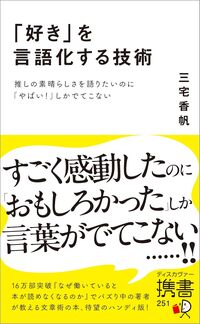
“I want to talk about how wonderful my oshi is, but all I can say is ‘It’s insane!’” If that subtitle rings a bell, you’re probably among the 90% of oshi-katsu fans who do the same.
Critic Kaho Miyake’s “Suki” o Gengoka suru Gijutsu (The Technique of Putting Your “Like” Into Words, Discover Keisho series, 2024) is a workout book for oshi-talk, designed to take you past “insane.” It has passed 300,000 copies and reached number one in Oricon’s first-half shinsho (new-book) ranking.
About the Book
Miyake, a critic who loves the Takarazuka Revue and idols herself, breaks the process of putting “like” into words down by situation: social media posts, conversation, fan letters and long reviews. With sample sentences, she shows how to make “words that are only yours.”
The core message is simple. Talking about your oshi is talking about your own life. Borrowed words like “emo” or “god-tier” won’t do; only words connected to your own experience can move someone else.
- 01NoticeSay what you felt
- 02Ask whyWhich action surprised you?
- 03RecallWhat from your past did it echo?
- 04WriteA post, a chat or a letter
- 05ShareWords only you could say
The book breaks the process down by situation, from short posts to long reviews.
It’s a considerate practical guide, too. It moves in stages from a mindset of “you don’t have to write well” and “step away from cliché words for a moment” to concrete steps. Writing books often leave you with “I read it but still can’t write,” but this one rarely does, because the author’s own oshi-talk appears abundantly as examples that you can imitate as you read.
Miyake describes the first question that gets an impression stuck at “insane” moving again.
Before you hunt for a grand expression, ask your own reaction “why.” Trace whose action, and which one, surprised you, and what from your past it reminded you of, and words that aren’t borrowed are born.
A Point That Stayed With Us: Jot Down Your Impressions First
Of the book’s techniques, the one that pays off starting today is the habit of writing down your own impressions before looking at anyone else’s.
After a live show or a film, we tend to open social media first. As we read the polished takes flowing past, the words that were in us get overwritten by other people’s. A few days later all that’s left is the summary “it was emo.” Many of us will recognize this.
The prescription is simple: just change the order. First your own note, then social media. That alone turns an impression from “borrowed” into “your own record.” It needs no tools and no talent, which is very much this book’s style.
Social media first
- Polished takes flow past
- Your words are overwritten
- Only "it was emo" remains
Your note first
- Impression stays your own
- Becomes a personal record
- No tools or talent needed
Just change the order.
The Editor-in-Chief’s View
The first thing I thought reading this book through the lab’s eyes was: “this is a marketing book wearing the face of a book for fans.”
Our OSHI-MAP® framework has seven axes, and the last is “promoter,” meaning whether a brand spreads through fans’ word of mouth. However much a company spends on ads, it can’t beat one post in a fan’s own words. Fans’ ability to put things into words is the currency of the fandom economy.
What Miyake does in this book is hand everyone the method for minting that currency. The moment a fan who could only say “insane” gets “their own words,” that person changes from a consumer into an evangelist. For a company there is no more important change. Building mechanisms that help fans put things into words, such as room that makes people want to write about their impressions and phrases they want to quote, is fan marketing that works better than ad spend, and I think this book proves it.
- 01A fan feels somethingSays only "insane"
- 02Learns to put it in wordsTheir own words
- 03RecommendsConsumer becomes evangelist
- 04Others are drawn inI get it
Helping fans find words is fan marketing that can outperform ad spend.
Notes From The Oshi Lab: Putting Feelings Into Words Is a Skill, Not a Measure of Love
- Putting feelings into words is a skill, not the total amount of love. Being unable to speak doesn’t mean you lack love. A skill can be practiced
- Winning is hearing “I get it.” Good oshi-talk is an entrance to empathy. The success rate of fukyo (spreading the word about your oshi) is proportional to the resolution of your words
- Companies can design “fans’ words.” Impression hashtags, easily quoted copy, stories people want to tell. Helping fans put things into words can become a campaign
Who It Will Resonate With
- Fans who want to go beyond “insane.” For anyone who wants a better success rate at fukyo or wants to try writing an impressions blog or a report, it’s right on target
- People who want to keep memories of their oshi. Putting feelings into words isn’t only for fukyo. It’s also a way to archive your “like,” preserving what you felt at that show for the future
- Corporate staff who want more fan word of mouth. For anyone thinking about mechanisms that make fans want to talk, it works as a practical textbook
Book Information
| Title | “Suki” o Gengoka suru Gijutsu: Oshi no Subarashisa o Katarita noni “Yabai!” Shika Detekonai (The Technique of Putting Your “Like” Into Words: I Want to Talk About How Wonderful My Oshi Is, But All I Can Say Is “It’s Insane!”) |
| Author | Kaho Miyake |
| Publisher | Discover 21 (Discover Keisho series) |
| Published | July 2024 |
Buy it here: Amazon / Rakuten Books (both Japanese-language stores)
Reading It Alongside Our Other Content
What Is Fukyo? lays out the words and the distance to use when handing your oshi’s appeal to someone who doesn’t know it yet. It’s the practice side, for turning the book’s techniques from a hard sell into an entrance the other person can walk through.
Reading What Is Oshi-Gatari? as well shows that what matters more than producing polished writing is how much of your own experience you share, and with whom. For the corporate view, What Is Oshi-Katsu Marketing? fills in the rest.
Three Books to Read Next
| Title | Why we recommend it |
|---|---|
| Naze Hataraite iru to Hon ga Yomenaku naru no ka (Kaho Miyake) | The same author’s huge hit, whose title translates as Why Can’t We Read Books When We Work? Its story of a society that leaves no time for what we like connects directly to the problem of oshi-katsu fatigue |
| Yomitai Koto o, Kakeba Ii. (Yasunobu Tanaka) | Its title translates as Just Write What You Want to Read. That principle works for oshi-talk as it stands, a standard of writing craft |
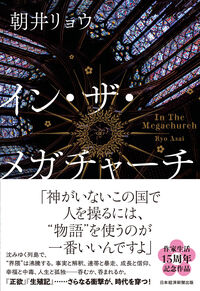
| In the Megachurch (Ryo Asai) | What happens when fans’ passion, once put into words, becomes an “economic sphere”? Next, that structure as a story (review here) |
Summary
A book that works both for fans who want to get better at fukyo and for companies that want more fan word of mouth. Read it alongside Fukyo (Glossary) and What Is Oshi-Katsu Marketing?.
In Oshi-Katsu x Bookshelf, we take a deeper look at books on oshi-katsu and fan culture, one at a time.
FAQ
What kind of book is "Putting Your 'Like' Into Words"?
A practical book by the book critic Kaho Miyake on describing your oshi's appeal in your own words (Discover Keisho series, 2024). It has passed 300,000 copies and took first place in the new-book (shinsho) category of Oricon's first-half BOOK ranking.
Can I do this if I'm not good at writing?
Yes. The book breaks its techniques down by situation: not just long reviews but short social media posts, conversation and fan letters. Even one habit, writing down your own impressions before reading anyone else's, makes a difference.
Is it useful for corporate marketers too?
Yes. The better fans are at speaking in their own words, the stronger word of mouth gets, so the book offers hints on leaving room for people to want to write about their impressions and giving them phrases worth quoting. Reading it alongside What Is Oshi-Katsu Marketing? rounds out the picture.