

Sumo Pilgrimage in Tokyo: Ryogoku Kokugikan, the Sumo Museum, and Yokozuna Monuments
At Tokyo’s Ryogoku Kokugikan, the ring and four-sided seating spread out beneath a broad green roof. The top-division wrestlers’ ceremonial aprons, the ring attendants’ ringing calls, and the referee’s war fan all belong to this stage. A short walk away, Ekoin Temple preserves the history of Edo-era sumo tournaments in its Chikara-zuka monument, while Nominosukune Shrine in Kamezawa bears a stone inscribed with the names of past yokozuna.
On the Kokugikan’s first floor, the Sumo Museum is presenting “100 Years Since the Birth of Chiyonoyama and His Disciples” in fall 2026. Its objects include a ceremonial apron embroidered with Hokusai’s waves and other pieces passed down from a yokozuna to his students. Around Ryogoku Station, visitors can also see a former station building with a full-size sumo ring, the site of the first Kokugikan, and an archive run by a photography studio that served as the Sumo Association’s official photographer. Across the Sumida River in Kuramae and south in Fukagawa, shrines preserve the memory of the kanjin sumo tournaments held in Edo.
Sumo Sites to Visit in Ryogoku, Kuramae, and Fukagawa
① Ryogoku Kokugikan
Venue for Tokyo’s January, May, and September tournaments. Watch wrestlers compete and perform the ring-entering ceremony from the spectator seats.
Explore Ryogoku Kokugikan② Sumo Museum
Themed displays feature ceremonial aprons, woodblock prints, and ranking lists. A tournament ticket is required during the Grand Sumo tournament.
Explore the Sumo Museum③ Ekoin Temple
A temple that served as a regular venue for kanjin sumo. Visit Chikara-zuka, a monument honoring generations of sumo elders.
Explore Ekoin Temple④ Nominosukune Shrine
A shrine dedicated to the deity of sumo. A stone inscribed with the wrestlers’ ring names preserves the sport’s history.
Explore Nominosukune Shrine⑤ Edo NOREN
A full-size sumo ring and a fire-watch tower stand in the open atrium of the former station building.
Explore Edo NOREN⑥ Kokugikan-dori Street
A street lined with a wrestler statue in the ring-entering pose and handprints of past yokozuna.
Explore Kokugikan-dori Street⑦ Site of the Former Kokugikan
The first Kokugikan was completed in 1909. A circle in the courtyard marks where its ring stood.
Explore the Former Kokugikan site⑧ Sumo Photography Archive
The photography studio that served the Sumo Association displays about 70 photographs for each tournament.
Explore the Sumo Photography Archive⑨ Kuramae Shrine
The site of a kanjin sumo tournament where Tanikaze’s 63-match winning streak ended in 1782.
Explore Kuramae Shrine⑩ Tomioka Hachimangu Shrine
The birthplace of Edo’s kanjin sumo tournaments, with a Yokozuna Rikishi Monument inscribed with the names of past yokozuna.
Explore Tomioka Hachimangu Shrine
1Ryogoku Kokugikan | A Green Roof Above a Ring Surrounded on All Sides by Spectators
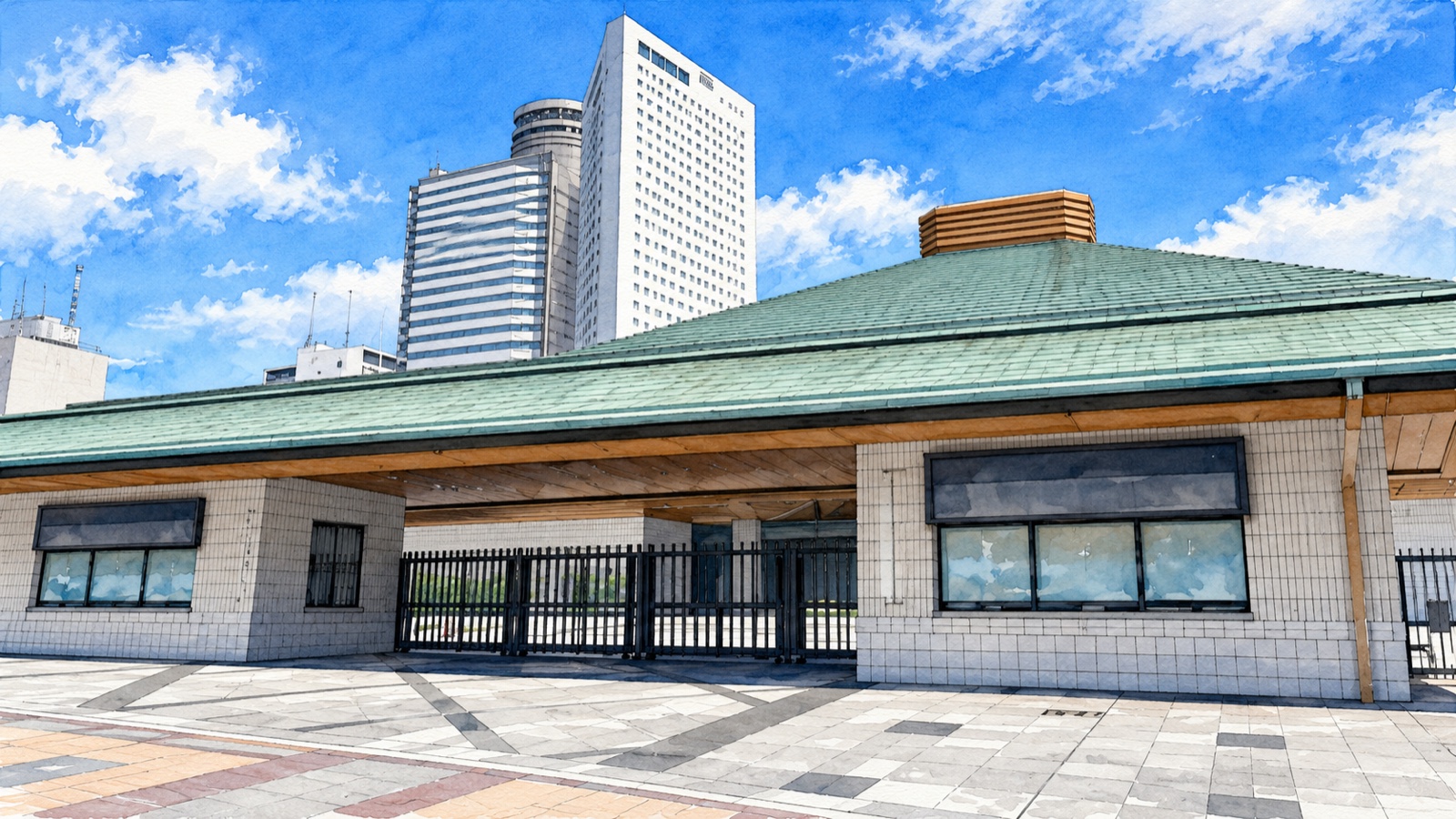
Today’s Ryogoku Kokugikan opened in January 1985. It hosts Tokyo’s January, May, and September Grand Sumo tournaments. The venue is a two-minute walk from the West Exit of Ryogoku Station on the JR Sobu Line. The neighborhood name in its address, Yokoami, is pronounced “yokoami.”
The building’s defining feature is its broad green roof, whose four corners slope diagonally. This shape is called a “truncated square,” and its eaves extend outward in a low, long profile. Tokyo’s architectural guide also highlights a system that collects roof runoff underground for use as utility water. The traditional Japanese exterior houses the practical systems of a modern venue built to welcome large crowds.
Once inside, another roof appears to float above the sumo ring. This is a suspended roof supported from the ceiling. The pillars that once stood at the ring’s four corners have been removed, and four colored tassels now hang in their place. Around the ring familiar from television broadcasts are the east, west, front, and back seating sections, along with two “flower paths” used by wrestlers to enter and leave.
On the first floor, box seats are cushions set within marked-off sections. The second floor is mostly chair seating. The official Kokugikan Seat View includes street-view imagery of the seats and passageways. Switch between the first and second floors to look around the venue, from the ring to the upper seating.
The next Tokyo tournament is the January tournament, running from January 10 to 24, 2027. Tickets are available through the Japan Sumo Association’s ticket information page. The first floor also houses the Sumo Museum, which visitors can enter on weekdays when no tournament is being held.
- Tournament
- 1-3-28 Yokoami, Sumida City, Tokyo
- Connection to sumo
- Venue for Tokyo tournaments; opened in January 1985
- Nearest station
- Two-minute walk from the West Exit of Ryogoku Station on the JR Sobu Line
- What to see
- Broad green roof with clipped corners; suspended roof and four colored tassels; first-floor box seats and second-floor chairs
Sources:Tokyo Metropolitan Government — The Kokugikan building and sumo ring (in Japanese) 、Kokugikan — Access (in Japanese) 、Kokugikan — Seat View (in Japanese) 、Kokugikan — January 2027 schedule (in Japanese)
2Sumo Museum | Yokozuna Ceremonial Aprons and Sumo History from Edo
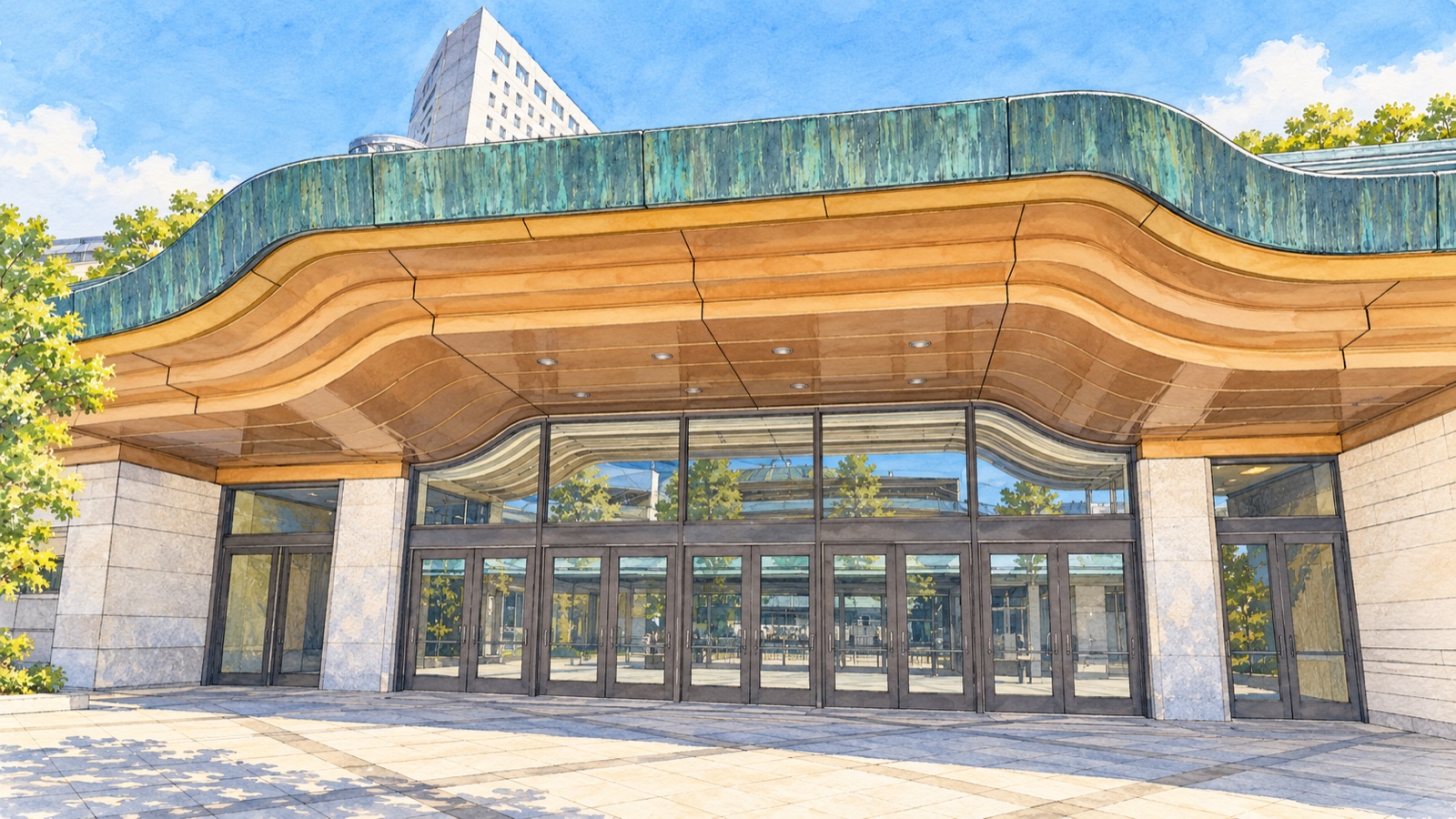
The Sumo Museum is a 150-square-meter exhibition room on the first floor of the Kokugikan. Based on the collection of its first director, Tadamasa Sakai, it opened in September 1954 alongside the Kuramae Kokugikan. The museum was established to collect and preserve sumo materials that might otherwise have become scattered, and moved to the current Kokugikan in 1985.
Its collection includes ceremonial aprons, ranking lists, and woodblock prints. There is no permanent display; the museum presents items from its collection in three special exhibitions each year. In 2026, following “Art and Sumo” and “Views of Edo Sumo,” the exhibition “100 Years Since the Birth of Chiyonoyama and His Disciples” runs from September 13 through December 17.
This fall’s exhibition includes Chiyonoyama’s ceremonial apron and yokozuna promotion certificate, as well as ceremonial aprons worn by Kitanofuji and Chiyonofuji. It offers a chance to examine the embroidery and patterns on the garments worn by wrestlers familiar from match footage. A curator-led gallery talk is also scheduled for November 11 at 2 p.m. and will last about 30 minutes. No reservation is required.
Admission is normally free, and the museum is open from 10 a.m. to 4:30 p.m., with last entry at 4 p.m. It is generally closed on Saturdays, Sundays, public holidays, and during the year-end and New Year period, though some dates have special opening hours and the museum also closes between exhibitions. During Tokyo tournaments, it is open from 12:30 to 4 p.m., and a ticket for that day’s Grand Sumo tournament is required. Regular museum admission does not include access to the arena.
The exhibition room also has a counter where visitors can receive amulets and talismans from Nominosukune Shrine. The shrine itself is in Kamezawa; the counter is inside the Kokugikan.
- Location
- First floor, Ryogoku Kokugikan, 1-3-28 Yokoami, Sumida City, Tokyo
- Connection to sumo
- A sumo history exhibition facility operated by the Japan Sumo Association
- Opening hours
- Regular hours: 10 a.m.–4:30 p.m. (last entry 4 p.m.); during Tokyo tournaments: 12:30–4 p.m.
- Admission
- Free during regular periods; a ticket for that day’s Grand Sumo tournament is required during Tokyo tournaments
Sources:About the Sumo Museum (in Japanese) 、Exhibition information (in Japanese) 、Opening calendar (in Japanese)
3Ekoin Temple | Chikara-zuka, a Monument at the Site of Kanjin Sumo Tournaments
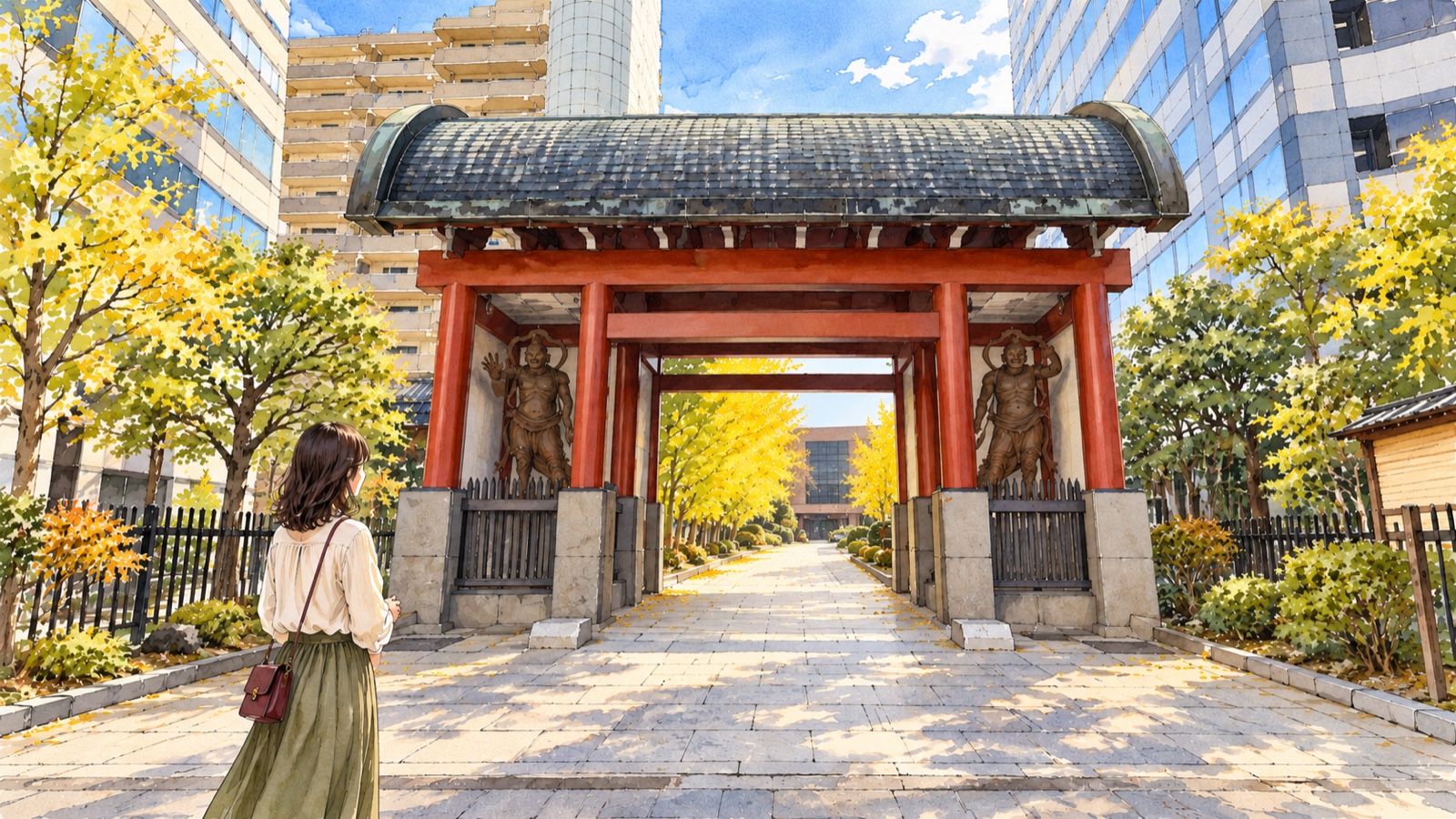
South of Ryogoku Station, Ekoin Temple was established to mourn those who died in the Great Fire of Meireki in 1657. Its connection to sumo is marked by Chikara-zuka, a monument in the temple grounds. The Sumo Association erected it in 1936 to honor generations of sumo elders. It also serves as a place where new wrestlers pray to receive strength.
During the Edo period, sumo tournaments were held as kanjin sumo, events that raised funds for projects such as repairing temples and shrines. The first tournament at Ekoin took place in 1768. From 1833, it became the regular venue for spring and autumn tournaments, drawing crowds for 76 years until the former Ryogoku Kokugikan was completed in 1909.
A vivid record of those crowds is Ryogoku Grand Sumo in Its Golden Age, a multicolor woodblock print made by Utagawa Kunisato in 1853. It depicts spectators filling the area inside and outside the temple gate, sumo teahouses, and banners and sake barrels presented by devoted supporters. The print appeared in the Sumo Museum’s 2026 special exhibition “Views of Edo Sumo” and is also featured on the museum’s official website.
The contrast between the quiet temple grounds, where Chikara-zuka remains, and the crowds in the print is striking. Today’s Kokugikan stands north of the station, but in Edo, people gathered south of it at Ekoin to watch sumo.
- Location
- 2-8-10 Ryogoku, Sumida City, Tokyo
- Connection to sumo
- Regular venue for Edo kanjin sumo for 76 years, beginning in 1833
- Nearest station
- Three-minute walk from the West Exit of Ryogoku Station on the JR Sobu Line
- What to see
- Chikara-zuka, a memorial to generations of sumo elders erected by the Sumo Association in 1936
Sources:Ekoin Temple — Visitor guide (in Japanese) 、Sumida City Tourism Association — Sumo-related sites (in Japanese) 、Sumo Museum — “Views of Edo Sumo” (in Japanese)
4Nominosukune Shrine | A Monument of Yokozuna Names and a Plum-Blossom Crest
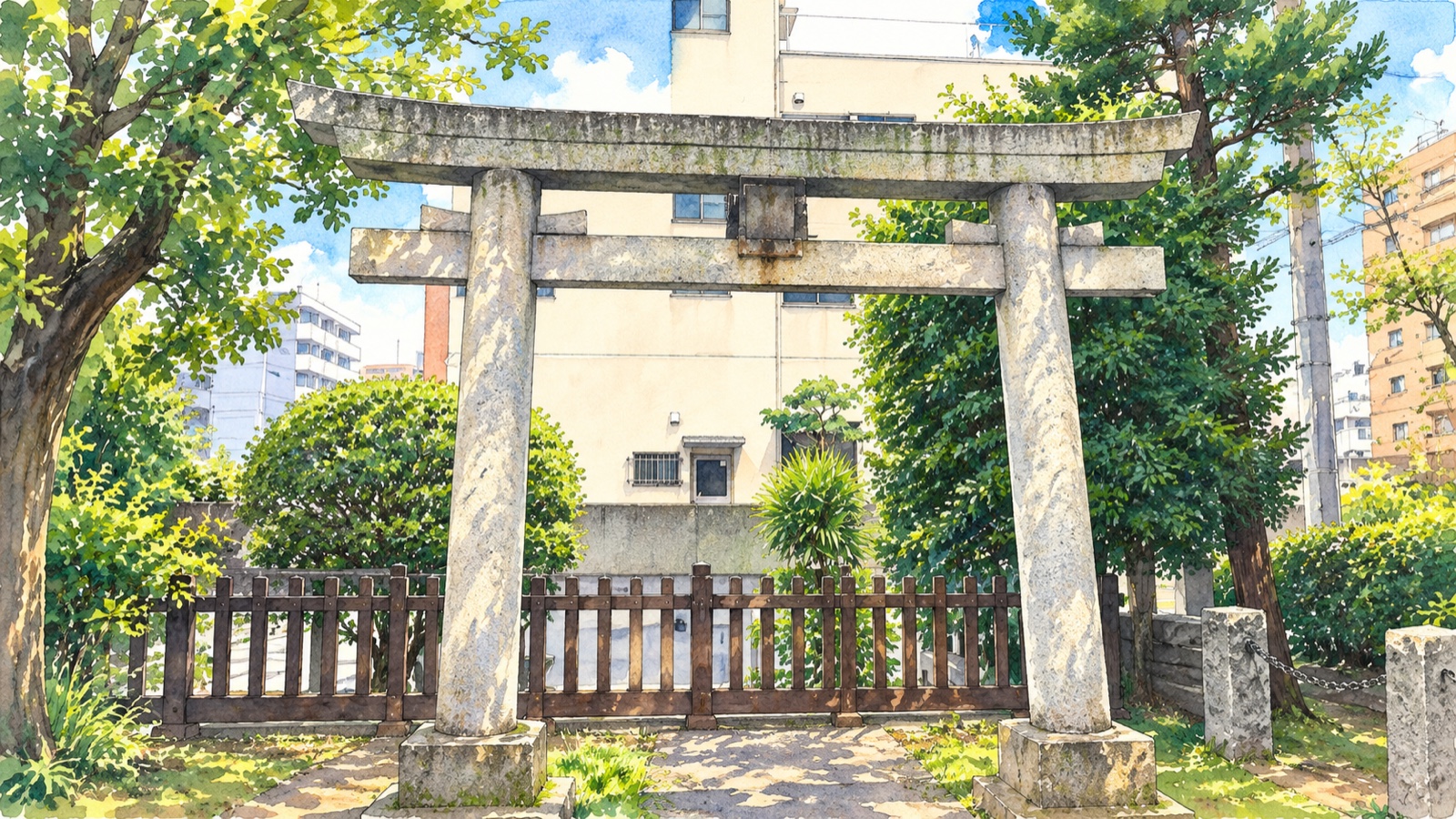
Nominosukune Shrine in Kamezawa was founded in 1885 by sumo figures including Takasago Uragoro, on the former site of the Tsugaru domain’s upper residence. It was destroyed in the Great Kanto Earthquake and the Tokyo air raids, then rebuilt in 1953. At that time, the Japan Sumo Association erected a monument to past yokozuna.
Nominosukune, enshrined here, is a figure who appears in the Chronicles of Japan. According to legend, he defeated Taima no Kehaya in a contest of strength. He has since been revered as the founder of sumo and a deity of victory. The names wrestlers used in the ring, or shikona, of yokozuna who have carried on the sport are inscribed on the monument in the shrine grounds.
The shrine crest is a plum blossom, reflecting its connection to Sugawara no Michizane, revered as a deity of learning. The shrine’s history explains that the Sugawara clan emerged from the Haji clan, which traced its ancestry to Nominosukune, and that Michizane descended from this line. This link explains why a shrine dedicated to sumo bears the plum design familiar from Tenmangu shrines.
Before Tokyo’s tournaments, the shrine holds an annual festival attended by the Sumo Association’s chairman and head of the judging department, among others. It is also known as a shrine where newly promoted yokozuna perform a ceremonial ring-entering. On an ordinary visit, you can quietly view the shrine building and monument to past yokozuna.
- Location
- 2-8-10 Kamezawa, Sumida City, Tokyo
- Connection to sumo
- A shrine dedicated to the legendary founder of sumo, established in 1885 by sumo figures including Takasago Uragoro
- Nearest station
- Six-minute walk from Exit A3 of Ryogoku Station on the Toei Oedo Line
- What to see
- The monument to past yokozuna, erected by the Japan Sumo Association when the shrine was rebuilt in 1953, and its plum-blossom crest
Source:Japan Sumo Association — Nominosukune Shrine (in Japanese)
5Edo NOREN in Ryogoku | A Full-Size Sumo Ring in the Former Station’s Atrium
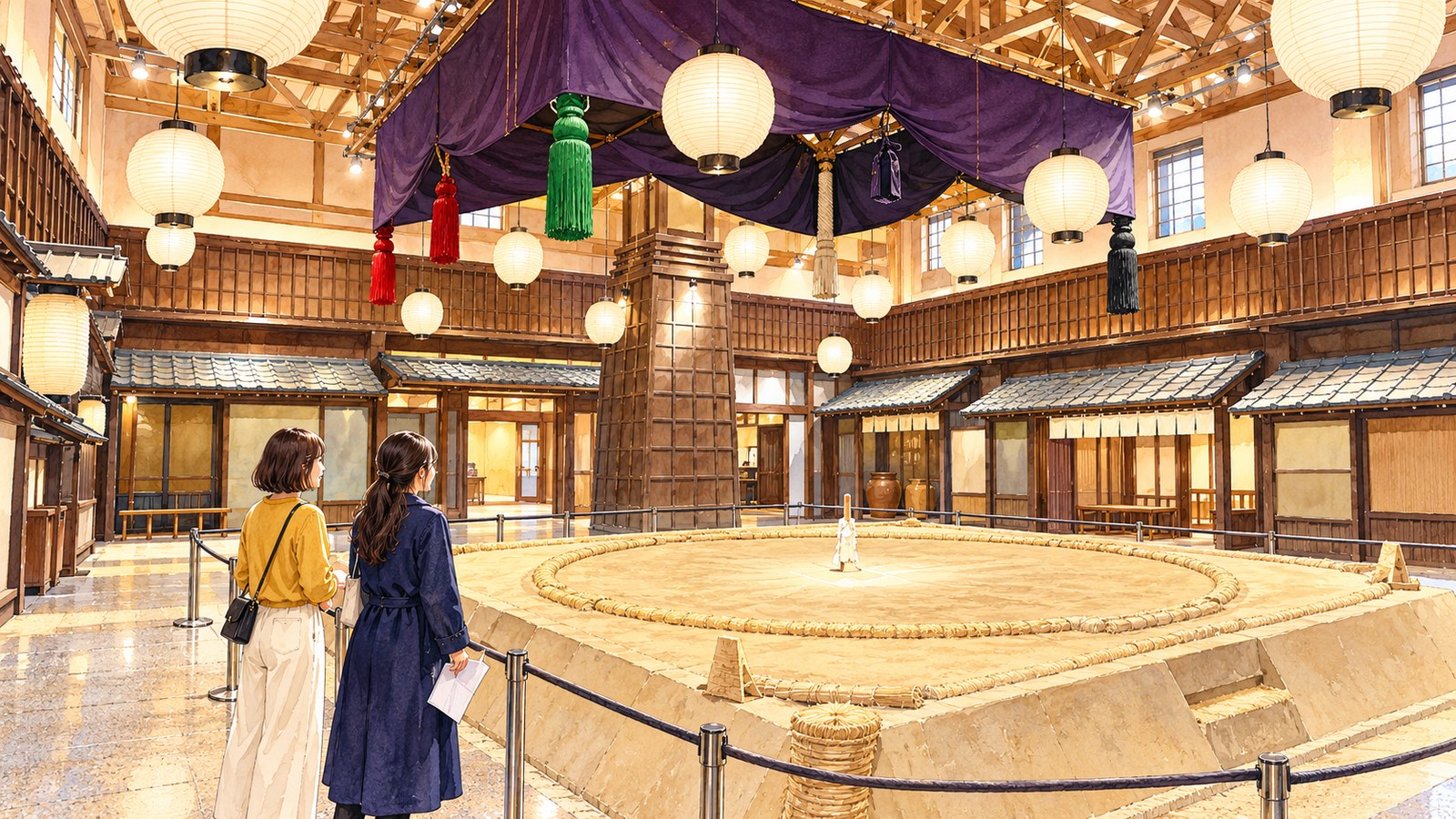
“Edo NOREN in Ryogoku,” directly connected to the West Exit of JR Ryogoku Station, is a dining complex renovated from the station’s former building. At the center of an open atrium recalling Edo townhouses stands a sumo ring the same size as one used in a Grand Sumo tournament. A fire-watch tower rises behind the ring, and a large lantern hangs from the high beams.
Restaurants around the ring serve sushi, soba, monjayaki, and other dishes. “Chanko Kirishima,” owned by former ozeki Kirishima, is also located here. The Ryogoku Tourist Information Center inside carries Sumida City brochures and souvenirs.
The complex is open from 10 a.m. to 11 p.m. It closes on January 1 and 2 and on facility inspection days. In fiscal year 2026, guided tours of the complex are available only to customers dining at one of its restaurants.
- Location
- 1-3-20 Yokoami, Sumida City, Tokyo
- Connection to sumo
- A full-size tournament ring stands at the center of the complex
- Nearest station
- Directly connected to the West Exit of Ryogoku Station on the JR Sobu Line
- Opening hours
- 10 a.m.–11 p.m. (hours vary by restaurant); closed January 1 and 2 and on facility inspection days
Sources:Edo NOREN in Ryogoku (in Japanese) 、Sumida City — Ryogoku Walking Guide, Vol. 1 (in Japanese) 、Sumida City — Ryogoku Walking Guide, Vol. 4 (in Japanese)
6Kokugikan-dori Street | A Wrestler Statue in the Ring-Entering Pose and Yokozuna Handprints
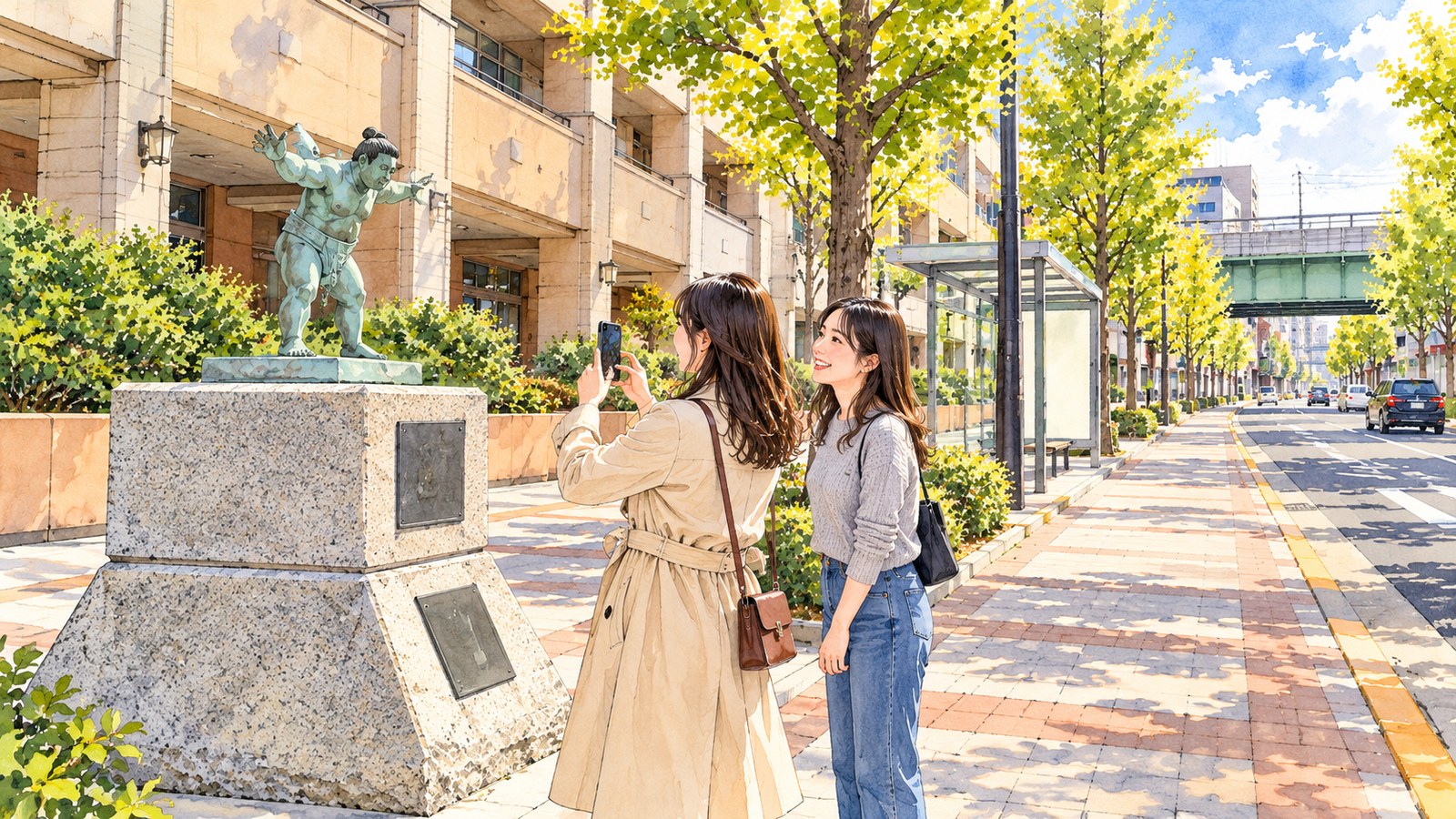
Kokugikan-dori is the road that runs from the west side of the Kokugikan, beneath the JR Sobu Line tracks, toward Keiyo-dori. Along its sidewalk, a bronze statue of a wrestler in the ring-entering pose stands on a pedestal, alongside handprints of past yokozuna.
Walk south from the West Exit of Ryogoku Station and a small bronze statue, weathered green with patina, comes into view on a granite pedestal. Many visitors take commemorative photos mimicking the wrestler’s arm position during the ring-entering ceremony.
Each spring, the Ryogoku Festival also brings events to this street. At its 19th edition in April 2025, a stage was set up along the road, alongside stalls where visitors could compare chanko hot pots.
- Location
- Sidewalks along Kokugikan-dori, from Yokoami 1-chome to Ryogoku 2-chome, Sumida City, Tokyo
- Connection to sumo
- A street lined with a wrestler statue in the ring-entering pose and handprints of past yokozuna
- Nearest station
- Just outside the West Exit of Ryogoku Station on the JR Sobu Line
- What to see
- A bronze wrestler statue standing on a granite pedestal
Sources:GO TOKYO — Walking through Ryogoku, the town of sumo (in Japanese) 、Sumida City — Ryogoku Walking Guide, Vol. 1 (in Japanese)
7Site of the Former Ryogoku Kokugikan | A Circle in the Courtyard Marks the Ring
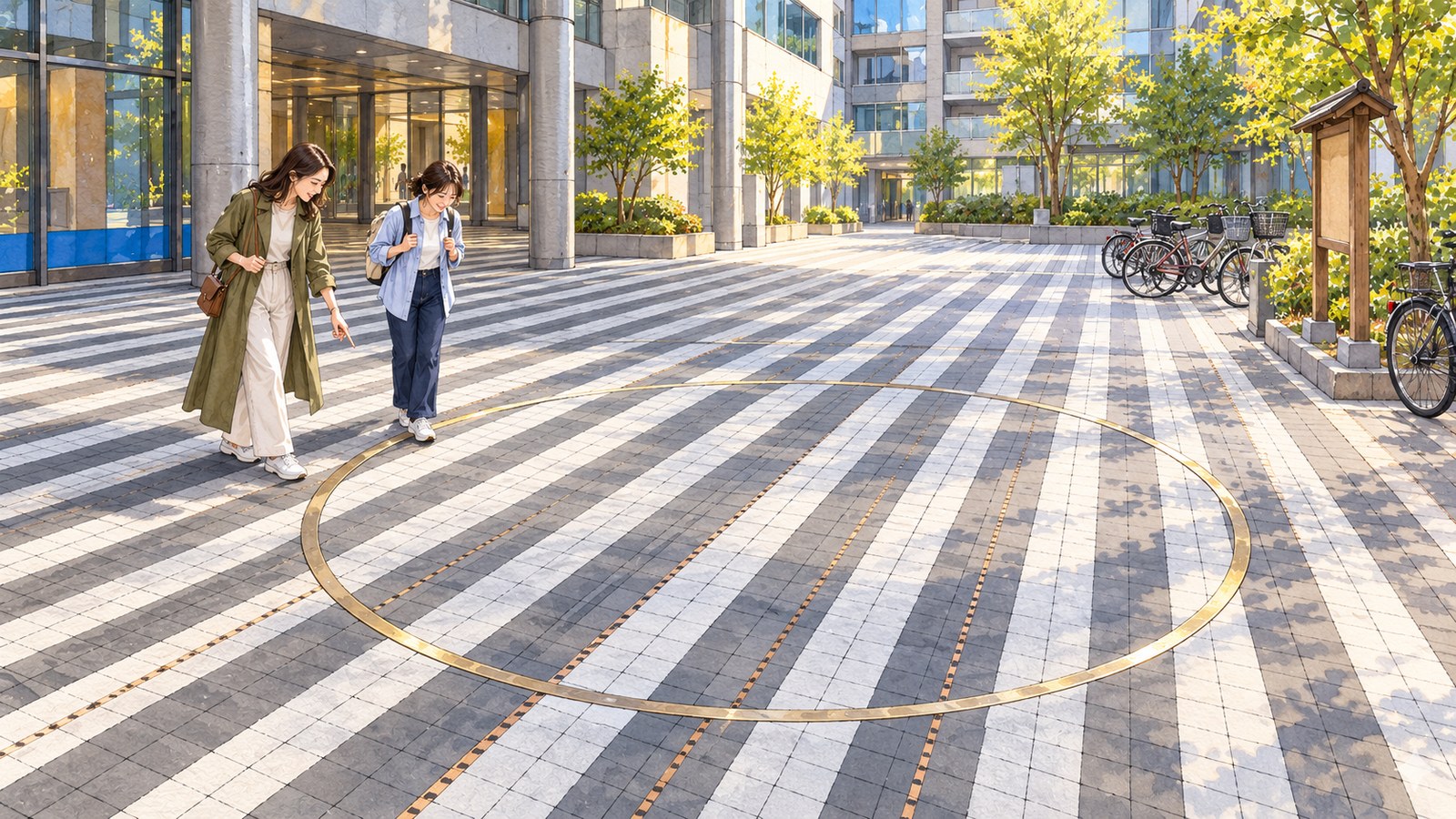
In the courtyard of the Ryogoku City Core complex, right beside Ekoin Temple, a large circle is set into the striped paving stones. It marks where the ring stood inside the first Kokugikan, completed in 1909.
The first Kokugikan was the first permanent indoor venue for Grand Sumo. Just eight years after it was completed, a fire destroyed it. It was rebuilt, then damaged by an earthquake and wartime air raids. The military used it after the January 1944 tournament, and the Allied occupation authorities took it over after the war.
In 1946, the renovated building—then called Memorial Hall—hosted the autumn Grand Sumo tournament and the retirement ceremony of Futabayama, the 35th yokozuna. This was the last sumo event held there. The building later served as, among other uses, Nihon University Auditorium before it was demolished in 1982.
Ryogoku City Core was built on the site in 1992. Near the circle, a Sumida City Board of Education sign displays a photograph of the former Kokugikan, with its round steel-frame roof.
- Location
- Courtyard of Ryogoku City Core, 2-10-14 Ryogoku, Sumida City, Tokyo
- Connection to sumo
- Site of the first Kokugikan, completed in 1909, and the location of its ring
- Nearest station
- About a three-minute walk from the West Exit of Ryogoku Station on the JR Sobu Line
- What to see
- The circle marking the ring in the paving and a sign with a historical photograph
Sources:Sumida City — Ryogoku Walking Guide, Vol. 5: “Changes to the Kokugikan and Other Sites” (in Japanese) 、Japan Sumo Association — Futabayama (in Japanese)
8Sumo Photography Archive | Records from the Sumo Association’s Official Photography Studio
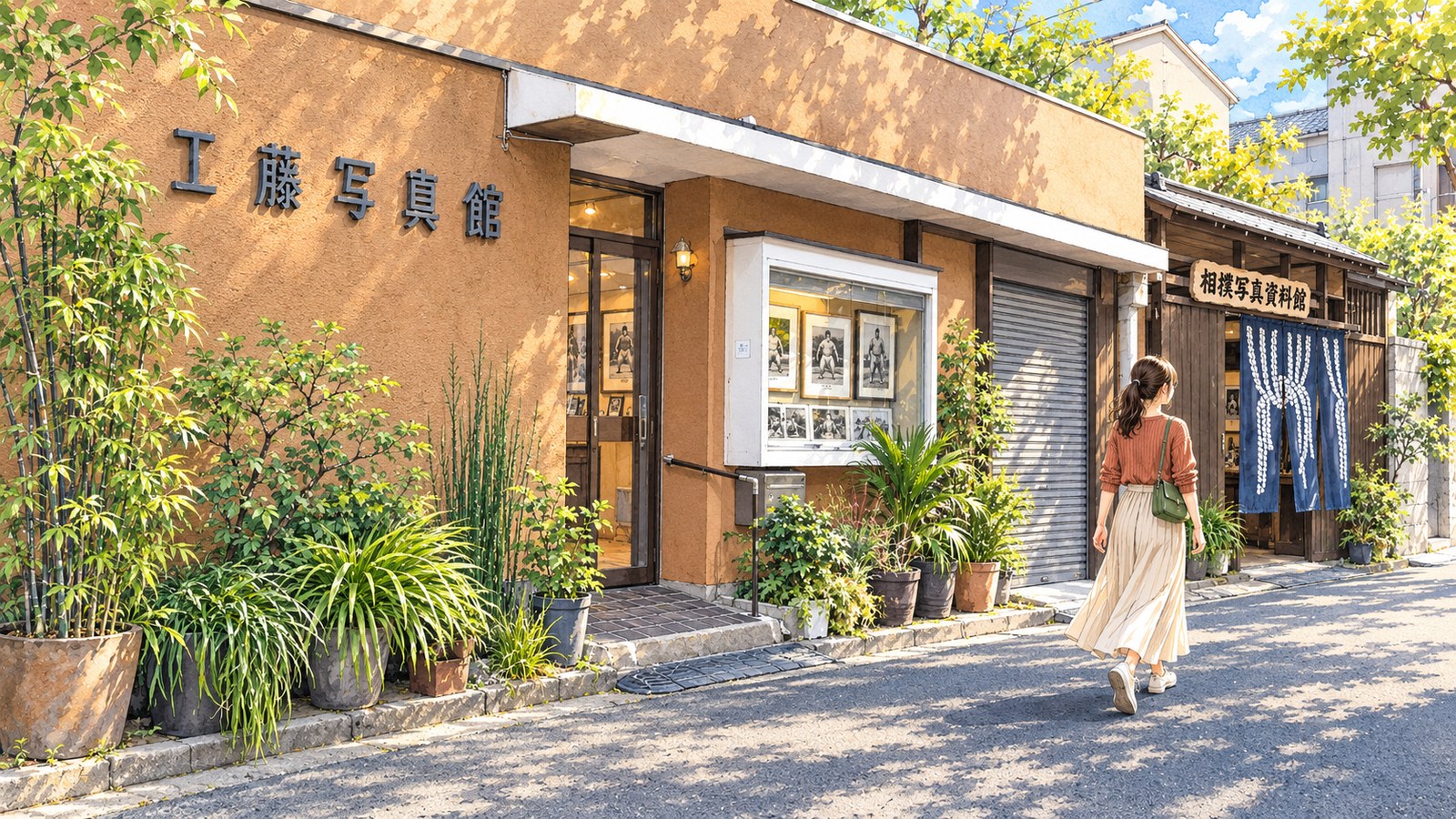
Kudo Photography Studio, on a side street in Ryogoku 3-chome, served as the Japan Sumo Association’s official photographer for more than 60 years, beginning in 1929. One section of the studio is open to the public as the Sumo Photography Archive.
The collection includes photographs of official Association events, past yokozuna, tournament champions, every wrestler in the top division, and changes to the Kokugikan over time. About 70 photographs are displayed at a time, rotated for each tournament from a selection of roughly 500 images.
A May 2026 feature by the Akita Sakigake Shimpo introduced a prewar photograph in the collection showing Futabayama, newly promoted to yokozuna, at the studio. The archive is open every Tuesday. During the January, May, and September tournaments in Tokyo, it is open every day of the tournament.
- Location
- Kudo Photography Studio, 3-13-2 Ryogoku, Sumida City, Tokyo
- Connection to sumo
- A photography studio that served as the Japan Sumo Association’s official photographer for more than 60 years from 1929
- Opening days
- Every Tuesday; daily during Tokyo tournaments
- What to see
- About 70 sumo photographs, rotated for each tournament
Sources:Sumida City Tourism Association — Sumo Town Walking Course (in Japanese) 、Sumida City — Ryogoku Walking Guide, Vol. 2 (in Japanese) 、Akita Sakigake Shimpo — Sumo Town Tokyo: Ryogoku (in Japanese)
9Kuramae Shrine | Site of the Kanjin Sumo Tournament Where Tanikaze’s Winning Streak Ended
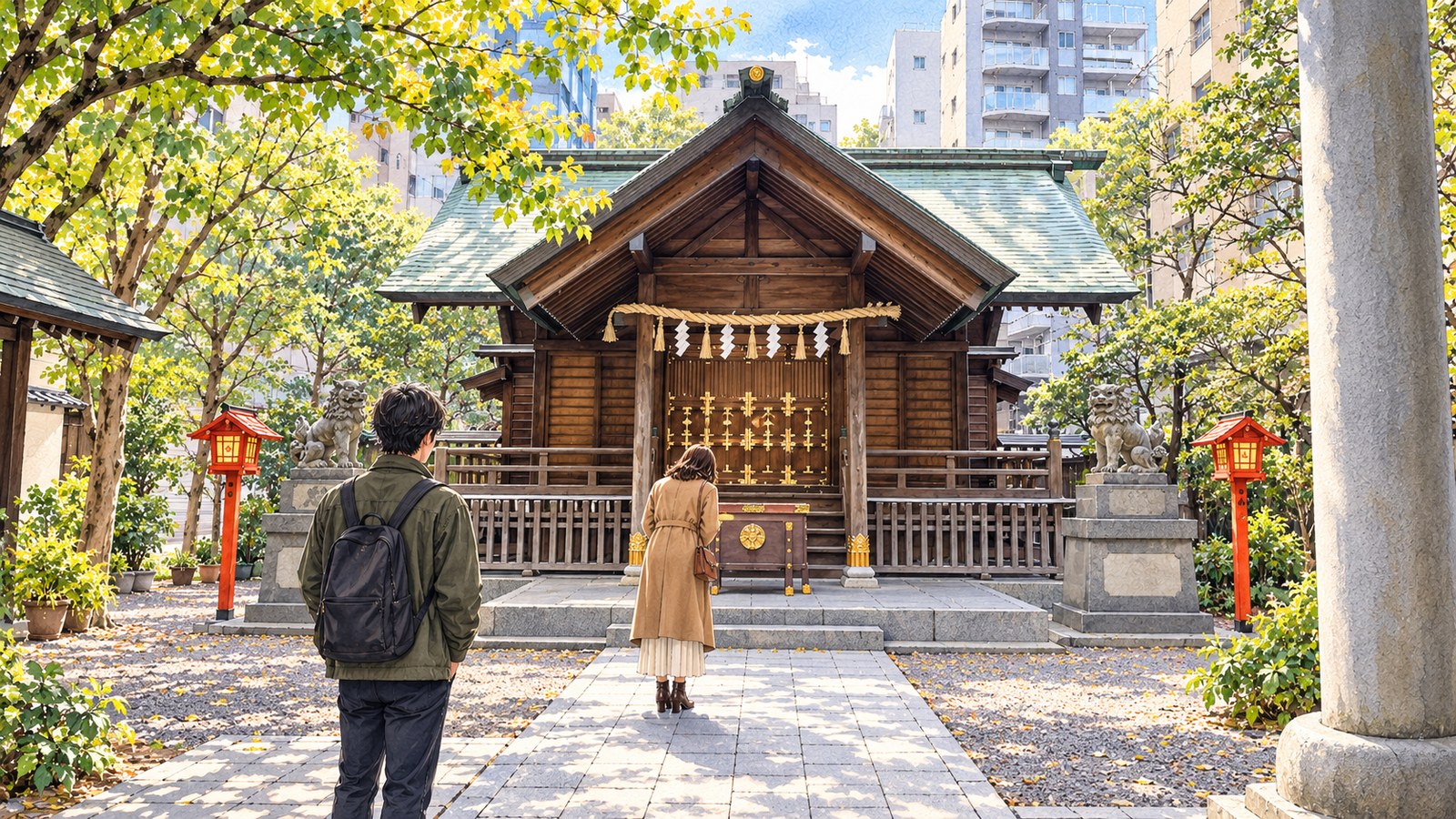
Across the Sumida River in Kuramae, Taito City, Kuramae Shrine was founded in 1693, when the fifth shogun, Tokugawa Tsunayoshi, invited the deity of Iwashimizu Hachimangu Shrine in Kyoto to be enshrined here. During the Edo period, it was known as Kuramae Hachiman.
The shrine’s history identifies this as the birthplace of kanjin Grand Sumo. Until Ekoin became the regular venue in 1833, it was one of three major sites for tournaments, along with Ekoin and Fukagawa Hachiman. In the February 1782 tournament, Onogawa Kisaburo defeated Tanikaze Kajinosuke, who was on a 63-match winning streak; the news is said to have caused a sensation across Edo. Both wrestlers became yokozuna in November 1789.
The Sumo Museum also holds an Edo sumo ranking list from October 1757, issued for a tournament at Kuramae Hachimangu. It is considered the oldest surviving ranking list in vertical format. The shrine grounds also have a statue of Motoinu, a character associated with the rakugo story “Motoinu.”
- Location
- 3-14-11 Kuramae, Taito City, Tokyo
- Connection to sumo
- One of three major sites for Edo-era kanjin Grand Sumo
- Nearest station
- Two-minute walk from Exit A6 of Kuramae Station on the Toei Oedo Line or Exit A4 of Kuramae Station on the Toei Asakusa Line
- What to see
- The grounds associated with the bout between Tanikaze and Onogawa, and the Motoinu statue
Sources:Kuramae Shrine — History (in Japanese) 、Kuramae Shrine — Donated feats of strength and kanjin sumo (in Japanese) 、Kuramae Shrine — Grounds (in Japanese) 、Sumo Museum — The Beginning of Grand Sumo (in Japanese) 、Japan Sumo Association — Tanikaze (in Japanese) 、Japan Sumo Association — Onogawa (in Japanese)
10Tomioka Hachimangu Shrine | The Yokozuna Rikishi Monument at the Birthplace of Kanjin Sumo
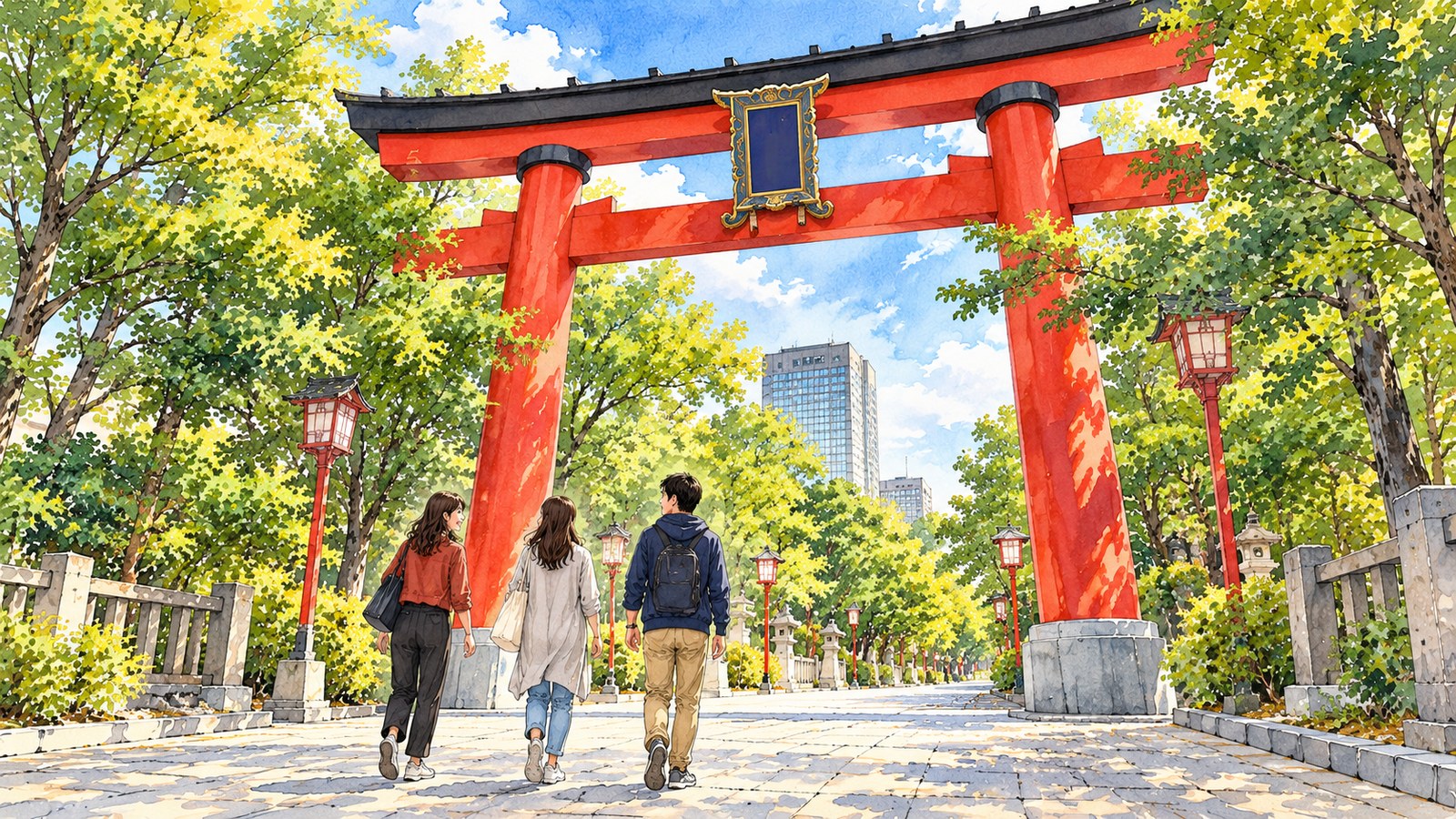
Tomioka Hachimangu Shrine in Fukagawa is known as the birthplace of Edo kanjin sumo. In 1684, the shogunate authorized two kanjin sumo tournaments each year, in spring and autumn, and the shrine grounds became their venue. Tournaments continued here for about 100 years. Regular scheduling and the ranking-list system are said to have taken shape during this period.
The Yokozuna Rikishi Monument in the shrine grounds was erected in 1900 at the initiative of Jinmaku Kyugoro, the 12th yokozuna. The stone monument is 3.5 meters high, 3 meters wide, and weighs 20 tons; it is inscribed with the ring names of yokozuna from the first onward. When a new yokozuna is promoted, the Sumo Association attends a ceremony to add the name, followed by the new yokozuna’s ceremonial ring-entering.
The names of supporters of the monument, including Ito Hirobumi, Yamagata Aritomo, and Okuma Shigenobu, are inscribed on either side. The grounds also contain a monument to ozeki and another bearing impressions of a wrestler’s large hand and foot. The main shrine building is undergoing major renovation from March 2026 through June 2027 (planned) and is covered by temporary construction screening.
- Location
- 1-20-3 Tomioka, Koto City, Tokyo
- Connection to sumo
- Birthplace of Edo kanjin sumo, authorized in 1684
- Nearest station
- Three-minute walk from Monzen-nakacho Station on the Tokyo Metro Tozai Line; six-minute walk from Monzen-nakacho Station on the Toei Oedo Line
- What to see
- The Yokozuna Rikishi Monument, the Ozeki Rikishi Monument, and monuments bearing wrestlers’ handprints and footprints
- Construction
- The main shrine building is under renovation through June 2027 (planned)
Sources:Tomioka Hachimangu Shrine — Sumo and the Shrine (in Japanese) 、Tomioka Hachimangu Shrine — Temporary screening during the main shrine renovation (in Japanese) 、Tomioka Hachimangu Shrine — Access (in Japanese) 、Japan Sumo Association — Jinmaku (in Japanese)
Ritual and Competition in the Tournament Ring
At the Kokugikan, the ring-entering ceremonies are a highlight alongside the matches. Wrestlers wearing ceremonial aprons advance along the flower paths, and a yokozuna enters the ring accompanied by a sword bearer and a ring-entering attendant. Each repeated gesture in the ring, along with the clothing and equipment wrestlers wear, has its own history, with traditions passed down since the Edo period.
The Ring-Entering Ceremony: A Showcase for Ceremonial Aprons
According to the Japan Sumo Association, ceremonial aprons began when wrestlers let the end of their mawashi hang down in front and added patterns to it. As sumo became a profession, wrestlers competed to create more elaborate designs using gold and silver thread. The ring-entering ceremony developed as a way to display these garments. At first, wrestlers wore the same mawashi for the ceremony and for matches.
Today, the mawashi worn for matches is separate from the ceremonial apron, which has a large decorative panel hanging at the front. For a yokozuna’s ring-entering ceremony, a set of three coordinated aprons—one each for the yokozuna, the sword bearer, and the ring-entering attendant—is used. The two side aprons, often cropped out of portraits showing only the yokozuna, can be seen alongside the central one during the ceremony.
The Sumo Museum’s fall exhibition displays all three aprons together. On Chiyonoyama’s set, the central apron for the yokozuna features waves by Katsushika Hokusai, while the two side aprons depict Fujin and Raijin, the wind and thunder gods, by Tawaraya Sotatsu. Tomiji Sekiya embroidered them. The set was later also used in ring-entering ceremonies when Sadanoyama, Kitanofuji, and Chiyonofuji became yokozuna. A garment made for one wrestler was there to mark the next steps in the careers of later yokozuna.
Sources:Japan Sumo Association — Ceremonial aprons and the ring-entering ceremony (in Japanese) 、Sumo Museum — Chiyonoyama’s ceremonial apron (in Japanese)
The Unryu and Shiranui Styles of the Yokozuna Ring-Entering Ceremony
As the yokozuna slowly rises from a low crouch, the movement is called the “seria-gari,” or rising motion. The arms take one of two forms. In the Unryu style, the right arm extends to the side while the left hand rests against the flank. In the Shiranui style, both arms extend outward. The rope tied at the yokozuna’s back also differs: the Unryu style has one loop, and the Shiranui style has two.
The Sumo Museum’s 2024 exhibition “Unryu and Shiranui Styles” presented the Unryu-style rope worn by Kitanoumi and the Shiranui-style rope worn by Takanosato. The rope is white and tied around the waist over the ceremonial apron. The arm position shows the difference from the front; the number of loops distinguishes the styles from behind.
The exhibition also featured the 1792 book Enlarged Illustrations of Yokozuna Styles, which depicts Tanikaze and Onogawa during their first ring-entering ceremonies. It brought together depictions of yokozuna attire from Edo and the ropes worn by wrestlers today.
Source:Sumo Museum — “Unryu and Shiranui Styles” exhibition (in Japanese)
Salt, Chikara-mizu, and Chirichozu: Rituals Before the Match Begins
A wrestler throws salt, faces his opponent and lowers into a crouch, then rises and steps back again. Before a match, a series of rituals takes place apart from the competition itself. Chikara-mizu, the water used to rinse the mouth, is meant to purify the wrestler. Salt sprinkled onto the ring is also intended to purify the space and express a wish for a match without injury.
The low crouch, with the body supported on the toes, is called sonkyo. The sequence of clapping the hands, extending the arms to either side, and turning the palms downward is called chirichozu. There are several accounts of its origin; the Sumo Association’s explanation includes the theory that it began as a way to purify the hands with morning dew collected from grass.
During shikiri, the wrestlers face each other at the center of the ring and try to synchronize their breathing before the tachiai, the initial charge. A time limit for this preparation and lines on the ring were introduced in 1928. The two white lines on the ring are part of the sport’s modern organization.
Sources:Japan Sumo Association — The origin of chirichozu (in Japanese) 、Japan Sumo Association — Grand Sumo introduction booklet (in Japanese) 、History of the Sumo Association (in Japanese)
Oshidashi and Yorikiri; Uwatenage and Shitatenage Throws
Even ways of forcing an opponent out of the ring use different techniques. In oshidashi, the wrestler presses against the opponent’s chest or underarm and pushes. The fingers spread into a shape called hasu, catching the opponent’s body from below. In yorikiri, the wrestler presses his body against the opponent, advances forward or sideways, and forces him out of the ring.
When pushing turns into a grapple, the point where each wrestler grips the mawashi becomes central to the contest. Taking hold from the outside of the opponent’s arm is uwate; gripping from the inside is shitate. For an uwatenage, the wrestler pulls the mawashi with an outside grip, turns his body, and throws the opponent. In a shitatenage, the wrestler pulls in the mawashi gripped from the inside and throws the opponent.
The Japan Sumo Association’s “82 Winning Techniques” page includes diagrams and explanations for each technique. Its illustrations distinguish the distance between wrestlers in oshidashi and yorikiri, and show the different positions of their arms in uwatenage and shitatenage.
Sources:Oshidashi (in Japanese) 、Yorikiri (in Japanese) 、Uwatenage (in Japanese) 、Shitatenage (in Japanese)
The Gyoji’s Brush and the Yobidashi’s Ring-Building: The Work Behind a Grand Sumo Tournament
The People Who Call the Wrestlers Also Build the Ring
A yobidashi opens a white fan and calls the names of the east- and west-side wrestlers. During a tournament, yobidashi also prepare the ring and beat the drums. They are the ones who build the round ring itself.
A record of a ring-building demonstration held at the Kokugikan on January 5, 2022, shows junior yobidashi shaping the straw bales one by one, then everyone tamping down the clay together. The work takes place about five days before a tournament. Among the tools used to compact the clay are beer bottles; the account even shows how everyday objects are put to work.
Once the ring is complete, the bales set into its circular edge mark the boundary of the contest, and wrestlers’ footprints remain in the sand outside it. The yobidashi sweep the ring with a broom, preparing the competition space for the next bout.
Sources:Grand Sumo Official Fan Club — Photo record of a ring-building demonstration (in Japanese) 、Japan Sumo Association — Yobidashi roster (in Japanese)
The Colors of a Gyoji’s Tassels and the Differences in Their Footwear
Gyoji, like wrestlers, have ranks. The color of the tassel hanging from the war fan, and of the decorative kikutomiji worn on the chest and elsewhere, indicates rank. Juryo-ranked gyoji wear green and white; makuuchi-ranked gyoji wear red and white; and sanyaku-ranked gyoji wear vermilion. Kimura Shonosuke, one of the two highest-ranking tate-gyoji, uses purple tassels.
Their footwear also differs by rank. Gyoji at the makushita level and below go barefoot; those ranked juryo and above wear tabi socks, and those at sanyaku rank and above also wear sandals. Each gyoji’s robe has its own pattern, while the tassel colors and footwear follow rules tied to rank.
On the ring, “Hakki-yoi!” is a call urging the wrestlers on, used when both have stopped moving, for example. “Nokotta!” signals that the bout is still undecided. Even when wrestlers are tangled together, the gyoji follows their movements from close by and raises the war fan as soon as the outcome is decided.
Source:Japan Sumo Association — “The World of the Gyoji,” November 2025 tournament guide (in Japanese)
The Gyoji Who Writes Tomorrow’s Matchups and the “Kao-zuke”
The gyoji who oversees each bout with a war fan also works with brush and ink. The kao-zuke, a handwritten list of the next day’s matchups, is displayed on the ring after the top-division ring-entering ceremony. At a 2022 demonstration, gyoji Kimura Yonosuke explained how sumo calligraphy is written and showed how gyoji prepare ranking boards and kao-zuke lists.
Another record of match results is called a maki. It lists the opponent who defeated a wrestler above his name and the opponent he defeated below it. Even in the same brush script, the ranking list that shows a wrestler’s standing, the kao-zuke that announces the next day’s matchups, and the maki that records each bout are laid out differently to serve their purposes.
A gyoji’s work also includes leading the ring-entering ceremony and presiding over the ring-purification ritual. Appearing along the flower path with the wrestlers and raising the war fan in the ring are the parts of a much broader role performed in front of spectators.
Sources:Grand Sumo Official Fan Club — Making ranking boards and kao-zuke lists (in Japanese) 、Japan Sumo Association — Article 50 of the Articles of Incorporation (in Japanese)
How the Tokoyama Stylist Shapes a Topknot Like a Ginkgo Leaf
Tokoyama are specialists who style wrestlers’ topknots. In a chonmage, the hair is gathered and folded back; in an oicho, the ends spread to either side. The shape resembles a ginkgo leaf, which gives the style its name. Only sekitori—wrestlers ranked juryo and above—wear the oicho, for bouts and official events. In everyday life, even sekitori wear a chonmage.
The Association says it takes five to ten years for a tokoyama to become skilled at tying an oicho, though the time varies by individual. For wrestlers with a lot of hair, the stylist shaves part of the crown, a process called nakazori, to shape the topknot. The tool box holds combs and scissors in a range of shapes.
The rule reserving the oicho for sekitori dates to the end of the Taisho period. Edo-period woodblock prints show both wrestlers with a shaved forelock, called sakayaki, and wrestlers without one. Even the hairstyle that now looks uniform has changed across eras, like the clothing and the ring.
Source:Japan Sumo Association — “Topknots,” March 2024 tournament guide (in Japanese)
Ranking Lists and Sumo Prints Preserved in the Museum
The history of banzuke ranking lists, which arrange wrestlers’ names on a single sheet, goes back to the Edo period. A 2018 Sumo Museum exhibition presented a ranking list for a tournament held at Kuramae Hachimangu in October 1757. Considered the oldest surviving vertical-format banzuke, it is arranged in six tiers, with middle- and preliminary-division wrestlers listed in the bottom tier.
The same exhibition included the “Street Sumo Picture Scroll,” dating from around the Genroku era. It depicts people wrestling in fields and at town crossroads, with onlookers gathered around them. The scroll documents how sumo tournaments developed: after disturbances over match outcomes, the shogunate issued bans, then began regulating kanjin sumo through a system of applications and permits.
Many woodblock prints of wrestlers were also made in the late Edo period. A print by Utagawa Toyokuni II, shown in the 2026 exhibition “Views of Edo Sumo,” depicts Onomatsu’s ring-entering ceremony in 1833. Two wrestlers beside the yokozuna are shown prominently, their ceremonial-apron designs side by side. The exhibition also included Raiden Tameemon’s travel haori, a jacket bearing the character “Rai” on its collar and his family crest on the back. It offers a glimpse of what wrestlers wore away from competition.
Sources:Sumo Museum — The Beginning of Grand Sumo (in Japanese) 、“Views of Edo Sumo” (in Japanese)
From the Tournaments at Ekoin to Today’s Kokugikan
- 1684Kanjin sumo authorized in the grounds of Tomioka Hachimangu ShrineTournament
- 1693Kuramae Hachiman (now Kuramae Shrine) is foundedShrine
- 1768First kanjin sumo tournament held at Ekoin TempleTournament
- 1782Tanikaze’s 63-match winning streak ends at a tournament at Kuramae HachimanTournament
- 1833Ekoin becomes the regular venue for spring and autumn tournamentsRyogoku
- 1885Nominosukune Shrine is founded in KamezawaShrine
- 1900The Yokozuna Rikishi Monument is erected at Tomioka Hachimangu ShrineShrine
- 1909The former Ryogoku Kokugikan is completedVenue
- 1925The Japan Sumo Association Foundation is establishedOrganization
- 1927The Tokyo and Osaka Sumo Associations mergeOrganization
- 1928A time limit and starting lines are introduced for shikiriRing
- 1931The ring’s diameter is increased to 15 shakuRing
- 1936Chikara-zuka is erected at EkoinMemorial
- 1946The final Grand Sumo tournament is held at the former Kokugikan; Futabayama’s retirement ceremony takes placeVenue
- 1952Four pillars are replaced by a suspended roof and four colored tasselsRing
- 1953Nominosukune Shrine is rebuilt and a yokozuna monument is erectedShrine
- 1954The Kuramae Kokugikan and Sumo Museum openVenue and exhibition
- 1982The building of the first Ryogoku Kokugikan is demolishedVenue
- January 1985Today’s Ryogoku Kokugikan opens, and the museum moves thereRyogoku
- 1992Ryogoku City Core is completed on the former Kokugikan siteRyogoku
From Rain-Delayed Tournaments to the First Permanent Roof
When sumo tournaments were held in temple and shrine grounds, rain could disrupt the schedule. The phrase “ten days in fine weather” on ranking lists meant that the tournament would run for ten days when the weather was clear. Once a permanent Kokugikan opened in 1909, the wording changed to ten days regardless of weather.
The former Ryogoku Kokugikan was designed by Kingo Tatsuno, known for Tokyo Station, and his partner in their architectural firm, Manji Kasai. Its large roof earned it the nickname “Great Iron Umbrella.” The venue later moved to Kuramae, where the Kuramae Kokugikan was completed in 1954. Tournaments there had already begun in 1950, while construction was still underway.
Kajima Corporation’s account of building the current Kokugikan also describes equipment for storing the ring and box seats. At the 1985 completion ceremony, the ring was lowered underground midway through the event to transform the venue, surprising the guests. This conversion system makes it possible to host concerts and ceremonies as well as sumo.
Source:Kajima Corporation — History of the Kokugikan (in Japanese)
The Four Pillars Are Removed and the Ring Gets Wider
The ring itself has changed over time. In 1931, its diameter was increased from 13 shaku to 15 shaku, or about 4.55 meters, and the double ring of straw bales was changed to a single ring. In 1952, the pillars at the four corners were removed and replaced by a suspended roof and four colored tassels. The difference between old sumo prints showing pillars and today’s broadcast images reflects changes to the arena itself.
The Sumo Association’s organization also changed. The Foundation of the Dai-Nippon Sumo Association was established in 1925, and the Tokyo and Osaka Sumo Associations merged in 1927. As the Ryogoku venue became an indoor facility, the organization of Grand Sumo and the form of the competition were also taking shape.
Source:Japan Sumo Association — History of the Association (in Japanese)
From Chiyonoyama to Chiyonofuji: Garments Passed Down to His Disciples
Chiyonoyama, featured in the Sumo Museum’s fall exhibition, was the 41st yokozuna. He was born in 1926 in Fukushima, Hokkaido. The yokozuna promotion certificate on display also records the first wrestler promoted after the 1951 rule change that made the Sumo Association responsible for deciding promotions.
In 1967, Chiyonoyama opened the Kokonoe stable at the Kagetsu restaurant in Yanagibashi, Taito City. His wrestlers borrowed the sumo training school’s ring for practice. The exhibition includes photographs of his disciples from this period.
Chiyonofuji, the 58th yokozuna, held the rank from September 1981 through May 1991. He competed during the period when the Kokugikan moved from Kuramae back to Ryogoku. One item in the exhibition is a ceremonial apron commemorating his 53 consecutive wins in 1988.
Nominosukune
A sumo deity who appears in the Chronicles of Japan. He is said to have defeated Taima no Kehaya in a sumo match before the emperor, and is enshrined at Nominosukune Shrine in Kamezawa.
Chiyonoyama
The 41st yokozuna. Born in 1926 in Fukushima, Hokkaido, he was the first yokozuna promoted under the system introduced in 1951 that placed promotion decisions in the Sumo Association’s hands. He trained wrestlers as the head of Kokonoe stable.
Kitanofuji
The 52nd yokozuna. He moved from Dewanoumi stable to Kokonoe stable and was promoted to yokozuna alongside Tamanoumi at the March 1970 tournament. Their era was known as the “Kita-Tama era.”
Kitanoumi
The 55th yokozuna, from Sobetsu, Hokkaido. A kimono painted and given to him by his stablemaster, Mihogaseki, was featured in the 2026 exhibition “Art and Sumo.”
Chiyonofuji
The 58th yokozuna, like Chiyonoyama from Fukushima, Hokkaido, and a wrestler at Kokonoe stable. His fall exhibition includes the ceremonial apron commemorating the 53-match winning streak he achieved in 1988.
Sources:Sumo Museum — “100 Years Since the Birth of Chiyonoyama and His Disciples” (in Japanese) 、Japan Sumo Association — Past yokozuna (in Japanese) 、Chiyonoyama (in Japanese) 、Kitanofuji (in Japanese) 、Kitanoumi (in Japanese) 、Chiyonofuji (in Japanese) 、Nominosukune Shrine (in Japanese) 、Sumo Museum — “Art and Sumo” (in Japanese)
Enjoy Ryogoku Through Sumo Footage and Memorabilia
A Look Inside the Kokugikan Through Official Video
The Japan Sumo Association’s official “SUMO PRIME TIME” channel has a video tour of the Kokugikan. It shows the suspended roof, championship portraits, and Sumo Museum, as well as wrestlers’ dressing rooms that spectators do not usually enter. The video offers an inside look at areas that are not part of the public tour.
The Japan Sumo Association’s website publishes bout results and rankings. Its “Search for a Wrestler” page lets visitors search by ring name or birthplace, and also filter by former ring names.
Sources:Japan Sumo Association (in Japanese) 、Search for a Wrestler (in Japanese)
The Kokugikan’s Famous Yakitori, Grilled in the Basement
One of the Kokugikan’s signature foods is yakitori: a pack of three skewers of chicken and two of chicken meatballs. It has been popular since the days of the Kuramae Kokugikan and is now made in the basement of the Ryogoku Kokugikan. Because birds stand on two legs, they were considered auspicious in sumo, where touching the ground with a hand means losing.
A 2022 account of a factory visit by Sumida City’s children’s public-relations ambassadors describes dipping the skewers in sauce four times and rapidly chilling the cooked meat. Unlike skewers served piping hot at a restaurant, this venue specialty is made to taste good during a tournament or after being taken home.
The dining guide for the January tournament lists Kokugikan Cafe and food stands inside the venue as places to buy it. The venue also sells boxed meals inspired by wrestlers.
Sources:Japan Sumo Association — Kokugikan dining guide (in Japanese) 、Sumida City — Behind the scenes at the Kokugikan (in Japanese)
Explore Ceremonial Apron Designs and the Craft Behind Them
For a closer look at how sumo garments are made, see Sumo and Design, published in 2026. The book covers ceremonial aprons and kimonos decorated with wrestlers’ ring names. It includes not only the finished garments, but also preliminary sketches and design drawings.
The book visits Hasegawa Shoten, which makes ceremonial aprons; Chiso, a long-established maker of Kyo-yuzen dyed textiles; and Nishikihata, which weaves wrestlers’ mawashi. It follows the work of turning the wishes of a wrestler or gift-giver into a design, then into a garment through weaving and embroidery. It also includes an interview with Tamawashi, known for his interest in handicrafts.
The book also features pieces from the Sumo Museum collection, including a photograph of Hitachiyama’s ceremonial apron set with jewels. The 208-page, full-color book presents text in both Japanese and English and is published by Two Virgins. It is available from bookstores and online book retailers.
Sources:Publisher’s introduction to Sumo and Design (in Japanese) 、Two Virgins — Bibliographic details (in Japanese)
Kitanoumi’s Kimono, Painted and Given to Him by His Stablemaster
The Sumo Museum’s January–April 2026 exhibition “Art and Sumo” featured a kimono belonging to Kitanoumi. It was painted by his stablemaster, Mihogaseki Kuniaki, whose ring name as a wrestler was Masuiyama. The piece shows how Kitanoumi’s mentor also became the artist when giving him a kimono. Mihogaseki was skilled enough at his hobby of painting to have work selected for the Nika Exhibition.
The same exhibition included original designs by Keigetsu Matsubayashi and Toko Kataoka for yokozuna ceremonial aprons. Wrestlers’ garments involve not only embroiderers and textile dyers, but also painters and stablemasters.
Source:Sumo Museum — “Art and Sumo” (in Japanese)
A Shop You Can Visit Even on Days Without a Tournament
The Kokugikan’s Grand Sumo merchandise shop also opens outside the tournament periods. Its opening days are listed on a calendar separate from the museum’s. During tournaments, the shop is for ticket holders, so if you are visiting just to shop, choose a day it is open outside a tournament.
You can also buy sumo merchandise through the Japan Sumo Association’s official online store, SuMALL. Its products include goods featuring wrestlers’ ring names or portraits you may have seen in Ryogoku, as well as everyday items.
Sources:Japan Sumo Association — Shop information (in Japanese) 、SuMALL
Lab Notes | Business Perspective: Making Collections Accessible on Days Without Matches
The Sumo Museum preserves garments worn during wrestlers’ careers and ranking lists, and presents them in three special exhibitions each year. In fall 2026, it follows Chiyonoyama and his disciples, using the passing down of ceremonial aprons to give fans from multiple generations a reason to visit.
To make use of sports and local history collections, a museum can build an exhibition around questions such as “Who passed this item to whom?” and “At what milestone was it used?” rather than simply displaying stored objects. Other sports venues can learn from connecting clothing and photographs with stories about the next generation, even after an athlete has retired.
Sumo Events and Official Resources for Each Site
FAQ
Can I visit the Kokugikan on a day when no tournament is being held?
You can visit on days when the Sumo Museum or the Grand Sumo merchandise shop is open. Regular museum admission does not include access to the arena.
Are Grand Sumo tournaments held in Ryogoku every month?
Tokyo tournaments at Ryogoku Kokugikan take place in January, May, and September. The March tournament is held in Osaka, the July tournament in Nagoya, and the November tournament in Fukuoka.
Is the Sumo Museum free?
Admission is normally free. During Tokyo tournaments, you need a ticket to that day’s Grand Sumo tournament; an admission ticket may also be required on days such as retirement ceremonies.
Is the Sumo Museum open on Saturdays and Sundays?
It is generally closed on weekends, but opens during Tokyo tournaments and for some special events. Its date-specific calendar lists opening hours as well as opening days.
Are a ceremonial apron and a wrestler’s mawashi the same thing?
They are different today. A ceremonial apron, with a large ornament hanging in front, is worn for the ring-entering ceremony; wrestlers wear a competition mawashi for their matches.
Where can I receive an amulet from Nominosukune Shrine?
There is a distribution counter in the Sumo Museum exhibition room on the Kokugikan’s first floor. Its hours follow the museum’s opening hours.
When is the Sumo Photography Archive open?
It is open every Tuesday. During the January, May, and September tournaments in Tokyo, it is open every day of the tournament. About 70 photographs are displayed, with the selection changing for each tournament.
Can I visit the main shrine building at Tomioka Hachimangu?
The main shrine building is undergoing major renovation from March 2026 through June 2027 (planned) and is covered by temporary construction screening. The shrine says its newly built guest hall will serve as a temporary main shrine building for about a year.
Is Chikara-zuka at Ekoin Temple a wrestler’s grave?
No. The Sumo Association erected the monument in 1936 to honor generations of sumo elders. It is also a place where new wrestlers pray to receive strength.
More in Pilgrimage

Nippon Budokan Pilgrimage Guide: The Octagonal Roof, Tayasumon Gate & Live Music History Since The Beatles

Where Tora-san Comes Home: 10 Pilgrimage Stops from Shibamata to His Travels
